
Skip to Content
  • 4.5
    Impact Factor
  • 8.1
    CiteScore
  • 13 days
    Submission to First Decision
  • 4 days
    Acceptance to Publication

Metabolites

Metabolites is an international, peer-reviewed, open access journal of metabolism and metabolomics, published monthly online by MDPI.
  • Open Access— free for readers, with article processing charges (APC) paid by authors or their institutions.
  • High Visibility: indexed within Scopus, SCIE (Web of Science), PubMed, PMC, Embase, CAPlus / SciFinder, and other databases.
  • Journal Rank: JCR - Q2 (Biochemistry and Molecular Biology) / CiteScore - Q1 (Endocrinology, Diabetes and Metabolism)
  • Rapid Publication: manuscripts are peer-reviewed and a first decision is provided to authors approximately 12.6 days after submission; acceptance to publication is undertaken in 3.7 days (median values for papers published in this journal in the first half of 2026).
  • Recognition of Reviewers: Reviewers whose reports are timely and of high quality receive an APC discount voucher for a future publication in an MDPI journal. Become a reviewer.

Get Alerted

Add your email address to receive forthcoming issues of this journal.

All Articles (7,077)

  • Article
  • Open Access

Background/Objectives: 1H NMR metabolomics is continuing to evolve standardised practice for the identification and measurement of simultaneous changes in multiple metabolites, enabling the interpretation of regulated metabolic processes that take place in response to complex biological stimuli. Dissociation of cell monolayers is a critical step in cell culture methodologies and the preparation of adherent cell-derived samples for metabolomic studies. Metabolite harvesting workflows associated with enzymatic dissociation methods that are commonly used to detach cells from supporting extracellular matrices can influence cellular metabolism, potentially having a negative impact on the quality of the cells and interpretation of 1H NMR metabolomic data. With the aim of advancing best practice methodologies within the intracellular metabolomics pipeline, we have used 1H NMR metabolomics to investigate the effect of metabolite harvesting workflows for enzymatic and non-enzymatic cell dissociation methods on the adult human ventricular cardiomyocyte AC10 cell line. Methods: AC10 cell cultures were dissociated from adherent culture by enzymatic dissociation, with either trypsin or TrypLE™, or mechanical cell scraping with comparison made against control in situ metabolite harvesting. Metabolites were extracted into 50% (v/v) acetonitrile for 1H NMR spectral acquisition. Results: Although there were no significant differences in overall metabolite abundance between different workflow methodologies, altered levels of several key metabolites were observed. Specifically, enzymatic dissociation workflows altered levels of amino acid metabolites and metabolites associated with ketone body production, suggesting changes in cellular metabolism, particularly increased oxidative stress. In contrast to all other methods, the workflow associated with in situ harvesting of intracellular metabolites produced the most stable metabolomic profiles, minimising the reduction of key amino acid and energy metabolites and reducing stress-associated metabolic shifts. Conclusions: Based on these results in situ harvesting should be considered best practice for 1H NMR metabolomics of adherent cell cultures.

Metabolites

17 November 2026

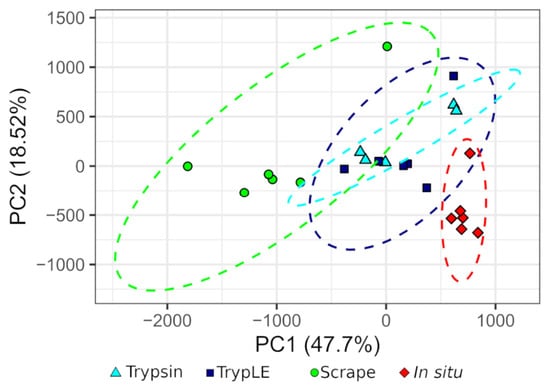
Multivariate analysis of AC10 intracellular metabolite profiles in response to four cell dissociation methods. Unsupervised Principal Component Analysis (PCA) of AC10 intracellular metabolites in response to four cell dissociation methods. The explained variance by each principal component (PC) is shown as PC1 representing 47.70% and PC2 representing 18.52%. Clear separation of cell dissociation methods is observed on PC1. Ellipses denote 95% confidence region around the mean of the points of each group. Non-enzymatic cell dissociation methods: in situ control = red diamonds; cell scraping = green circles. Enzymatic cell dissociation methods: trypsin = cyan triangles; TrypLE™ = blue squares. Analysis was performed on n = 3 independent flasks and 2 batch replicates (Trypsin) and n = 5 independent flasks and 1 batch replicate (TrypLE, Cell scraping, In situ) independent technical replicates of AC10 cell cultures within each cell dissociation group.
  • Article
  • Open Access

Background/Objectives: The prevalence of childhood obesity has become a major public health concern, closely linked to metabolic health and inflammatory markers. The aim of the present study was to investigate the effects of a physical literacy intervention on metabolic health in children with obesity, and to examine the mediating roles of physical activity and inflammatory profiles. Methods: In this study with a pretest-posttest design, 70 obese boys aged 8 to 12 years were selected through cluster random sampling and then randomly assigned to two intervention and control groups. The intervention group received a 12-week game-based physical literacy program (three 60 min sessions per week). Results: Data were analyzed using analysis of covariance and structural equation modeling for mediation analysis. Compared with the control group, the intervention group showed significant improvements in total physical literacy scores and in physical activity (p < 0.001). Body composition indicators improved significantly: body mass index (p = 0.003), waist circumference (p = 0.004), and body fat percentage (p = 0.002). Several cardiometabolic risk markers improved: fasting glucose decreased (p = 0.002), triglycerides decreased (p = 0.002), HDL-C increased (p < 0.001), and systolic blood pressure decreased (p < 0.001). Insulin resistance was significantly improved (p < 0.001), and all inflammatory markers were significantly reduced: hs-CRP, IL-6, TNF-α, and leptin (p < 0.001). Exploratory mediation analysis suggested that physical activity and inflammatory profile may partially account for the relationship between physical literacy and metabolic health. Conclusions: Physical literacy, through increased physical activity and reduced inflammation, can be an effective strategy for improving metabolic health in children with obesity.

Metabolites

17 November 2026

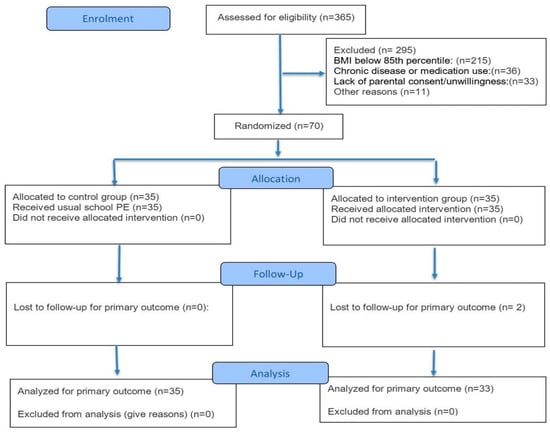
CONSORT 2025 flow diagram.
  • Article
  • Open Access

Background: Cerebral ischemia–reperfusion injury (CIRI) remains a critical bottleneck underlying poor outcomes after ischemic stroke. However, the brain–blood metabolic coupling mechanism and the toxic role of endogenous metabolites have not been systematically elucidated. Most previous studies have treated differential metabolites as passive biomarkers of tissue injury, while their potential as active neurotoxic mediators that directly drive brain damage remains poorly understood. This study aimed to characterize brain–blood metabolic coupling and the neurotoxic mechanisms of differential metabolites in CIRI, and to identify candidate biomarkers with translational value. Methods: Thirty male specific pathogen-free Sprague–Dawley rats were randomly assigned to a sham-operated group or a middle cerebral artery occlusion/reperfusion (MCAO/R) model group, with 11 rats per group included in the final analysis. A paired brain tissue–serum design was employed, and UHPLC-MS/MS untargeted metabolomics was integrated with network toxicology, molecular docking, and molecular dynamics simulations to systematically dissect brain–blood metabolic coupling and metabolite toxicity in CIRI. Results: A total of 27 metabolites with differential abundance in both brain tissue and serum were identified. They showed three patterns: increased abundance in both compartments, decreased abundance in both compartments, and increased abundance in brain tissue with decreased abundance in serum. The two compartments shared 48 enriched pathways, and further prioritization identified 11 core metabolites and 21 core pathways. Network toxicology identified eight metabolites with in silico-predicted neurotoxic potential and BBB permeability, and linked their candidate targets to the PI3K-Akt, MAPK, and apoptosis pathways. Molecular docking and 100 ns molecular dynamics simulations supported the predicted binding poses and the stability of the selected metabolite–target complexes during the simulations. Conclusions: This study elucidates the brain–blood metabolic coupling mechanism of CIRI from the perspective of endogenous metabolic toxicity. Beyond serving as passive biomarkers, the eight prioritized metabolites are proposed as putative neurotoxic mediators that may contribute to CIRI by targeting the PI3K-Akt/MAPK signaling axes, based on computational prediction rather than experimental validation. The core metabolites identified in this study hold promise as candidate biomarkers for the early diagnosis and prognostic evaluation of ischemic stroke. The findings also provide a theoretical basis for precision intervention in CIRI and identify potential therapeutic targets.

Metabolites

17 November 2026

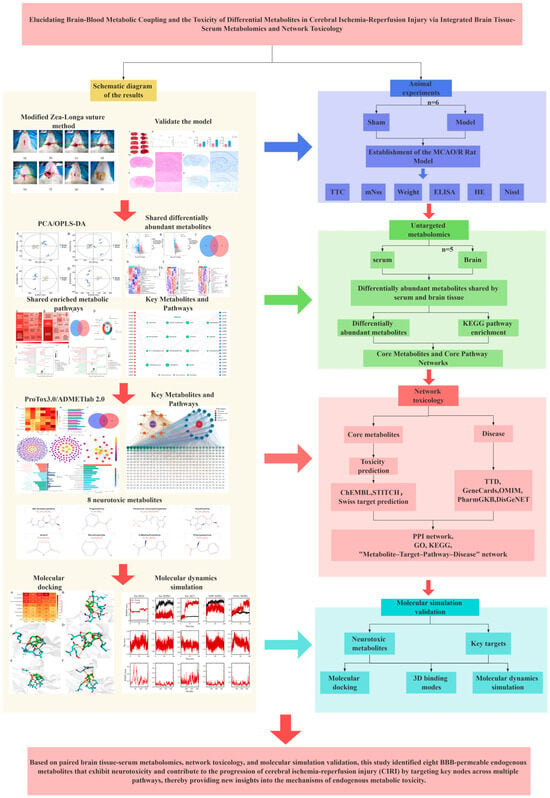
Experimental workflow.
  • Article
  • Open Access

Background: Fibroblast activation and extracellular matrix (ECM) remodeling are central to ventricular remodeling in heart failure (HF), but fibroblast heterogeneity complicates the prioritization of disease-associated genes. We integrated single-cell and bulk transcriptomic data to prioritize HF fibroblast-associated candidates and evaluate their predicted network effects. Methods: High-dimensional weighted gene co-expression network analysis (hdWGCNA) was performed on GSE288222 fibroblasts, and module-HF associations were evaluated at the subject level. Candidate screening, classifier comparison, and TreeSHAP ranking were conducted in three bulk myocardial cohorts. We assessed robustness using training-fitted batch correction, fully nested cross-validation, repeated feature ranking, and nested leave-one-cohort-out analysis. Candidate-level and fixed-model performance were evaluated in GSE55296 and GSE42955. Hallmark single-sample gene set enrichment analysis (ssGSEA) assessed tissue-level pathway associations. A shared fibroblast network from GSE226314 was analyzed by scTenifoldKnk. Results: The Fibro-M1 module (303 genes) was positively associated with HF across 12 subjects (r = 0.919, FDR = 9.77 × 10⁻⁵), and leave-one-subject-out correlations ranged from 0.910 to 0.934. Seventy-four genes entered machine learning, and TreeSHAP prioritized SMOC2, FNDC1, KCNN3, SFRP4, and LUM. Training-fitted preprocessing recovered the same five-gene set; the internal-test AUC was 0.961 (95% CI, 0.924–0.999), and the fully nested five-fold AUC was 0.940 (95% CI, 0.907–0.972). In GSE42955 (24 HF samples and five controls), the locked five-gene SVM yielded an AUC of 0.875 (95% CI, 0.662–1.000). In GSE55296, SMOC2 and SFRP4 were replicated at the expression level, whereas fixed-reference five-gene discrimination was not maintained (AUC = 0.492; 95% CI, 0.240–0.745). Nested leave-one-cohort-out AUCs ranged from 0.863 to 0.959, but selected features differed among rotations. In the pooled fibroblast network, the five virtual knockouts yielded 1, 0, 1, 2, and 2 significant genes, respectively; recurrence of DCN varied across pooled and stratified networks. Conclusions: Integrating fibroblast co-expression structure with multi-cohort transcriptomics prioritized SMOC2, FNDC1, KCNN3, SFRP4, and LUM as HF-associated candidates. Their cross-cohort evidence and predicted network effects were heterogeneous, and model transportability depended on the evaluation platform. The recurrent DCN signal suggests a shared extracellular-matrix network response that deserves further study.

Metabolites

17 November 2026

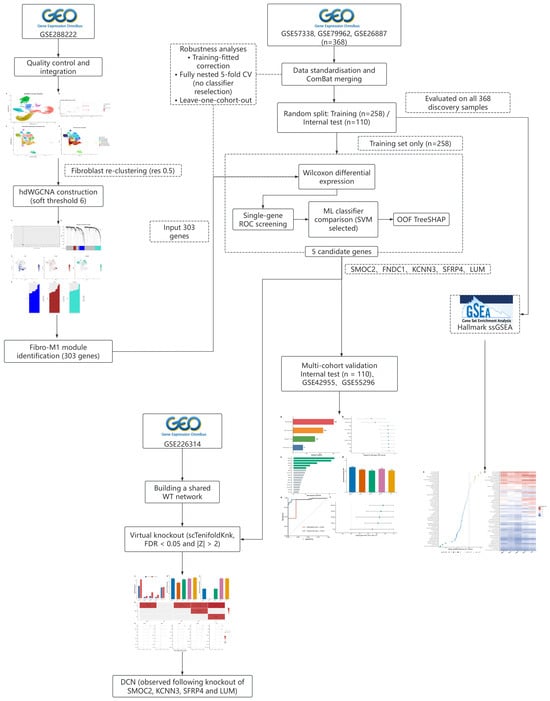
Overview of the study design.

Highly Accessed Articles

News & Conferences

Latest Issues

Open for Submission

Journal Sections

XFacebookLinkedIn
Metabolites - ISSN 2218-1989