



You are currently viewing a new version of our website. To view the old version click .

Materials

Materials is an international peer-reviewed, open access journal on materials science and engineering published semimonthly online by MDPI.
The Spanish Materials Society (SOCIEMAT), Manufacturing Engineering Society (MES) and Chinese Society of Micro-Nano Technology (CSMNT) are affiliated with Materials and their members receive discounts on the article processing charges.
Indexed in PubMed | Quartile Ranking JCR - Q2 (Metallurgy and Metallurgical Engineering | Physics, Applied | Physics, Condensed Matter)

All Articles (54,141)

Analysis of Physical Processes in Confined Pores of Activated Carbons with Uniform Porosity

  • Magdalena Blachnio,
  • Malgorzata Zienkiewicz-Strzalka and
  • Anna Derylo-Marczewska

Mesoporous carbons based on silica hard templates were used to investigate physical processes in confined pores. Nitrogen adsorption, scanning electron microscopy, and scattered X-ray analyses revealed two classes of materials: carbons with moderate and highly developed mesoporosity. The pore structure was strongly dependent on pore expanders which proved essential for generating open, accessible architectures. All carbons exhibited a basic, graphitic surface (pHPZC = 8.4–10.9), enriched in electron-donating oxygen functionalities. Differential scanning calorimetry studies of confined water showed that melting point depression follows the Gibbs–Thomson relationship, confirming the strong dependence of phase transitions on pore size and water–surface interactions. Adsorption experiments using methylene blue demonstrated that capacity is governed by surface area, pore volume, and pore size distribution. For carbon with the largest average pore size, adsorption of various dyes revealed that uptake decreases with increasing molecular size, whereas affinity depends strongly on electrostatic interactions. Kinetic studies indicated that carbons with larger mesopores exhibit the fastest adsorption, and that large, complex dye molecules undergo significant diffusion limitations. Overall, the results show that the interplay between pore structure, adsorbate size, and surface chemistry influences both the equilibrium uptake and adsorption kinetics in mesoporous carbon materials.

4 January 2026

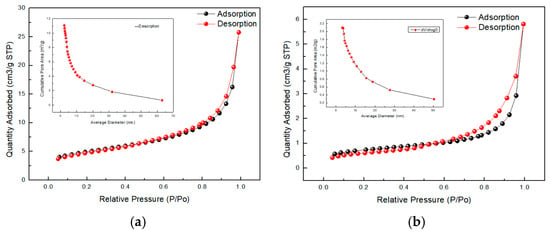
Nitrogen adsorption–desorption isotherms for the mesoporous carbons (A). BJH pore size distribution curves from adsorption (B) and desorption (C) branches of isotherms.
  • Feature Paper
  • Article
  • Open Access

This study aims to investigate the effects of Cr and Mo added to Fe-Al alloys on their corrosion behavior in acidic and chloride-containing environments. Corrosion tests were carried out in 0.5 M H2SO4 and 3.5 wt.% NaCl aerated aqueous solutions. X-ray diffraction analyses reveal that all alloys exhibited predominantly body-centered cubic structures in the homogenized states. In the 0.5 M H2SO4 solution, the addition of Cr can effectively reduce the critical current density; however, the anodic and cathodic polarization curves still intersected three times, similar to the alloy without the addition of Cr, resulting in three corrosion potentials. With the further addition of Mo, the critical current density became much lower, leading to a single corrosion potential. In the 3.5 wt.% NaCl solution, the addition of Cr alone markedly improved the pitting resistance of Fe-Al alloys, while the further addition of Mo broadened the passive region and increased the pitting potential. The analysis of ion concentrations was consistent with the potentiodynamic polarization results, verifying the stabilization of Mo on the passive film. It is evident that the addition of Cr promotes passivation of the Fe-Al alloy, and the further incorporation of Mo enhances this effect even more significantly. The related corrosion mechanisms are discussed with Nerst equations of metal–metal oxides and their solubility products (Ksp).

4 January 2026

Accurately predicting the ultimate strain of fiber-reinforced polymer (FRP)-confined concrete columns is essential for the widespread application of FRP in strengthening reinforced concrete (RC) columns. This study comprehensively investigates the performance of ensemble machine learning (ML) models in estimating the ultimate strain of FRP-confined concrete (FRP-CC) columns. A dataset of 547 test results of the ultimate strain of FRP-CC columns was collected from the literature for training and testing ML models. The four best single ML models were used to develop ensemble models employing voting, stacking and bagging techniques. The performance of the ensemble models was compared with 10 single ML and 11 empirical strain models. The study results revealed that the single ML models yielded good agreement between the estimated ultimate strain and the test results, with the best single ML models being the K-Star, k-Nearest Neighbor (k-NN) and Decision Table (DT) models. The three best ensemble models, a stacking-based ensemble model comprising K-Star, k-NN and DT models; a stacking-based ensemble model comprising K-Star and k-NN models and a voting-based ensemble model comprising K-Star and k-NN models, achieved higher estimation accuracy than the best single ML model in estimating the strain capacity of FRP-CC columns.
4 January 2026

Low-density thermal insulation materials tend to settle during operation or under small loads. Resistance to loads and settling is ensured by increasing the density of thermal insulation materials several times. This increases the weight of the material and the structure and production costs. In this work, using various technological processes, corrugated textile sheets and thermal insulation materials were produced from textile fabric. The development of such materials as effective thermal insulation materials for building insulation has not yet been studied. The corrugation of textile sheets enabled the thermal insulation material to exhibit good mechanical and deformation properties without increasing its density or thermal conductivity. The density of the specimens of the thermal insulation material made from corrugated sheets ranged from 76.8 to 51.9 kg/m3, and the thermal conductivity ranged from 0.0535 to 0.0385 W/(m·K). The most significant influences on density and thermal conductivity were the wave size and the adhesive layer. The density of unglued sheets of the same composition ranged from 51.3 to 29.8 kg/m3, and the thermal conductivity ranged from 0.0530 to 0.0371 W/(m·K). The highest compressive and bending strengths were observed in thermal insulation materials prepared from finely corrugated sheets. Their compressive stress at 10% deformation was 17.3 kPa, and their bending strength was −157 kPa. In comparison, the compressive stress of thermal insulation materials of the same density as non-corrugated sheets was only 0.686 kPa and, in the case of bending strength, 9.90 kPa. The obtained results show that the application of materials engineering principles allows us to improve the performance characteristics of materials.
4 January 2026

News & Conferences

Issues

Open for Submission

Editor's Choice

Reprints of Collections

Advances in Computation and Modeling of Materials Mechanics
Reprint

Advances in Computation and Modeling of Materials Mechanics

Editors: Hai Huang, Abduljabar Alsayoud, Yucheng Lan
Recent Researches in Polymer and Plastic Processing
Reprint

Recent Researches in Polymer and Plastic Processing

Editors: Joanna Izdebska-Podsiadły

Get Alerted

Add your email address to receive forthcoming issues of this journal.

XFacebookLinkedIn
Materials - ISSN 1996-1944