Skip to Content
  • 1.2
    Impact Factor
  • 2.3
    CiteScore
  • 25 days
    Submission to First Decision
  • 6 days
    Acceptance to Publication

Magnetism

Magnetism is an international, peer-reviewed, open access journal on science and technology for all original researches on magnetism and related fields, published quarterly online by MDPI. The UK Magnetics Society (UKMagSoc) is affiliated with Magnetism and their members receive discounts on the article processing charges.

Get Alerted

Add your email address to receive forthcoming issues of this journal.

All Articles (147)

  • Review
  • Open Access

Biomagnetism occupies the interface of bioinorganic chemistry, coordination chemistry, and quantum mechanics, addressing how metal-centered electronic and spin states give rise to magnetic phenomena in living systems. This review highlights the recent developments in the field of electronic, coordinative, and spin-state parameters which control the magnetic properties in five different biological systems that are mechanistically interlinked: (i) biomineralization of nanocrystalline forms of iron oxides namely magnetite (Fe3O4), maghemite (γ-Fe2O3), and ferrihydrite core inside ferritin and magnetosomes associated proteins; (ii) coordination chemistry of paramagnetic agents used as contrast agents for magnetic resonance imaging (MRI); (iii) quantum chemistry of radical pairs responsible for avian magnetoreception through cryptochromes; (iv) processes controlling the formation of ferrihydrite core and iron storage inside ferritin proteins; and (v) role of biomagnetic field in the chemistry of free radicals and reactive oxygen species (ROS). Analysis based on the experimental results obtained by spectroscopy, magnetometry, and computation between 2020 and 2026 illustrates how changes in covalent bonding, spins of electrons, and orbital symmetries result in observable phenomena in magnetic fields that are weak (µT) and strong (T-scale). The discussion is restricted to naturally occurring and biomimetic coordination environments, deliberately excluding industrial synthetic methodologies, in order to foreground the intrinsic coordination chemistry governing these biomagnetic systems.

Magnetism

31 October 2026

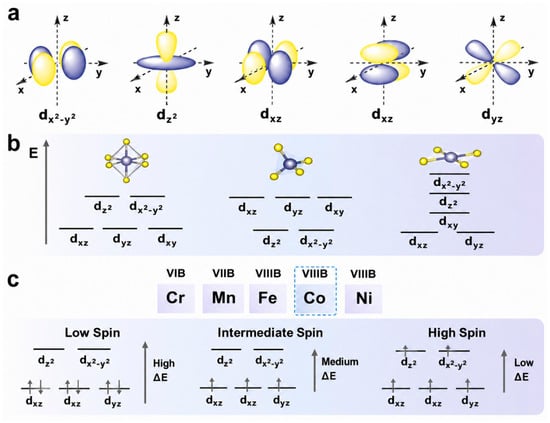
Illustrations of the spin state. (a) Spatial illustration of the five d-orbitals, (b) crystal field splitting of d-orbitals in a transition metal cation when ligands interact with the cation in octahedral, tetrahedral, and square planar molecular geometries, and (c) elements reported in the previous research involving spin states, as well as d-orbital energy levels and possible spin states (low spin state, intermediate spin state, and high spin state) of Co(III) when interacting with ligands in octahedral molecular geometry as an example to illustrate the effect of d-orbital energy level splitting on the spin state of transition metal cations. Adapted with permission from Ref. [18]. Copyright 2024, RSC Publishing.
  • Article
  • Open Access

In this paper, a spoke-type flux-modulated permanent magnet in-wheel (SFM-PMIW) motor is taken as the research object. A design and optimization method for field-modulated motors guided by multi-air-gap harmonics is proposed. In the research, the requirements for high torque and low torque ripple are integrated into the motor design, leading to the implementation of rotor slotting. Subsequently, the influence of rotor slotting on rotor permanent magnet magnetomotive force and rotor permeance is analyzed. Then, by designing the unique modulation behavior after rotor slotting, the air-gap harmonics are altered to improve motor performance, including cogging torque. Guided by this concept, the air-gap harmonics related to cogging torque are analyzed, and these harmonics are used as a design link for motor parameter optimization, resulting in the final motor structure. Finally, a comparative analysis of the no-load and load performance before and after harmonic design is conducted, demonstrating the effectiveness of the proposed design and optimization approach.

Magnetism

27 October 2026

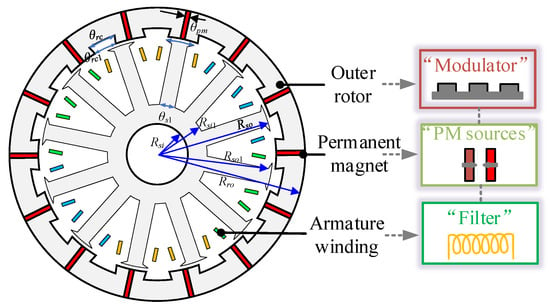
Initial topology diagram of the SFM-PMIW motor.
  • Article
  • Open Access

The growing demand for reliable and sustainable renewable energy systems has increased interest in advanced electrical machines for wind energy conversion. Among these, the multiphase switched reluctance generator (SRG) offers advantages such as simple construction, low cost, high reliability, and inherent fault-tolerant capability. This paper presents the modeling and performance analysis of a four-phase switched reluctance generator under normal and fault conditions for wind energy applications. A MATLAB/Simulink model of the SRG integrated with a variable-speed wind turbine is developed to evaluate key performance parameters, including voltage, current, torque, speed, and flux characteristics. To investigate fault tolerance, phase exclusion faults are introduced and the generator performance is analyzed under degraded operating conditions. The simulation results show that the multiphase SRG continues operation even after the loss of one phase, although with increased torque ripple and current stress in the remaining phases. The implemented excitation and converter control strategies maintain system stability and acceptable performance under the investigated operating-speed conditions and phase-exclusion fault. The present work considers representative operating-speed conditions rather than a continuously varying wind-speed profile. The results demonstrate that multiphase SRGs provide reliable and robust operation for wind energy conversion systems. These characteristics make SRGs a potential option for wind-energy conversion applications.

Magnetism

22 September 2026

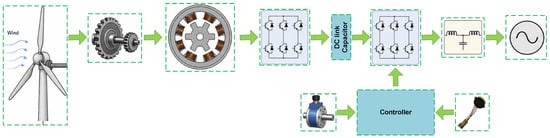
Block-level architecture of the SRG-based wind energy conversion system, including the wind turbine, gearbox, sensing units, power converter, DC-link, inverter, and grid interface.
  • Article
  • Open Access

In this paper, a sharp band-pass filter (BPF) with enhanced pass-band and stop-band specifications is presented. The filter can be utilized for 5G mid-band applications along with LTE42 (3.4–3.6 GHz) and LTE43 (3.6–3.8 GHz) to comply with the standards of different countries. The initial design of the filter consists of a high impedance transmission line connecting the filter’s two ports, which are terminated by 50 Ω resistors. Although this design results in reasonable pass-band characteristics, its stop-band and transition-band characteristics are relatively weak. Due to this shortcoming, the stop-band and transition-band characteristics of the filter are improved by locating sharp transmission zeros within the stop-band to determine the filter bandwidth and to significantly increase the stop-band attenuation. These modifications are achieved by inserting a pair of shunt short- and open-circuit stubs, a pair of short-circuited U-shaped parasitic elements, and a central short-circuited U-shaped element. The filter is mathematically analyzed and modeled, and the design steps are also demonstrated. The simulation and measured results are compatible, and the measurements show an insertion loss of 0.35 dB, stop-band attenuation larger than 20 dB, sharp transmission zeros, and a transition-band value within 10% of the center frequency.

Magnetism

12 September 2026

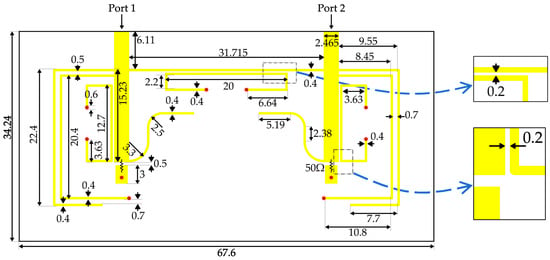
Geometry of the proposed filter (all dimensions are in mm).

Highly Accessed Articles

News & Conferences

Latest Issues

Open for Submission

Journal Sections

XFacebookLinkedIn
Magnetism - ISSN 2673-8724