Article

Contrasting Effects of Bi and Si Substitution at the Ni Site on Magnetostructural Transitions and Magnetocaloric Properties in Ni–Mn–In Heusler Alloys


1
School of Physics and Applied Physics, Southern Illinois University, Carbondale, IL 62901, USA
2
Faculty of Physics, Lomonosov Moscow State University, 119991 Moscow, Russia
3
Department of Physics, Samarkand State University after Sharof Rashidov, Samarkand 140104, Uzbekistan
4
Institute for Theoretical and Applied Electrodynamics RAS, 125412 Moscow, Russia
5
Department of Chemistry & Physics, Southeast Missouri State University, Cape Girardeau, MO 63701, USA
6
Department of Physics & Astronomy, Louisiana State University, Baton Rouge, LA 70803, USA
*
Author to whom correspondence should be addressed.
Magnetism 2026, 6(2), 20; https://doi.org/10.3390/magnetism6020020
Submission received: 28 March 2026 / Revised: 9 May 2026 / Accepted: 25 May 2026 / Published: 3 June 2026

Abstract

We investigated the structural, magnetic, magnetocaloric, and magnetotransport properties of Ni50Mn35In15 Heusler alloys via partial substitution of Ni with 3 at.% Bi (Ni47Bi3Mn35In15) and 3 at.% Si (Ni47Si3Mn35In15) synthesized by arc melting. X-ray diffraction confirms a predominantly L21 cubic structure (space group Fm-3m), while SEM/EDX analysis verifies compositional homogeneity. Temperature-dependent magnetization measurements reveal that the Bi-substituted alloy exhibits a first-order magnetostructural transition associated with the martensitic transformation, followed by a second-order magnetic phase transition from ferromagnetic to paramagnetic behavior near the Curie temperature. In contrast, the Si-substituted alloy shows a single second-order transition with negligible thermal hysteresis, indicating suppression of the martensitic phase. The Curie temperature decreases from 324 K for the parent alloy to 313 K and 286 K for the Bi- and Si-substituted alloys, respectively. A maximum magnetic entropy change of 6.0 Jkg−1K−1 and 4.5 Jkg−1K−1 is observed for the Bi- and Si-substituted alloys, respectively, under an applied magnetic field change of 50 kOe, with corresponding relative cooling power values of 303 Jkg−1 and 345 Jkg−1. These results demonstrate that lattice expansion (Bi) and contraction (Si) distinctly modify Mn–Mn exchange interactions, enabling tunable magnetocaloric performance in Ni–Mn–In Heusler alloys.

1. Introduction

Magnetic refrigeration is an emerging sustainable cooling technology with strong potential to lower greenhouse gas emissions and help address global warming. This approach improves energy efficiency relative to conventional vapor-compression refrigeration systems [1,2,3]. The functionality of magnetic refrigeration is facilitated by the magnetocaloric effect (MCE), which describes the reversible temperature change of a magnetic material when an external magnetic field is applied or removed, causing heating during magnetization and cooling during demagnetization [4,5]. Researchers have identified several materials that are nearly suitable for magnetic cooling systems. While Gd-based materials exhibit sufficient magnetocaloric properties, their high cost and limited availability hinder large-scale practical applications, motivating the search for alternative materials [6,7,8,9]. In this regard, Ni-Mn-In-based Heusler alloys are the emerging viable candidates due to their tunable magnetostructural transitions and significant magnetocaloric response. These intermetallic compounds are composed of combinations of transition elements and one or more main group elements. They can be separated into different classes based on their general formula such as X2YZ, XYZ, Y2XZ, where X and Y commonly represent 3d transition metals and Z corresponds to a main group element such as Al, In, Ga, Si, or Sb, termed as full, semi, inverse, and quaternary Heusler alloys, respectively [10]. Off-stoichiometric compositions of these systems have attracted considerable interest due to their remarkable magneto-responsive properties, including magnetic shape memory effects, large magnetoresistance, anomalous Hall effects, and both normal and inverse magnetocaloric effects [11,12,13,14,15,16].
Previous studies have shown that off-stoichiometric Ni-Mn-In-based alloys exhibit structural phase changes from a high-temperature austenite phase (AP) to a low-temperature martensite phase (MP) near room temperature. Additionally, they undergo magnetic phase transitions from an antiferromagnetic (AFM) to a ferromagnetic (FM) phase near the martensitic temperature (TM), and from FM to paramagnetic (PM) at the Curie temperature (TC) [17,18,19]. The crystal structure of the alloy is temperature-dependent and can transition between an austenite phase, a low-temperature martensite phase, and mixed phases near the temperature-induced structural (martensitic) transition (T = TM or TA), where TM and TA are the forward and reverse transition temperatures, respectively [20,21]. In their austenitic phase, full Heusler alloys crystallize in an L21 cubic structure, while half Heusler compounds crystallize in a C1b structure. Substitution at the Ni site in Ni50Mn35In15-based alloys can significantly alter their physical properties. Such a substitution modifies the conduction electron concentration (e/a ratio), interatomic separation of Mn–Mn, and 3d–3d hybridization, thereby tuning the electronic, magnetic, and structural behavior of the system [14,22,23].
A.K. Pathak et al. [24] investigated the magnetocaloric effect (MCE) in Ni50Mn34In16 and reported a magnetic entropy change (|ΔSM|) of ≈ 6.8 Jkg−1K−1 near the Curie temperature (TC = 325 K) and 5.3 Jkg−1K−1 around TM ≈ 280 K under an applied field change of ΔH = 50 kOe. In another study, L. Chen et al. [25] examined Ni45Co4.75Fe0.25Mn36.6In13.4, which exhibited a significantly higher |ΔSM| of 25 Jkg−1K−1 at 281 K under ΔH = 5T. Stadler et al. [26] reported an exceptionally large magnetic entropy change of 65 Jkg−1K−1 and a relative cooling power (RCP) of 72 Jkg−1 in Ni2Mn0.75Cu0.25Ga near TC ≈ 310 K. Furthermore, Bourgault et al. [27] observed a |ΔSM| of 20 J kg−1 K−1 with a higher RCP of 220 J kg−1 in Ni45Co5Mn37.5In12.5 around TC ≈ 368 K.
The Ni50Mn50-xInx (x = 15, 15.05, 15.2, 16) alloys are reported to exhibit a gradual increase in |∆SM| and a significant enhancement in RCP near TC with increasing concentration. In the case of Ni50Mn35In15-xBix (x = 0, 0.25, 0.5, 1.5), the saturation magnetization and magnetic entropy change (ΔSM) decreases with increasing x, while the RCP increases [19]. Additionally, substitution of Bi at the Ni site in Ni49BiMn35In15 [17] has been reported to yield enhanced |ΔSM| and RCP compared with the Ni50Mn35In15-xBix (x ≥ 0.5) alloy [19]. These studies demonstrate that compositional tuning significantly influences magnetocaloric performance; however, a direct comparison of contrasting substitutions (such as Bi and Si) at the Ni site remains limited.
Previous studies have shown that introducing Bi into such alloys decreases the martensitic transition temperature (TM) while enhancing magnetization, magnetic entropy change (ΔSM), and relative cooling power (RCP) [17,19]. These effects are highly desirable for magnetic refrigeration applications. Despite these advances, the impact of higher substitution levels on the Ni site remains insufficiently explored. In particular, the Ni47Bi3Mn35In15 (Ni-Bi) composition is of interest because it involves a relatively higher level of Bi substitution (3 at.%) at the Ni site, representing a compositional regime that remains largely unexplored in the literature. Likewise, the Ni47Si3Mn35In15 (Ni-Si) alloy enables a systematic comparison, allowing a direct evaluation of the contrasting effects of lattice expansion in the Bi-substituted alloy and lattice contraction in the Si-substituted alloy relative to each other on the structural, magnetic, magnetocaloric, and magnetotransport properties. A portion of this work was previously presented as an abstract at the APS March Meeting [18].

2. Experimental Methods

The pure elements Ni, Bi, Si, In, and Mn with a purity of no less than 99.99% were used to synthesize Ni47Bi3Mn35In15 and Ni47Si3Mn35In15 alloys with a total mass of about 5g. Excess Mn of about 5% was added to compensate for possible mass loss during arc melting. The elements were weighed accurately to match the desired chemical composition and arc-melted under a flow of ultra-high purity argon gas. The resulting ingots were re-melted three or four times to ensure homogeneity. The ingots were then cut into small pieces for magnetization and resistivity measurements and ground into powders for structural analysis. The sample purities and crystal structures were characterized using powder X-ray diffraction (XRD) with Cu- kα radiation (λ = 1.5406 Å) at room temperature, with a step size of 0.012°/step. The compositional uniformity of the alloys was examined using scanning electron microscopy (SEM) and energy-dispersive X-ray spectroscopy (EDX) with a Quanta 450 FEG scanning electron microscope Thermo Fisher Scientific (FEI, Hillsboro, OR, USA) fitted with an Oxford Instruments X-Max 50 EDX detector (Oxford Instruments, Abingdon, Oxfordshire OX13 5QX, UK).
Magnetization and resistivity measurements were conducted using a superconducting quantum interference device (SQUID MPMS, Quantum Design, San Diego, CA, USA). Separate pieces of the sample were used for magnetization and resistivity measurements. The temperature-dependent magnetization was measured over the range of 10–380 K during both heating and cooling cycles under applied magnetic fields of 100 Oe and 50 kOe. Field-dependent isothermal magnetization curves were used to calculate the magnetic entropy change (∆SM) by applying a Maxwell relation: | S M | = H 1 H 2 d M d T H d H , where H1 and H2 are initial and final magnetic fields.
The relative cooling power (RCP) was calculated using RCP = |ΔSM| x ẟTFWHM, where ẟTFWHM is the full-width-at-half-maximum of the |ΔSM | peak. The refrigeration capacity (RC) was determined using R C = T 1 T 2 | Δ S M ( T ) | d T , where T1 and T2 are temperature corresponding to the half-maximum points of the |ΔSM| peak [12].

3. Results and Discussion

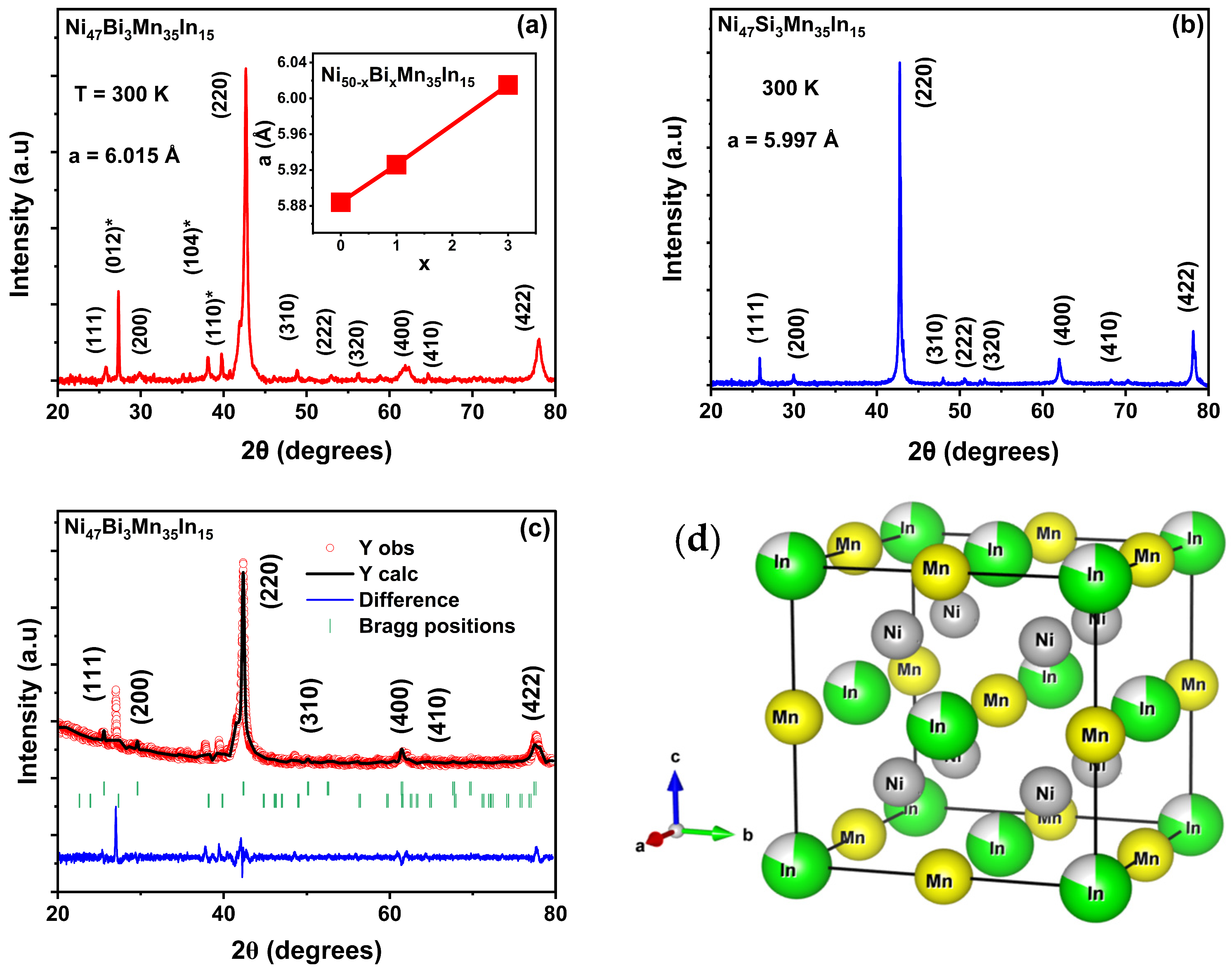
Figure 1a shows the X-ray diffraction (XRD) patterns recorded at room temperature for Ni47Bi3Mn35In15 and Ni47Si3Mn35In15, confirming that both compounds crystallize in a face-centered cubic (fcc) structure with space group Fm-3m (L21 ordered phase) [17,28]. The lattice parameters of both alloys were calculated using the strong well-defined (220) fundamental diffraction peak. A decrease in lattice parameter is observed from 6.015 Å for the Ni-Bi alloy to 5.997 Å for Ni-Si alloy, likely due to the smaller atomic size of Si compared with Bi. Previously, the parent alloy Ni50Mn35In15 has been reported to show a lattice parameter a = 5.884 Å with a mix of cubic and tetragonal phase at room temperature [19], while Ni49BiMn35In15 exhibited a = 5.926 Å [17]. The relative lattice change calculated with respect to the cubic parent phase is ~0.71%(Bi1), ~2.23%(Bi3) and ~1.92% (Si3), indicating significant lattice expansion upon substitution. The observed variation in lattice parameter directly influences the Mn–Mn interatomic distance, which plays a critical role in governing the magnetic exchange interactions in these alloys [29]. The inset of Figure 1a presents the variation of lattice parameter for Ni50xBixMn35In15 (x = 0, 1, 3). For x = 0 and 1, previously reported results from [17,19] are used, demonstrating a linear increase with increasing Bi concentration. This behavior is consistent with lattice expansion due to the larger atomic size of Bi compared with Ni. Additional diffraction peaks are observed in the Bi-containing samples, indicating the presence of secondary phases, possibly due to Bi segregation. The observed Bi segregation suggests that the 3% Bi is close to the maximum amount that can be incorporated at the Ni sites in Ni-Mn-In compounds. This is further supported by the Rietveld refinement of Ni47Bi3Mn35In15, performed using FullProf software (Version 5.10). A single-phase model based on the Ni-Mn-In crystallographic information file (CIF) was employed; however, it does not account for all observed diffraction peaks, suggesting that the unindexed peaks may be associated with Bi-rich secondary phases. Furthermore, slight shifts and broadening of the main peaks suggest structural instability associated with a martensitic transformation near room temperature, which is further supported by the thermal hysteresis and abrupt change in magnetization observed in the M(T) curves. However, temperature-dependent XRD measurements would provide direct structural confirmation of this behavior [28].
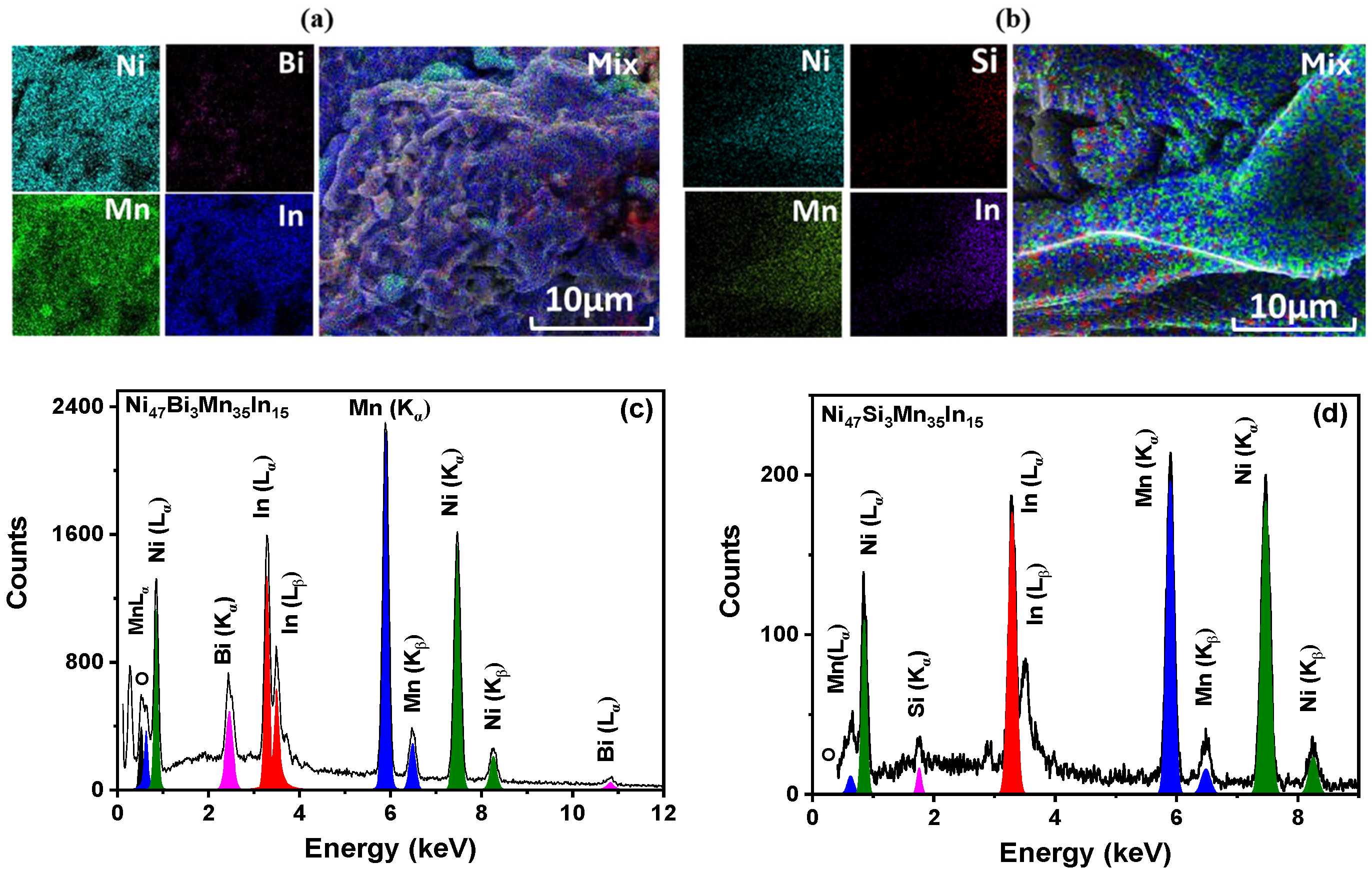
In Figure 2, panel (a) and (b) present the SEM micrographs and corresponding EDX analyses of Ni47Bi3Mn35In15 and Ni47Si3Mn35In15, respectively, to examine their surface morphologies and elemental compositions. The SEM images reveal relatively uniform and homogeneous microstructures without noticeable phase segregation, while the corresponding EDX spectra confirm the presence of all constituent elements. Table 1 illustrates the experimentally obtained compositions from EDX analysis, reported in both weight percentage (wt.%) and atomic percentage (at.%). The results show reasonable agreement with the nominal compositions within typical experimental uncertainty (~ ± 5%), which is consistent with the typical accuracy of EDX measurements. The reported compositions represent the average values obtained from measurements at multiple regions (4–5 points) across the sample surface, confirming the reliability of the data. Minor deviations are observed, which can be attributed to the surface-sensitive nature of EDX analysis, surface enrichment, and the intentional addition of excess Mn to compensate for evaporation losses during arc melting [30]. Overall, the good match between the measured and nominal compositions, along with the consistency across multiple measurement points, suggests the successful formation of the target alloys and indicates good compositional homogeneity.
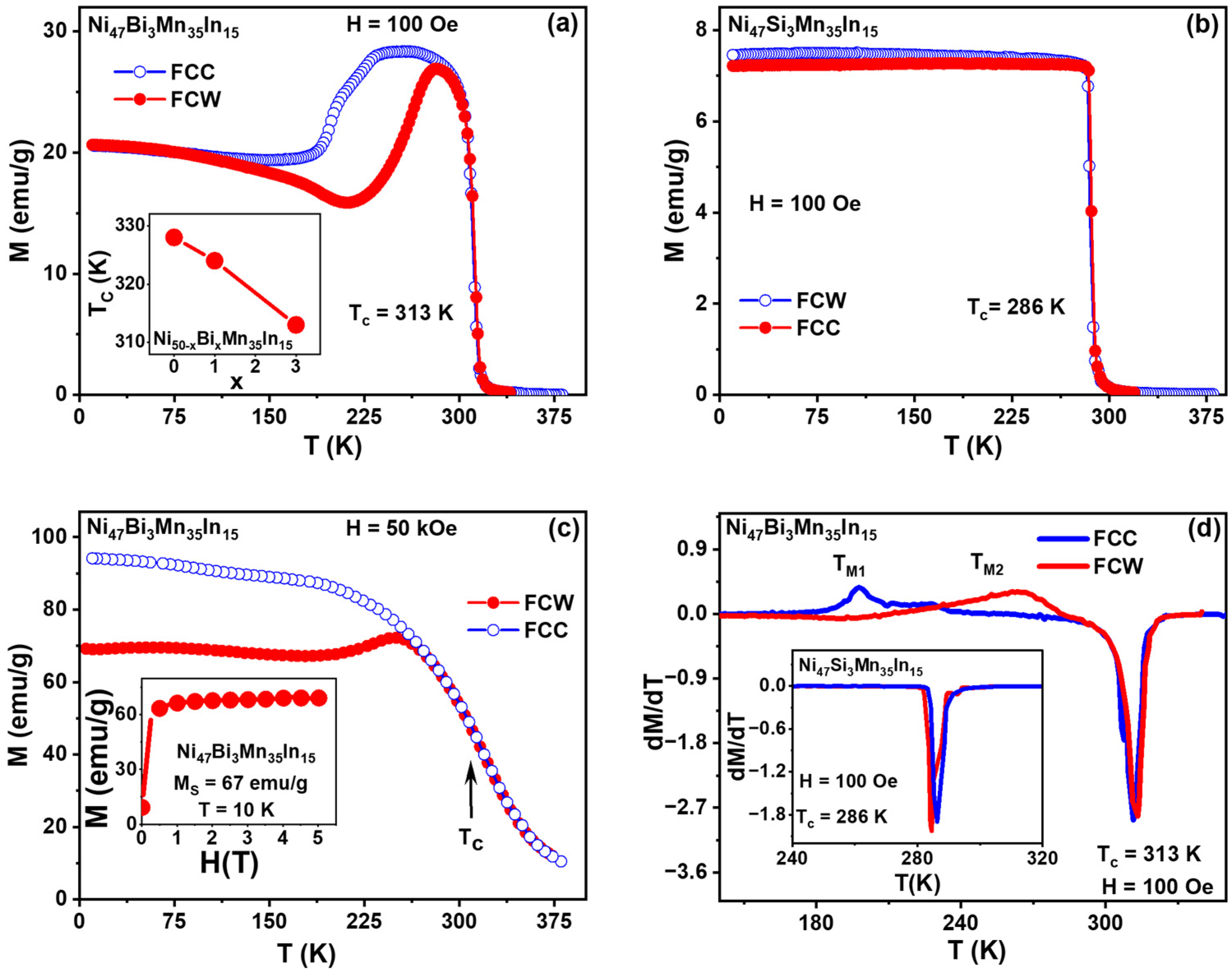
Figure 3a,b show the temperature-dependent magnetization M(T) for Ni47Bi3Mn35In15 and Ni47Si3Mn35In15 measured under an applied field of H = 100 Oe using field-cooled-cooling (FCC) and field-cooled-warming (FCW) protocols. For Ni47Bi3Mn35In15, a sharp change in magnetization occurs near the martensitic transition temperature (TM), accompanied by pronounced thermal hysteresis, confirming a first-order phase transition (FOPT) from the ferromagnetic MP to the ferromagnetic AP [24,31]. Furthermore, a second-order transition from the ferromagnetic austenite to the paramagnetic phase is observed near the Curie temperature (TC). The inset of Figure 3a demonstrates that, as the Bi concentration increases in Ni50-xBixMn35In15 (x = 0, 1, 3), the TC decreases and shifts closer to room temperature. This behavior is possibly due to the substitution of non-magnetic Bi at the Ni site, which modifies the Mn–Mn interatomic distance and weakens the ferromagnetic exchange interactions, thereby reducing the overall magnetic coupling [32].
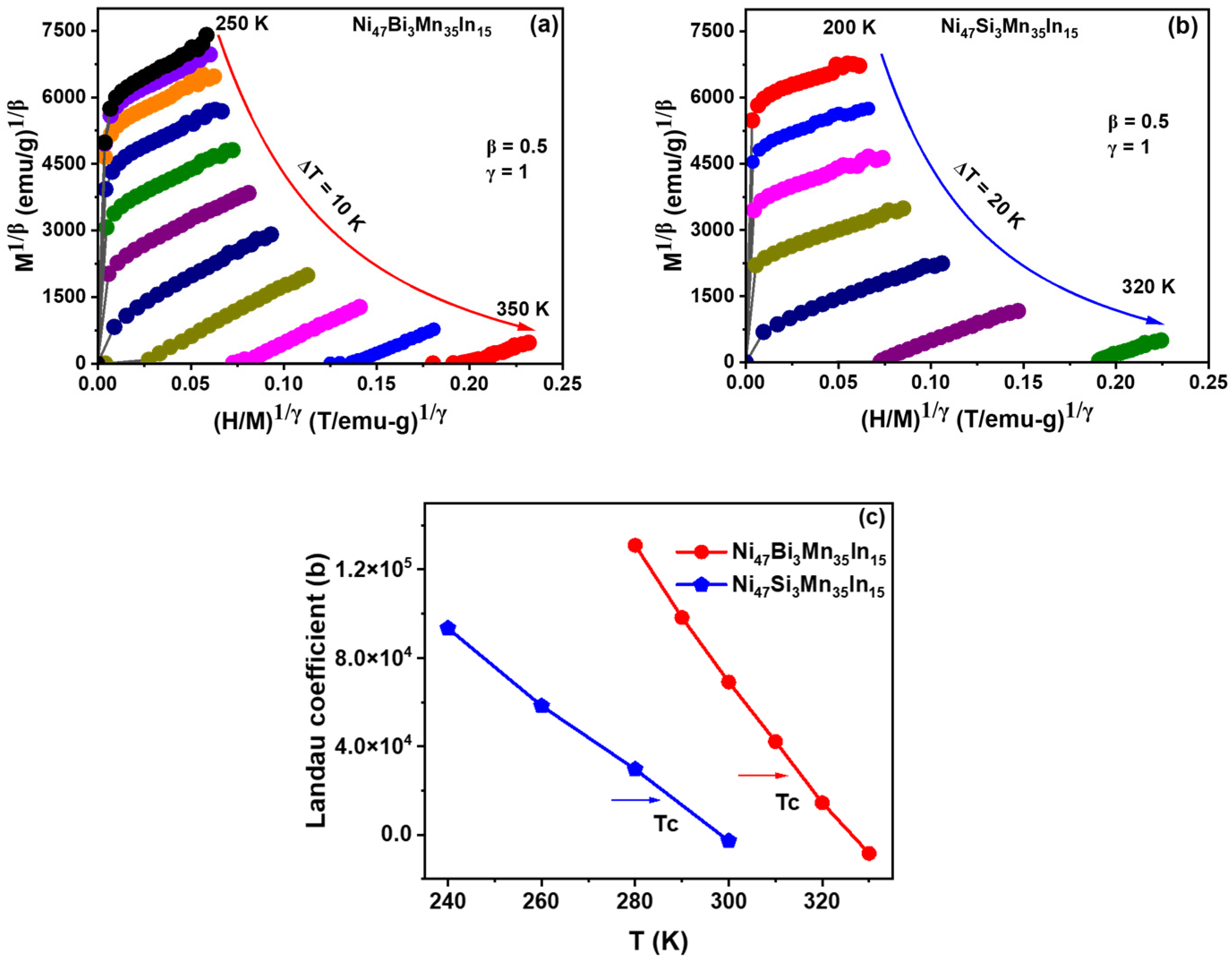
In contrast, Ni47Si3Mn35In15 exhibits a single magnetic transition with nearly overlapping FCC and FCW curves, showing negligible thermal hysteresis (~1.8 K) and a predominantly second-order phase transition, as further confirmed by the corresponding Arrott plots (Figure 4b). This suggests that Si substitution suppresses (or significantly weakens) the martensitic transformation and stabilizes the ferromagnetic austenitic phase. Owing to its smaller atomic size, Si induces relative lattice contraction compared with Ni47Bi3Mn35In15, which can reduce the Mn–Mn interatomic distance and modifies the exchange interactions. This change can enhance antiferromagnetic contributions or weaken ferromagnetic coupling, thereby influencing the magnetic properties [23,29]. Previous studies have shown that Si substitution reduces the valence electron concentration (e/a ratio) and modifies the balance between ferromagnetic and antiferromagnetic interactions through changes in Mn–Mn spacing, leading to a reduction in both magnetization and Curie temperature [21]. In the present study the calculated e/a values for the Bi- and Si- substituted alloys are approximately 7.75 and 7.72, respectively, which are lower than that of the parent alloy (7.90). Although the difference in e/a between the Bi and Si substituted alloys is relatively small, their contrasting magnetic behavior suggests that the observed changes likely arise from the coupled influence of lattice modification and electronic structure variation rather than from a single parameter alone.
The magnetic behaviors of these Heusler alloys are primarily governed by the Mn atoms, whose large magnetic moments dominate the overall magnetization [23,33]. Due to the relatively large Mn–Mn separation, direct 3d–3d exchange is weak, and the magnetic interactions are mainly mediated by indirect Ruderman–Kittel–Kasuya–Yosida (RKKY)-type exchanges [34]. Figure 3c exhibits the M-T curves measured under an applied field of H = 50 kOe, which indicates that the first-order phase transition is significantly suppressed, as evidenced by the reduced hysteresis and the smoother nature of the transition. This weakening of the FOPT at a higher field suggests the field-induced stabilization of the ferromagnetic austenitic phase, consistent with previous findings [19,35]. The applied magnetic field favors the high-magnetization austenitic phase, thereby suppressing the low-magnetization martensitic phase due to the large difference in magnetization between the two phases [17]. The inset of Figure 3c shows the M(H) curves at 10 K, where a saturation magnetization (MS) of ~67 emu/g is observed for the Bi-substituted alloy, which is higher compared with the parent alloy [19]. This enhancement suggests that the Bi-containing sample exhibits an improved magnetic response, likely through modifications in Mn–Mn exchange interactions associated with lattice expansion, while the possible contribution of minor secondary phases cannot be excluded.
The temperature dependence of the derivative of magnetization (dM/dT), shown in Figure 3d, provides clear evidence for the coexistence of first-order and second-order magnetic phase transitions in Ni47Bi3Mn35In15. The dM/dT curves exhibit two anomalies TM1 and TM2, with clear thermal hysteresis between cooling and heating, confirming the first-order nature of the martensitic transition [19]. This behavior reflects abrupt changes in magnetization associated with a simultaneous structural transformation in the same temperature range. In contrast, near TC = 313 K, the dM/dT curves exhibit a sharp minimum without any thermal hysteresis, characteristic of a second-order magnetic phase transition. This is further supported by the Arrott plot shown in Figure 4a. By contrast, the inset of Figure 3d shows that the dM/dT curves for Ni47Si3Mn35In15 nearly overlap during cooling and heating over the full temperature range, indicating negligible thermal hysteresis and confirming a predominantly second-order transition. Unlike the Ni-Bi alloy, no low-temperature discontinuity is observed, suggesting the absence or strong suppression of the first-order transition in the Ni-Si alloy. In this study we observed that both Bi and Si substitutions lead to an increase in the lattice parameter, accompanied by a reduction in the valence electron concentration (e/a) compared with the parent alloy.
Figure 4a,b show the Arrott plots for Ni47Bi3Mn35In15 and Ni47Si3Mn35In15, constructed using the mean-field approximation with critical exponents β = 0.5, and γ = 1. The presence of positive slopes in all isotherms confirms that the magnetic phase transition near TC in both alloys is predominantly of second order, according to Banerjee’s criterion. The isotherm that passes closest to the origin corresponds to the Curie temperature (TC), providing an independent estimation of the transition temperature [36]. To further examine the nature of the FM-PM transition, a Landau fitting of the magnetic isotherms was performed near TC using the relation H M = a + b M 2 + c M 4 . The positive values of the Landau coefficient b, shown in Figure 4c, further support the predominantly second-order magnetic behavior in both alloys [37]. Negative b values observed at temperatures well above Tc are attributed to fitting uncertainty in the paramagnetic region, where the magnetization becomes very small. From the combined analysis of the dM/dT vs. T curves, and the Arrott plots, the Curie temperatures of Ni47Bi3Mn35In15 and Ni47Si3Mn35In15 are determined to be 313 K and 286 K, respectively, in good agreement with the magnetization data.
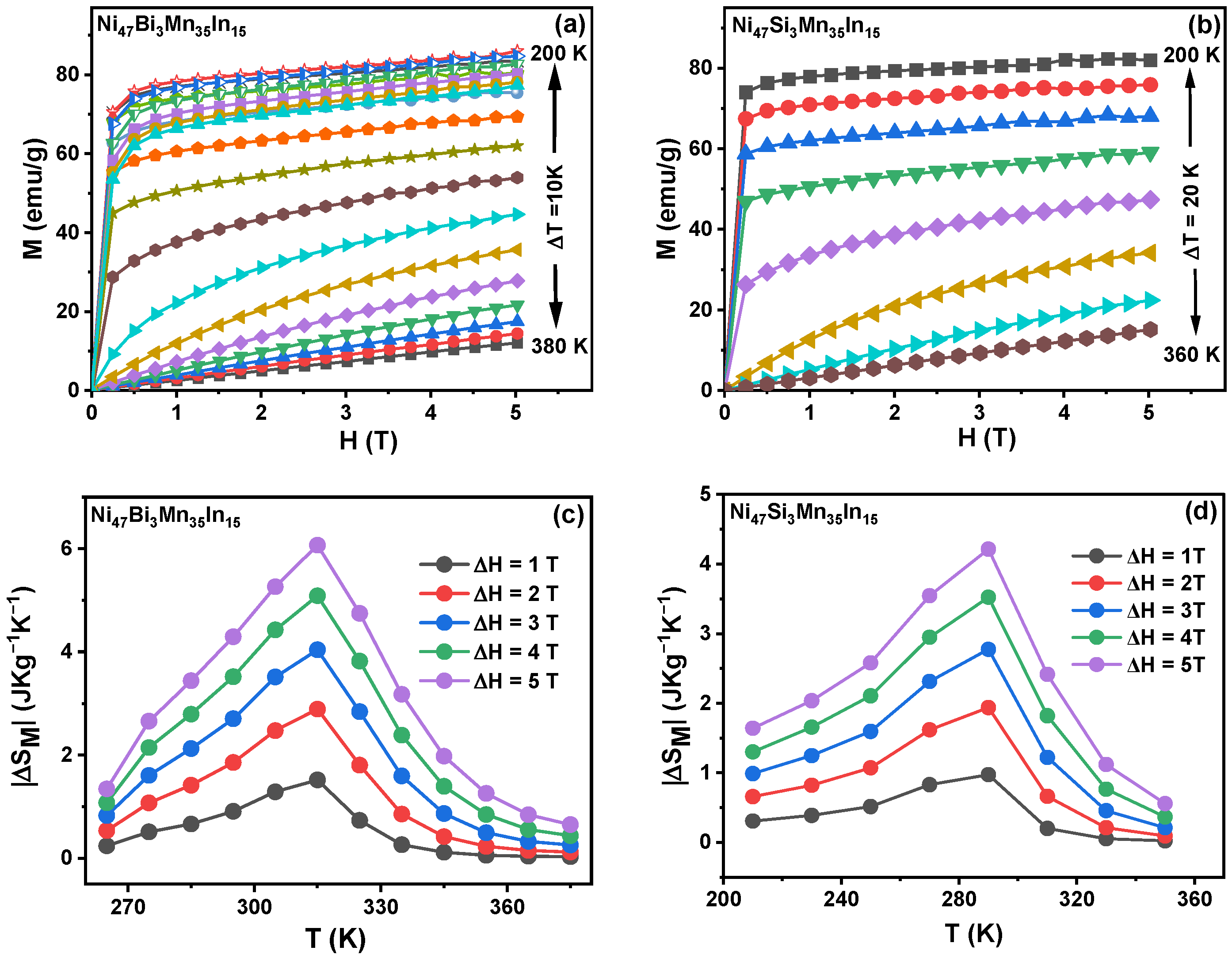
Figure 5a,b show the isothermal magnetization [M(H)] curves for Ni47Bi3Mn35In15 and Ni47Si3Mn35In15, respectively, measured over selected temperature ranges with intervals of ΔT = 10 K and 20 K under an applied magnetic field of up to 50 kOe. Figure 5c,d present the corresponding magnetic entropy changes (|ΔSM|) as a function of temperature for both alloys, estimated from the M(H) data using Maxwell’s thermodynamic relation under a magnetic field change of ΔH = 5 T [3]. It is noted that a larger temperature interval may lead to slight underestimation and reduced resolution of the |ΔSM| peak; however, the overall trend and peak position remain unaffected, ensuring a reliable comparision between the samples. Magnetocaloric properties are primarily evaluated near the FM to PM transition owing to its reversible behavior and negligible hysteresis. Previously, Ni49BiMn35In15 has been reported to exhibit a maximum magnetic entropy change of |ΔSM| = 5.5 Jkg−1K−1 and a relative cooling power of 312 Jkg−1 at TC = 325 K. In the present study, increasing the Bi content leads to an enhanced magnetocaloric response, with |ΔSM| = 6 Jkg−1K−1 and RCP and refrigerant capacity (RC) values of 303 Jkg−1 and 257 Jkg−1, respectively. In contrast, substitution with 3 at.% Si reduces the magnetic entropy change to |ΔSM| = 4.2 Jkg−1K−1, while the RCP increases to 345 Jkg−1 (RC = 300 Jkg−1) at TC = 286 K. The enhanced magnetocaloric response in the Ni–Bi alloy is attributed to lattice expansion, which increases the Mn–Mn interatomic distance and enhances the magnetization change across the transition [19]. In contrast, Si substitution induces lattice contraction compared with Ni47Bi3Mn35In15, reducing the Mn–Mn distance and modifying the balance between ferromagnetic (FM) and antiferromagnetic (AFM) interactions, thereby lowering |ΔSM|. However, the relatively higher RCP (and RC) values observed for the Si-substituted alloy arise from the broader |ΔSM|-T peak, which extends the effective temperature span of the magnetocaloric response [32]. These parameters represent key figures of merit for magnetic refrigeration, reflecting the heat transfer capability between the hot and cold reservoirs during a magnetic refrigeration cycle, and are widely used to evaluate material performance [21]. Furthermore, previous studies have shown that doping Ni-Mn-In alloys with magnetic elements such as Cu, Co, Fe, and Mn enhances |ΔSM| due to the strengthening of magnetic exchange interactions, particularly Mn-Mn and Ni-Mn coupling [31].
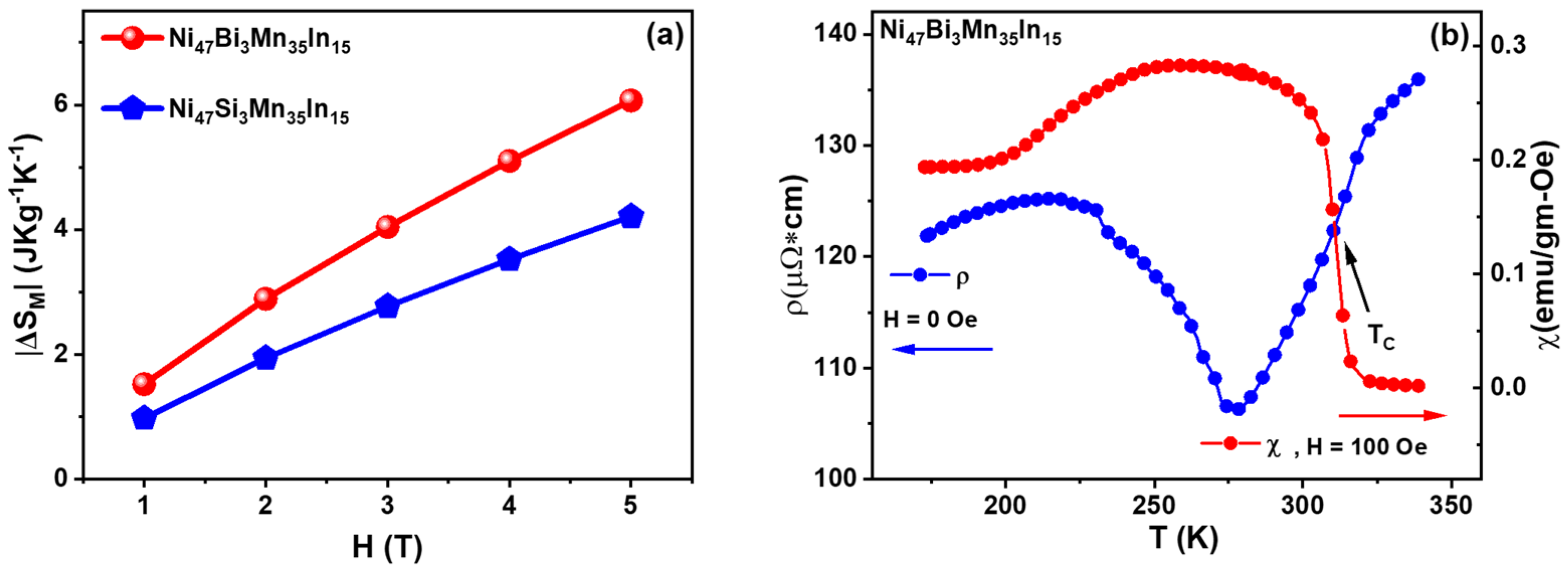
Figure 6a exhibits the comparison of magnetic entropy changes (|ΔSM|) for both alloys under different magnetic field changes (ΔH = 1–5 T). Although, the magnetic entropy change (|∆SM|) is lower than that reported for some Ni–Mn-based alloys, the present system exhibits a broader magnetic transition, resulting in a competitive relative cooling power (RCP), thereby enhancing their suitability for practical magnetic refrigeration [3]. It is also noteworthy that several compositions listed in Table 2 exhibit lower |∆SM| values than the present systems, thereby highlighting the competitive overall magnetocaloric performance observed in this study.
Figure 6b shows the temperature-dependent resistivity (ρ) of Ni47Bi3Mn35In15 at a zero field, along with the magnetic susceptibility (χ) measured under an applied field of 100 Oe during cooling. The resistivity was calculated from four-probe resistance measurements using ρ = ( R * A ) / L , where A is the cross-sectional area and L is the distance between voltage contacts. Two distinct transitions are observed: (i) a sharp drop in resistivity near TM, coinciding with the temperature of the first-order martensitic transformation, and (ii) a gradual change in slope near TC, corresponding to a second-order ferromagnetic-paramagnetic transition, associated with spin disorder scattering [17]. These features are consistent with the corresponding χ(T) data and are in good agreement with previous reports on Ni-Mn-based Heusler alloys [38,39]. From the M-T measurements, the Si-substituted alloy was found to undergo only a second-order magnetic transition without a martensitic transformation. Consequently, the expected variation in ρ(T) is relatively smooth; therefore, resistivity measurements were not included in the present study.
Table 2. Comparison of magnetic entropy changes |∆SM| and relative cooling powers (RCPs) for representative Heusler alloys near the second-order phase transition (SOPT) with changing magnetic field of ΔH = 5 T. ‘-’ indicates the data not reported.
S.N.Systems|∆SM|
[JKg−1K−1]
RCP
[JKg−1]
TC [K] References
1.Ni47Bi3Mn35In156303313This work
2.Ni47Si3Mn35In154.2345286This work
3.(Ni37.5Co12.5Mn35Ti15)99.9B0.412.2183305[39]
4.Ni50Mn34.80In15.27224328[24]
5.Ni49Mn35In15Bi5.5312325[17]
6.Ni50Mn35In14.50Bi0.55165320[19]
7.Ni45Co5Mn37.5In12.520-368[31]
8.Ni2Mn0.75Cu0.25Ga65-308[26]
9.Ni52Mn26Ga2211.4-348[40]
10.Ni50Mn35In155.4-324[19]
11.Ni44Mn36In14Co623.5250368[41]
12.Ni47Cu2Mn38Sn133.54-316[42]
13.Ni2Mn1.34In0.664.5201305[34]
14.Ni42Mn46CoSn110.97129350[43]
15.Ni50Mn35In10Fe51.474298[44]
16.Ni50Mn32Sn10Fe810.04184318[45]
17.MnNi0.85Fe0.15Ge4.8836.33274[32]
18.MnCoGeSi0.0426.7-283[21]
19.Ni50Mn34In15.5Al0.53.869.9321[22]
20.Ni36Co14Mn35Ti15~20~285305[46]

4. Conclusions

In summary, this work investigates the structural, magnetic, magnetocaloric, and magnetotransport properties of Ni–Mn–In-based alloys with the partial substitution of Ni by Bi and Si (each at 3 at.%). A clear contrasting behavior was observed between Bi and Si substitutions. Bi substitution enhances magnetocaloric performance, with the maximum magnetic entropy change (|ΔSM|) increasing from 5.5 (the parent) to 6 J kg−1 K−1 as the Bi content increases from 1 to 3 at.%. In contrast, Si substitution led to a reduction in |ΔSM|, while the broadening of the ΔSM peak resulted in an enhanced RCP. Furthermore, the Curie temperatures of both alloys (286 K and 313 K) are close to room temperature (~300 K), making them suitable for practical magnetocaloric applications. These results demonstrate that lattice expansion (Bi) and contraction (Si), relative to each other, distinctly modify the Mn–Mn exchange interactions and affect the magnetocaloric responses. These results highlight the contrasting roles of Bi and Si substitution in tuning the magnetocaloric response of Ni–Mn–In-based Heusler alloys.

Author Contributions

Conceptualization, A.O., I.D., S.S., N.A. and S.T.; Methodology, A.O., I.D., M.P.H. and S.T.; Software, A.O., S.S. and S.T.; Validation, A.O., I.D., A.G., D.K.G., S.S., N.A. and S.T.; Formal analysis, A.O., I.D., A.G., D.K.G., M.A.I., M.P.H., S.S. and S.T.; Investigation, A.O. and S.S.; Resources, I.D., S.S., N.A. and S.T.; Data curation, A.O., D.K.G. and M.P.H.; Writing – original draft, A.O.; Writing – review & editing, A.O., I.D., A.G., D.K.G., S.S. and S.T.; Visualization, I.D., S.S., N.A. and S.T.; Supervision, I.D., A.G., S.S., N.A. and S.T.; Project administration, S.S., N.A. and S.T.; Funding acquisition, S.S., N.A. and S.T. All authors have read and agreed to the published version of the manuscript.

Funding

Funding support from the U.S. Department of Energy (DOE), Office of Basic Energy Sciences. Grant No. DE-FG02-06ER46291 (S.T., N.A.) and Grant No. DE-SC0010521 (S.S.) is gratefully acknowledged.

Data Availability Statement

The raw data supporting the conclusions of this article will be made available by the authors on request.

Conflicts of Interest

The authors declare no conflict of interest.

References

  1. Maji, C. Heusler Alloys: Sustainable Material for Sustainable Magnetic Refrigeration. In Handbook of Sustainable Materials: Modelling, Characterization, and Optimization; CRC Press: Boca Raton, FL, USA, 2023; pp. 323–339. [Google Scholar] [CrossRef] [Scilit]
  2. Oli, A.; Dubenko, I.; Granovsky, A.; Razhabov, R.; Hill, M.; Koshkid’ko, Y.; Stadler, S.; Ali, N.; Talapatra, S. Effects of carbon substitution on magnetic properties and magnetocaloric effects in Mn65-xGa17C18+x compounds. J. Alloys Compd. 2025, 1017, 179036. [Google Scholar] [CrossRef] [Scilit]
  3. Batdalov, A.B.; Aliev, A.M.; Khanov, L.N.; Buchel’nikov, V.D.; Sokolovskii, V.V.; Koledov, V.V.; Shavrov, V.G.; Mashirov, A.V.; Dil’mieva, E.T. Magnetic, thermal, and electrical properties of an Ni45.37Mn40.91In13.72 Heusler alloy. J. Exp. Theor. Phys. 2016, 122, 874–882. [Google Scholar] [CrossRef] [Scilit]
  4. Tiwari, N.; Mishra, S.; Kumar, A.; Malik, V.K.; Roy, D.; Paliwal, M.; Chaudhary, V.; Singh, A.K.; Tiwary, C.S. Manganese-Copper-Gallium Alloys for Sustainable Refrigeration Through a Synergistic Study of Magnetocaloric and Mechanical Behavior. Adv. Eng. Mater. 2026, 28, e202502236. [Google Scholar] [CrossRef] [Scilit]
  5. Shahbazi, M.; Manshadi, A.D.; Shinde, K.; Mackinnon, I.D.R. Magnetocaloric Properties and Microstructures of HoB2 and Nb-Substituted HoB2. Materials 2025, 18, 866. [Google Scholar] [CrossRef] [Scilit]
  6. Villa, E.; Villa, F.; Crespo, B.R.; Lazpita, P.; Salazar, D.; Hosoda, H.; Chernenko, V. Shape memory and elastocaloric properties of melt-spun NiMn-based Heusler alloys. J. Alloys Compd. 2023, 965, 171437. [Google Scholar] [CrossRef] [Scilit]
  7. Sivaprakash, P.; Kim, I.; Divya, S.; Hajra, S.; Oh, T.H.; Muthu, S.E. Influence of non-magnetic Cu on structural, magnetic and magnetocaloric properties on NiMnIn bulk Heusler alloys. Mater. Sci. Eng. B 2023, 297, 116760. [Google Scholar] [CrossRef] [Scilit]
  8. Oli, A.; Dubenko, I.S.; Granovsky, A.B.; Gusthigngnhadurage, D.; Razhabov, R.M.; Hill, M.P. Tuning Magnetocaloric Properties in Mn60Ga20-xInxC20 Antiperovskites via Isoelectronic Substitution of In. SSRN Electron. J. 2026. [Google Scholar] [CrossRef] [Scilit]
  9. Dubenko, I.; Oli, A.; Duncan, J.; Granovsky, A.; Razhabov, R.; Hill, M.; Koshkid’ko, Y.; Stadler, S.; Talapatra, S.; Ali, N. Magnetic properties of B doped Mn-Ga-C based alloys. J. Magn. Magn. Mater. 2023, 595, 171505. [Google Scholar] [CrossRef] [Scilit]
  10. Wederni, A.; Daza, J.; Ben Mbarek, W.; Saurina, J.; Escoda, L.; Suñol, J.-J. Crystal Structure and Properties of Heusler Alloys: A Comprehensive Review. Metals 2024, 14, 688. [Google Scholar] [CrossRef] [Scilit]
  11. Krenke, T.; Duman, E.; Acet, M.; Wassermann, E.F.; Moya, X.; Mañosa, L.; Planes, A. Inverse magnetocaloric effect in ferromagnetic Ni–Mn–Sn alloys. Nat. Mater. 2005, 4, 450–454. [Google Scholar] [CrossRef] [Scilit]
  12. Gschneidner, K.A.; Pecharsky, V.K.; Tsokol, A.O. Recent developments in magnetocaloric materials. Rep. Prog. Phys. 2005, 68, 1479–1539. [Google Scholar] [CrossRef] [Scilit]
  13. Beckmann, B.; Taubel, A.; Gottschall, T.; Pfeuffer, L.; Koch, D.; Staab, F.; Bruder, E.; Scheibel, F.; Skokov, K.P.; Gutfleisch, O. Giant magnetocaloric effect of Ni-Co-Mn-Ti all-d Heusler alloys in high magnetic fields. Acta Mater. 2024, 282, 120460. [Google Scholar] [CrossRef] [Scilit]
  14. Zhang, X.; Guo, Z.; Zhang, F.; Li, Y. Recent Advances in Magnetocaloric Effect of High-Entropy Alloys. Coatings 2025, 15, 1425. [Google Scholar] [CrossRef] [Scilit]
  15. Karki Chhetri, S.; Acharya, G.; Graf, D.; Basnet, R.; Rahman, S.; Sharma, M.M.; Upreti, D.; Un Nabi, R.; Kryvyi, S. Large negative magnetoresistance in antiferromagnetic Gd2Se3. Phys. Rev. B 2025, 111, 014431. [Google Scholar] [CrossRef] [Scilit]
  16. Khan, A.N.; Moreno-Ramírez, L.M.; Law, J.Y.; Franco, V. Magnetostructural transformation and magnetocaloric response in Mn(Fe)NiSi(Al) alloys. J. Alloys Compd. 2024, 1008, 176724. [Google Scholar] [CrossRef] [Scilit]
  17. Aryal, A.; Dubenko, I.; Talapatra, S.; Granovsky, A.; Lähderanta, E.; Stadler, S.; Ali, N. Magnetic field dependence of the martensitic transition and magnetocaloric effects in Ni49BiMn35In15. AIP Adv. 2020, 10, 015138. [Google Scholar] [CrossRef] [Scilit]
  18. Oli, A. Phase Transitions and Magnetocaloric Effects in Ni50Mn35In12Bi3 and Ni47Mn35In15Bi3 Heusler Alloys. APS 2023, 2023, Z54.008. Available online: https://ui.adsabs.harvard.edu/abs/2023APS..MARZ54008O/abstract (accessed on 22 February 2026).
  19. Aryal, A.; Quetz, A.; Pandey, S.; Dubenko, I.; Stadler, S.; Ali, N. Effect of Bi substitution on the magnetic and magnetocaloric properties of Ni50Mn35In15-xBix Heusler alloys. AIP Adv. 2018, 8, 56409. [Google Scholar] [CrossRef] [Scilit]
  20. Sokolovskiy, V.V.; Gamzatov, A.G.; Kadirbardeev, A.T.; Buchelnikov, V.D. Interplay of Magnetism and Magnetocaloric Effect in Ni–Co–Mn–Ti Heusler Alloys: Theory and Experiment. Phys. Met. Met. 2025, 126, 1424–1434. [Google Scholar] [CrossRef] [Scilit]
  21. Li, R.; Liu, J.; Xie, C.; Jin, B.; Wang, L.; Tang, X.; Tan, G.; Xu, F. Enhancing magnetostructural coupling to realize a giant magnetocaloric effect in silicon-incorporated MnCoGe alloys. J. Magn. Magn. Mater. 2026, 645, 173987. [Google Scholar] [CrossRef] [Scilit]
  22. Arman, M.; Shahri, F.; Gholamipour, R.; Sohrabi, S. Effect of Al doping on the magnetic, magneto-structural, and magnetocaloric properties of Ni-Mn-In Heusler alloys. Solid State Commun. 2024, 396, 115767. [Google Scholar] [CrossRef] [Scilit]
  23. Ahn, K. Ni-Mn based conventional full Heusler alloys, all-d-metal full Heusler alloys, and their promising functional properties to solid state cooling by magnetocaloric effect. J. Alloys Compd. 2024, 978, 173378. [Google Scholar] [CrossRef] [Scilit]
  24. Pathak, A.K.; Khan, M.; Dubenko, I.; Stadler, S.; Ali, N. Large magnetic entropy change in Ni50Mn50−xInx Heusler alloys. Appl. Phys. Lett. 2007, 90, 262504. [Google Scholar] [CrossRef] [Scilit]
  25. Chen, L.; Hu, F.X.; Wang, J.; Bao, L.F.; Sun, J.R.; Shen, B.G.; Yin, J.H.; Pan, L.Q. Magnetoresistance and magnetocaloric properties involving strong metamagnetic behavior in Fe-doped Ni45(Co1−xFex)5Mn36.6In13.4 alloys. Appl. Phys. Lett. 2012, 101, 012401. [Google Scholar] [CrossRef] [Scilit]
  26. Stadler, S.; Khan, M.; Mitchell, J.; Ali, N.; Gomes, A.M.; Dubenko, I.; Takeuchi, A.Y.; Guimarães, A.P. Magnetocaloric Properties of Ni2Mn1−xCuxGa. Appl. Phys. Lett. 2006, 88, 192511. [Google Scholar] [CrossRef] [Scilit]
  27. Bourgault, D.; Porcar, L.; Rivoirard, S.; Courtois, P.; Hardy, V. Entropy change of a Ni45.5Co4.5Mn37In13 single crystal studied by scanning calorimetry in high magnetic fields: Field dependence of the magnetocaloric effect. Appl. Phys. Lett. 2015, 107, 092403. [Google Scholar] [CrossRef] [Scilit]
  28. Ari-Gur, P.; Madiligama, A.; Bhale, P.; Ren, Y.; Noebe, R.D.; Vogel, S.C.; Koledov, V.V.; Shavrov, V.G. The use of diffraction techniques for understanding structure–property relationships in Heusler alloys. J. Magn. Magn. Mater. 2024, 596, 171809. [Google Scholar] [CrossRef] [Scilit]
  29. Şaşioglu, E.; Sandratskii, L.M.; Bruno, P. First-principles study of exchange interactions and Curie temperatures of half-metallic ferrimagnetic full Heusler alloys Mn2V Z (Z = Al, Ge). J. Phys. Condens. Matter 2005, 17, 995–1001. [Google Scholar] [CrossRef] [Scilit]
  30. Ares, J.; Pascual, A.; Ferrer, I.; Sánchez, C. A methodology to reduce error sources in the determination of thin film chemical composition by EDAX. Thin Solid Films 2004, 450, 207–210. [Google Scholar] [CrossRef] [Scilit]
  31. Pathak, A.K.; Dubenko, I.; Xiong, Y.; Adams, P.W.; Stadler, S.; Ali, N. Effect of partial substitution of Ni by Co on the magnetic and magnetocaloric properties of Ni50Mn35In15 Heusler alloy. J. Appl. Phys. 2011, 109, 07A916. [Google Scholar] [CrossRef] [Scilit]
  32. Boussaida, B.; Masrour, R. Electronic structure, magnetic properties, and magnetocaloric performance of MnNi1-xFexGe (x = 0.15 and 0.18) alloys: A combined KKR-CPA and Monte Carlo study. Mater. Chem. Phys. 2026, 358, 132370. [Google Scholar] [CrossRef] [Scilit]
  33. D’SOuza, S.W.; Chakrabarti, A.; Barman, S.R. Magnetic interactions and electronic structure of Ni–Mn–In. J. Electron Spectros. Relat. Phenom. 2016, 208, 33–39. [Google Scholar] [CrossRef] [Scilit]
  34. Dahal, B.; Huber, C.; Zhang, W.; Valloppilly, S.; Huh, Y.; Kharel, P.; Sellmyer, D. Effect of partial substitution of in with Mn on the structural, magnetic, and magnetocaloric properties of Ni2Mn1+xIn1−x Heusler alloys. J. Phys. D Appl. Phys. 2019, 52, 425305. [Google Scholar] [CrossRef] [Scilit]
  35. Bekhouche, A.; Alleg, S.; Dadda, K.; Costa, B.F.O.; Wederni, A.; Suñol, J.-J. Ni50Mn37.5Sn12.5 Heusler Alloy: Influence of Co Addition on the Structure, Martensitic Transition, and Magnetic Properties. Magnetochemistry 2024, 10, 59. [Google Scholar] [CrossRef] [Scilit]
  36. Banerjee, B.K. On a generalised approach to first and second order magnetic transitions. Phys. Lett. 1964, 12, 16–17. [Google Scholar] [CrossRef] [Scilit]
  37. Souca, G.; Dudric, R.; Küpper, K.; Tiusan, C.; Tetean, R. Band Structure Calculations, Magnetic Properties and Magnetocaloric Effect of GdCo1.8M0.2 Compounds with M = Fe, Mn, Cu, Al. Magnetochemistry 2024, 10, 53. [Google Scholar] [CrossRef] [Scilit]
  38. Kamantsev, A.P.; Koshkid’ko, Y.S.; Gaifullin, R.Y.; Musabirov, I.I.; Koshelev, A.V.; Mashirov, A.V.; Sokolovskiy, V.V.; Buchelnikov, V.D.; Ćwik, J.; Shavrov, V.G. Inverse Magnetocaloric Effect in Heusler Ni44.4Mn36.2Sn14.9Cu4.5 Alloy at Low Temperatures. Metals 2023, 13, 1985. [Google Scholar] [CrossRef] [Scilit]
  39. López-Cruz, M.; Varga, R.; Llamazares, J.L.S. Magnetostructural Transformation and Magnetocaloric Properties of (Ni37.5Co12.5Mn35Ti15)100−xBx (x = 0.0 and 0.4) Melt-Spun Ribbons. Metals 2024, 14, 216. [Google Scholar] [CrossRef] [Scilit]
  40. Li, Z.B.; Llamazares, J.L.S.; Sánchez-Valdés, C.F.; Zhang, Y.D.; Esling, C.; Zhao, X.; Zuo, L. Microstructure and magnetocaloric effect of melt-spun Ni52Mn26Ga22 ribbon. Appl. Phys. Lett. 2012, 100, 174102. [Google Scholar] [CrossRef] [Scilit]
  41. Zhou, Z.; Akamine, H.; Yang, L.; Higashizono, T.; Hu, Q.; Nishida, M.; Li, J. Tuning martensite transformation behavior and magneto-caloric effect in Ni44Mn36In14Co6 alloy through doping the fifth element Cu. J. Alloy. Compd. 2020, 817, 153150. [Google Scholar] [CrossRef] [Scilit]
  42. Paramasivam, S.; Sankaran, E.M.; Kim, I. Investigation of magnetic, magnetocaloric cooling, magneto transport properties and critical behavior of Cu-doped Ni49Mn38Sn13 alloys. J. Magn. Magn. Mater. 2024, 614, 172737. [Google Scholar] [CrossRef] [Scilit]
  43. Dadda, K.; Ghouari, L.; Elmohri, A.; Debili, M.Y.; Hlil, E.-K. Prediction of the Magnetocaloric Effect of Ni42Mn46CoSn11 Heusler Alloy with a Phenomenological Model. Mater. Proc. 2025, 25, 4. [Google Scholar]
  44. Bachagha, T.; Chakaravarthy, R.; Ren, W.; Saurina, J.; Suñol, J.-J. Structural, Magnetocaloric, and Magnetic Properties in Heusler Ni50Mn35In10X5 (X = Ga, Fe and Al) Alloys. Metals 2023, 13, 1913. [Google Scholar] [CrossRef] [Scilit]
  45. Li, R.; Liaw, P.K.; Jiang, J.; Deng, L.; Zhang, Y. Design strategy for enhancing mechanical properties and magnetocaloric effect of eutectic Ni-Mn-Sn-Fe alloy via laser powder bed fusion. Mater. Sci. Eng. A 2026, 954, 149795. [Google Scholar] [CrossRef] [Scilit]
  46. Khan, A.N.; Moreno-Ramírez, L.M.; Garcia-Garcia, F.J.; Varela, M.; Revuelta-Losada, J.; Law, J.Y.; Franco, V. Enhanced local homogeneity obtained by induction melting for optimizing reversible magnetocaloric response in all-d-metal Ni(Co)-Mn-Ti Heusler alloys. J. Alloys Compd. 2026, 1052, 186135. [Google Scholar] [CrossRef] [Scilit]
Figure 1. Room-temperature X-ray diffraction (XRD) patterns of (a) Ni47Bi3Mn35In15 and (b) Ni47Si3Mn35In15 alloys. The asterisk (*) in panel (a) denotes secondary phases associated with Bi. The inset in (a) shows the variation of lattice parameter for Ni50-xBixMn35In15 (x = 0, 1, 3). (c) Rietveld refinement pattern for Ni47Bi3Mn35In15. (d) Shows the L21 cubic unit cell of the Ni-Mn-In-based Heusler alloy.
Magnetism 06 00020 g001
Figure 2. (a,b) SEM micrographs and (c,d) corresponding energy-dispersive X-ray (EDX) spectra of Ni47Bi3Mn35In15 and Ni47Si3Mn35In15 respectively.
Magnetism 06 00020 g002
Figure 3. Temperature-dependent magnetization M(T) measured at H = 100 Oe for (a) the Ni-Bi alloy, and (b) the Ni-Si alloy. The inset in (a) shows the variation of the Curie temperature (TC) with Bi concentration in Ni50-xBixMn35In15 (x = 0, 1, 3). (c) M(T) curves measured at H = 50 kOe for Ni-Bi; the inset shows the corresponding M(H) curves at 10 K. (d) Temperature derivative of the magnetization (dM/dT) as a function of temperature, used to estimate the magnetic transition temperatures; the inset shows dM/dT vs. T for the Ni-Si alloy.
Magnetism 06 00020 g003
Figure 4. Arrott plots (M1/β vs. H/M 1/γ) for (a) Ni47Bi3Mn35In15 and (b) Ni47Si3Mn35In15 measured in the vicinity of their second-order magnetic transition. (c) The temperature dependences of the Landau b coefficient for Ni47Bi3Mn35In15 and Ni47Si3Mn35In15.
Magnetism 06 00020 g004
Figure 5. (a,b) Isothermal M(H) curves measured at indicated temperatures under varying magnetic fields. (c,d) Corresponding magnetic entropy change |ΔSM| derived from the isothermal magnetization curves (M(H) for the indicated magnetic field changes ΔH.
Magnetism 06 00020 g005
Figure 6. (a) Comparison of magnetic entropy change (ΔSM) for Ni47Bi3Mn35In15 and Ni47Si3Mn35In15 alloys under different magnetic field changes (1–5 T). (b) Temperature dependence of resistivity and DC magnetic susceptibility of the Ni47Bi3Mn35In15 sample.
Magnetism 06 00020 g006
Table 1. Elemental compositions of Ni47Bi3Mn35In15 and Ni47Si3Mn35In15 alloys obtained from EDX analysis presented in both weight (wt %) and atomic% (at %). The atomic percentages are normalized after excluding carbon and oxygen contributions.
Ni47Bi3Mn35In15Ni47Si3Mn35In15
ElementsWt.%At.%ElementsWt.%At.%
Ni38.943.2Ni40.950.1
Mn28.239.7Mn30.734.2
In23.614.4In27.213.2
Bi9.32.7Si1.22.5
Disclaimer/Publisher’s Note: The statements, opinions and data contained in all publications are solely those of the individual author(s) and contributor(s) and not of MDPI and/or the editor(s). MDPI and/or the editor(s) disclaim responsibility for any injury to people or property resulting from any ideas, methods, instructions or products referred to in the content.