
Journal Description
Genealogy
Genealogy
is an international, scholarly, peer-reviewed, open access journal devoted to the analysis of genealogical narratives (with applications for family, race/ethnic, gender, migration and science studies) and scholarship that uses genealogical theory and methodologies to examine historical processes. The journal is published quarterly online by MDPI.
- Open Access— free for readers, with article processing charges (APC) paid by authors or their institutions.
- High Visibility: indexed within Scopus, ESCI (Web of Science), and many other databases.
- Rapid Publication: manuscripts are peer-reviewed and a first decision is provided to authors approximately 25.1 days after submission; acceptance to publication is undertaken in 4.9 days (median values for papers published in this journal in the second half of 2025).
- Recognition of Reviewers: reviewers who provide timely, thorough peer-review reports receive vouchers entitling them to a discount on the APC of their next publication in any MDPI journal, in appreciation of the work done.
- MDPI’s Journal Cluster of Social Studies: Challenges-Journal of Planetary Health, Disabilities, Genealogy, Laws, Sexes, Social Sciences and Societies.
Impact Factor:
0.6 (2024);
5-Year Impact Factor:
1.0 (2024)
Latest Articles
“I Worked Really Hard to Know Who I Am”: A Qualitative Study of Identity Development in Latter-Day Saint Women in Midlife
Genealogy 2026, 10(2), 54; https://doi.org/10.3390/genealogy10020054 - 30 Apr 2026
Abstract
Although identity development is often framed as a task of adolescence, identity continues to evolve across the life course. Midlife, in particular, involves significant role change, reflection, and meaning-making, yet women’s midlife identity development within religious contexts remains understudied. Using life course and
[...] Read more.
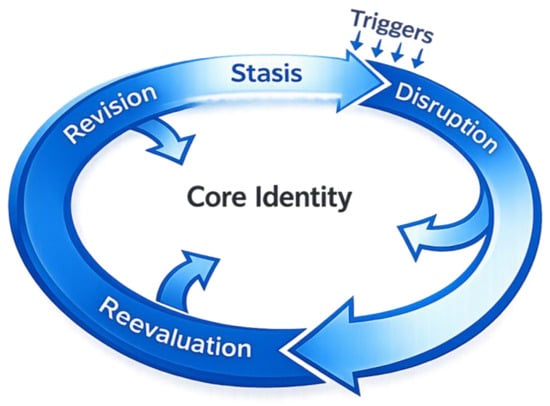
Although identity development is often framed as a task of adolescence, identity continues to evolve across the life course. Midlife, in particular, involves significant role change, reflection, and meaning-making, yet women’s midlife identity development within religious contexts remains understudied. Using life course and narrative identity frameworks, this qualitative study examined how women navigate identity shifts during midlife within a family-centered faith context. In-depth semi-structured interviews were conducted with 30 women aged 38–69 who identified as practicing members of The Church of Jesus Christ of Latter-day Saints in six countries. A grounded theory analysis revealed three interrelated processes, identity disruption, re-evaluation, and revision, while anchoring identity in core sources of meaning. Faith and purpose provided continuity across transitions, supporting coherence, resilience, and growth. These findings challenge deficit-based models and position midlife as a generative period of ongoing identity development.
Full article
(This article belongs to the Special Issue Narratives of Impact: The Influence of Family Stories on Personal Meaning)
►
Show Figures
Open AccessArticle
The Shona Perceptions on Deoxyribonucleic Acid (DNA) Tests and Implications on Gender Relations, Parenthood and Identity in Zimbabwe
by
Beatrice Taringa
Genealogy 2026, 10(2), 53; https://doi.org/10.3390/genealogy10020053 - 29 Apr 2026
Abstract
Africa is historically celebrated as the cradle of humankind. However, there is doubt on whether she is maintaining her own originality and position as the motherland and fatherland of all humanity. Although globalisation has impacted all continents and states, its negative effects seem
[...] Read more.
Africa is historically celebrated as the cradle of humankind. However, there is doubt on whether she is maintaining her own originality and position as the motherland and fatherland of all humanity. Although globalisation has impacted all continents and states, its negative effects seem to be skewing towards African and in particular Zimbabwean Shona families. This paper examines how DNA testing has impacted on some of the Shona families in Zimbabwe. The Shona community in Zimbabwe is culturally porous and receptive in terms of traditional, religious, linguistic and cultural values. They embraced Western democracy that is premised on human rights principles, constitutionalism, and citizenship, which, however, do not guarantee their belongingness. As some of the Shona families in Zimbabwe drifted away from the traditional cultural belief system campus, they got into a foreign and alien worldview that is dictated by the host in the name of technology. This has led to excessive reliance on foreign systems that are appearing like global standards yet they are disempowering them and causing them emotional and social distress. The reliance is a result of neocolonialism, linguistic and cultural imperialism that needs decolonisation. Thus, the paper adopts a qualitative approach based on an illuminating multiple case study design of six purposively selected scenarios aired on the The Closure DNA Show programme broadcasted on Zimbabwe Television (ZTV). The Afrocentric paradigm serves as a lens to uncover some of the perceptions of Shona families in Zimbabwe on DNA testing and its implications on parenthood, the family unit, and identity. The findings reveal that DNA testing is perceived as gender divisive and a destroyer of the family unit and exposing children to vulnerability, while it is also perceived positively as a way of (dis)affirming identity, which is crucial among the Shona. The paper recommends that other television programmes be screened based on their implications on gender relations, the family unit and identity.
Full article
(This article belongs to the Section Genealogical Communities: Community History, Myths, Cultures)
Open AccessArticle
Theological Reflections and Dialogues in South Africa: God, Ancestors, and the Supernatural Powers
by
Hundzukani P. Khosa
Genealogy 2026, 10(2), 52; https://doi.org/10.3390/genealogy10020052 - 29 Apr 2026
Abstract
With a focus on how both traditions influence identity, memory, and lived spirituality in African contexts, this article examines the theological and cultural interactions between Christianity and African Traditional Religion (ATR). This study highlights the ongoing interaction between ATR and Christianity as two
[...] Read more.
With a focus on how both traditions influence identity, memory, and lived spirituality in African contexts, this article examines the theological and cultural interactions between Christianity and African Traditional Religion (ATR). This study highlights the ongoing interaction between ATR and Christianity as two significant systems ingrained in African life, notwithstanding the continent’s religious diversity. In Africa, religion and culture are inextricably linked, influencing social customs, moral standards, and a sense of community but also constantly changing due to personal experience. African spiritual systems were frequently disregarded by missionary Christianity in the past, which led to conflicts that still exist in modern African Christianity. The importance of ancestors, rituals, and supernatural beliefs all of which are still fundamental to the worldviews of many African Christians are areas where these conflicts are especially noticeable. This article makes the case for a positive theological approach that acknowledges ATR as an essential tool for African Christian identity rather than as a rival or subpar system, drawing on the idea of inculturation. The article illustrates how African spirituality serves as a storehouse of collective memory and identity over generations by delving into issues of ancestry, ritual, and spiritual mediation. Additionally, it offers a liberative and dialogical theological concept that promotes understanding between Christianity and ATR. Such an approach not only bridges spiritual divides but also contributes to the development of a contextually grounded liberation theology that affirms indigenous knowledge systems while remaining open to global theological discourse.
Full article
Open AccessArticle
Life Expectancy and Survival Patterns in a Multigenerational Romanian Family (1900–2024): A Descriptive Study Based on Synthetic Cohort Life Tables
by
Madalina Iordache, Ioana Chelu, Daniel Dicu and Ioan Gaica
Genealogy 2026, 10(2), 51; https://doi.org/10.3390/genealogy10020051 - 25 Apr 2026
Abstract
►▼
Show Figures
This study aimed to estimate life expectancy at birth and survival patterns within a multigenerational family from Romania (102 individuals), whose members lived across the period 1900–2024. Life expectancy was estimated using abridged synthetic cohort life tables, and the results were interpreted through
[...] Read more.
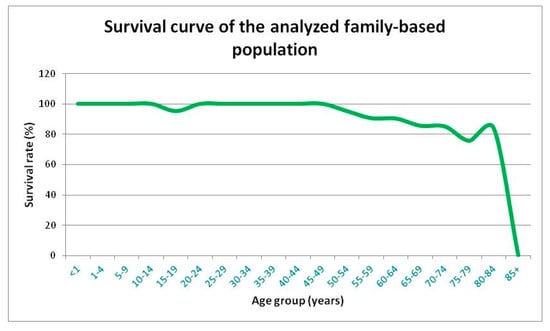
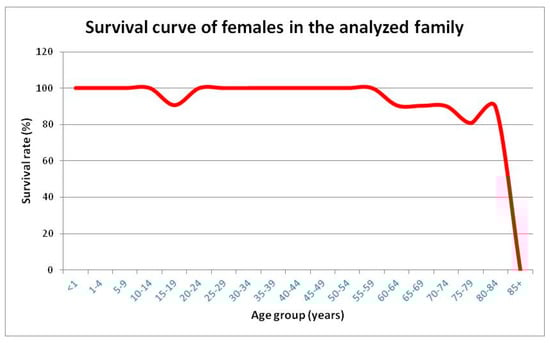
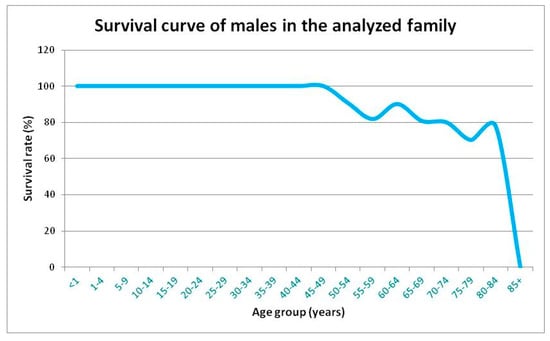
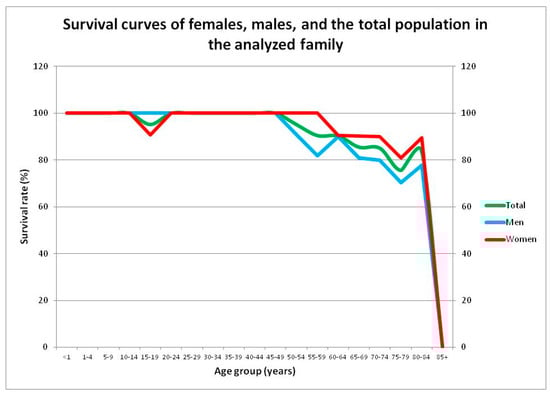
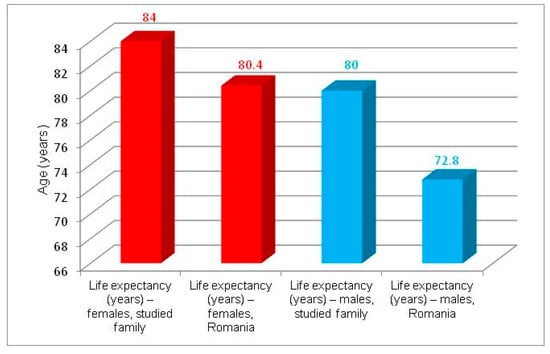
This study aimed to estimate life expectancy at birth and survival patterns within a multigenerational family from Romania (102 individuals), whose members lived across the period 1900–2024. Life expectancy was estimated using abridged synthetic cohort life tables, and the results were interpreted through survival curve analysis. Life expectancy at birth was estimated at approximately 84 years for females and 80 years for males, while the overall life expectancy for the total family population was 81 years, representing a weighted estimate derived from sex-specific life tables, with weights corresponding to the proportion of females and males in the studied population, rather than a simple arithmetic mean, following standard demographic practice. The resulting survival curves exhibited a clear Type I survival pattern, characterized by low mortality at younger ages and an increasing concentration of deaths at older ages. When contextualized using recent Eurostat data, the life expectancy estimated for the analyzed family exceeds current national-level values reported for Romania and is close to the European Union average, particularly for females. These findings indicate a favorable survival profile at the familial level and illustrate the usefulness of life tables for investigating longevity patterns in small populations.
Full article

Figure 1
Open AccessArticle
Racialized Surveillance and Voting: Connecting Government Monitoring to American Muslim Electoral Participation
by
Aaron Rosenthal and Saher Selod
Genealogy 2026, 10(2), 50; https://doi.org/10.3390/genealogy10020050 - 24 Apr 2026
Abstract
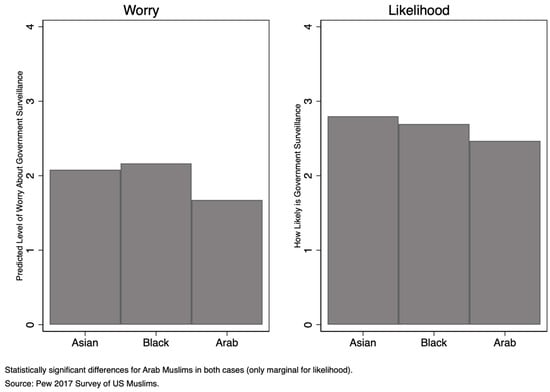
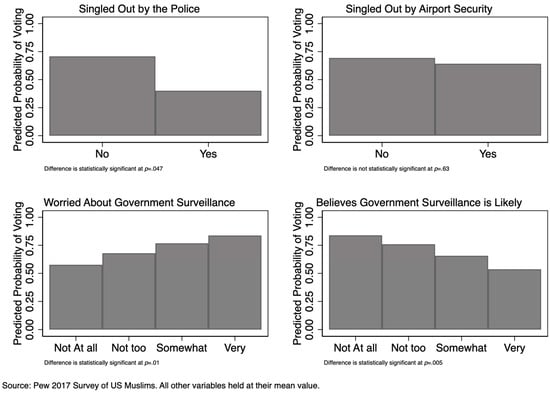
Objectives: Government surveillance of American Muslims has grown following 9/11, yet little scholarship has analyzed how this activity impacts political participation. We examine racial and ethnic variation in American Muslims’ experiences of state surveillance, as well as the connection between those experiences
[...] Read more.
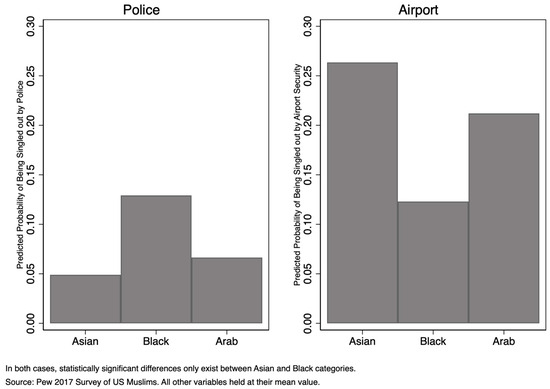
Objectives: Government surveillance of American Muslims has grown following 9/11, yet little scholarship has analyzed how this activity impacts political participation. We examine racial and ethnic variation in American Muslims’ experiences of state surveillance, as well as the connection between those experiences and voter turnout. Methods: Using a survey of 1000 American Muslims, we identify racial and ethnic patterns in being singled out in airports and by the police. We then analyze how being stopped in these venues shaped turnout behavior in the 2016 presidential election. Results: Black Muslims are more likely to encounter surveillance from the police, while Muslims who identify as Asian report the highest degree of monitoring in airports. We find that police encounters are linked to decreased electoral participation, but being singled out by airport security is not tied to a change in turnout. Conclusions: These findings provide a more detailed and comprehensive understanding of who is impacted by surveillance in the US and how that surveillance shapes American democracy.
Full article
(This article belongs to the Special Issue Global Racialization, Class and the Politics of Nation: Tensions and Articulations in the Twenty-First Century)
►▼
Show Figures

Figure 1
Open AccessArticle
The Colonial Present: How Transnational Genealogies Shape Migration, Space, and Identity Today
by
Nomatter Sande
Genealogy 2026, 10(2), 49; https://doi.org/10.3390/genealogy10020049 - 21 Apr 2026
Abstract
There is a correlation between colonial histories and contemporary migration practices, and this paper examines these transnational enduring connections. Using a qualitative thematic synthesis of existing interdisciplinary sources, this paper argues that the politics of space, migration, and identity in the present cannot
[...] Read more.
There is a correlation between colonial histories and contemporary migration practices, and this paper examines these transnational enduring connections. Using a qualitative thematic synthesis of existing interdisciplinary sources, this paper argues that the politics of space, migration, and identity in the present cannot be fully comprehended without tracing their colonial genealogies. The findings demonstrate that colonial migrations in all forms (forced, enslaved, or settled) formed transnational genealogies that determine who moves, who is stopped, who belongs, and who is an outsider. The paper concludes that understanding current migration politics, spatial inequalities, and identities requires an appreciation of transnational genealogies that connect the past to the present. The paper suggests that colonial history is more than a background but a framework that sets the conditions within which migration occurs today. This paper contributes to showing that family functions as a neglected site where genealogies are transmitted and contested across generations.
Full article
(This article belongs to the Special Issue Transnational Genealogies: The Politics of Space, Migration, and Identity in Colonial and Postcolonial Contexts)
Open AccessArticle
“That Sense of Belonging … That Comes from Within”: Beyond Legal Permanence: Aboriginal Understandings of Cultural Connection, Belonging and Child Wellbeing, and Cultural Adaptation in Child Welfare Reform
by
Wendy Hermeston
Genealogy 2026, 10(2), 48; https://doi.org/10.3390/genealogy10020048 - 21 Apr 2026
Abstract
Permanency planning, an approach to the placement of children in out-of-home care, is central to child and family system practice, policy and law. Using the example of legislative reforms in New South Wales (NSW), Australia, this article explores how privileging legal permanence leads
[...] Read more.
Permanency planning, an approach to the placement of children in out-of-home care, is central to child and family system practice, policy and law. Using the example of legislative reforms in New South Wales (NSW), Australia, this article explores how privileging legal permanence leads to ongoing failures to account for Aboriginal worldviews and child-rearing practices. Drawing on qualitative research, including Yarning Circles and semi-structured interviews that I conducted with Aboriginal community members in NSW, the findings contribute to limited evidence on permanence from Indigenous perspectives, revealing how familial and cultural connectedness shape belonging and social and emotional wellbeing and highlighting the importance of children’s ongoing connections with extended Aboriginal family, community and culture. Aboriginal understandings of permanence align more closely with cultural, relational and physical domains than with the construct of legal permanence that predominates in permanency planning approaches. Prioritizing legally permanent care arrangements above other domains poses long-term risks to Aboriginal children’s social and emotional wellbeing, demonstrating the need for “deep-level” cultural adaptation in child welfare law, policy and practice. The findings have implications for decolonizing child protection and repositioning Aboriginal conceptualizations of permanence as the foundation for legislation, policy and practice—reforms that must be Indigenous-led, culturally grounded from the outset, and anchored in full implementation of principles embedding self-determination and Indigenous children’s fundamental rights.
Full article
(This article belongs to the Special Issue The Impact of Social Connectedness and Cultural Adaptation on Mental Health)
Open AccessArticle
Names as Archives: A Comparative Analysis of Lineage and Settlement Histories Through Dàgáárè and Yorùbá Anthroponymy
by
Ănúolúwapọ̀ Adéwùnmí Adétọ̀míwá, Elvis Banoeye Batung and Hasiyatu Abubakari
Genealogy 2026, 10(2), 47; https://doi.org/10.3390/genealogy10020047 - 16 Apr 2026
Abstract
This study investigates the role of naming practices as cultural repositories that preserve family, lineage, and community identity. It explores how anthroponymy encodes histories of ancestry, migration, settlement, and sociopolitical organisation in two West African societies, Dàgáárè-speaking communities and Yorùbá communities. Adopting a
[...] Read more.
This study investigates the role of naming practices as cultural repositories that preserve family, lineage, and community identity. It explores how anthroponymy encodes histories of ancestry, migration, settlement, and sociopolitical organisation in two West African societies, Dàgáárè-speaking communities and Yorùbá communities. Adopting a comparative onomastic ethnographic approach, this research analyses names among the two selected cultures. Data is drawn from interviews, school registers, attendance sheets, and cultural practices, with emphasis on how names record genealogical descent, settlement histories, occupational roles, spiritual affiliations, and ethical expectations. In Dàgáárè and Yorùbá culture, bal/baloo yoe (clan names) and lineage names identify descent from founding ancestors, document migration and settlement, mark ritual responsibilities, memorialise historical events, and regulate kinship and marriage through totemic and spiritual identities. This study argues that names in Dàgáárè- and Yorùbá-speaking societies operate as cultural texts that preserve and transmit heritage across generations. The significant implications extend to linguistics, anthropology, and heritage studies, where names can be leveraged as tools for cultural preservation and historical analysis.
Full article
(This article belongs to the Special Issue Names as Heritage: Tracing Family and Community Identity Through Naming)
Open AccessArticle
Towards Solidarity with Abya Yala: African Feminist Perspectives on Body–Land as Praxis
by
Ruth Ratidzai Murambadoro and Carol Lynne D’Arcangelis
Genealogy 2026, 10(2), 46; https://doi.org/10.3390/genealogy10020046 - 15 Apr 2026
Abstract
This article juxtaposes the Indigenous communitarian feminist concept cuerpo-territorio and the African proverb musha mukadzi drawing on ethnographic research with Zimbabwean women activists in the context of land reform, thereby expanding the scope of both concepts. Our entry point is Zimbabwean women’s struggles
[...] Read more.
This article juxtaposes the Indigenous communitarian feminist concept cuerpo-territorio and the African proverb musha mukadzi drawing on ethnographic research with Zimbabwean women activists in the context of land reform, thereby expanding the scope of both concepts. Our entry point is Zimbabwean women’s struggles for land in the Third Chimurenga, or post-2000 Fast-Track Land Reform Programme. Despite egalitarian promises, land redistribution efforts have favored political elites and men, reinforcing colonial capitalist practices of extraction and accumulation. Our comparative exercise reveals musha mukadzi as a political discourse that enables Indigenous women to reclaim their body–land relationship through struggles for land reform and beyond. In the process, we identify four key resonances between musha mukadzi and cuerpo-territorio, namely, an ontological similarity expressed through Indigenous women’s commitments to and responsibilities for re/generating the network of life; a common appeal to ancestral (feminist) wisdom to enhance ongoing struggle; the political mobilization of the concepts by Indigenous women to seek liberation from patriarchal, neo/colonial oppression; and, their conceptual utility as feminist analytics. Finally, we lay the foundation for further work on the possibilities of transnational feminist solidarity between Indigenous women in Africa and Abya Yala.
Full article
(This article belongs to the Special Issue Body–Land Relationships)
Open AccessArticle
Race, Class, Gender, and Language in Bulawayo’s We Need New Names
by
Khalid Ahmed, Hassan Mahmood, Sardaraz Khan and Aasia Nusrat
Genealogy 2026, 10(2), 45; https://doi.org/10.3390/genealogy10020045 - 14 Apr 2026
Abstract
This study analyses NoViolet Bulawayo’s We Need New Names through the framework of intersectional feminism, a concept introduced by Kimberlé Crenshaw that examines how multiple identities, such as race, gender, and class, intersect to shape distinct experiences of marginalization. Bulawayo’s narrative, centred on
[...] Read more.
This study analyses NoViolet Bulawayo’s We Need New Names through the framework of intersectional feminism, a concept introduced by Kimberlé Crenshaw that examines how multiple identities, such as race, gender, and class, intersect to shape distinct experiences of marginalization. Bulawayo’s narrative, centred on the protagonist Darling, reveals the complex social forces she encounters as she navigates cultural and geographic transitions. Through a blend of English and Shona, the text reflects cultural duality and the tensions of migration, including acculturation and displacement. The episodic structure mirrors the fragmentation inherent in Darling’s African upbringing and her transcontinental journey. The analysis situates the novel alongside contemporary works such as Chimamanda Ngozi Adichie’s Americanah and Yaa Gyasi’s Homegoing, highlighting shared thematic concerns with identity, oppression, and the migrant experience. Ultimately, the study argues that Bulawayo’s representation of intersecting identities enriches the novel’s engagement with gender, race, class, and the transformative potential of language in articulating minority experiences.
Full article
(This article belongs to the Special Issue Transnational Genealogies: The Politics of Space, Migration, and Identity in Colonial and Postcolonial Contexts)
Open AccessEssay
Towards a List of Clans and Families in Scotland—Identity Politics, Cultural Appropriation and Romantic Idealism
by
Bruce Durie
Genealogy 2026, 10(2), 44; https://doi.org/10.3390/genealogy10020044 - 14 Apr 2026
Abstract
►▼
Show Figures
The question of which Scottish surnames constitute a Clan and which do not is hotly contested. It is wrongly felt, especially in the Scots-abroad communities, that Clan is somehow of higher status than “Family” or “House” and/or applies to everyone of Scottish heritage.
[...] Read more.
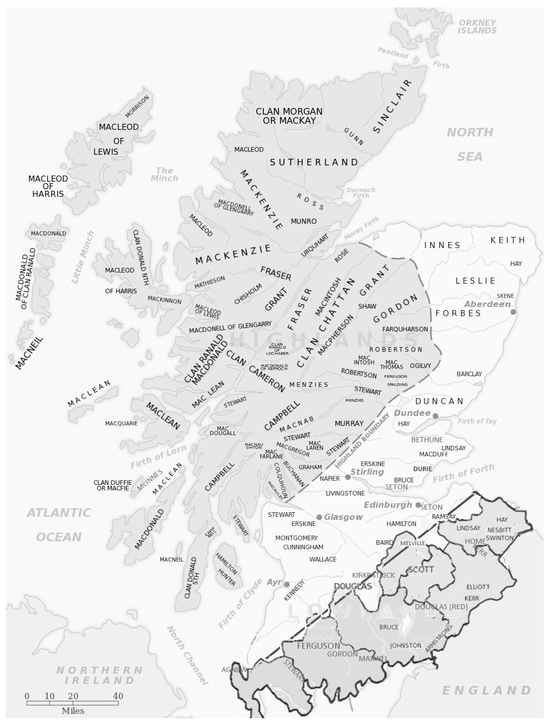
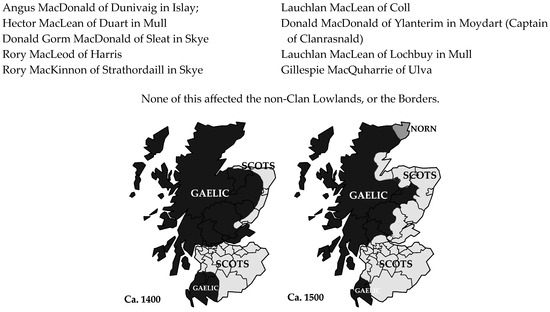
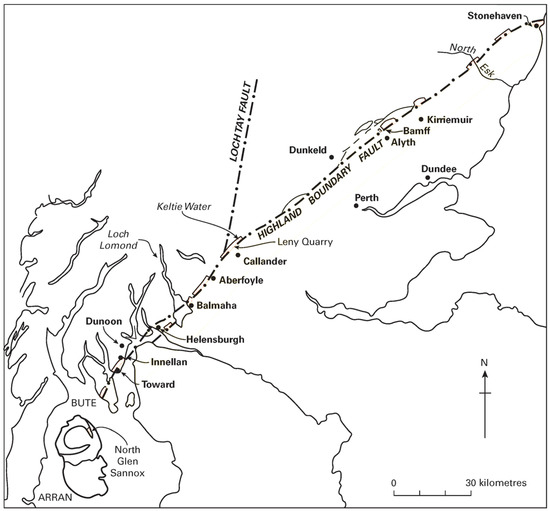
The question of which Scottish surnames constitute a Clan and which do not is hotly contested. It is wrongly felt, especially in the Scots-abroad communities, that Clan is somehow of higher status than “Family” or “House” and/or applies to everyone of Scottish heritage. Opinions and assertions are on a spectrum between two absolutes: (a) “everyone in Scotland is in a Clan, and everyone should wear kilts and tartans”; to (b) “Clans disappeared in the 18th century and there is no point clinging to a Romantic notion with no modern relevance”. Historically, the Clan is a phenomenon of the Gaelic-speaking Highlands and Islands and was not found as a social structure in the Lowlands; the Southern Uplands (Scottish Borders) are a special case. The “everyone” persuasion leads to cultural nonsenses such as Lowland-ancestry Scots abroad forming “Clan” Societies and adopting Highland dress. Scots overseas are looking for an authoritative statement as to whether their surname constitutes a Clan, a family, or some other nomenclature. Yet, there is no official or agreed historically based list of who are Clans and who are not. There is no such list—or a formula by which an answer can be derived. This essay is intended as a step towards that. Also, the non-historical concept of “Septs” is dismissed.
Full article

Figure 1
Open AccessArticle
In the Space Between Words: Speech–Silence Dynamics, Religio–Racial Formations, and Christian–Muslim Relationships in The Netherlands
by
Deniz Aktaş
Genealogy 2026, 10(2), 43; https://doi.org/10.3390/genealogy10020043 - 10 Apr 2026
Abstract
In Western Europe, and particularly in The Netherlands, speech is rarely neutral: to talk is to participate morally and civically, while silence is frequently marked as evasive, passive, or suspect. The capacities for speech, for being heard, understood, and responsive, are widely regarded
[...] Read more.
In Western Europe, and particularly in The Netherlands, speech is rarely neutral: to talk is to participate morally and civically, while silence is frequently marked as evasive, passive, or suspect. The capacities for speech, for being heard, understood, and responsive, are widely regarded as hallmarks of autonomous, transparent, free-thinking, and sovereign subjectivity, celebrated as expressions of a shared progressive modernity. These ideals of subjectivity are routinely placed in tension within the so-called secular–religious binary framework, in which the compatibility of non-secular sensibilities or non-Christian religions, especially Islam, with such Dutch societal values is persistently and heavily problematized. Within such accounts, speech becomes a criterion Muslims in Europe are then expected to meet, not merely by speaking but by doing so in ways deemed proper and intelligible. To complicate and deepen understanding of these dynamics, this article draws on ethnographic insights from (secular) Christian–Muslim couples in The Netherlands, looking at how the dynamics of speech–silence function within intimate contexts, where they take place, where they break down, and ultimately where their limits lie. Attuned to the cacophony of multivocal gestures, whether in acts of refusal, the quiet eloquence of silence, or the directness of vocal protest, the article reveals the intricate and consequential interplay between these dynamics and the structuring and affective forms of secular and religio-racial norms in everyday life.
Full article
(This article belongs to the Special Issue Secularism, Multiculturalism and Race–Religion Entanglements)
Open AccessArticle
Empire, Race, and Gender: The Ancient Origins of White Supremacy and Patriarchy
by
Bernd Reiter
Genealogy 2026, 10(2), 42; https://doi.org/10.3390/genealogy10020042 - 2 Apr 2026
Abstract
►▼
Show Figures
This article argues that racism did not originate with the modern invention of race but crystallized out of a much older imperial grammar that had already learned how to naturalize domination through embodied difference. Long before race emerged as a named category, ancient
[...] Read more.
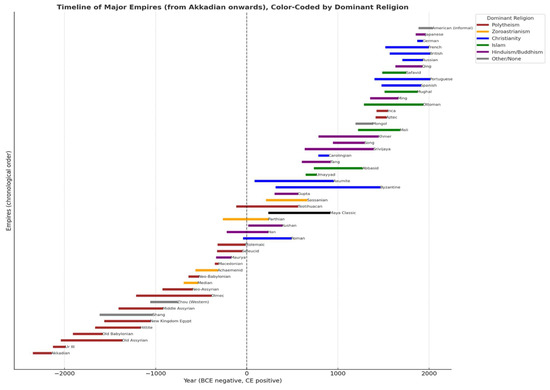
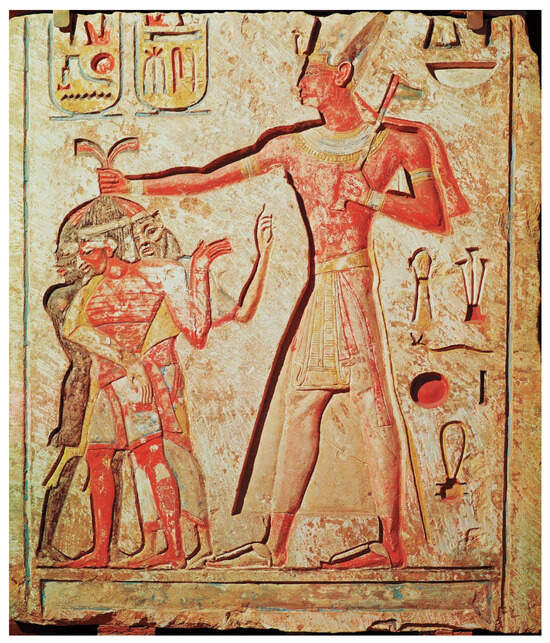
This article argues that racism did not originate with the modern invention of race but crystallized out of a much older imperial grammar that had already learned how to naturalize domination through embodied difference. Long before race emerged as a named category, ancient and medieval empires developed durable ways of converting historically produced hierarchies into features of nature, the cosmos, and divine order. Through a comparative genealogy spanning early Mesopotamian epic, Near Eastern imperial inscriptions, Egyptian visual regimes, Greek philosophy and historiography, biblical scripture, South Asian metaphysics, late antique encyclopedism, and medieval Marian devotion, the article shows how inequality was repeatedly anchored in the body, in genealogy, in geography, and in moral psychology. Across these traditions, political authority is consistently masculinized, while subordination is feminized, animalized, or rendered reproductively vulnerable. Patriarchy and racialization thus emerge as co-constitutive imperial technologies rather than as separate or sequential phenomena. Modern racism did not invent hierarchy; it rendered an ancient logic portable, inheritable, and globally scalable by fastening domination to visible human difference. By situating race within a longue durée history of empire and male domination, the article reframes contemporary debates on racism as questions of imperial continuity rather than modern deviation.
Full article

Figure 1
Open AccessArticle
A Systematic Review of the Political, Social, and Cultural Legacies of the 1923 Greek–Turkish Population Exchange
by
Husniye Merve Bingol Turkan
Genealogy 2026, 10(2), 41; https://doi.org/10.3390/genealogy10020041 - 29 Mar 2026
Abstract
The 1923 Greek–Turkish Population Exchange (Mubadele in Turkish), formalized through the Lausanne Convention, remains one of the most consequential cases of compulsory migration in modern history. This systematic review synthesizes a century of scholarship across political, legal, social, cultural, and historiographical dimensions. Findings
[...] Read more.
The 1923 Greek–Turkish Population Exchange (Mubadele in Turkish), formalized through the Lausanne Convention, remains one of the most consequential cases of compulsory migration in modern history. This systematic review synthesizes a century of scholarship across political, legal, social, cultural, and historiographical dimensions. Findings indicate that the exchange not only legitimized forced displacement under international law but also reinforced authoritarian state-building in Turkey and exacerbated political instability in Greece. The social consequences included trauma, marginalization, and the emergence of heterogeneous refugee identities, while cultural memory oscillated between nationalist silencing and transnational remembrance. Urban landscapes and demographic structures were profoundly reshaped, producing visible legacies in contemporary cities. Furthermore, assimilation policies formalized the integration of populations, influencing the development of national identities in both Turkey and Greece. Historiographical trajectories diverged, with Greek scholarship emphasizing refugee struggles and Turkish scholarship foregrounding nation-building. Recent studies highlight hybrid identities and transgenerational redefinitions of belonging. This review underscores the necessity of integrating political, social, and memory studies to capture the multi-layered impacts of the exchange, offering a comprehensive account of its enduring relevance for migration, nationalism, and memory studies in Southeast Europe.
Full article
Open AccessArticle
Genealogy-as-Pedagogy for Afro-Descendant Communities in Costa Rica, Panama, and Belize
by
Dianala M. Bernard
Genealogy 2026, 10(2), 40; https://doi.org/10.3390/genealogy10020040 - 27 Mar 2026
Abstract
Intergenerational memories, migration histories, and the lasting influence of colonial linguistic systems profoundly shape heritage language maintenance in Afro-descendant communities of Central America. This study examines how genealogy functions as a pedagogical tool for sustaining English-based Creole languages among Afro-descendant populations in Costa
[...] Read more.
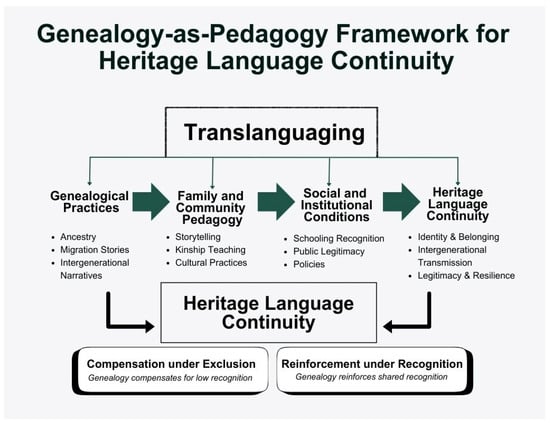
Intergenerational memories, migration histories, and the lasting influence of colonial linguistic systems profoundly shape heritage language maintenance in Afro-descendant communities of Central America. This study examines how genealogy functions as a pedagogical tool for sustaining English-based Creole languages among Afro-descendant populations in Costa Rica, Panama, and Belize, three nations linked by Afro-Caribbean migration yet shaped by distinct colonial and educational systems. Drawing on scholarship documenting oral histories, family narratives, and community-based linguistic practices, the study advances a genealogy-as-pedagogy framework to explain how families transmit language, identity, and belonging across generations through ancestral memory, positioning family-based knowledge transmission as curriculum. In Costa Rica and Panama, where Spanish colonial and post-independence language ideologies marginalize English-based Creole varieties, genealogical practices operate as primary mechanisms of linguistic continuity in the absence of sustained institutional support. In Belize, by contrast, British colonial legacies and the national recognition of Belizean Kriol create a distinct sociolinguistic environment in which state institutions, the media, and educational policy reinforce genealogical memory. Through comparative analysis, the study argues for integrating genealogical knowledge into multilingual education, community revitalization initiatives, and heritage language policy to strengthen Afro-descendant linguistic continuity in Costa Rica, Panama, and Belize.
Full article
(This article belongs to the Special Issue Language, Education, and Genealogy: Heritage Language Maintenance in Families, Communities, and Schools)
►▼
Show Figures

Figure 1
Open AccessEditorial
Introduction to “Identity in Flux: Intercultural Conflict and the Dynamics of Belonging”
by
Nikos Gogonas and Christina Maligkoudi
Genealogy 2026, 10(2), 39; https://doi.org/10.3390/genealogy10020039 - 27 Mar 2026
Abstract
Intercultural conflict is expressed as struggle due to a perceived incompatibility of values, norms, face orientations, goals, scarce resources, processes, and/or outcomes between at least two parties from different cultural communities in an interactive situation (Ting-Toomey and Oetzel 2001) [...]
Full article
(This article belongs to the Special Issue Identity in Flux: Intercultural Conflict and the Dynamics of Belonging)
Open AccessEditorial
Indigenous Self-Determination in Child and Family Systems: Reclaiming Law, Restoring Relationships, Reimagining Futures
by
Terri Libesman, Paul Gray, Wendy Hermeston and Kirsten Gray
Genealogy 2026, 10(2), 38; https://doi.org/10.3390/genealogy10020038 - 25 Mar 2026
Abstract
Across occupied Indigenous nations, child protection systems remain one of the most enduring sites of colonial power [...]
Full article
(This article belongs to the Special Issue Self Determination in First Peoples Child Protection)
Open AccessArticle
A Critical Evaluation of the Impact of “After Tears” Parties on the Funeral Traditions of the Vatsonga in Limpopo—A South African Traditional Perspective
by
Magezi Elijah Baloyi
Genealogy 2026, 10(2), 37; https://doi.org/10.3390/genealogy10020037 - 24 Mar 2026
Abstract
Death is a universal phenomenon, defined by the rituals associated with it and conducted within the confines of the culture to which the deceased belonged; thus, it is nearly impossible to universalise a particular mourning pattern, as African people display considerable diversity. The
[...] Read more.
Death is a universal phenomenon, defined by the rituals associated with it and conducted within the confines of the culture to which the deceased belonged; thus, it is nearly impossible to universalise a particular mourning pattern, as African people display considerable diversity. The complexities introduced into African mourning by colonialism and other developmental changes, such as urbanisation and the recent COVID-19 pandemic, have relegated many African traditions in relation to bereavement to the periphery. A newer and controversial practice associated with funerals conducted among black communities in South Africa is that of the “after tears” party. Although this practice has not yet infiltrated the rural areas, it is nevertheless a phenomenon that is worth investigating, seeing that those who participate in this practice are predominantly from townships in Gauteng, and such events are gradually occurring in the rural villages as well.
Full article
(This article belongs to the Special Issue Transnational Genealogies: The Politics of Space, Migration, and Identity in Colonial and Postcolonial Contexts)
Open AccessArticle
Tribal Settlement Along the Frontiers: Space, Sovereignty, and Identity in Çıldır and Ardahan (18th and 19th Centuries)
by
Mehmet Nuri Şanda and Doğan Gün
Genealogy 2026, 10(1), 36; https://doi.org/10.3390/genealogy10010036 - 20 Mar 2026
Abstract
Located in northeastern Anatolia, Çıldır and Ardahan serve as a gateway to the Caucasus for political entities such as the state and mobile groups such as the tribe. Due to this geopolitical characteristic, the region has fallen under the dominion of numerous states
[...] Read more.
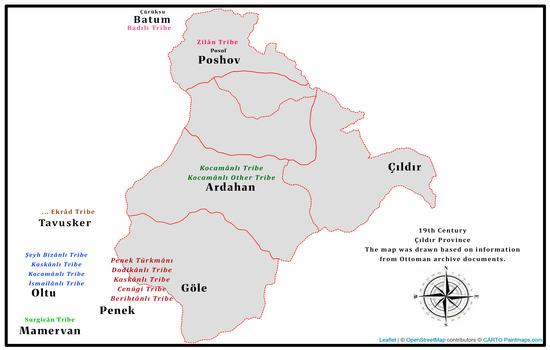
Located in northeastern Anatolia, Çıldır and Ardahan serve as a gateway to the Caucasus for political entities such as the state and mobile groups such as the tribe. Due to this geopolitical characteristic, the region has fallen under the dominion of numerous states and civilizations throughout history. With its fertile highlands, Lake Çıldır, and natural water resources like the Kura River, the area constitutes an attractive living space for hem settled agriculturalists and nomadic tribe groups subsisting on animal husbandry. These features have profoundly influenced the ethnic, demographic, socio-economic, and cultural fabric of the region. Following the establishment of Ottoman sovereignty in the 16th century, Çıldır and Ardahan assumed a vital role in the state’s Caucasian and Eastern policies. This research addresses the Turkmen tribe and other ethnic communities residing around the eyalet of Çıldır and the sanjak of Ardahan. It further examines the banditry activities carried out by these groups, the attitudes of central and local administrators toward such activities, migration and settlement patterns, and the economic and political pressures exerted by the Russian State upon these tribes. The political and economic pressures exerted by the Russian State on these tribes reflect a broader imperial strategy of frontier making, as discussed by Khodarkovsky in the context of Russia’s expansion into its southern borderlands. By positioning the region as a negotiated frontier, this study moves beyond a descriptive narrative to analyze how tribal mobility and settlement functioned as tools of sovereignty and resistance within the broader context of Ottoman state formation and trans-imperial rivalry. The methodology employed in this study is the Qualitative Research Method; accordingly, documents from the Presidential Ottoman Archives (BOA) were transcribed, and the relevant sections were interpreted and incorporated into the study. The archival findings are contextualized within recent historiographical debates concerning the shifting definition of the state versus nomadic agency during the transition from the 18th to the 19th century. While existing literature contains academic studies aiming to elucidate the archaeological, geographical, economic, and administrative structures of Çıldır and Ardahan, it has been determined that no academic research has been conducted to analyze the ethno-socio-demographic structure of the region specifically focusing on the 18th and 19th centuries in a historical sense. With this focus on the interplay between imperial frontiers and tribal identity, this study provides a critical analysis of how local dynamics shaped the grand strategies of the Ottoman and Russian Empires.
Full article
(This article belongs to the Special Issue Transnational Genealogies: The Politics of Space, Migration, and Identity in Colonial and Postcolonial Contexts)
►▼
Show Figures

Figure 1
Open AccessArticle
Navigating Everyday Racism in Norway: Young Women of Colour Performing Anti-Racism
by
Tiara Fernanda Aros Olmedo and Hilde Danielsen
Genealogy 2026, 10(1), 35; https://doi.org/10.3390/genealogy10010035 - 18 Mar 2026
Abstract
This article explores how young women of colour in Norway navigate everyday racism and how such negotiations are shaped by the tension between speaking out or maintaining social harmony in a society that largely perceives itself as egalitarian and non-racist. The study draws
[...] Read more.
This article explores how young women of colour in Norway navigate everyday racism and how such negotiations are shaped by the tension between speaking out or maintaining social harmony in a society that largely perceives itself as egalitarian and non-racist. The study draws on qualitative interviews with 13 participants from diverse ethnic backgrounds—some were adopted, and others were children of immigrant parents or immigrants themselves. The analysis examines how anti-racism strategies are shaped by drawing on feminist and postcolonial theory, particularly the concept of the feminist killjoy. The notion of Orientalism, and the notion of cultural repertoires. The findings show that participants demonstrated different reactions from silence to confrontation, all demanding emotional labour. Several participants described the burden of having to choose between remaining polite and educating others, while others chose silence as a protective strategy. Rather than viewing resistance as a binary between silence and confrontation, this study demonstrates that everyday anti-racism is a fluid and context-dependent practice. How women performed anti-racism was also closely linked to their social position, social support, cultural norms, and access to political perspectives. The stories show that, over time, some women became more outspoken or secure in their interpretations of racist encounters, especially when gaining distance from constraining environments.
Full article
(This article belongs to the Special Issue Towards a Genealogy of the Idea of “Race” and the Ideology of “Racism”)
Highly Accessed Articles
Latest Books
E-Mail Alert
News
Topics
Topic in
Arts, Genealogy, Histories, Philosophies, Religions
Reimagining Totemism: Mystical Experience, Life Values, and Contemporary Art Practices
Topic Editors: Zhilong Yan, Lidija Stojanović, Aixin ZhangDeadline: 31 October 2026
Topic in
Dietetics, Genealogy, Nutrients
Ancestry, Nutrition, and Health: From Ancestral Diets to Modern Nutritional Science
Topic Editors: Naim Akhtar Khan, Athena LeoussiDeadline: 15 January 2027
Topic in
Histories, Humanities, Humans, Religions, Genealogy
Mysticism and Spiritual Syncretism in Ancestral Andean Cultures
Topic Editors: Edgar Gutiérrez-Gómez, Aldo Bazán-RamírezDeadline: 1 June 2027
Topic in
Healthcare, Social Sciences, Societies, Merits, Genealogy
Community-Driven Health: Advancing Indigenous Well-Being and Workforce
Topic Editors: Donna-Marie Palakiko, Morgan A. Torris-HedlundDeadline: 31 December 2027
Special Issues
Special Issue in
Genealogy
Across Bodies and Roles: Indigenous Identity, Gender, Sexuality, and Resistance to Colonial Power
Guest Editors: Corrinne Sullivan, Kim SpurwayDeadline: 30 May 2026
Special Issue in
Genealogy
Genealogy and Modernity: Familial, Ethnic, and National Ties
Guest Editor: Athena LeoussiDeadline: 31 May 2026
Special Issue in
Genealogy
Journeyalogy: Other-stories and counter-mappings of migration
Guest Editors: Lina Fadel, Esa AldegheriDeadline: 31 May 2026
Special Issue in
Genealogy
Race, Identities and Transnational Soundscapes
Guest Editors: Natasha Pravaz, Andrew SnyderDeadline: 15 June 2026