Article

“I Worked Really Hard to Know Who I Am”: A Qualitative Study of Identity Development in Latter-Day Saint Women in Midlife


School of Family Life, Brigham Young University, Provo, UT 84602, USA
*
Author to whom correspondence should be addressed.
Genealogy 2026, 10(2), 54; https://doi.org/10.3390/genealogy10020054
Submission received: 17 March 2026 / Revised: 26 April 2026 / Accepted: 27 April 2026 / Published: 30 April 2026

Abstract

Although identity development is often framed as a task of adolescence, identity continues to evolve across the life course. Midlife, in particular, involves significant role change, reflection, and meaning-making, yet women’s midlife identity development within religious contexts remains understudied. Using life course and narrative identity frameworks, this qualitative study examined how women navigate identity shifts during midlife within a family-centered faith context. In-depth semi-structured interviews were conducted with 30 women aged 38–69 who identified as practicing members of The Church of Jesus Christ of Latter-day Saints in six countries. A grounded theory analysis revealed three interrelated processes, identity disruption, re-evaluation, and revision, while anchoring identity in core sources of meaning. Faith and purpose provided continuity across transitions, supporting coherence, resilience, and growth. These findings challenge deficit-based models and position midlife as a generative period of ongoing identity development.

Identity development has long been recognized as a central task of human growth, particularly in adolescence (Erikson 1968; Kroger 2006). However, contemporary lifespan and narrative identity perspectives conceptualize identity as a dynamic, contextually embedded process in which individuals continually negotiate continuity and change through adulthood in response to life transitions, social relationships, and cultural contexts (Kroger 2006; McAdams 2001; McAdams and McLean 2013; McLean and Syed 2015; Syed and McLean 2022).
Midlife, in particular, has been identified as a period marked by new possibilities for identity growth as adults confront major life transitions, turning points, shifting roles, and redefined priorities (Lachman 2004; Whitbourne and Willis 2006). Much like adolescence, midlife is increasingly recognized as a stage marked not only by disruption but also possibility for growth. Scholars highlight parallels in identity development between adolescence and midlife that reframe midlife as a time of transformation and growth rather than merely decline or stability (Lachman 2004; Lachman et al. 2022). Historically, the study of adult development has been constructed through a male-centered conceptual lens, with theoretical frameworks reflecting masculine norms of autonomy, achievement, and individuation while marginalizing women’s relational and contextual modes of development (Gilligan 1982; Helson 1992; Josselson 1987). Additionally, research on women’s midlife often focuses on the physiological changes surrounding menopause, overlooking the psychosocial processes through which women rework identity, relationships, and purpose during this stage (Avis et al. 2005).
While acknowledging the biological dimension as an important contribution to a holistic understanding of women’s development (Sheehy 1998), this framing nonetheless tends to reinforce deficit-based narratives that devalue aging women and obscure the developmental potential inherent in midlife (Calasanti 2004; Gullette 2011). Expanding scholarship in this area challenges the deficit-based narratives that have long framed midlife as a time of loss and instead highlights the potential for growth, empowerment, and opportunities for re-evaluation (Newton and Stewart 2010; Seligman 2011). Additionally, for women in family-centered faith traditions, midlife transitions may be especially salient, as identities strongly organized around relational and caregiving roles are more vulnerable to disruption when family roles change or expectations are not met (Gilligan 1982; Helson 1992; Josselson 1987). Simultaneously, faith may serve as an anchoring dimension of identity, offering continuity and meaning that supports women’s capacity to reinterpret and reconstruct the self across transitions (McAdams 2011; Mahoney 2021).
Therefore, the purpose of this study is to amplify women’s voices using qualitative inquiry and a resilience-focused approach, examining how women narrate and navigate identity transitions in midlife. This study aims to deepen our understanding of women’s midlife identity development by centering their lived experiences and meaning-making processes. The sample consists of women situated within a religious context, offering a distinctive lens through which to examine the intersections of faith, culture, and gender in shaping midlife identity development.

1. Review of Literature

This review of the literature situates the present study within life course and narrative identity theories to examine how identity evolves beyond adolescence and across midlife. Identity is understood as an evolving sense of self that provides continuity across time by integrating personal commitments, social roles, and lived experiences (Erikson 1968; McLean and Pasupathi 2012), and is shaped through transitions, turning points, and liminal periods within gendered sociocultural contexts, particularly among women in a family-centered faith tradition.

1.1. Life Course Theory and Identity Development

Life course and identity theory have historically emphasized adolescence as the key developmental stage in which individuals explore and consolidate a sense of self (Erikson 1968). Erikson’s life course theory famously frames adolescence as a period of identity versus role confusion, where young people begin to define themselves in relation to social roles and future possibilities. Kroger and Marcia (2011) further argue that identity development, while primarily examined in adolescence and emerging adulthood, is not linear but dynamic, with individuals revisiting identity statuses as they encounter new developmental tasks and cultural shifts. Although these models have generated substantial research, they face criticism for their male-centric assumptions about developmental sequencing (Archer 1989; Gilligan 1982; Josselson 1987; Kroger 2006; Levinson 1978).

1.1.1. Resilience & Midlife Identity Development

While scholars position adolescence and emerging adulthood as the critical period for identity formation, others have drawn parallels to midlife. Midlife is generally understood as the developmental period spanning approximately ages 40 to 65, characterized not only by chronological age but also by shifting social roles, accumulated life experience, and increasing awareness of time and finitude (Lachman 2004, 2015). It is often marked by heightened self-reflection and goal re-evaluation, during which identity is actively reworked in response to changing roles, particularly in work and family contexts (Josselson 1998; Lachman 2004; Whitbourne and Willis 2006). Although many adults anticipate a midlife crisis, relatively few report experiencing one, and women are less likely to frame this stage as crisis (Wethington 2000). Instead, midlife is often characterized by resilience, stability, competence, growth, and personality development marked by increased confidence and emotional maturity (Helson and Soto 2005; Lachman 2015; Sheehy 1996; Wethington 2000). Qualitative studies of women’s midlife narratives indicate that this period can involve rediscovery, a time when they re-assess personal goals, renegotiate relationships, and cultivate new sources of meaning, with transitions serving as catalysts for self-understanding, personal growth, and the active reconstruction of identity, rather than as symptoms of decline (Apter 1995; Josselson 2017; Sheehy 2006).
Identity shifts may be triggered by life transitions or turning points that unsettle existing self-concepts or role identities requiring reorganization (Elder 1994; Elder et al. 2003), but rather than view identity revision as reactive, scholars describe it as a process that fosters resilience, wisdom, eudaimonic well-being, and a deep sense of purpose and fulfillment grounded in self-understanding and contribution (Ryff and Singer 2008; Seligman 2011). It is a time when the threads of identity may be rewoven instead of unraveled, when continuity and change coexist in a dynamic balance that reflects the complexity of personal narratives.

1.1.2. Narrative Identity

In addition to life course and identity theory perspectives, more recent identity scholarship has increasingly emphasized the narrative processes through which individuals construct and revise a sense of self. Narrative identity theory highlights how people make sense of past events, present roles, and imagined futures by weaving them into a coherent story (McAdams and McLean 2013). Central to this process is the ongoing integration of autobiographical experiences into a sense of “who I am” and “how I became this person” as individuals actively construct meaning across time (McLean and Pasupathi 2012). Themes such as redemption (a bad event turns to something good), contamination (a good event turns bad), agency (emphasis on autonomy and achievement), and communion (highlights love, belonging, connection) often structure these life stories, shaping how people interpret adversity and envision growth (McAdams 1993, 1996, 2006; McAdams and McLean 2013). Importantly, these stories are not static; they shift as individuals encounter transitions, turning points, and liminal spaces (McAdams 2011).
Transitions
Transitions refer to extended periods of change encompassing the sequential phases of moving in, moving through, and moving out, during which individuals adapt to evolving roles and contexts (Schlossberg 2011). They represent ongoing, process-oriented adaptations rather than singular events, unfolding over time as individuals renegotiate internal and external definitions of self (Lachman 2015; Schlossberg 2011). Taken together, transitions serve as key sites of narrative identity work as individuals actively reinterpret past experiences and imagine their future selves to maintain coherence and meaning across periods of change (McAdams and McLean 2013).
Turning Points
Within broader trajectories, turning points are sometimes subjectively meaningful events that are retrospectively identified as pivotal in shaping the life narrative and redefining the self (Leonard and Burns 1999, 2006). Turning points are moments when accumulated experiences and contextual changes converge to produce lasting shifts in roles or worldviews (Elder 1994). In narrative studies in which adults were asked to describe key turning points in their lives, participants frequently identified events such as career changes, relationship transitions, or experiences of loss as pivotal scenes that reshaped their sense of purpose and self-understandings (McAdams 2001). Importantly, the narrative reconstruction created from these experiences shows the ability to find meaning within the structure and path of one’s own life (Elder 1994; McAdams and McLean 2013).
Liminality
The concept of liminality originates in anthropology, most notably in van Gennep’s (1960) and Turner’s (2017) analyses of rites of passage. Liminality denotes the “betwixt and between” phase in which individuals are temporarily released from established roles and social structures, occupying a threshold position between what was and what will be (Beech 2011). Stein (1983) positions liminality as the central metaphor for midlife transformation, depicting it as an extended threshold between an old life structure and a newly emerging one. Qualitative research underscores that women in midlife often experience this phase as a liminal threshold marked by disorientation and ambiguity followed by exploration and reorientation, a process more akin to metamorphosis than crisis (Evans 2008).
Although concepts of transitions, turning points, and liminality offer important insight into midlife identity shifts, these processes are inherently embedded within sociocultural contexts (Elder 1998; Turner 2017). These experiences are shaped by culturally defined roles, gendered expectations, and institutional narratives that influence how identity disruption is experienced and resolved (Acker 1990; Beech 2011; Evans 2008). Examining midlife within specific cultural and institutional settings is essential for understanding how identity disruption and reconstruction unfold.

1.2. Women, Transitions, and Identity

Women may experience more frequent, or at least different identity shifts than men across the life course due to socially patterned role transitions and expectations that shape women’s relational, occupational, and family trajectories (Avis et al. 2005). These shifts often include surname changes, family planning decisions, evolving responsibilities related to caregiving and paid work, each of which can prompt renegotiation of identity (Barrett 2005). Across adulthood, women are also more likely to encounter identity-relevant transitions that prompt renegotiation of self-definition, often associated with physiological changes and shifting relational demands, such as the transition to the “empty nest” (Newton and Stewart 2010). Taken together, these gendered patterns of transition often position women as a particularly informative group for examining how identity is reconstructed across the life course (Thomas et al. 2018).

1.3. The Role of Faith in Women’s Midlife Identity

Within these gendered patterns of identity transition, religious and spiritual engagement may shape how women navigate midlife changes, providing interpretive frameworks through which life events are understood and integrated into a coherent sense of self (Greenfield et al. 2009; Seeman et al. 2003). From a narrative identity perspective, faith traditions offer culturally embedded storylines about purpose, sacrifice, endurance, and divine identity that can structure how women interpret disruption and reconstruct meaning across the life course. Consistent with this idea, greater frequency of formal religious participation and spiritual perceptions is associated with higher psychological well-being and sense of purpose among adults in midlife, with some evidence suggesting stronger links for women (Ryff and Keyes 1995). Attendance at religious services and strength of religious belief has also been linked to better subsequent mental health outcomes among middle-aged women, indicating that religious commitment may buffer stress during this life stage (King et al. 2005). Additionally, daily spiritual experiences have been shown to attenuate associations between stressors (like perceived discrimination) and psychological distress in large samples of U.S. midlife women (Barnes et al. 2025).
From a life course perspective, religion also functions as a social institution that organizes roles, expectations, and relational commitments over time (Elder 1998). Gender and religion intersect in complex ways, as faith traditions both provide support and impose normative expectations on women’s roles, shaping the timing, sequencing and meaning of developmental transitions (Seeman et al. 2003). These institutionalized expectations can stabilize identity by reinforcing continuity, but they may also intensify identity disruption when anticipated roles shift, dissolve, or remain unrealized.
These dynamics, where religion can both support and constrain women’s identity, are particularly salient in a family-centered faith tradition, where institutionalized beliefs about gender roles and relational responsibilities may shape the ways in which women experience and reconstruct their identities during midlife. Studying midlife within a family-centered faith tradition offers a nuanced lens for understanding how relational commitments influence identity development. The Church of Jesus Christ of Latter-day Saints emphasizes that “the family is ordained of God” and that marriage is central to God’s eternal plan (The Church of Jesus Christ of Latter-Day Saints 1995). The Family: A Proclamation to the World further states that “mothers are primarily responsible for the nurture of their children,” positioning relational roles as central to women’s identities. While this emphasis carries notable strengths, it may intensify identity disruption when marital or maternal roles change or are not experienced across the life course. Consequently, Latter-day Saint women represent a particularly informative group for examining the intersection of gender, faith, and midlife identity development.
Despite the relevance of faith for many of women’s midlife experiences, peer-reviewed literature examining women’s midlife identity transitions within specific faith contexts is extremely limited. Existing research primarily focuses on the broader role of spirituality in women’s midlife development rather than on particular religious traditions. One study found that women experienced spirituality as both a personal and relational resource, and that participation in spirituality groups provided emotional support, healing, and meaningful connections with others (Geertsma and Cummings 2004). More research is needed to move beyond general spirituality to examine faith-based experiences and midlife identity transitions more closely.

2. Study Aims/Current Study

Drawing on life course, narrative identity, and resilience-focused perspectives, the present study addresses these gaps by examining how women in a family-centered faith community navigate midlife identity transitions. Using a qualitative, grounded theory approach (Charmaz and Belgrave 2012), this study illuminates the complex, contextually embedded processes of identity reconstruction and meaning-making that characterize this pivotal life stage. Our central research question is How are women talking about, re-evaluating, and navigating identity shifts in midlife? By engaging with women’s own stories, this study seeks to move beyond deficit-based models and instead highlight midlife as a potentially dynamic process of growth, meaning-making, and resilience.

3. Methods

3.1. Participants

The sample for this study included 30 women from the Midlife Insights on Development: Women’s Adjustment across the Years through Story (MIDWAYS) Project. Participants were recruited using purposive sampling, with the goal of capturing rich accounts of women of the Church of Jesus Christ of Latter-day Saints who were actively navigating midlife transitions. Recruitment occurred primarily through personal and professional networks of the primary investigators during the summer of 2025. This sampling strategy was intentionally designed to identify women who were meaningfully engaged in midlife transitions and willing to reflect on their experiences in depth, consistent to the study’s qualitative, exploratory aims.
In-depth, semi-structured interviews were conducted with women (n = 30; the primary author personally conducted 17) who were approaching, in, or exiting midlife, ranging in age from 38 to 69 years (M = 51.93, SD = 12.08). Participants were currently living in either Europe (n = 15) or the United States (n = 15). Although participants were diverse in several respects, they shared a key similarity: all identified as practicing members of The Church of Jesus Christ of Latter-day Saints, a family-oriented, Christian faith. More description of the sample can be found in Table 1.

3.2. Procedure

This study was approved by the Institutional Review Board at the primary author’s university, and participants were treated in accordance with the human subjects’ guidelines from the American Psychological Association (APA 2017). The interviews were semi-structured with open-ended questions, allowing interviewers to guide the conversation and ask follow-up questions. The majority (n = 22) of interviews were conducted in-person, while eight interviews were conducted over Zoom video conferencing. No meaningful differences in the depth or quality of responses were observed between in-person and remote interviews. Interviews ranged from 55 min to 2 h and 12 min, with an average length of approximately 87 min (M = 87.05). Interviewers recorded each interview’s audio, which was later transcribed verbatim by an audio transcription service (clipto.ai 2025) and then reviewed for accuracy and de-identified by the lead interviewer. Interviews included questions about participants’ experiences leading up to their present midlife age, current transitions, and self-perception. The full interview guide can be found in Appendix A. Examples of question prompts used in the interview include the following:
  • Tell me about [participant’s name] in her 20/30s. What was going on in her life? What did she think about herself? What was going on in the world?
  • Can you tell me about a transition that you are experiencing right now?
  • What are some things that you like about yourself better now, more than you did 5–10 years ago?
Interviewers took a narrative approach, prompting participants to share specific stories or moments about the ideas they expressed. While most interviews were conducted in English, four were conducted in Italian with a female translator of the same faith, and transcriptions were translated through a professional service and verified for accuracy by a fluent Italian speaker to ensure faithful representation of participants’ narratives.

3.3. Analyses

The interview transcripts were analyzed using an inductive, grounded theory-based qualitative approach, allowing themes to emerge from participant’s lived experiences rather than being imposed from researchers’ prior assumptions or biases (Charmaz and Belgrave 2012). The primary author and two graduate research assistants conducted open coding in NVivo to identify initial concepts and core themes. These themes were systematically refined through an iterative process and constant comparison and discussion. Open coding was conducted across six transcripts, at which point thematic saturation was reached, as no substantively new codes emerged.
Once preliminary themes were established, the first ten transcripts were independently coded by all three coders and reviewed to achieve consensus regarding the central themes presented later in this paper. The remaining twenty transcripts were coded in pairs, with the primary author coding all interviews and the two research assistants dividing the remaining transcripts. Coding reliability was defined as a complete agreement across coders for each transcript. Following completion of coding, the primary author selected prevalent themes presented across interviews: identity disruption, re-evaluation/revision, core identity, purpose, and faith narratives. The identity disruption theme encompassed experiences of loss, grief, regret, and diminished sense of self, while the re-evaluation and revision themes captured empowerment, resilience, adaptation, self-compassion, and personal growth. Core identity and purpose reflected how women understood their true selves and life goals. Finally, faith narratives described ways God showed up in participants stories and how women saw themselves in relation to their faith. Counts for these prevalent themes can be found on Table 2. Building on these initial themes, the primary author then organized participants narratives into three overarching identity processes: identity disruption, re-evaluation, and revision, while a fourth theme captured narratives reflecting core identity, divine identity, and purpose.
This analytic approach was well suited to the complexity and depth of participants’ narratives and provided a robust framework for examining how women construct meaning, continuity, and change in their life stories, particularly within the frameworks of narrative identity and life course theory. Although qualitative analysis cannot fully eliminate subjectivity, this study mitigated potential bias through transparent coding procedures, iterative reflexivity, and team-based auditing (Marks 2015). By explicitly acknowledging these limitations, the analytic process maintains methodological rigor while preserving interpretive depth and recognizing that the findings represent participants’ experiences as interpreted through a carefully structured and reflective qualitative lens.

3.4. Reflexivity

Throughout the research process, the interviewers and two graduate research assistants engaged in reflexivity to consider how their own faith, life stage, and scholarly commitments shaped the study (Daly 2007). Sharing the same religious tradition as the participants positioned them as insiders, requiring special attention to how shared frameworks could influence interpretation. The primary author’s identity as a woman navigating midlife and her academic focus on positive psychology further shaped the questions asked and highlighted the interpretive attention given to certain themes of resilience. The graduate assistants contributed to coding transcripts and helping ensure that interpretations were grounded in participants’ narratives. These positionalities not only enriched engagement with participants but also introduced potential biases, which were addressed through critical reflection and collaborative analysis.

4. Findings

This section presents four core themes and corresponding sub-themes which emerged from the analysis related to identity and self-perception: (1) Identity Disruption, (2) Re-Evaluation, (3) Identity revision, and (4) Core identity. Supporting qualitative data from participants are presented for each theme.

4.1. Theme 1: Identity Disruption

Identity disruption captures women’s experiences of destabilization, uncertainty, and loss as familiar roles, capacities, and self-definitions were challenged during midlife transitions.

4.1.1. Subtheme 1a: Identity Uncertainty

All 30 participants described being in a period of life transition accompanied by identity shifts and experiences of liminality or moratorium, but the degree of active identity struggle differed among participants. However, a subset of participants appeared to be actively and acutely grappling with these tensions at the time of their interview, reflecting a more pronounced engagement with the unresolved identity negotiation. Jenny (all participants’ names are pseudonyms to protect identity), a white American mother in her late forties, who has worked both inside and outside the home since her children were young, articulated a sentiment echoed by many women regarding the evolving transitions of motherhood: “It’s an interesting change of life when your kids don’t really need you that much anymore. And then what do you do next? So that’s kind of where I’m at right now.”
Similarly, Ellen, a white Scottish mother of four in her fifties, expressed comparable tension in her identity during this stage of life.
So, I’m kind of at the point where I’m wanting to change identities. I’m not the mother to a busy group of children. I’m not the caretaker… Naturally, I am a loner and I’m an introvert, so I wonder how my identity is going to evolve really to embrace and develop these characteristics. I’m kind of at that stage.
Mary, a white American in her mid-sixties who was widowed in her forties and soon after cared for her aging parents, described the feeling of liminality and the challenges of redefining her identity after a lifetime of caregiving. At the time of the interview, she was experiencing a recent transition following her father’s death.
As far as what role am I in now. I’m not a caregiver anymore. So, what am I? I’m still a nurse and, of course, I’m still a mother. I’m still a sister. But those aren’t really active. I’m a grandma, but, you know, those kids are far away, and I talk to them but it’s nothing that’s fulfilling me right now on a day-to-day basis. I don’t have anything. I don’t have anything that is fulfilling me or giving me satisfaction or making me feel good about myself. I’m still carrying on. I’m doing my things, but it’s just a weird time. This is a weird time right now. And then I have to keep saying, ‘You are 65 years old. Oh my gosh, you haven’t figured it out yet?’ You know, I mean, I shouldn’t be weeping around the house.
Not all participants were empty nesting or searching for new purpose; some were facing the challenges of finding their place in other life transitions, such as Ana and Kate, who both married in their forties. Ana, a Native Hawaiian in her mid-forties who had remarried stated that “I think being married has been a transition for me being married in my forties, which is different than like a first marriage with no children.” Kate, a white American in her late forties, adjusting to her first marriage, stated:
I’m figuring out how to be married at this point, and while he’s been married, he’s never been married to me. How do I carve out space for family time and his family time and his extended family, you know, and all these ward [faith community] members? How do I maintain the people that I cherish that have been vital to my life and have been my village, to then invest appropriately into his?
Additionally, Kate, who has extensive and diverse work experience, expressed uncertainty in finding her identity, narrative, and “existence” in conversations about her new marriage while navigating a job that she finds unsatisfying:
And usually my job is the conversation, like most people get to talk about their kids… because I don’t have that I ask the questions, but then it’s always [about] my job. And usually it’s been jobs that are exciting that they know how to connect with. And this job is not that—and I’m not loving it. And so I have nothing to offer. So then they ask about his kids and so it’s his kids, which I’m fine for him to have the airtime for sure. I just, I then don’t exist because my job conversation doesn’t exist. And I don’t have the kids. And if I haven’t articulated what I’m gaining, how I’m enjoying it, or have something to connect in positive ways to the people around me, it is hell. It is really hell.
Angie, a Japanese woman in her early forties, described how her self-perception was deeply harmed after discovering and coping with her husband’s infidelity:
As a wife, I blamed myself [for] his choices. I was repeating in my head, you know, how bad I [was]. This identity was so loud, ‘I’m a burden, I’m a burden for everybody’; yeah, that was loud.
Some women expressed anticipatory grief or a sense of loss about upcoming transitions. Jenny, a former collegiate athlete who still plays competitive soccer in midlife, reflected that “It does cause a little anxiety, which is then just grief of not being able to keep doing the [physically active] things that [I’ve been] doing forever.” Mary, a physically active 65-year-old, expressed similar concerns: “I see myself not being able to do those [things] as time marches on.” And in regard to transitioning out of her nursing career, she remarked that “I see myself retiring from the nursing profession. You’re not going to want an 80-year-old nurse in the ER. I don’t even know if you want a 70-year-old one. And then what? Then I’m not a nurse anymore?”
Lauren, a white American in her early forties raising her family in Europe, shared a moment when she was surprised to realize the dynamics of her family were changing, even though she thought she had been looking forward to this stage:
I think there was a moment where I was sitting in church and I had two of my four kids with me and it was just like, okay, I think this might be the new normal, you know? And it was just kind of like a moment of like sadness. I just felt a little sadness and yeah, a little bit of that loss and that’s not what I expected.

4.1.2. Subtheme 1b: Loss of Identity

This identity uncertainty or tension expressed by many women was often accompanied by feelings of loss of identity or loss of expectations about identity. Kirsten, a Danish woman in her mid-fifties, described grieving the life she once imagined: “So it’s the loss of that fairy tale that didn’t come about.” Ana, a Native Hawaiian in her mid-forties, expressed this loss of expectations about what her life would be like at this stage:
I wasn’t really sure as far as a career, and truth be told I didn’t really want to work, I wanted to be a stay-at-home mom. That was my dream. I wanted to raise babies. I wanted to volunteer. I wanted to be that PTA mom. I wanted to be not [just] the soccer mom, but the soccer coach. I just wanted to immerse myself into my family and into my home. And, you know, it didn’t work out that way.
For some women, however, identity loss was not rooted in unmet expectations but by abrupt or destabilizing life events that disrupted previously stable senses of self and agency. After a major life turning point marked by the sudden death of her husband and her own serious health challenges, Lucia, an Italian in her mid-sixties, reflected on her loss of identity and agency: “I, who usually do so many things—sewing, painting, drawing—couldn’t do anything anymore. I still don’t know if I’m capable.”
Mary, reflecting on an earlier midlife transition in her forties that took place a few years after her husband’s death, recalled moving back home to care for her parents while raising a teenage son and the disorienting experience of being defined by others through labels rather than her own sense of self:
When I moved here… nobody knew [deceased husband]. Nobody knew my three other kids. They knew me as [so-and-so’s] daughter. Or she’s the one that used to live in [other country]. She’s the one that just lost her husband. You know, it’s all those titles, labels. You don’t really know me unless you know my husband, because that was my life…And so, just me as an individual … it was just a strange …You know, she’s the widow.
In contrast to identity loss shaped by grief and social labeling, other women described more ambivalent transitions in which joy and loss coexisted. At a time when Kate was often met with congratulations for finding love in midlife and marrying, she acknowledged that, alongside her happiness, she also grieved the loss of her former life:
We’re finally grasping the invisible loss of what it is to be single, and the grieving that happens coming to that conclusion … there’s a loss of those dreams and those hopes and expectations because I’d created a really beautiful game plan and pathway and things I wanted to do, and I didn’t have any time to mourn the loss of what I’d created.
One of our participants, Helen, a white American in her early fifties, recently lost her only child to suicide. This loss and turning point created a disorienting sense of self:
I felt like, well, who am I now? If I’m not [son]’s mom, then who am I? And so, you know, there’s this huge void for me. Huge. Because he and I talked every day, several times a day. If I’m not [son]’s mom, then who am I? And who’s going to call me mom? Because my stepdaughters certainly don’t call me mom … when [son] passed, it was one of the hardest things for me—there’s no one going to call me mom now. And so in that regard, I kind of felt like, who the heck am I? If my whole life and my whole purpose has been to be [son]’s mom, and yes, I am a wife and I am a stepmom, but like that bond was just so strong … the strongest earthly bond that I had.
A loss of identity also emerged in more subtle, everyday ways, particularly through erosion of roles that had previously structured women’s sense of competence and self-worth. Ellen, a Scottish 57-year-old who experienced a transition in employment, said that “I do sometimes miss the complexity that I’ve got to deal with in my job. You know, I’m not in charge of anything anymore. No one comes to ask me about stuff.”
For Ana, loss of identity was experienced through changes in physical energy and capacity, disrupting her sense of continuity with her former self: “I’m exhausted, and it didn’t used to be that way.” She further described how her experience with aging was shaped by the intersection of embodiment and racialized identity as a Polynesian woman:
I think the only thing that really sucks is losing hair, because now I have to take vitamins and do serums, like, how come our maintenance becomes so high? That’s why I curl it and fluff it because I’m going to make it look like I’m actually Polynesian … I’m Hawaiian in a sea of Caucasian women.
As shown in Theme 1: Identity Disruption, women experienced uncertainty and loss, yet this disruption created space for re-evaluation. And for some women, mourning and loss emerged as a prerequisite for growth, allowing women to release their former identities before fully receiving what midlife offered next.

4.2. Theme 2: Re-Evaluation

Participants described processes of re-evaluating their identities often through making new discoveries, finding themselves, and gaining a deeper understanding of who they were, sometimes through seeing themselves reflected in the eyes of others. Kate captured this moment when she asked, “Okay, so what am I doing? What am I doing with my life? And what do I want to create and build?” For many women this re-evaluation was accompanied by a re-assessment of themselves. Lauren, a white American in her mid-forties, described this growing recognition of her resilience:
I can look back at previous years and think [to myself] like ‘you’re actually a pretty capable person, you can deal with a lot’ … I can look and see that I’m a resilient person and I think I was then but I don’t think I appreciated it. And now I’m like, no, you’re a resilient person. You can deal with a lot.
Re-evaluation also emerged through moments of action that prompted women to see themselves differently. Camilla, an Italian in her late fifties, described an experience where she re-examined her identity:
Between [ages] 40 and 50, I was waiting at the train station … and there were some disrespectful boys who kept opening and closing the door. Usually, I ignore things like that. I don’t let it get to me… [but] I felt that I had to tell them to stop. So I said to them, “Please, seriously, stop,” and they stopped. I had the sense that I was no longer the 20-year-old girl, but starting to be… a mature woman. I still struggle a bit with this because sometimes I still feel very insecure. There are still many things I don’t do well or could learn, but I feel like a part of me says, ‘No, now you’re capable of doing it.’
As women engaged in re-evaluation, many described making new discoveries about themselves.

4.2.1. Subtheme 2a: New Discoveries

Many women moving through midlife transitions described gaining new insights and making new discoveries about who they are and what interests them. Karlie, a white American in her mid-forties raising her children in Europe, expressed excitement about ways she is growing: “I love that I can look at somebody and, instead of getting angry or frustrated, [I] get curious. So like, that’s new, in the last five years. And I love it!”
Some women also described feeling newly empowered in their aging bodies. Chantelle, a white American in her late forties who had recently moved to a new region, explained:
I wouldn’t ever say I was a hiker before, but I’ve done a lot more hiking. And it’s kind of cool to see my body get stronger just from doing something outside my comfort zone and challenging [myself]. I learned I like hiking. So I feel like proud of my body.
Isabella, an Italian in her mid-sixties, found menopause to be a liberation from restrictive messages about sexuality she internalized and a time of new discoveries:
All of my friends said they were having problems with their husbands because they no longer had sexual desire. But for me, since my mother had been very strict, I still remember her words: “Don’t let yourself be touched or you’ll get pregnant”… I actually experienced menopause as a liberation from that voice. And so, for me, it was like a second chance to live a very satisfying sexual life.
Finally, some women described new discoveries emerging after profound relational loss. Becca, a Native American in her mid-forties who experienced a difficult divorce in her early forties, explained, “I think I’m in this time in my life where I’m finding things out about myself.” Lisa, a white American in her early forties whose husband passed away of cancer one year earlier, shared that her therapist encouraged her to explore who she was without her deceased husband:
I didn’t realize that I’m actually quite adventurous. I like to try new things. And I’m also very social, but [he] wasn’t. So the very first New Year’s Eve that [he] was gone, we’ve been invited to this party with friends for years and we never went. [He] didn’t want to go. And this last year I went, I was like, I’m going and I can go. And I don’t have to worry that [he] doesn’t want to be there. [A friend recently said], ‘I don’t even know who you are anymore. You’re eating sushi, you’re going to classical music things, this is so different.’ And I’m like, ‘You know, I enjoy these [things].’
Beyond discovering new facets of themselves, women often revisited and re-engaged with earlier aspects of their identities.

4.2.2. Subtheme 2b: Rediscoveries

For some women, the process of re-evaluation was accompanied by a sense of revival or rediscovery, reconnecting with aspects of their previous selves, rediscovering passions, and reclaiming individuality. Jenny, age 47, described this reconnection as finding space for herself: “I’ve been able to sort of go back and pursue interests of my own, have a little more of my own time.” Heather, a white British woman in her early forties, described a similar revival through returning to work after time away:
And so going back to work, I was like, I don’t think I can do that. I can’t do it. Can’t do it. But when I stepped in that classroom, I was just like, ‘Oh my goodness, of course I can do it.’ But I think because [I’ve] been away for so long and [I] just start to really doubt [my] worth. I was always taught in [church] that I have individual worth. And there was no caveat to say that was predicated on my husband. With or without one, I have individual worth and a divine nature. And I have gifts and talents regardless of him. So I needed to find them again.
Amy reflected a similar claiming of self, noting: “I don’t compare myself to anyone else and I really do love who I am and who I am becoming.”
Insights gained through self-reflection were often deepened when women saw themselves reflected in the words and perceptions of others.

4.2.3. Subtheme 2c: Reflected Appraisals

Some women rediscovered their identities by seeing themselves through the eyes of others. As she ages, Camilla, an Italian in her late fifties, explained that “I have greater self-awareness.” When asked what had led to this awareness, she reflected on an experience earlier in her life when a trusted mentor reminded her of her capabilities:
Shortly after our kids were born, I felt like my husband made me feel small. I don’t think he did it intentionally … But [that was] the result. I remember one evening, he was away for work, and I was alone with the three kids. That evening, I felt like I was no longer capable of putting them to bed… During that time, I [saw] my [past] primary teacher. She must have understood how I felt, she looked at me and said, “Don’t you remember who you are? Don’t you remember that you were that little girl who played the piano for me?” I was no longer the little girl who played the piano, but that helped me plant the first stake. I am that little girl who plays the piano. Slowly, with many prayers and help, I managed to rebuild myself.
Camilla reflected on the later transition of losing her parents, particularly her mother, and the challenge of seeing herself without her mother’s “mirror.”
Even though before that there were other transitions—becoming a wife, becoming a mother—those are things you’re kind of prepared for, you expect them in life. But I don’t think, at least in my case, I was ever prepared to become an orphan. To feel my mom gone. A mother is always a mother… my mother was a wonderful mirror. I could see myself through her eyes. And her eyes sent me back a beautiful image of myself. She believed in me, gave me self-esteem, and gave me courage. …And so I really had to decide and understand who I wanted to be—for myself—without my mother’s mirror anymore. It was truly like walking on my own two feet.
Similarly, during a period of insecurity about her purpose, Kim, a white American in her late thirties, discovered a new perception of herself from a mentor when re-entering work:
I just felt so rejected … and being in this room and having this person just be like, ‘I started an executive search firm. I spent my entire career assessing talent. And I want you here.’ And I remember writing in my journal: “I think I’ve just hitched my wagon to someone that doesn’t live small and is not going to let me either.”
Through processes of re-evaluation, including new discoveries, rediscoveries, and reflected appraisals, women created space to actively revise and reshape their identities.

4.3. Theme 3: Identity Revision

This process of identity re-evaluation fostered growing confidence. Expressions of confidence in identity revisions emerged in three interrelated themes: self-efficacy, feelings of empowerment, and finding one’s voice. While closely connected, these themes reflect distinct dimensions of confidence.

4.3.1. Subtheme 3a: Self-Efficacy: “If She Can, I Can”

Self-efficacy captures women’s beliefs in their capacity to act, persist, and succeed through challenges (Bandura 1997). Self-efficacy for women sometimes comes as a result of thinking “if she can, I can.” Helen emphasized the importance of drawing strength from other women, particularly family members: “Use the other women around you and their stories to realize that you can do it. You can get through it.” Helen, who lived through an abusive marriage and the death of an only child, reflected on stories from her own family history that shaped her belief in her own capability:
I had an aunt … we have a picture of her in this fur coat, and she’s got this beautiful grin… you can tell that she’s flirty and fun… she had been in an abusive marriage and she left, and she put herself through school and she graduated and then found a job. And with the money from her first paycheck, she went and bought herself a fur coat. And she was one of my heroines when I went back to school because I had also been in an abusive relationship and here I was taking myself back to school and I just kept thinking, ‘What am I going to do with my first paycheck? What am I going to do with my first paycheck?’ And [son] and I decided together that we would go to Red Lobster, like that was such a big deal to go to Red Lobster. But I knew that part of her conviction lived in me. And I had this example … if she could do it, I felt like I could do it too.
Helen, later speaking of her great-grandmother who showed resilience and faith in her life challenges, said, “And that gives me a lot of hope because if a little bit of her is in me, because I’ve inherited some of her traits, then I have some of that in me and that gives me courage to move forward.”
Paola, an Italian woman in her early sixties, reflected on her own inherent resilience:
My mother was a woman born during the Second World War. So this is what I have in my DNA, all these aspects of the woman: resilient, patient, brave. So yes, I was born in 1962 but in my blood something is flowing from the Second World War and from my mother.
While some women highlighted self-efficacy, empowerment emerged as another way women expressed confidence and agency in revising their identities.

4.3.2. Subtheme 3b: Empowerment

Beyond believing they could act, many women expressed confidence in their identity revisions through feelings of empowerment marked by agency, ownership, and comfort with themselves as they aged. When asked what she liked about herself more now than in earlier years, Camilla responded without hesitation: “My hair. My white hair. I really like the white color. Maybe because it’s me. It’s not dyed or colored, it’s me.”
Several women described empowerment as taking ownership of their circumstances. Shannon, an American raising a family in Europe and nearly 50 years old, described how she recently realized that she has the ability to make changes in her home that have bothered her: “It’s not perfect, but I have power to control some things. I can improve the sofas or I can repaint the entryway and get new rugs. I just felt confident in my voice and taking ownership.” Ana similarly described empowerment as embracing the entirety of who she is:
I feel like I’ve just taken more ownership for everything about who I am, the good, the bad, the beautiful, the ugly—all of it. And one of the most empowering things is taking ownership of what’s awesome, what’s awesome about me, what’s awesome about my personality. And, you know, how I can use that to affect the lives of those people I care about.
Lauren echoed embracing her intersectional identities, describing a renewed alignment between her personal values and actions:
When I started going back to work, I felt like I couldn’t talk about motherhood at work because I might be perceived as not as serious. Whereas now, I’m like, ‘Well I really don’t care what you think, so this is my life and I’m not gonna apologize for it.’
Women also expressed empowerment in their ability to define themselves beyond hardship. Becca, a sexual abuse survivor, reflecting on experiences of trauma and divorce, described her story as “heartbreaking, but at the same time, not, I’m not broken from it.” Lucia, a widow in her sixties who experienced significant health challenges, said, “I went through therapy and came back. My return was more joyful. I no longer need that buffer, because now I create it myself. I’ve had to rebuild a new balance in everything.” Karlie, in her mid-forties, emphasized empowerment through choice:
I don’t have control over my husband, over my kids, over anything else. But I can choose. And so what gives me hope is that I can still choose. I can choose how to react. I can choose to become curious. I can choose to ask questions. I can choose to change things about myself that might be making my life hard… there’s choice.
Kate similarly described empowerment as an active orientation toward growth:
I think that’s the thing I’m most proud of in my life is that I proactively seek out transitions. I don’t wait for them to happen. I am constantly seeking the transitions. And I think if there’s anything I’m proud about, it’s that I boldly will walk into new transitions because I love who I am because of them, that I want so many more.
Helen shared a turning point from her early adulthood that reminded her of her source of resilience. While this event did not occur in midlife, her reflections on this memory illustrate how she draws on sources of power:
When I bought my house as a single mom, that felt like a turning point for me…. my ex said, ‘Nobody will ever want you. You will never amount to anything. You need a man … and no one will want somebody who has a child and you’ll never be able to succeed raising a child and trying to work at the same time.’ And so, buying my own house felt like coming into my own power. … I fully recognized that it was not me. God had provided that for me… gave me the confidence… confidence in the Lord that he’s going to take care of me as long as I consecrate myself. And as long as I try as hard as I can, I think that gave me a lot of courage to move forward and to know that, as long as he was there with me, I could be resilient.
As women grew more comfortable and confident in themselves, this empowerment frequently manifested in self-advocacy and the ability to voice their desires and boundaries.

4.3.3. Subtheme 3c: Self-Advocacy and Finding a Voice

Women described confidence in their identity revisions by finding and using their voice. Mia, a Black American in her mid-forties, said, “I have the vocabulary and I have the clarity of who I am to know how to advocate for myself, stand up for myself, and say what I need to say without apology.” Gina, a Native American in her mid-sixties, reflected on releasing the need for approval:
I can see things clearer now. I don’t care if people accept me. I am who I am. And if I make a bad choice, guess what? I can make a better choice next time. If I’m sad, guess what? I got to put my glad pants on. I’ve done the best I can. I don’t have to have everyone’s acceptance. I don’t have to have everyone’s approval.
Jenny, a white American in her late forties, echoed these words:
I think I care less now about some things that just aren’t that important. I’m doing the best I can. And I think I recognize that. And so if other people find fault with that, that’s fine. So in those ways, I feel more confident.
Isabella, an Italian woman in her mid-sixties, explained how finding her voice reshaped her marriage:
I had the strength to say: “If you don’t like me like this anymore, then take someone else.” For a while, my husband was a little confused, because he no longer had the woman he’d had before… but this helped him too, because he also began to express what his needs are.
Kim, a career-driven woman approaching forty, recalled a pivotal moment at work when asserting her voice clarified her next step:
And by the end of the conversation, I just kept kind of pushing him, which is uncomfortable for me and I’m like ‘Okay something’s off here,’ and by the end of the conversation he was like, ‘I don’t want you to leave, okay? You can’t do both this job and that job. And I don’t want you to leave this job.’ And I left. I was like, ‘He’s willing to keep me small for his benefit.’ And that’s when I knew I would leave.
Finally, Kate, age 47, shared a metaphor that continues to shape her sense of self-advocacy. In her thirties, while working on a campus with narrow sidewalks, she described how she spent the first couple of years always stepping aside to let others pass. At one point, she realized:
I was like, ‘What am I doing? Why am I always the one making space for somebody else?’ I have every right to the sidewalk as they do. They can make way for me. I’m [just as] deserving of the sidewalk as [they] are. This is a Christian female mindset or a conservative religious mindset… just kind of feeling like we, we don’t take room. We don’t take space. I think that’s constantly a battle in my head. It’s just like, ‘How much space am I allowed to take?’
Across the processes of disruption, re-evaluation, and revision, women not only navigated challenges and explored new aspects of themselves but also drew upon enduring aspects of who they are. These experiences of self-reflection and growth often led them to anchor their identities in deeper, more stable dimensions, including a sense of purpose, values, and, for many, their faith or divine identity.

4.4. Theme 4: Core Identity

Amid change and growth, many women anchored themselves in enduring dimensions of identity—faith, divine connection, and purpose—that guided their sense of self.

4.4.1. Subtheme 4a: Faith and Divine Identity

Faith narratives emerged as a central dimension of core identity for many women in this study. Rather than functioning solely as a source of comfort or meaning-making, faith often served as an anchor for how women understood who they were at their deepest level. Through their faith, women articulated a sense of divine identity that grounded their worth, strength, and purpose. Ellen in Scotland, age 57, described how her relationship with God deepened during a transition, shaping her understanding of herself:
So I do understand now, having come through it, that Heavenly Father did not forsake me. He was always there and He knew everything that was going on, but He knew something that I didn’t. He knew that those experiences would be the making of me. I’m strong now. So much stronger than I could ever have been without having lived through that.
Similarly, Isabella, age 66, reflected on how a serious illness became a catalyst for reconnecting with her divine identity and reshaping how she viewed herself:
[After cancer] my energy came back. I returned stronger than before. The temple helped me so much… it was a very important experience with Jesus Christ because I truly felt that He was a God of miracles… He helped me to see myself differently too… and over time I discovered that I have great strength, because not even death managed to kill me.
For Kate, age 47, her core identity was clarified through her faith during an extended period of being single in midlife. She described a pivotal realization that reframed both her sense of self-worth and her understanding of divine identity:
The realization that I am not less than because I don’t have a partner and that marriage is not the end goal was a huge aha. I’m not better or less than with or without a man by my side. I am a daughter of God. Me, I am a daughter of God.
After marrying, Kate noted that others often asked how she appeared so confident and strong. She attributed this to a deeply established sense of identity rooted in her relationship with God:
I’m like, ‘Because I worked really hard to know who I am. I know who I am.’ That’s not ever in question… that God thing, you know, I think the reality of knowing who I am and that God knows me gives me the courage to navigate through lots of pieces…. I’m going to keep seeking and finding where my highest potential is and my greatest spot because I know who I am. I am a daughter of God.
Gina described the intersection of her Native American identity and her faith identity, framing divine identity as something that shaped both her purpose and responsibility:
Who did God send down? Why did he send me down as a Navajo woman, as a Navajo child? What did he want me to learn? He wanted me to learn to be who I am … because I’m afraid I’m going to get back there and he’s going to say, ‘Okay, what did you learn about your culture? I sent you down as a Navajo girl.’
Not all women described divine identity as fixed or uncomplicated. Lauren articulated a more fluid and evolving relationship between faith and identity, reflecting on how doubt and questioning were integrated into her sense of self:
I feel like my journey of discipleship has just been so up and down—if I’m really honest, you know? And I think that’s something that I’ve had to accept about myself is that sometimes I’m going to be feeling really good and I’m going to be like, ‘Yes, this is awesome and I love it for this reason and that reason.’ And then other times it feels really hard … I just might be less sure about certain elements. And so I think having friends who have left the church… and family members who have walked away, I think that can sometimes poke holes or make you reflect on where you’re at with church…If a close family member or friend leaves, they’re usually leaving for the same things that I struggle with. So that can be kind of hard sometimes. Yeah, I think sometimes my journey has been up and down.
While some women grounded their core identity in a sense of divine identity, others drew a similar stability and meaning from a strong sense of purpose.

4.4.2. Subtheme 4b: Purpose

For many women, a sense of purpose was deeply intertwined with core identity, providing direction, meaning, and a sense of belonging across life transitions. Purpose was not always tied to a single role but rather to an understanding of who they were and why they mattered. These purpose narratives often emerged through caregiving, vocation, service, or an internal sense of calling.
Several women described purpose as inseparable from motherhood. Helen reflected on the delivery of her son after leaving her abusive marriage, describing a moment that crystallized both her identity and reason for living:
[I remember] as the baby grew inside me, just feeling more at peace with having a baby and knowing that it was going to be okay. So that when [son] was born, when they brought him to my chest you could see his eyes lock in on my face and when they took him away, he did the same thing. I felt his spirit right then. Like we had a moment together. And from that moment on, we were just besties. I felt I had purpose. I had something to live for. I knew what I needed to do. I didn’t feel as much like I didn’t belong. I think [that] set the stage for the rest of my life—that moment with [my son]. Just really knowing that I was his mom and that was my purpose.
For others, purpose was closely connected to vocational identity and contributing beyond the home. Heather described how returning to teaching reconnected her to a core sense of self after feeling identity disruption:
I think once [my oldest child] started school, I realized that being on my own [at] home wasn’t me. I got really lonely. And I think that was the moment that I was like, ‘Right’, I need to find something for me. I find no joy—this is terrible—I find no joy in putting the washing on, doing the dishes, and hoovering again.’ I like having a lovely, clean house, but I don’t want to do it every day. I really struggle with it. And [my spouse] will say, he says, ‘When you put this [teacher’s] lanyard on, you change.’ This is my identity. I feel quite proud to be able to walk around and people know that I’m a teacher. And I felt quite lost when I didn’t. Because then people were like, ‘Well, what are you?’ I’m a mother and to me, that’s number one. But a teacher was absolutely who I was and contributing to society was everything to me … having a purpose.
Mary, age 64, similarly described nursing as a stable and enduring source of purpose that anchored her identity across multiple roles and challenges: “I am a lot of other things, but a nurse is true. And that always just made [me] feel like, Okay. Even when [I] feel like [I’m] a horrible mom, obviously I’m an okay nurse.”
Some women articulated purpose less through formal roles and more through an internal sense of calling. Keiko, a 60-year-old from Japan, reflected on how living in alignment with her ambitious nature, though often exhausting, felt essential to who she was:
Sometimes living as [she says her full name] is very, very tiring. You think of some things and you want to do it. You just get busier and busier. You need to learn more. That’s who you are.
When asked to elaborate, Keiko described how embracing her talents became central to her sense of purpose and identity:
One of my best friends would say, ‘You are alien.’ Because, she said, ‘people usually don’t do what you do… You do so many [things] for others.’ When I see some needs, when I think of something that I can do, I just can’t help it. And I think Heavenly Father knows each of us. And each person has different talents and different missions.
Across these narratives, purpose functioned as a stabilizing core identity, whether rooted in motherhood, profession, service or perceived calling, helping women navigate transitions while maintaining a sense of coherence and meaning.

5. Discussion

The current study examined how women in a family-centered faith tradition talk about, experience, and navigate identity shifts during midlife. Analysis revealed three central ways women experience midlife identity shifts: disruption, re-evaluation, and revision. These findings highlight that women’s experiences of midlife identity involve navigating periods of uncertainty and actively reconstructing a sense of self within the context of their faith. Drawing on life course theory and narrative identity, the findings support the notion that midlife is a dynamic period of identity disruption and reconstruction rather than decline. Across these narratives, women described experiences that closely resemble identity moratorium and exploration, processes associated with adolescence, suggesting that identity development remains active, iterative, and responsive to context well into adulthood (Kroger and Marcia 2011; Whitbourne and Willis 2006). These findings extend identity theory by highlighting midlife as a salient period of renewed identity work, potentially for women whose earlier identities were organized around relational and caregiving roles. Although this sample is small and drawn from a single faith tradition, it represents a multi-national, multi-ethnic group with diverse life experiences, offering findings that are transferable and highlighting recurring, central themes about identity in midlife.
Consistent with life course theory (Elder 1994; Elder et al. 2003; Hareven 2000), identity shifts were often triggered by transitions and turning points such as children leaving the home, widowhood, illness, remarriage, career change, and aging bodies. These transitions frequently produced periods of liminality characterized by uncertainty, loss of roles-based identity, and questioning of self-worth. These disruptions were not experienced as isolated events but as unfolding processes that required women to renegotiate identity over time. The narratives illustrate how identity disruption created a space for re-evaluation, echoing Schlossberg’s (2011) conceptualization of transitions as meaning-making processes rather than discrete life events. The identity revisions described by the women align with Josselson’s (1998) work on women’s ongoing revision of self. Identity disruption functioned less as a threat and more as an invitation to reinterpret one’s life story.
Narrative identity theory provides a particularly useful lens for understanding how women integrated loss, disruption, and growth into coherent stories. Across interviews, women engaged in active narrative reconstruction, reframing experiences of loss through themes of agency, redemption, and communion (McAdams 2006; McAdams and McLean 2013). Even in the context of profound adversity (e.g., bereavement, trauma, or health crisis), participants often articulated narratives that emphasized meaning, resilience, and self-awareness rather than contamination or irreversible loss. These findings align with prior work linking narrative meaning-making to eudaimonic well-being, wisdom, and purpose (Ryff and Singer 2008), suggesting that midlife identity revision may serve adaptive and growth-oriented functions.
A central contribution of this study lies in its attention to women’s confidence during midlife. As women moved through re-evaluation, they described increasing self-efficacy, empowerment, and self-advocacy, dimensions of identity confidence that are often underemphasized in deficit-oriented models of midlife. The findings of this study actively challenge deficit models, not that transitions are painless—disruption and loss are present—but transitions can act as a catalyst for growth rather than decline. Confidence emerged as an embodied sense of competence, voice, and permission to “take up space.”
Faith and purpose functioned as stabilizing cores of identity amidst change. For many participants, a sense of divine identity provided continuity when role-based identities shifted or dissolved. In line with Mahoney’s (2021) work on religious identity and sanctification, faith often offered an enduring framework that linked past, present, and anticipated future selves. Rather than constraining growth, faith often supported identity reconstruction by anchoring women’s worth beyond marital status, motherhood, or productivity. Purpose, whether rooted in caregiving, vocation, service, or perceived calling, further supported coherence across transitions, consistent with life course perspective’s emphasis on linked lives and cumulative meaning.
Taken together, the findings position midlife not as a singular crisis or even plateau but as a layered period of identity recalibration in which loss and growth coexist. For women in family-centered faith communities, identity disruption may be intensified when relational roles change; yet these same contexts can also provide narrative, spiritual, and relational resources that foster reconstruction. By centering women’s voices and lived experiences, this study advances identity theory beyond age-bound and male-centered models and highlights the importance of cultural and institutional contexts in shaping how identity is disrupted, renegotiated, and ultimately strengthened across the life course.

5.1. A Conceptual Model of Midlife Identity Development

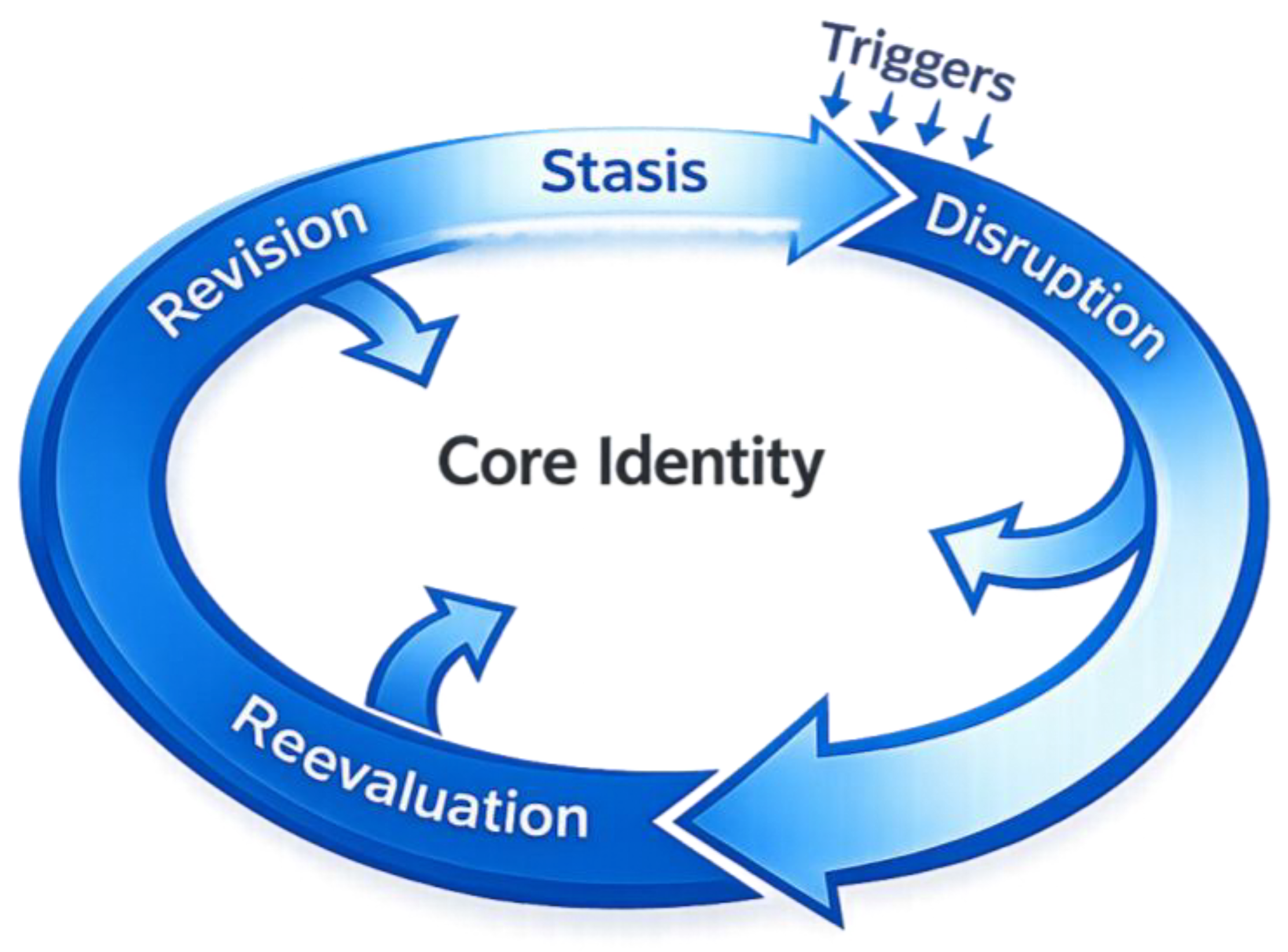
Building on these findings, Figure 1 presents a conceptual model of women’s identity development in midlife that integrates identity disruption, re-evaluation, and revision as a recursive process rather than a linear sequence. In this model, identity disruption is initiated by external triggers such as life transitions, turning points, and periods of liminality common in midlife. These disruptions create conditions of uncertainty and loss that prompt women to re-evaluate previously held identities, roles, and assumptions about self-worth and purpose.
Through re-evaluation, women engage in narrative meaning-making and exploration, often drawing on accumulated life experience, faith, and relational contexts. This process can lead to identity revision in which aspects of the self are reassembled in ways that feel more agentic, coherent, and authentic. Central to the model is a core identity that provides continuity across cycles of change. Faith and purpose frequently served as stabilizing elements of this core, anchoring women’s sense of worth. The circular structure of the model reflects participants’ accounts that identity disruption and reconstruction occurred multiple times across midlife, underscoring the identity development as an ongoing and adaptive process across the life course.

5.2. Limitations

Several limitations should be noted. First, the sample consisted exclusively of women who identified as practicing members of a singular faith tradition, preventing generalizability. Participants were also self-selected, which may reflect women who were more willing or able to articulate and reflect on their identity experiences. Second, although this study includes some diversity within a small sample, participants were predominantly European and American, with fewer voices of women from other racial, ethnic, and cultural backgrounds whose perspectives are critically important to understanding faith and development more globally. Third, the cross-sectional design of this study captures only a single moment in midlife transitions, not the full trajectory of narrative across the lifespan. Fourth, this study is missing perspectives of women who may have left this faith community due to faith transition. Fifth, this study also reflects an explicitly emic approach, including the use of translators who shared participants’ faith tradition. While this contributed to cultural safety, trust, and contextual sensitivity in participants’ narratives, it may also have shaped how experiences were elicited and interpreted. An etic approach may have produced different forms of articulation or contextualization of participants’ identity experiences.
These limitations meaningfully shape the interpretation of our findings. Because participants were practicing members of a single faith tradition, the model likely reflects identity development within continued religious commitment, where faith functions as a stabilizing and integrative resource. As such, faith may function not only as a core component of identity for some women, but also as a scaffolding through which identity is interpreted and organized. Including women who have experienced faith transition or religious exit may have revealed more conflicted or fragmented identity processes. Because the sample was largely European and American, the themes of agency, authenticity, and finding one’s voice may reflect Western individualistic narrative traditions, which may not translate the same way within collectivist cultural contexts.

5.3. Implications

The findings of this study have important implications for both clinical practice and community-based support for women in midlife. For clinicians working with women during midlife transitions, these narratives highlight the importance of attending to identity disruption not as pathology but as a normative and potentially generative process (Lachman 2015). Therapeutic approaches might honor loss while identifying emerging strengths and exploring core sources of identity. Re-framing these transitions as identity development (as opposed to “crisis”) can be extremely powerful in how a woman might experience a life transition (Helson and Soto 2005; Apter 1995). Additionally, we must note how many women found these interviews therapeutic or even cathartic. Being asked to share their stories and make meaning seemed to be empowering for at least some. For example, after my interview with Mary, who had expressed feeling extremely down and lost prior to our conversation, she shared as we were saying goodbye, “After thinking about and sharing all of those experiences from my life, I realize that I’ll be okay getting through this current transition.”
For religious communities, these findings underscore the need to provide space for women to renegotiate identity without implying loss of worth or belonging. Faith communities can play a critical role by affirming divine identity beyond marital or maternal status, or gendered roles, thereby validating diverse life paths and offering institutional narratives that frame midlife transitions as opportunities for growth, contribution, and continued purpose (Josselson 2017; Gilligan 1982). Together these implications point to the value of strengths-based approaches that support women’s identity continuity and resilience across the life course (Lachman 2015).
The findings also have important implications for future research on women’s midlife identity development, particularly within faith-centered contexts. First, these narratives suggest that identity disruption in midlife is normative and potentially generative, highlighting the need for longitudinal studies to track identity trajectories over time. Prospective studies could examine how specific transitions or turning points (such as caregiving shifts, career changes, health challenges, or evolving religious commitments) precipitate cycles of disruption, re-evaluation, and revision (Whitbourne and Willis 2006). Future research could also more directly examine how biological aging processes such as menopause, physical health changes, or shifts in energy and cognition interact with these socio-psychological transitions to shape identity development in midlife. Multi-wave qualitative interviews would allow researchers to observe identity reconstruction as it unfolds rather than relying solely on retrospective coherence.
Second, future research should more directly examine variation within faith-centered samples. Including women who experience faith transition, religious doubt, or institutional disaffiliation would clarify whether faith functions as an anchor, a site of rupture, or both. Comparative designs across denominations, religious traditions, and non-religious populations could test whether the recursive identity model holds across theological frameworks or whether different spiritual narratives shape identity revision.
Third, the intersection of faith, gender, and social roles warrants deeper attention. Mixed-method or intersectional approaches could explore how race, migration history, marital status, motherhood, socioeconomic status, or leadership roles within religious communities influence the meaning and intensity of midlife disruption. Such work would move beyond demographic diversity toward examining how context shapes identity processes.
Finally, extending beyond predominantly American and European samples is essential. Cross-cultural comparative studies could investigate how midlife identity revision manifests in collectivist settings, politically unstable contexts, or communities where women’s religious participation is constrained or differently structured. This would allow scholars to distinguish which elements of the proposed model reflect culturally specific narrative traditions and which represent more universal development processes.
Together, these directions would advance a more culturally responsive, intersectional, and developmentally precise understanding of women’s midlife identity across diverse socioreligious landscapes.

6. Conclusions

Midlife for the women in this study was not a quiet settling, nor a crisis of collapse, but a period of active identity work. Across disruption, re-evaluation, and renewed confidence, women engaged in ongoing narrative work, loosening identities that no longer fit, reclaiming neglected parts of self, and anchoring continuity in faith, purpose, and wisdom. Rather than signaling decline, midlife emerged as a generative threshold in which identity was not lost but deliberately reassembled in ways that felt more honest, agentic, and whole.

Author Contributions

Conceptualization, C.C.-D.; methodology, C.C.-D. and L.M.; software, C.C.-D.; validation, S.M.C., L.M., E.K.H., and A.L.G.; formal analysis, C.C.-D.; investigation, C.C.-D.; resources, S.M.C. and L.M.; data curation, C.C.-D.; writing—original draft preparation, C.C.-D.; writ-ing—review and editing, S.M.C., and L.M.; visualization, C.C.-D.; supervision, S.M.C., L.M., E.K.H. and A.L.G.; project administration, S.M.C.; funding acquisition, L.M. All authors have read and agreed to the published version of the manuscript.

Funding

This research received no external funding.

Institutional Review Board Statement

The study was conducted according to the guidelines of the Declaration of Helsinki, and approved by the Institutional Review Board of Brigham Young University (protocol code IRB2025-058 and date of approval: 2025-09-10).

Informed Consent Statement

Informed consent was obtained from all subjects involved in the study.

Data Availability Statement

The original contributions presented in this study are included in the article. Further inquiries can be directed to the corresponding author.

Conflicts of Interest

The authors declare no conflict of interest.

Appendix A. Interview Guide

Interview Guide
Tell me about [interviewees name] in her 20s. What was going on in her life? What did she think about herself? What was going on in the world?
What about the 30s? 40s?
Transitions
Everyone experiences transitions in life. It could be argued that women potentially experience many more transitions than their male counterparts. A life transition is a time when your life shifts significantly. These transitions might be exciting or scary. Either way, they usually involve some adapting, and maybe both loss and growth. We are particularly interested in transitions during midlife, which is the 40’s and 50’s but can be a little earlier or later.
We want to know (1) how these transitions impact the way you see yourself (i.e., self-perception/identity shifts), (2) how your body may or may not be involved in these transitions, and (3) how your faith may or may not evolve during this time. We are not looking for any specific answers. We are simply wanting to know how women are making sense of these transitions during mid-life. What we are hoping for are narrative-based responses, so I might prompt you to think about specific moments or times to exemplify your responses to my questions.
  • Can you tell me about a transition that you are experiencing right now? Or recently?
    What was the catalyst for this transition? When/How did it start?
    Does/Did this transition affect the way you see yourself/identity?
    How did your body experience this transition (if at all)?
    Does/did this transition impact your relationships and connection to others? (probe for both ways it might have challenged and strengthened)
    Do you feel like experienced loss, grief, mourning during this transition?
    Do you feel like you have experienced or are experiencing personal development/growth during this time?
    What kind of support do you wish you had during this transition? Or tell me about the support you received. (Specific stories)
Hope (balancing loss and growth)
  • What are some things that you like about yourself better now, more than you did 5–10 years ago? Specific story?
  • Some people call HOPE a “framework for action” or an awareness that you have power to act. Have you experienced hope or action as a strategy during this transition? How/when?
  • Tell me a story about a time you acted or adapted during a life transition.
  • Some women experience this idea of “coming into their own power.” Have you experienced anything like this? Can you tell me about a time?
    Coming into your power means stepping fully into your confidence, self-awareness, and authenticity. It’s about recognizing your strengths, embracing your values, and living in alignment with them. This process often involves overcoming self-doubt, setting healthy boundaries, and making decisions that reflect your true desires rather than external expectations.
It can look different for everyone, but some key aspects include:
Self-acceptance—Letting go of the need for external validation and embracing who you are.
Confidence in your voice—Speaking up for yourself and advocating for your needs.
Taking ownership—Recognizing that you have control over your choices and actions.
Resilience—Learning from setbacks and using challenges as opportunities for growth.
Empowerment of others—Using your own growth and wisdom to support and uplift those around you.
Future
  • Can you tell me about a transition or crossroads that you have coming up?
  • What gives you hope about the future?
Generativity
  • What advice do you have for someone who might experience a similar transition?
Discipleship
  • Have you experienced any changes in your faith during midlife? Story? Moment?
  • Are there women in your life who are strong examples of female discipleship?
  • Think of your mother, a grandmother, or a great grandmother. Can you think of a story or stories about how they dealt with a transition? (Prompt to share the story if they don’t automatically). Does remembering this effect how you feel about any of your transitions you’re facing now?
What have we missed?
What other questions do you wish we had asked about these topics?

References

  1. Acker, Joan. 1990. Hierarchies, jobs, bodies: A theory of gendered organizations. Gender & Society 4: 139–58. [Google Scholar] [CrossRef]
  2. American Psychological Association. 2017. Ethical Principles of Psychologists and Code of Conduct. Available online: https://www.apa.org/ethics/code (accessed on 25 April 2026).
  3. Apter, Terri. 1995. Secret Paths: Women in the Middle Years. New York: W. W. Norton. [Google Scholar]
  4. Archer, Sally L. 1989. Gender differences in identity development: Issues of process, domain, and timing. Journal of Adolescence 12: 117–38. [Google Scholar] [CrossRef]
  5. Avis, Nancy E., Sybil. L. Crawford, and Sonja. M. McKinlay. 2005. Psychosocial, behavioral, and health factors related to menopause symptomatology. Women & Health 41: 19–35. [Google Scholar]
  6. Bandura, Albert. 1997. Self-Efficacy: The Exercise of Control. Dallas: Freeman, Vol. 11. [Google Scholar]
  7. Barnes, Marilyn J. D., Imke Janssen, Sheila A. Dugan, Howard M. Kravitz, and George Fitchett. 2025. Religious and spiritual experiences, discrimination, and stress among midlife women in the USA: The study of women’s health across the nation. Journal of Religion and Health 64: 272–86. [Google Scholar] [CrossRef]
  8. Barrett, Anne E. 2005. Gendered experiences in midlife: Implications for age identity. Journal of Aging Studies 19: 245–57. [Google Scholar] [CrossRef]
  9. Beech, Nic. 2011. Liminality and the practices of identity reconstruction. Human Relations 64: 285–302. [Google Scholar] [CrossRef]
  10. Calasanti, Toni. 2004. Feminist gerontology and old men. The Journals of Gerontology Series B: Psychological Sciences and Social Sciences 59: S305–14. [Google Scholar] [CrossRef]
  11. Charmaz, Kathy, and Linda Liska Belgrave. 2012. Qualitative interviewing and grounded theory analysis. In The SAGE Handbook of Interview Research: The Complexity of the Craft. Edited by Jaber F. Gubrium. Thousand Oaks: Sage, pp. 347–65. [Google Scholar]
  12. Daly, Kerry J. 2007. Qualitative Methods for Family Studies and Human Development. Thousand Oaks: Sage. [Google Scholar] [CrossRef]
  13. Elder, Glen H., Jr. 1994. Time, human agency, and social change: Perspectives on the life course. Social Psychology Quarterly 57: 4–15. [Google Scholar] [CrossRef]
  14. Elder, Glen H., Jr. 1998. The life course as developmental theory. Child Development 69: 1–12. [Google Scholar] [CrossRef]
  15. Elder, Glen H., Monica Kirkpatrick Johnson, and Robert Crosnoe. 2003. The emergence and development of life course theory. In Handbook of the Life Course. Handbook of Sociology and Social Research. Edited by Jeylan T. Mortimer and Michael J. Shanahan. Berlin/Heidelberg: Springer, pp. 3–19. [Google Scholar] [CrossRef]
  16. Erikson, Erik H. 1968. Identity: Youth and Crisis. New York: W. W. Norton & Company. [Google Scholar]
  17. Evans, Patricia. 2008. Midlife metamorphosis. The Qualitative Report 13: 78–99. [Google Scholar] [CrossRef]
  18. Geertsma, Elisabeth J., and Anne L. Cummings. 2004. Midlife transition and women’s spirituality groups: A preliminary investigation. Counseling and Values 49: 27–36. [Google Scholar] [CrossRef]
  19. Gilligan, Carol. 1982. In a Different Voice: Psychological Theory and Women’s Development. Cambridge: Harvard University Press. [Google Scholar] [CrossRef]
  20. Greenfield, Emily A., George E. Vaillant, and Nadine F. Marks. 2009. Do formal religious participation and spiritual perceptions have independent linkages with diverse dimensions of psychological well-being? Journal of Health and Social Behavior 50: 196–212. [Google Scholar] [CrossRef]
  21. Gullette, Margaret Morganroth. 2011. Agewise: Fighting the New Ageism in America. Chicago: University of Chicago Press. [Google Scholar]
  22. Hareven, Tamara K. 2000. Families, History, and Social Change: Life-Course and Cross-Cultural Perspectives. Boulder: Westview Press. [Google Scholar]
  23. Helson, Ravenna. 1992. Women’s difficult times and the rewriting of the life story. Psychology of Women Quarterly 16: 331–47. [Google Scholar] [CrossRef]
  24. Helson, Ravenna, and Christopher J. Soto. 2005. Up and down in middle age: Monotonic and nonmonotonic changes in roles, status, and personality. Journal of Personality and Social Psychology 89: 194–204. [Google Scholar] [CrossRef] [PubMed][Green Version]
  25. Josselson, Ruthellen. 1987. Finding Herself: Pathways to Identity Development in Women. Hoboken: Jossey-Bass/Wiley. [Google Scholar]
  26. Josselson, Ruthellen. 1998. Revising Herself: The Story of Women’s Identity from College to Midlife. Oxford: Oxford University Press. [Google Scholar]
  27. Josselson, Ruthellen. 2017. Paths to Fulfillment: Women’s Search for Meaning and Identity. Oxford: Oxford University Press. [Google Scholar]
  28. King, Dana E., Doyle Cummings, and Lauren Whetstone. 2005. Attendance at religious services and subsequent mental health in midlife women. The International Journal of Psychiatry in Medicine 35: 287–97. [Google Scholar] [CrossRef]
  29. Kroger, Jane. 2006. Identity Development: Adolescence Through Adulthood. Thousand Oaks: Sage Publications. [Google Scholar]
  30. Kroger, Jane, and James E. Marcia. 2011. The identity statuses: Origins, meanings, and interpretations. In Handbook of Identity Theory and Research. Edited by Seth J. Schwartz, Koen Luyckx and Vivian L. Vignoles. Berlin/Heidelberg: Springer, pp. 31–53. [Google Scholar] [CrossRef]
  31. Lachman, Margie E. 2004. Development in midlife. Annual Review of Psychology 55: 305–31. [Google Scholar] [CrossRef] [PubMed]
  32. Lachman, Margie E. 2015. Mind the gap in the middle: A call to study midlife. Research in Human Development 12: 327–34. [Google Scholar] [CrossRef]
  33. Lachman, Margie E., Salom Teshale, and Stefan Agrigoroaei. 2022. Midlife as a pivotal period in the life course. Developmental Psychology 58: 1038–51. [Google Scholar] [CrossRef]
  34. Leonard, Rosemary, and Ailsa Burns. 1999. Turning points in the lives of midlife and older women. Australian Psychologist 34: 87–93. [Google Scholar] [CrossRef]
  35. Leonard, Rosemary, and Alisa Burns. 2006. Turning points in the lives of midlife and older women: Five-year follow-up. Australian Psychologist 41: 28–36. [Google Scholar] [CrossRef]
  36. Levinson, Daniel J. 1978. The Seasons of a Man’s Life. New York: Ballantine Books. [Google Scholar]
  37. Mahoney, Annette. 2021. Religion in families 1999 to 2009: A relational spirituality framework. Journal of Marriage and Family 83: 355–82. [Google Scholar] [CrossRef]
  38. Marks, Loren D. 2015. A pragmatic, step-by-step guide for qualitative methods. Current Psychology 34: 494–505. [Google Scholar] [CrossRef]
  39. McAdams, Dan P. 1993. The Stories we Live by: Personal Myths and the Making of the Self. New York: Guilford Press. [Google Scholar]
  40. McAdams, Dan P. 1996. Personality, modernity, and the storied self: A contemporary framework for studying identities. Psychological Inquiry 7: 295–321. [Google Scholar] [CrossRef]
  41. McAdams, Dan P. 2001. The psychology of life stories. Review of General Psychology 5: 100–22. [Google Scholar] [CrossRef]
  42. McAdams, Dan P. 2006. The redemptive self: Generativity and the stories Americans live by. Research in Human Development 3: 81–100. [Google Scholar] [CrossRef]
  43. McAdams, Dan P. 2011. Narrative identity. In Handbook of Identity Theory and Research. Edited by Seth J. Schwartz, Koen Luyckx and Vivian L. Vignoles. Berlin/Heidelberg: Springer, pp. 99–115. [Google Scholar] [CrossRef]
  44. McAdams, Dan P., and Kate C. McLean. 2013. Narrative identity. Current Directions in Psychological Science 22: 233–38. [Google Scholar] [CrossRef]
  45. McLean, Kate C., and Moin Syed. 2015. The field of identity development needs an identity: An introduction to the special issue. Developmental Psychology 51: 1150–56. [Google Scholar] [CrossRef]
  46. McLean, Kate C., and Monisha Pasupathi. 2012. Processes of identity development: Where I am and how I got there. Identity 12: 8–28. [Google Scholar] [CrossRef]
  47. Newton, Nicky J., and Abigail J. Stewart. 2010. The road to the future is paved with the past: Women’s life paths through time. Journal of Research in Personality 44: 350–62. [Google Scholar]
  48. Ryff, Carol D., and Burton Singer. 2008. Know thyself and become what you are: A eudaimonic approach to psychological well-being. Journal of Happiness Studies 9: 13–39. [Google Scholar] [CrossRef]
  49. Ryff, Carol D., and Corey Lee M. Keyes. 1995. The structure of psychological well-being revisited. Journal of Personality and Social Psychology 69: 719–27. [Google Scholar] [CrossRef]
  50. Schlossberg, Nancy K. 2011. Counseling Adults in Transition: Linking Schlossberg’s Theory with Practice in a Diverse World, 4th ed. Berlin/Heidelberg: Springer Publishing Company. [Google Scholar]
  51. Seeman, Teresa E., Linda Fagan Dubin, and Melvin Seeman. 2003. Religiosity/spirituality and health: A critical review of the evidence for biological pathways. American Psychologist 58: 53. [Google Scholar] [CrossRef]
  52. Seligman, Martin E. P. 2011. Flourish: A Visionary New Understanding of Happiness and Well-Being. New York: Free Press. [Google Scholar]
  53. Sheehy, Gail. 1996. New Passages: Mapping Your Life Across Time. New York: Ballantine Books. [Google Scholar]
  54. Sheehy, Gail. 1998. The Silent Passage. New York: Simon and Schuster. [Google Scholar]
  55. Sheehy, Gail. 2006. Passages: Predictable Crises of Adult Life. New York: Ballantine Books. [Google Scholar]
  56. Stein, Murray B. 1983. In Midlife: A Jungian Perspective. Putnam: Spring Publications. [Google Scholar]
  57. Syed, Moin., and Kate C. McLean. 2022. Who gets to live the good life? Master narratives, identity, and well-being within a marginalizing society. Journal of Research in Personality 100: 104285. [Google Scholar] [CrossRef]
  58. The Church of Jesus Christ of Latter-Day Saints. 1995. The Family: A Proclamation to the World. Available online: https://www.churchofjesuschrist.org/study/manual/the-family-a-proclamation-to-the-world?lang=eng (accessed on 1 November 2025).
  59. Thomas, Annette Joan, Ellen Sullivan Mitchell, and Nancy F. Woods. 2018. The challenges of midlife women. Women’s Midlife Health 4: 8. [Google Scholar] [CrossRef] [PubMed]
  60. Turner, Victor. 2017. Liminality and communitas. In Ritual: Perspectives and Dimensions. Edited by Catherine Bell. Abingdon: Routledge, pp. 169–87. [Google Scholar]
  61. van Gennep, Arnold. 1960. The Rites of Passage. Translated by Monika B. Vizedom, and Gabrielle L. Caffee. Chicago: University of Chicago Press. [Google Scholar]
  62. Wethington, Elaine. 2000. Expecting stress: Americans and the “midlife crisis”. Motivation and Emotion 24: 85–103. [Google Scholar] [CrossRef]
  63. Whitbourne, Susan Krauss, and Sherry L. Willis. 2006. The Baby Boomers Grow Up: Contemporary Perspectives on Midlife. Mahwah: Lawrence Erlbaum Associates. [Google Scholar]
Figure 1. Identity Development in Midlife.
Genealogy 10 00054 g001
Table 1. Demographic Statistics.
Variable%
Age
38–403.33
41–4420.00
45–4926.67
50–5416.67
55–596.67
60–6416.67
65–6910.00
Ethnicity
White73.33
Latina/Hispana6.67
Asian6.67
Native American6.67
Polynesian 3.33
Black American3.33
Nationality/Citizenship
American 50.00
Italian13.33
Scottish6.67
English6.67
Welsh6.67
Japanese6.67
Danish3.33
Mexican3.33
Argentine3.33
Geographic Residence
Utah43.33
Italy20.00
England, Scotland, Wales26.67
Education Level
High School3.33
Trade or Associates30.00
Bachelors30.00
Masters30.00
Doctoral6.67
Work Status
Currently working for pay86.67
Full time43.33
Marital Status
Single16.67
Married63.33
Divorced3.33
Widowed13.33
Number of Children
1 child3.33
2 children30.00
3 children23.33
4 children30.00
5 children10.00
Note: n = 30.
Table 2. Numerical Content Analysis of Qualitative Coding.
ThemeNo. ReferencesNo. Interviews% InterviewsAvg. No. References per Interview
Theme 1: Disruption, Uncertainty, Loss2772273.3312.59
Theme 2 & 3: Re-Evaluation, Revision283301009.43
Theme 4: Core Identity3872583.332.72
Theme 4a: Faith Identity234301007.80
Theme 4b: Purpose852376.673.70
Disclaimer/Publisher’s Note: The statements, opinions and data contained in all publications are solely those of the individual author(s) and contributor(s) and not of MDPI and/or the editor(s). MDPI and/or the editor(s) disclaim responsibility for any injury to people or property resulting from any ideas, methods, instructions or products referred to in the content.