1. Introduction: Ancient Empire, Male Dominance, and Racism
Ibram X. Kendi’s 2019 essay “How Racism Relies on Arbitrary Hierarchies” offers one of the most consequential reframings of modern racism by relocating its origins from ignorance or prejudice to power and policy. Kendi locates the emergence of racism in the fifteenth century with the publication of Gomes de Zurara’s
Chronicle of the Discovery and Conquest of Guinea, first published in 1453. He argues that this chronicler of the Portuguese crown was the first to group all Africans “into a single race” (
Kendi 2019, p. 3). Kendi thus links race to European modernity. However, his analysis risks mistaking a moment of conceptual consolidation for a point of origin.
While some scholars have argued that premodern hierarchies should not be described in racial terms, emphasizing the absence of fixed biological classifications or coherent racial doctrines (
Hannaford 1996;
Snowden 1970,
1983), others have identified processes of proto-racialization in which descent, color, climate, and inherited stigma were mobilized to stabilize inequality (
Isaac 2004;
Goldenberg 2009;
Eliav-Feldon et al. 2009;
Nederveen Pieterse 1992;
Wade 2002,
2015). This article adopts a mediating position: it does not claim that racism existed in its modern form prior to the fifteenth century but argues that the mechanisms through which hierarchy becomes naturalized through embodied difference were already well established within earlier imperial formations.
To avoid conceptual ambiguity, three related but distinct terms are used throughout this article. First, “imperial domination” refers to political systems that produce and stabilize hierarchy across populations through conquest, extraction, and rule. Second, “racialization” refers to processes by which embodied or genealogical differences are made to signify moral, political, or civilizational rank. Third, “racism,” in the stricter modern sense, refers to a historically specific formation in which hierarchy is rendered hereditary, increasingly fixed, globally portable, and subject to legal, bureaucratic, and eventually scientific administration. Premodern cases examined in this article are therefore not treated as “racism” in the modern sense but as necessary preconditions for its emergence.
This article argues that racial domination long predates race as a named category and that it emerges together with another equally foundational structure of empire, male domination (
Gopal 2019). With
Sharma (
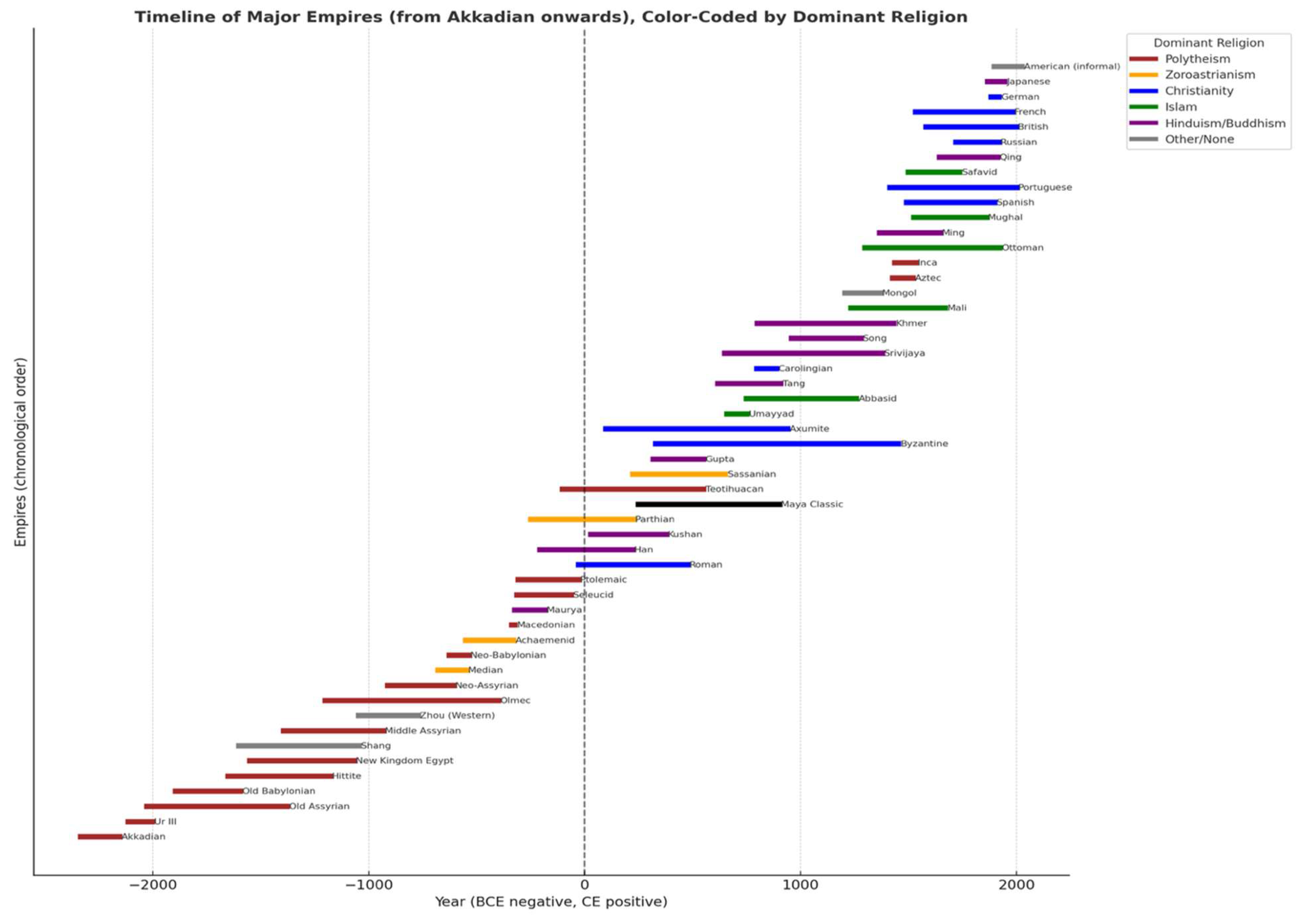
2015), I argue that modern racism did not arise ex nihilo in early modern Europe; it crystallized within a far older imperial grammar that had already normalized hierarchy, patriarchy, and embodied inequality as the foundations of political order. Empires first emerged in human affairs in 2334 BCE, with the Akkadian Empire. Since then, the world has seen 52 empires come and go. I treat empires not simply as large-scale territorial rule but as political formations that govern differentiated populations through expansion, extraction, and durable inequality. Empire is analytically central because it provides the conditions under which hierarchy becomes scalable, reproducible, and anchored in bodies, space, and lineage. This article focuses on empire as the primary site in which these mechanisms are generated and stabilized, while recognizing that similar processes of naturalizing hierarchy may also occur in non-imperial contexts.
Empires developed durable ways of making domination appear natural rather than contingent by anchoring inequality in the body, in geography, in genealogy, in cosmology, and in moral psychology. These mechanisms were applied, from the very beginning, to groups of people, thus forging a sense of groupness based on discrimination and shared suffering among them (
Brubaker 2004) long before the concept of “race” was applied to humans. Already in the earliest Middle Eastern empires, thus some five thousand years ago, whiteness and male supremacy were mutually reinforcing processes through which empires stabilized authority, inheritance, and control over labor, reproduction, and violence (
Bethencourt 2013;
Isaac 2004;
Thompson 1989).
The use of the term “whiteness” in this context is heuristic rather than descriptive of a fully developed racial category, referring to early forms of hierarchical valuation associated with lightness and superiority that only later become consolidated into modern racial formations. The concept of naturalization is used here in a broad and historically sensitive sense. This broad usage is intended to capture functional similarities across different historical contexts without implying a single, continuous, or identical understanding of nature across time. It refers to any discursive, visual, genealogical, theological, or philosophical operation that renders hierarchy necessary, inevitable, or given, rather than contingent. This does not imply that all traditions understood “nature” as fixed or immutable. In many historical contexts, heredity was seen as shaped by environment or practice (
Wade 2002;
Banton 1987). What unites these different forms is their political function as they transform domination into an apparently natural feature of the world.
Before empire, most of humanity lived in small groups. In pre-4500 BCE Europe, “The old European social structure was matrilineal, with the succession to the throne and inheritance passing through the female line. The society was organized around a theacratic, democratic temple community guided by a highly respected priestess and her brother (or uncle); a council of women served as a governing body. In all of old Europe, there is no evidence for the Indo-European type of patriarchal chieftainate.” (
Gimbutas 1999, p. 125). In pre-Neolithic Africa, ancient Anatolia, Cypress, and Minoan Crete, small, mostly peaceful societies dominated. In most of them, women had equal standing to men (
Reiter 2025).
Empires brought an end to small-scale societies that were common before the Neolithic Revolution all over the globe. The age of empire replaced egalitarianism with male dominance, and in those parts of the world conquered by Indo-Germanic tribes and “Aryans”, it constructed oppression and control of natives on white supremacy (
Anthony 2007;
Beckwith 2023). Below is a timeline of Empire (
Figure 1):
Male domination is not treated here as a secondary or merely cultural phenomenon. Across ancient and medieval empires, control over women’s bodies, reproduction, sexuality, and lineage formation was a central technology of rule. Patriarchy organized inheritance, secured conquest through sexual domination, regulated mixture and descent, and ensured the transmission of status across generations (
Olsen 2014). White supremacy did not displace patriarchy but intensified it, fastening domination simultaneously to sexed and racialized bodies. Empire required both a gender order that disciplined reproduction and a color-coded order that associated lighter skin tones with privilege and positive attributes. Patriarchy is therefore not treated as an accompanying feature of empire but as one of its central organizing principles. The regulation of women’s bodies and reproduction provides the mechanism through which hierarchy becomes inheritable and socially durable, linking gender domination directly to processes of racialization.
To demonstrate this claim, this article advances a comparative genealogy structured around eight cases drawn from ancient, classical, and medieval traditions—all predating 1453, the date Kendi locates as the beginning of “race”. These cases are not illustrative in the loose sense, nor are they intended to suggest a single linear transmission of ideas. Rather, they function as analytically comparable sites in which domination is repeatedly naturalized through embodied difference long before the emergence of modern racial categorizations. Across these traditions, different vocabularies perform the same political work. Epic distinctions between civilization and wildness, divine punishment, climate theory, genealogical descent, purity and mixture, metaphysical duty, devotional affect, encyclopedic classification, heroic masculinity, and paternal authority all transform historically produced hierarchies into features of nature, cosmos, or divine order, while aligning masculinity with rule and femininity with dependence, danger, or disorder. These cases are not intended to demonstrate that premodern societies possessed fully developed racial doctrines. Rather, they reveal recurring mechanisms through which hierarchy is anchored in embodied difference, thereby establishing the conditions under which modern racism later emerges as a more fixed and institutionalized system.
Taken together, the cases demonstrate that racism and male domination were not born with modernity. More precisely, male domination and processes of racialization long predate modernity, while modern racism emerges when these older structures are reorganized into a hereditary, global, and increasingly bureaucratic system of rule. They are expressions of ancient imperial technologies: the naturalization of permanent inequality through embodied difference. What changes across time is not the underlying logic, but the justificatory language through which it is expressed. Law, epic, iconography, philosophy, ethnography, scripture, metaphysics, devotion, and encyclopedic knowledge all participated in the same work long before modern biology entered the scene. The main argument of this article thus resonates strongly with the one advanced by Geraldine Heng, who attests to an “ascension of
whiteness to supremacy as a category of identity in the definition of the Christian European subject.” (
Heng 2018, p. 44) Different from Heng, who is a medieval scholar, I trace back the same phenomenon even further, to the emergence of empire in the Middle East. This longer genealogy sharpens rather than negates Kendi’s central insight. Racist ideas do indeed follow racist policies, but those policies draw on a civilizational archive that vastly predates modernity and that is inseparable from patriarchal domination. The fifteenth century marks not the origin of racial hierarchy, but its global consolidation within an already gendered imperial order. Early modern racial formations of the fifteenth and sixteenth centuries often operated through lineage, religion, and inherited status, as in the Iberian notion of
limpieza de sangre. These differed significantly from nineteenth-century scientific racism, which increasingly grounded hierarchy in biology, measurement, and typology. Modern racism should therefore be understood as a developing formation rather than a static system. To confront racism at its roots, therefore, requires engaging these deep structures of empire, racial, sexual, and epistemic, rather than mistaking race alone for their source.
2. Method: Comparative Genealogy and Textual Analysis
This article employs a comparative genealogical method to examine how durable hierarchies of domination are naturalized through embodied difference across diverse historical and textual traditions. The goal is not to trace direct influence between cases but to identify structurally similar mechanisms through which inequality is presented as natural, inevitable, or divinely sanctioned long before modern racial science. This approach is comparative rather than diffusionist and does not assume historical transmission between the cases examined. Racism is therefore treated not as an isolated modern ideology but as a late crystallization of an older imperial grammar that stabilized hierarchy through nature, cosmology, genealogy, and the body.
The research combines close reading of primary sources with comparative synthesis. The analysis is qualitative, historical, and interpretive, guided by consistent analytical criteria across traditions, including Mesopotamian epic, Greek historiography, South Asian scripture, medieval devotion, and Christian encyclopedism. The central focus is how texts convert historically contingent relations of domination into seemingly natural features of the world.
Cases were selected for their canonical authority, emergence within imperial or expansionist political orders, durability of reception, and the presence of passages linking bodily difference to moral rank or political capacity. The selection is therefore illustrative rather than exhaustive and is intended to demonstrate recurring mechanisms rather than provide a comprehensive survey. Early modern racial science and colonial administrative writings are excluded in order to foreground the premodern archive within which modern racism later crystallized.
The corpus includes the Epic of Gilgamesh, Akkadian and Neo-Assyrian royal inscriptions, Egyptian New Kingdom iconography, Aristotle’s Politics, the Hebrew Bible and New Testament, the Bhagavad Gita, the Cantigas de Santa Maria, and Isidore of Seville’s Etymologiae. The study relies on scholarly translations and, where relevant, key original-language terms such as “varna”, “svabhava”, “Aithiops”, “versipelles”, and medieval uses of “negro”, analyzed within broader semantic fields linking bodily description to moral and political judgment.
Two limitations should be noted. The study is not exhaustive, and not all hierarchies or bodily references constitute racism. The claim is narrower: modern racism becomes intelligible only against a long imperial history in which hierarchy was already naturalized through embodied difference.
3. Case Studies
3.1. Case 1: The Epic of Gilgamesh—Civilization, Masculinity, and the Graded Human
The
Epic of Gilgamesh is among the earliest surviving works of world literature. Its oldest components consist of independent Sumerian poems dating to approximately 2100 BCE, while the most complete version, the so-called Standard Babylonian recension, was compiled in Akkadian during the late second millennium BCE. The epic emerged from early Mesopotamian urban societies already structured by kingship, monumental architecture, corvée labor, military expansion, and sharp distinctions between the city and the non-urban periphery. These societies were not only hierarchical but profoundly patriarchal. Political authority was concentrated in male rulers, inheritance followed male lines, and masculinity was closely associated with domination, violence, and control over both land and bodies (
Dalley 2000;
Van de Mieroop 2016;
Oppenheim 1977;
Collins 2000).
The epic reflects this world not simply by describing kings and gods but by articulating an anthropology in which full humanity is inseparable from urban order, masculine sovereignty, and participation in a civilizational regime defined by consumption, clothing, sexual regulation, and disciplined violence. The text does not present empire as an external political structure. It presents it as the condition under which humanity itself becomes intelligible.
3.1.1. Textual Evidence
The figure of Enkidu provides the epic’s most consequential claim about what it means to be human. Enkidu is biologically human but initially lives among animals:
“He ate grass with the gazelles,
drank at the watering-place with the animals,
his heart delighted with the wild creatures.”
(Tablet I)
At this stage, Enkidu is explicitly positioned outside the category of proper humanity. His body is human, but his mode of life aligns him with animals rather than with men. He lacks clothing, bread, beer, speech, and social hierarchy. Most importantly, he exists outside male political order.
His transformation begins through prolonged sexual initiation with the prostitute Shamhat. The encounter is not incidental. It lasts “six days and seven nights,” and it fundamentally alters Enkidu’s status. When he attempts to return to the animals afterward, the text emphasizes bodily incompatibility:
“When he had made love with her six days and seven nights,
Enkidu turned back toward his herd,
but the gazelles saw him and fled,
the wild beasts shunned his body.”
(Tablet I)
Sex with a woman does not simply initiate Enkidu socially; it permanently estranges him from the natural world. His body is now marked by civilization. He is no longer compatible with animals because he has been incorporated into a human order structured by sexual regulation, consumption, and hierarchy.
Shamhat then instructs Enkidu in the practices that define urban life. He eats bread; drinks beer; is clothed, anointed, and taught speech. The culmination of this process is announced with striking brevity:
“Enkidu became human.”
(Tablet II)
Humanity here is not biological. It is conferred. It is achieved through submission to a civilizational regime in which masculinity, sexuality, consumption, and hierarchy are tightly connected.
3.1.2. Analysis, Interpretation, and Significance
The epic articulates a graded concept of humanity in which not all human bodies count as fully human. Humanity appears not as a species condition but as a status conferred through incorporation into urban, masculine order. Those outside that order are not political enemies; they are ontologically incomplete.
This hierarchy is inseparable from male domination. Gilgamesh’s kingship rests on hypermasculinity—excessive strength, sexual entitlement, and violence. His abuse of women in Uruk is treated not as injustice but as misdirected masculinity requiring regulation. The gods respond not by protecting women but by creating another man, Enkidu, whose companionship absorbs and stabilizes royal violence. Women thus function as instruments of social order rather than political subjects.
Shamhat’s role makes the logic explicit. Civilization enters Enkidu’s body through sexual initiation, yet her agency is purely instrumental. Female sexuality operates as a mechanism of domestication serving male authority, while women themselves remain excluded from sovereignty. Women become gateways to humanity but not participants in its political form—a foundational patriarchal move.
Because humanity is a graded status, violence against those outside the city becomes moralized. Conquest appears as improvement, domination as education, and annihilation as correction. The wild are not wronged; they are civilized or eliminated. This framework requires no race. It requires only a hierarchy between ordered and disorderly bodies reinforced through gendered domination.
For this reason, the Epic of Gilgamesh represents an early formulation of empire before race. Long before biological classification or visible bodily markers organize inequality, power already naturalizes hierarchy by ranking humanity itself. Modern racism does not invent the idea that some humans are more human than others; it inherits it. Race later attaches this hierarchy to inheritable markers and administrative systems, but the underlying logic—that domination improves and inequality reflects natural order—is already present.
Gilgamesh matters not because it contains racial categories but because it establishes a civilizational ontology in which hierarchy appears necessary, violence benevolent, and domination the condition of humanity. Patriarchy is not incidental to this system; it is one of its organizing principles. Empire begins by defining who counts as human, who must be disciplined, and whose bodies may be used to stabilize order.
The epic therefore inaugurates a grammar that reappears across millennia in new idioms. Race refines this structure but does not originate it. The deep structure of racism lies in an older logic that makes domination look like civilization and patriarchy look like nature.
3.2. Case 2: Akkadian and Assyrian Royal Inscriptions—Masculine Violence and the Ontologization of Domination
Royal inscriptions from the Akkadian and Neo-Assyrian empires constitute one of the earliest and most explicit archives of imperial self-representation. Beginning with the reign of Sargon of Akkad in the late third millennium BCE and reaching their most developed form under the Neo-Assyrian kings of the ninth to seventh centuries BCE, these inscriptions were carved on stelae, palace walls, reliefs, and foundation deposits. They were not private reflections but public instruments of rule, intended to be seen, read aloud, and remembered. Their function was not merely to record conquest but to render domination intelligible, legitimate, and necessary (
Grayson 1972–1976;
Pritchard 1969).
These empires were profoundly patriarchal. Kingship was exclusively male, succession followed agnatic lines, and political authority was performed through controlled displays of masculine violence. Warfare, punishment, and bodily destruction were not failures of order but its primary enactments. The inscriptions emerge from a world in which masculinity itself is a political technology, and where the king’s body and voice stand as mediators between gods and subjects. Empire here is not an abstract structure. It is embodied in a male ruler whose capacity to dominate defines cosmic stability.
3.2.1. Textual Evidence
The inscriptions of Ashurnasirpal II, who ruled from 883 to 859 BCE, are paradigmatic of Neo-Assyrian imperial ideology. In recounting his campaigns against rebellious populations, Ashurnasirpal describes violence in graphic, corporeal terms,
“I flayed as many nobles as had rebelled against me and draped their skins over the pile of corpses; I burned their young men and women to death.”
Elsewhere, he explains the moral condition of those he conquers,
“They did not know submission, nor fear of the gods.”
The combination is decisive. Violence is not justified by strategic necessity alone. It is framed as a response to a moral and ontological deficiency. The conquered are not simply political opponents; they are beings who lack the proper orientation toward divine and royal authority.
Other Assyrian inscriptions repeat this pattern. Rebellion is consistently described as disorder, arrogance, or ignorance. Punishment is presented as corrective rather than punitive. The king does not merely defeat enemies; he restores the world to its proper state through bodily destruction.
3.2.2. Analysis, Interpretation, and Significance
The inscriptions present a form of domination in which difference is moralized and embodied before it becomes political. The defining trait of the conquered is not ethnicity or ancestry but refusal to submit. Yet resistance is treated as intrinsic rather than situational—evidence of a defect in being rather than a response to imperial aggression.
This logic is inseparable from masculine sovereignty. Royal authority is performed through the visible destruction of bodies, including women and children. The reference to “young men and women” burned alive signals that imperial power extends over reproduction itself. Destroying women asserts control over lineage and futurity, while the flaying of male elites humiliates rival masculinities and reestablishes the king’s singular authority.
Violence is therefore pedagogical. Bodies are made to teach submission. The skin of rebels becomes a surface on which imperial order is publicly inscribed. This is not arbitrary cruelty but a technology of rule converting bodily difference into moral hierarchy. Those who resist are not wronged but corrected, their suffering framed as instruction.
Crucially, this system justifies annihilation without racial categories. The enemy is marked not by skin color but by posture, behavior, and perceived moral deficiency. Some bodies become legitimate targets of exemplary violence because they are defined as improperly ordered and therefore less fully human. Sovereignty is organized through masculinized violence, and the destruction of feminized bodies demonstrates total power. Empire thus teaches subjects to read pain and submission as natural features of order rather than political outcomes.
The Akkadian and Assyrian inscriptions reveal a grammar of domination that predates race. Empire already converts embodied difference into moral inferiority and violence into necessity through a hierarchical ontology that renders certain bodies disposable. The spectacular brutality often labeled “pre-modern” is not the opposite of rational rule but one of its earliest forms.
This archive exposes the structure into which later racial systems are inserted. Racism does not invent the expendability of some lives; it inherits it. Racialization later stabilizes and administers this logic more efficiently, but the foundation remains: conquest appears as order, violence as virtue, and difference as destiny. Race renames and organizes a hierarchy empire had long practiced.
3.3. Case 3: Egyptian New Kingdom Iconography—Visual Hierarchy, Color, and Pharaonic Masculinity
The visual program of the Egyptian New Kingdom, spanning roughly from the mid-sixteenth to the late eleventh century BCE, constitutes one of the most sustained and systematic uses of imagery for imperial rule in the ancient world. Temple reliefs, tomb paintings, monumental statuary, and palace decoration produced under rulers such as Thutmose III, Amenhotep II, Seti I, and Ramesses II were not merely decorative. They were instruments of political pedagogy designed to train perception, normalize hierarchy, and render imperial domination as cosmic order (
Hornung 1982;
Lichtheim 1976).
This iconographic system emerged within a deeply patriarchal society structured around divine kingship. The pharaoh was male, his authority framed as both biological and cosmic, and his body served as the axis linking gods, land, and people. Masculinity was not a private attribute but a principle of rule. Military conquest, physical strength, and sexual potency were repeatedly fused in visual form, while women, foreigners, and conquered populations were positioned as objects through which royal power was displayed and reproduced.
Egyptian imperial expansion into Nubia, the Levant, and Libya generated a sustained visual encounter with foreign populations. Rather than representing these encounters as contingent political struggles, New Kingdom art absorbed them into a stable grammar of difference. Bodies, skin color, posture, clothing, and spatial arrangement became signs through which rank was communicated without narrative explanation. What was seen did not require argument.
3.3.1. Visual Evidence
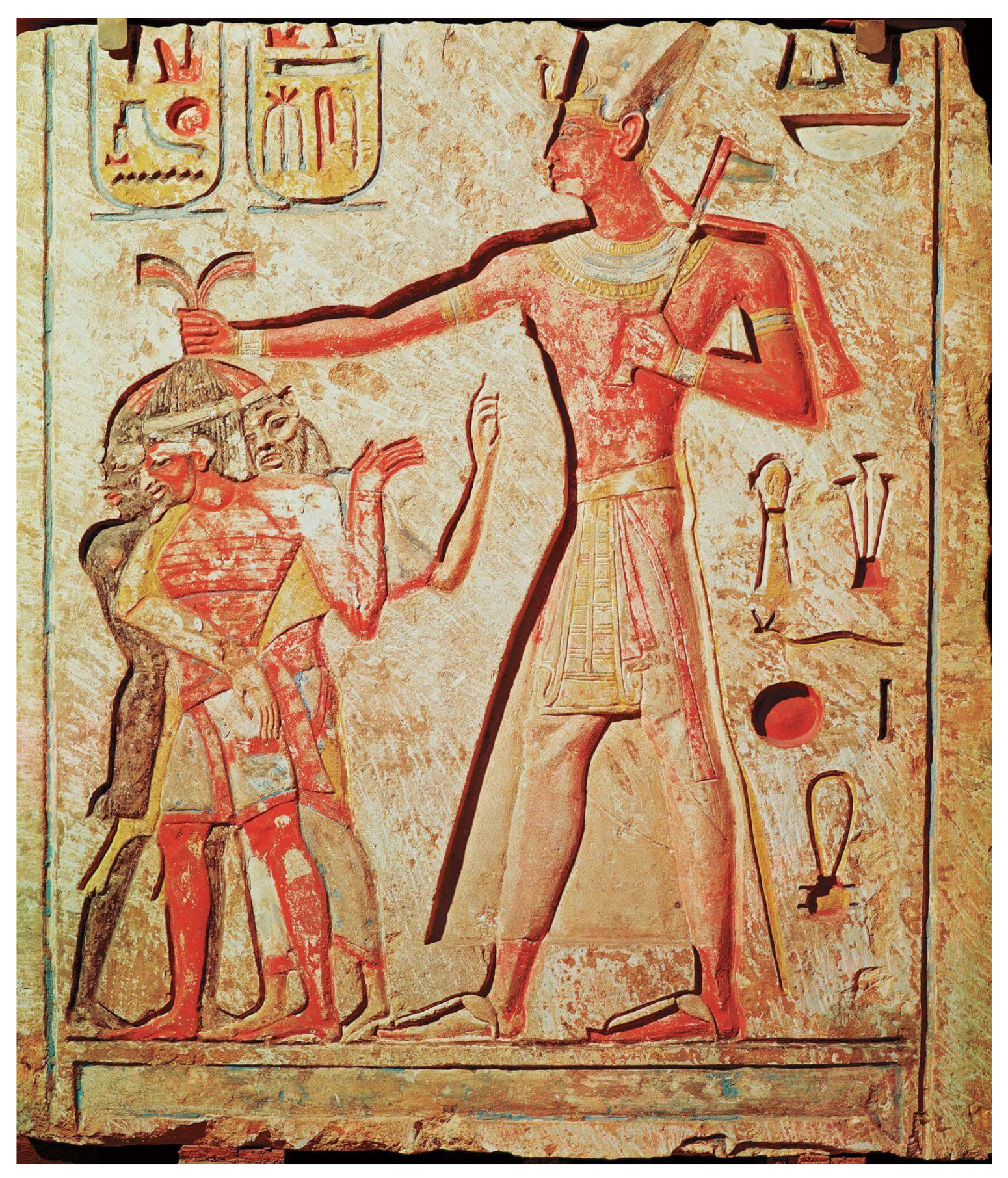
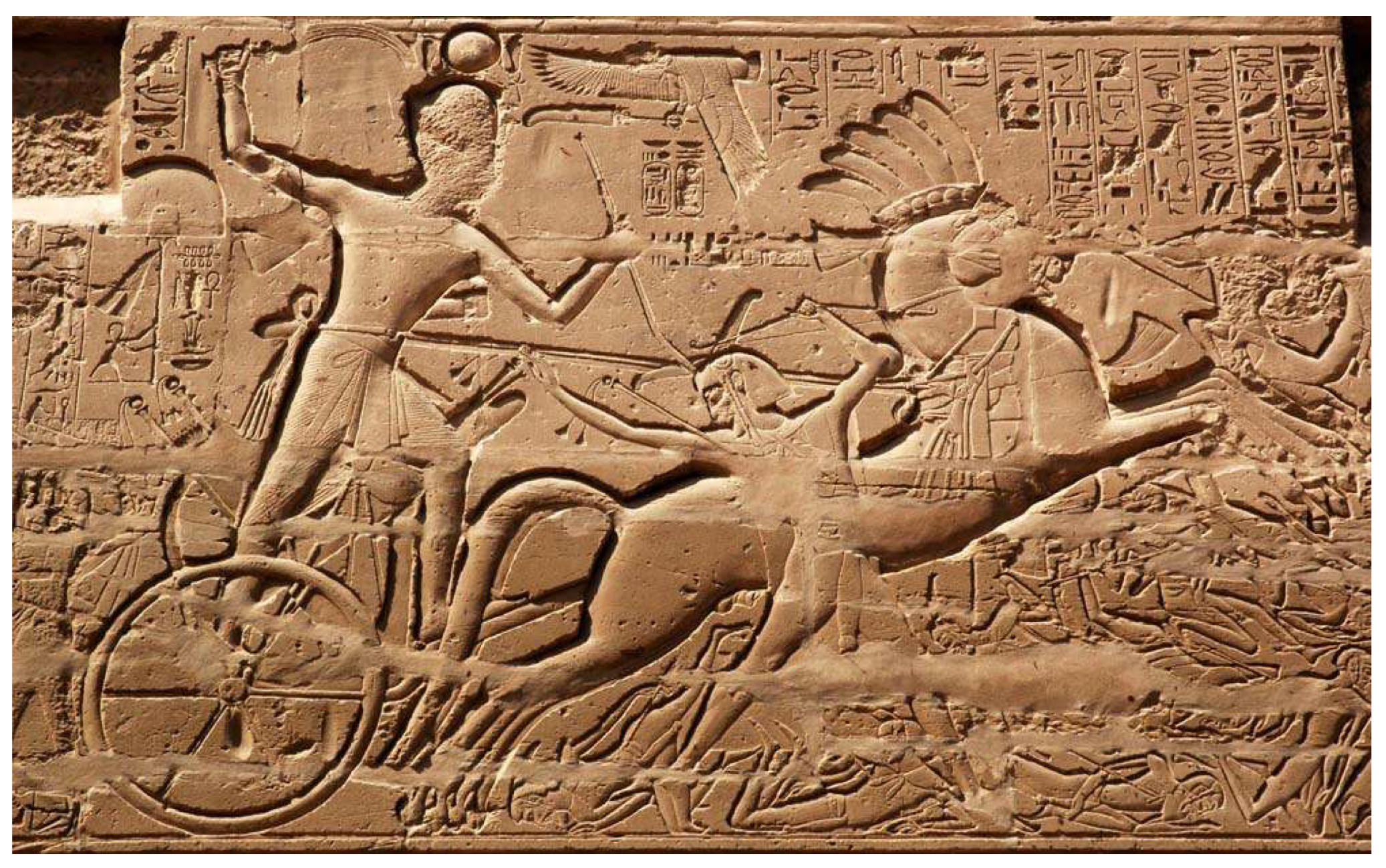
Across New Kingdom reliefs and paintings, foreign peoples appear in highly standardized forms. Nubians are consistently depicted with darker skin tones, distinctive hairstyles, exaggerated lips, and submissive postures. Asians and Libyans are rendered with lighter skin than Nubians but marked through other visual codes, including dress, beard style, and gesture. Egyptians, by contrast, are portrayed with idealized proportions, controlled movement, and balanced coloration, occupying the central visual field. The two reliefs below are typical in their representation of pharaohs vis-á-vis subjugated populations (see
Figure 2 and
Figure 3).
In the recurring motif of the pharaoh smiting enemies, the king is shown grasping bound captives by the hair, raising a weapon in preparation for execution. The captives’ bodies are contorted, kneeling, or collapsed, while the pharaoh’s body is upright, symmetrical, and monumental. Nubian captives are frequently placed beneath the king’s feet or beneath hieroglyphic representations of Egypt itself, fusing political domination with spatial and cosmic hierarchy.
Tomb paintings and reliefs also repeatedly present rows of bound foreigners labeled as the “Nine Bows”, Egypt’s enemies. These figures are differentiated visually by skin color and physiognomy, arranged in predictable sequences, and positioned below the pharaoh or the gods. Individual identity is erased in favor of typology. Foreigners are not shown acting; they are shown being acted upon.
3.3.2. Analysis, Interpretation, and Significance
Egyptian New Kingdom iconography operates through immediate legibility. Hierarchy is not argued but seen. Color functions as a central semiotic element: darker skin, especially that of southern populations such as Nubians, is repeatedly associated with defeat, subjugation, and distance from the divine center embodied by the pharaoh. Because these visual codes recur across temples, tombs, and monuments, difference becomes intuitive rather than discursive.
This visual order is inseparable from male domination. The pharaoh’s masculinity organizes the image. His body signifies stability, fertility, and cosmic order, while conquered bodies signify disorder and threat. The recurring gesture of grasping captives by the hair collapses military conquest and bodily domination into a single act of absolute control. Authority appears as the capacity of a male body to master other bodies.
Women largely appear as symbols rather than agents. Conquered lands are often personified as feminized figures subdued or presented to the king, framing conquest as both political domination and sexual possession. Foreign territories become feminized bodies to be penetrated, subdued, and rendered productive under Egyptian rule.
The system requires no narrative explanation. A viewer need not know who the captives are or what they have done; posture, placement, and color already communicate inferiority as a natural fact. Embodied difference becomes immediately legible as rank. This is racialization in practice without an explicit racial theory.
The Egyptian case shows how imperial hierarchy can be stabilized through vision long before race emerges as a formal concept. The images train perception itself. By repeatedly linking darker skin with submission, foreignness with disorder, and masculinity with sovereignty, hierarchy becomes self-evident. Racialization and patriarchy, therefore, operate not only as ideas but also as perceptual regimes in which the body functions as a sign and seeing becomes a political act.
Male domination anchors the system. The pharaoh’s masculine body legitimates authority, while the feminized bodies of territories and the marked bodies of foreigners demonstrate its reach. Empire teaches subjects both whom to obey and how to perceive obedience as natural.
This case provides a key link in the genealogy of racism before race. Modern racial regimes will later formalize classification, but they do not invent the association between color, hierarchy, and authority. They inherit a visual grammar in which difference appears obvious, domination inevitable, and violence the restoration of order.
3.4. Case 4: Aristotle’s Politics—Natural Slavery, Sexual Difference, and Ontological Hierarchy
Aristotle’s
Politics was composed in the mid-fourth century BCE within a Greek world structured by slavery, household patriarchy, and imperial expansion. Athens and other poleis depended materially on enslaved labor, while Greek colonization and warfare continuously brought non-Greek populations into systems of domination. Political participation was restricted to free adult men, and the household (oikos) functioned as the foundational unit of social order. Authority within the household was explicitly gendered and hierarchical. The adult male citizen ruled over women, children, and slaves, each positioned as naturally subordinate (
Isaac 2004).
Politics reflects this world not merely as description but as theory. Aristotle’s project is to explain why hierarchical relations are not contingent arrangements but expressions of nature itself. His political philosophy does not begin with equality or justifying inequality. It begins with inequality as ontological fact and then builds political order upon it. Slavery, patriarchy, and ethnic hierarchy are not treated as problems to be solved but as givens to be rationalized.
3.4.1. Textual Evidence
In Book I of Politics, Aristotle introduces the doctrine of natural slavery with remarkable clarity. He asserts that from birth some are destined to rule and others to be ruled:
“From the hour of their birth, some are marked out for subjection, others for rule.”
The slave, in this account, is not merely someone who happens to be enslaved. He is defined by an inherent deficiency in rational capacity. Aristotle writes that the slave participates in reason only insofar as he can recognize it in another, not exercise it himself. On this basis, the slave is described as an instrument:
“The slave is a living tool.”
This logic is extended to populations Aristotle identifies as barbarians. He suggests that many non-Greek peoples are naturally servile because they lack the rational disposition necessary for self-rule. Their political subordination is thus framed not as conquest but as appropriate governance.
Aristotle’s discussion of slavery is inseparable from his account of sexual difference. He repeatedly draws analogies between the rule of the master over the slave and the rule of the male over the female. Women, Aristotle argues, possess reason but lack authority. They are governed by it but cannot govern with it. Male rule over women is therefore presented as natural and beneficial, not coercive.
3.4.2. Analysis, Interpretation, and Significance
Aristotle’s political ontology rests on the claim that hierarchy is inscribed in nature. Difference is not historical but essential, and bodies are treated as evidence of destiny. Rational capacity—or its alleged absence—becomes the criterion through which domination is justified.
This framework fuses slavery, patriarchy, and ethnocentrism into a single system. The same logic that defines some men as natural slaves also renders women subordinate and foreigners governable. Each group is marked by a supposed deficiency that legitimizes rule by those deemed fully rational. Masculinity functions as the normative model of humanity, while femininity and foreignness appear as deviations.
Male domination is therefore not secondary but foundational. The household provides the template for political order: male authority over women makes domination over slaves and barbarians appear natural. What is normalized in the oikos becomes the justification for rule in the polis and beyond.
The theory does not depend on visible markers such as skin color. Ontological hierarchy is inferred from attributed capacities rather than phenotype. Yet this abstraction strengthens its racializing potential. Once inequality is grounded in nature, it can be attached to any group interpreted as deficient in reason or self-rule.
Aristotle thus marks a decisive moment in the genealogy of domination. Unlike the spectacular violence of Assyrian inscriptions or the visual coding of Egyptian iconography, he supplies conceptual infrastructure. Domination no longer needs to be displayed; it can be reasoned. Inequality becomes philosophy.
Patriarchy anchors this move. The naturalization of male authority within the household provides the most immediate model of hierarchy, making slavery and the governance of foreign peoples appear extensions of an already accepted order. Modern racism will later fasten these claims onto biology and skin color, but the structure is already present: some humans are naturally suited to rule and others to be ruled, and domination appears benevolent.
Aristotle therefore occupies a central place in the long history of empire. Racism does not require race to exist; it requires a theory of nature capable of turning power into virtue and domination into care. Race later stabilizes and administers this logic, but it does not originate it.
3.5. Case 5: The Christian Bible—Genealogy, Blackness, Patriarchy, and the Moralization of Difference
The Christian Bible constitutes the most authoritative textual archive in the history of European empires. Formed over roughly a millennium, the Hebrew Bible incorporates ancient Near Eastern myth, Israelite tribal memory, royal ideology, prophetic critique, and post-exilic redaction, while the New Testament adds first-century Christian writings produced within the Roman imperial world. Canonized in late antiquity, the Bible became not only a religious text but also a foundational framework for law, anthropology, geography, and political imagination across medieval and early modern Europe (
The Holy Bible NRSV 1989;
Goldenberg 2009;
Pritchard 1969).
This archive emerged within deeply patriarchal societies in which lineage, inheritance, sexual regulation, and male authority structured social order. Descent was traced through male lines, women’s sexuality was closely regulated to secure genealogical continuity, and political authority was overwhelmingly masculine. These gendered structures are not incidental to the Bible’s later racializing potential. They provide the mechanisms through which difference could be made inheritable, morally charged, and durable.
The Bible does not contain a modern doctrine of race. Nor does it offer a systematic ethnography of Africa. Its power lies elsewhere: in its capacity to organize difference through genealogy, symbol, curse, and moral cartography. These elements, once embedded in a sacred canon, could be activated across centuries to render hierarchy ancient, providential, and natural.
3.5.1. Textual Evidence: Africa, Blackness, and Genealogical Difference
Biblical references to Africa appear through dispersed motifs rather than through sustained description. Terms such as Cush, Ethiopia, Egypt, Put, and Libya surface in genealogical lists, prophetic poetry, narrative episodes, and eschatological visions. Their significance lies not in frequency but in function.
Genesis 10, the so-called Table of Nations, anchors Africa genealogically through Ham and his descendants. Cush, Egypt, Put, and Canaan are positioned as lines of descent, transforming geography into lineage. Difference becomes inheritable (
Yountae 2024). Genesis 9 intensifies this logic through the curse narrative associated with Noah and Canaan, later transferred in Christian interpretation to Ham’s African descendants. Regardless of original intent, the structure is decisive: servitude is rendered genealogical and therefore natural.
Symbolic blackness enters the archive through poetic and prophetic language. Passages such as Song of Songs 1:5 and Jeremiah 13:23 introduce darkness and Ethiopian skin as metaphors of fixity, endurance, and moral condition. Ethiopia is repeatedly positioned as distant, future-oriented, or exemplary, as in Psalm 68:31 and Isaiah’s prophecies. Inclusion is promised but deferred.
The New Testament continues this pattern through selective incorporation. The Ethiopian eunuch in Acts 8 is included through mediated conversion, marked simultaneously by piety and by sexual and social liminality. Universalism is affirmed, but hierarchy remains intact.
The following
Table 1 presents the full range of biblical passages central to this structure.
3.5.2. Analysis, Interpretation, and Significance
The biblical corpus provides an infrastructure through which hierarchy can be stabilized without an explicit racial doctrine. Genealogy is its central mechanism. By organizing peoples as lines of descent, the text renders difference inheritable. Genesis 10 maps the world genealogically, while Genesis 9 links lineage to social rank, allowing servitude to appear as destiny rather than policy.
Alongside genealogy operates symbolic blackness. Poetic and prophetic passages transform darkness into a morally charged sign without direct reference to skin color. Jeremiah’s rhetorical question about the Ethiopian treats blackness as immutable, establishing a portable association between bodily difference and fixity that later racialization can readily adopt.
Biblical universalism includes everything without equalizing. Psalm 68 and Acts 8 place Africa within salvation history, yet always asymmetrically: Africa approaches the center but does not constitute it. Inclusion remains mediated and exceptional, permitting religious universality to coexist with social hierarchy. Africa is also repeatedly depicted as an edge-space associated with distance, excess, or exemplary punishment, and prophetic imagery such as Isaiah 45 channels an extractive logic in which African wealth flows outward rather than inward.
These structures are inseparable from patriarchy. Genealogy depends on control over women’s sexuality, inherited status follows male lines, and figures such as the Ethiopian eunuch mark hierarchy through sexualized liminality. Control of reproduction secures the transmission of difference across generations.
The Bible, therefore, does not invent racism but provides durable forms through which racial domination becomes thinkable and legitimate: lineage as destiny, blackness as a moral symbol, and inclusion without equality. These mechanisms long precede modern race science. When early modern empires racialize Africans explicitly, they activate an existing framework rather than create a new one.
Patriarchal authority makes this inheritance possible by governing lineage and reproduction, allowing hierarchy to appear ancient and sacred rather than constructed. The biblical archive thus exemplifies empire before race. Modern racism does not break from it; it secularizes and bureaucratizes its logic.
3.6. Case 6: The Bhagavad Gita—Varna, Color, Patriarchy, and the Metaphysical Naturalization of Hierarchy
The Bhagavad Gita occupies a singular position in South Asian intellectual and political history. Embedded within the Mahabharata yet widely circulated as an autonomous philosophical scripture, the text emerged over a long period of composition and redaction, reaching something close to its extant form between the late centuries BCE and the early centuries CE. It reflects a social world shaped by Indo-Aryan migration and conquest, the consolidation of Brahmanical authority, and the stabilization of a stratified social order structured by ritual hierarchy, gendered domination, and inherited status (
Davis 2014;
Malinar 2007;
Thapar 2002;
van Buitenen 1981;
Jamison and Brereton 2014).
This world was profoundly patriarchal. Lineage was traced through male descent, control over women’s sexuality was central to maintaining caste boundaries, and religious authority was monopolized by male elites. The Gita does not challenge these structures. It presupposes them. Its philosophical intervention is not to question hierarchy but to render it morally and metaphysically secure at a moment when violence, war, and social instability threaten its legitimacy. The dialog between Krishna and Arjuna unfolds on the battlefield precisely because the text’s task is to reconcile domination with righteousness.
3.6.1. Textual Evidence
Several passages are central to the Gita’s articulation of hierarchy. The injunction that one must perform one’s own duty, even imperfectly, rather than another’s duty well, appears repeatedly, most prominently in 3.35 and again in 18.47. This principle sanctifies social boundaries by framing role transgression as moral danger rather than as aspiration.
Hierarchy is explicitly attributed to divine creation in 4.13, where Krishna declares that he created the fourfold varna order according to guna and karma. The social world is thus presented as the outcome of cosmic design rather than of conquest or coercion. The closing chapter elaborates this structure by assigning distinct duties to Brahmins, Kshatriyas, Vaishyas, and Shudras, grounding these assignments in svabhava, “born nature” (18.41–44). Labor hierarchy is not explained as a pragmatic arrangement; it is revealed as an expression of intrinsic disposition.
Gender is explicitly incorporated into this hierarchy. In 9.32, Krishna states that even women, Vaishyas, and Shudras—described collectively as “of sinful birth”—can attain the highest goal through devotion. Spiritual inclusion is offered, but only by reaffirming social stigma and inherited inferiority. Equality is deferred to the transcendent realm, leaving worldly hierarchy untouched.
These passages operate within a much older symbolic field. Early Vedic texts repeatedly contrast the arya with darker-skinned dāsa or dasyu populations, associating conquest with the protection of “Aryan color” and the destruction of “dark skin.” Later Brahmanical legal texts consolidate this logic by codifying hereditary service and restricting economic mobility for subordinate groups. The Gita does not introduce these associations; it ratifies them at the level of metaphysics.
The full evidentiary structure of this argument is presented in the analytical
Table 2 below (
Bhaktivedanta Swami Prabhupada 1972), which documents the textual nodes through which color, birth, gender, and hierarchy are bound together.
3.6.2. Analysis, Interpretation, and Significance
The texts describe a coherent system through which hierarchy is stabilized across cosmology, ethics, law, and everyday life. Conquest forms the historical background, yet it is narratively erased. Vedic hymns already transform violence into cosmic restoration, turning displacement into moral necessity. Color functions as a collective marker long before modern race, anchoring dominance in visible difference without biological theory.
The decisive move of the Bhagavad Gita is the sanctification of social boundaries. The insistence on svadharma converts obedience into virtue and resistance into moral failure. Once role-crossing is framed as dangerous, hierarchy no longer relies primarily on coercion; it becomes internalized as ethical discipline. By attributing varna to divine creation and grounding duty in born nature, inequality is relocated beyond critique. Social rank appears not as a product of power but as a reflection of the cosmos.
Patriarchy is central to this order. Control over women’s sexuality preserves caste boundaries, and anxiety about mixture presupposes male authority over reproduction. When women are grouped with Vaishyas and Shudras as beings of “sinful birth,” gender hierarchy fuses with caste hierarchy. Spiritual inclusion—most clearly in 9.32—offers transcendence while leaving worldly inequality intact. Liberation becomes consolation rather than transformation.
Placed within the wider Indo-Aryan archive, this structure acquires an explicitly embodied dimension. The very term “varna” derives from “color,” and early Vedic hymns contrast Arya with darker dāsa or dasyu populations. Verses praising Indra for destroying the “dark skin” and protecting the “Aryan color” encode a memory of conquest in which political domination is narrated as the restoration of order. Later Brahmanical texts such as the Manusmṛti translate this symbolic hierarchy into hereditary law, assigning intellectual authority to Brahmins and servitude to Shudras while presenting rank as natural and enduring.
The Gita gives this inherited order metaphysical depth. By grounding duties in svabhava—one’s intrinsic nature—it converts historically produced inequality into ontological necessity. Hierarchy becomes cosmic structure rather than social arrangement. Violence disappears from view, replaced by a moral psychology in which individuals learn to desire obedience and fear mixture.
This case shows how racialization and patriarchy can function without modern racial doctrine. Where imperial inscriptions rely on terror and visual programs train perception, the Gita disciplines conscience. It teaches subjects to experience inequality as duty. Patriarchal control over lineage supplies the mechanism through which difference becomes reproducible across generations. What distinguishes modern racism from these earlier forms is not the existence of hierarchy itself, but the degree to which such hierarchy becomes hereditary, standardized, and globally scalable. Modern racism represents a qualitative transformation in which domination is increasingly fixed in allegedly immutable inherited traits, rendered legible to law and bureaucracy, and later reinforced through scientific classification. In this sense, modern racism does not merely refine earlier imperial structures—it stabilizes, universalizes, and rigidifies them.
3.7. Case 7: Isidore of Seville, Etymologiae (Origines)
Isidore of Seville’s
Etymologiae, also known as the Origines, was composed in the early seventh century, with most of the work compiled between approximately 615 and 630 CE. Isidore himself was born around 560 CE and died in 636 CE. The text thus belongs to the final phase of late antiquity, a period marked by the political collapse of Roman authority in the western Mediterranean and the simultaneous consolidation of Christian episcopal power within post-Roman kingdoms (
Isidore of Seville 1911;
Barney et al. 2006).
Isidore served as bishop of Seville in the Visigothic kingdom of Hispania, a polity engaged in an active project of religious and political unification following the conversion of its rulers from Arianism to Catholic Christianity. The
Etymologiae must be read as part of this project. It was not conceived as an original philosophical intervention but as a pedagogical and organizational undertaking designed to preserve, reorder, and authorize inherited knowledge for a Christian society that understood itself as heir to Rome. In a context of institutional fragility and political reconstitution, encyclopedic knowledge became a technology of stability (
Seth 2021).
The work is organized into twenty books arranged by subject matter, encompassing language, peoples, law, medicine, animals, geography, and theology. Its unifying methodological principle is etymology, understood not merely as linguistic inquiry but as a pathway to essence. Words are repeatedly treated as repositories of truth, and the origins of names are presented as revealing the nature of things themselves. This epistemic stance is crucial. By treating names as explanatory, the Etymologiae converts historically contingent classifications into features of the natural and moral order.
Although the text draws extensively on classical authors, biblical tradition, and late antique compilations, it is not a neutral anthology. Isidore selects, condenses, and arranges material in ways that impose coherence, hierarchy, and moral intelligibility on the world. The authority of the Etymologiae derives precisely from this posture of synthesis. It presents itself not as an argument but as an inventory of reality, a reference work that answers the question of what exists and how it is ordered.
The influence of the Etymologiae throughout the Middle Ages was immense. It became one of the most frequently copied and consulted texts in Latin Christendom, second only to Scripture in many educational contexts. Its categories shaped monastic and cathedral schooling, clerical training, and later university curricula. As a result, the text’s representations of Africa, Ethiopians, Moors, and other peoples were not marginal curiosities. They were embedded within a framework of authoritative knowledge that defined how educated readers understood geography, human difference, and the limits of the human.
This historical position makes the Etymologiae a pivotal source for any genealogy of racial domination. Isidore does not articulate a modern doctrine of race. Instead, he offers a model for how hierarchy can be stabilized through classification, climate theory, genealogy, and etymology, all presented in the authoritative form of encyclopedic knowledge. In doing so, the text exemplifies how imperial ways of seeing human difference are converted into durable structures of understanding long before the emergence of racial science.
3.7.1. Textual Evidence
The African material in the Etymologiae is concentrated primarily in Book IX, which treats languages and peoples, and Book XIV, which addresses the earth and its regions. Across these books, Africa, Mauretania, Ethiopia, and their associated populations appear repeatedly as objects of explanation. They are defined through a combination of color, climate, genealogy, geography, and proximity to the monstrous. These elements are not scattered observations but components of a coherent classificatory system.
At the core of this system is climate determinism. Isidore repeatedly asserts that variation in the heavens produces differences in faces, bodily form, color, and even differences of the soul. Human character is thus explained as an effect of environment. Within this framework, Africans are assigned a specific moral-psychological disposition presented as a natural consequence of climate rather than as a product of social or political conditions. The difference is rendered explanatory and self-sufficient.
Etymology reinforces this logic by converting description into essence. Regions such as Mauretania and Ethiopia are explained through the color of their inhabitants, with blackness treated as the defining feature that gives the place its name and identity. This move is decisive. When color is embedded in etymology, it ceases to be a contingent attribute and becomes an essential property. The name itself appears to testify to the nature of the people.
Geography further intensifies this structure. Africa is repeatedly described through a spatial gradient that moves from fertile and accessible regions near the Mediterranean to interiors marked by heat, aridity, danger, and excess. As distance from the imperial and ecclesiastical center increases, human populations are increasingly associated with animals, serpents, marvels, and monstrosities. The boundary between human variation and inhuman abnormality becomes unstable. Geography thus functions as moral anthropology.
Biblical genealogy supplies temporal depth to this system. Africans and Ethiopians are anchored in descent from Ham and Cush, embedding difference within sacred history. Even without explicit invocation of later curse traditions, genealogy alone is sufficient to make a difference ancient, inheritable, and meaningful. Climate explains how Africans are different; genealogy explains why that difference persists and why it matters.
Taken together, these textual elements construct Africa as explanatorily different. blackness explains geography, climate explains character, genealogy explains destiny, and monstrosity explains distance. None of these claims are presented polemically. They appear as components of a comprehensive description of the world, as shown in
Table 3.
3.7.2. Analysis, Interpretation, and Significance
Read synthetically, the Etymologiae does not merely transmit inherited ethnographic prejudice but organizes it into an epistemic system in which hierarchy appears natural. The significance lies less in any single claim about Africans than in the convergence of classificatory logics that reinforce one another.
Color becomes essence through etymology. When people and regions are defined by blackness or whiteness, color shifts from description to explanation, embedded in language and insulated from political critique by philological authority. Climate determinism then links body and character: environmental conditions are said to produce differences not only in appearance but also in temperament, making moral judgment appear observational rather than normative.
Geography turns into moral anthropology through bestialization. Africa’s interior is associated with animals and monstrous beings, establishing a spatial hierarchy in which humanity itself is graded. The farther from the temperate center, the less stable the human form appears, anticipating later imperial contrasts between civilized cores and savage interiors. Genealogy stabilizes this difference across time by anchoring African peoples in biblical descent, rendering variation ancient and providential rather than historical.
The encyclopedic form is crucial. The Etymologiae does not argue for hierarchy; it inventories it. Readers encounter classifications as knowledge rather than claims. Its political effect lies precisely here: hierarchy becomes common sense.
In this way the text marks a key moment in the long history of racial domination. Inequality is stabilized without explicit doctrines, legal codification, or overt violence. Classification itself functions as a technology of empire. Isidore does not invent prejudice; he organizes climate theory, color symbolism, genealogy, and geography into authoritative knowledge, helping convert imperial judgments into features of the natural world. Long before race is named, hierarchy already appears as nature.
Parallel developments can be observed in medieval Arab thought, where environmental determinism and hierarchical accounts of human difference were articulated with comparable sophistication. Writers such as Al-Jāḥiẓ (c. 776–868 CE) and Ibn Khaldūn (1332–1406) linked climate and geography to bodily form, temperament, and social capacity, at times associating darker skin with environmental conditions and with moral or cultural traits. These discourses did not constitute race in the modern sense, yet they formed part of a shared premodern repertoire through which difference was naturalized rather than historicized. Crucially, such ideas circulated into Latin Christendom through translation and intellectual exchange in Iberia and the Mediterranean, contributing to the wider classificatory horizon within which works such as the Etymologiae were received and reproduced. The naturalization of hierarchy was thus not confined to Christian theology but emerged within a broader Afro-Eurasian field of knowledge in which climate, color, and character were repeatedly aligned.
3.8. Case 8: Cantigas De Santa Maria—Devotion, Blackness, and the Aesthetic Training of Hierarchy
The
Cantigas de Santa Maria (
n.d.) constitute one of the most extensive vernacular song collections of medieval Europe. The corpus was produced in the second half of the thirteenth century, with composition and compilation generally dated between approximately 1257 and 1284, during the reign of Alfonso X of Castile, who was born in 1221 and died in 1284. The manuscripts that preserve the collection were copied and illuminated within this same period, making the Cantigas a contemporaneous product of Alfonso’s court rather than a later retrospective compilation.
Although Alfonso X is frequently invoked in the first person within the songs and has traditionally been credited as their author, modern scholarship understands the Cantigas as a collective courtly project. They were produced by a workshop of poets, scribes, musicians, and illuminators operating under Alfonso’s patronage and ideological direction. Alfonso’s role is best understood as that of commissioner, organizer, and symbolic author. His repeated self-inscription functions as a strategy of royal presence, aligning Marian devotion with Christian kingship and juridical authority (
Mettmann 1959–1972).
The collection emerged within the political and cultural conditions of thirteenth-century Iberia, a region marked by ongoing Christian territorial expansion, sustained coexistence and conflict with Muslim and Jewish populations, and the consolidation of royal power through law, historiography, and vernacular culture. Marian devotion at Alfonso’s court was inseparable from this political project. Mary appears not only as an object of piety but also as a moral arbiter whose miracles reinforce Christian hierarchy, royal justice, and confessional order.
The Cantigas are fundamentally multimodal artifacts. Text, melody, and illumination operate together to shape affect, perception, and moral intuition. Their importance for the genealogy of racial domination lies in this integration. They do not argue for hierarchy; they train it through repetition, pleasure, and devotion. Blackness, danger, and subordination become perceptible, memorable, and emotionally charged within a cultural form designed for circulation, performance, and visual consumption.
3.8.1. Textual and Visual Evidence
Within the Cantigas, blackness appears with striking frequency and consistency as a descriptive and evaluative marker. The concordance of terms built around negro(s) and intensified expressions of blackness reveals a stable semantic field. Blackness is repeatedly associated with devils, demons, monstrous figures, Moors, punishment, suffering, and moral danger. In some instances, blackness is presented as an intrinsic attribute of non-Christian adversaries; in others, it is produced as the bodily consequence of sin or divine judgment.
The visual dimension of the manuscripts reinforces these associations. Illuminations regularly depict devils and enemies with darkened bodies, distorted features, and exaggerated physiognomy. Moors are visually coded in ways that echo demonic iconography, while Christian figures are rendered with lighter skin, ordered posture, and spatial centrality. The repetition of these visual codes across hundreds of miniatures ensures that blackness functions as an immediately legible sign of ontological inferiority.
The evidentiary basis for this claim is contained in the concordance
Table 4 below, which documents every explicit occurrence of
negro(s) and its intensified variants in the corpus.
3.8.2. Analysis, Interpretation, and Significance
Read as a whole, the material reveals a disciplined chromatic system in which blackness functions as a visual-moral absolute. It is not one descriptor among others but the privileged sign through which danger, punishment, and subordination become perceptible without explanation.
The dominant pattern is the association of blackness with the demonic. Devils are repeatedly described as darker than pitch or coal, creating a scalar logic in which greater blackness signifies greater corruption. Through repetition the association becomes affective rather than argumentative. Blackness carries negative meaning before any narrative clarification.
Moors occupy a liminal position within this system. They remain human adversaries yet are described using the intensified vocabulary reserved for demons. Comparisons rendering them darker than Satan collapse religious differences into ontological threats. Violence against them can thus be framed not as political conflict but as defense of cosmic order.
A further mechanism is blackening as punishment. Bodies become black through sin, suffering, or divine intervention, turning color into evidence of moral history. Even when blackness appears as an outcome rather than an origin, the logic invites existing blackness to be read as deserved. Minimal references to a “black man” rely on these learned associations: color alone marks difference.
Male domination structures the entire moral universe. The narratives speak from a masculine Christian perspective in which women appear primarily as objects of protection, temptation, or discipline, and even Marian devotion ultimately stabilizes patriarchal authority. Blackness, demonization, and subordination are embedded within a cosmos ordered by masculine sovereignty and enforced through affect rather than law.
The Cantigas de Santa Maria therefore show how racialization can operate through aesthetic repetition rather than doctrine. Song, image, and miracle narrative train audiences to feel blackness as danger. Devils, Moors, punished Christians, and blackened bodies circulate within a shared chromatic economy in which blackness becomes a transferable sign of disorder, independent of specific reference to Africa.
Patriarchy provides the stable vantage point from which this hierarchy is perceived and reproduced, mirroring control over the Christian household in the moralization of outsiders. The Cantigas refine an imperial grammar already visible in earlier cases: hierarchy is embedded not only in law or philosophy but also in devotion, pleasure, and perception itself. Long before racial theory, blackness had already been aestheticized as a moral problem. Modern race would later formalize and administer a hierarchy that audiences had first learned to see and feel.
4. Conclusions: Empire Before Race
This article has argued that racism did not originate with the modern invention of race, racial science, Atlantic slavery, or colonial bureaucracy. Modern racism crystallized from an older imperial grammar that had already learned to naturalize domination through embodied difference. Race did not create hierarchy. It refined and globalized it by fastening inequality to the body in a visible and inheritable form. Understanding racism therefore requires looking beyond race itself to the imperial structures within which race later became an efficient technology of rule.
Across the cases examined—Mesopotamian epic, Near Eastern imperial inscriptions, Egyptian visual regimes, Greek philosophy and historiography, biblical scripture, South Asian metaphysics, medieval encyclopedism, and Marian devotion—a structural convergence appears. Long before race is named, domination is justified through recurring operations: humanity is graded rather than assumed, difference becomes explanatory rather than historical, inequality is attached to bodies rather than policies, and violence is reframed as restoration or care. These traditions differ in medium and cosmology but perform the same political work: they transform historically produced hierarchies into features of nature, cosmos, or divine order.
Male domination is constitutive of this process. Authority is masculinized while subordination is feminized, infantilized, or animalized. Control over women’s bodies and lineage stabilizes hierarchy across generations, regulating mixture and securing inheritance. Racialization later intensifies rather than replaces patriarchy by binding domination simultaneously to sexed and racialized bodies.
Each case demonstrates a variation in the same logic: Gilgamesh grades humanity through urban masculine order; imperial inscriptions turn violence into pedagogy; Egyptian imagery trains perception; Aristotle converts hierarchy into philosophy; the Bible stabilizes it through genealogy and symbolic blackness; the Bhagavad Gita anchors it in cosmic duty; Isidore converts prejudice into knowledge; and the Cantigas disseminate it affectively through devotion and image.
What unites these examples is not linear transmission but functional equivalence. The argument is therefore not that these cases form a continuous historical chain, but that they reveal recurring solutions to the problem of legitimizing durable inequality. Each addresses the political problem of legitimizing durable inequality by relocating domination from history into nature and from violence into virtue. When race emerges in early modern Europe, it does not introduce a new logic; it greatly increases the efficiency of an existing one, allowing empire to scale hierarchy across oceans, generations, and bureaucracies.
This perspective sharpens rather than rejects the claim that racist ideas follow racist policies. The policies themselves are rooted in imperial formations that predate modernity and already possessed sophisticated justificatory grammars. Focusing too narrowly on modern race obscures this deeper archive and encourages the belief that exposing biological racism alone is sufficient to undue it. Confronting racism requires confronting the broader imperial structures that taught societies to read bodies as destiny and domination as order. These structures are racial but also sexual, genealogical, aesthetic, and epistemic. Race is not the foundation of the problem; it is one of its most successful instruments.
Racism, in this light, is not an anomaly of modernity but a durable achievement of empire. The task is not only to challenge racial categories but also to dismantle the underlying grammars of hierarchy, masculinity, and knowledge that made race persuasive and enduring.