Towards a List of Clans and Families in Scotland—Identity Politics, Cultural Appropriation and Romantic Idealism


Abstract
1. Introduction
1.1. Not Every Surname in Scotland Constitutes a Clan
- The cultural appropriation of Highland garb by Lowlanders began as a fashion around the time of the visit by King George IV to Scotland in 1822, and was reinforced by: Queen Victoria’s and Prince Albert’s passion for all things Highland; the novels of Sir Walter Scott over-emphasising of the “noble savage” aspect of Highlanders; the marketing practices of tartan weavers and sellers; the Romanticising of Highland culture in popular media; and the “blind eye” attitude of Scotland’s tourism and inward investment bodies. This is fairly harmless in on its own, but it is compounded with the following.
- The overlaying of Highland culture onto the Lowlands dilutes the importance of the Lowlands; consequently, the dominant historical and cultural role of non-Highland Scotland is ignored.
- As the website of the Standing Council of Scottish Chiefs (SCSC) says:“The growing assumption that every person recognised as a chief means that they must have a clan, though neat, is a false friend. A chief can as well be head of a family—highland, lowland (north or south) or borders—as head of a clan. And to deny that there is as much pride in bearing the name of a distinct family, or House, as of a clan is misplaced. The now fashionable pursuit of trying to turn any Scottish name into a clan risks devaluing all. It undermines and fails to respect the distinctions that run through Scottish history; and in the end, seeks to replace that history through “clan creation”. False history: false romance. Much of this may be driven by commercial considerations; though not all. To use the famous caveat, itself from the world of commerce: Beware Imitation.”The shorthand for this is: Robert Burns never wore a kilt.
- Possibly most important of all…Scots overseas are looking for an authoritative statement as to whether their surname constitutes a Clan, a family, or some other nomenclature. Without such a list—or at least a formula by which an answer can be derived—they feel let down by the various bodies routinely asked—the Standing Council (SCSC), the Lyon Office, VisitScotland and the wider Scottish Government.
1.2. Scottish Games Overseas
1.3. Sir Water Scottery
- Securing in 1782 the repeal of the Dress Act 1746 (a statutory proscription of Highland Dress, introduced by a way of government retaliation for the Jacobite rising of 1745);
- Establishing an extensive (supposedly definitive) collection of Clan tartans;
- Helping to publish but also initiating investigations into the poems supposedly by Ossian—these are now known to be largely composed by the Scottish poet James Macpherson, in some cases based on oral collecting from contemporary sources.
“Sir Walter Scott is probably responsible for the [Louisiana] Capitol building; for it is not conceivable that this little sham castle would ever have been built if he had not run the people mad, a couple of generations ago, with his mediaeval romances. The South has not yet recovered from the debilitating influence of his books. Admiration of his fantastic heroes and their grotesque “chivalry” doings and romantic juvenilities still survives here.”
“Then comes Sir Walter Scott with his enchantments, and by his single might checks this wave of progress, and even turns it back; sets the world in love with dreams and phantoms; with decayed and swinish forms of religion; with decayed and degraded systems of government; with the sillinesses and emptinesses, sham grandeurs, sham gauds, and sham chivalries of a brainless and worthless long-vanished society. He did measureless harm; more real and lasting harm, perhaps, than any other individual that ever wrote. Most of the world has now outlived good part of these harms, though by no means all of them; but in our South they flourish pretty forcefully still.”
1.4. Exporting Scottishness
1.5. The Lord Lyon and the Lyon Court22
- a judge in his own court (the Lyon Court);
- a Minister of State with the administrative responsibility for managing heraldry and certain ceremonial matters;
- the King’s representative in Scotland in all matters heraldic, processional, ceremonial, etc.
2. Results
2.1. Defining Highlands, Lowlands and Borders
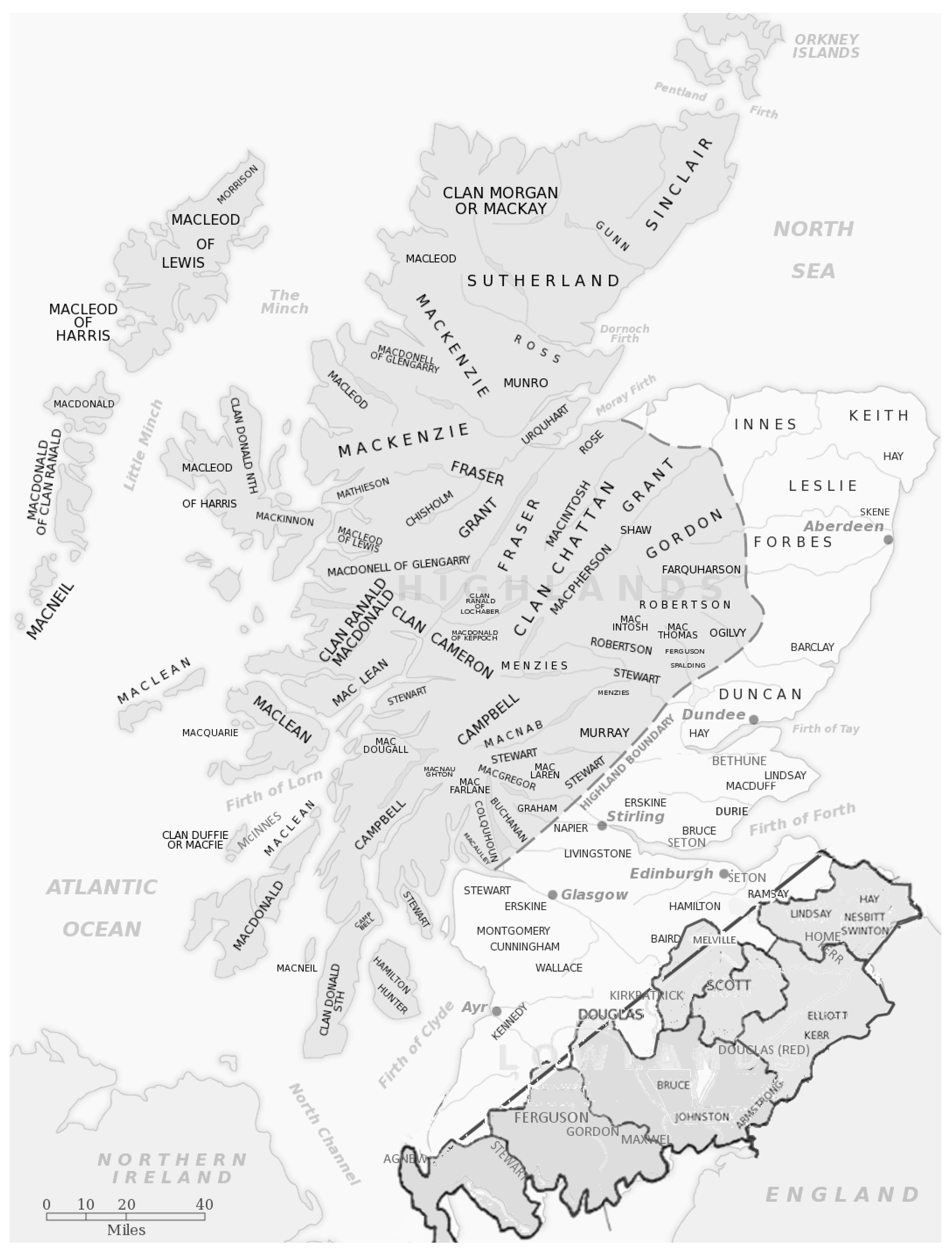
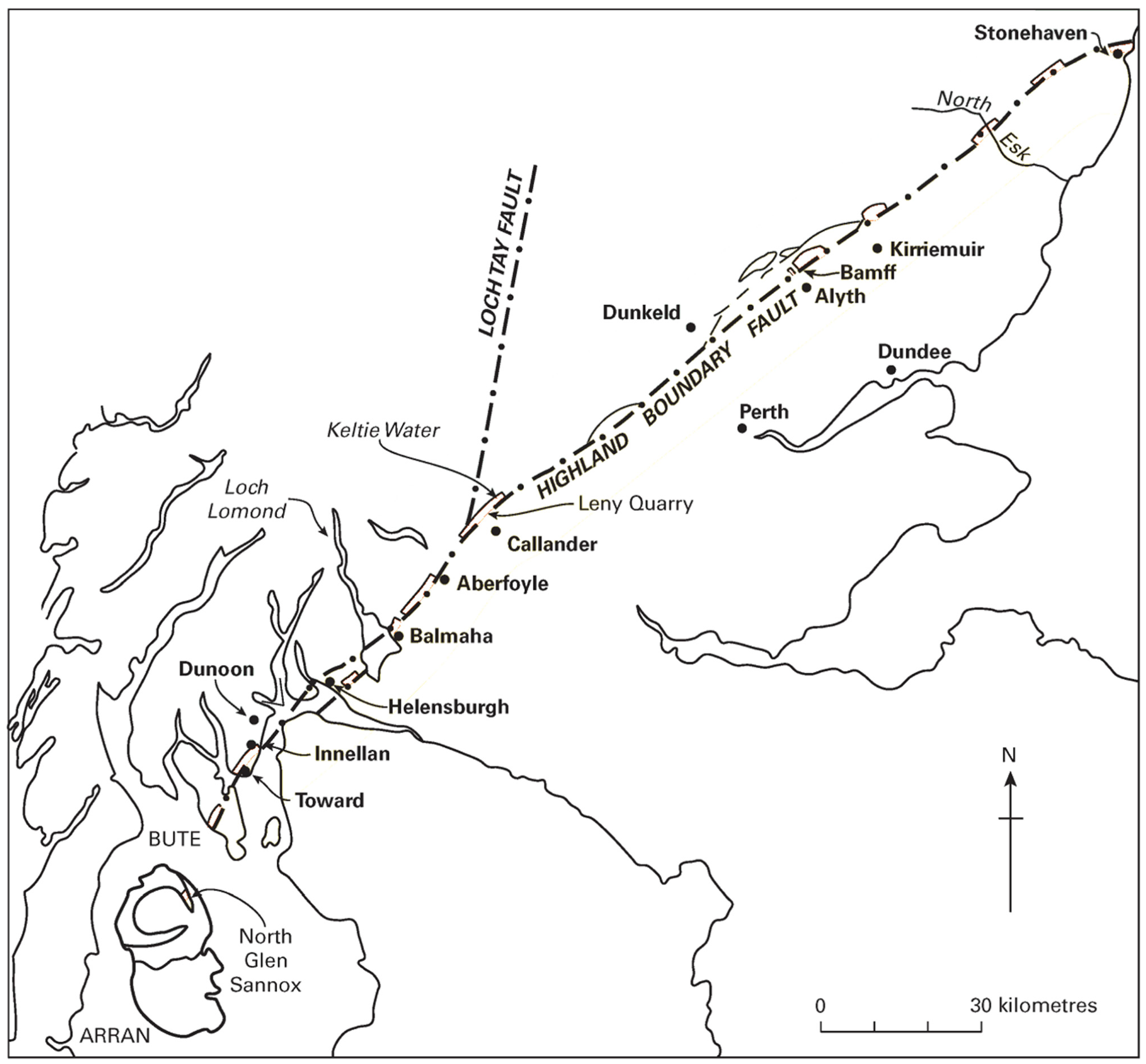
2.1.1. The Highland Boundary Fault
2.1.2. The North-East Anomaly

2.1.3. The Lowlands
2.1.4. The Borders, or Southern Uplands32
2.1.5. Dumfries & Galloway and the West March
2.1.6. Are the Lowlands and the Borders Considered to Be the Same?

| Webster 1755 | % | 1801 | % | 1811 | % | 1971 | % | 2022 | % | |
|---|---|---|---|---|---|---|---|---|---|---|
| Assuming Perth, Stirling and Aberdeen are half Highlands, half Lowlands | ||||||||||
| Highlands | 434,985 | 36 | 498,244 | 31 | 529,575 | 29 | 813,989 | 15 | 983,500 | 17 |
| Lowlands | 633,209 | 52 | 917,585 | 57 | 1,068,298 | 59 | 4,301,602 | 80 | 4,454,200 | 78 |
| Borders | 69,820 | 6 | 77,450 | 5 | 83,947 | 5 | 97,281 | 2 | 116,900 | 2 |
| Galloway | 76,859 | 6 | 106,726 | 7 | 117,385 | 7 | 143,191 | 3 | 145,900 | 3 |
| 1,214,873 | 100 | 1,600,005 | 100 | 1,799,204 | 100 | 5,356,062 | 100 | 5,700,500 | 100 | |
| Assuming Perth, Stirling are entirely in the Highlands | ||||||||||
| Highlands | 455,466 | 37 | 525,948 | 33 | 558,876 | 31 | 694,899 | 13 | 1,481,100 | 26 |
| Lowlands | 612,728 | 50 | 889,881 | 56 | 1,038,996 | 58 | 4,293,587 | 82 | 3,956,600 | 69 |
| Borders | 69,820 | 6 | 77,450 | 5 | 83,947 | 5 | 97,281 | 2 | 116,900 | 2 |
| Galloway | 76,859 | 6 | 106,726 | 7 | 117,385 | 7 | 143,191 | 3 | 145,900 | 3 |
| 1,214,873 | 100 | 1,600,005 | 100 | 1,799,204 | 100 | 5,228,958 | 98 | 5,700,500 | 100 | |
| H/L/B/G | County | Webster 1755 | 1801 | 1811 | Region | 1971 | Council Area | 2022 | |
|---|---|---|---|---|---|---|---|---|---|
| H | Argyll | 66,286 | 81,277 | 86,541 | Argyll | 59,777 | Argyll and Bute | 86,000 | H |
| H | Bute | 7125 | 11,701 | 12,033 | Bute | 13,309 | |||
| H | Caithness | 22,215 | 22,609 | 23,149 | Caithness | 27,792 | Highland | 235,400 | H |
| H | Inverness | 59,563 | 72,672 | 77,671 | Inverness | 89,655 | Na h-Eileanan Siar | 26,200 | H |
| H | Moray | 30,604 | 27,700 | 27,967 | Moray | 51,502 | Moray | 93,400 | H |
| H | Nairn | 5694 | 8322 | 8406 | Nairn | 11,050 | |||
| H | Orkney | 23,381 | 24,445 | 23,238 | Orkney | 17,082 | Orkney Islands | 22,000 | H |
| H | Ross and Croma;ty | 48,084 | 50,318 | 60,853 | Ross and Cromarty | 58,284 | |||
| H | Sutherland | 20,174 | 28,117 | 23,629 | Sutherland | 13,055 | |||
| H | Zetland | 15,210 | 22,379 | 22,915 | Zetland | 17,331 | Shetland Islands | 22,900 | H |
| H/L | Perth* | 120,116 | 125,583 | 134,300 | Perth | 127,104 | Perth + Kinross | 150,800 | H/L |
| H/L | Stirling* | 37,014 | 50,825 | 58,174 | Stirling | 208,958 | Stirling | 92,600 | H/L |
| H/L | Aberdeen | 116,168 | 121,000 | 133,871 | Aberdeen + City | 320,033 | Aberdeen + City | 751,800 | H/L |
| L | Angus | 68,883 | 99,053 | 107,187 | Angus + Dundee | 279,516 | Angus + Dundee | 262,500 | L |
| L | Ayr | 50,000 | 84,207 | 103,839 | Ayr | 361,248 | Ayrshire N + E | 365,300 | L |
| L | Banff | 38,478 | 37,216 | 38,433 | Banff | 43,500 | |||
| L | Clackmannan | 9003 | 10,858 | 12,010 | Clackmannan | 45,544 | Clackmannanshire | 51,800 | L |
| L | Dunbarton | 13,837 | 20,710 | 24,189 | Dunbarton | 237,540 | Dunbartonshire E + W | 197,400 | L |
| L | East Lothian | 29,709 | 29,986 | 31,050 | East Lothian | 55,908 | East Lothian | 112,300 | L |
| L | Fife | 81,570 | 93,143 | 101,272 | Fife | 327,126 | Fife | 370,400 | L |
| L | Kincardine | 23,057 | 20,349 | 27,439 | Kincardine | 26,066 | Falkirk | 158,400 | L |
| L | Kinross | 4889 | 6725 | 7245 | Kinross | 6423 | |||
| L | Lanark | 81,726 | 147,692 | 191,291 | Lanark + Glasgow | 1,524,271 | Lanarkshire N + S + Glasgow | 1,288,900 | L |
| L | Midlothjnn | 90,412 | 122,597 | 148,607 | Midlothian + Edinburgh | 595,798 | Midlothian + Edinburgh | 609,300 | L |
| L | Renfrew | 26,645 | 78,501 | 93,112 | Renfrew | 362,130 | Renfrewshire + Inverclyde | 359,000 | L |
| L | West Lothian | 16,829 | 17,844 | 19,451 | West Lothian | 108,484 | West Lothian | 181,300 | L |
| B | Berwick | 23,087 | 30,206 | 30,893 | Berwick | 20,778 | |||
| B | Peebles | 8008 | 8735 | 9935 | Peebles | 13,675 | Scottish Borders | 116,900 | B |
| B | Roxburgh | 34,704 | 33,121 | 37,230 | Roxburgh | 41,960 | |||
| B | Selkirk | 4021 | 5388 | 5889 | Selkirk | 20,868 | |||
| G+ | Dumfries | 39,188 | 54,597 | 62,900 | Dumfries | 88,215 | Dumfries and Galloway | 145,900 | G |
| G | Kirkcudbright | 21,205 | 29,211 | 33,684 | Kirkudbright | 27,639 | |||
| G | Wigtown | 16,466 | 22,918 | 20,801 | Wigtown | 27,337 | |||
| * Perth and Stirling are considered 50% H and 50% L | |||||||||
| + The counties of Galloway are a special case, neither H, L nor B | |||||||||
| Some Councils disappeared or were amalgamated in the consolidations of 1971, 1975 and 1996 e.g., | |||||||||
| Highlands, Borders, Dumfries and Galloway | |||||||||
| Some divided areas have been re-merged for this assessment. Such as: | |||||||||
| East, North and South Ayrshire, North and South Lanarkshire. | |||||||||
2.2. Populations—Highlands, Lowland, Borders, and Dumfries & Galloway
2.3. The Act of 1587 Differentiates Between the Highland & Islands, the Borders, and the Lowlands
later, it says (italics emphasis by BD):…considering the wicked inclination of the disordered subjects, inhabitants in some parts of the borders adjacent to England and in the highlands and isles…
and that letters shall be directed……to make them answerable to the law as the lowland and obedient men under the pains contained in the acts of parliament.
and makes reference to…by open proclamation at the market cross of the head burgh of the shire where they frequent, or head burghs of the two next shires in the lowlands (where there is clearly not safe access)…
…thieves or disobedient persons and clans that dare not come to public markets in lowlands
| The Borders—Middle March Armstrong Crosier Elliott Nixon The Borders—West March Bateson Bell Carruther(s) Glendinning Graham Irving Jardine Johnston Latimer Little Moffat Scotts of Ewesdale Thomson | Highlands and Isles Clan Andrew Buchanan Clan Cameron Campbell of Inverawe Campbell of Lochnell Clan Chattan Clan Donachie in Atholl and parts adjacent Clan Dowell of Lorne Ferguson Fraser Graham of Menteith Grant Clan Gregor Clan Ian Clan Kenzie Clan Kinnon Clan Laren | Clan Leod of Harris Clan Lewis of the Lewis MacFarlane, Arrochar MacIntosh in Atholl Clan MacKean of Ardvorlich MacNab Clan MacThomas in Glenshee Menzies in Atholl and Apnadull Munro Murray in Sutherland Clan Neil Clan Ranald in Lochaber Clan Ranald of Knoydart, Moidart and Glengarry Spalding Stewart of Balquhidder Stewart of Lorne or of Appin Stewarts of Atholl and parts adjacent |
2.4. Other Sources for List of Clans and Families
2.4.1. King George IV’s 1822 Visit to Scotland
2.4.2. Lists of Clans from Books
2.4.3. Problems with Such Lists
2.5. Standing Council of Scottish Chiefs (SCSC)
2.6. Towards a List of Clans and Families—See Table 11 and Table 12 for Attempt at Classification
- There are as many or more Lowland Families and surnames from the Borders and Dumfries and Galloway as there are from the Highlands (15 vs. 31 at LMG, 52 vs. 44 on COSCA, and at 44 vs. 48 at GFM;
- There are anomalies (see Appendix A) where either a surname has genuine representation as a Highland Clan and a Lowland Family (e.g., Fraser, Stewart) or is genuinely indeterminate or mixed as to seat and/or origin (Currie, Keith), or has conflicting documented status (MacDuff);
- No attempt has been made to settle the question as to whether surnames in the Borders are Clans (such as the “Riding Clans” or not), as many families did not behave in a “reiving” way and showed little or no Clan-type organisation. The 1587 Act does list some Borders surname as Clans, but not all. This is a subject for future work.
2.7. Armigerous Clans/Families
2.8. New Clans and Families—A Non-Exhaustive List
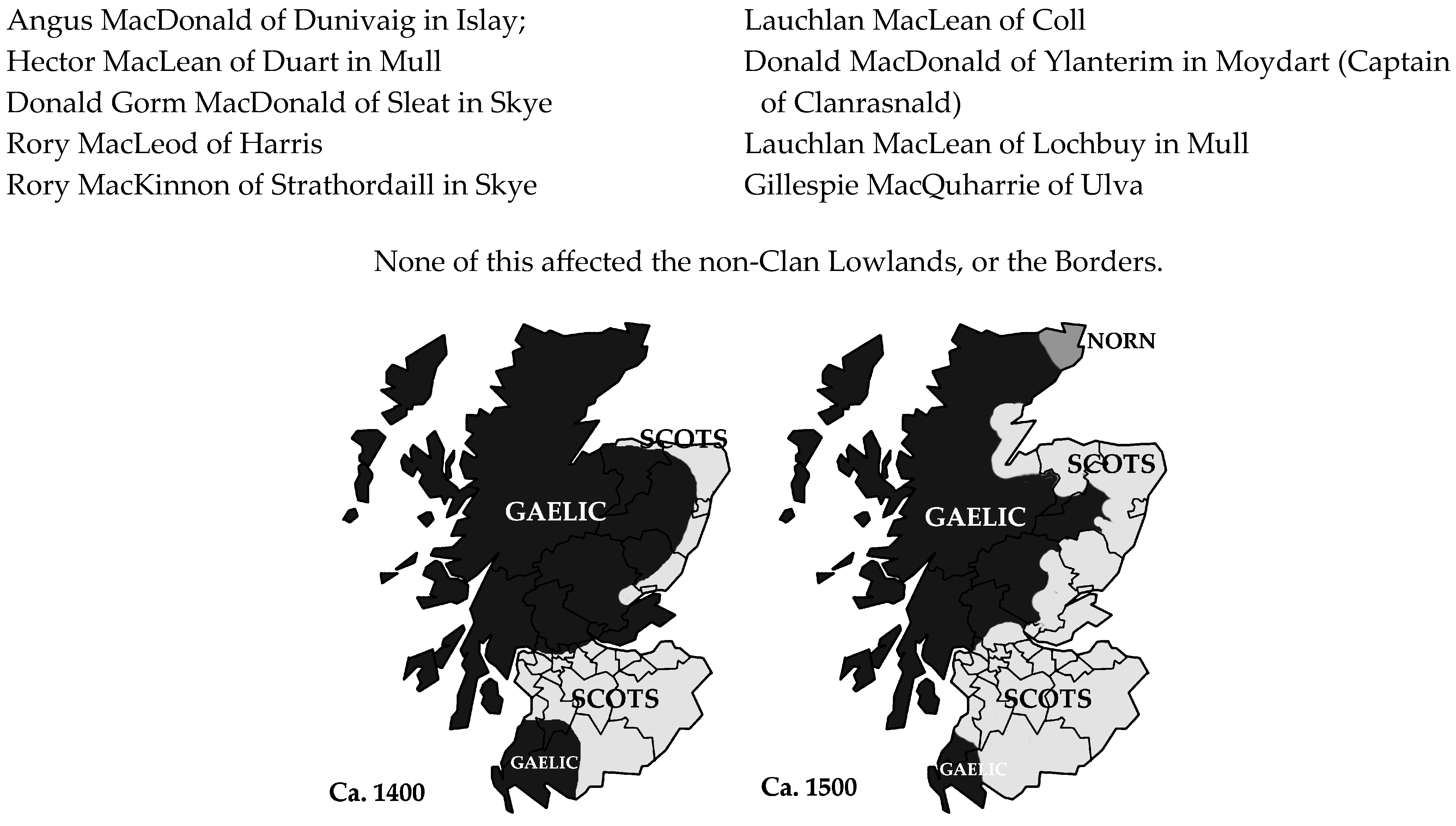
2.9. Gaelic vs. Scots Language
3. Discussion and Conclusions
3.1. Not Everyone in Scotland Is in a “Clan”
- Scotland consists only of the Highlands and the Borders (is Dundee, say, in Borders?) and that therefore clans were found all over Scotland;
- The distinction between clans and families is a “Victorian invention”—in fact it is the contrary, as before 1822 and the subsequent Highland Revival, Lowlanders wanted nothing to do with Clans and the Highlands, which were considered barbaric;
- Everyone is in a clan—the chief of one of the premier names in Scotland (Bruce) dismisses this, and many other historically prominent Lowland surnames feel the same.
3.2. There Are Tensions Around All This
3.3. The Need for a List
Funding
Institutional Review Board Statement
Informed Consent Statement
Data Availability Statement
Conflicts of Interest
Appendix A
- New Hampshire Highland Games & Festival, 19–21 September 2025 at Loon Mountain
Clans & Organizations Surname Seat Clan/Family Clan Anderson Society Anderson Indeterminate ? Armstrong Clan Society Armstrong Borders Clan Arthur Association, USA McArthur Highland Clan Clan Baird Society Worldwide, Inc. Baird Lowland Family Clan Bell North America Bell Borders Clan Bell Society Bell Borders House of Boyd Society Boyd Lowland Lowland Family of Bruce International Bruce Lowland Family Clan Buchanan Society International Inc. Buchanan Highland Clan House of Burnett Burnett Lowland Lowland Clan Campbell Society Campbell Highland Clan Clan Carnegie Society International Carnegie Lowland Family Clan Carruthers Society International Carruthers Borders Clan Chisholm International, US Branch Chisholm Highland Clan Clan Cochrane in North America Cochrane Lowland Family Clan Crawford Association Crawford Lowland Family Clan Cumming Society US Cumming Lowland Family Clan Cunningham International Cunningham Lowland Family Clan Davidson Society, USA Davidson Highland Clan Clan Donald USA MacDonald Highland Clan Clan Dunbar Dunbar Lowland Family Edmonstone Clan Society Edmonstone Lowland Family Clan Elliot Society USA Elliot Borders Ewing Family Association Ewing Lowland Family Clan Farquharson, USA Farquharson Highland Clan Clan Fleming Association Fleming Lowland Family Clan Fleming Scottish Society Fleming Lowland Family Clan Forbes Society, Inc. Forbes Lowland Family Clan Forrester Society, Inc. Forrester Lowland Family Clan Forsyth Society USA Forsyth Lowland Family Clan Fraser Society of North America Fraser* H/L Clan or Family Clan Galbraith Society Galbraith Lowland Family House of Gordon USA Gordon H/L/B House Clan Graham Society Graham Lowland Family Clan Grant Society-USA Grant- Highland Clan Clan Gunn Society of North America Gunn Highland Clan Clan Hannay USA Branch Hannay D/G Clan Hay Society—American Branch Hay Highland Clan Clan Henderson Henderson Lowland Family Clan Home Association Home Borders Clan Hope of Craighall Hope Borders Innes Clan Society Innes Lowland Family Clan Irving—The Border Irvings & Irvines Irving & Irvine Borders Clan Irwin Association Irwin Borders Joss/Joyce Family Joss/Joyce Family Ireland Clan Keith Society USA Keith H/L ? The Clan Keith Society USA, Inc. Keith H/L ? Kennedy Society of North America Kennedy Lowland Family Clan Kerr/Carr of the United States and North America Kerr Lowland Family Kerr Family Association of NA Kerr Lowland Family House of Kidd Society Worldwide Kidd Lowland House Clan Kirkpatrick Society Kirkpatrick Lowland Family Clan Lamont of North America Lamont Highland Clan Clan Lennox Lennox Lowland Family Clan Leslie Society International Leslie Lowland Family Leslie Global Diaspora Foundation Leslie Lowland Family Clan Little Society, Inc. Little Borders Clan Logan Society International Logan Lowland Family The Clan Logan Society International Logan Lowland Family House of MacAlpine MacAlpine Highland House MacAskill Sept Society MacAskill Highland Clan MacAulay Association MacAulay Highland Clan Clan MacCall (Caithness) MacCall Highland Clan Clan MacCord Society MacCord Highland Clan Clan MacDuff Society of America, Inc. MacDuff* Lowland MacDuffee Clan Society of America, Inc. MacDuffee* Highland Clan Clan MacEwen MacEwen Highland Clan Clan MacFarlane Worldwide, Inc MacFarlane Highland Clan Macfie Macfie* Highland Clan Clan MacFie Society of America MacFie* Highland Clan American Clan Gregor Society MacGregor Highland Clan International Association of Clan MacInnes MacInnes Highland Clan Clan MacIntyre Association MacIntyre Highland Clan Clan MacKenzie Society in the US MacKenzie Highland Clan Clan MacKinnon Society MacKinnon Highland Clan Clan MacLachlan Assoc of North America MacLachlan Highland Clan Clan MacLachlan Society of Western US MacLachlan Highland Clan Clan MacLaren Society of North America MacLaren Highland Clan Clan MacLean Association In the U.S. MacLean (Gillean) Highland Clan Clan MacLellan in America MacLellan Borders Clan MacLellan Worldwide MacLellan Borders Associated Clan MacLeod Societies MacLeod Highland Clan Clan MacNab Society International MacNab Highland Clan Clan MacNeil Association of North America MacNeil Highland Clan Clan MacNicol Society, Inc. MacNicol Highland Clan Clan MacQueen Society of America MacQueen Highland Clan Clan MacRae Society of North America MacRae Highland Clan Clan MacTavish MacTavish Highland Clan Clan MacThomas Society MacThomas Highland Clan Clan Maitland Society of North America Maitland Lowland Family Clan Maxwell Society Maxwell Lowland Family Clan McAlister of America McAlister Highland Clan Clan Moffat Society Moffat Borders Clan Montgomery Society International Montgomery Lowlands Family Morgan Sept of the Clan MacKenzie Morgan/MacKenzie Highland Clan Clan Morrison Society of North America Morrison Highland Clan Clan Muirhead Muirhead Lowland Family Murray Clan Society of North America Murray H/L ? Clan Napier in North America Napier Lowland Family Oliphant Clan and Family Association of North America Oliphant Lowland Family Clan Pollock International Pollock Lowland Family Clan Poole Poole Ireland Clan Rose Association, Inc. Rose Highland Clan Clan Rose International Rose Highland Clan Clan Ross of the United States Ross Highland Clan Clan Scott Society Scott Borders Clan Skene Association Skene Lowland Family Clan Somerville Family Association Somerville Lowland Family Clan Stewart Society in America Stewart H/L ? Clan Thom(p)son Society Thomson Borders Turnbull Clan Association Turnbull Borders Clan Urqhart Association Urqhart Highland Clan Clan Wardlaw Association Wardlaw Lowland Family Clan Watson Society Watson Lowland Family The Clan Watson Society Watson Lowland Family Clan Wood Wood Lowland Family Clan Young Society Young B/L Family Notes: *Fraser—there is a Highland Clan and a Lowland Family, *MacDuffee—Now part of Clan MacDubhsith, *Macfiee—Now part of Clan MacDubhsith, *MacFie—Now part of Clan MacDubhsith. *MacDuff (Fife and North-East) is not related to MacDuffe. MacDuffie, MacDuffy, etc. - The current membership list of COSCA, 2026
Clans & Organizations Surname Seat Clan/Family Clan Anderson Society Anderson Indeterminate Indeterminate Armstrong Clan Society Armstrong Borders Clan Arthur Association, USA McArthur Highland Clan Clan Baird Society Worldwide, Inc. Baird Lowland Family Clan Bell North America Bell Borders Clan Bell Society Bell Borders House of Boyd Society Boyd Lowland Lowland Family of Bruce International Bruce Lowland Family Clan Buchanan Society International Inc. Buchanan Highland Clan House of Burnett Burnett Lowland Lowland Clan Campbell Society Campbell Highland Clan Clan Carnegie Society International Carnegie Lowland Family Clan Carruthers Society International Carruthers Borders Clan Chisholm International, US Branch Chisholm Highland Clan Clan Cochrane in North America Cochrane Lowland Family Clan Crawford Association Crawford Lowland Family Clan Cumming Society US Cumming Lowland Family Clan Cunningham International Cunningham Lowland Family Clan Davidson Society, USA Davidson Highland Clan Clan Donald USA MacDonald Highland Clan Clan Dunbar Dunbar Lowland Family Edmonstone Clan Society Edmonstone Lowland Family Clan Elliot Society USA Elliot Borders Ewing Family Association Ewing Lowland Family Clan Farquharson, USA Farquharson Highland Clan Clan Fleming Association Fleming Lowland Family Clan Fleming Scottish Society Fleming Lowland Family Clan Forbes Society, Inc. Forbes Lowland Family Clan Forrester Society, Inc. Forrester Lowland Family Clan Forsyth Society USA Forsyth Lowland Family Clan Fraser Society of North America Fraser* H/L Clan or Family Clan Galbraith Society Galbraith Lowland Family House of Gordon USA Gordon H/L/B House Clan Graham Society Graham Lowland Family Clan Grant Society-USA Grant- Highland Clan Clan Gunn Society of North America Gunn Highland Clan Clan Hannay USA Branch Hannay D/G Clan Hay Society—American Branch Hay Highland Clan Clan Henderson Henderson Lowland Family Clan Home Association Home Borders Clan Hope of Craighall Hope Borders Innes Clan Society Innes Lowland Family Clan Irving—The Border Irvings & Irvines Irving & Irvine Borders Clan Irwin Association Irwin Borders Joss/Joyce Family Joss/Joyce Family Ireland Clan Keith Society USA Keith H/L ? The Clan Keith Society USA, Inc. Keith H/L ? Kennedy Society of North America Kennedy Lowland Family Clan Kerr/Carr of the United States and North America Kerr Lowland Family Kerr Family Association of NA Kerr Lowland Family House of Kidd Society Worldwide Kidd Lowland House Clan Kirkpatrick Society Kirkpatrick Lowland Family Clan Lamont of North America Lamont Highland Clan Clan Lennox Lennox Lowland Family Clan Leslie Society International Leslie Lowland Family Leslie Global Diaspora Foundation Leslie Lowland Family Clan Little Society, Inc. Little Borders Clan Logan Society International Logan Lowland Family The Clan Logan Society International Logan Lowland Family House of MacAlpine MacAlpine Highland House MacAskill Sept Society MacAskill Highland Clan MacAulay Association MacAulay Highland Clan Clan MacCall (Caithness) MacCall Highland Clan Clan MacCord Society MacCord Highland Clan Clan MacDuff Society of America, Inc. MacDuff* Lowland *MacDuff—Indeterminate MacDuffee Clan Society of America, Inc. MacDuffee* Highland Clan Clan MacEwen MacEwen Highland Clan Clan MacFarlane Worldwide, Inc MacFarlane Highland Clan Macfie Macfie Highland Clan Clan MacFie Society of America MacFie Highland Clan American Clan Gregor Society MacGregor Highland Clan International Association of Clan MacInnes MacInnes Highland Clan Clan MacIntyre Association MacIntyre Highland Clan Clan MacKenzie Society in the US MacKenzie Highland Clan Clan MacKinnon Society MacKinnon Highland Clan Clan MacLachlan Assoc of North America MacLachlan Highland Clan Clan MacLachlan Society of Western US MacLachlan Highland Clan Clan MacLaren Society of North America MacLaren Highland Clan Clan MacLean Association In the U.S. MacLean (Gillean) Highland Clan Clan MacLellan in America MacLellan Borders Clan MacLellan Worldwide MacLellan Borders Associated Clan MacLeod Societies MacLeod Highland Clan Clan MacNab Society International MacNab Highland Clan Clan MacNeil Association of North America MacNeil Highland Clan Clan MacNicol Society, Inc. MacNicol Highland Clan Clan MacQueen Society of America MacQueen Highland Clan Clan MacRae Society of North America MacRae Highland Clan Clan MacTavish MacTavish Highland Clan Clan MacThomas Society MacThomas Highland Clan Clan MacThomas Society MacThomas Highland Clan Clan Maitland Society of North America Maitland Lowland Family Clan Maxwell Society Maxwell Lowland Family Clan McAlister of America McAlister Highland Clan Clan Moffat Society Moffat Borders Clan Montgomery Society International Montgomery Lowlands Family Morgan Sept of the Clan MacKenzie Morgan/MacKenzie Highland Clan Clan Morrison Society of North America Morrison Highland Clan Clan Muirhead Muirhead Lowland Family Murray Clan Society of North America Murray H/L Indeterminate Clan Napier in North America Napier Lowland Family Oliphant Clan and Family Association of North America Oliphant Lowland Family Clan Pollock International Pollock Lowland Family Clan Poole Poole Ireland Clan Rose Association, Inc. Rose Highland Clan Clan Rose International Rose Highland Clan Clan Ross of the United States Ross Highland Clan Clan Scott Society Scott Borders Clan Skene Association Skene Lowland Family Clan Somerville Family Association Somerville Lowland Family Clan Stewart Society in America Stewart H/L ? Clan Thom(p)son Society Thomson Borders Turnbull Clan Association Turnbull Borders Clan Urqhart Association Urqhart Highland Clan Clan Wardlaw Association Wardlaw Lowland Family Clan Watson Society Watson Lowland Family The Clan Watson Society Watson Lowland Family Clan Wood Wood Lowland Family Clan Young Society Young B/L Family Notes: *Fraser—there is a Highland Clan and a Lowland Family, *MacDuffee—Now part of Clan MacDubhsith, *MacFie—Now part of Clan MacDubhsith, *Macfiee—Now part of Clan MacDubhsith. *MacDuff (Fife and North-East) is not related to MacDuffe. MacDuffie, MacDuffy, etc. - “Invited Scottish Clans & Societies” and “clans listed below will also be attending” at Grandfather Mountain Games, 2025
Invited Scottish Clans & Societies, 2025 Seat Clan/Family Anderson* Indeterminate Indeterminate Armstrong Borders Arthur Highland Clan Baird Lowland Family Bell Borders Blair Lowland Family Boyd Lowland Family Bruce Lowland Family Buchanan Highland Clan Burnett Lowland Family Cameron Highland Clan Campbell Lowland Family Carmichael Borders Chattan Highland Clan Cochrane Lowland Family Colquhoun Lowland Family Crawford Lowland Family Cunningham Lowland Family Currie* H/L Kindred Davidson Highland Clan Donald Highland Clan Donnachaidh/Robertson Highland Clan Douglas L/B Family Dunbar Lowland Family Elliott Borders Farquharson Highland Clan Ferguson H/L Clan Fleming Lowland Family Forbes Lowland Family Forrester Lowland Family Forsyth Lowland Family Fraser* H/L Clan or Family Galbraith Lowland Family Gordon H/L/B House Graham Lowland Family Gregor Highland Clan Gunn Highland Clan Guthrie Lowland Family Hamilton Lowland Family Hannay D/G Hay Highland Clan Henderson Lowland Family Home/Hume Borders Hunter Borders Innes Lowland Family Irwin Borders Johnston/e Borders Keith H/L ? Kennedy Lowland Family Kerr Lowland Family Kincaid Lowland House Kirkpatrick Lowland Family Lamont Highland Clan Leslie Lowland Family Lindsay Lowland Family Little Borders Logan Lowland Family MacAlister Highland Clan MacAlpine Highland House Macaulay Highland Clan MacBean Highland Clan MacCallum/Malcolm H/L ? MacDougall Highland Clan MacDuff* Lowland ? MacDuffee* Highland Clan MacEwen Highland Clan MacFarlane Highland Clan MacGillivray Highland Clan MacInnes Highland Clan MacIntyre Highland Clan Mackay Highland Clan MacKenzie Highland Clan Mackinnon Highland Clan Mackintosh Highland Clan MacLachlan Highland Clan MacLaine of Lochbuie Highland Clan MacLaren Highland Clan Maclean Highland Clan MacLellan D&G MacLennan Highland Clan MacLeod Highland Clan MacMillan Highland Clan Macnaghten Highland Clan Macneil Highland Clan MacPherson Highland Clan MacQueen Highland Clan MacRae Highland Clan MacTavish Highland Clan MacThomas Highland Clan Matheson Highland Clan Maxwell Lowland Family Moffatt Borders Montgomery Lowland Family Morrison Highland Clan Munro Highland Clan Murray H/L ? Napier Lowland Family Oliphant Lowland Family Pollock Lowland Family Ramsay Lowland Family Ranald Highland Clan Rose Highland Clan Ross Highland Clan Scott Borders Sinclair Lowland Family Skene Lowland Family Stewart H/L ? Sutherland Highland Clan Turnbull Borders Wallace Lowland Family Wardlaw Lowland Family Young B/L Family Note: *Anderson—this is a common name all over Scotland (“Andrew’s son” and not all Andersons are even vaguely related. *Currie—Composite of (H) MacMhurich and (L) Currie, *Fraser—there is a Highland Clan and a Lowland Family, *MacDuff—there is an early reference to “Clen MacDuff” even though it name is from Fife (Lowlands) and was transplanted to the Lowland North-East, *MacDuffee—Now part of Clan MacDubhsith.
| 1 | A Short History of the Ceres Highland Games, see http://www.ceresgames.co.uk/history.html, last accessed 25 October 2025. |
| 2 | On 1 July 1782, royal assent was given to the Use of Highland Dress Act 1782 (22 Geo. 3. c. 63), which lifted the ban. A proclamation issued in Gaelic and English announced: “This must bring great joy to every Highland Heart. You are no longer bound down to the unmanly dress of the Lowlander”. (It has to be said that the average Highlander took less to the wearing of tartan and “traditional Highland dress” than the chiefs and aristocrats who attended meetings of the Highland Society in London and similar exclusive bodies in Scotland—the loss of local weaving skills, the dominance of tartan weaving mills in the Lowlands, sheer economics and dispersal mitigated against a full return to “the garb of old Gaul”—see Prebble (1988), p. 106. |
| 3 | The Act of Proscription (19 Geo. 2. c. 39), also called the Act of Proscription 1746 or the Disarming the Highlands, etc. Act 1745, was an act of the Parliament of Great Britain, which came into effect in Scotland on 1 August 1746. It was part of a series of efforts to assimilate the Scottish Highlands, ending their ability to revolt, and the first of the “King’s laws” that sought to crush the Clan system in the aftermath of the Jacobite rising of 1745. The Act says: “…no man or boy, within that part of Great Briton called Scotland, other than shall be employed as officers and soldiers in his Majesty’s forces, shall on any pretence whatsoever, wear or put on the clothes commonly called Highland Clothes (that is to say) the plaid, philibeg, or little kilt, trowse, shoulder belts, or any part whatsoever of what peculiarly belongs to the highland garb; and that no tartan, or partly-coloured plaid or stuff shall be used for great coats, or for upper coats; and if any such person shall presume, after the said first day of August, to wear or put on the aforesaid garments or any part of them”. These laws were finally repealed on 1 July 1782. See also https://www.electricscotland.com/history/other/proscription_1747.htm (last accessed 26 March 2026). |
| 4 | For the record, “plaid” is a garment—a large rectangular woollen scarf or wrap in a tartan pattern worn over the left shoulder. It is not a synonym for the pattern, which is “tartan”. |
| 5 | The Braemar Gathering has operated in in its present form since 1832, but may have an earlier origin in the 11th century, when (apocryphally) Malcolm III King of Scots held a foot race to the summit of Craig Choinnich (overlooking Braemar) in order to find the fastest runner to be his royal messenger. See https://www.braemargathering.org/, last accessed 20 October 2025. |
| 6 | “Highland Games 101”. National Trust for Scotland Foundation USA, see https://ntsusa.org/highland-games/ last accessed 25 October 2025. |
| 7 | “Grandfather Mountain Highland Games Fast Facts”. See https://grandfather.com/highland-games-media/. Last accessed 12 July 2010. |
| 8 | “Scottish Games Draw Record Crowds”. The Independent. London, England. Last accessed 23 September 2015. |
| 9 | See https://www.glengarryhighlandgames.com/. Last accessed 13 November 2025. |
| 10 | Brigadoon at the Internet Movie DataBase (IMDB) database: https://www.imdb.com/title/tt0046807/ Last accessed 13 November 2025. |
| 11 | Braveheart at the Internet Movie DataBase (IMDB) database: https://www.imdb.com/title/tt0112573/ Last accessed 13 November 2025. |
| 12 | Outlander: https://www.starz.com/us/en/series/outlander/21796 Last accessed 13 November 2025. |
| 13 | Sir Harry Lauder: Biography on Undiscovered Scotland: https://www.undiscoveredscotland.co.uk/usbiography/l/sirharrylauder.html. Last accessed 26 November 2025. |
| 14 | Prime examples included The White Heather Club, broadcast by BBC TV from 1958 to 1968 and The Kilt is My Delight from 1957 to 1963: see https://en.wikipedia.org/wiki/The_White_Heather_Club Last accessed 13 November 2025. |
| 15 | The Lady of the Lake (Project Gutenberg version) is available in various formats at https://archive.org/details/ladylake09scotgoog/. Last accessed 3 March 2026. |
| 16 | See the details of an exhibition Scots on the Move: Railways and Tourism in Victorian Scotland (on display in the Adam Dome of General Register House, Edinburgh the summer of 2025) at https://www.nrscotland.gov.uk/learning-and-events/all-features-and-articles/scots-on-the-move-railways-and-tourism-in-victorian-scotland/. Last updated 4 December 2025. |
| 17 | The Highland Society of London Act 1816 (56 Geo. 3. c. xx) 21 May 1816. |
| 18 | The Royal Highland and Agricultural Society of Scotland. “The Society’s Foundation”. Available at https://rhass.org.uk/. s 20 September 2020. |
| 19 | See https://www.scotland.org/inspiration/scottish-clans. Last accessed 12 December 2025. |
| 20 | COSCA: Find My Clan: https://www.cosca.scot/clanlist. Last accessed 12 December 2025. |
| 21 | SHUSA (Scottish Heritage USA). See https://scottishheritageusa.org/. Last accessed 12 December 2025. |
| 22 | The website of the Lyon Court has much more information on all this, Arms granted, legal decisions regarding Chiefships and the like—https://courtofthelordlyon.scot/ Last accessed 26 March 2026. |
| 23 | “What is a clan?”. Court of the Lord Lyon. Archived from the original on 17 January 2008. http://web.archive.org/web/20080117201604/http://www.lyon-court.com/lordlyon/239.html. Retrieved 26 February 2008. |
| 24 | Scottish Government. ‘The role and functions of the Lord Advocate.’ https://www.gov.scot/publications/lord-advocate-role-and-functions/. Last updated 23 October 2024. |
| 25 | See http://www.buchananchief.org.uk/ and in particular the page describing ‘The Inauguration Celebration of The Buchanan’ This also shows the Lord Lyon and Officers in full ceremonial tabards etc. Last accessed 26 March 2026. |
| 26 | For a recent example of this, see ‘Clan MacEwen > Progress of Chiefship’ https://www.clanmacewen.com/chiefship Last accessed 26 March 2026. |
| 27 | Gàidhealtachd (pronounced gael-tacht) is usually translated as “Gaeldom”. |
| 28 | The most recent administrative sub-divisions of Scotland were established by the Local Government etc. (Scotland) Act 1994 (c. 39). Historic County names are no longer official, but are widely used—e.g., Perthshire, Wigtownshire, Banffshire—as here. |
| 29 | Statement of interest: the author was born in the Kingdom of Fife, lived most of his adult life there or in Edinburgh or in Glasgow, and is now in Aberdeenshire—all Lowlands. |
| 30 | See—www.bgs.ac.uk Last accessed 26 March 2026. |
| 31 | “Overview of Southern Uplands Fault”. Gazetteer for Scotland. The Institute of Geography, University of Edinburgh. Retrieved 20 August 2024. |
| 32 | Borders, The. Encyclopædia Britannica, vol. 4 (11th edition, 1911). |
| 33 | The word “grayn” is Middle English in origin, borrowed from Old Norse grein indicating an offshoot, branch or member of something. A Dictionary of the Older Scottish Tongue (up to 1700). See https://dsl.ac.uk/entry/dost/graine_n_2. Last accessed 26 March 2026. |
| 34 | See Scottish History Society volumes, Series 3, Scottish population statistics, including Rev. Alexander Webster’s Analysis of population, 1755. Available at the National Library of Scotland https://digital.nls.uk/126796467. Last accessed 26 March 2026. |
| 35 | Compiled from data available at https://www.nrscotland.gov.uk/statistics-and-data/ and https://statistics.gov.scot/. Last accessed 26 March 2026. |
| 36 | Act of the Scottish Parliament 1587/7/70 “For the quieting and keping in obedience of the disorderit subjectis, inhabitantis of the bordouris, hielandis and ilis”. See www.rps.ac.uk for the original Scots and an English translation. Last accessed 26 March 2026. |
| 37 | Translation from Scots to English: Chieftains and chiefs of all clans…dwelling in the Highlands or Borders. |
| 38 | For a well-known example, see Sir Crispin Agnew of Lochnaw, Clans, Families and Septs, www.electricscotland.com/webclans/clans_families_septs.htm 13 August 2001 (accessed 4 May 2013). |
| 39 | 1594/4/48 James VI: Parliamentary Register 8 June 1594 Available at NAS, PA2/15, f.39v-41r and at https://www.rps.ac.uk/. Last accessed 26 March 2026. |
| 40 | |
| 41 | “The garb of old Gaul”—Scott is not the only writer to conflate the words Gaul (the supposed Celtic heartlands in Europe), Gael (the generic name for the Irish and their descendants in the Highlands) and galla (originally meaning coward or female dog but indicating Lowlander or foreigner). The Garb of old Gaul became a popular song and pipe tune, written by General John Reid of the 42nd Regiment of Foot (The Black Watch) during the Seven Years’ War, with words by Sir Harry Erskine (1710–1765). See The Traditional Tune Archive, https://tunearch.org/wiki/Annotation:Garb_of_Old_Gaul_(The). Last accessed 12 November 2025. |
| 42 | Christian Matthias Theodor Mommsen (1817–1903) was a German classical scholar, regarded as one of the greatest classicists of the 19th century and recipient of the 1902 Nobel Prize in Literature for his historical writings, including the multi-volume History of Rome (published 1854–1856). See also The Roman Concept of Auctoritas https://highspeedhistory.com/2024/07/30/the-roman-concept-of-auctoritas/ last accessed 12 December 2025. |
| 43 | Durie, Bruce. Clans & Families/Durie, https://www.scsc.app/clans/durie Last edited 11 February 2026. |
| 44 | NH Highland Games & Festival: https://www.loonmtn.com/events/nh-highland-games. Last accessed 22 December 2025. |
| 45 | Council of Scottish Clans and Associations—Clans & Organizations: https://www.cosca.scot/members. Last accessed 22 December 2025. |
| 46 | Grandfather Mountain Highland Games—Invited Scottish Clans & Societies: https://gmhg.org/clansandsocieties/. Last accessed 22 December 2025. |
| 47 | There is a list of these at (for example) https://en.wikipedia.org/wiki/Clan_Anderson last accessed 3 January 2026, largely taken from Way and Squire (1994, p. 347, ff. Both authors have said that such a list was inserted against their better judgement, and at the behest of the then-publisher who felt it would increase the book’s salability (personal communications)). |
| 48 | See https://www.clanchiefs.org.uk/chiefs-clans-and-families/ last accessed 20 January 2026. |
| 49 | MacDubhsith is pronounced mac-vhoo-hee because of the Gaelic pronunciational principle known as “lenition”—see https://gaelicgrammar.org/~gaelic/mediawiki/index.php/Lenition last accessed 2 January 2026. |
| 50 | Scottish Gaelic or Gàidhlig is pronounced/ˈɡælɪk/ GA-lik in Scotland, but the Irish language Gaeilge is pronounced/ˈɡeɪlɪk/GAY-lik. |
| 51 | See http://clan-innes.org/septs.html last accessed 15 October 2025. Also, personal communications over the last 20 years. |
| 52 | See https://www.clan-forbes.org/ last accessed 15 October 2025. Also, personal communications over the last two decades. |
References
- Adam, Frank. 1960. The Clans, Septs and Regiments of the Scottish Highlands. Edinburgh and London: W&AK Johnston and GW Bacon. First published 1908, 6th ed. Edited by Thomas Innes 1960. [Google Scholar]
- Anderson, W. E. K., ed. 1972. The Journal of Sir Walter Scott. Oxford: Clarendon Press. [Google Scholar]
- Barbour, Johne. 1375. The Brus: From a Collation of the Cambridge and Edinburgh Manuscripts. Edited by Cosmo Innes. Aberdeen: The Spalding Club. Published 1856. [Google Scholar]
- Brendon, Piers. 2004. Cook, Thomas (1808–1892). In Oxford Dictionary of National Biography, online ed. Oxford: Oxford University Press. [Google Scholar] [CrossRef]
- Brown, Ian. 2012. Introduction: Tartan, Tartanry and Hybridity. In From Tartan to Tartany: Scottish Culture, History and Myth. Edinburgh: Edinburgh University Press, pp. 6–7. ISBN 978-0-7486-6464-1. [Google Scholar]
- Cathcart, Alison. 2010. The Statutes of Iona: The Archipelagic Context. Journal of British Studies 49: 4–27. [Google Scholar] [CrossRef] [Scilit]
- Durie, B. Clans. 2022. Families and Kinship Structures in Scotland. Genealogy 6: 88. [Google Scholar] [CrossRef] [Scilit]
- Durie, Bruce. 2024. Did John Lydgate Write the Original for the ‘Scotch Copy of a Poem on Heraldry’? Genealogy 8: 17. [Google Scholar] [CrossRef] [Scilit]
- Henderson, John. 1884. Caithness Family History. Edinburgh: D. Douglas. [Google Scholar]
- Horne, Marc. 2010. Highland games were the model for modern Olympics. The Times, April 25.
- Jackson, Kenneth. 1983. Loanwords, British and Pictish. In The Companion to Gaelic Scotland. Edited by D. S. Thomson. Oxford: Blackwell, pp. 151–52. [Google Scholar]
- Jamieson, John. 1998. “Blind Harry”. In Wallace; or, the Life and Acts of Sir William Wallace, of Ellerslie. Translated by William Hamilton. introduction by Elspeth King. Edinburgh: Luath Press. [Google Scholar]
- McIan, Robert Ronald, and James Logan. 1983. The Clans of the Scottish Highlands. London: Chancellor Press. First published 1845 and 1847, edition consulted 1983. [Google Scholar]
- Paterson, Michael Bennis. 2001. Selling Scotland: Towards an Intercultural Approach to Export Marketing Involving Differentiation on the Basis of ‘Scottishness’. Ph.D. dissertation, University of Glasgow, Glasgow, UK. [Google Scholar]
- Paul, James Balfour. 1910. The Scots Peerage; Founded on Wood’s Edition of Sir Robert Douglas’s Peerage of Scotland; Containing an Historical and Genealogical Account of the Nobility of that Kingdom. Edinburgh: David Douglas, vol. VII. [Google Scholar]
- Prebble, John. 1988. The King’s Jaunt: George IV in Scotland, August, 1822, “One and Twenty Daft Days”. London: Collins. [Google Scholar]
- Saint-Clair, R. W. 1898. The Saint-Clairs of the Isles; Being a History of the Sea-Kings of Orkney and Their Scottish Successors of the Sirname of Sinclair. Auckland: H. Brett. [Google Scholar]
- Scott, Walter. 1810. The Lady of the Lake. Edinburgh: John Ballantyne and Co. London: Longman. [Google Scholar]
- Twain, Mark. 1883. Life on the Mississippi. Boston: J. R. Osgood. [Google Scholar]
- Way, George, and Romilly Squire. 1994. Collins Scottish Clan & Family Encyclopedia. Glasgow: HarperCollins. [Google Scholar]
- Withers, Charles W. J. 1984. Gaelic in Scotland, 1698–1981. Edinburgh: John Donald Publishers Ltd. [Google Scholar]
- Wordsworth, Dorothy. 1803. Published 1874. Recollections of a Tour Made in Scotland Project Gutenberg Version. Available online: https://www.gutenberg.org/files/28880/28880-h/28880-h.htm (accessed on 5 January 2025).


| “inhabiting the highlands and isles” and “inhabiting the sheriffdoms of Argyll, Bute, Dunbarton, Stirling, Perth, Forfar, Aberdeen” and “and inhabiting the sheriffdoms of Argyll, Banff, Elgin, Forres, Nairn, Inverness and Cromarty, stewartries of Strathearn and Menteith”: | “inhabiting the borders opposite England in the sheriffdoms of Roxburgh, Selkirk, Peebles, Dumfries and stewartry of Annandale”: | |
| Cheilphale Clanandries Clancameron Clanchattan Clanchewill Clandonald south and north Clandonnachie, Clandowal Claneoin, Clanfarlane Clangilliane Clangregor Clangun Clankenzie Clankinnon Clanmaclaren Clanmacleod of Harris Clanmacleod of the Lewis Clanmorgan Clanneill Clanranald in Knoydart, Moidart and Glengarry Clanronald in Lochaber | and also many broken men of the surnames of: Buchanans Campbells Farquharsons in Brae of Mar Fergusons Frasers Galbraiths Grahams in Menteith Grants MacCalls MacIntoshes in Atholl MacNabbs MacNabrichis MacPhersons MacThomas in Glenshee Menzies Montroses Neilsons Rosses Spaldings Stewarts in Atholl, Lorne and Balquhidder | Armstrong Beatsons Bells Carlisles Carruthers Crosars Elliott Glendinnings Grahams Irvings Jardines Johnstons Latimers Littles Moffatts Nicolsons Thomsons, and others |
| Campbell MacDonald | MacIntosh MacKenzie | MacDougall MacLachlan | MacLeod Stewart (Stuart) |
| Abercromby Abernethy Arbuthnott Balfour Beattie Bellenden Berwick Blair Borthwick Campbell Chisholm | Cockburn Colville Dalrymple Douglas Douglas Dundas Elphinstone Erskine Farquharson Forbes Gordon | Graham Hamilton Hamilton Home Hope Johnstone Kennedy Ker Lindsay Livingstone Maitland | Maxwell Murray Murray Ogilvy Ramsay Scott Sinclair Stewart/Stuart Wemyss |
| Buchanan Cameron Campbell Campbell of Breadalbane Campbell of Cawdor Campbell of Loudoun Mackintosh Macpherson. Colquhoun Cumming* Davidson Drummond Farquharson Ferguson Forbes* Fraser Gordon Graham Grant Gunn | Innes* Lamont Leslie* Lindsay* MacAllister MacAulay MacArthur MacDonald MacDonald of Clanranald MacDonald of Ardnamurchan MacDonald of Glencoe MacDonell of Glengarry MacDonell of Keppoch MacDougall MacDuff MacFarlane Macfie MacGillivray MacGregor | Macinnes Macintyre Mackay MacKenzie Mackinnon Mackintosh MacLachlan Maclaine of Lochbuie MacLaurin Maclean Maclennan MacLeod of Harris MacLeod of Lewis Macmillan Macnab MacNaughton MacNeil Macpherson Macquarrie Macqueen | Macrae Malcolm Mar (Tribe of) Mathieson Menzies Munro Morison Murray Ogilvy Robertson (Donnachaidh) Ross Sinclair* Skene Stewart Stewart, Appin Stewart, Atholl Stuart, Bute Sutherland |
| Buchanan Cameron Campbell of Argyle Campbell of Breadalbane Chisholm Colquhon Cumin Davidson Drummond Farquharson Ferguson Forbes* Fraser Gordon Graeme Grant Grant of Glenmoriston Gunn Kennedy* | Lamond Logan* MacAllaster MacArthur MacAulay MacBean MacColl MacCruimin MacDonald of Clan Ranald MacDonald of Garagach and Keppoch MacDonald of Glencoe MacDonald of the Isles MacDonell of Glengarry MacDuff MacDugal MacGillivray MacGregor | MacInnes MacIntire Maclntosh MacIvor Mackay Mackenzie Mackinnon MacLachlan MacLaurin MacLean MacLennan ·MacLeod MacMillan MacNab MacNachtan MacNicol MacNiel MacPharlan MacPhee | MacPherson MacQuarie MacRae Matheson Menzies Munro Murray Ogilvie Robertson Rose Ross Shaw Sinclair* Skene Stewart Sutherland Urquhart |
| Name Agnew Anstruther Arthur Bannerman Barclay Borthwick Boyle Brodie Broun Bruce Buchanan Burnett Cameron Campbell Carmichael Carruthers Charteris Chisholm Cochrane Colquhoun Cranstoun Cunningham Dalrymple Dewar Drummond Dunbar | Dundas Crichton Durie Elliot Elphinstone Erskine Ewen Ewing Farquharson Forsyth Fraser Fraser Gordon Graham Grant Gunn Guthrie Haldane Hamilton Hannay Hay Henderson Hope Hunter Irvine Irving Jardine | Johnstone Kennedy Kerr Kincaid Lamont Leask Leslie Lindsay Lockhart Lumsden MacDonald of Clanranald Macdonald of Glengarry MacDonald of Keppoch MacDougall Macdonald of Macdonald Macdonald of Sleat Macdowall MacGillivray MacGregor MacIntyre Machlachlan Mackay Mackenzie | Mackintosh MacLaine MacLaren Maclea MacLean MacLennan Macleod of Raasay Macleod of the Lewes MacMillan Macnab Macnaghten Macneacail Macneil Macpherson MacTavish MacThomas Maitland Malcolm (MacCallum) Marjoribanks Matheson McBain Moffat Moncreiffe Montgomerie Morrison | Munro Napier Nesbitt Ogilvy Oliphant Pringle Ramsay Riddell Robertson Rollo Rose Ross Scott Scott of Harden Scrymgeour Sempill Shaw of Tordarroch Sinclair Skene Strange Sutherland Trotter Urquhart Wallace Wedderburn Wemyss |
| Armstrong Glendinning MacIan (MacDonald) Neilson Bateson/Beatson Latimer | MacKean of Ardvorlich Nickson/Nicolson/Nixon Bell Little MacKinnon Spalding | Carlisle MacAndrew MacPhail (Cheilphale) Stewart of Atholl and Glengarry Crosar/Crosier | MacCall Morgan Watson of Saughton Galbraith MacFarlane Murray in Sutherland |
| Family/House/Clan etc. | Chief | County | H/L/ B/DG | Chief in SCSC | Clan/ Family? | Named in 1587 or 1594 Acts? |
|---|---|---|---|---|---|---|
| Agnew | Sir Crispin Agnew of Lochnaw Bt. | Wigtownshire | DG | Yes | No | |
| Allardice | Richard Christopher Barclay Allardice of Allardice | Kincardineshire | L | No | Family | No |
| Anstruther | Toby Anstruther of that Ilk | Fife | L | Yes | Family | No |
| Arbuthnott | Keith Arbuthnott 17th Viscount of Arbuthnott | Aberdeenshire | L | No | Family | No |
| Arthur | John MacArthur of that Ilk | Wigtownshire | DG | Yes | No | |
| Bannerman | Sir David Bannerman of Elsick Bt. | Kincardineshire | L | Yes | Family | No |
| Barclay | Peter Barclay of that Ilk | Aberdeenshire | L | Yes | Family | No |
| Borthwick | The Lord Borthwick | Midlothian | L | Yes | Family | No |
| Boyd | Robin Jordan Boyd 8th Baron Kilmarnock | Ayrshire | L | No | Family | No |
| Boyle | The Earl of Glasgow | Ayrshire | L | Yes | Family | No |
| Brodie | Alexander Brodie of Brodie | Moray | H | Yes | Clan | No |
| Broun | Sir Wayne Broun of Colstoun Bt. | East Lothian | L | Yes | Family | No |
| Bruce | The Earl of Elgin & Kincardine K.T. | Fife | L | Yes | Family | No |
| Buchan | David Buchan of Auchmacoy | Aberdeenshire | L | No | Family | No |
| Buchanan | Michael Buchanan of that Ilk and Arnprior | Stirlingshire | H | Yes | Clan | Yes |
| Burnett | James Burnett of Leys | Aberdeenshire | L | Yes | Family | Yes |
| Cameron | Lord Cameron of Lochiel | Inverness-shire | H | Yes | Clan | Yes |
| Campbell | The Duke of Argyll | Argyll | H | Yes | Clan | No |
| Campbell of Cawdor | Colin Campbell, 7th Earl Cawdor | Nairn | H | No | Clan | No |
| Carmichael | Richard Carmichael of Carmichael | Lanarkshire | L | Yes | Family | No |
| Carnegie | David Carnegie, 4th Duke of Fife | Kincardineshire | L | No | Family | No |
| Carnegie | James Carnegie, Duke of Fife | Kincardineshire | L | No | Family | No |
| Carruthers | Dr Simon Peter Carruthers of Holmains | Dumfriesshire | DG | Yes | Yes | |
| Cathcart | Charles Alan Andrew Cathcart, 7th Earl Cathcart | Renfrewshire | L | No | Family | No |
| Charteris | The Earl of Wemyss and March | East Lothian | L | Yes | Family | No |
| Chisholm | Hamish Chisholm of Chisholm | Inverness-shire | H/B | Yes | Clan | No |
| Cochrane | The Earl of Dundonald | Renfrewshire | L | Yes | Family | No |
| Colquhoun | Sir Malcolm Colquhoun of Luss Bt. | Argyll & Bute | H | Yes | Clan | No |
| Colville | Charles Mark Townshend Colville, 5th Viscount Colville of Culross | Fife | L | No | Family | No |
| Cranstoun | David Cranston of that Ilk | Midlothian | L | Yes | Family | No |
| Crichton | David Crichton of that Ilk | Dumfriesshire | DG | Yes | No | |
| Cumming | Sir Alexander Penrose Gordon Cumming of Altyre, 7th Bt. | Angus | L | No | Family | No |
| Cunningham | Sir John Cuninghame of that Ilk, Bt | Ayrshire | L | Yes | Family | No |
| Dalrymple | The Earl of Stair | Ayrshire | L | Yes | Family | No |
| Darroch | Duncan Darroch of Gourock | Stirlingshire | L | No | Family | No |
| Davidson | Grant Guthrie Davidson, 3rd of Davidston | Ross and Cromarty | H | No | Clan | No |
| Dewar | Midlothian | L | Yes | Family | No | |
| Drummond | The Earl of Perth | Perthshire | H | Yes | Clan | No |
| Dunbar | Sir James Dunbar of Mochrum Bt. | Lothians, Wigtownshire | L/DG | Yes | Family | No |
| Dundas | David Dundas of Dundas | West Lothian | L | Yes | Family | No |
| Dunlop | James Stuart Wallace Dunlop, Dunlop of that Ilk | Ayrshire | L | No | Family | No |
| Durie | Andrew Durie of Durie, CBE | Fife | L | Yes | Family | No |
| Edmonstone | Sir Archibald Bruce Charles Edmonstone of Duntreath, 7th Bt | Stirlingshire | L | No | Family | No |
| Eliott | Madam Margaret Eliott of Redheugh | Roxburghshire | B | Yes | Yes | |
| Elphinstone | The Lord Elphinstone | East Lothian | L | Yes | Family | No |
| Erskine | The Earl of Mar And Kellie | Renfrewshire | L | Yes | Family | No |
| Ewing | Thor Ewing | Cowal, Dumbartonshire, Stirlingshire | H/L | Yes | Family | No |
| Farquharson | James Farquharson of Invercauld | Aberdeenshire | H | Yes | Clan | Yes |
| Fergusson | Charles Fergusson | Ayrshire | L | No | Family | Yes |
| Forbes | Malcolm Nigel Forbes, 23rd Lord Forbes | Aberdeenshire | L | No | Family | No |
| Forsyth | Alistair Forsyth of that ilk | Angus | L | Yes | Family | No |
| Fraser | The Lady Saltoun | Aberdeenshire | L | Yes | Family | Yes |
| Fraser | The Lord Lovat | Inverness-shire | H | Yes | Clan | No |
| Gordon | The Marquess of Huntly | Aberdeenshire | H | Yes | Clan | No |
| Graham | The Duke of Montrose | Angus | L | Yes | Family | Yes |
| Grant | The Lord Strathspey | Moray | H | Yes | Clan | Yes |
| Grierson | Madam Sarah Grierson of Lag | Dumfriesshire | DG | No | No | |
| Gunn | John Gunn of Gunn | Caithness | H | Yes | Clan | Yes |
| Guthrie | Alexander Guthrie of Guthrie | Angus | L | Yes | Family | No |
| Haig | Alexander Haig, Earl Haig | Roxburghshire | B | No | No | |
| Haldane | Martin Haldane of Gleneagles | Perthshire | L | Yes | Family | No |
| Hamilton | The Duke of Hamilton | Lanarkshire | L | Yes | Family | No |
| Hannay | David Hannay of Kirkdale and of that Ilk | Wigtownshire | DG | Yes | No | |
| Hay | The Earl of Erroll | various | H | Yes | Clan | No |
| Henderson | Alistair Henderson of Fordell | Fife | L | Yes | Family | No |
| Home | Michael David Alexander Douglas-Home, 16th Earl of Home | Berwickshire | B | No | No | |
| Hope | Sir Alexander Hope of Craighall Bt. | Fife | L | Yes | Family | No |
| Hunter | Madam Pauline Hunter of Hunterson | Ayrshire | L | Yes | Family | No |
| Irvine | Alexander Irvine of Drum | Aberdeenshire | L | Yes | Family | No |
| Irvine | Rupert Irving of Bonshaw | Dumfriesshire | D&G | Yes | Yes | |
| Jardine | Sir William Jardine of Applegirth Bt. | Dumfriesshire | D&G | Yes | Yes | |
| Johnstone | The Earl of Annandale and Hartfell | Dumfriesshire | D&G | Yes | Yes | |
| Keith | James William Falconer Keith, 14th Earl of Kintore | East Lothian, Aberdeenshire | L | No | Family | No |
| Kennedy | The Marquess of Ailsa | Ayrshire | L | Yes | Family | No |
| Kerr | The Marquess of Lothian | Midlothian | L | Yes | Family | No |
| Kincaid | Madam Arabella Kincaid of Kincaid | Dunbartonshire | L | Yes | Family | No |
| Lamont | Father Peter Noel Lamont | Argyll | H | Yes | Clan | No |
| Leask | Dr Jonathan Leask of that Ilk | Aberdeenshire | L | Yes | Family | No |
| Lennox | Edward Lennox of that Ilk | Dumbartonshire | L | No | Family | No |
| Leslie | The Hon. Alexander Leslie (representative) | Fife, Angus, the Mearns, Aberdeenshire | L | Yes | Family | No |
| Lindsay | The Earl of Crawford and Balcarres | Angus | L | Yes | Family | No |
| Lockhart | Ranald Lockhart of The Lee | Lanarkshire | L | Yes | Family | No |
| Lumsden | Gillem Lumsden of that Ilk | Berwickshire | B | Yes | No | |
| MacAlister | William St John Somerville McAlester of Loup and Kennox | Argyll, Ayrshire | H/L | No | Clan | No |
| MacAulay | Joan MacAulay | Argyll | H | No | Clan | No |
| MacDonald of Clanranald | The Captain of Clanranald | Argyll | H | Yes | Clan | Yes |
| Macdonald of Glengarry | Ranald Macdonell of Glengarry | Argyll | H | Yes | Clan | Yes |
| MacDonald of Keppoch | Ranald MacDonald of Keppoch | Argyll | H | Yes | Clan | No |
| Macdonald of Macdonald | The Lord Macdonald | Argyll | H | Yes | Clan | Yes |
| Macdonald of Sleat | Sir Ian Macdonald of Sleat Bt. | Argyll | H | Yes | Clan | Yes |
| MacDougall | Morag MacDougall of MacDougall | Argyll | H | Yes | Clan | No |
| Macdowall | Fergus Macdowall of Garthland | Renfrewshire | L | Yes | Family | No |
| MacGillivray | Iain MacGillivray | Inverness-shire | H | Yes | Clan | No |
| MacGregor | Sir Malcolm MacGregor of MacGregor Bt. | Argyll, Perthshire | H | Yes | Clan | Yes |
| MacIntyre | Duncan MacIntyre of Camus-na-h-Erie (Representative) | Argyll | H | Yes | Clan | No |
| Mackay | The Lord Reay | Sutherland | H | Yes | Clan | No |
| Mackenzie | The Earl of Cromartie | Ross and Cromarty | H | Yes | Clan | Yes |
| MacKinnon | Madam Anne MacKinnon of MacKinnon | Argyll | H | No | Clan | No |
| Mackintosh | John Mackintosh of Mackintosh | Inverness-shire | H | Yes | Clan | Yes |
| Maclachlan | Euan Maclachlan of Maclachlan | Argyll | H | Yes | Clan | No |
| MacLaine | Lorne Maclaine of Lochbuie | Argyll | H | Yes | Clan | No |
| MacLaren | Perthshire | H | Yes | Clan | Yes | |
| Maclea (Livingstone) | Niall Livingstone of Bachuil, Baron the Bachuil | Argyll | H | Yes | Clan | No |
| MacLean (Clangilliane) | Major the Hon. Sir Lachlan MacLean of Duart and Morvern Bt. | Argyll | H | Yes | Clan | Yes |
| MacLennan | Ruairidh MacLennan of MacLennan | Ross and Cromarty, | H | Yes | Clan | No |
| Macleod | Hugh Magnus MacLeod of MacLeod | Argyll | H | No | Clan | No |
| Macleod of Raasay | John Macleod of Raasay | Inverness-shire | H | Yes | Clan | Yes (of Harris) |
| Macleod of the Lewes | Torquil Macleod of the Lewes | Ross and Cromarty | H | Yes | Clan | Yes |
| MacMillan | George MacMillan of MacMillan and Knap | Argyll | H | Yes | Clan | Yes |
| Macnab | Jamie Macnab of Macnab | Perthshire, Stirlingshire | H | Yes | Clan | No |
| Macnaghten | Sir Malcolm Francis Macnaghten of MacNaghten Bt | Argyll | H | Yes | Clan | No |
| Macneacail | John Macneacail of Macneacail & Scorrybreac | Argyll (Skye/Lewis) | H | Yes | Clan | No |
| Macneil | Roderick Macneil of Barra | Argyll | H | Yes | Clan | Yes |
| Macpherson | James Macpherson of Cluny | Inverness-shire | H | Yes | Clan | Yes |
| MacTavish | Steven MacTavish of Dunardry | Argyll | H | Yes | Clan | No |
| MacThomas | Andrew MacThomas of Finegand | Perthshire | H | Yes | Clan | Yes |
| Maitland | The Earl of Lauderdale | Berwickshire | B | Yes | No | |
| Makgill | Ian Arthur Alexander Makgill, 14th Viscount of Oxfuird | Fife, Midlothian | L | No | Family | No |
| Malcolm (MacCallum) | Robin Malcolm of Poltalloch | Dumbartonshire, Stirlingshire, Argyll | H/L | Yes | No | |
| Marjoribanks | Andrew Marjoribanks of that Ilk | West Lothian | L | Yes | Family | No |
| Matheson | Major Sir Alexander Matheson of Matheson, Bt. | Ross and Cromarty | H | Yes | Clan | No |
| McBain | James McBain of McBain | Inverness-shire | H | Yes | Clan | No |
| McEwen | Sir John McEwen of Marchmont, Bt. | Argyll | H | Yes | Clan | No |
| McKenzie of Torry | Keith Ngamphon McKenzie of Torry | Argyll, Ross | H | No | Clan | No |
| Menzies | Robert Ronald Steuart Menzies of Menzies | Perthshire | H | No | Clan | Yes |
| Moffat | Madam Jean Moffat of that Ilk | Dumfriesshire | B | Yes | Yes | |
| Moncreiffe | The Hon. Peregrine Moncreiffe of that Ilk | Perthshire | L | Yes | Family | No |
| Montgomerie | The Earl of Eglinton & Winton | Ayrshire | L | Yes | Family | No |
| Morrison | Alasdair Morrison of Ruchdi | various | H/L | Yes | No | |
| Munro | Hector Munro of Foulis | Ross and Cromarty | H | Yes | Clan | Yes |
| Murray | Bruce Murray, Duke of Atholl | Perthshire | H | No | Clan | No |
| Napier | The Lord Napier & Ettrick | Midlothian | L | Yes | Family | No |
| Nesbitt | Mark Nesbitt of that Ilk | Berwickshire | B | Yes | No | |
| Nicolson | Adam Nicolson, 5th Baron Carnock | Stirlingshire | L | No | Family | No |
| Ogilvy | The Earl of Airlie | Angus | L | Yes | Family | No |
| Oliphant | Richard Oliphant of that Ilk | Angus, Perthshire | L | Yes | Family | No |
| Primrose | Neil Primrose, 7th Earl of Rosebery | Fife, West Lothian | L | No | Family | No |
| Pringle | Pringle of that Ilk and Stichill | Selkirkshire, Roxburghshire | B | Yes | No | |
| Ramsay | The Earl of Dalhousie | Midlothian | L | Yes | Family | No |
| Rattray | Alexander Rattray of Rattray | Perthshire | H | No | Clan | No |
| Riddell | Sir Walter John Buchanan Riddell Bt | various | L | Yes | Family | No |
| Robertson | Gilbert Robertson of Struan (Clan Donnachie in Atholl, etc.) | Perthshire | H | Yes | Clan | Yes |
| Rollo | The Lord Rollo | Perthshire | L | Yes | Family | No |
| Rose | Under consideration | Inverness-shire | H | Yes | Clan | No |
| Ross | Under consideration | Ross and Cromarty | H | Yes | Clan | Yes |
| Ruthven | Alexander Patrick Greysteil Ruthven, Earl of Gowrie | Perthshire | L | No | Family | No |
| Sandilands | James Andrew Douglas Sandilands, 15th Lord Torphichen | Lanarkshire | L | No | Family | No |
| Scott | The Duke of Buccleuch and Queensberry | Selkirkshire | B | Yes | Yes (of Ewesdale) | |
| Scott of Harden | Lord Polwarth | Roxburghshire | B | Yes | No | |
| Scrymgeour | The Earl of Dundee | Angus | L | Yes | Family | No |
| Sempill | The Lord Sempill | Renfrewshire | L | Yes | Family | No |
| Shaw of Tordarroch | John Shaw of Tordarroch (Clanchewill) | Inverness-shire | H | Yes | Clan | Yes |
| Sinclair | The Earl of Caithness | Caithness | H | Yes | Clan | No |
| Skene | Dugald Skene of Skene | Aberdeenshire | L | Yes | Family | No |
| Somerville | Dr. David C. Somerville | Lanarkshire | L | No | Family | No |
| Spens | Patrick Spens, 4th Baron Spens | Fife | L | No | Family | No |
| Stirling | Francis John Stirling of Cadder | Dunbartonshire, Stirlingshire | L | No | Family | No |
| Strange | Major Timothy Strange of Balcaskie | Fife | L | Yes | Family | No |
| Stuart of Bute | The Most Hon. John Crichton-Stuart, 7th Marquess of Bute | Argyll | H | No | Clan | No |
| Sutherland | The Earl of Sutherland | Sutherland | H | Yes | Clan | No |
| Swinton | Rolfe Swinton of That Ilk | Berwickshire | B | No | No | |
| Trotter | Henry Trotter of Mortonhall | Berwickshire | B | Yes | No | |
| Urquhart | Colonel Wilkins Urquhart of Urquhart | Ross & Cromarty | H | Yes | Clan | No |
| Wallace | Andrew Wallace of that Ilk | Ayrshire, Renfrewshire | L | Yes | Family | No |
| Wedderburn | Lord Scrymgeour | Angus | L | Yes | Family | No |
| Wemyss | Michael Wemyss of Wemyss | Fife | L | Yes | Family | No |
| Wood | Oonagh Elizabeth Susan Fawcett Wood of Largo | Fife, Angus | L | No | Family | No |
| H/L/B/D&G | No | % | Category | No | % |
|---|---|---|---|---|---|
| Lowland | 79 | 49% | Families with Chiefs | 80 | 47% |
| Highland | 62 | 39% | Clans with Chiefs | 65 | 38% |
| H/L (could be either) | 4 | 3% | B, D&G | 24 | 14% |
| B | 12 | 8% | SCSC | 127 | 75% |
| D&G | 3 | 2% | Not SCSC | 42 | 25% |
| LMG 2025 | COSCA 2026 | GFMG 2025 | |||
|---|---|---|---|---|---|
| Total | 45 | Total | 117 | Total | 112 |
| Listed as Clans | 43 | Listed as Clans | 104 | Listed as Clans | 112 |
| Actually Clans | 31 (72%) | Actually Clans | 44 (42%) | Actually Clans | 48 (43%) |
| Lowland families | 9 | Lowland families | 38 | Lowland families | 32 |
| Borders | 3 | Borders | 9 | Borders | 6 |
| Indeterminate | 3 | Indeterminate | 5 | Indeterminate | 6 |
Disclaimer/Publisher’s Note: The statements, opinions and data contained in all publications are solely those of the individual author(s) and contributor(s) and not of MDPI and/or the editor(s). MDPI and/or the editor(s) disclaim responsibility for any injury to people or property resulting from any ideas, methods, instructions or products referred to in the content. |
© 2026 by the author. Licensee MDPI, Basel, Switzerland. This article is an open access article distributed under the terms and conditions of the Creative Commons Attribution (CC BY) license.
Share and Cite
Durie, B. Towards a List of Clans and Families in Scotland—Identity Politics, Cultural Appropriation and Romantic Idealism. Genealogy 2026, 10, 44. https://doi.org/10.3390/genealogy10020044
Durie B. Towards a List of Clans and Families in Scotland—Identity Politics, Cultural Appropriation and Romantic Idealism. Genealogy. 2026; 10(2):44. https://doi.org/10.3390/genealogy10020044
Chicago/Turabian StyleDurie, Bruce. 2026. "Towards a List of Clans and Families in Scotland—Identity Politics, Cultural Appropriation and Romantic Idealism" Genealogy 10, no. 2: 44. https://doi.org/10.3390/genealogy10020044
APA StyleDurie, B. (2026). Towards a List of Clans and Families in Scotland—Identity Politics, Cultural Appropriation and Romantic Idealism. Genealogy, 10(2), 44. https://doi.org/10.3390/genealogy10020044