Previous Article in Journal
Introduction to “Identity in Flux: Intercultural Conflict and the Dynamics of Belonging”
 
 
Due to scheduled maintenance work on our servers, there may be short service disruptions on this website between 11:00 and 12:00 CEST on March 28th.
Article

Genealogy-As-Pedagogy for Afro-Descendant Communities in Costa Rica, Panama, and Belize


by
Dianala M. Bernard
College of Education, University of Arizona, Tucson, AZ 85721, USA
Genealogy 2026, 10(2), 40; https://doi.org/10.3390/genealogy10020040
Submission received: 13 January 2026 / Revised: 18 February 2026 / Accepted: 25 March 2026 / Published: 27 March 2026

Abstract

Intergenerational memories, migration histories, and the lasting influence of colonial linguistic systems profoundly shape heritage language maintenance in Afro-descendant communities of Central America. This study examines how genealogy functions as a pedagogical tool for sustaining English-based Creole languages among Afro-descendant populations in Costa Rica, Panama, and Belize, three nations linked by Afro-Caribbean migration yet shaped by distinct colonial and educational systems. Drawing on scholarship documenting oral histories, family narratives, and community-based linguistic practices, the study advances a genealogy-as-pedagogy framework to explain how families transmit language, identity, and belonging across generations through ancestral memory, positioning family-based knowledge transmission as curriculum. In Costa Rica and Panama, where Spanish colonial and post-independence language ideologies marginalize English-based Creole varieties, genealogical practices operate as primary mechanisms of linguistic continuity in the absence of sustained institutional support. In Belize, by contrast, British colonial legacies and the national recognition of Belizean Kriol create a distinct sociolinguistic environment in which state institutions, the media, and educational policy reinforce genealogical memory. Through comparative analysis, the study argues for integrating genealogical knowledge into multilingual education, community revitalization initiatives, and heritage language policy to strengthen Afro-descendant linguistic continuity in Costa Rica, Panama, and Belize.

1. Introduction

Across Central America, English-based Creole languages represent more than contact varieties formed through colonial labor, migration, and regional mobility. They also function as deeply rooted heritage languages sustained through family memory, kinship ties, and community life in Afro-descendant contexts (D. M. Bernard 2023a; Duncan 2024; Lipski 2022). In Costa Rica, Panama, and Belize, English-based Creole-speaking communities have long mobilized practices such as intergenerational storytelling, ancestral identity, and genealogical knowledge to transmit belonging, history, and language across generations, even when schooling and policy frameworks have not consistently recognized these Creole languages as legitimate forms of knowledge (Vásquez Carranza and Schlemer Alcântara 2023).
This analysis conceptualizes these practices as genealogy-as-pedagogy, in which the use of ancestral memory, lineage, migration history, and kinship identity is an intentional educational resource for cultural and linguistic continuity and a deliberate approach in initiatives to transfer to standard English forms (Rose 2025). Rather than positioning heritage-language transmission as a purely linguistic process, the framework emphasizes the pedagogical work performed in families, churches, community networks, and cultural spaces, where children learn how to speak, who they are, and where they come from (Fishman 1991; Spence Sharpe 2021). Genealogy operates as a structured intergenerational pedagogy (Hollebeke et al. 2022).
To ground this framework, the study develops a comparative analysis of three Central American country cases in which English-based Creole languages emerged through Afro-Caribbean and regional circulations but now exist under distinct institutional conditions. In Costa Rica and Panama, Spanish-dominant schooling and public language ideologies often limit formal recognition of English-based Creole varieties, placing greater responsibility for continuity on families and communities (Baird 2023; Lipski 2022; Vásquez Carranza and Schlemer Alcântara 2023). In Belize, by contrast, the official status of English and the broad public use of Belizean Kriol as a national vernacular create a more supportive ecology for everyday legitimacy and functional use (Decker 2014; Salmon and Gómez Menjívar 2019). Guided by this framework, the study considers the following three questions:
  • RQ1. How do Afro-descendant families and communities in Costa Rica, Panama, and Belize use genealogical memory, migration narratives, and kinship ties as pedagogical resources for sustaining English-based Creole languages across generations?
  • RQ2. How do schooling systems, policy environments, and dominant language ideologies shape whether genealogy-as-pedagogy functions as compensation for exclusion or reinforcement of heritage-language continuity?
  • RQ3. What do these cases reveal about the role of genealogical knowledge in designing historically and culturally sustaining and decolonial approaches to language and heritage-affirming education?
In reframing heritage-language continuity as an educational process, it advances a theoretical lens for understanding how communities negotiate genealogical knowledge, particularly where institutional support is uneven, and what this means for future language policy and historically and culturally sustaining educational practices. These insights also suggest the relevance of AI-supported educational approaches as a conceptual extension of genealogy-as-pedagogy, offering new ways to develop or strengthen English-based Creole languages within formal education while enabling initiatives for transfer to standard English without reproducing extractive or assimilationist language structures (Bonacina-Pugh 2025; Rose 2025).

2. Background and Related Work

The scale of Afro-Caribbean migration to Central America explains the persistence of English-based Creole varieties in Costa Rica, Panama, and Belize, where they remain rooted in family, church, and community life (Muhammad et al. 1996). Migrants from Jamaica, Barbados, Trinidad, and other British Caribbean territories arrived during the late nineteenth and early twentieth centuries as laborers on significant infrastructure projects, including Costa Rica’s railroad and the Panama Canal (LaBoda 2021; Nesbitt 2021). These migrations transmitted language, culture, and genealogical memory, embedding English-lexifier Creoles as markers of belonging in communities primarily along Caribbean coasts (Putnam 2013). Over time, English-based Creoles were maintained within Spanish-dominant environments in Costa Rica and Panama and within an Anglophone yet multilingual state framework in Belize (Nesbitt 2021; Spence Sharpe 2021). Dense coastal settlement patterns enabled intergenerational transmission despite limited state recognition or educational support in Costa Rica and Panama (Muhammad et al. 1996). As a result, language functioned as inherited cultural knowledge, aligning with the genealogy-as-pedagogy framework guiding this analysis (Fishman 1991; Fuller Medina 2021; Lipski 2022; Yakpo 2021).
These linguistic trajectories were shaped by colonial systems that defined legitimacy, citizenship, and schooling. In Costa Rica and Panama, Spanish has historically represented national unity and social respectability, with schools reinforcing monolingual norms and marginalizing non-Spanish languages (Wang and Hatoss 2024). Belize’s British colonial legacy, in contrast, established an Anglophone state in which English is the official language, while Belizean Kriol remains widely used along with Spanish (Mignolo and Walsh 2018). These contrasting systems form the comparative contexts for understanding genealogy-as-pedagogy experienced by Afro-Descendants in Central America. They also determine how communities experience linguistic legitimacy and how states position English-based Creole-speaking populations within national identity projects.
Across Central America, while English-based Creoles remain central to belonging, they are often positioned as nonstandard or unsuitable, constraining literacy development and linguistic confidence. Still, transmission continues in Afro-descendant communities (Bellón and Nieva 2024). In Costa Rica, Limonese Creole or Mekatelyu, for example, operates as an ancestral heritage language and a mechanism of cultural resistance in a Spanish-dominant society (Vásquez Carranza and Schlemer Alcântara 2023). With Panamanian English Creole, the language remains largely excluded from formal settings and policy, reinforcing hierarchies that privilege Spanish and standardized English. In Belize, Kriol is received differently, creating a distinct multilingual legitimacy structure (Schneider 2025).
Education policy ultimately determines whether heritage languages are validated or marginalized. Multilingual pedagogies can advance equity by recognizing students’ linguistic resources, while monolingual approaches reinforce hierarchy and exclusion (Rantanen 2024). When heritage languages are absent from education policy, their omission shapes teacher practice and students’ perceptions of what counts as legitimate knowledge (Bonacina-Pugh 2025; Wang and Hatoss 2024). Even limited recognition can strengthen linguistic legitimacy and expand domains of use (Bellón and Nieva 2024; Wang and Hatoss 2024).
Within a genealogy-as-pedagogy framework, schools either affirm intergenerational memory as knowledge or confine it to private life. Evidence from Afro-descendant education in Costa Rica shows that achievement improves when identity and community knowledge are treated as assets (D. M. Bernard 2023a, 2023b). An analysis of Indigenous education in Costa Rica through a Freirean lens demonstrates that schooling can either reproduce colonial epistemologies or foster liberatory learning through historically and culturally grounded pedagogy (D. M. Bernard 2024), reinforcing the case for multilingual education grounded in genealogical knowledge. As an extension of this argument, English-based Creole languages are carriers of identity, offering structurally complete linguistic systems, with phonological, morphological, syntactic, semantic, and pragmatic features that provide a solid foundation for principled transfer to standardized English instruction (Rose 2025).

3. Theoretical Framework

The concept of genealogy-as-pedagogy draws from Foucault’s genealogical method, which examines how power produces knowledge and identity through discourse (Rybińska 2016). Educational interpretations emphasize that families and communities teach through memory and lived experience rather than formal curricula (Luthérová 2023). This aligns with Sleeter’s (2020) critical family history, which situates personal narratives within broader histories of migration and inequality. Family stories, therefore, become meaning-making systems that link intimate experience to social history (Byrnes and Coleborne 2023), and in heritage language contexts, they operate as a curriculum through which younger generations inherit linguistic forms and their cultural significance (Inan and Harris 2025).
For the purposes of this study, culture is defined operationally rather than abstractly. Culture refers to intergenerational narrative practices, kinship-based memory transmission, ritual participation, naming systems, community linguistic norms, and institutional representations that shape how language and belonging are understood and enacted. Within this framework, culture is not an amorphous symbolic backdrop; instead, it is observable and documentable practices, as evidenced in oral histories, literary production, community archives, sociolinguistic descriptions, and policy texts. Thus, culture in this analysis is measured through its pedagogical function: how ancestral memory, language use, and lineage narratives are mobilized as structured knowledge systems that sustain heritage-language continuity across generations.
This reframing expands education beyond formal schooling. Families teach through storytelling, ritual, naming, and religious participation, transmitting dignity, origin, and linguistic legitimacy (Fishman 1991; Fuller Medina 2025). In Afro-descendant communities, such genealogical curricula embed English-based Creole within narratives of migration and pride (Duncan 2024; Vásquez Carranza and Schlemer Alcântara 2023). Student success increases when schools recognize this knowledge rather than marginalizing it (D. M. Bernard 2023a, 2023b). Where Creole is devalued, families mobilize memory to legitimize the use of heritage language (Fishman 1991; Fuller Medina 2025), echoing Freirean calls for historically grounded, community-centered learning (D. M. Bernard 2024).
Heritage language maintenance and continuity also depend on how genealogical pedagogy interacts with broader social ecologies. While Fishman (1991) identified intergenerational transmission as foundational, more recent research shows outcomes emerging from interactions among families, communities, and institutions (Wang and Hatoss 2024). Home-language choices are shaped by ideology and opportunity, while community environments such as churches and cultural associations sustain vitality (Bonacina-Pugh 2025; Fuller Medina 2025). Thus, genealogy-as-pedagogy functions across multiple scales linking households, communities, and national systems (Salmon and Gómez Menjívar 2019; Schneider 2025). Colonial linguistic orders continue to privilege standardized Spanish or English over Creole varieties (Mignolo and Walsh 2018), reinforcing the call for decolonial pedagogies that recognize community epistemologies as legitimate knowledge systems (Bilgory-Fazakas and Armon-Lotem 2025).
Another consideration in understanding heritage-language continuity is the role of translanguaging. Translanguaging provides a valuable lens for understanding how Afro-descendant families in Central America move fluidly across English-based Creole, standardized English, and Spanish in daily communication (Mendoza et al. 2023; Padilla et al. 2025). While this phenomenon has sometimes been described as code-switching—“the practice of alternating between languages or dialects within a conversation, plays a multifaceted role in multilingual contexts, particularly in education, communication, and cultural identity” (Ramaila 2025, p. 142)—the translanguaging perspective emphasizes that speakers are not merely alternating between separate, bounded languages, but instead drawing on a single, integrated linguistic structure as a unified resource for meaning-making, identity formation, and relationship building (Duncan 2024; Fuller Medina 2021; Lipski 2022; Ramaila 2025; Wang and Hatoss 2024).
Duncan’s (2024) trilingual narrative Dem tell mi se… They told me that… Me contaron que exemplifies translanguaging as a cultural and pedagogical practice. Rather than presenting English-based Creole, standardized English, and Spanish as separate linguistic systems, Duncan shows how these languages coexist as an integrated communicative structure through which memory, belonging, and Afro-Caribbean identity are expressed. Duncan’s work reflects how Afro-Costa Rican families move fluidly across languages in daily life, using translanguaging for communication, teaching history, affirming dignity, and sustaining genealogical continuity. The creative and intentional use of a three-language model for younger generations demonstrates that their full linguistic heritage is valid, meaningful, and central to who they are.
Across all three cases examined in this study, translanguaging is central to how children learn and to why particular language forms matter. However, its visibility and legitimacy vary by context (Jocelyn and Rose 2025). In Belize, translanguaging is widely audible in public life and increasingly normalized within education because English and Kriol are already closely related and embedded in national identity. In Costa Rica and Panama, translanguaging remains more regionally concentrated in Afro-Caribbean coastal communities and is less formally recognized in schooling, if at all, leaving families to sustain these practices without institutional validation. This variation underscores how genealogy operates as pedagogy through intergenerational narrative and memory, as well as through everyday multilingual practice and the broader social meanings attached to language use.
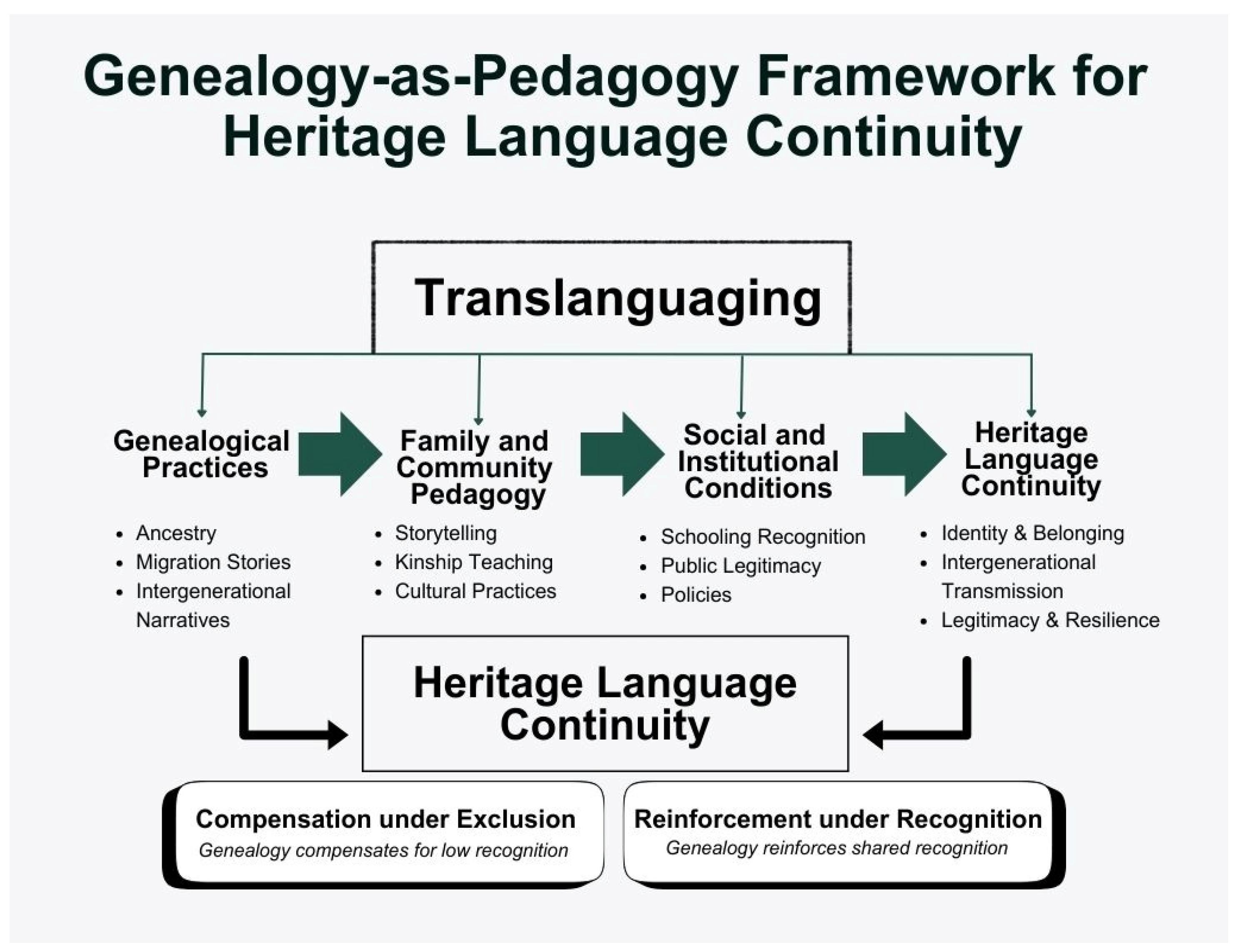
Conceptually, genealogy-as-pedagogy operates through translanguaging practices across three interacting levels that together sustain heritage language continuity. At the genealogical level, intergenerational memories and lineage narratives function as curriculum, anchoring speakers to histories of kinship, migration, and survival (Duncan 2024; Fishman 1991; Putnam 2013; Yakpo 2021). At the community and language-ecology level, family, religious, and cultural institutions shape whether Creole remains confined to private domains or circulates within schools, media, and civic life (Fuller Medina 2021; Lipski 2022).
At the institutional and policy level, colonial language structures embedded in national education systems shape recognition, legitimacy, and status (D. M. Bernard 2023a, 2023b, 2024). Across contexts, these interacting levels explain how genealogy-as-pedagogy compensates for exclusionary environments while reinforcing continuity where institutional support exists (Fishman 1991; Wang and Hatoss 2024). This multi-level interaction is reflected in Figure 1, which provides an analytic scaffold guiding comparative analysis across the three cases in the present study and supporting transferability to other contexts.
Building on this model, the study advances five interrelated propositions that guide the comparative analysis of Afro-descendant communities in Costa Rica, Panama, and Belize. Each proposition extends the theoretical logic of genealogy-as-pedagogy into the domains of language, education, and decolonial knowledge. These propositions structure the case analyses and support the cross-case comparison, explaining variation in heritage language continuity beyond a matter of family will and as the outcome of interaction among genealogical pedagogy, community language ecology, and broader colonial language structures (Yin 2017).
Proposition 1.
Genealogy-as-pedagogy functions as a compensatory mechanism in contexts of linguistic exclusion (Fishman 1991; Fuller Medina 2025; Wang and Hatoss 2024).
Proposition 2.
Institutional recognition amplifies genealogical transmission rather than replacing it (Bellón and Nieva 2024; Salmon and Gómez Menjívar 2019; Schneider 2025; Wang and Hatoss 2024).
Proposition 3.
Genealogical pedagogy transforms memories into curriculum (Byrnes and Coleborne 2023; Sleeter 2020).
Proposition 4.
Integrating genealogical knowledge is essential to decolonial educational practice (Duncan 2024; Mignolo and Walsh 2018).
Proposition 5.
Genealogy-as-pedagogy is sustained through migration-linked kinship networks (Putnam 2013; Wang and Hatoss 2024).

4. Materials and Methods

This study uses a comparative, literature-based document analysis design to examine genealogical pedagogy in heritage language maintenance and continuity in Afro-descendant communities in Costa Rica, Panama, and Belize. Document analysis is appropriate for exploring how ideas, practices, and institutional conditions appear in published texts and narratives, particularly in contexts where lived practices are embedded in collective memory rather than formal schooling structures, allowing for tracing patterns of continuity, exclusion, and resistance without introducing new human participant data (Bowen 2009; Danilović 2022; Morgan 2022). Each country is treated as a bounded case shaped by its colonial language structure, with findings interpreted through organized cross-case comparison (Creswell and Poth 2018; Yin 2017).
The design is nonintrusive and synthesizes existing sources rather than collecting new participant data, aligning with case study scholarship that emphasizes clearly defined temporal, social, and linguistic boundaries in multilingual and postcolonial contexts (Adams et al. 2022; Stake 2006). The analysis is grounded in constructivist and experiential learning theory, framing genealogy as identity-based learning through reflection, story, and cultural memory (Kolb 1984; McLeod 2025). Constructivism, as articulated by Vygotsky (1978), refers to a socially mediated process in which knowledge is actively constructed through interaction, language, and culturally situated meaning-making. Experiential learning, drawing on Kolb’s (1984) model, conceptualizes learning as a process involving lived experience, reflective observation, conceptual understanding, and active meaning-making.
Decolonial and intercultural scholarship further informs interpretation by foregrounding ancestral knowledge, embodiment, and place as learning resources (Mignolo and Walsh 2018; Nay 2025; Tito-Sanches and De Sousa Cordeiro 2025). These perspectives criticize Eurocentric education systems and highlight tensions between institutional structures and community epistemologies (Arias-Gutiérrez and Minoia 2023). The comparative design follows Yin’s (1994, 2017) cross-case pattern logic, extended through Adams et al. (2022) and Stake’s Quintain approach to synthesize within-case and cross-case patterns, bridging scholarly and community knowledge (Mignolo and Walsh 2018), positioning genealogy-as-pedagogy in cultural and language continuity and policy critique.
To operationalize this framework, a purposive documentary corpus was constructed for each national case. Appendix C summarizes key sources by country, coded by document type and analytic contribution. The intent was not to compile an exhaustive archive, but to develop a representative, evidence-based sampling to explain the genealogical, sociolinguistic, and educational processes shaping heritage-language continuity. Sources were selected to ensure coverage across four analytic domains: (a) historical–genealogical accounts documenting Afro-Caribbean migration, kinship formation, and settlement; (b) sociolinguistic research on English-based Creole structures and language contact; (c) education and policy texts shaping language recognition and legitimacy; and (d) community-based and cultural materials reflecting lived experiences. The selection continued until conceptual saturation was reached, meaning that additional documents reinforced rather than altered the interpretive categories guiding genealogy-as-pedagogy.
Document significance extended beyond neutral background sources to analytic evidence that enables the identification and comparison of genealogical pedagogy across contexts. Historical–genealogical texts were examined for explicit references to lineage transmission, migration narratives, and kinship-based identity formation. Sociolinguistic research was analyzed for structural descriptions, domains of language use, and evidence of maintenance or shift. Education and policy texts were coded for recognition, omission, or marginalization of English-based Creoles within curricular and institutional frameworks. Community and cultural materials were analyzed for representations of language as identity, memory, and belonging. Across these domains, evidence was interpreted comparatively to assess whether genealogy-as-pedagogy functioned primarily as compensation for institutional exclusion or as reinforcement within supportive ecologies. This analytic logic guided the cross-case pattern matching presented in Section 5, Section 6, Section 7 and Section 8 and summarized in Appendix A.
The corpus includes five categories of documents to capture family, community, institutional, and pedagogical perspectives on language maintenance:
Published oral histories and documented narratives were used as sources of genealogical discourse rather than as raw linguistic corpora. The analytic focus was not on phonetic transcription accuracy or conversational frequency counts but on how intergenerational memory, lineage, and language were represented as pedagogical resources. Qualitative scholarship recognizes that recorded narratives, while shaped by documentation contexts, function as culturally authoritative accounts of memory and identity formation when analyzed interpretively (Bowen 2009; Braun and Clarke 2021). In this study, works such as Duncan (2024) were examined as structured narrative expressions of genealogical transmission, with genealogical discourse serving as the primary unit of analysis. To mitigate potential bias, oral-history materials were triangulated with peer-reviewed sociolinguistic scholarship, policy documents, and community archives, thereby strengthening interpretive credibility and ensuring that genealogical patterns identified in published narratives aligned with broader empirical research on language use and maintenance.
The inclusion criteria ensured direct relevance to genealogy-as-pedagogy and to heritage language maintenance and continuity. Research published from 2005 to 2025 was prioritized, with seminal theoretical works also included (Bowen 2009; Fishman 1991; Kolb 1984; Vygotsky 1978). Sources addressed Limonese Creole or Mekatelyu, Panamanian English-based Creole, or Belizean Kriol and focused on Costa Rica, Panama, or Belize, including Spanish-language scholarship when applicable. Additionally, relevance required engagement with written family narratives, community practices, schooling, language ideology, or policy. Also, searches combined targeted keywords with citation chaining, including regional and comparative sources (Yin 2017). Triangulation of the sources strengthened the credibility and trustworthiness of the cross-case analysis (Braun and Clarke 2021; Nowell et al. 2017). Appendix C, therefore, reflects the empirical base for the study’s interpretation of genealogy-as-pedagogy across the three contexts.
The analysis occurred in three phases. First, documents were thematically coded to identify recurring ideas about genealogy, language transmission, institutions, and identity using reflexive thematic analysis (Braun and Clarke 2006, 2021). Second, cross-case matrices supported pattern matching against theoretical propositions (Yin 2017). Third, colonial language contexts were treated as explanatory variables shaping legitimacy and domains of use, consistent with decolonial theory (Mignolo and Walsh 2018). Of importance to understand is that heritage language continuity cannot be understood apart from the historical power relations that structure which languages are legitimized, marginalized, or rendered invisible.
Guided by the propositions, the analysis accounts for how genealogy-as-pedagogy operates within the three contexts of Costa Rica, Panama, and Belize. Each case is treated as a bounded sociolinguistic environment shaped by Afro-Caribbean migration, colonial language structures, and contemporary educational practice (Creswell and Poth 2018; Yin 2017). The purpose is not to compare language systems in the abstract, but to analyze how genealogical pedagogy interacts with community ecologies and institutional recognition to sustain the continuity of heritage languages. The cases, therefore, are presented as applied illustrations of the conceptual model presented in Figure 1, showing where genealogy compensates for exclusion and where it operates as reinforcement (Appendix A).

5. Case 1: Costa Rica

Afro-Costa Rican communities, primarily in Limón, are shaped by Afro-Caribbean migration, coastal settlement, and kinship networks in which genealogy is carried through family narratives of movement, labor, and community building shared in homes, churches, and local institutions (Duncan 2024; Putnam 2013; Ravasio 2020, 2021; Telles et al. 2020). Historical documents show that the recruitment of Jamaican and other Afro-Caribbean workers by American Minor Cooper Keith for railroad and banana enterprises created a dense Black English-speaking population, with the 1927 census recording that 55 percent of Limón’s residents were first-language English speakers and 37 percent were Spanish speakers (LaBoda 2021). Company schools, Protestant churches, and English-language newspapers reinforced these practices while mobility controls and racialized governance constrained Afro-Caribbean movement to the rest of the country (Herzfeld 2015; Putnam 2002).
Recent scholarship further shows that Afro-descendant life in Limón has long existed in tension with national narratives that privilege mestizo and Hispanicized identity formations, rendering Afro-Caribbean histories simultaneously critical to Costa Rica’s nation-building initiatives and marginalized (Baird 2023; Ravasio 2021; Telles et al. 2020). These tensions persist in the present, where cultural belonging and linguistic legitimacy must often be defended in public discourse and in school settings (Bell Jiménez 2020; Ravasio 2020). In some cases, Afro-descendant activism and cultural reclamation movements increasingly frame Mekatelyu as a symbolic anchor of Black identity and resistance to cultural erasure (Pizarro Chacón and Cordero Badilla 2015; Vásquez Carranza 2025).
Costa Rica’s Afro-Caribbean intellectual tradition further illustrates how genealogy operates as pedagogy. Rothe (2024) points to criticality and the dynamic relationship between written and oral forms of expression in literary works such as poetry, novels, and theater, as well as across different music genres. With the works by Afro-descendant authors such as Eulalia Bernard’s My Black King by (E. Bernard 1991), Shirley Campbell Barr’s Rotundamente Negra (Campbell Barr 2021) and Quince Duncan’s La Paz del Pueblo (Duncan 2013), have chronicled the lived experiences, migrations, and linguistic practices of Afro-Costa Rican communities, preserving memory as a form of cultural and educational continuity (Joseph Montout 2013; Rothe 2024). Their narratives document how storytelling, kinship knowledge, and community history shape the legitimacy and emotional meaning of Limonese Creole as a heritage language, reinforcing the intergenerational role of genealogy in sustaining cultural and linguistic identity.
Therefore, Mekatelyu emerges as an English-lexifier heritage language rooted in Afro-Caribbean lineages and regional belonging (Instituto de Investigaciones Lingüísticas 2024; Joseph-Haynes et al. 2021; Spence Sharpe 2021). Sociolinguistic research reveals a stratified system in which Spanish indexes national belonging, mainstream English indexes mobility and tourism, and Mekatelyu indexes Afro-Costa Rican identity and cultural memory, even as discourse labels it “broken English” (Aguilar-Sánchez 2005; LaBoda 2021). Scholars emphasize that these deficit narratives reflect broader racialized ideologies that historically positioned Afro-Caribbean languages as inferior (Lipski 2022; Telles et al. 2020). At the same time, work in Afro-Costa Rican studies situates Mekatelyu within a broader Caribbean Creole continuum, challenging the myth of Costa Rica as a monolingual nation (Schmalz and Meer 2023).
From a genealogy-as-pedagogy perspective, families and communities in Limón are the primary curriculum makers. They are the elders who transmit Mekatelyu through everyday routines, intergenerational stories of migration and work, and community practices that teach why the language matters and what it represents when institutions do not fully recognize its value (Joseph-Haynes et al. 2021; Pizarro Chacón and Cordero Badilla 2015; Universidad de Costa Rica [UCR], Facultad de Ciencias Sociales 2025). Church networks and cultural events create intergenerational spaces. Narrative-based inheritance is especially significant in Limón because racialized stereotypes in national discourse have often dismissed Afro-descendant contributions (Organization of American States (OAS) n.d.; UNESCO 2022; United Nations 2025). These genealogical practices operate as everyday acts of self-definition within a country that has historically emphasized Spanishness, rooted in identification with Spain, as the normative cultural ideal (Ravasio 2021).
Decisions about transmission are negotiated within a hierarchy that associates Spanish with national legitimacy, mainstream English with opportunity, and Mekatelyu with racialized Afro-Caribbean identity, leading some parents to prioritize dominant codes while others insist on maintaining Mekatelyu as an affirmation of Black/Afro-Costa Rican continuity and resistance (Solano-Campos 2022; Vásquez Carranza and Schlemer Alcântara 2023). Questions of authenticity and linguistic ownership also arise when Spanish-identified Costa Ricans (Paña) speak Mekatelyu, crossing an ethnolinguistic boundary historically tied to Afro-Caribbean ancestry, surnames, and kinship networks (Bartens as cited in Schoch Angel 2021). These dynamics underscore that linguistic legitimacy is continually negotiated through ancestry, proximity, and community recognition, which increases the genealogical weight of transmission within Black families (Bell Jiménez 2020; Vásquez Carranza 2025).
Schooling and policy frameworks in Costa Rica are organized around Spanish as the normative language of instruction and national identity, with English positioned as a foreign or second language for competitiveness, and Creole varieties such as Mekatelyu excluded from formal curricular recognition or protection as heritage languages altogether (Bell Jiménez 2020; Spence Sharpe 2021; UNESCO 2022). Heritage language theory suggests that such exclusion narrows the formal domains of Mekatelyu and signals that it belongs in informal or private spaces, constraining intergenerational maintenance (Fishman 1991; Vásquez Carranza 2025; Vásquez Carranza and Schlemer Alcântara 2023). Further, International monitoring reports further note that Afro-descendant children often experience educational invisibility when their histories and languages are not incorporated into curriculum design, reinforcing the need for historically and culturally sustaining approaches (Organization of American States (OAS) n.d.; Ravasio 2020; United Nations 2025).
As a result, genealogical pedagogy in the Costa Rica case operates mainly as a compensatory mechanism: families and communities shoulder the responsibility of sustaining language (Joseph-Haynes et al. 2021; Vásquez Carranza 2025; Vásquez Carranza and Schlemer Alcântara 2023). This aligns with broader scholarship demonstrating that Afro-descendant survival strategies across Latin America rely heavily on family-based cultural transmission when formal institutions fail to affirm Black identity (Baird 2023; Telles et al. 2020). Recognizing Mekatelyu as a legitimate heritage language within education policy and curriculum would validate Afro-descendant knowledge systems and provide a meaningful linguistic bridge that could support students’ development of standard English while affirming their genealogical and cultural continuity.
Hence, the structural analysis of Mekatelyu across phonology, morphology, syntax, semantics, and pragmatics confirms that the language constitutes a fully developed and internally coherent linguistic system (Herzfeld 2015; Instituto de Investigaciones Lingüísticas 2024; Vásquez Carranza 2025). Its phonological alignment with Caribbean Creoles, its analytic morphological system, its stable syntactic organization, and its semantically rich lexicon rooted in Afro-Caribbean migration histories underscore its capacity to support complex meaning-making beyond informal domains (Schmalz and Meer 2023). Pragmatically, Mekatelyu continues to be strongly associated with identity, solidarity, and a sense of community belonging (Pizarro Chacón and Cordero Badilla 2015; Solano-Campos 2022). The predominance of externally produced linguistic documentation reflects a strong resistance and disconnect between structural recognition and Afro-Costa Rican epistemologies of language ownership and heritage (Herzfeld 2015; Vásquez Carranza 2025).

6. Case 2: Panama

Like Costa Rica, Afro-Antillean presence in Panama is grounded in nineteenth- and early twentieth-century Caribbean migration tied to infrastructure development, especially the Canal era, which produced enduring lineages, kinship networks, and community formations in sites such as Colón and Río Abajo (Aceto 2001; Lipski 2017; Putnam 2013). These migrations brought labor, religious life, moral codes, kinship practices, and English-based Creole varieties that became core markers of Afro-Panamanian belonging (Aceto 1995; Nesbitt 2021; Ray 2025). Canal-era lineages are repeatedly narrated across generations as stories of work, sacrifice, migration, and racialized exclusion within a Spanish-dominant nation-state, so that Afro-Panamanian identity becomes inseparable from memory work about how ancestors settled and asserted dignity (Lipski 2017; Nesbitt 2021). Documentary archives of West Indian canal labor, including UNESCO collections, reflect a broader genealogical archive through which communities reconstruct and teach their past, reinforcing the idea that these histories are structured instructional content rather than mere background context (UNESCO n.d.).
Since Panamanian English-based Creole is widely associated with Afro-Panamanians of West Indian ancestry and historic labor migrations, it is a valuable case for examining how heritage language maintenance relies on family-based genealogical pedagogy in the absence of strong institutional support (Ray 2025). At the same time, its use by some Spanish-identified Panamanians, or Paña, demonstrates that Creole crosses ethnolinguistic boundaries and functions as a resource for identity performance and stance-taking beyond Afro descendant communities (Schoch Angel 2021). This fluidity positions Panamanian Creole as a heritage language and part of a broader sociolinguistic series shaped by contact and power. Regional research shows that such linguistic practices occur within persistent structures of racial and ethnic inequality, where African descendant populations continue to face educational and economic exclusion (Telles et al. 2020; United Nations 2025).
As a result, decisions to use or suppress Creole are closely tied to racialized opportunity structures that genealogical narratives help make visible. Family and community transmission thus operates as a continuity practice grounded in intergenerational memories of labor, segregation, and community making, often reinforced through religious and cultural institutions that sustain storytelling, ritual speech, and other genealogical discourse routines (Lipski 2017, 2022; Nesbitt 2021; Baird 2023; Ray 2025). Recent regional reports on people of African descent further document how Afro-Panamanian communities continue to face territorial and socio-economic inequalities, while also consolidating collective rights and organizational structures such as the National Secretariat for the Development of Afro-Panamanians (SENADAP) and the Coordinadora Nacional de Organizaciones Negras Panameñas (Perez 2023; United Nations 2025). Comparative work on racial stratification in Latin America similarly shows how whitening ideologies, mestizaje narratives, and ethno-racial hierarchies have historically marginalized Afro-descendants, shaping the conditions under which Panama’s Afro-Antillean communities negotiate recognition and citizenship (Telles et al. 2020).
While Panamanian English-based Creole is treated as a heritage language because it is tied to Afro-Antillean migration lineages and because its continuity depends on intergenerational transmission in a context where Spanish carries public legitimacy (Aceto 2001; Fuller Medina 2025; Lipski 2017, 2022), regional scholarship also situates Panama within a circum-Caribbean contact zone where English-based Creoles and Spanish interact to create complex multilingual systems and layered identity alignments (Aceto 1995; Fuller Medina 2025; Jamieson 1993; Lipski 2022). Global mapping projects on the world’s languages classify Panamanian English-lexifier Creoles as part of a broader Afro-diasporic creole continuum, underscoring their historical depth and structural distinctiveness beyond the label “broken English” (Snow 2000, p. 149).
Racio-linguistic and decolonial linguistics literature further indicates that such Creoles crystallize the confluence of race, labor, and colonial power within language hierarchies, which continue to shape how Panamanian English-based Creole is valued in public and educational domains (Mignolo and Walsh 2018; Montrul 2023). Nesbitt (2021) argues that Afro-Panamanian identity cannot be separated from English-lexifier Creole inheritance, as Creole is embedded in religious practice, moral teachings, and diasporic consciousness, remaining a symbolic anchor even when speakers switch to Spanish in formal domains. At the same time, emerging work on Afro-Latinx representation in language education underscores how the visibility of Afro-descendant communities and their linguistic practices in curricula reshapes students’ understandings of legitimacy, offering a broader pedagogical frame within which Panamanian English-based Creole can be interpreted as an epistemic rather than merely communicative resource (Padilla et al. 2025).
Panama’s Spanish-dominant ideology and national bilingual initiatives, such as the Programa Panamá Bilingüe under Law 18 of 2017, foreground a Spanish–English bilingual competence while largely failing to recognize English-based Creoles as educational resources (Ministerio de Educación de Panamá (MEDUCA) 2026; UNESCO 2017; United Nations 2025). This pattern mirrors regional findings that education systems often promote standardized varieties associated with whiteness and middle-class respectability, while sidelining Afro-descendant languages and knowledge systems, despite international commitments under frameworks such as the International Decade for People of African Descent and UNESCO’s calls for inclusive, historically and culturally responsive education (Telles et al. 2020; UNESCO n.d.; United Nations 2025).
Nesbitt (2021) also notes that Spanish nationalism historically cast Afro-Antillean Creole speakers as culturally external to the nation, contributing to the marginalization of Panamanian English-based Creole in schools and shifting the burden of legitimacy and continuity to families and community institutions (Baird 2023; Lipski 2017). Thus, in Panama, genealogy-as-pedagogy is primarily as a compensatory mechanism: Canal-era and Afro-Antillean lineages provide a narrative curriculum through which families teach why Creole matters, not only how it is spoken, sustaining heritage language and diasporic belonging in the face of limited institutional recognition (Aceto 2001; Baird 2023; Fuller Medina 2025; Lipski 2017, 2022; Nesbitt 2021; Putnam 2013).
Moreover, regional policy and demographic studies reinforce that Afro-descendant organizations in Panama, including SENADAP and allied civil-society networks, are increasingly leveraging genealogical and territorial claims to demand educational, linguistic, and cultural rights, suggesting that future language policy reforms will need to engage more intentionally with Afro-Antillean genealogies and Panamanian English-based Creole as sites of epistemic justice (Minority Rights Group 2023; Perez 2023; Telles et al. 2020; United Nations 2025).
Consequently, the structural analysis of Panamanian English-based Creoles across phonology, morphology, syntax, semantics, and pragmatics demonstrates that these varieties constitute linguistically systematic and historically grounded languages (Aceto 1995, 2001; Jamieson 1993; Lipski 2017). Phonological variability shaped by diverse Caribbean origins, analytic morphological patterns, and a consistent Subject–Verb–Object syntactic base reflects structural continuity, even as increased Spanish influence in question formation, clause embedding, and lexical choice signals ongoing contact-induced change (Aceto 1995). Semantically, Panamanian English-based Creole continues to encode histories of labor, migration, and canal-era experience, though lexical attrition and borrowing are increasingly evident in public and institutional domains (Ray 2025). Pragmatically, the restriction of Creole use to informal settings and its stigmatization in educational and professional contexts reveal the consequences of limited institutional mediation and the absence of sustained community-based literacy initiatives (Lipski 2017).

7. Case 3: Belize

Belize, formerly British Honduras, follows a distinct colonial and institutional trajectory because British governance positioned English as the official language of administration and schooling, creating a national language ecology in which English functions as the public language of state life while Belizean Kriol circulates broadly as a contact-derived national vernacular (Salmon and Gómez Menjívar 2019; Velasquez 2009). Family histories and kinship narratives are therefore often organized around settlement, labor, and the mixing of linguistic lineages across households. Genealogy and language intertwine as families narrate why particular language practices signal belonging, identity, and continuity (Brown 2025; Fuller Medina 2021). Belize today is a multilingual society, with survey data showing 62.9% English use, 56.6% Spanish use, and 45.3% Kriol use, meaning that many Belizeans routinely engage three or more languages in daily life (Fuller Medina 2021).
This layered multilingualism reflects colonial history, Spanish-speaking migration, and the consolidation of Kriol as a language associated with Belizeanness (Schneider 2021; Velasquez 2009). Comparative linguistic mapping classifies Belizean Kriol within the broader English-lexifier Creole continuum of the Caribbean Basin, reinforcing its genealogical and structural ties to Afro-diasporic movement and heritage transmission (Snow 2000). Unlike Costa Rica and Panama, state language structures in Belize already align more closely with everyday vernacular use, altering how legitimacy, belonging, and heritage-language continuity are negotiated in public and private spaces.
Therefore, Belizean Kriol functions as a heritage language that carries intergenerational inheritance and as a national vernacular linking diverse ethnic communities (Brown 2025; Fuller Medina 2021; Ministry of Education, Culture, Science and Technology 2021). While English remains the language of law and schooling, Kriol increasingly indexes Belizean identity at the national level as well (Schneider 2021). Spanish, despite its widespread use, is sometimes labeled “kitchen Spanish” or “Kriol Spanish,” revealing a class-linked, racialized stigma that prevents it from serving as the primary vernacular marker of national belonging (Fuller Medina 2021; Schneider 2021).
At the same time, regional reports on people of African descent emphasize that Afro-Caribbean heritage remains central to language, culture, and kinship continuity in Belize, where Kriol plays a significant role in shaping identity across ethnic groups (United Nations 2025; Telles et al. 2020). Institutional legitimacy for Kriol is further supported by cultural work from the National Kriol Council and dictionary and digital language development projects that frame Kriol as a language of learning and heritage rather than an informal register (Decker 2014; Herrera et al. 2009). International organizations and linguistics scholarship now increasingly treat Kriol within the broader landscape of decolonial language justice, documenting how orthography development, dictionary work, and public recognition strengthen Kriol’s educational and sociocultural legitimacy (Montrul 2023; UNESCO 2022). Thus, Kriol’s dual identity as a heritage language and national vernacular remains central to genealogical continuity in Belize.
Family and community transmission remain foundational, but unlike Spanish-dominant states, genealogical pedagogy in Belize unfolds within a public environment where Kriol already has broad audibility, symbolic value, and everyday social reach. Intergenerational stories, naming practices, and memories teach children how language indexes local belonging and family lineage (Brown 2025). Ethnographic research shows that multilingual discourse is routine: Spanish-speaking Belizeans incorporate English and Kriol elements into daily speech, even while deficit narratives about language mixing persist (Fuller Medina 2021). Some speakers underreport Spanish use while practicing multilingualism in everyday life (Schneider 2021).
Research on Garifuna communities further illustrates that language continuity depends on intergenerational practice and cultural meaning rather than simple linguistic transmission, reinforcing the idea that heritage languages are sustained through social participation, moral teaching, and collective identity (UNESCO 2008). This fluidity suggests that genealogical inheritance in Belize cannot be understood through static language labels but rather through flexible multilingual systems in which Kriol anchors cultural identity while Spanish and English circulate through mobility, education, and governance (Krämer et al. 2022). Pisani and Pisani (2023) further contend that multilingual proficiency intersects with earnings outcomes in Belize’s polyglot society, a finding consistent with regional analyses linking language, race, and economic stratification in Latin America (Telles et al. 2020).
Institutionally, Belize presents a comparatively supportive ecology. English remains the official language and the language of schooling, while Spanish has a strong institutional presence through documentation and required instruction (Fuller Medina 2021), despite ongoing anxieties about migration and belonging (Schneider 2021). Kriol carries strong covert and increasingly overt prestige as a symbol of national identity (Brown 2025; Schneider 2021) and is widely used in media, community organizations, and cultural programming. Orthography development projects, dictionary initiatives, and public-facing language materials further consolidate recognition of Kriol as a legitimate language variety rather than merely informal speech (Decker 2014; Herrera et al. 2009; UNESCO 2022).
The structural analysis of Belizean Kriol across phonology, morphology, syntax, semantics, and pragmatics demonstrates a high degree of linguistic stability and social functionality within a multilingual, postcolonial context (Decker 2014; Ministry of Education, Culture, Science and Technology 2021). Phonological regularity reinforced through media, strong analytic morphology with stable aspectual marking, and consistent Subject–Verb–Object syntax supported by written and broadcast forms underscore Kriol’s capacity for sustained intergenerational transmission and broad communicative reach (Decker 2014). Semantically, Kriol functions as a shared linguistic resource across ethnic groups, extending beyond Afro-descendant communities while continuing to support semantic innovation alongside preservation (Velasquez 2009). Pragmatically, its use across informal and semi-formal domains, including radio, literature, and public discourse, reflects a level of social legitimacy (Decker 2014).
Congruently, the Belize case demonstrates how genealogical pedagogy operates within a supportive linguistic environment in which Kriol functions simultaneously as a heritage language and a national vernacular. Intergenerational narratives remain foundational to continuity, but community organizations and public resources such as dictionary projects and digital tools further strengthen visibility and usability, extending transmission beyond the private sphere (Decker 2014; Herrera et al. 2009). Comparative regional research confirms that Afro-descendant identity, migration history, and collective memory remain crucial to language continuity across Central America. However, Belize demonstrates that public recognition and policy alignment reduce the burden placed solely on families (UNESCO 2022; United Nations 2025; Telles et al. 2020).

8. Cross-Case Comparative Analysis

The cross-case comparison refines the propositions introduced in Section 3 by specifying the conditions under which genealogical pedagogy compensates for institutional absence versus cooperating with institutional reinforcement. The three cases illustrate how language policy, understood as text, discourse, and practice, interacts with genealogy to shape heritage language continuity differently across institutional contexts (Bonacina-Pugh 2025). As illustrated in Appendix B, all three English-based Creoles, analytic morphology, Subject–Verb–Object syntax, and aspect-based tense systems reflect common Caribbean origins and genealogical transmission.
At the same time, degrees of structural stability diverge markedly. Belizean Kriol demonstrates the highest level of stability across all five linguistic elements, supported by institutional visibility and broad social legitimacy. Mekatelyu maintains strong grammatical integrity but remains pragmatically constrained due to limited educational and institutional recognition. Panamanian Creoles exhibit the greatest structural vulnerability, particularly in morphology and pragmatics, where language shift pressures are most pronounced. These patterns support the broader argument that colonial language structures shape language status and structural sustainability, influencing how English-based Creole grammars are maintained, adapted, or eroded over time.
The cross-case comparison refines the propositions by specifying the institutional conditions under which genealogy-as-pedagogy compensates for exclusion versus operates in coordination with recognition. Examining Costa Rica, Panama, and Belize side by side reveals variation in intensity, institutional alignment, and structural sustainability. These differences indicate that genealogical pedagogy is not uniform but is shaped by colonial language systems and educational policy structures. The revised propositions, therefore, move from descriptive framing to explanatory mechanism.
Proposition 1
(Revisited). Genealogy-as-pedagogy operates most intensively as a compensatory mechanism in Spanish-dominant institutional contexts. A comparative analysis clarifies that in Costa Rica and Panama, genealogy-as-pedagogy does not merely supplement formal schooling but assumes primary responsibility for language legitimation, even when Spanish-centered education systems constrain recognition of Creole (Fishman 1991; Wang and Hatoss 2024).
Proposition 2
(Revisited). Institutional recognition shifts genealogy-as-pedagogy from compensation to reinforcement rather than replacement. The Belize case refines this proposition by demonstrating that even partial institutional support expands the domains in which genealogical transmission operates, allowing family-based pedagogy to function in coordination with, rather than in opposition to, public language structures (Salmon and Gómez Menjívar 2019; Wang and Hatoss 2024).
Proposition 3
(Revisited). Genealogical pedagogy intensifies as stigma increases, transforming memory into a structured curriculum. Across cases, the analysis shows that the more marginalized a Creole becomes within formal education, the more explicitly genealogical narratives are mobilized as pedagogical resources, sharpening the boundary between home-based instruction and institutional curricula while simultaneously challenging it (Sleeter 2020).
Proposition 4
(Revisited). Centering genealogical knowledge is not additive but structurally necessary for decolonial educational practice. Comparative findings indicate that treating genealogical knowledge as peripheral sustains colonial language hierarchies, whereas positioning it as curriculum-level knowledge enables continuity, belonging, and epistemic inclusion for Afro-descendant learners (Mignolo and Walsh 2018).
Proposition 5
(Revisited). Genealogy-as-pedagogy is inherently diasporic, sustained through migration-linked kinship networks rather than bounded by national policy structures. The cross-case analysis sharpens this proposition by showing that linguistic continuity is reinforced through transnational Afro-Caribbean kinship networks, allowing genealogical pedagogy to persist despite divergent national language policies (Putnam 2013; Wang and Hatoss 2024).

9. From Genealogy to Infrastructure: AI-Supported Paths to English–Creole Education

Across Costa Rica, Panama, and Belize, English-based Creole languages are already foundational to meaning-making and English acquisition (Byrnes and Coleborne 2023; Fuller Medina 2021, 2025). However, their educational potential remains constrained by institutional structures that separate community knowledge from schooling. Emerging AI-supported tools offer a mechanism for bridging this divide by extending genealogical pedagogy into curricular, instructional, and professional domains without displacing community authority. Building on the structural analysis of English-based Creoles, this study proposes an integrated set of artificial intelligence technologies to support Creole-based instruction as a pedagogical bridge to the learning of standard English in Costa Rica, Panama, and Belize (Clarke et al. 2024; Mora-Reyes et al. 2025; Robinson et al. 2024). Also see Appendix C.
Rather than relying on a single technological intervention, this proposal advances a layered artificial intelligence (AI) ecosystem grounded in the oral traditions, grammatical integrity, and sociolinguistic realities of Creole-speaking communities. At its core are large language models (LLMs) fine-tuned using Creole corpora derived from oral histories, community narratives, and parallel Creole–English–Spanish texts. When these models are designed for educational rather than general fluency purposes, they can facilitate contrastive language instruction, helping learners identify correspondences between Creole grammatical structures and Standard English forms. This pedagogical approach promotes metalinguistic awareness, a cognitive skill consistently associated with improved outcomes in second-language acquisition and literacy development (Armstrong et al. 2022; Clarke et al. 2024; Mora-Reyes et al. 2025; Robinson et al. 2024).
Complementing language models, machine translation systems can be developed for domain-specific instructional purposes rather than unrestricted translation. In educational contexts, Creole–English–Spanish translation tools enable side-by-side comparisons that make grammatical and semantic relationships explicit (Robinson et al. 2024). Such tools are particularly effective for applied language learning in commercial and professional domains, including tourism, logistics, customer service, and entrepreneurship. Additionally, given the oral transmission of Creole languages, speech-based technologies play a critical role. Automatic speech recognition and text-to-speech systems allow spoken Creole to be converted into written form, supporting literacy development without privileging accent erasure. These tools also facilitate pronunciation modeling for English that builds on, rather than suppresses, Creole phonological patterns, supporting intelligibility while maintaining linguistic identity (Lent et al. 2022; Robinson et al. 2024).
AI-driven adaptive learning systems further enhance this model, personalizing instructional pathways based on learners’ linguistic profiles. Such systems can differentiate instruction for students who are Creole-dominant, Spanish-dominant, or already emerging bilinguals, tailoring English instruction to local economic sectors and workforce needs (Lent et al. 2022). Adaptivity reduces stigma, meeting learners where they are linguistically rather than imposing monolithic proficiency expectations. Also, multimodal AI platforms that integrate text, audio, images, and scenario-based simulations extend these affordances into applied learning environments. These systems are particularly well-suited to commerce-oriented instruction. Visual and contextual supports also reinforce comprehension and accelerate functional use of English (Robinson et al. 2024).
Finally, the sustainability of any AI-supported Creole initiative depends on the development of community-controlled language corpora (Cardoso et al. 2025). Unlike earlier externally governed documentation efforts, this proposal centers local ownership, ethical consent, and transparency in data use. Community governance of linguistic data ensures that AI tools serve educational and economic empowerment rather than extractive knowledge production. These technologies support a pedagogical progression in which Creole functions as a language of comprehension and cognitive scaffolding, enabling more effective English acquisition for participation in regional and global economies (Yong et al. 2023).

10. The Impact of Genealogy-As Pedagogy Across Families, Communities, and Schools

The comparative findings across Costa Rica, Panama, and Belize demonstrate that genealogy-as-pedagogy is a structured, multi-scalar educational process operating across families, community institutions, and state systems. Across the three cases, intergenerational memory, kinship narratives, and translanguaging practices function as curriculum-level knowledge, shaping linguistic continuity and perceptions of legitimacy. The cross-case contrast clarifies that genealogy operates differently across institutional contexts. These patterned differences confirm that families, communities, and schools are central to the production and stabilization of heritage-language continuity, interacting within pedagogical environments where the degree of institutional alignment shapes linguistic durability. Families transmit memory and identity, communities expand social reach, and schools and governments can shape whether such knowledge remains confined to private domains or attains public legitimacy. This interaction situates genealogy-as-pedagogy directly within the thematic focus of Families, Communities and Schools and demonstrates that heritage-language maintenance emerges through relational infrastructures rather than isolated familial transmission.
  • Implications for Families and Communities Engaging in Heritage Language Maintenance
Across all three cases, the analysis demonstrates that intergenerational storytelling, naming practices, religious participation, and kinship-based migration narratives operate as curriculum-level knowledge systems. In Spanish-dominant contexts such as Costa Rica and Panama, families function as primary curriculum makers, assuming responsibility for linguistic legitimation when institutional recognition is limited. The findings suggest that continuity is strongest when genealogical memory is treated as structured instruction rather than incidental transmission. Community organizations, churches, literary production, and cultural archives, therefore, serve as pedagogical extensions of the family, expanding domains of use and reinforcing linguistic dignity. Belize illustrates that even when institutional environments are more supportive, genealogical pedagogy remains foundational; public recognition amplifies rather than replaces family-based transmission.
  • Implications for Schools and Educational Stakeholders
Collectively, the three cases indicate that schools influence language proficiency and perceptions of legitimacy. Where Creole languages are excluded from curricular recognition, genealogical pedagogy intensifies as a compensatory measure. Where partial recognition exists, as in Belize, schools can coordinate with family knowledge rather than operate in opposition to it. The findings, therefore, suggest that educational stakeholders should reconsider the binary positioning of Creole varieties as either informal speech or obstacles to standard English acquisition. The structural analyses across phonology, morphology, syntax, and pragmatics confirm that these English-based Creoles constitute coherent linguistic systems that support metalinguistic awareness and principled transfer to standardized English. Integrating genealogical narratives and translanguaging practices into instructional design would align schooling with the lived linguistic ecologies documented in this study, reducing sociolinguistic stigma while strengthening additive bilingual development.
  • Policy-Relevant Insights for Governments
The comparative design of this study provides policy-relevant clarification. Institutional recognition strengthens, stabilizes, and expands genealogical transmission. Belize demonstrates that recognition, orthographic development, media presence, and curricular acknowledgment reduce the burden placed exclusively on families. Costa Rica and Panama illustrate that exclusion narrows domains of use and heightens the risk of language shift, particularly at the pragmatic level. These findings suggest that language policy frameworks need not replace home-based transmission but can function as a reinforcing infrastructure. Policies that recognize English-based Creoles as heritage languages within multicultural and multilingual education structures would align with existing family practices rather than introduce new pedagogical paradigms. Accordingly, genealogical pedagogy provides a grounded analytical basis for designing language policies that are historically and culturally sustainable.

11. Conclusions and Future Directions

This study advances genealogy-as-pedagogy as a comparative framework for understanding heritage-language continuity in Afro-descendant communities across Costa Rica, Panama, and Belize. Rather than treating language maintenance as a purely structural or demographic phenomenon, the analysis demonstrates that intergenerational memory, migration histories, and kinship narratives function as curriculum-level knowledge systems. Across the three cases, genealogical pedagogy consistently shapes linguistic continuity, but its institutional positioning determines whether it compensates for exclusion or aligns with recognition. Situating language within broader sociopolitical ecologies clarifies how colonial language hierarchies continue to structure which languages count in education.
The comparative cases examined in this study illustrate how colonial language structures continue to shape the conditions under which heritage languages endure. In Costa Rica and Panama, Spanish-dominant education systems and national language ideologies position English-based Creole varieties outside formal legitimacy structures, placing disproportionate responsibility for their continuity on families and community institutions. Belize presents a contrasting configuration in which English-oriented governance and public recognition of Belizean Kriol expand domains of use and legitimacy. Across these three contexts, genealogy-as-pedagogy consistently matters, but institutional alignment determines whether it must compensate for exclusion or collaborate with recognition. These empirical contrasts reinforce the need for sociolinguistic research that situates language maintenance within broader sociopolitical ecologies rather than treating language shift as an isolated linguistic outcome.
More broadly, the present study responds to ongoing calls within sociolinguistics to move beyond macro-methodological description toward frameworks that integrate historical, ethnographic, and educational perspectives. Afro-descendant English-based Creole-speaking communities in Central America remain underrepresented in comparative sociolinguistic scholarship, particularly regarding access to bilingual education, language attitudes, and institutional policy. In centering genealogy as an analytic lens and educational practice, this research contributes to a growing body of work that treats families and communities as producers of knowledge rather than passive sites of transmission, aligning with interdisciplinary approaches that bridge sociolinguistics, genealogy, education, and decolonial theory.
Thus, building on the family-based practices identified in this study, the findings also point to future research and applied directions that advance genealogy-as-pedagogy within emerging methodological spaces. Comparative, community-engaged studies tracing transnational kinship networks. Accordingly, AI-supported documentation and educational tools offer new opportunities to sustain genealogical and linguistic knowledge, particularly when designed to support rather than replace community authority. As sociolinguistics confronts evolving global conditions, genealogy-as-pedagogy offers a framework for understanding how languages persist, and how communities narrate their pasts and imagine their linguistic futures within and beyond institutional boundaries.

Funding

This research received no external funding.

Institutional Review Board Statement

Not applicable.

Informed Consent Statement

Not applicable.

Data Availability Statement

The original contributions presented in this study are included in the article. Further inquiries can be directed to the author.

Conflicts of Interest

The author declares no conflict of interest.

Appendix A

Table A1. Documentary Corpus Summary by Country and Analytic Domain.
CountryDocument TypeExample SourcesAnalytic Contributions
Costa Rica1. Published Oral Histories and Documented NarrativesDuncan (2013, 2024); Joseph Montout (2013); Putnam (2002, 2013); Ravasio (2020)Capture intergenerational family memory, migration genealogies, and Afro-Caribbean settlement histories central to Limón’s English-based Creole-speaking heritage.
2. Peer-reviewed Scholarship on Mekatelyu and IdentityAguilar-Sánchez (2005); Herzfeld (2015); LaBoda (2021); Pizarro Chacón and Cordero Badilla (2015); Vásquez Carranza (2025)Provide sociolinguistic analyses of Mekatelyu structure, use, and vitality, situating Limonese Creole within Costa Rica’s multilingual ecology.
3. Policy and Institutional TextsBell Jiménez (2020); Solano-Campos (2022); Universidad de Costa Rica [UCR], Facultad de Ciencias Sociales (2025)Examine bilingual education policy, institutional frameworks, and Afro-descendant representation in educational planning.
4. Community and Cultural ArchivesRavasio (2021); Organization of American States (OAS) (n.d.); UNESCO (2022); United Nations (2025)Contextualize community activism, Afro-descendant recognition, and public discourses on heritage language and identity.
5. Educational and Pedagogical ResourcesD. M. Bernard (2023a, 2023b); De Oliveira et al. (2023); Paris and Alim (2017)Trace how identity and heritage are represented within educational discourse and curriculum development.
Panama1. Historical–Genealogical AccountsAceto (1995, 2001); Lipski (2017); Muhammad et al. (1996); UNESCO (n.d.)Document Afro-Caribbean migration, labor histories, and the evolution of English-based Creoles linked to the Canal Zone.
2. Sociolinguistic and Structural ResearchBaird (2023); Nesbitt (2021)Analyze multilingual practices, variation, and code-switching in Panamanian Creole communities.
3. Policy and Educational TextsMinisterio de Educación de Panamá (MEDUCA) (2026); UNESCO (2017, 2022)Provide insight into bilingual initiatives and institutional treatment of English and Creole languages.
4. Community and Cultural SourcesRay (2025); United Nations (2025)Highlight regional advocacy, Afro-descendant rights frameworks, and cultural representations of linguistic identity.
5. Comparative Frameworks and Theoretical AnchorsBowen (2009); Mignolo and Walsh (2018); Yin (2017); Anchor Panama’s data in a comparative case study design and decolonial theoretical frameworks.
Belize1. Historical–Genealogical NarrativesFuller Medina (2021); Salmon and Gómez Menjívar (2019); Schneider (2021)Explore colonial genealogies, family histories, and multilingual inheritance shaping Kriol’s development.
2. Sociolinguistic and Heritage-Language ResearchDecker (2014); Herrera et al. (2009); Pisani and Pisani (2023); Vásquez Carranza and Schlemer Alcântara (2023); Yakpo (2021)Provide linguistic description, orthographic documentation, and sociolinguistic accounts of Kriol as heritage and national vernacular.
3. Educational and Policy TextsDe Oliveira et al. (2023); Ministry of Education, Culture, Science and Technology (2021); Paris and Alim (2017)Address institutional responses to multilingualism and historically and culturally sustaining pedagogy.
4. Community and Media SourcesBrown (2025); Velasquez (2009); UNESCO (2022); United Nations (2025)Illustrate public narratives, digital engagement, and policy support for heritage language visibility.
5. Theoretical and Comparative WorksAdams et al. (2022); Braun and Clarke (2006, 2021); Fishman (1991) Guide the analytic framework for coding, pattern identification, and cross-case synthesis.
Appendix A summarizes the key documentary sources reviewed in each national case. The appendix reflects a representative corpus rather than an exhaustive archive, consistent with qualitative documentary research standards and the purposive sampling strategy described in Section 4.

Appendix B

Table A2. Cross-Case Comparative Linguistic and Pedagogical Analysis of English-Based Creoles.
Analytic DimensionCosta Rica (Mekatelyu/Limonese Creole)Panama (English-Based Creoles)Belize (Belizean Kriol)
Public language of the stateSpanishSpanishEnglish
Status of Creole in education policyExcluded from formal recognition as a heritage languageExcluded from formal curricular recognitionPartial recognition through cultural, media, and educational initiatives
Institutional visibility of CreoleLowVery lowModerate to high
Function of genealogy as pedagogyCompensatoryCompensatory, most intensiveReinforcing and coordinating
Morphological systemAnalytic morphology; internally coherentAnalytic morphology with signs of erosion under shift pressureAnalytic morphology; highly stable
Syntactic structureConsistent Subject–Verb–Object orderSubject–Verb–Object with contact-induced variationConsistent Subject–Verb–Object order
Tense–aspect systemAspect-based tense system; productiveAspect-based system; reduced in some domainsAspect-based system; fully productive
Pragmatic range of useConstrained to informal, familial, and community domainsHighly restricted and stigmatized in public and educational domainsBroad use across informal and semi-formal domains
Degree of structural stabilityModerate to highLow to moderateHigh
Intensity of genealogical pedagogyHighVery highModerate
Relationship to institutionsOperates in opposition to institutional exclusionOperates despite institutional exclusionOperates in coordination with institutions
Risk of language shiftModerateHighLow to moderate

Appendix C

Table A3. AI-Supported Technologies for Creole-Based Instruction.
Technology CategoryDesign FocusData SourcesEducational UsesRelevance to Creole-Based Bridge Instruction
Large Language Models (LLMs)Instruction-tuned models focused on education rather than general fluencyTranscribed oral narratives, community-authored texts, parallel Creole–English–Spanish corpora, business communication samplesContrastive grammar explanations, vocabulary development, and guided writing aligned with commerce and servicesMakes structural correspondences between Creole and English explicit, supporting metalinguistic awareness and accelerating English acquisition
Machine Translation (MT)Domain-specific educational translation rather than unrestricted translationCurated sentence-level parallel datasets, sector-specific vocabulary listsSide-by-side sentence comparison, functional translation for emails, customer service, invoices, and trade communicationPositions Creole as a cognitive scaffold rather than a replacement for English, supporting additive bilingualism
Speech Technologies (ASR and TTS)Recognition and synthesis that respect Creole phonology and accent legitimacyCommunity-recorded speech, classroom audio, oral historiesOral-to-written literacy development, pronunciation awareness, and listening comprehensionAligns with the oral foundations of Creole transmission and supports inclusive literacy development
Adaptive Learning SystemsPersonalized learning pathways responsive to linguistic background and target economic sectorsLearner interaction data, proficiency diagnostics, sector-specific contentDifferentiated instruction, flexible pacing, workforce-aligned English pathwaysReduces stigma by meeting learners at their linguistic starting point rather than imposing monolithic proficiency standards
Multimodal AI PlatformsIntegrated text, audio, visual, and scenario-based learning environmentsImages, audio recordings, contextualized task simulationsRole-play scenarios in tourism, logistics, trade, and services; visual glossariesSupports applied language learning and prepares learners for real-world commercial interaction
Community-Controlled Language CorporaLocally governed linguistic data infrastructure with ethical safeguardsCommunity-consented recordings, locally curated textsSustainable AI training, historically and culturally grounded materials developmentAddresses historical concerns about extractive documentation and ensures linguistic sovereignty

References

  1. Aceto, Michael. 1995. Variation in a secret Creole language of Panama. Language in Society 24: 537–60. [Google Scholar] [CrossRef]
  2. Aceto, Michael. 2001. The linguistic matrix of Panama, with special focus on Anglophone Creoles. World Englishes 20: 379–99. [Google Scholar] [CrossRef]
  3. Adams, Charmayne R., Casey A. Barrio Minton, Jennifer Hightower, and Ashley J. Blount. 2022. A systematic approach to multiple case study design in professional counseling and counselor education. Journal of Counselor Preparation and Supervision 15: 24. [Google Scholar]
  4. Aguilar-Sánchez, Jorge. 2005. English in Costa Rica. World Englishes 24: 161–72. [Google Scholar] [CrossRef]
  5. Arias-Gutiérrez, Ruth Irene, and Paola Minoia. 2023. Decoloniality and critical interculturality in higher education: Experiences and challenges in Ecuadorian Amazonia. Forum for Development Studies 50: 11–34. [Google Scholar] [CrossRef]
  6. Armstrong, Ruth-Ann, John Hewitt, and Christopher D. Manning. 2022. JamPatoisNLI: A Jamaican Patois natural language inference dataset. In Findings of the Association for Computational Linguistics: EMNLP 2022. Stroudsburg: Association for Computational Linguistics, pp. 5231–40. Available online: https://aclanthology.org/2022.findings-emnlp.389 (accessed on 24 March 2026).
  7. Baird, Brandon. 2023. Sociolinguistics in Central America. In The Routledge Handbook of Sociolinguistics. London: Routledge, pp. 1–18. [Google Scholar] [CrossRef]
  8. Bell Jiménez, Ana Gabriela. 2020. Facts and challenges facing bilingual intercultural education and interculturalism: A case study of Afro-Costa Ricans. Revista Educación 44: 631–48. [Google Scholar] [CrossRef]
  9. Bellón, Paula, and Silvia Nieva. 2024. Perspectives about home-language maintenance in multilingual families with and without language and communication disorders: A scoping review. Revista de Logopedia, Foniatría y Audiología 44: 100496. [Google Scholar] [CrossRef]
  10. Bernard, Dianala M. 2023a. Beyond assessments: Exploring strategies for Afro descendant students’ success in Costa Rica. Journal of Social, Humanity, and Education 3: 253–69. [Google Scholar] [CrossRef]
  11. Bernard, Dianala M. 2023b. Rethinking “Educación Diversificada” for Afro descendants in Costa Rica. Journal of Education and Practice 14: 49–58. [Google Scholar] [CrossRef]
  12. Bernard, Dianala M. 2024. Reimagining Indigenous education in Costa Rica through Paulo Freire’s pedagogical lens: A critical analysis. LATAM Revista Latinoamericana de Ciencias Sociales y Humanidades 5: 3415–37. [Google Scholar] [CrossRef]
  13. Bernard, Eulalia. 1991. My Black King: A Collection of Poetry. Bilingual Poetry Collection. San José: World Peace University. [Google Scholar]
  14. Bilgory-Fazakas, Orsolya, and Sharon Armon-Lotem. 2025. Resilient heritage language maintenance: The interplay of family, culture, and pragmatic choices. Frontiers in Psychology 16: 1550704. [Google Scholar] [CrossRef]
  15. Bonacina-Pugh, Florence. 2025. Language policy. In International Encyclopedia of Language and Linguistics, 3rd ed. Edited by Sin-Wang Chong. Amsterdam: Elsevier Science. [Google Scholar] [CrossRef]
  16. Bowen, Glenn A. 2009. Document analysis as a qualitative research method. Qualitative Research Journal 9: 27–40. [Google Scholar] [CrossRef]
  17. Braun, Virginia, and Victoria Clarke. 2006. Using thematic analysis in psychology. Qualitative Research in Psychology 3: 77–101. [Google Scholar] [CrossRef]
  18. Braun, Virginia, and Victoria Clarke. 2021. Thematic Analysis: A Practical Guide. Thousand Oaks: SAGE. [Google Scholar]
  19. Brown, Alvin J. 2025. Belizean Creole: More Than a Language—It’s How We Live. Belize with Alvin. Available online: https://belizewithalvin.com/belizean-creole/ (accessed on 10 December 2025).
  20. Byrnes, Giselle, and Catharine Coleborne. 2023. Critical family history and migration: Introductory essay. Genealogy 7: 56. [Google Scholar] [CrossRef]
  21. Campbell Barr, Shirley. 2021. Rotundamente Negra y Otros Poemas. San José: Encino Ediciones. [Google Scholar]
  22. Cardoso, Henrique L., Rui Sousa-Silva, Maarit Koponen, and Antonio Pareja-Lora, eds. 2025. Language understanding in the human machine era 2025. In Proceedings of the 2nd LUHME Workshop. Stroudsburg: Association for Computational Linguistics. Available online: https://aclanthology.org/2025.luhme-1.pdf (accessed on 10 December 2025).
  23. Clarke, Christopher, Roland Daynauth, Charlene Wilkinson, Hubert Devonish, and Jason Mars. 2024. Guylingo: The Republic of Guyana Creole Corpora. arXiv arXiv:2405.03832. [Google Scholar] [CrossRef]
  24. Creswell, John W., and Cheryl N. Poth. 2018. Qualitative Inquiry and Research Design: Choosing Among Five Approaches, 4th ed. Thousand Oaks: SAGE. [Google Scholar]
  25. Danilović, Nedjo. 2022. Application of the document analysis method in the social sciences. Social Communications: Theory and Practice 13: 12–25. [Google Scholar] [CrossRef]
  26. Decker, Ken D. 2014. Orthography Development for Creole Languages. National Kriol Council of Belize. Available online: https://scispace.com/pdf/orthography-development-for-creole-languages-2wjenngaz1.pdf (accessed on 11 December 2025).
  27. De Oliveira, Thais C., Rodrigo Secolin, and Iscia Lopes-Cendes. 2023. A review of ancestrality and admixture in Latin America and the Caribbean focusing on native American and African descendant populations. Frontiers in Genetics 14: 1091269. [Google Scholar] [CrossRef]
  28. Duncan, Quince. 2013. Dos Novelas. Los Cuatro Espejos. La paz del Pueblo. Bloomington: Edición Palibrio. [Google Scholar]
  29. Duncan, Quince. 2024. Dem Tell Mi se… They Told Me That… Me Contaron Que…. San José: H&H Editores. [Google Scholar]
  30. Fishman, Joshua A. 1991. Reversing Language Shift: Theoretical and Empirical Foundations of Assistance to Threatened Languages. Clevedon: Multilingual Matters & Channel View Publications. [Google Scholar]
  31. Fuller Medina, Nicté. 2021. “Lo que hacen mix es el Kriol y el English”: How Spanish speakers reconcile linguistic encounters with English and Kriol in Belize. In When Creole and Spanish Collide: Language and Cultural Contact in the Caribbean. Edited by Glenda-Alicia Leung and Miki Loschky. Paderborn: Brill, pp. 126–54. [Google Scholar]
  32. Fuller Medina, Nicté. 2025. Central America, English and Creoles in. In The Wiley Blackwell Encyclopedia of World Englishes, 2nd ed. Edited by Kingsley Bolton, Braj B. Kachru and Yamuna Kachru. Hoboken: Wiley-Blackwell. [Google Scholar] [CrossRef]
  33. Herrera, Yvette, Myrna Manzanares, Silvana Woods, Cynthia Crosbie, and Ken Decker. 2009. Kriol–Inglish Dikshineri = English–Kriol Dictionary (P. Crosbie, Ed.-in-Chief). Belize Kriol Project. Available online: https://www.sil.org/system/files/reapdata/91/95/49/91954925699176285931841170600318709537/BelizeKriol_EngDic_49337_2009.pdf (accessed on 10 December 2025).
  34. Herzfeld, Anita. 2015. Language and identity: The black minority of Costa Rica. Revista de Filología y Lingüística de la Universidad de Costa Rica 20: 113–42. [Google Scholar] [CrossRef]
  35. Hollebeke, Ily, Graziela N. M. Dekeyser, Thomas Caira, Orhan Agirdag, and Esli Struys. 2022. Cherishing the heritage language: Predictors of parental heritage language maintenance efforts. International Journal of Bilingualism 27: 925–41. [Google Scholar] [CrossRef]
  36. Inan, Seda, and Yvette R. Harris. 2025. Beyond the home: Rethinking heritage language maintenance. Frontiers in Psychology 16: 1616510. [Google Scholar] [CrossRef]
  37. Instituto de Investigaciones Lingüísticas. 2024. Criollo Limonense. Universidad de Costa Rica. Available online: https://inil.ucr.ac.cr/linguistica/criollo-limonense/ (accessed on 11 December 2025).
  38. Jamieson, Martín. 1993. The English Creole spoken in Panama: A bibliography. Revista Alicantina de Estudios Ingleses 6: 219–21. Available online: https://rua.ua.es/server/api/core/bitstreams/0fab7fc9-483c-40e5-8981-b9f03f1740df/content (accessed on 10 December 2025). [CrossRef]
  39. Jocelyn, Jessica, and Sulare Telford Rose. 2025. Using translanguaging as an intervention for Caribbean Creole children. Seminars in Speech and Language 46: 117–44. [Google Scholar] [CrossRef]
  40. Joseph-Haynes, Marisol, Camille A. Wagner Rodríguez, and Yolanda Rivera Castillo. 2021. Limonese syllable structure: Language innovation in Creoles. In When Creole and Spanish Collide: Language and Cultural Contact in the Caribbean. Edited by Glenda-Alicia Leung and Miki Loschky. Paderborn: Brill, pp. 100–25. [Google Scholar]
  41. Joseph Montout, Darlene. 2013. Tres Relatos del Caribe Costarricense; San José: Ministerio de Cultura y Juventud, Imprenta Nacional. Available online: https://www.patrimonio.go.cr/biblioteca_digital/publicaciones/2013/tres_relatos_caribe.pdf (accessed on 10 December 2025).
  42. Kolb, David A. 1984. Experiential Learning: Experience as the Source of Learning and Development. Englewood Cliffs: Prentice-Hall. [Google Scholar]
  43. Krämer, Phillip, Eric N. Mijts, and Angela Bartens. 2022. Language making of Creoles in multilingual postcolonial societies. International Journal of the Sociology of Language 2022: 51–82. [Google Scholar] [CrossRef]
  44. LaBoda, Ashley. 2021. Generalmente el Criol es empezamos en inglés y terminamos en español: Language attitudes and ideologies in Puerto Limón, Costa Rica. In When Creole and Spanish Collide: Language and Cultural Contact in the Caribbean. Edited by Glenda-Alicia Leung and Miki Loschky. Paderborn: Brill, pp. 300–20. [Google Scholar]
  45. Lent, Heather, Kelechi Ogueji, Miryam de Lhoneux, Orevaoghene Ahia, and Anders Søgaard. 2022. What a Creole wants, what a Creole needs. Paper presented at 13th Conference on Language Resources and Evaluation (LREC 2022), Marseille, France, June 20–25; Paris: European Language Resources Association (ELRA), pp. 6439–49. Available online: https://aclanthology.org/2022.lrec-1.691.pdf (accessed on 21 December 2025).
  46. Lipski, John M. 2017. The Congo language of Panama: Born of resistance, surviving through activism. Afro-Hispanic Review 36: 97–118. Available online: https://www.jstor.org/stable/26572066 (accessed on 12 December 2025).
  47. Lipski, John M. 2022. When Creole and Spanish collide: Language and cultural contact in the Caribbean Basin. New West Indian Guide 96: 435–53. Available online: https://brill.com/view/journals/nwig/96/3-4/article-p435_53.xml (accessed on 12 December 2025). [CrossRef]
  48. Luthérová, Soňa G. 2023. Review of the book Family memory: Practices, transmissions and uses in a global perspective, edited by Lutherová, Soňa G. “Radmila Švaříčková Slabáková. Slovenský národopis/Slovak Ethnology 71: 246–49. [Google Scholar] [CrossRef]
  49. McLeod, Saul. 2025. Kolb’s Learning Styles and Experiential Learning Cycle. Simply Psychology, March 19. Available online: https://www.simplypsychology.org/learning-kolb.html (accessed on 21 December 2025).
  50. Mendoza, Anna, Laura Hamman-Ortiz, Zhongfeng Tian, Shakina Rajendram, Kevin W. H. Tai, Wing Yee Jenifer Ho, and Pramod K. Sah. 2023. Sustaining critical approaches to translanguaging in education: A contextual framework. TESOL Quarterly 58: 664–92. [Google Scholar] [CrossRef]
  51. Mignolo, Walter D., and Catherine E. Walsh. 2018. On Decoloniality: Concepts, Analytics, Praxis. Durham: Duke University Press. [Google Scholar]
  52. Ministerio de Educación de Panamá (MEDUCA). 2026. Dirección Nacional de Enseñanza de Lengua Extranjera. Available online: https://www.meduca.gob.pa/organizacion/despacho-superior/direccion-nacional-de-ensenanza-de-lengua-extranjera/ (accessed on 21 December 2025).
  53. Ministry of Education, Culture, Science and Technology. 2021. The Belize Education Sector13plan 2021 to 2025. Government of Belize. Available online: https://www.moecst.gov.bz/wp-content/uploads/2022/02/The-Belize-Education-Sector-Plan-2021-2025_MoECST.pdf (accessed on 11 December 2025).
  54. Minority Rights Group. 2023. Afro-Panamanians in Panama. Available online: https://minorityrights.org/communities/afro-panamanians/ (accessed on 11 December 2025).
  55. Montrul, Silvina. 2023. Heritage languages: Language acquired, language lost, language regained. Annual Review of Linguistics 9: 399–418. [Google Scholar] [CrossRef]
  56. Mora-Reyes, Brigitte A., Jennifer A. Drewyor, and Abel A. Reyes-Angulo. 2025. Advancing equitable AI: Evaluating cultural expressiveness in LLMs for Latin American contexts. arXiv arXiv:2511.04090. [Google Scholar] [CrossRef]
  57. Morgan, Hani. 2022. Conducting a qualitative document analysis. The Qualitative Report 27: 415–31. [Google Scholar] [CrossRef]
  58. Muhammad, Jameelah S., Jane Freeland, Darien J. Davis, Kathleen Sawyers Royal, Franklin Perry, Debbie Ewens, and Rachel Sieder. 1996. Afro-Central Americans: Rediscovering the African Heritage. London: Minority Rights Group International. Available online: https://minorityrights.org/app/uploads/2023/12/download-417-afro-central-americans-rediscovering-the-african-heritage.pdf (accessed on 11 December 2025).
  59. Nay, Eric. 2025. Canadian contexts: Place as pedagogy. Folk, Knowledge, Place. Concepts, Theories, and Introductions 2: 108–26. [Google Scholar] [CrossRef]
  60. Nesbitt, Francis N. 2021. Afro Panamanian creolization. In When Creole and Spanish Collide: Language and Cultural Contact in the Caribbean. Edited by Glenda-Alicia Leung and Miki Loschky. Paderborn: Brill, pp. 234–49. [Google Scholar]
  61. Nowell, Lorelli S., Jill M. Norris, Deborah E. White, and Nancy J. Moules. 2017. Thematic analysis: Striving to meet the trustworthiness criteria. International Journal of Qualitative Methods 16: 1609406917733847. [Google Scholar] [CrossRef]
  62. Organization of American States (OAS). n.d. The Decade for People of African Descent. Available online: https://www.oas.org/en/media_center/the-decade-for-people-of-african-descent.asp (accessed on 11 December 2025).
  63. Padilla, Lillie, Frederica Jackson, and Sydney Odoi. 2025. Representation matters: An exploration of the impact of Afro-Latinx representation in an L2 class. Languages 10: 114. [Google Scholar] [CrossRef]
  64. Paris, Django, and H. Samy Alim. 2017. Culturally Sustaining Pedagogies: Teaching and Learning for Justice in a Changing World. New York: Teachers College Press. [Google Scholar]
  65. Perez, Gilberto. 2023. Ley que Crea la Secretaría Nacional de Políticas y Desarrollo Para los Afropanameños. Available online: https://www.mides.gob.pa/2023/05/26/presidente-laurentino-cortizo-cohen-sanciona-ley-que-crea-la-secretaria-nacional-de-politicas-y-desarrollo-para-los-afropanamenos/?csrt=11227406073416573649 (accessed on 12 December 2025).
  66. Pisani, Michael J., and Jana S. Pisani. 2023. The economic returns to language in Belize: Evidence from the 2000 census. Economía y Administración 15: 29–54. [Google Scholar] [CrossRef]
  67. Pizarro Chacón, Ginneth, and Damaris Cordero Badilla. 2015. Limon Creole phrases: A vehicle for linguistic and cultural preservation (Frases de criollo limonense: Vehículo para la conservación lingüística y cultural). LETRAS 58: 91–117. [Google Scholar] [CrossRef]
  68. Putnam, Lara. 2002. The Company They Kept: Migrants and the Politics of Gender in Caribbean Costa Rica, 1870–1960. Chapel Hill: University of North Carolina Press. [Google Scholar]
  69. Putnam, Lara. 2013. Radical Moves: Caribbean Migrants and the Politics of Race in the Jazz Age. Chapel Hill: University of North Carolina Press. [Google Scholar]
  70. Ramaila, Sam. 2025. The affordances of code-switching: A systematic review of its roles and impacts in multilingual contexts. African Journal of Teacher Education 14: 142–75. [Google Scholar] [CrossRef]
  71. Rantanen, Venla. 2024. Multilingual pedagogies―Towards more equitable education? Apples: Journal of Applied Language Studies 18: 116–35. [Google Scholar] [CrossRef]
  72. Ravasio, Paola. 2020. Black Costa Rica: Pluricentrical Belonging in Afro-Costa Rican Poetry. Bavaria: Würzburg University Press. [Google Scholar]
  73. Ravasio, Paola. 2021. Home is where the womb is: Towards a new consideration of home in diaspora. Forum for Inter-American Research 14: 51–66. Available online: https://interamerica.de/wp-content/uploads/2021/11/ravasio11-21.pdf (accessed on 22 December 2025).
  74. Ray, Clifton. 2025. The English and Creole influence on panama’s linguistic landscape. Languageboat, April 15. Available online: https://languageboat.com/the-english-and-creole-influence-on-panamas-linguistic-landscape/ (accessed on 12 December 2025).
  75. Robinson, Nathaniel R., Raj Dabre, Ammon Shurtz, Rasul Dent, Onenamiyi Onesi, Claire Bizon Monroc, Loïc Grobol, Hasan Muhammad, Ashi Garg, Naome A. Etori, and et al. 2024. Kreyòl-MT: Building MT for Latin American, Caribbean and Colonial African Creole languages. In Proceedings of the 2024 Conference of the North American Chapter of the Association for Computational Linguistics: Human Language Technologies (Volume 1: Long Papers). Stroudsburg: Association for Computational Linguistics, pp. 3083–110. Available online: https://aclanthology.org/2024.naacl-long.170 (accessed on 11 December 2025).
  76. Rose, Pamela. 2025. Teaching English to Creole-speaking children. In The Wiley Blackwell Encyclopedia of World Englishes. Hoboken: Wiley. [Google Scholar] [CrossRef]
  77. Rothe, Thomas. 2024. Notes on voice and tempo in Anglophone Caribbean literatures. English Studies in Latin America: A Journal of Cultural and Literary Criticism 27: 27. [Google Scholar] [CrossRef]
  78. Rybińska, Krystyna. 2016. The genealogy of pedagogy as a scientific discourse in light of Discipline and punish—Towards a paradox of pedagogical philosophy. Studia Humanistyczne AGH 15: 53–63. [Google Scholar] [CrossRef]
  79. Salmon, William, and Jennifer Gómez Menjívar. 2019. Whose Kriol is moa beta? Prestige and dialects of Kriol in Belize. Proceedings of the Berkeley Linguistics Society 45: 456–79. Available online: https://journals.linguisticsociety.org/proceedings/index.php/BLS/article/download/3153/2872/3682 (accessed on 11 December 2025). [CrossRef]
  80. Schmalz, Mirjam, and Philipp Meer. 2023. Englishes of the Caribbean: A research bibliography. World Englishes 42: 169–83. [Google Scholar] [CrossRef]
  81. Schneider, Britta. 2021. The multiplex symbolic functions of Spanish in multilingual Belize. In When Creole and Spanish Collide: Language and Cultural Contact in the Caribbean. Edited by Glenda-Alicia Leung and Miki Loschky. Paderborn: Brill, pp. 253–76. [Google Scholar]
  82. Schneider, Britta. 2025. Language ideologies and the Creole context. In Liquid Languages: Constructing Languages in Late Modern Cultures of Diffusion. Hoboken: Wiley, pp. 38–53. [Google Scholar] [CrossRef]
  83. Schoch Angel, Miriam. 2021. When a Paña speaks Creole: Crossing ethnolinguistic boundaries. In When Creole and Spanish Collide: Language and Cultural Contact in the Caribbean. Edited by Glenda-Alicia Leung and Miki Loschky. Paderborn: Brill, pp. 213–33. [Google Scholar]
  84. Sleeter, Christine. 2020. Critical family history: An introduction. Genealogy 4: 64. [Google Scholar] [CrossRef]
  85. Smith, Linda Tuhiwai. 2021. Decolonizing Methodologies: Research and Indigenous Peoples, 3rd ed. London: Zed Books. [Google Scholar]
  86. Snow, Peter. 2000. Language variation in Caribbean Creole/Non-Lexifier contact situations: Continua or Diglossia? Texas Linguistic Forum 44: 148–62. Available online: https://asol.ling.utexas.edu/salsa/proceedings/2000/snow.pdf (accessed on 11 December 2025).
  87. Solano-Campos, Ana. 2022. English as a foreign language policy in Latin America: The neoliberal “multilingual” nationalism of Costa Rica. Comparative Education Review 66: 643–63. [Google Scholar] [CrossRef]
  88. Spence Sharpe, Melissa. 2021. Lexical transfer from Spanish into Limonese Creole. In When Creole and Spanish Collide: Language and Cultural Contact in the Caribbean. Edited by Glenda-Alicia Leung and Miki Loschky. Paderborn: Brill, pp. 82–99. [Google Scholar]
  89. Stake, Robert E. 2006. Multiple Case Study Analysis. New York: Guildford Press. [Google Scholar]
  90. Telles, Edward E., Stanley R. Bailey, Shadi Davoudpour, and Neil C. Freeman. 2020. Racial and Ethnic Inequality in Latin America. Washington, DC: Inter-American Development Bank. Available online: https://publications.iadb.org/publications/english/document/Racial-and-Ethnic-Inequality-in-Latin-America.pdf (accessed on 12 December 2025).
  91. Tito-Sanches, Miquelly Pastana, and Albert Alan De Sousa Cordeiro. 2025. Histórias do meu povo [Stories of My People]. Reflections on Decolonial Pedagogies in Esmeraldina dos Santos’ Escrevivência—AP [Amapá State]. Bakhtiniana: Revista de Estudos do Discurso 20: 3. [Google Scholar] [CrossRef]
  92. UNESCO. 2008. Language, Dance and Music of the Garifuna. Available online: https://ich.unesco.org/en/RL/language-dance-and-music-of-the-garifuna-00001 (accessed on 24 March 2026).
  93. UNESCO. 2017. Poder Legislativo de Panamá. Programa Panamá Bilingüe (Ley 18 de 2017). Available online: https://siteal.iiep.unesco.org/bdnp/3447/programa-panama-bilingue-ley-182017 (accessed on 12 December 2025).
  94. UNESCO. 2022. The Role of Culture in Education Policy in Latin America and the Caribbean. Available online: https://unesdoc.unesco.org/ark:/48223/pf0000374614 (accessed on 12 December 2025).
  95. UNESCO. n.d. Silver Men: West Indian Labourers at the Panama Canal, 1880–1914. UNESCO Memory of the World. Available online: https://www.unesco.org/en/memory-world/lac/silver-men-west-indian-labourers-panama-canal-1880-1914 (accessed on 11 December 2025).
  96. United Nations. 2025. People of African Descent in Latin America and the Caribbean. Available online: https://caribbean.un.org/sites/default/files/2025-04/People%20of%20African%20descent%20in%20Latin%20America%20and%20the%20Caribbean.pdf (accessed on 21 December 2025).
  97. Universidad de Costa Rica [UCR], Facultad de Ciencias Sociales. 2025. EAT-265-2025: Criterios y Lineamientos [Informe]. San José: Facultad de Ciencias Sociales, Universidad de Costa Rica. Available online: https://www.fcs.ucr.ac.cr/images/DOCUMENTOS/CRITERIOS/2025/EAT-265-2025.pdf (accessed on 21 December 2025).
  98. Vásquez Carranza, Luz Marina. 2025. El criollo limonense: Evidencia de su vitalidad dentro y fuera de la provincia de Limón. Revista Rupturas 15: 19–37. [Google Scholar] [CrossRef]
  99. Vásquez Carranza, Luz Marina, and Liliane Cristine Schlemer Alcântara. 2023. Lenguas de herencia ancestral como mecanismos de resistencia: El caso del criollo limonense en Costa Rica. Rupturas 13: 1–20. [Google Scholar] [CrossRef]
  100. Velasquez, Maria-Elena. 2009. Belizean Kriols. BlackPast. Available online: https://blackpast.org/global-african-history/belizean-kriols/ (accessed on 12 December 2025).
  101. Vygotsky, Lev Semyonovich. 1978. Mind in Society: The Development of Higher Psychological Processes. Cambridge, MA: Harvard University Press. [Google Scholar]
  102. Wang, Hui, and Anikó Hatoss. 2024. Language policy and planning for heritage language maintenance: A scoping review. Current Issues in Language Planning 25: 612–32. [Google Scholar] [CrossRef]
  103. Yakpo, Kofi. 2021. Creole prosodic systems are areal, not simple. Frontiers in Psychology 12: 690593. [Google Scholar] [CrossRef]
  104. Yin, Robert K. 1994. Case Study Research: Design and Methods, 2nd ed. Thousand Oaks: Sage. [Google Scholar]
  105. Yin, Robert K. 2017. Case Study Research and Applications: Design and Methods, 6th ed. Thousand Oaks: Sage. [Google Scholar]
  106. Yong, Zheng-Xin, Ruochen Zhang, Jessica Zosa Forde, Skyler Wang, Arjun Subramonian, Holy Lovenia, Samuel Cahyawijaya, Genta Indra Winata, Lintang Sutawika, Jan Christian Blaise Cruz, and et al. 2023. Prompting multilingual large language models to generate code-mixed texts: The case of South East Asian languages. In Proceedings of the 1st Workshop on Computational Approaches to Linguistic Code-Switching (CALCS 2023). Stroudsburg: Association for Computational Linguistics. Available online: https://aclanthology.org/2023.calcs-1.5 (accessed on 12 December 2025).
Figure 1. The genealogy-as-pedagogy framework illustrates how genealogical practices enacted through translanguaging move through family and community pedagogy and interact with social and institutional conditions to sustain heritage-language continuity across generations.
Genealogy 10 00040 g001
Disclaimer/Publisher’s Note: The statements, opinions and data contained in all publications are solely those of the individual author(s) and contributor(s) and not of MDPI and/or the editor(s). MDPI and/or the editor(s) disclaim responsibility for any injury to people or property resulting from any ideas, methods, instructions or products referred to in the content.