


Abstract
Objectives: Government surveillance of American Muslims has grown following 9/11, yet little scholarship has analyzed how this activity impacts political participation. We examine racial and ethnic variation in American Muslims’ experiences of state surveillance, as well as the connection between those experiences and voter turnout. Methods: Using a survey of 1000 American Muslims, we identify racial and ethnic patterns in being singled out in airports and by the police. We then analyze how being stopped in these venues shaped turnout behavior in the 2016 presidential election. Results: Black Muslims are more likely to encounter surveillance from the police, while Muslims who identify as Asian report the highest degree of monitoring in airports. We find that police encounters are linked to decreased electoral participation, but being singled out by airport security is not tied to a change in turnout. Conclusions: These findings provide a more detailed and comprehensive understanding of who is impacted by surveillance in the US and how that surveillance shapes American democracy.
1. Introduction
Following 9/11, the New York City Police Department (NYPD) created a program to surveil American Muslims.1 In the years to come, it would gather intelligence on over 250 mosques, taking videos of attendees as they entered and left, recording license plate numbers, and sending in informants known as “mosque crawlers” to record the religious services and report back on their content. In addition to mosques, the NYPD surveilled 31 Muslim Student Associations (MSA), labeling seven of these as MSAs of concern. Plainclothes officers attended events put on by these groups, while members of the Department’s Cyber Intelligence Unit monitored the student organizations’ websites.2
This policing activity can be contextualized within a much broader rise in the surveillance of American Muslims over the last twenty years. Fueled by the nation’s “War on Terror” and policies like the PATRIOT Act, government agencies ranging from the FBI to local police departments have engaged in aggressive monitoring and intimidation campaigns aimed at Muslim communities in the US (Ahmadi 2011; Alshrari 2019). Networks of watchlists and informants have been created in service of these efforts, frequently focusing on individuals with “Muslim-sounding names” or neighborhoods with a greater density of Muslims (what the NYPD referred to as “ancestries of interest”) (Apuzzo and Goldman 2011). As a result, American Muslims have experienced state surveillance as an increasingly commonplace part of daily life (Alimahomed-Wilson 2019; Selod 2018).
Much has been written about the consequences of this monitoring (Pitt 2011; Sidhu 2007). One argument is that this type of surveillance is racializing, marking Muslim bodies as a threat to national security (Selod 2018). In addition, the ACLU has warned that the “NYPD’s discriminatory surveillance has chilled religious speech and political activism- from engagement in public debates and protests, to friendly coffee-house banter.”3 Accounts from Muslim individuals living through this program support these claims. As a Muslim student during the NYPD’s campus surveillance, Asad Dandia recalls visiting the MSA at Hunter College, where a sign read “Please, no political discussions in the prayer room.” Reflecting on the symbolic meaning of this sign, Asad noted:
And so it was very chilling because we didn’t know who to trust and who to speak to, whether the guy praying next to me is an informant or a friend… And so it really created an environment of distrust because the people who were supposed to be protecting us were the ones who were spying on us, right? And so it was like who do we go to for help if not the police, right? And so a general climate of distrust, of social deterioration, of uncertainty, of you know, political acquiescence.4
Similar to the ACLU, Asad also raises the idea that this form of surveillance fostered political disengagement among the American Muslim community. In doing so, these arguments reflect a longstanding belief that government monitoring silences political expression (Foucault 2019; Westin 2018).
Yet recent research has cast doubt on this conventional wisdom, arguing that the rise in state surveillance in the US has actually led to increased levels of political participation (Best and Krueger 2011). According to these studies, the growth of government monitoring is perceived as a threat by Americans that mobilizes individuals to engage in the political process. Notably, however, this research has tended to treat the American public homogenously, leaving an open question as to how this surveillance has shaped political behavior among the Muslim population that serves as its prime target.
Asking the question of how surveillance shapes American Muslim political behavior points us towards an important gap in the extant literature. On one side, there is a growing body of research concerning the relationship between policing and American democracy (Burch 2013; Walker 2020). This scholarship frequently takes its inspiration from the rise in mass incarceration and “broken windows” policing, finding that the increased level of contact between the public and the criminal legal system generally fosters political disengagement (Lerman and Weaver 2014a; White 2019).5 Such findings are particularly troubling for racial equality within American democracy, considering the concentration of policing and incarceration within Black communities, and communities of color more broadly (Alexander 2010; Soss and Weaver 2017). On the other side of this divide is the literature examining political engagement among American Muslims (Chouhoud et al. 2019; Jamal 2005). This research has examined the political impact of numerous factors, ranging from mosque attendance to social structures (Dana et al. 2011; Ayers and Hofstetter 2008). Largely missing from this literature, however, is an investigation into the intersecting point of these two lines of scholarship, namely an investigation into the political effects of racialized state surveillance experienced by American Muslims (Al-Faham 2021; Alimahomed-Wilson 2019).
Our analysis seeks to address this gap in two steps. First, we provide a systematic analysis of surveillance experiences and attitudes among American Muslims. In doing so, we address how state monitoring is felt and perceived, while also considering how these interactions and understandings vary within the American Muslim community based on the intersecting dimensions of race, gender, and country of birth. This analysis provides results that are both consistent with findings from the extant scholarship on policing, as well as results that point to unique aspects of state surveillance faced by American Muslims. For example, in alignment with prior research on police stops (Stoudt et al. 2011; Weaver and Geller 2019), we find that Black Muslims are more likely to experience discriminatory contact from the police. But in a point of departure, we also see evidence that this type of contact is particularly prevalent among Black Muslim women. This gender discrepancy differs from the greater police attention that is generally focused on Black men, highlighting how Muslim customs, such as wearing the hijab, can complicate understandings of the way gender and race shape experiences with state control institutions.
Second, we analyze how surveillance experiences and attitudes shape American Muslim’s involvement in electoral politics, specifically through the acts of registering to vote and voting in the 2016 presidential election. Once again, this analysis finds commonality and difference in relation to existing research. Mirroring previous studies on the political effects of criminal legal system contact (Burch 2013; Lerman and Weaver 2014a), we show that experiences with the police lead to decreased participation among American Muslims. In contrast, experiencing discriminatory surveillance in the airport has no impact on electoral engagement. Such a finding adds nuance to current ideas about the relationship between state monitoring and political mobilization, illuminating how the venue and actors involved in these interactions can alter their influence.
Through these findings, we take a first step towards incorporating American Muslims into the growing literature on the relationship between state control and political engagement (Lerman and Weaver 2014a; Walker 2020). In doing so, we provide a more comprehensive and complex account of the democratic consequences fostered by the American state’s unequal application of surveillance and policing.
2. American Muslim Political Engagement
Political involvement among American Muslims has increased considerably over the last five years. Polling from the Institute for Social Policy and Understanding found that 39 percent of eligible Muslim voters were not registered to vote in the lead-up to the 2016 election. By October of 2020, that number had been nearly cut in half, with roughly 80 percent of American Muslims saying they were registered (Mogahed and Ikramullah 2020). While this figure still leaves Muslim voter registration rates slightly lower than most other religious groups in America, it illuminates a mobilizing trend. Further, if we look beyond the ballot box, American Muslim participation is comparatively high. Nearly a quarter of American Muslims in the 2020 poll said they had attended a recent town hall meeting, as compared to 15 percent of the general public. Similarly, where just 7 percent of the public said they had volunteered for a political campaign, this figure more than doubles to 16 percent when looking at American Muslims alone (Mogahed and Ikramullah 2020).
Beyond levels of political engagement, scholars have devoted significant attention to studying the factors that drive American Muslim involvement in the first place. Research has found that many of the forces that explain participation among the American public as a whole, such as income (Nie and Verba 1987) and partisanship (Rosenstone and Hansen 1993), also shape mobilization among American Muslims, though these impacts do not hold equally across all subgroups within the Muslim community (Chouhoud et al. 2019). Within this literature, several scholars have also investigated the participatory influence of religiosity and mosque attendance, with mixed findings providing a somewhat complex picture of this link (Ayers and Hofstetter 2008; Dana et al. 2011; Jamal 2005).
Of greater relevance to this study, recent research has considered how hostility and discrimination can shape Muslim political involvement. Kalkan et al. (2009) found that attitudes toward Muslims have been negative well before 9/11 because they are viewed by the general population as falling outside of traditional cultural norms. Cho et al. (2006) demonstrate that exposure to media stories about the PATRIOT Act was associated with increased voter registration among Arab Americans, though this was particularly the case among those with higher levels of education. Schoettmer (2015) drew on voting trends following 9/11 to argue that growing persecution of the Muslim community has been a politically mobilizing force. Adding nuance to this study, Oskooii (2016) finds that the political effect of discriminatory experiences is contingent. Political discrimination, meaning discriminatory practices and policies, fosters greater political involvement among American Muslims. In contrast, societal discriminatory experiences, occurring at an interpersonal level, generate acquiescence. To explain this distinction, he argues that political discrimination is understood as group-oriented and systemic, generating the kind of linked fate and group consciousness that has been shown to drive participation among Black Americans (Dawson 1995; Tate 1998). In contrast, the more individually targeted and informal nature of societal discrimination leads to greater political withdrawal.
Where these studies come close to the subject of surveillance, each ultimately focuses its analysis in a way that differs from our approach here. In particular, these studies tend to analyze how political participation is shaped by perceptions of broader persecution and discrimination aimed at American Muslims as a whole. This approach differs from scholarship into policing and participation, which relies more heavily on the political effect of personal experiences with state control. This distinction is important, given past research showing that aggressive policing aimed at communities may politically mobilize the community as a whole, but not the individuals who directly experience that policing (White 2016). In addition, the analyses tend to combine discrimination fostered by both private and public institutions, while our focus is only on the impact of experiences with government authorities. From this perspective, our analysis shares more in common with Al-Faham’s (2021) study of the way racialized state control impacts political attitudes and self-perceptions among American Muslims. Echoing our own intervention, she notes that the literature on American Muslim political participation has missed “how Muslims are situated vis-à-vis the state, as the subjects of disproportionate surveillance,” (p. 1132). Differing from the approach we pursue here, however, Al-Faham utilizes in-depth, qualitative interviews in one city and focuses more on engagement in civic activities that take place outside of the electoral arena. Building on this analysis, we rely on a quantitative approach with nationally representative data to analyze the impact of surveillance experiences on explicitly political actions.6
2.1. Surveillance and American Democracy
Several political theories have followed the intuitive logic that state surveillance dampens political activity (Foucault 2019; Westin 2018). Fear that criticism of the government will be picked up through state monitoring is thought to foster political disempowerment (Selod 2018). Advancing these theoretical accounts, several empirical analyses have supported this hypothesis, including analyses both inside and outside of the US context (e.g., Almond and Verba 1963; Gibson 2008).
In contrast to this longstanding belief, recent scholarship has found just the opposite relationship: surveillance generating greater levels of political involvement (Best and Krueger 2011; Krueger 2005). These more recent studies explain their findings by relating concerns about surveillance to concepts of threat, noting that work within political psychology has demonstrated that threat pushes people to become more politically active (Miller and Krosnick 2004). For example, Best and Krueger (2011) suggest that the threat of surveillance politically mobilizes individuals, though this mobilization is contingent on that threat triggering emotions of anger. In instances when the dominant emotional response to the threat of surveillance is anxiety, they find that political disengagement is more likely. Similarly, Bateson (2012) finds that crime victimization broadly increases political participation, suggesting that threatening or harmful experiences can push individuals toward political engagement. Notably, however, Bateson’s analysis focuses on victimization by private actors rather than state actors, a distinction that may be crucial for understanding whether threatening experiences mobilize or demobilize individuals politically.
Where this research has considered conditional effects based on emotional responses, attention has not been given to contingencies stemming from differences in social position. This absence is notable, given the possibility that social position may dictate the kind of emotional response that an individual has to surveillance, as well as their exposure to surveillance in their daily life. In this way, the literature has analyzed the political influence of surveillance across the American population as a whole, meaning it has done more to capture the sentiments and behaviors of white, Christian individuals due to their numeric dominance in the US. Thus, extant studies may have missed the political effects of surveillance among the American Muslim population that has been more actively targeted by rising levels of government monitoring. Put simply, if we want to understand how experiencing surveillance shapes participation in the US, as opposed to the mere perception of being surveilled, it is crucial to examine the political responses of American Muslims.
2.2. Racialization and the Impact of Racialized Surveillance on American Muslim Citizenship
The concept of racialization allows for an understanding of how a religious group can encounter experiences of racism because of their religious identity. According to Selod (2018) racialization is defined as “the process by which bodies become racial in their lived realities because of biological and/or cultural traits as a result of the intersection and cooperation between ideologies, policies, laws, and social interactions, resulting in the unequal treatment in society” (p. 23). For American Muslims, the laws and policies that were passed in the years after September 11th that relied on the stereotype of Muslims as a potential terrorist and threat to national security. The state expanded its surveillance capabilities, and because of the association of Muslims with terrorism, they have been repeatedly targeted by the state for surveillance via multiple counterterrorism laws and policies.
Racialized surveillance, surveillance that targets specific populations based on race, ethnicity and religion, shapes feelings of citizenship. Rather than being viewed as law-abiding citizens in need of protecting, South Asian and Arab American Muslims are marked and treated as if they are a threat to national security (Selod 2015). In airports, security becomes a performance where American Muslims are singled out, stopped, and searched in front of their fellow passengers, making some feel safer at the expense of others (Selod 2018). This symbolic act of security highlights that one of the privileges of citizenship is when the state marks your body as worthy of protection. Race plays a crucial role in determining which bodies are worthy of protecting (e.g., white), versus which ones should be watched and closely monitored (e.g., Muslims bodies).
Just as this literature has illuminated the state singling out American Muslims for surveillance in airports, so too have studies identified the state’s intense focus on Black Americans on the nation’s sidewalks and roads (Soss and Weaver 2017). As we work towards a theoretical understanding of how surveillance may shape electoral engagement among American Muslims, these similarities between “flying while Muslim” (Selod 2018) and “driving while Black” (Epp et al. 2014) point us towards the literature on America’s policing (Alexander 2010). More specifically, it is helpful to examine the growing literature concerning the relationship between policing and political participation in the US (Walker 2020; White 2019).
2.3. Policing and Participation: A Useful Comparison
Analyses regarding the political consequences of American policing tend to show that contact with the criminal legal system generates lower levels of political involvement. This disengagement has been found at various levels of contact, including long prison sentences (Lerman and Weaver 2014a), short jail stints (White 2019), and being stopped and frisked by the police (Lerman and Weaver 2014b). Studies have even found that whole communities exposed to concentrated surveillance by the police can experience a decrease in electoral activities (Burch 2013).
In explaining these findings, scholars have generally turned to the study of policy feedback effects, which show how interactions with government entities can influence subsequent political attitudes and behavior (Campbell 2012; Michener 2019). According to policy feedback studies, experiences with state actors teach people how government relates to them, and how they in turn should relate back to government (Soss 1999). From this perspective, contact with controlling state forces (e.g., the police) leads to political demobilization because people learn that speaking up to the government is fruitless, and may even be dangerous (Epp et al. 2014). In these interactions, “citizens are passive subjects acted on by authorities, not responded to by representatives; where decisions are made about them, not in response to their claims” (Weaver and Lerman 2010, p. 819).
Complementing this policy feedback account, recent research on trauma and political participation offers a psychological-level explanation for the same demobilizing dynamic. Marsh (2023) develops a theory of post-traumatic political response in which traumatic events, particularly those that are interpersonal and intentional, as police encounters typically are, generate post-traumatic stress responses that manifest politically as decreased trust in government, estrangement from social and political networks, and ultimately lower voter turnout. Extending this framework, Marsh (2025) finds that post-traumatic stress responses are specifically associated with decreased trust in government and a lower likelihood of voting, while post-traumatic growth responses are associated with the opposite. Where policy feedback theory explains demobilization at the level of political learning, this trauma framework explains the same outcome at the level of individual psychological response, and these mechanisms likely operate in tandem.
This research is important in light of research showing that surveillance is more likely to lead to political disengagement when it fosters a feeling of anxiety and loss of control (Best and Krueger 2011). If this is the more dominant response to surveillance among American Muslims, it would follow that experiences of state monitoring may lead to lower levels of electoral engagement within this population.
Drawing on this policy feedback framework, research into the criminal legal system’s demobilizing effects has largely focused on Black Americans, rightly reflecting the concentrated policing and incarceration faced by Black communities (Burch 2013; Lerman and Weaver 2014a). To a slightly lesser extent, scholarship has also considered how similar forms of racialized state surveillance shape political behavior among Latinx communities (Walker and García-Castañon 2017), with the recognition that this surveillance frequently takes the form of immigration enforcement as opposed to local police (Terriquez 2017; Theodore and Habans 2016). Following a similar extension, we seek to build on this literature to analyze the impact of government monitoring among American Muslims (Al-Faham 2021) by examining the intersection of race and ethnicity on surveillance and political participation.7
In sum, putting the policing literature into conversation with recent work on surveillance and participation generates conflicting expectations. American Muslims may perceive and experience state surveillance as threatening in a way that leads to more involvement in the political process (Best and Krueger 2011). Conversely, surveillance may be understood as a form of state repression that is dangerous to resist and impossible to control. To the extent that American Muslim’s understand surveillance to function in this more inevitable way, we would expect to find that experiences of state monitoring are associated with decreased levels of electoral participation. In Section 3, we spell out the data and methods utilized to test these competing expectations.
3. Data and Methods
Given our explicit focus on American Muslims, we are relatively limited in the surveys that can be used for our analysis. Fortunately, the Pew Research Center fielded a nationally representative poll of 1000 American Muslims in 2017.8 This survey is well-suited to our analysis, as it posed questions about both surveillance and electoral participation, which serve as our primary independent and dependent variables of interest.
In addition, the large sample size and weighting from the survey provide us with the capacity to systematically analyze how surveillance experiences and attitudes vary across populations within the American Muslim community. We consider this variation an important aspect of the research we pursue here, insofar as the Muslim community contains substantial diversity along several dimensions that we anticipate will create differences in people’s experiences with surveillance.
For example, the racial diversity of American Muslims may impact the particular state surveillance entities that individuals encounter. Previous research shows that Arab American Muslims were targeted for various types of surveillance, such as FBI visits and the National Security Entry-Exit Registration System (NSEERS), which were implemented in the War on Terror (Cainkar 2009). The registration policy, NSEERS, required non-citizen men aged 16 and older from 25 countries to register with the government where they were interrogated, fingerprinted and photographed. Of the 25 countries targeted by NSEERS, all of them were Muslim-majority with the exception of North Korea. Because many US airports are ports of entry, they have also become a site where border security is tightened and consequently surveillance of Muslims has intensified, which is directly tied to their nation of origin (Selod 2018). Muslim men, specifically South Asian and Arab Muslim Americans, were told they were on a list at the airports and had to endure multiple points of security, such as being interrogated about their travel and having their bodies and luggage searched, as a result of being on this list (Selod 2018). The Secondary Security Screening Selection list (Selectee List) used in airports is derived from the FBI terrorist databases. Although there is a cloud of secrecy on how these lists are populated, NSEERS registration indicates there is a registration of Muslim noncitizen men. While American Muslims who have associations with Muslim majority countries are therefore subjected to surveillance that marks them as a threat to national security, including being stopped and searched at airports, for native Black Americans, Muslim or not, their racial identity as Black instigates state-led surveillance by local law enforcement, like stops and searches. Black immigrant Muslims are caught in between being visibly Black and an association with a Muslim majority country, making them vulnerable to both national security surveillance and stops and searches by local police (Mauleón 2018). Thus, the types of state surveillance that Muslims experience are often complicated by their racial and ethnic identities.
This focus on race creates some complexity, however, vis-à-vis the relationship between American Muslims and the racial categories used in contemporary America. This complexity has been made apparent in recent debates over adding a racial or ethnic category for Middle Eastern or North African (MENA) to the census (Lo Wang 2018). Lacking this category, American Muslims generally place themselves into the racial categories of Asian, Black, or white, with most Arab Muslims from the Middle East or North Africa identifying as white (Gualtieri 2001). With that said, many advocates argue this white category ignores Arab Americans’ experiences with racism, an important argument to consider given that these experiences may include the distinct interactions that Arab Muslims have with state surveillance (Love 2017; Maghbouleh 2017; Selod 2018). To account for this complexity, we follow the racial coding schemes of previous analyses and divide our sample into three racial groups: Arab, Asian, and Black (Chouhoud et al. 2019). The Black and Asian classifications are based on responses to the race question posed by Pew, while the Arab category is based first on the respondent’s answer to the race question (i.e., identifying as neither Black nor Asian), and then based on the respondent identifying either their own birth country or the birth country of their parents as being in the Middle East or North Africa. As a result of this coding scheme, our analysis excludes white respondents who were born in the US or Europe and had two parents who were born in the US or Europe, as well as Muslims who identified as Latinx.9
In addition to this racial and ethnic diversity, we also consider how surveillance experiences and attitudes may differ along the dimensions of gender (male and female) and country of birth (US or outside of the US). Previous research has highlighted the gendered nature of surveillance experienced by American Muslims, as structured by factors such as the wearing of the hijab (Dana et al. 2019; Selod 2018). In addition, country of birth allows us to examine variation in surveillance based on individuals who immigrated to the US and those born and raised in the country. As noted before, such comparisons may be useful when thinking about differences in surveillance experiences and attitudes among Black Muslims who were born in the US as compared to Muslims who immigrated to the US and identify as Black. Table 1 presents a demographic profile of the sample across these social dimensions of interest.
Table 1.
Demographic Profile of Sample.
3.1. Measuring Surveillance
With these social categories established, our analysis begins with an investigation into how this diversity shapes people’s surveillance experiences and perceptions. To capture these experiences, we rely on two items. First, individuals were asked if they had been singled out by airport security because they were Muslim within the past year. Respondents were then asked this same question, but in relation to law enforcement officers. Each of these items captures experiences with entities performing state control, though they come with their own distinct histories and dynamics. Where law enforcement is associated with neighborhood surveillance and a longer history of racialized state control (Alexander 2010), airport security is a more recent form of surveillance and one that is specifically associated with discriminating against Muslims and related to national security and protecting borders (Selod 2018).10 These distinct histories provide an interesting opportunity to explore variation both in terms of who is singled out by these forces, as well as their impact on participation.
Beyond these experiences with state control, we also examine people’s attitudes about surveillance. Here, we again consider two questions. First, individuals were asked how worried they were about the government monitoring their phone calls and emails because of their religion, with people able to respond on a scale ranging from “not at all worried” to “very worried.” Next, individuals were asked how likely it was that their calls and emails were being watched by the government, with responses again varying from “not at all likely” to “very likely.” This distinction between worry and likelihood is useful for our purposes, as worry does more to capture people’s concerns about surveillance, while likelihood provides a better measure of the degree to which people believe they are being watched, regardless of how worried they are.
3.2. Measuring Participation
To capture political participation, we rely on people’s self-reports of being (1) registered to vote and (2) voting in the 2016 presidential election. Each of these questions was only asked to individuals who identified as US citizens (approximately 80 percent of the sample), with 56 percent of respondents indicating they had voted and 74 percent saying they were registered. The inclusion of these measures is important as they are foundational in studies of American political participation more broadly (Rosenstone and Hansen 1993; Sinclair 2012), as well as scholarship specifically analyzing American Muslim engagement (Chouhoud et al. 2019; Jamal 2005). We also recognize the limitations of these measures given their explicit focus on the electoral arena. Not only does this focus exclude political involvement from individuals lacking citizenship, but it also ignores important acts that take place outside of electoral politics (e.g., protesting), as well as more mundane political activities (e.g., discussing politics with coworkers). We are unable to examine these forms of engagement due to a lack of questions about them, but we hope that future scholarship will bring these actions into its analysis. Finally, all of our multivariate analyses use a range of control variables which will be discussed in greater detail below.
4. Analysis
4.1. Surveillance Experiences and Attitudes
We begin our analysis with a descriptive exploration of surveillance experiences and attitudes among American Muslims. The first two columns in Table 2 examine the percentage of respondents who claimed to have been singled out by the police or airport security for being Muslim, while the latter two columns provide the percentage of Muslims who say they are either “somewhat” or “very” worried about government surveillance or believe that government surveillance is “somewhat” or “very” likely. In examining these percentages, we also consider how these experiences and attitudes vary across the social dimensions of interest discussed above.
Table 2.
Surveillance Experiences and Attitudes among American Muslims.
Table 2 demonstrates that surveillance experiences are common among American Muslims, though not universal. Only 7.2 percent of American Muslims say they have been singled out by law enforcement, while 19.2 percent say this kind of contact has happened in airports with the Transportation Security Administration (TSA). This gap reinforces the particular attention focused on American Muslims in airports, demonstrating the unique form of surveillance faced by this population (Selod 2018). In addition, it is clear that most Muslims think it is quite likely that the government is surveilling their emails and phone calls (62.7 percent), but a significantly smaller percentage expresses considerable concern about this surveillance (36.2 percent). Indeed, answers to these two questions correlate at 0.31, indicating that they are related but do not capture identical feelings.
Underlying these statistics, however, is a large amount of variation across social positions. In comparison to the full sample, Black Muslims are more than twice as likely to claim they have been singled out by the police (16.2 percent). While this finding aligns with numerous studies examining the prevalence of police contact among Black Americans (e.g., Alexander 2010; Lerman and Weaver 2014a), it also differs from this literature in an important way. Notably, where Black men are generally considered the larger target of policing, these statistics suggest that it is actually Black Muslim women who are more heavily surveilled by local law enforcement. This gendered reversal may reflect the particular lived experience of Black Muslim women and the kind of state attention they attract due to wearing the hijab, a form of being visibly Muslim that Black Muslim men can more easily avoid. Notably, however, this gendered discrepancy does not extend to Asian Muslims, where more men than women claim to have been singled out by the police (5.1 percent compared to 1.7 percent). This difference reinforces the value of thinking about state surveillance at the intersection of gender and race, as opposed to focusing on each individually. Finally, Table 2 also reveals that the police attention on Black Muslims is particularly directed at Black Muslims born in the US, with over 20 percent of this group claiming to have been stopped by the police as compared to just 5 percent of Black Muslims born outside of the country, a pattern that generally holds true across the full sample.
Interestingly, many of these dynamics change when examining experiences with airport security. In this context, Asian and Arab respondents are more likely to report being singled out by the state. And in a reversal of dynamics with law enforcement, Black Muslims born outside of the US are nearly four times more likely to report TSA discrimination as compared to those born in the country. One explanation for this difference is that Black Muslim immigrants have Muslim names, whereas Black Muslims born in the US may not, due to conversion to Islam later in life. Also, their country of origin may have been one of the ones listed on NSEERS. While these differences demonstrate the specific nature of airport surveillance, the disproportionate focus on women seen in policing remains the case here. Across all racial groups, Muslim women report higher rates of being singled out, highlighting the specific form of state control faced by individuals at this intersection of religion and gender.
This gendered difference in surveillance experiences appears to carry over into attitudes about surveillance as well. Muslim women were more likely to say that they felt government surveillance was likely and also to indicate higher levels of worry about that surveillance. While this gender gap carries through each racial group, it is particularly sizeable among Arab Muslims, where women were nearly twice as likely as men to say it was likely that the government was monitoring their phone calls and emails (68.4 percent compared to 37.8 percent). One rationale behind this persistent gender gap could be that women were more likely to acknowledge and discuss surveillance compared to men. Research has shown that South Asian and Arab Muslim men were more likely to be visited by the FBI and were more likely to be on airport security lists than Muslim women (Selod 2018). This gendered form of surveillance may silence Muslim men in ways that it did not silence Muslim women.
Table 3 turns to multivariate analysis to examine if this variation in experiences and attitudes holds when controlling for other factors. Here, each surveillance experience and attitude is a separate dependent variable. To model the impact of race, we include predictors for Arab and Black, making Asian the reference category against which these variables are compared. We also bring in a large set of control variables, including education, age, employment, income, marital status, and strength of partisan and ideological attachment. In addition, we include a range of variables that are more specific to studies of American Muslim political engagement. These include how important people consider religion to be in their lives, as well as the frequency of mosque attendance (Dana et al. 2011; Jamal 2005). In addition, we control for other forms of religious discrimination that individuals may have faced beyond government monitoring (e.g., being called offensive names) to ensure that our results are specifically dealing with state surveillance and not merely capturing broader feelings of religious persecution (Oskooii 2016, 2020). Finally, we include a measure for individuals indicating that there is something distinctive about their appearance, voice, or clothing that people associate with being Muslim, recognizing the role that these features can play in people’s experiences of state surveillance and discrimination (Dana et al. 2019; Selod 2018).
Table 3.
Predicting Surveillance Experiences and Attitudes.
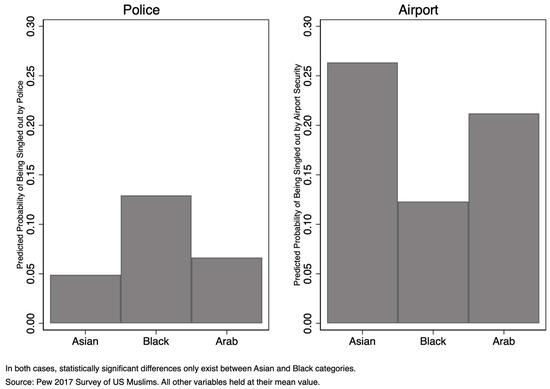
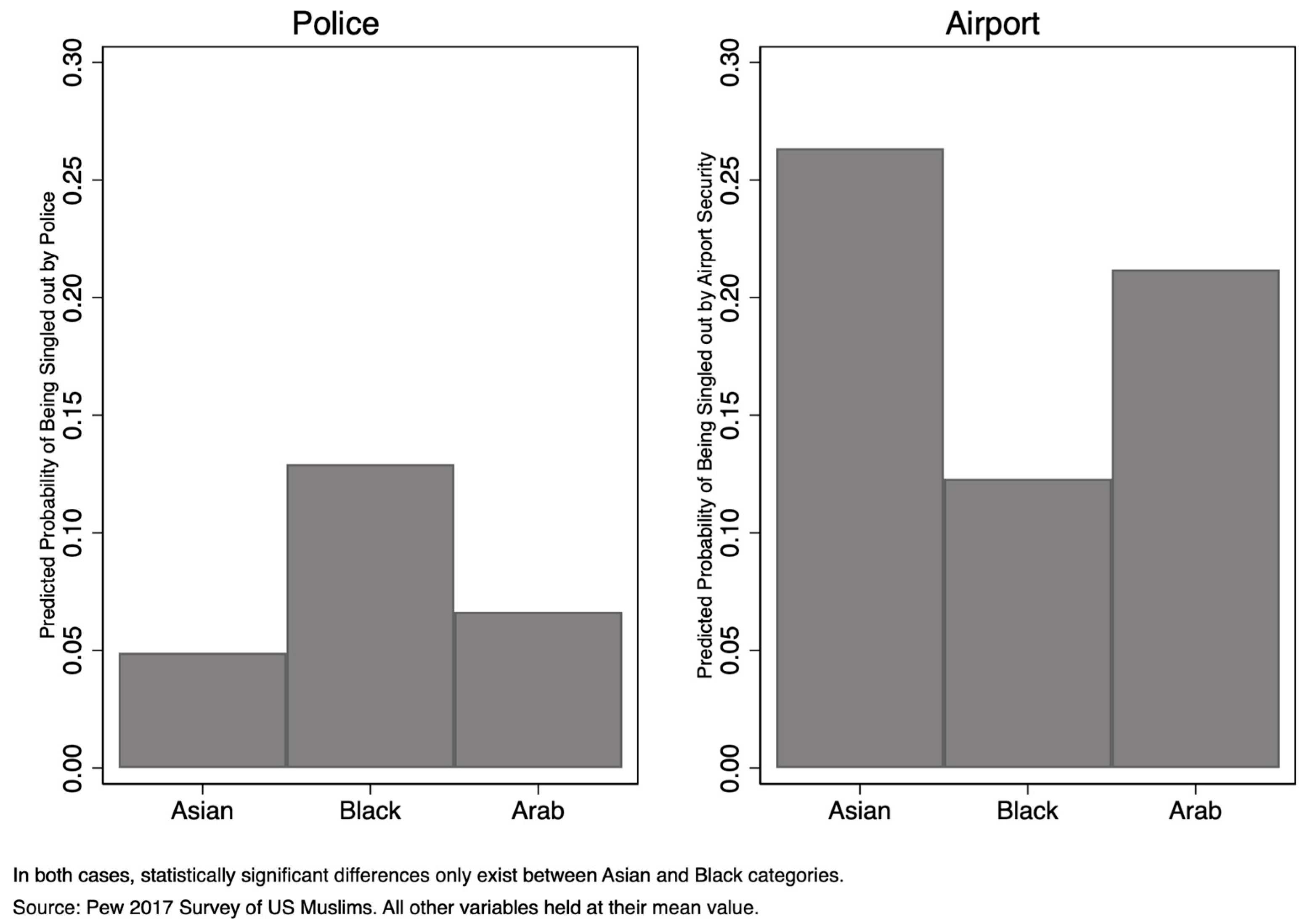
Model 3.1 begins this multivariate analysis with an investigation into the factors predicting police surveillance, using logistic regression to model this dichotomous dependent variable. The results show that even when controlling for this range of additional factors, Black Muslims are more likely to be singled out by the police when compared to Asian Muslims. The left panel in Figure 1 illustrates this racial asymmetry, though it is worth noting that the difference in rates of police surveillance is only significant between Asian and Black Muslims, whereas neither of these two groups is statistically distinct from Arab Muslims. Also holding up in this multivariate analysis is the greater likelihood of experiencing police contact for Muslims who were born in the US. This finding may link to the particular law enforcement attention focused on Black people born in the US who converted to Islam, as highlighted in the history of surveillance aimed at the Nation of Islam (Colley 2014). Interestingly, while Table 2 suggested that Muslim women were more likely to be singled out by the police, the negative coefficient for the female variable here indicates that women experience less contact with law enforcement, though this negative link is not significant.11
Figure 1.
Racial Differences in Surveillance Experiences Among American Muslims.
It is possible that this flipped direction for the role of gender also comes from the model including a predictor for individuals having something distinctive about their outward presence that people associate with being Muslim, a variable that is positive and significant in Model 3.1. In this way, the model partials out the role of factors like wearing the hijab, which may have driven most of the gendered impact found in Table 2. The significance of this “Visibly Muslim” variable is also notable insofar as Model 3.1 shows that it draws greater police suspicion, while Model 3.2 suggests that this kind of outward appearance is positively associated with being singled out in airports, but not to a degree of statistical significance.
Model 3.2 also provides a few other points of contrast between airport and police surveillance. A comparison of the left and right panels of Figure 1 shows that, where Black Muslims were more likely than Asians to be targeted by law enforcement, Asian Muslims face greater levels of attention from airport security. This finding reinforces the importance of considering racial diversity within the Muslim community to understand not only the levels of surveillance faced by American Muslims, but also the different forms in which that surveillance is encountered (Cainkar 2009; Kundnani 2015; Bayoumi 2015; Selod 2018). Similar to policing, however, Model 3.2 and the right panel of Figure 1 also show that Arab Muslims once again fall into a middle ground, such that their level of airport scrutiny is not statistically distinguishable from either Black or Asian Muslims.
The only other variables that show up as statistically significant in Model 3.2 are income and education. While there are several possible explanations for these impacts, our assessment is that this is likely caused by a selection effect relating to the education and income levels of people who fly more frequently in the US. To deal with this issue, Model 3.3 re-runs this analysis of airport surveillance, but only includes individuals with incomes above the sample mean.12 In this model, income and education now fall out of significance. By comparison, the impact of race becomes stronger in this specification, with Asians now experiencing significantly higher levels of scrutiny compared to both Black and Arab Muslims. In addition, the gender variable reaches marginal significance, demonstrating that Muslim women are indeed singled out more in airports, though this impact is limited to those who have income levels that may allow them to fly more often (Selod 2018).
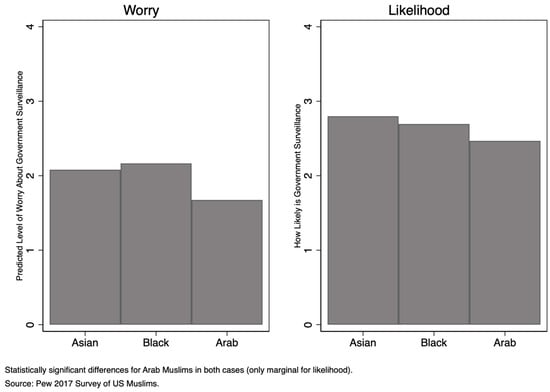
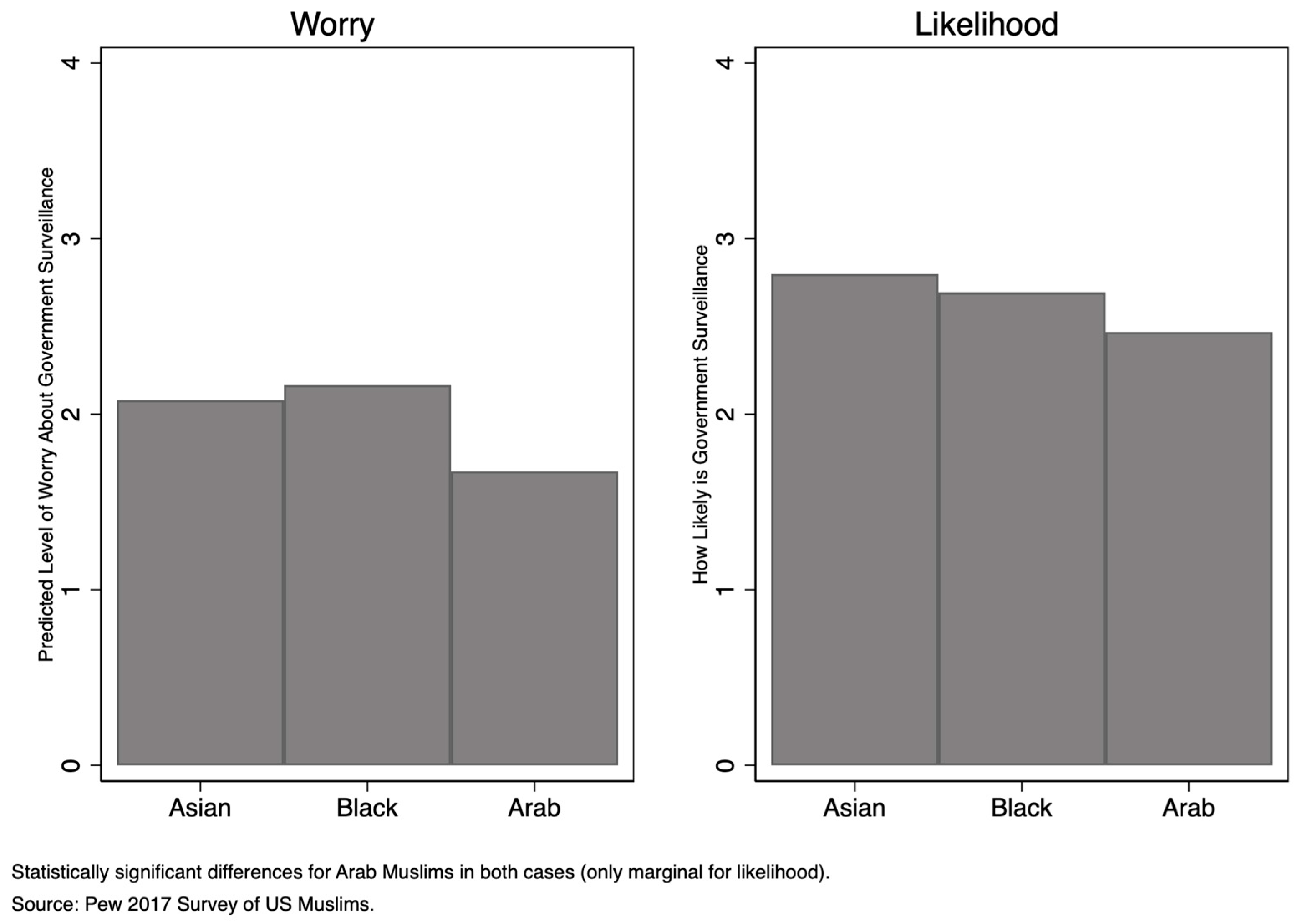
Models 3.4 and 3.5 turn to predictions of attitudes about surveillance, with each model employing OLS regression due to its five-point scale.13 Once again, racial differences are made apparent. The left panel of Figure 2 represents the results from Model 3.4, showing that Arab Muslims express a significantly lower level of worry about government monitoring their emails and phone calls when compared to both Asian and Black Muslims. Along similar lines, the right panel of Figure 2 shows that Arab Muslims tend to think that government surveillance is less likely, though this response is only marginally different from Asian Muslims and is not statistically distinct from Black Muslims. This reduced anxiety and feeling of likelihood aligns with the previous results, suggesting that Arab Muslims encounter neither the police scrutiny faced by Black Muslims, nor the airport surveillance taken on by Asian Muslims.
Figure 2.
Racial Differences in Surveillance Attitudes Among American Muslims.
In both attitudinal models, the only variable that is consistently significant apart from race is the discrimination scale, indicating that American Muslims who have experienced persecution from non-state actors are also more likely to express worry about government monitoring, while also feeling like that monitoring is more likely. Finally, the results in Model 3.4 demonstrate that Muslim women express a greater sense that government monitoring is taking place, while those with stronger partisan attachments say the opposite. Where this partisan difference may stem from political parties fostering higher levels of government trust, the gendered difference could have more to do with surveillance experiences. Model 3.1 shows the higher level of police contact felt by those who appear “Visibly Muslim”, while Model 3.3 indicates that women are particularly likely to be singled out by the TSA among higher-income Muslims. Such encounters with the state may inform Muslim women’s view that government monitoring is particularly likely.
In sum, our investigation into surveillance experiences and attitudes among American Muslims reveals important complexities. Racial identities appear to consistently shape both the degree and form of government surveillance, with Black Muslims more consistently encountering the police, while Asian Muslims are disproportionately singled out by the TSA. Beyond these racial differences, gender, outward appearance, non-state discrimination, and country of birth also stand out as important factors, though their impact tends to shift depending on the experience and attitude in question. Together, these findings underscore the idea that American Muslims are not faced with a monolithic system of racialized government surveillance, but rather with various and interlocking systems that work together to exercise state control. With this variation in experiences and attitudes illuminated, we turn now to a question of their impact on electoral participation.
4.2. Electoral Participation
Before analyzing the impact of surveillance, we begin with models that only include our control variables to provide us with a baseline understanding of the factors shaping Muslim electoral participation. This analysis draws on the same set of control variables as those seen in Table 3, with the one exception of citizenship being removed as a predictor due to registration and voting only being open to US citizens. Finally, because registration and turnout each operate as binary dependent variables, we utilize logistic regression for all of the models in Table 4.
Table 4.
Impact of Surveillance Experiences and Attitudes on Electoral Participation.
Models 4.1 and 4.2 provide support for many of the standard explanations for participation within American politics, including the notion that older, wealthier, and more highly educated people are more likely to vote, as are those with stronger partisan ties (Chouhoud et al. 2019; Rosenstone and Hansen 1993; Verba et al. 1995). Beyond these variables, there is also some indication of the political roles played by Islamic institutions, such as Model 4.1 showing that registration rates are higher among those who attend mosque more frequently (Dana et al. 2011; Jamal 2005). Finally, racial identities also show up as important here, with Model 4.2 demonstrating that Asian Muslims were more likely to vote in 2016 when compared to both their Black and Arab counterparts.
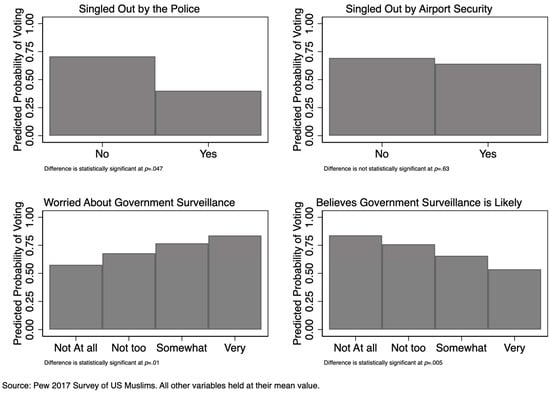
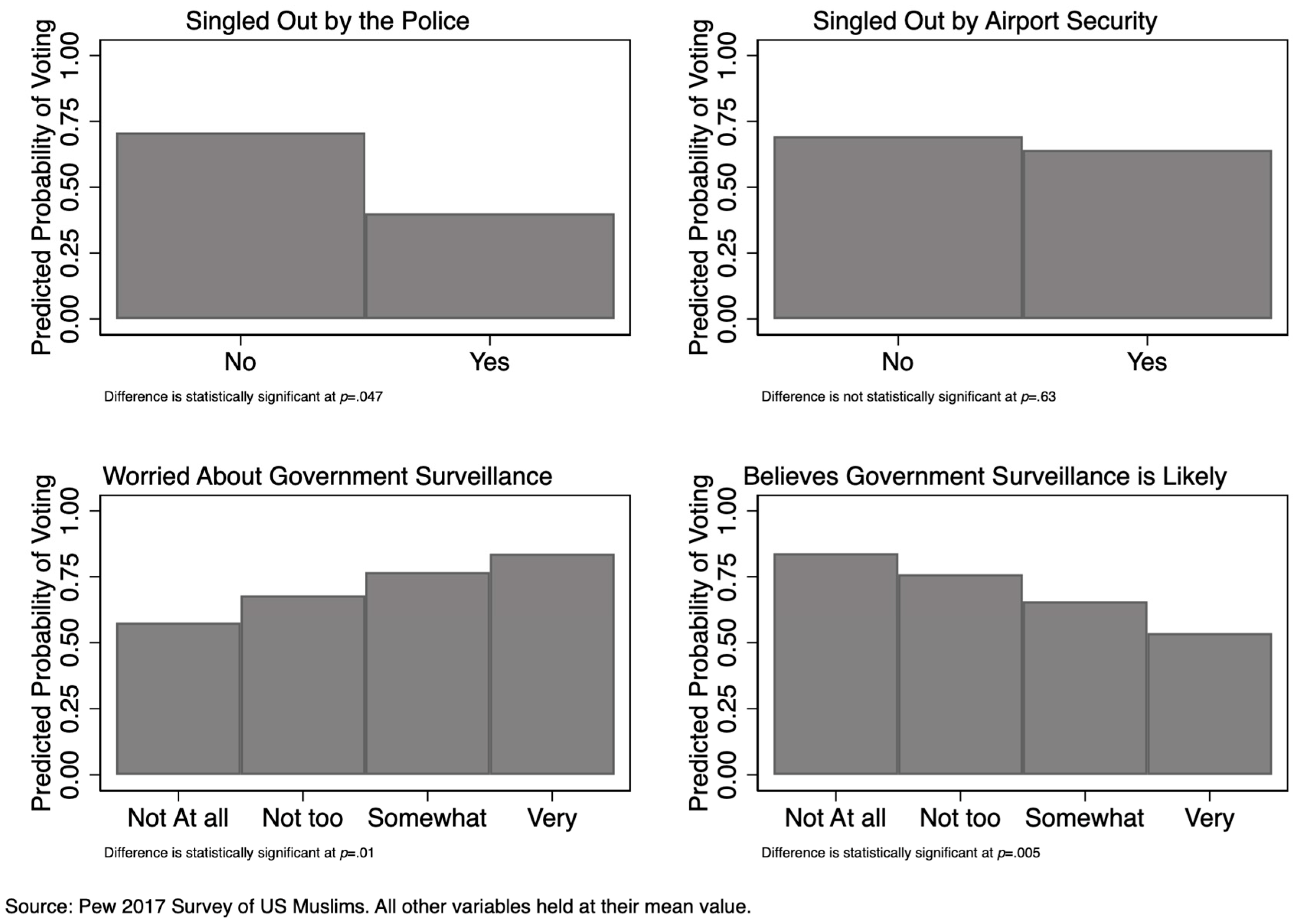
With this baseline established, we turn to Models 4.3 and 4.4, where we introduce all four of our surveillance variables. Several findings stand out here. First, being singled out by the police is linked to lower rates of registration and turnout. This finding is consistent with previous analyses examining the political impact of interactions with the police (Laniyonu 2018; Lerman and Weaver 2014a), with the top left panel of Figure 3 showing that this disengaging effect is quite potent in driving down voting rates. Differing from police contact, the results in Table 4 do not indicate that being singled out by airport security has an influence on electoral participation. The distinction between these two forms of surveillance illuminates the value of attending to the particular forms of state control encountered by American Muslims. Here, we are provided with a more nuanced understanding of those places in which government monitoring pushes people away from the political process. While this dataset does not provide the level of detail needed to properly dig into this variation, there are several plausible explanations. Perhaps airport security does not generate the same disengagement because it is more likely to be faced by people who fly frequently (i.e., those with higher levels of socioeconomic status). Alternatively, the police may carry a stronger association with the government as compared to TSA, making it more likely that people will carry lessons from their interactions with the police over into their interactions with other parts of the state. TSA is also a newer state security agency that was created after 9/11, and while they do target Muslims, these interactions rarely result in arrests. We hope that other researchers might pick up on this contrast in future studies to explore it in greater depth.
Figure 3.
The Impact of Surveillance on Voting Among American Muslims.
In another interesting distinction, Model 4.4 shows opposing political effects from being worried about government surveillance and feeling that government surveillance is likely. As illustrated in the bottom two panels of Figure 3, American Muslims become more likely to vote as they grow increasingly worried about government surveillance, yet the inverse effect takes place as they believe that surveillance is more likely. This difference is particularly remarkable due to the similarity of the questions and the fact that they were asked one after the other. Despite these forces working towards people answering the questions in similar ways, it is clear from Figure 3 that the political impact of worrying about surveillance is quite distinct from thinking that surveillance is happening.
This contrast takes us back to the competing expectations discussed earlier in relation to the impact of surveillance on electoral participation. On the one side, recent surveillance literature has suggested that when individuals feel threatened by this government intrusion, they become more likely to participate (Best and Krueger 2011; Krueger 2005). This line of reasoning likely explains why American Muslims who were more worried about surveillance also voted at higher rates in the 2016 election. Diverging from this expectation, other studies have argued that when people feel like state control is inevitable and dangerous to challenge, they will become less likely to engage in the electoral process (Lerman and Weaver 2014a; Soss 1999). From this perspective, it makes sense that American Muslims who feel government surveillance is particularly likely are less interested in voting. In this way, the findings add considerable complexity to extant understandings of the role of surveillance in American democracy and reinforce the importance of studying the political impact of surveillance among populations who experience state monitoring in their daily lives.
5. Conclusions
State surveillance has become an increasingly common aspect of life for Muslims living in America (Alimahomed-Wilson 2019; Selod 2018), with the presumption often being made that this form of government presence will dampen Muslim political activity. We set out to test this expectation through an exploration of the influence of specific surveillance experiences and attitudes on electoral participation. In addition, we provided what we believe is a first-of-its-kind systematic account of how these surveillance experiences and attitudes vary across salient social dimensions within the American Muslim community.
Brought together, our findings add considerable complexity to both the ways that American Muslims think about and encounter surveillance, as well as the influence of those perceptions and interactions on electoral behavior. First, we find evidence of racial variation within the American Muslim community. While both Black and Asian Muslims face substantial surveillance from state agencies, the actors involved in those experiences differ considerably. Cutting across this racial difference, our findings also suggest that gender plays an important role in the frequency and form of government monitoring, as well as the fears that American Muslims hold about that monitoring.
Building on these differences, our analyses also demonstrate that the political effects of surveillance experiences and attitudes among American Muslims are varied. Reflecting the importance of analyzing different state surveillance entities, we find that police surveillance dampens electoral participation, but no similar impact is found from increased monitoring in airports. In addition, we uncover variation in the political effects of being worried about surveillance as compared to thinking that state monitoring is likely. Aligning with competing expectations from the prior literature, we suggest that American Muslims are more likely to electorally mobilize when surveillance is perceived as threatening (Best and Krueger 2011), as opposed to understanding surveillance as inevitable. Brought together, this complexity illuminates how various state surveillance forces interact to control and shape the political lives of American Muslims.
While we believe these findings provide important contributions to studies of American Muslim participation and analyses on state surveillance, we are also cognizant of many limitations. Most notably, our reliance on cross-sectional, observational quantitative data creates two issues. First, we cannot investigate aspects of government surveillance and political participation that are not asked about on this survey. Though local law enforcement and airport security are salient examples of state actors encountered by American Muslims, this is far from an exhaustive list. Recent government initiatives have driven up the presence of the FBI in Muslim communities, creating a particularly visible and intrusive form of state surveillance. Investigating the political impact of these initiatives could add greater richness to our findings by demonstrating the diverse political effects created by different forms of law enforcement monitoring. Similarly, we reduce our focus on political participation to just two forms of electoral activity, obscuring the various other ways that individuals engage in politics. Given recent findings about the role that policing can play in mobilizing people into forms of political involvement outside of the electoral arena (Walker 2020; Williamson et al. 2018), pursuing analyses that look at the impact of surveillance on Muslim political activity in other areas seems particularly promising.
Second, we are limited to looking at the relationship between surveillance and participation without being able to ask questions to individuals about how they are related. In several places here, we put forward explanations about the relationships we find that are grounded in the extant literature, such as our argument about the different political impacts of worrying about surveillance as opposed to thinking surveillance is likely. However, we feel that such explanations would be aided by more in-depth qualitative work that could dig into the way these attitudes and experiences inform people’s political behavior. Ultimately, such analyses will further advance understandings of the way instruments of state control are shaping American democracy.
Author Contributions
Conceptualization, A.R. and S.S.; methodology, A.R.; software, A.R.; formal analysis, A.R. and S.S.; writing—original draft preparation, A.R. and S.S.; writing—review and editing, A.R. and S.S. All authors have read and agreed to the published version of the manuscript.
Funding
This research received no external funding.
Institutional Review Board Statement
Not applicable.
Informed Consent Statement
Not applicable.
Data Availability Statement
The data presented in this study are openly available in [Pew Research Center] [https://www.pewresearch.org/religion/dataset/2017-survey-of-u-s-muslims/] (accessed on 12 April 2021).
Conflicts of Interest
The authors declare no conflict of interest.
Appendix A
Table A1.
Predicting Surveillance Attitudes Using Ordinal Logistic Regression.
Notes
| 1 | This manuscript uses the term “American Muslim” to refer to Muslim individuals living in the United States. In this way, the term refers to both US citizens and non-citizens. Places where the analysis focuses only on citizens are noted. |
| 2 | Information about the NYPD’s surveillance program was uncovered in a Pulitzer Prize winning investigation by Matt Apuzzo, Adam Goldman, Eileen Sullivan, and Chris Hawley of the Associated Press. All of the articles from this investigation can be found at https://www.pulitzer.org/winners/matt-apuzzo-adam-goldman-eileen-sullivan-and-chris-hawley (accessed on 1 April 2021). |
| 3 | See ACLU “Factsheet: The NYPD Muslim Surveillance Program”: https://www.aclu.org/other/factsheet-nypd-muslim-surveillance-program (accessed 10 April 2021). |
| 4 | This excerpt is taken from a 2018 oral history interview conducted by the Center for Brooklyn History for their Muslims in Brooklyn project. The full interview can be found at: https://oralhistory.brooklynhistory.org/interviews/dandia-asad-20180216/ (accessed 16 March 2021). |
| 5 | Following the example of other scholars, we use the terms criminal legal system in place of the more commonly used criminal justice system to challenge the implicit assumption that the current system provides justice. |
| 6 | Laniyonu (2018) provides another similar study in showing that policing has a weaker demobilizing impact on Muslims living in the UK, but this variation in context makes it difficult to draw a direct connection to the analysis explored here. |
| 7 | In drawing on this literature, it is not our suggestion that American Muslims face the same kind of surveillance as Black or Latinx communities. Instead, we recognize the unique nature of each of these forms of racialized state control, even as we also consider times and places in which they have overlapped (e.g., Black Muslims caught in the policing and surveillance of the Nation of Islam). The goal here is to take a first step towards exploring how surveillance of American Muslims may produce similar political effects, with the hope that future research can do more to draw out the nuanced similarities and differences among these different forms of racialized state control. |
| 8 | Data available at https://www.pewforum.org/dataset/2017-survey-of-u-s-muslims (accessed on 12 April 2021). |
| 9 | 117 respondents are removed from the analysis due to this exclusion. While we recognize the limitations that come from excluding this group, we do not believe there is a common identity within this group that makes it useful for comparisons in our analysis. |
| 10 | We also recognize the way airport security discriminates against other racialized groups, as exemplified in Browne’s work on flying while black (Browne 2015). |
| 11 | While we would love to investigate intersectional differences by modeling surveillance experiences and attitudes within each racial group, the relatively small sample size means that such analysis mostly creates a set of insignificant variables. We would encourage this kind of intersectional analysis within future studies that have larger sample sizes. |
| 12 | In this sample, having an income greater than the mean constitutes individuals with family incomes greater than $50,000. |
| 13 | We also run these models using ordinal logistic regression and find substantively identical results. These results are available in Models A1.1 and A1.2 in Appendix A. |
References
- Ahmadi, Shafiqa. 2011. The Erosion of Civil Rights: Exploring the Effects of the Patriot Act on Muslims in American Higher Education. Rutgers Race & L. Rev. 12: 1. [Google Scholar]
- Alexander, Michelle. 2010. The New Jim Crow: Mass Incarceration in the Age of Colorblindness. New York: The New Press. [Google Scholar]
- Al-Faham, Hajer. 2021. Researching American Muslims: A Case Study of Surveillance and Racialized State Control. Perspectives on Politics 19: 1131–46. [Google Scholar] [CrossRef] [Scilit]
- Alimahomed-Wilson, Sabrina. 2019. When the FBI Knocks: Racialized State Surveillance of Muslims. Critical Sociology 45: 871–87. [Google Scholar] [CrossRef] [Scilit]
- Almond, Gabriel, and Sidney Verba. 1963. The Civic Culture: Political Attitudes and Democracy in Five Countries. Princeton: Princeton University Press. [Google Scholar]
- Alshrari, Abdullah. 2019. Patriot Act, Section 206: It’s Impact on Muslim Populations in the US (With Special Reference to Roving Wiretap Policy). Public Policy and Administration 7: 15–21. [Google Scholar] [CrossRef] [Scilit]
- Apuzzo, Matt, and Adam Goldman. 2011. NYPD Gathered Intelligence on 250-Plus Mosques, Student Groups in Terrorist Hunt. New York: The Associated Press. [Google Scholar]
- Ayers, John W., and C. Richard Hofstetter. 2008. American Muslim Political Participation Following 9/11: Religious Belief, Political Resources, Social Structures, and Political Awareness. Politics and Religion 1: 3–26. [Google Scholar] [CrossRef] [Scilit]
- Bateson, Regina. 2012. Crime Victimization and Political Participation. American Political Science Review 106: 570–87. [Google Scholar] [CrossRef] [Scilit]
- Bayoumi, Moustafa. 2015. This Muslim American Life: Dispatches from the War on Terror. New York: NYU Press. [Google Scholar]
- Best, Samuel J., and Brian S. Krueger. 2011. Government Monitoring and Political Participation in the United States: The Distinct Roles of Anger and Anxiety. American Politics Research 39: 85–117. [Google Scholar] [CrossRef] [Scilit]
- Browne, Simone. 2015. Dark Matters: On the Surveillance of Blackness. Durham: Duke University Press. [Google Scholar]
- Burch, Traci. 2013. Trading Democracy for Justice: Criminal Convictions and the Decline of Neighborhood Political Participation. Chicago: University of Chicago Press. [Google Scholar]
- Cainkar, Louise A. 2009. Homeland Insecurity: The Arab American and Muslim American Experience After 9/11. New York: Russell Sage Foundation. [Google Scholar]
- Campbell, Andrea Louise. 2012. Policy Makes Mass Politics. Annual Review of Political Science 15: 333–51. [Google Scholar] [CrossRef] [Scilit]
- Cho, Wendy K. Tam, James G. Gimpel, and Tony Wu. 2006. Clarifying the Role of SES in Political Participation: Policy Threat and Arab American Mobilization. The Journal of Politics 68: 977–91. [Google Scholar] [CrossRef] [Scilit]
- Chouhoud, Youssef, Karam Dana, and Matt Barreto. 2019. American Muslim Political Participation: Between Diversity and Cohesion. Politics and Religion 12: 736–65. [Google Scholar] [CrossRef] [Scilit]
- Colley, Zoe. 2014. “All America is a Prison”: The Nation of Islam and the Politicization of African American Prisoners, 1955–1965. Journal of American Studies 48: 393–415. [Google Scholar] [CrossRef] [Scilit]
- Dana, Karam, Matt A. Barreto, and Kassra A. R. Oskooii. 2011. Mosques as American Institutions: Mosque Attendance, Religiosity and Integration into the Political System among American Muslims. Religions 2: 504–24. [Google Scholar] [CrossRef] [Scilit]
- Dana, Karam, Nazita Lajevardi, Kassra A. R. Oskooii, and Hannah L. Walker. 2019. Veiled Politics: Experiences with Discrimination among Muslim Americans. Politics and Religion 12: 629–77. [Google Scholar] [CrossRef] [Scilit]
- Dawson, Michael C. 1995. Behind the Mule: Race and Class in African-American Politics. Princeton: Princeton University Press. [Google Scholar]
- Epp, Charles R., Steven Maynard-Moody, and Donald P. Haider-Markel. 2014. Pulled Over: How Police Stops Define Race and Citizenship. Chicago: University of Chicago Press. [Google Scholar]
- Foucault, Michel. 2019. Discipline and Punish: The Birth of the Prison. New York: Penguin. [Google Scholar]
- Gibson, James L. 2008. Intolerance and Political Repression in the United States: A Half Century after McCarthyism. American Journal of Political Science 52: 96–108. [Google Scholar] [CrossRef] [Scilit]
- Gualtieri, Sarah. 2001. Becoming” White”: Race, Religion and the Foundations of Syrian/Lebanese Ethnicity in the United States. Journal of American Ethnic History 20: 29–58. [Google Scholar] [CrossRef] [Scilit]
- Jamal, Amaney. 2005. The Political Participation and Engagement of Muslim Americans: Mosque Involvement and Group Consciousness. American Politics Research 33: 521–44. [Google Scholar] [CrossRef] [Scilit]
- Kalkan, Kerem Ozan, Geoffrey C. Layman, and Eric M. Uslaner. 2009. “Bands of others”? Attitudes toward Muslims in contemporary American society. The Journal of Politics 71: 847–62. [Google Scholar] [CrossRef] [Scilit]
- Krueger, Brian S. 2005. Government Surveillance and Political Participation on the Internet. Social Science Computer Review 23: 439–52. [Google Scholar] [CrossRef] [Scilit]
- Kundnani, Arun. 2015. The Muslims are Coming: Islamophobia, Extremism, and the Domestic War on Terror. London: Verso Books. [Google Scholar]
- Laniyonu, Ayobami. 2018. Police, Politics and Participation: The Effect of Police Exposure on Political Participation in the United Kingdom. The British Journal of Criminology 58: 1232–53. [Google Scholar] [CrossRef] [Scilit]
- Lerman, Amy E., and Vesla Weaver. 2014a. Arresting Citizenship: The Democratic Consequences of American Crime Control. Chicago: University of Chicago Press. [Google Scholar]
- Lerman, Amy E., and Vesla Weaver. 2014b. Staying out of Sight? Concentrated Policing and Local Political Action. The ANNALS of the American Academy of Political and Social Science 651: 202–19. [Google Scholar] [CrossRef] [Scilit]
- Love, Erik. 2017. Islamophobia and Racism in America. New York: New York University Press. [Google Scholar]
- Lo Wang, Hansi. 2018. No Middle Eastern or North African Category on 2020 Census, Bureau Says. Washington: National Public Radio. [Google Scholar]
- Maghbouleh, Neda. 2017. The Limits of Whiteness: Iranian Americans and the Everyday Politics of Race. Stanford: Stanford University Press. [Google Scholar]
- Marsh, Wayde Z. C. 2023. Trauma and Turnout: The Political Consequences of Traumatic Events. American Political Science Review 117: 1036–52. [Google Scholar] [CrossRef] [Scilit]
- Marsh, Wayde Z. C. 2025. Trust After Tragedy: How Traumatic Events Impact Trust in Government(s) and Voting. Political Behavior, 1–23. [Google Scholar] [CrossRef] [Scilit]
- Mauleón, Emmanuel. 2018. Black Twice: Policing Black Muslim Identities. UCLA Law Review 65: 1326–90. [Google Scholar]
- Michener, Jamila. 2019. Policy Feedback in a Racialized Polity. Policy Studies Journal 47: 423–50. [Google Scholar] [CrossRef] [Scilit]
- Miller, Joanne M., and Jon A. Krosnick. 2004. Threat as a Motivator of Political Activism: A Field Experiment. Political Psychology 25: 507–23. [Google Scholar] [CrossRef] [Scilit]
- Mogahed, Dalia, and Erum Ikramullah. 2020. American Muslim Poll 2020: Amid Pandemic and Protest. ISPU. Available online: https://www.ispu.org/american-muslim-poll-2020-amid-pandemic-and-protest/ (accessed on 20 April 2021).
- Nie, Norman H., and Sidney Verba. 1987. Participation in America: Political Democracy and Social Equality. Chicago: University of Chicago Press. [Google Scholar]
- Oskooii, Kassra A. R. 2016. How Discrimination Impacts Sociopolitical Behavior: A Multidimensional Perspective. Political Psychology 37: 613–40. [Google Scholar] [CrossRef] [Scilit]
- Oskooii, Kassra A. R. 2020. Perceived Discrimination and Political Behavior. British Journal of Political Science 50: 867–92. [Google Scholar] [CrossRef] [Scilit]
- Pitt, Cassady. 2011. US Patriot Act and Racial Profiling: Are There Consequences of Discrimination? Michigan Sociological Review 25: 53–69. [Google Scholar]
- Rosenstone, Steven J., and John Mark Hansen. 1993. Mobilization, Participation, and Democracy in America. New York: Macmillan Publishing Company. [Google Scholar]
- Schoettmer, Patrick. 2015. Mobilization and the Masjid: Muslim Political Engagement in Post-9/11 America. Politics, Groups, and Identities 3: 255–73. [Google Scholar] [CrossRef] [Scilit]
- Selod, Saher. 2015. Citizenship Denied: The Racialization of Muslim American Men and Women Post-9/11. Critical Sociology 41: 77–95. [Google Scholar] [CrossRef] [Scilit]
- Selod, Saher. 2018. Forever Suspect: Racialized Surveillance of Muslim Americans in the War on Terror. New Brunswick: Rutgers University Press. [Google Scholar]
- Sidhu, Dawinder S. 2007. The Chilling Effect of Government Surveillance Programs on the Use of the Internet by Muslim-Americans. University of Maryland Law Journal of Race, Religion, Gender, and Class 7: 375. [Google Scholar]
- Sinclair, Betsy. 2012. The Social Citizen: Peer Networks and Political Behavior. Chicago: University of Chicago Press. [Google Scholar]
- Soss, Joe. 1999. Lessons of Welfare: Policy Design, Political Learning, and Political Action. The American Political Science Review 93: 363–80. [Google Scholar] [CrossRef] [Scilit]
- Soss, Joe, and Vesla Weaver. 2017. Police Are Our Government: Politics, Political Science, and the Policing of Race-Class Subjugated Communities. Annual Review of Political Science 20: 565–91. [Google Scholar] [CrossRef] [Scilit]
- Stoudt, Brett G., Michelle Fine, and Madeline Fox. 2011. Growing up Policed in the Age of Aggressive Policing Policies. New York Law School Law Review 56: 1331–70. [Google Scholar]
- Tate, Katherine. 1998. From Protest to Politics: The New Black Voters in American Elections. Cambridge: Harvard University Press. [Google Scholar]
- Terriquez, Veronica. 2017. Legal Status, Civic Organizations, and Political Participation Among Latino Young Adults. The Sociological Quarterly 58: 315–36. [Google Scholar] [CrossRef] [Scilit]
- Theodore, Nik, and Robert Habans. 2016. Policing Immigrant Communities: Latino Perceptions of Police Involvement in Immigration Enforcement. Journal of Ethnic and Migration Studies 42: 970–88. [Google Scholar] [CrossRef] [Scilit]
- Verba, Sidney, Kay Lehman-Schlozman, and Henry Brady. 1995. Voice and Equality: Civic Voluntarism in American Politics. Cambridge: Harvard University Press. [Google Scholar]
- Walker, Hannah L. 2020. Mobilized by Injustice: Criminal Justice Contact, Political Participation, and Race. New York: Oxford University Press. [Google Scholar]
- Walker, Hannah L., and Marcela García-Castañon. 2017. For Love and Justice: The Mobilizing of Race, Gender, and Criminal Justice Contact. Politics and Gender 13: 541–68. [Google Scholar] [CrossRef] [Scilit]
- Weaver, Vesla, and Amanda Geller. 2019. De-policing America’s Youth: Disputing Criminal Justice Policy Feedbacks that Distort Power and Derail Prospects. The ANNALS of the American Academy of Political and Social Science 685: 190–226. [Google Scholar] [CrossRef] [Scilit]
- Weaver, Vesla, and Amy E. Lerman. 2010. Political Consequences of the Carceral State. The American Political Science Review 104: 817–33. [Google Scholar] [CrossRef] [Scilit]
- Westin, Alan F. 2018. Privacy and Freedom. New York: Ig Publishing. [Google Scholar]
- White, Ariel. 2016. When Threat Mobilizes: Immigration Enforcement and Latino Voter Turnout. Political Behavior 38: 355–82. [Google Scholar] [CrossRef] [Scilit]
- White, Ariel. 2019. Misdemeanor Disenfranchisement? The Demobilizing Effects of Brief Jail Spells on Potential Voters. American Political Science Review 113: 311–24. [Google Scholar] [CrossRef] [Scilit]
- Williamson, Vanessa, Kris-Stella Trump, and Katherine Levine Einstein. 2018. Black Lives Matter: Evidence That Police-Caused Deaths Predict Protest Activity. Perspectives on Politics 16: 400–15. [Google Scholar] [CrossRef] [Scilit]

Disclaimer/Publisher’s Note: The statements, opinions and data contained in all publications are solely those of the individual author(s) and contributor(s) and not of MDPI and/or the editor(s). MDPI and/or the editor(s) disclaim responsibility for any injury to people or property resulting from any ideas, methods, instructions or products referred to in the content. |
© 2026 by the authors. Licensee MDPI, Basel, Switzerland. This article is an open access article distributed under the terms and conditions of the Creative Commons Attribution (CC BY) license.