
Skip to Content
  • 4.4
    Impact Factor
  • 7.5
    CiteScore
  • 17 days
    Submission to First Decision
  • 4 days
    Acceptance to Publication

Bioengineering

Bioengineering is an international, peer-reviewed, open access journal on the science and technology of bioengineering, published monthly online by MDPI. 
  • Open Access— free for readers, with article processing charges (APC) paid by authors or their institutions.
  • High Visibility: indexed within Scopus, SCIE (Web of Science), PubMed, PMC, CAPlus / SciFinder, Inspec, Ei Compendex, and other databases.
  • Journal Rank: JCR - Q2 (Engineering, Biomedical) / CiteScore - Q2 (Bioengineering)
  • Rapid Publication: manuscripts are peer-reviewed and a first decision is provided to authors approximately 16.9 days after submission; acceptance to publication is undertaken in 3.1 days (median values for papers published in this journal in the first half of 2026).
  • Recognition of Reviewers: Reviewers whose reports are timely and of high quality receive an APC discount voucher for a future publication in an MDPI journal. Become a reviewer.

Get Alerted

Add your email address to receive forthcoming issues of this journal.

All Articles (7,107)

  • Article
  • Open Access

Background: Electroencephalography (EEG) is increasingly used to investigate consumer preferences; however, most predictive studies rely on local spectral or temporal features, and the predictive and statistical relevance of functional connectivity remains underexplored. This study evaluated the statistical significance, predictive performance, and feature-selection stability of EEG functional connectivity measures associated with consumer preference. Methods: Phase Locking Value (PLV) and Normalized Mutual Information (NMI) were computed for the delta, theta, alpha, beta, and gamma frequency bands using product-related EEG recordings from the NeuMa dataset. Subject-level paired statistical analyses were performed with false discovery rate correction. PLV, NMI, and early feature-level PLV+NMI fusion were evaluated using LASSO-based feature selection and five machine-learning classifiers under stratified 10-fold and subject-independent leave-one-subject-out (LOSO) validation. Feature-selection stability was assessed under both validation strategies. Results: Preferred-product viewing was associated with widespread reductions in functional connectivity for both PLV and NMI, with NMI showing particularly extensive differences in the delta band. PLV and NMI yielded broadly comparable predictive performance, with the highest balanced accuracy of 0.699 achieved by PLV combined with Naive Bayes under both stratified 10-fold and LOSO validation. Early PLV+NMI fusion did not improve predictive performance. In contrast, NMI-derived features dominated the fused stability ranking, accounting for 18 of the 20 highest-ranked stable features, predominantly in the delta band. Conclusions: EEG functional connectivity provides complementary information about consumer preference at the statistical, predictive, and feature-stability levels. PLV combined with Naive Bayes provided the highest balanced accuracy, whereas NMI exhibited greater statistical sensitivity and feature-selection stability. These findings highlight low-frequency, particularly delta-band, connectivity as a relevant target for further investigation and demonstrate the importance of evaluating EEG representations beyond classification performance alone.

Bioengineering

18 November 2026

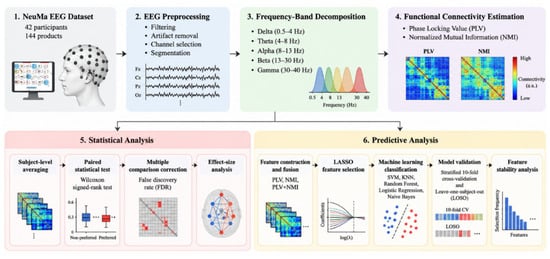
Overall workflow of the proposed functional connectivity framework.
  • Article
  • Open Access

Older adults use furniture during sit-to-stand (STS), but effects of small surface modifications remain unclear. This exploratory within-participant study examined hand forces across table-surface configurations and millimeter-scale edge-protrusion heights during two preparatory trunk movements followed by STS. Of 59 participants, 56 were analyzed. Participants performed trials using the Normal surface, PVC sheet, silicone rubber, grooved MDF, and edge protrusions of 3, 5, and 7 mm. Condition order was randomized within two fixed-order blocks; Normal served as the surface-block reference. Peak horizontal pulling and downward vertical forces were normalized by body weight. PVC and silicone rubber showed significantly higher horizontal peaks than Normal (mean paired differences: +0.62 and +0.81 percentage points of body weight, respectively). Exploratory height comparisons showed higher horizontal peaks at 7 than 3 mm (+1.18 percentage points, 95% confidence interval: 0.55–1.90). No significant vertical-force differences were detected within either block. These findings suggest that local furniture surface configurations and protrusion heights may influence task-level hand-force use. However, small surface differences may not be distinguishable from condition-dependent measurement error; functional benefits, attachment security, and furniture stability remain unestablished.

Bioengineering

18 November 2026

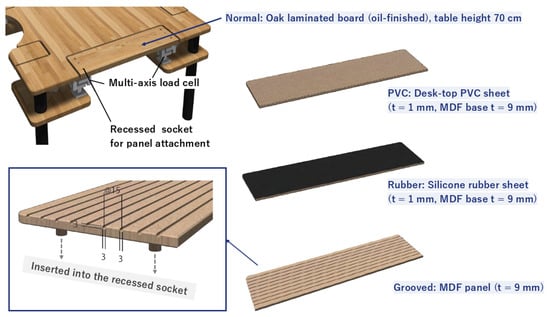
Experimental apparatus for the tested surface conditions. A custom table apparatus equipped with two embedded multi-axis load cells was used to measure supportive forces at the table edge. Interchangeable surface panels—polyvinyl chloride (PVC) sheet, silicone-rubber sheet, and grooved medium-density fiberboard (MDF) panel—were inserted into a recessed socket at the front edge of the table. These interchangeable panels enabled controlled manipulation of surface properties while using the same underlying table and sensing structure.
  • Article
  • Open Access

Burn wound instance segmentation on edge devices requires accurate contours and low inference cost. Light-YOLO-Seg replaces six bottlenecks in the YOLOv8n-Seg backbone with GhostV2 bottlenecks and adds coordinate attention at three feature fusion nodes while retaining the segmentation head. We split 455 original images at the image level into 364 training, 46 validation, and 45 internal test images before augmenting only the training set. On the internal test set, mask mean average precision at intersection-over-union thresholds of 0.50–0.95 (mAP50–95) reached 61.1%, up 5.4 percentage points over the baseline. Dice and mean boundary intersection over union reached 87.2% and 75.1%, respectively. Parameters and computational cost fell by 10.3% and 10.2%, respectively. Across five seeds, mask mAP50–95 was 61.21% ± 0.97%. On 80 cross-source images, it reached 53.6% versus 49.2% for the baseline. On a Raspberry Pi 5, mean inference latency and peak resident memory fell by 8.1% and 6.1%, respectively. The edge system displayed contours at 7.4 frames per second over 120 s using simulated silicone wounds. These results support lightweight wound segmentation and continuous contour display in the tested settings.

Bioengineering

18 November 2026

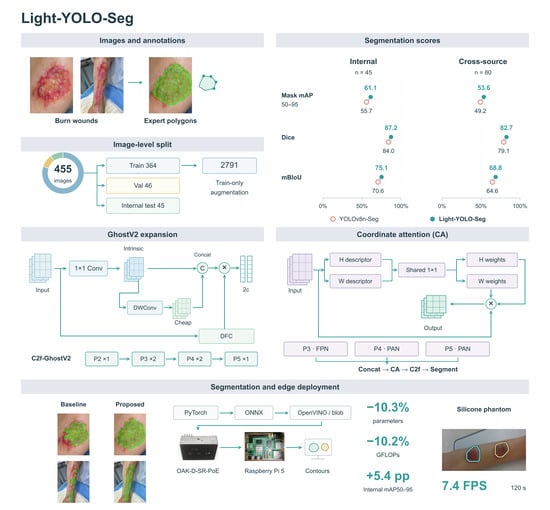
Research workflow and evaluation scope of Light-YOLO-Seg. CA = coordinate attention, YOLO = You Only Look Once, AP = average precision, IoU = intersection over union, mBIoU = mean boundary IoU, GFLOPs = billions of floating-point operations, and FPS = frames per second. Val = validation set, Params = parameter count, and PoE = power over Ethernet.
  • Article
  • Open Access

Background: The shell technique is a well-recognized method for alveolar ridge augmentation; however, conventional protocols are often technically demanding, requiring substantial autogenous bone harvesting and precise fixation of thin cortical shells, which is a step associated with risks of graft fracture and increased operative time. Objective: The Kamali technique, described in this case report, represents a modification of the conventional shell technique that employs corticocancellous allogeneic bone blocks to provide structural support for graft containment while minimizing reliance on autogenous bone. Methods: This report describes a single patient who underwent horizontal alveolar ridge augmentation using the modified corticocancellous shell (Kamali) technique as part of routine clinical care. Clinical records, surgical documentation, clinical photographs, and preoperative and postoperative cone-beam computed tomography (CBCT) images were reviewed to describe the treatment procedure and clinical and radiographic findings. No additional intervention was performed for research purposes. The corticocancellous allogeneic block was contoured to fit the osseous defect and stabilized using fixation screws. Particulate autogenous bone harvested from an intraoral donor site was combined with a bone substitute and placed within the grafted compartment. Clinical and radiographic healing was assessed at approximately six months. Results/Clinical Observations: The corticocancellous composition of the allogeneic block provided a structural framework for particulate graft containment and space maintenance. The porous architecture of the cancellous portion appeared to facilitate graft integration and vascular ingrowth. Ridge width increased from 2.9 mm preoperatively to 8.5 mm after six months, allowing placement of a 4 × 9.5 mm implant with more than 35 Ncm primary stability. In this case, the technique allowed the use of a reduced volume of autogenous bone and was successfully applied for graft fixation and horizontal ridge augmentation. Conclusions: The Kamali technique represents a potential modification of conventional shell techniques for horizontal alveolar ridge augmentation. However, its clinical efficacy and reproducibility require further investigation through larger clinical studies and controlled trials.

Bioengineering

18 November 2026

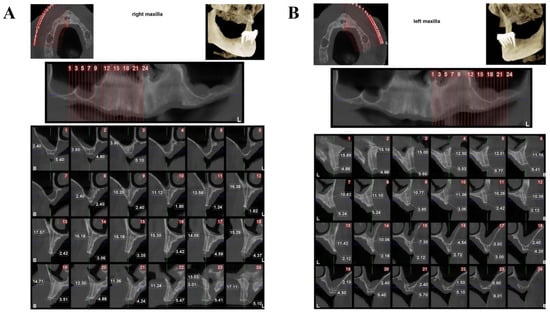
Preoperative CBCT assessment of the horizontal alveolar ridge deficiencies in the right maxilla (A) and left maxilla (B). Representative serial cross-sectional images illustrate the distribution and extent of the residual ridge deficiency across the planned implant sites and provide the anatomical reference for subsequent postoperative comparisons.

Highly Accessed Articles

News & Conferences

Latest Issues

Open for Submission

Journal Sections

XFacebookLinkedIn
Bioengineering - ISSN 2306-5354