Skip Content
You are currently on the new version of our website. Access the old version .

Agronomy

Agronomy is an international, peer-reviewed, open access journal on agronomy and agroecology published semimonthly online by MDPI. 
The Spanish Society of Plant Biology (SEBP) is affiliated with Agronomy and their members receive discounts on the article processing charges.
Quartile Ranking JCR - Q1 (Agronomy | Plant Sciences)

All Articles (18,790)

Monitoring the soil–plant system in forest ecosystems is crucial for preserving their ecological functions and services. This study assessed carbon and nitrogen stable isotopes and ecoenzymatic stoichiometry as suitable indicators for characterizing the soil–plant system as a functional unit of ecological processes. To this end, in June 2021 six plots (1 m2 each) were selected in two typical Mediterranean forest ecotypes: a coastal stone pine forest (Pinus pinea L., PF) and a meso-hygrophilous broadleaf forest (RV). Soil samples (0–15 and 15–30 cm depth) and litter samples (40 × 40 cm) were collected and characterized in terms of physical, chemical and biochemical properties. t-tests revealed significant differences between RV and PF, indicating distinct microbial nutrient acquisition strategies. The higher C:N ratio in PF suggested lower litter quality and greater recalcitrance to microbial decomposition. Consistently, RV showed a more pronounced 13C and 15N enrichment from litter to SOM down to a 30 cm depth, confirming faster organic matter decomposition and mineralization. Enzyme activity patterns supported these findings. The higher β-glucosidase and butyrate esterase activities in RV reflected its greater microbial potential to activate biogeochemical cycles. Both forests exhibited a higher microbial demand for C and P than for N to maintain ecological stoichiometric balance, with stronger C limitation at the surface and P limitation in the subsoil, particularly in RV soil. This integrated monitoring approach provides insights into nutrient cycling and ecosystem resilience and offers tools to evaluate ecosystem functionality under changing environmental conditions, supporting sustainable forest management.

3 February 2026
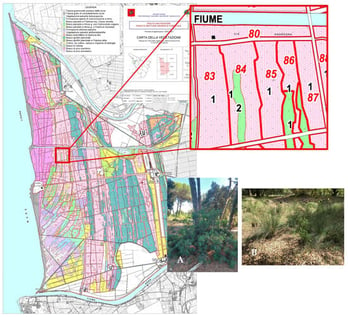
Map of the study area (red rectangle) showing the distribution of Pinus pinea L. forest (pink, photo (A)) and meso-hygrophilous broadleaved forest with retrodunal depressed plain vegetation (green, photo (B)).

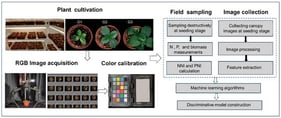
Rapid and accurate diagnosis of nitrogen (N) and phosphorus (P) is crucial for Hydrangea macrophylla nursery management. Traditional methods are time-consuming, and existing non-destructive studies rarely target ornamental plants or support joint N-P diagnosis at the early growth stage. A total of 339 RGB images were captured from potted hydrangeas grown under varying N and P levels at the seedling stage, with 65 phenotypic traits (color, texture, and morphology) extracted. Nutritional status (deficient, optimal, and surplus) was categorized with reference to plant nutrition indices. Discriminant models were then developed using four machine learning algorithms: convolutional neural network (CNN), support vector machine (SVM), random forest (RF), and probabilistic neural network (PNN). The model performances were evaluated using overall accuracy, precision, recall, F1-score, and Cohen’s Kappa coefficient (κ). As a result, CNN achieved 82.65% accuracy (κ = 0.7392) for N classification, and SVM reached 83.65% accuracy (κ = 0.7357) for P classification. Color-related traits dominated the top five contributing features, indicating a stronger correlation with N and P status. This work offers a practical solution for real-time, low-cost, and non-destructive nutrient diagnosis, supporting precision fertilization and enhancing environmental sustainability in nursery production.

3 February 2026

The research flowchart.

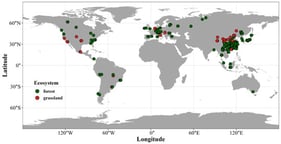
As a pivotal component of the global carbon cycle, the spatial variation in soil respiration (Rs) is crucial for forecasting climate change trajectories. Despite extensive research on the spatial patterns of total Rs, the distinct drivers of its two components, heterotrophic respiration (Rh) and autotrophic respiration (Ra), are still not well defined. We compiled a global dataset from studies published between 2007 and 2023 to investigate the drivers of spatial variations in Rs, Ra, and Rh. This dataset comprises 308 annual flux measurements from 172 sites. The results showed that Rh contributed 63% and 60% to Rs in forest and grassland ecosystems, respectively. Further analyses using structural equation modelling (SEM) showed that the spatial variation in Rh and Ra exhibited divergent responses to climatic factors and plant community structure (mostly driven by gross primary production, GPP). Rh was more affected by mean annual temperature (MAT) than by mean annual precipitation (MAP), with standardized total effects of 0.17 (forests) and 0.57 (grasslands) for MAT versus 0.10 and 0.07 for MAP, respectively. In contrast, Ra exhibited greater sensitivity to MAP (0.08 and 0.18) than to MAT (−0.01 and 0.04). GPP exerted biome-specific effects: in forests, high GPP enhanced Rh (0.18) more substantially than Ra (0.08), while in grasslands, elevated GPP significantly increased Ra (0.34) but suppressed Rh (−0.30). Moreover, these variables incorporated into the SEMs accounted for a greater proportion of the variation in Rh and Ra in grasslands (R2 = 0.73 for Rh, 0.48 for Ra) as compared to forests (R2 = 0.21 for Rh, 0.22 for Ra), suggesting the greater complexity in forest soil C dynamics. By using the whole yearly measured soil respiration data around the world, this study highlights the differential environmental regulation of Rh and Ra, providing critical insights into the mechanisms governing Rs variations under climate change.

3 February 2026

Global distribution of the soil respiration measurement sites collected in this study.

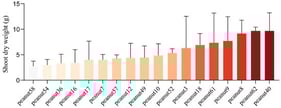
Soil acidification is among the primary abiotic stress factors that constrain plant growth. The adoption of acid-tolerant plant varieties and the inoculation of plant growth-promoting rhizobacteria have the distinct advantages of simultaneously increasing soil fertility and ensuring crop growth in acidic soil. However, how acid-tolerant plant varieties interact with the associated rhizosphere microbiota still needs to be explored. In this study, acid-tolerant peanut varieties were screened and planted in natural and sterile environments. The results revealed significant differences in growth performance among the varieties in acidic soil and between natural and sterile environments, revealing that the rhizosphere microbiota is dependent on acid tolerance. Through high-throughput sequencing analysis, the key taxa Sinomonas and Aspergillus were identified, and subsequent greenhouse verification experiments demonstrated their function in promoting peanut plant growth in acidic soil. In total, our findings suggest that the holobiont of tolerant plants and the rhizosphere microbiota is important for stress resistance. This perspective opens up new avenues for improving crop cultivation in soils with different stresses, in which both plant and associated microbial properties are considered.

3 February 2026

Dry weight of aboveground parts of different peanut varieties. The specific variety names of the 18 peanut accessions shown in the figure are provided in the Table S1.

News & Conferences

Issues

Open for Submission

Editor's Choice

Reprints of Collections

Plant Invasion
Reprint

Plant Invasion

Editors: Bruce Osborne, Panayiotis G. Dimitrakopoulos
Climate Change Impacts and Adaptation
Reprint

Climate Change Impacts and Adaptation

Interdisciplinary Perspectives—Volume II
Editors: Cheng Li, Fei Zhang, Mou Leong Tan, Kwok Pan Chun

Get Alerted

Add your email address to receive forthcoming issues of this journal.

XFacebookLinkedIn
Agronomy - ISSN 2073-4395