Breeding Smarter: Artificial Intelligence and Machine Learning Tools in Modern Breeding—A Review

 , , , and
Abstract
1. Introduction

| Aspects | Farming Smarter | Breeding Smarter | Intersection: Smart Agriculture Integration | References |
|---|---|---|---|---|
| Focus | Managing and optimizing production systems using data and technology | Improving the genetic potential of crops/animals using genomic and artificial intelligence (AI) tools | Integrating genetic, environmental, and management data to co-optimize variety/breed performance and management practices. | [8,9,10] |
| Scale | Field, farm, or regional level | Population or breeding program level | Multi-scale: linking genotype × environment × management (G × E × M) interactions across farms and breeding programs. | |
| Core tools | Sensors, drones, IoT, robotics, ML-driven decision support, remote sensing for management | Genotyping, phenotyping, genomic prediction, gene editing, bioinformatics for selection | Shared AI and big data analytics platforms for both genetic and management optimization. | |
| Time Horizon | Short- to medium-term (seasonal improvements) | Long-term (genetic gains over generations) | Continuous: real-time feedback from farm data informs breeding targets; new varieties feed back into optimized farming. | |
| Data used | Environmental, soil, weather, and management data | Genetic, genomic, and phenotypic data | Integrated datasets combining genotypic, phenotypic, and environmental information for holistic modeling | |
| Outcome | Higher efficiency, sustainability, and profitability of production systems | Higher yield potential, resilience, and quality in new cultivars | Accelerated genetic gain and improved field performance through adaptive management and precision breeding | |
| Type of innovation | Process innovation: improving how farming is performed Better decisions → higher efficiency | Product innovation: improving what is farmed (cultivars/breeds) Better varieties/breeds → higher yield/resilience | System innovation: co-designing crops, environments, and practices for maximum synergy | |
| Role of technology, particularly AI | Support on decision-making for input use, disease and pest control, irrigation, and logistics | Predicts genotype performance, identifies key genes, and enhances selection accuracy | Enabling predictive agriculture, linking genomic prediction with environmental sensing and management optimization |

2. Review Methodology
Data Sources and Exclusion Criteria
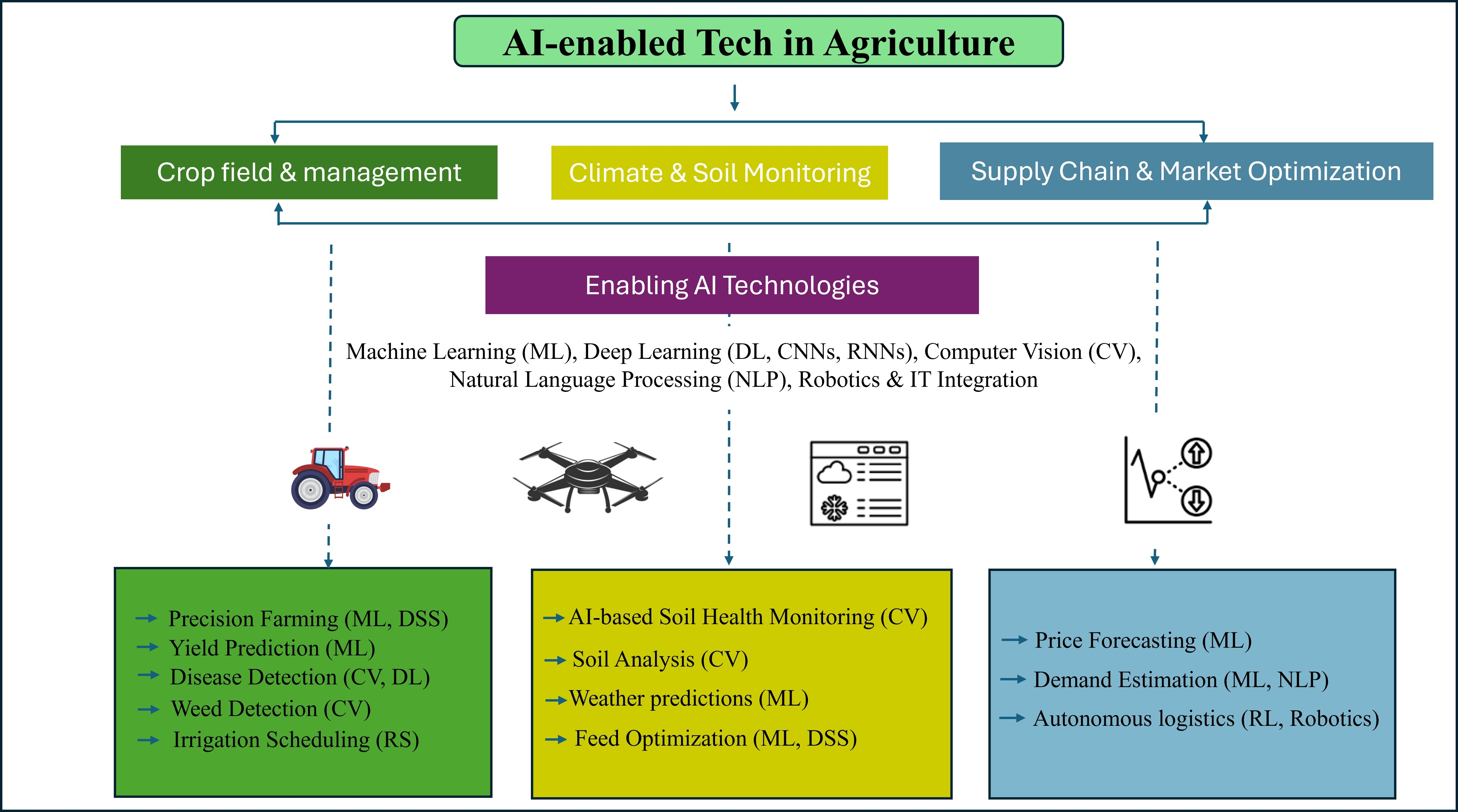
3. Smart Farming
4. Satellite Imaging, UAVs, and Proximal Phenotyping in Plants
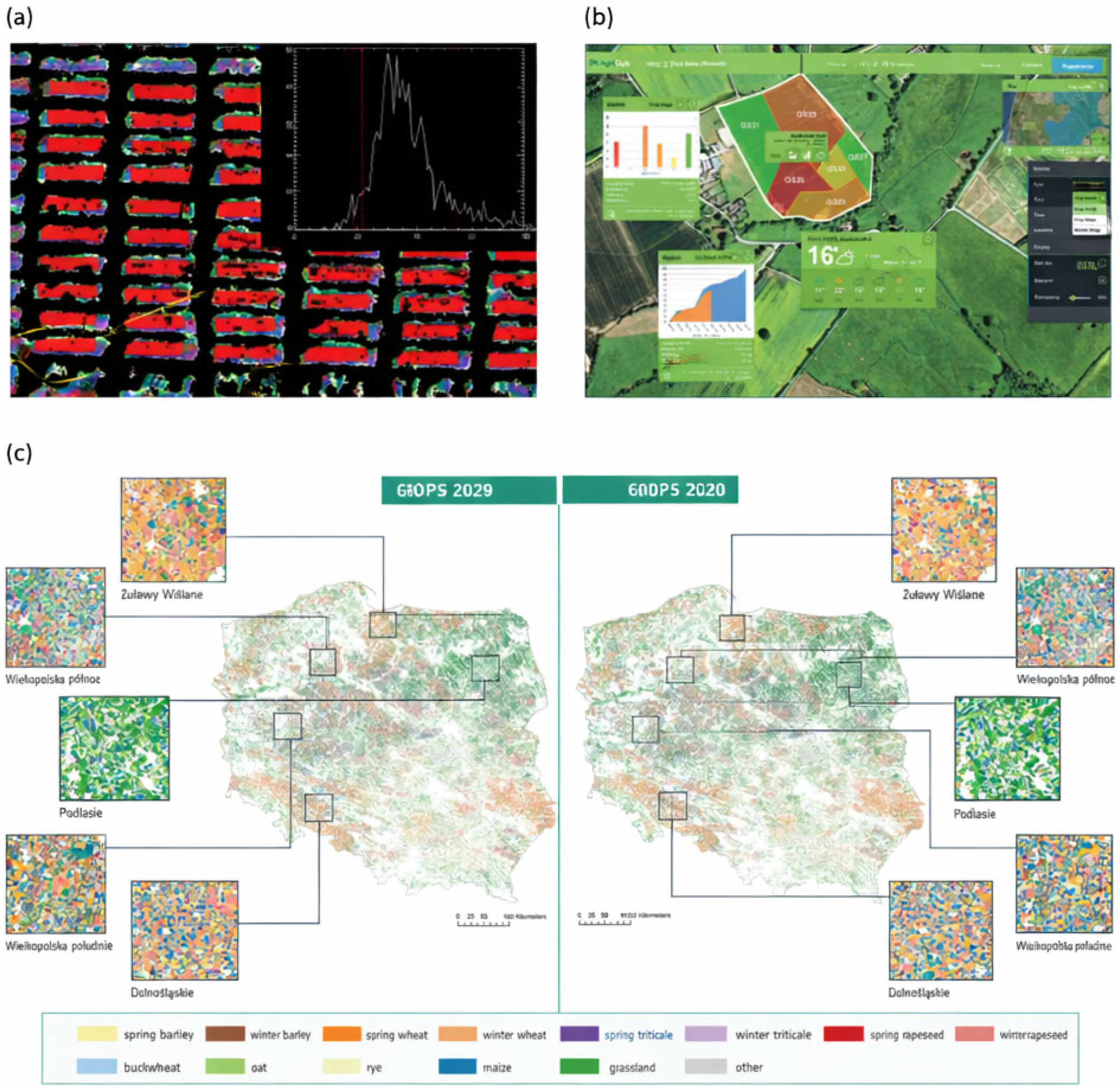
4.1. Satellite Imaging and GIS
4.2. UAV-Based and Proximal Phenotyping
| Purpose | Organism | Reference |
|---|---|---|
| High resolution satellite systems (HRSS) | ||
| Mapping leaf area index | Grapevine; giant bamboo | [38,39,40] |
| Surface soil property, soil mapping, soil salinity, moisture, and pH | Soil | [31,32,33,34,35,36,37,38,39,40,41,42,43,44,45] |
| Yield monitoring and prediction | Sorghum, cotton, sugar beet, spring wheat, corn/maize, and sunflower | [46,47,48,49,50,51] |
| Disease detection | Wheat, rice, citrus | [52,53,54] |
| Agronomic parameters, N quantification and fertilization, protein content | Maize, barley, wheat, turfgrasses | [55,56,57,58,59,60,61] |
| Crop identification | [62] | |
| Forest burn index evaluation | Trees and forest ecosystem | [19] |
| Photosynthetic capacity | Various | [15] |
| Unmanned aircraft Vehicle (UAV) | ||
| Growth stages determination | Bambara groundnut; cotton | [63,64] |
| Structural/morphological trait evaluation (biomass, heigh, count) | Barley, sugarcane, maize | [65,66,67] |
| Leaf area index (LAI) | Soybean, maize, sorghum, bambara groundnut, vineyard | [39,68,69,70,71,72] |
| Yield forecast | Maize, wheat, barley, canola, field peas, rice, sugarcane, rye, cotton, bambara groundnut, soybean | [72,73,74,75,76,77,78,79,80,81] |
| Vegetation and soil segmentation | [82] | |
| Crop row detection, tree detection and classification, fire monitoring | Coniferous trees, forest ecosystem | [82,83,84] |
| Nitrogen (N) estimation | Soybean; bread wheat; sugarcane | [85,86,87,88] |
| Crop stress and crop phenotyping monitorization and evaluation | Sugarcane, citrus, wheat, oilseed rape, maize; black poplar | [85,89,90,91,92,93] |
| Must quality parameters, vigor zones, yield, diversity | Grapevine | [94,95,96,97,98] |
| Disease detection | Citrus, avocado, banana, wheat, groundnut | [99,100,101,102,103,104] |
| Irrigation scheduling | Fruit trees | [105] |
| Carbon stock and sequestering above ground, carbon dynamics | Forest trees, mangrove | [84,106,107] |
| Reproductive traits (floral opening) | Lettuce | [108] |
| Unnamed ground Vehicle (UGV) | ||
| Row detection | Lettuce | [109] |
| Operations on peat fields | [110] | |
| Ground properties of greenhouses | [111] | |
| Organism | Trait | Model | Reference |
|---|---|---|---|
| Yield | |||
| Coffee tree | Number of branches, % of fruit weight and maturation | SVM | [112] |
| Cherry tree | Harvesting mechanization | BM/GNB | [113] |
| Citrus tree | Early yield mapping | SVM | [114] |
| Grass | Estimation of biomass | ANNs and multitemporal remote sensing data | [115] |
| Wheat, apple | Yield prediction | Satellite imagery + soil data; MLP/CNN, SVR | [116,117,118] |
| Tomato | Fruit detection/counting | Sensed RGB images, CNN | [119,120] |
| Rice | Development stage prediction | SVM and basic geographic information | [121] |
| Sugarcane | Plant heigh and stalk density | [80] | |
| Lemon | Quality assessment/control | CNN | [122] |
| Rice | Grain protein content | DCGAN | [123] |
| Land vegetation | Soil heavy metal monitorization | Various | [124] |
| Biotic stresses | |||
| Mediterranean milk thistle | Infection rate to smut fungus, weed detection | ANN/XY-Fusion, ANN/CP | [125] |
| Strawberry | Thrips detection; Botrytis sp., Penicillium sp., and Rhyzopus sp. discrimination | SVM, NN | [126,127] |
| Rice | Disease and geographical origin detection | SVM, EL/RF | [128,129] |
| Wheat | Disease infection rate to yellow rust and Septoria, N and H2O stress, weed management | ANN/XY-Fusion, ANN/MLP, SVM/LS-SVM, ANN/SOM, DNN | [13,125,130,131,132,133] |
| Maize, soybean | Weed detection and control | ANN/one-class SOM; CNN; UFAB/DNN, DL | [134,135,136,137] |
| Pears | Fragrancy detection | SVM/SPA-SVM | [138] |
| Beans, soybean | Identification and classification, root system architecture (RSA) | DL/CNN, CNN | [139,140] |
| Common grape vine | Health status, powdery mildew, black rot, downy mildew | SVM, Gaussian Mixture Model (GMM)/LBPs | [141] |
| Banana | Disease and pest detection (e.g., Black Sigatoka) | CNN/DCNN, CNN-VGG | [101,142] |
| Quality Control/Quality assurance | |||
| Tobacco | Recognition of non-tobacco-related materials | CNN: LRNTRM-YOLO | [143] |
4.3. Precision and Generalist Agriculture
5. Integration of Remote Sensing AI and Genetic Algorithms in Phenotyping to Identify Loci Associated with Agronomically Beneficial Traits
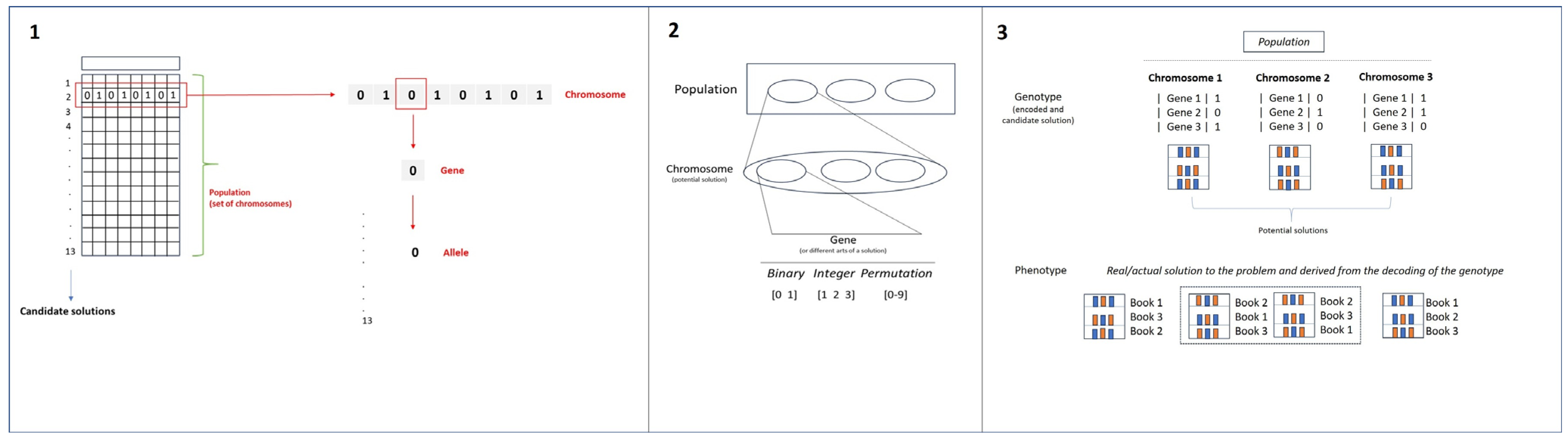
5.1. Genetic Algorithms: Principles and Optimization
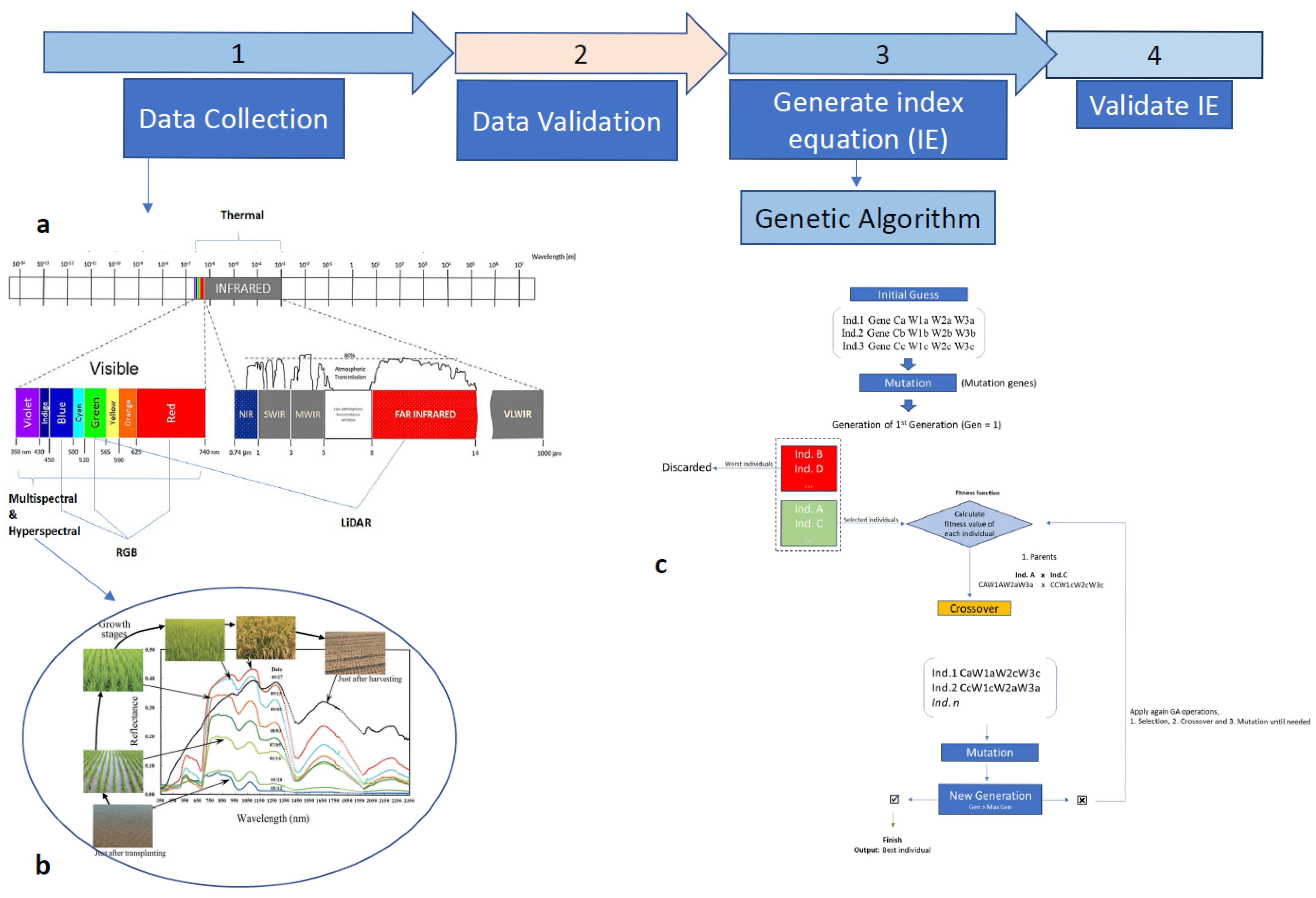
5.2. Integration with Remote Sensing and UAV-Based Phenotyping

5.3. Broader Applications in Agriculture and Food Systems
6. Data Integration—Multi-Omics Data to Enhance Genetic Predictions
6.1. Metabolomics, Multi-Sensor Integration, and ML Approaches
6.2. Genomic Resources, Causal Gene Discovery, and Smart Laboratory Platforms
7. Simulation Models in Support of Plant Breeders
7.1. Crop, Environmental, and Genomic Prediction Models
7.2. Generative Adversarial Networks (GANs): The Next Frontier
8. Ethics on the Use of Aerial Systems, Geospatial Information, ‘Big Data’, and Governance Policies
8.1. Ethical and Regulatory Considerations for UAVs and Aerial Systems in Plant Breeding
8.2. Big Data Governance, Ownership, and Ethical Use in Agriculture
9. Overcoming Challenges
10. Final Considerations
| Internal | |
|---|---|
| Strengths | Weaknesses |
|
|
| Opportunities | Threats |
|
|
| External | |
| Examples of successes: Study cases | |
| Increase in data throughput, better-quality data, reduced cost by datapoint, fewer safety incidents, large usage of technology https://pestdisplace.org/; http://www.terra-i.org/terra-i.html; https://croppie.org/, all accessed on 21 December 2025 | |
Supplementary Materials
Author Contributions
Funding
Data Availability Statement
Acknowledgments
Conflicts of Interest
Glossary
| Accuracy check | Related to the genetic algorithm, this is the evaluation of how well a given individual (solution) in the population performs with respect to a predefined fitness function (objective). |
| ANNs | Acronym for artificial neural networks, which are widely used for various tasks, including classification, regression, pattern recognition, and prediction in a AI models. |
| Binary variables | Variables that can take on one of two values (e.g., 0 and 1) and that are often used in classification tasks where the outcome is either one of two possible classes or values. |
| Biological pressure | Percentage of individuals that reproduce, where the values can vary between 0% and 100% [0% indicates that no individuals reproduce and 100% indicates that all individuals reproduce]. |
| BM/GNB | Refers to the Bernoulli Naive Bayes variant of the Naive Bayes classifier used for binary features. |
| BP | Acronym for backward propagation neural network, which is a key algorithm used for training neural networks, including multilayer feed-forward networks. It involves propagating the error backward through the network to update the weights and minimize the loss. |
| Breed | Refers to a specific group of animals, plants, or organisms that share specific characteristics that distinguish them from other groups within the same species. |
| BREEDING 4.0. | Refers to the advanced integration of artificial intelligence (AI), genomics, and multiplex gene editing technologies to optimize crop breeding. This approach enables the precise identification, modification, and enhancement of multiple genetic traits simultaneously, leading to the development of crops that are more resilient, resource-efficient, and high-yielding. |
| CNN | Acronym for convolutional neural network, which is a type of artificial neural network (ANN) designed to process and analyze grid-like data, such as images, video frames, and time series. |
| DCGAN | Acronym for deep convolution generative adversarial network, which is a type of generative adversarial network (GAN) that uses deep convolutional neural networks for both the generator and discriminator and is used to generate new data, such as images, that are similar to a given training dataset. |
| DCNN | Acronym for deep convolutional neural network, which is another type of convolutional neural network (CNN) with multiple layers of convolutions designed for automatically and hierarchically learning features from data such as images, video frames, and even time-series data. |
| Elitism | Number of individuals in the search. |
| Elitism stage | In the general sense, elitism refers to the process in GA where the best individuals (solutions) from the current generation are carried over to the next generation without modification; elitism stage means that there is the preservation of the best individuals from one generation to the next, thereby avoiding losing good solutions. |
| Fitness function | Function to evaluate the performance of any proposed gains. |
| GA | Acronym for genetic algorithm, which is used to find approximate solutions to optimization and search problems by mimicking the process of evolution. GA uses techniques such as selection, crossover (recombination), mutation, and inheritance to evolve a population of candidate solutions over generations, improving the solutions with each iteration. |
| GA optimization | Refers to the optimization of the parameters of the random forest (RF), backpropagation (BP), and kernel extreme learning machine (KELM) models. |
| GMMs | Acronym for Gaussian mixture models, which used for clustering and density estimation. |
| GS | Acronym for genomic selection, which refers a breeding method that uses DNA data to predict genetic potential and select candidates based on estimates from genomic prediction models. |
| KELM | Acronym for kernel extreme learning machine, which and refers to a learning machine based on the kernel function. |
| Ideotypes | In the context of AI and ML, ideotypes are crop models that combine beneficial traits to improve performance in specific environmental conditions. This concept differs from genetic ideotypes, which are specific genetic profiles designed to optimize performance based on inherited traits. |
| Index equation (IE) | This is an equation used to access specific data in an indexed collection, such as arrays or databases, and is particularly relevant when dealing with large datasets where indexing helps in retrieving data efficiently. |
| Integer | An integer is a discrete variable that represents discrete categories or quantities, such as the number of items in a group, the number of visits to a website, or the count of certain features or events. |
| Labeled dataset | Here, dataset refers to each input example (or data point) paired with a corresponding target output or label. For example, in genomic studies, the input attributes might include genetic markers or sequence data, while the label could be the phenotypic trait (e.g., yield, disease resistance, etc.) associated with those markers. |
| MLP | Acronym for multilayer perceptron, which refers to a type of neural network used for classification and regression. |
| Mutation probability | The probability that individuals have a mutation. The value can vary from 0 and 1, where 0 means no mutation occurs and 1 means every individual will undergo mutation. |
| NIR | Acronym for near infrared, typically ranging from approximately 750 to 1400 nanometers on the electromagnetic spectrum. |
| NN | Acronym for neural network, which is a type of machine learning model (MLM) inspired by the structure and functioning of the human brain and is composed of interconnected layers of nodes—neurons or artificial neurons—which work together to solve various tasks such as classification, regression, and pattern recognition. |
| Parity | In the context of this review, parity refers to the number of times the cattle have given birth. |
| Permutation | Arrangement or re-arrangement of objects or elements in a specific order, and in some machine learning (ML) algorithms (e.g., decision trees or ensemble methods), permutations can be used in feature selection or bootstrapping. |
| Population | Number of individuals used in the search. |
| Proximal phenotyping | This is the process of measuring traits or characteristics using sensors and technologies that are physically close to the plants, but not in direct contact. This can be performed using drones, robotic systems, or ground-based devices, which collect high-resolution data on various attributes (e.g., leaf area, chlorophyll content, water stress, among others). Unlike traditional methodologies, which are quick and accurate, these are used for large-scale and non-invasive agricultural practices. |
| R2 | Refers to the coefficient of determination, which measures how well the regression model fits the data. An R2 value closer to 1 is better, as it indicates that a greater proportion of the variance in the dependent variable is explained by the model. |
| Range of the search | Values between which best gains are used in the search. It ranges from the minimum value and the maximum value of the search space. |
| RGB | Acronym for red, green, and blue, which refers to the color a model uses for representing images. |
| RF | Acronym for random forest regression (also known as RFR), which refers to the data-driven integrated learning approach. |
| RMSE | Acronym for root mean square error, and ideally, the smaller the value is, the better, since it measures the average magnitude of the error between the values that are predicted and the values that are observed. A smaller value means that the model’s predictions are closer to the actual values. |
| RPD | Acronym for relative percentage difference, which is used to check the quality of a predictive model, particularly in the context of spectroscopy or chemometrics. It compares the prediction error to the variation in the data. The values used include the following: <1.4: impossible estimation, indicating that the model’s predictions are highly inaccurate; ≥1.4 and <2: rough estimation, indicating that the predictions are moderately accurate but not precise; and ≥2: good estimation, indicating that the predictions are reliable and accurate (as described by [177]). |
| Small Scale Farmer (SSF) | Both FAO and CGIAR operate with this definition, although the exact criteria may differ depending on the region, crop/livestock type, and context. The system refers to SSF, which often operates <2 hectares for crops, relies primarily on family labor, and focuses on subsistence or local markets. Regarding livestock, SSF refers to systems that own small herds or flocks. |
| SOM | Acronym for self-organizing map, which is a type of unsupervised neural network that is used for dimensionality reduction, clustering, and visualization of high-dimensional data. |
| Stop condition | The number of iterations in which a search is performed, which can vary from 1 to any specified maximum number of iterations. The exact number depends on the problem and the algorithm being used. |
| SVR | Acronym for support vector regression, which is usually used for regression tasks to predict continuous values instead of predicting discrete categories as in the classification tasks. It is a powerful algorithm when the relationship between the input features and the target variable is complex and non-linear. |
| SVM | Acronym for support vector machine, which is also used for regression tasks. Its main strength lies in its ability to work efficiently with both linear and non-linear data using kernel functions. |
| UFAB | Acronym for universal function approximation block, which is a component used for approximating any given function. |
References
- Alotaibi, M. Climate change, its impact on crop production, challenges, and possible solutions. Not. Bot. Horti Agrobot. Cluj-Napoca 2023, 51, 13020. [Google Scholar] [CrossRef]
- Meuwissen, T.H.E.; Hayes, B.J.; Goddard, M.E. Prediction of Total Genetic Value Using Genome-Wide Dense Marker Maps. Genetics 2001, 157, 1819–1829. [Google Scholar] [CrossRef] [PubMed]
- Washburn, J.D.; Cimen, E.; Ramstein, G.; Reeves, T.; O’Briant, P.; McLean, G.; Cooper, M.; Hammer, G.; Buckler, E.S. Predicting phenotypes from genetic; environment; management; and historical data using CNNs. Theor. Appl. Genet. 2021, 134, 3997–4011. [Google Scholar] [CrossRef] [PubMed]
- Jubair, S.; Domaratzki, M. Crop genomic selection with deep learning and environmental data: A survey. Front. Artif. Intell. 2023, 5, 1040295. [Google Scholar] [CrossRef]
- Garcia-Oliveira, A.L.; Ortiz, R.; Sarsu, F.; Rasmussen, S.K.; Agre, P.; Asfaw, A.; Kante, M.; Chander, S. The importance of genotyping within the climate-smart plant breeding value chain–integrative tools for genetic enhancement programs. Front. Plant Sci. 2025, 15, 1518123. [Google Scholar] [CrossRef]
- Chawade, A.; van Ham, J.; Blomquist, H.; Bagge, O.; Alexanderson, E.; Ortiz, R. High-Throughput Field-Phenotyping Tools for Plant Breeding and Precision Agriculture. Agronomy 2019, 9, 258. [Google Scholar] [CrossRef]
- Resende, R.T.; Chenu, K.; Rasmussen, S.K.; Heinemann, A.B.; Fritsche-Neto, R. Editorial. Enviromics in Plant Breeding. Front. Plant Sci. 2022, 13, 935380. [Google Scholar] [CrossRef]
- Kick, D.R.; Wallace, J.G.; Schnable, J.C.; Kolkman, J.M.; Alaca, B.; Beissinger, T.M.; Edwards, J.; Ertl, D.; Flint-Garcia, S.; Gage, J.L.; et al. Yield prediction through integration of genetic, environment, and management data through deep learning. G3 Genes Genomes Genet. 2023, 13, jkad006. [Google Scholar] [CrossRef]
- Tomura, S.; Wilkinson, M.J.; Cooper, M.; Powell, O. Improved genomic prediction performance with ensembles of diverse models. G3 Genes Genomes Genet. 2025, 15, jkaf048. [Google Scholar] [CrossRef]
- Xu, Y.; Zhang, X.; Li, H.; Zheng, H.; Zhang, J.; Olsen, M.S.; Varshney, R.K.; Prasanna, B.M.; Qian, Q. Smart breeding driven by big data, artificial intelligence, and integrated genomic-enviromic prediction. Mol. Plant 2022, 15, 1664–1695. [Google Scholar] [CrossRef]
- Thilakarathne, N.N.; Bakar, M.S.A.; Abas, P.E.; Yassin, H. Internet of things enabled smart agriculture, Current status, latest advancements, challenges and countermeasures. Heliyon 2025, 11, E42136. [Google Scholar] [CrossRef] [PubMed]
- Sparrow, R.; Howard, M. Robots in agriculture, prospects, impacts, ethics; and policy. Precis. Agric. 2021, 22, 818–833. [Google Scholar] [CrossRef]
- Zou, K.; Liao, Q.; Zhang, F.; Che, X.; Zhang, C. A segmentation network for smart weed management in wheat fields. Comput. Electron. Agric. 2022, 202, 107303. [Google Scholar] [CrossRef]
- Inoue, Y.; Peñuelas, J.; Miyata, A.; Mano, M. Normalized Difference Spectral Indices for Estimating Photosynthetic Efficiency and Capacity at a Canopy Scale Derived from Hyperspectral and CO2 Flux Measurements in Rice. Remote Sens. Environ. 2008, 112, 156–172. [Google Scholar] [CrossRef]
- Fu, P.; Montes, C.M.; Siebers, M.H.; Gomez-Casanova, N.; McGrath, J.M.; Ainsworth, E.A.; Bernacchi, C.J. Advances in field-based high-throughput photosynthetic phenotyping. J. Exp. Bot. 2022, 73, 3157–3172. [Google Scholar] [CrossRef]
- Carroll, O.H.; Seabloom, E.W.; Borer, E.T.; Harpole, W.S.; Wilfahrt, P.; Arnillas, C.A.; Bakker, J.D.; Blumenthal, D.M.; Boughton, E.; Bugalho, M.N.; et al. Frequent failure of nutrients to increase plant biomass supports the need for precision fertilization in agriculture. Sci. Rep. 2025, 15, 14564. [Google Scholar] [CrossRef]
- Wang, T.; Zuo, Y.; Manda, T.; Hwarari, D.; Yang, L. Harnessing Artificial Intelligence; Machine Learning and Deep Learning for Sustainable Forestry Management and Conservation, Transformative Potential and Future Perspectives. Plants 2025, 14, 998. [Google Scholar] [CrossRef]
- Lechner, A.M.; Foody, G.M.; Boyd, D.S. Applications in Remote Sensing to Forest Ecology and Management. One Earth 2020, 2, 405–412. [Google Scholar] [CrossRef]
- Sannigrahi, S.; Pilla, F.; Basu, B.; Basu, A.S.; Sarkar, K.; Chakraborti, S.; Joshi, P.K.; Zhang, Q.; Wang, Y.; Bhatt, S.; et al. Examining the effects of forest fire on terrestrial carbon emission and ecosystem production in India using remote sensing approaches. Sci. Total Environ. 2020, 725, 138331. [Google Scholar] [CrossRef]
- Gao, Y.; Skutsch, M.; Paneque-Galvez, J.; Ghilardi, A. Remote sensing of forest degradation: A review. Environ. Res. Lett. 2020, 15, 103001. [Google Scholar] [CrossRef]
- Velazquez-Chavez, L.J.; Daccache, A.; Mohamed, A.Z.; Centritto, M. Plant-based and remote sensing for water status monitoring of orchard crops. Systematic review and meta-analysis. Agric. Water Manag. 2024, 303, 109051. [Google Scholar] [CrossRef]
- Muzammal, H.; Zaman, M.; Safdar, M.; Shahid, M.A.; Sabir, M.K.; Khil, A.; Raza, A.; Faheem, M.; Ahmed, J.; Sattar, S.M.; et al. Climate Change Impacts on Water Resources and Implications for Agricultural Management. In Transforming Agricultural Management for a Sustainable Future; World Sustainability Series; Kanga, S., Singh, S.K., Shevkani, K., Pathak, V., Sajan, B., Eds.; Springer: Cham, Switzerland, 2024; pp. 21–45. [Google Scholar] [CrossRef]
- Singh, A.; Ganapathysubramanian, B.; Singh, A.K.; Sarkar, S. Machine Learning for High-Throughput Stress Phenotyping in Plants. Trends Plant Sci. 2016, 21, 110–124. [Google Scholar] [CrossRef] [PubMed]
- Mahato, S.; Bi, H.; Neethirajan, S. Dairy DigiD: A keypoint-based deep learning system for classifying dairy cattle by physiological and reproductive status. Front. Artif. Intell. 2025, 8, 1545247. [Google Scholar] [CrossRef] [PubMed]
- Tattaris, M.; Reynolds, M.P.; Chapman, S.C. A Direct Comparison of Remote Sensing Approaches for High-Throughput Phenotyping in Plant Breeding. Front. Plant Sci. 2016, 7, 1131. [Google Scholar] [CrossRef]
- ESA (European Space Agency). Sentinel Data Enables New System for Agricultural Monitoring in Poland. 2020. Available online: https://www.esa.int/Applications/Observing_the_Earth/Copernicus/Sentinel_data_enables_new_system_for_agricultural_monitoring_in_Poland (accessed on 27 October 2025).
- Page, M.J.; McKenzie, J.E.; Bossuyt, P.M.; Boutron, I.; Hoffmann, T.C.; Mulrow, C.D.; Shamseer, L.; Tetzlaff, J.M.; Akl, E.A.; Brennan, S.E.; et al. The PRISMA 2020 statement: An updated guideline for reporting systematic reviews. BMJ 2021, 372, 71. [Google Scholar] [CrossRef]
- Assimakopoulos, F.; Vassilakis, C.; Margaris, D.; Kotis, K.; Spiliotopoulos, D. AI and related technologies in the fields of smart agriculture: A review. Information 2025, 16, 100. [Google Scholar] [CrossRef]
- Ghosh, A.; Sumit, R.; Ashoka, P.; Kotyal, K.; Sabarinathan, B.; Anjali, S.S.; Sivakumar, K.P.; Panotra, N.; Pandey, S.K. Data-driven decision making in agriculture with sensors, satellite imagery and AI analytics by digital farming. Arch. Curr. Res. Int. 2025, 25, 37–52. [Google Scholar] [CrossRef]
- Tatem, A.J.; Goetz, S.J.; Hay, S.I. Fifty years of Earth observation satellites, Views from above have lead to countless advances on the ground in both scientific knowledge and daily life. Am. Sci. 2008, 96, 390–398. [Google Scholar] [CrossRef]
- Badola, S. Role of remote sensing and GIS in land use planning. Int. J. Eng. Res. Manag. Technol. 2019, 6, 59–65. Available online: https://www.ijermt.org/publication/41/306.%20ijernt%20JULY%202019.pdf (accessed on 21 December 2025).
- Raihan, A. A Comprehensive review of the recent advancement in integrating deep learning with geographic information systems. Res. Briefs Inf. Commun. Technol. Evol. 2023, 9, 98–115. [Google Scholar] [CrossRef]
- Trivedi, A.; Rao, K.V.R.; Yadav, D.; Verma, N.S. Remote sensing and geographic information system applications for precision farming and natural resource management. Indian J. Ecol. 2022, 49, 1624–1633. [Google Scholar] [CrossRef]
- Xie, C.; Yang, C. A review on plant high-throughput phenotyping traits using UAV-based sensors. Comput. Electron. Agric. 2020, 178, 105731. [Google Scholar] [CrossRef]
- Chandra, A.L.; Desai, S.V.; Guo, W.; Balasubramanian, V.N. Computer vision with deep learning for plant phenotyping in agriculture: A survey. arXiv 2020, arXiv:2006.11391. [Google Scholar] [CrossRef]
- Sankaran, S.; Khot, L.R.; Espinoza, C.Z.; Jarolmasjed, S.; Sathuvalli, V.R.; Vandemark, G.J.; Miklas, P.N.; Carter, A.H.; Pumphrey, M.O.; Knowles, N.R.; et al. Low-altitude; high-resolution aerial imaging systems for row and field crop phenotyping, A review. Eur. J. Agron. 2015, 70, 112–123. [Google Scholar] [CrossRef]
- Duarte, A.; Acevedo-Munoz, L.; Goncalves, C.I.; Mota, L.; Sarmento, A.; Silva, M.; Fabres, S.; Borralho, N.; Valente, C. Detection of longhorned borer attack and assessment in eucalyptus plantations using UAV imagery. Remote Sens. 2020, 12, 3153. [Google Scholar] [CrossRef]
- Johnson, L.F.; Roczen, D.E.; Youkhana, S.K.; Nemani, R.R.; Bosch, D.F. Mapping vineyard leaf area with multispectral satellite imagery. Comput. Electron Agric. 2003, 38, 33–44. [Google Scholar] [CrossRef]
- Johnson, L.F. Temporal stability of an NDVI-LAI relationship in a Napa Valley vineyard. Aust. J. Grape Wine Res. 2008, 9, 96–101. [Google Scholar] [CrossRef]
- Qin, Z.; Yang, H.; Shu, Q.; Yu, J.; Yang, Z.; Ma, X.; Duan, D. Estimation of Dendrocalamus giganteus leaf area index by combining multi-source remote sensing data and machine learning optimization model. Front. Plant Sci. 2025, 15, 1505414. [Google Scholar] [CrossRef]
- Sullivan, D.G.; Shaw, J.N.; Rickman, D. IKONOS imagery to estimate surface soil property variability in two Alabama physiographies. Soil Sci. Soc. Am. J. 2005, 69, 1789–1798. [Google Scholar] [CrossRef]
- Ping, J.L.; Ferguson, R.B.; Dobermann, A. Site-specific nitrogen and plant density management in irrigated maize. Agron. J. 2008, 100, 1193–1204. [Google Scholar] [CrossRef]
- Kumar, N.; Anouncia, S.; Madhavan, P. Application of satellite remote sensing to find soil fertilization by using soil colour. Int. J. Online Eng. 2013, 9, 2530. [Google Scholar] [CrossRef]
- Ghazali, M.; Wikantika, K.; Harto, A.; Kondoh, A. Generating soil salinity, soil moisture, soil ph from satellite imagery and its analysis. Inf. Process Agric. 2019, 7, 294–306. [Google Scholar] [CrossRef]
- Montaldo, N.; Gaspa, A.; Corona, R. Multiscale assimilation of sentinel and Landsat data for soil moisture and leaf area index predictions using an ensemble-Kalman-filter-based assimilation approach in a heterogeneous ecosystem. Remote Sens. 2022, 14, 3458. [Google Scholar] [CrossRef]
- Dobermann, A.; Ping, J.L. Geostatistical integration of yield monitor data and remote sensing improves yield maps. Agronomy J. 2004, 96, 285–297. [Google Scholar] [CrossRef]
- Yang, C.; Everitt, J.H.; Bradford, J.M. Comparison of QuickBird satellite imagery and airborne imagery for mapping grain sorghum yield patterns. Precis. Agric. 2006, 7, 33–44. [Google Scholar] [CrossRef]
- Yang, C.; Everitt, J.H.; Bradford, J.M. Evaluating high resolution QuickBird satellite imagery for estimating cotton yield. Trans. ASABE 2006, 49, 1599–1606. [Google Scholar] [CrossRef]
- Yang, C.; Everitt, J.H.; Fletcher, R.S.; Murden, D. Using high resolution QuickBird imagery for crop identification and area estimation. Geocarto Int. 2007, 22, 219–233. [Google Scholar] [CrossRef]
- Yang, C.; Everitt, J.H.; Murden, D. Using high resolution SPOT 5 multispectral imagery for crop identification. Comput. Electron. Agric. 2011, 75, 347–354. [Google Scholar] [CrossRef]
- Bu, H.; Sharma, L.K.; Denton, A.; Franzen, D.W. Comparison of satellite imagery and ground-based active optical sensors as yield predictors in sugar beet, spring wheat, corn, and sunflower. Agron. J. 2017, 109, 299–308. [Google Scholar] [CrossRef]
- Franke, J.; Menz, G. Multi-temporal wheat disease detection by multispectral remote sensing. Precis. Agric. 2007, 8, 161–172. [Google Scholar] [CrossRef]
- Li, X.; Lee, W.S.; Li, M.; Ehsani, R.; Mishra, A.R.; Yang, C.; Mangan, R.L. Feasibility study on Huanglongbing (citrus greening) detection based on WorldView-2 satellite imagery. Biosyst. Eng. 2015, 132, 28–38. [Google Scholar] [CrossRef]
- Ghobadifar, F.; Aimrun, W.; Jebur, M.N. Development of an early warning system for brown planthopper (BPH) (Nilaparvata lugens) in rice farming using multispectral remote sensing. Precis. Agric. 2016, 17, 377–391. [Google Scholar] [CrossRef]
- Bausch, W.C.; Halvorson, A.D.; Cipra, J. QuickBird satellite and ground-based multispectral data correlations with agronomic parameters of irrigated maize grown in small plots. Biosyst. Eng. 2008, 101, 306–315. [Google Scholar] [CrossRef]
- Bausch, W.C.; Khosla, R. QuickBird satellite versus ground-based multi-spectral data for estimating nitrogen status of irrigated maize. Precis. Agric. 2010, 11, 274–290. [Google Scholar] [CrossRef]
- Söderström, M.; Borjesson, T.; Pettersson, C.G.; Nissen, K.; Hagner, O. Prediction of protein content in malting barley using proximal and remote sensing. Precis. Agric. 2010, 11, 587–599. [Google Scholar] [CrossRef]
- Wagner, P.; Hank, K. Suitability of aerial and satellite data for calculation of site-specific nitrogen fertilisation compared to ground based sensor data. Precis. Agric. 2013, 14, 135–150. [Google Scholar] [CrossRef]
- Caturegli, L.; Casucci, M.; Lulli, F.; Grossi, N.; Gaetani, M.; Magni, S.; Bonari, E.; Volterrani, M. GeoEye-1 satellite versus ground-based multispectral data for estimating nitrogen status of turfgrasses. Int. J. Remote Sens. 2015, 36, 2238–2251. [Google Scholar] [CrossRef]
- Magney, T.S.; Eitel, J.U.H.; Vierling, L.A. Mapping wheat nitrogen uptake from RapidEye vegetation indices. Precis. Agric. 2017, 18, 429–451. [Google Scholar] [CrossRef]
- Yu, Y.; Luo, Y.; Wang, X.; Wang, X.; Hu, C. Precise assimilation prediction of short-term and long-term maize irrigation water based on EnKF-DSSAT and fuzzy optimization-DSSAT models. IEEE Access 2025, 13, 27150–27166. [Google Scholar] [CrossRef]
- Rußwurm, M.; Lefevre, S.; Korner, M. Breizhcrops: A satellite time series dataset for crop type identification. In Proceedings of the Time Series Workshop of the 36th International Conference on Machine Learning, Long Beach, CA, USA, 9–15 June 2019; Volume 97. [Google Scholar]
- Suhairi, T.; Jahanshiri, E.; Nizar, N.M.M. Multicriteria land suitability assessment for growing under utilised crop, bambara groundnut in Peninsular Malaysia. IOP Conf. Ser. Earth Environ. Sci. 2018, 169, 012044. [Google Scholar] [CrossRef]
- Xu, R.; Li, C.; Paterson, A.H.; Jiang, Y.; Sun, S.; Robertson, J.S. Aerial images and convolutional neural network for cotton bloom detection. Front. Plant Sci. 2018, 8, 2235. [Google Scholar] [CrossRef] [PubMed]
- Bendig, J.; Yu, K.; Aasen, H.; Bolten, A.; Bennertz, S.; Broscheit, J.; Gnyp, M.L.; Bareth, G. Combining UAV-based plant height from crop surface models, visible, and near infrared vegetation indices for biomass monitoring in barley. Int. J. Appl. Earth Obs. Geoinf. 2015, 39, 79–87. [Google Scholar] [CrossRef]
- De Souza, C.H.W.; Lamparelli, R.A.C.; Rocha, J.V.; Magalhães, P.S.G. Height estimation of sugarcane using an unmanned aerial system (UAS) based on structure from motion (SfM) point clouds. Int. J. Remote Sens. 2017, 38, 2218–2230. [Google Scholar] [CrossRef]
- Gnädinger, F.; Schmidhalter, U. Digital Counts of Maize Plants by Unmanned Aerial Vehicles (UAVs). Remote Sens. 2017, 9, 544. [Google Scholar] [CrossRef]
- Colombo, R.; Bellingeri, D.; Fasolini, D.; Marino, C.M. Retrieval of leaf area index in different vegetation types using high resolution satellite data. Remote Sens. Environ. 2003, 86, 120–131. [Google Scholar] [CrossRef]
- Gano, B.; Dembele, J.S.B.; Tovignan, T.K.; Sine, B.; Vadez, V.; Diouf, D.; Audebert, A. Adaptation Responses to Early Drought Stress of West Africa Sorghum Varieties. Agronomy 2021, 11, 443. [Google Scholar] [CrossRef]
- Peng, X.; Han, W.; Ao, J.; Wang, Y. Assimilation of LAI derived from UAV multispectral data into the SAFY model to estimate maize yield. Remote Sens. 2021, 13, 1094. [Google Scholar] [CrossRef]
- Buthelezi, S.; Mutanga, O.; Sibanda, M.; Odindi, J.; Clulow, A.D.; Chimonyo, V.G.; Mabhaudhi, T. Assessing the prospects of remote sensing maize leaf area index using UAV-derived multi-spectral data in smallholder farms across the growing season. Remote Sen. 2023, 15, 1597. [Google Scholar] [CrossRef]
- Jewan, S.Y.Y.; Singh, A.; Billa, L.; Sparkes, D.; Murchie, E.; Gautam, D.; Cogato, A.; Pagay, V. Can Multi-Temporal Vegetation Indices and Machine Learning Algorithms Be Used for Estimation of Groundnut Canopy State Variables? Horticulture 2024, 10, 748. [Google Scholar] [CrossRef]
- Shanahan, J.F.; Schepers, J.S.; Francis, D.D.; Varvel, G.E.; Wilhelm, W.W.; Tringe, J.M.; Schlemmer, M.R.; David, D.J. Use of remote-sensing imagery to estimate corn grain yield. Agron. J. 2001, 93, 583–589. [Google Scholar] [CrossRef]
- Swain, K.; Thomson, S.; Jayasuriya, H. Adoption of an unmanned helicopter for low-altitude remote sensing to estimate yield and total biomass of a rice crop. Trans. ASABE 2010, 53, 21–27. [Google Scholar] [CrossRef]
- Mkhabela, M.S.; Bullock, P.; Raj, S.; Wang, S.; Yang, Y. Crop yield forecasting on the Canadian Prairies using MODIS NDVI data. Agric. For. Meteorol. 2011, 151, 385–393. [Google Scholar] [CrossRef]
- Geipel, J.; Link, J.; Claupein, W. Combined spectral and spatial modeling of corn yield based on aerial images and crop surface models acquired with an unmanned aircraft system. Remote Sens. 2014, 6, 10335–10355. [Google Scholar] [CrossRef]
- Gracia-Romero, A.; Vergara-Díaz, O.; Thierfelder, C.; Cairns, J.E.; Kefauver, S.C.; Araus, J.L. Phenotyping conservation agriculture management effects on ground and aerial remote sensing assessments of maize hybrids performance in Zimbabwe. Remote Sens. 2018, 10, 349. [Google Scholar] [CrossRef]
- Galán, R.J.; Bernal-Vasquez, A.M.; Jebsen, C.; Piepho, H.P.; Thorwarth, P.; Steffan, P.; Gordillo, A.; Miedaner, T. Integration of genotypic, hyperspectral, and phenotypic data to improve biomass yield prediction in hybrid rye. Theor. Appl. Genet. 2020, 133, 3001–3015. [Google Scholar] [CrossRef]
- Ashapure, A.; Jung, J.; Chang, A.; Oh, S.; Yeom, J.; Maeda, M.; Maeda, A.; Dube, N.; Landivar, J.; Hague, S.; et al. Developing a machine learning based cotton yield estimation framework using multi-temporal UAS data. ISPRS J. Photogramm Rem. Sens. 2020, 169, 180–194. [Google Scholar] [CrossRef]
- Sumesh, K.C.; Ninsawat, S.; Som-ard, J. Integration of RGB-based vegetation index; crop surface model and object-based image analysis approach for sugarcane yield estimation using unmanned aerial vehicle. Comput. Electron. Agric. 2021, 180, 105903. [Google Scholar] [CrossRef]
- Alabi, T.R.; Abebe, A.T.; Chigeza, G.; Fowobaje, K.R. Estimation of soybean grain yield from multispectral high-resolution UAV data with machine learning models in West Africa. Remote Sens. Appl. Soc. Environ. 2022, 27, 100782. [Google Scholar] [CrossRef]
- Hassanein, M.; Lari, Z.; El-Sheimy, N. A new vegetation segmentation approach for cropped fields based on threshold detection from hue histograms. Sensors 2018, 18, 1253. [Google Scholar] [CrossRef]
- Merino, L.; Caballero, F.; Martínez-de-Dios, J.R.; Maza, I.; Ollero, A. An unmanned aircraft system for automatic forest fire monitoring and measurement. J. Intell. Robot. Syst. 2012, 65, 533–548. [Google Scholar] [CrossRef]
- Fujimoto, A.; Haga, C.; Matsui, T.; Machimura, T.; Hayashi, K.; Sugita, S.; Takagi, H. An end-to-end process development for UAV-SfM based forest monitoring: Individual tree detection, species classification and carbon dynamics simulation. Forests 2019, 10, 680. [Google Scholar] [CrossRef]
- Amaral, L.R.; Molin, J.P.; Portz, G.; Finazzi, F.B.; Cortinove, L. Comparison of crop canopy reflectance sensors used to identify sugarcane biomass and nitrogen status. Precis. Agric. 2015, 16, 15–28. [Google Scholar] [CrossRef]
- Maimaitijiang, M.; Ghulam, A.; Sidike, P.; Hartling, S.; Maimaitiyiming, M.; Peterson, K.; Shavers, E.; Fishman, J.; Peterson, J.; Kadam, S.; et al. Unmanned Aerial System (UAS)-based phenotyping of soybean using multi-sensor data fusion and extreme learning machine. ISPRS J. Photogramm. Remote Sens. 2017, 134, 43–58. [Google Scholar] [CrossRef]
- Zheng, H.; Cheng, T.; Li, D.; Zhou, X.; Yao, X.; Tian, Y.; Cao, W.; Zhu, Y. Evaluation of RGB; color-infrared and multispectral images acquired from unmanned aerial systems for the estimation of nitrogen accumulation in rice. Remote Sens. 2018, 10, 824. [Google Scholar] [CrossRef]
- Hagn, L.; Mittermayer, M.; Kern, A.; Kimmelmann, S.; Maidl, F.-X.; Hülsbergen, K.-J. Effects of sensor-based, site-specific nitrogen fertilizer application on crop yield, nitrogen balance, and nitrogen efficiency. Sensors 2025, 25, 795. [Google Scholar] [CrossRef]
- Ludovisi, R.; Tauro, F.; Salvati, R.; Khoury, S.; Mugnozza, G.S.; Harfouche, A. UAV-based thermal imaging for high-throughput field phenotyping of black poplar response to drought. Front. Plant Sci. 2017, 8, 1681. [Google Scholar] [CrossRef]
- Ampatzidis, Y.; Partel, V.; Meyering, B.; Albrecht, U. Citrus rootstock evaluation utilizing UAV-based remote sensing and artificial intelligence. Comput. Electron. Agric. 2019, 164, 104900. [Google Scholar] [CrossRef]
- Bhandari, M.; Baker, S.; Rudd, J.C.; Ibrahim, A.M.H.; Chang, A.; Xue, Q.; Jung, J.; Landivar, J.; Auvermann, B. Assessing the effect of drought on winter wheat growth using unmanned aerial system (UAS)-based phenotyping. Remote Sens. 2021, 13, 1144. [Google Scholar] [CrossRef]
- Brewer, K.; Clulow, A.; Sibanda, M.; Gokool, S.; Odindi, J.; Mutanga, O.; Naiken, V.; Chimonyo, V.G.P.; Mabhaudhi, T. Estimation of maize foliar temperature and stomatal conductance as indicators of water stress based on optical and thermal imagery acquired using an unmanned aerial vehicle (UAV) platform. Drones 2022, 6, 169. [Google Scholar] [CrossRef]
- Yang, Y.; Wei, X.; Wang, J.; Zhou, G.; Wang, J.; Jiang, Z.; Zhao, J.; Ren, Y. Prediction of seedling oilseed rape crop phenotype by drone-derived multimodal data. Remote Sens. 2023, 15, 3951. [Google Scholar] [CrossRef]
- Fiorillo, E.; Crisci, A.; de Filippis, T.; di Gennaro, S.F.; di Blasi, S.; Matese, A.; Primicerio, J.; Vaccari, F.P.; Genesio, L. Airborne high-resolution images for grape classification: Changes in correlation between technological and late maturity in a Sangiovese vineyard in Central Italy. Aust. J. Grape Wine Res. 2012, 18, 80–90. [Google Scholar] [CrossRef]
- Bonilla, I.; de Toda, F.M.; Martínez-Casasnovas, J.A. Vine vigor, yield and grape quality assessment by airborne remote sensing over three years: Analysis of unexpected relationships in cv Tempranillo. Span. J. Agric. Res. 2015, 13, e0903. [Google Scholar] [CrossRef]
- Ledderhof, D.; Brown, R.; Reynolds, A.; Jollineau, M. Using remote sensing to understand Pinot noir vineyard variability in Ontario. Can. J. Plant Sci. 2016, 96, 89–108. [Google Scholar] [CrossRef]
- Ferrer, M.; Echeverría, G.; Pereyra, G.; Gonzalez-Neves, G.; Pan, D.; Mirás-Avalos, J.M. Mapping vineyard vigor using airborne remote sensing: Relations with yield, berry composition and sanitary status under humid climate conditions. Precis. Agric. 2019, 21, 178–197. [Google Scholar] [CrossRef]
- Garcia-Fernandez, M.; Sanz-Ablanedo, E.; Rodríguez-Pérez, J.R. High-resolution drone-acquired RGB imagery to estimate spatial grape quality variability. Agronomy 2021, 11, 655. [Google Scholar] [CrossRef]
- Abdulridha, J.; Batuman, O.; Ampatzidis, Y. UAV-based remote sensing technique to detect citrus canker disease utilizing hyperspectral imaging and machine learning. Remote Sens. 2019, 11, 1373. [Google Scholar] [CrossRef]
- Harihara, J.; Fuller, J.; Ampatzidis, Y.; Abdulridha, J.; Lerwill, A. Finite difference analysis and bivariate correlation of hyperspectral data for detecting laurel wilt disease and nutritional deficiency in avocado. Remote Sens. 2019, 11, 1748. [Google Scholar] [CrossRef]
- Selvaraj, M.G.; Vergara, A.; Ruiz, H.; Elayabalan, S.; Ocimati, W.; Blomme, G. AI-powered banana diseases and pest detection. Plant Methods 2019, 15, 92. [Google Scholar] [CrossRef]
- Bhandari, M.; Ibrahim, A.M.H.; Xue, Q.; Jung, J.; Chang, A.; Rudd, J.C.; Maeda, M.; Rajan, N.; Neely, H.; Landivar, J. Assessing winter wheat foliage disease severity using aerial imagery acquired from small unmanned aerial vehicle (UAV). Comput. Electron. Agric. 2020, 176, 105665. [Google Scholar] [CrossRef]
- Chang, A.; Yeom, J.; Jung, J.; Landivar, J. Comparison of canopy shape and vegetation indices of citrus trees derived from UAV multispectral images for characterization of citrus greening disease. Remote Sens. 2020, 12, 4122. [Google Scholar] [CrossRef]
- Kassim, Y.B.; Oteng-Frimpong, R.; Puozaa, D.K.; Sie, E.K.; Rasheed, A.; Rashid, A.; Danquah, A.; Akogo, D.A.; Rhoads, J.; Hoisington, D.; et al. High-throughput plant phenotyping (HTPP) in resource-constrained research programs: A working example in Ghana. Agronomy 2022, 12, 2733. [Google Scholar] [CrossRef]
- Gonzalez-Dugo, V.; Zarco-Tejada, P.; Nicolas, E.; Nortes, P.A.; Alarcon, J.J.; Intrigliolo, D.S.; Fereres, E. Using high resolution uav thermal imagery to assess the variability in the water status of five fruit tree species within a commercial orchard. Precis. Agric. 2013, 14, 660–678. [Google Scholar] [CrossRef]
- Hashem, A. Estimation of Aboveground Biomass/Carbon Sequestration Using UAV Imagery at Kebun Raya Unmul Samarinda Education Forest, East Kalimantan, Indonesia. Master’s Thesis, University of Twente, Enschede, The Netherlands, 2019; p. 77. [Google Scholar]
- Anand, A.; Pandey, P.C.; Petropoulos, G.P.; Pavlides, A.; Srivastava, P.K.; Sharma, J.K.; Malhi, R.K.M. Use of hyperion for mangrove forest carbon stock assessment in Bhitarkanika Forest Reserve: A contribution towards Blue Carbon Initiative. Remote Sens. 2020, 12, 597. [Google Scholar] [CrossRef]
- Han, R.; Wong, A.J.Y.; Tang, Z.; Truco, M.J.; Lavelle, D.O.; Kozik, A.; Jin, Y.; Michelmore, R.W. Drone phenotyping and machine learning enable discovery of loci regulating daily floral opening in lettuce. J. Exp. Bot. 2021, 72, 2979–2994. [Google Scholar] [CrossRef]
- Bonadies, S.; Gadsden, A.S. An overview of autonomous crop row navigation strategies for unmanned ground vehicles. Eng. Agric. Environ. Food 2019, 12, 24–31. [Google Scholar] [CrossRef]
- Kägo, R.; Vellak, P.; Karofeld, E.; Noorma, M.; Ol, J. Assessment of using state of the art unmanned ground vehicles for operations on peat fields. Mires Peat 2021, 27, 11. [Google Scholar] [CrossRef]
- Ruiz-Larrea, A.; Roldán, J.J.; Garzón, M.; del Cerro, J.; Barrientos, A. A UGV Approach to Measure the Ground Properties of Greenhouses. In Robot 2015: Second Iberian Robotics Conference; Reis, L., Moreira, A., Lima, P., Montano, L., Muñoz-Martinez, V., Eds.; Advances in Intelligent Systems and Computing; Springer: Cham, Switzerland, 2015; Volume 418. [Google Scholar] [CrossRef]
- Ramos, P.J.; Prieto, F.A.; Montoya, E.C.; Oliveros, C.E. Automatic fruit count on coffee branches using computer vision. Comput. Electron. Agric. 2017, 137, 9–22. [Google Scholar] [CrossRef]
- Amatya, S.; Karkee, M.; Gongal, A.; Zhang, Q.; Whiting, M.D. Detection of cherry tree branches with full foliage in planar architecture for automated sweet-cherry harvesting. Biosyst. Eng. 2016, 146, 3–15. [Google Scholar] [CrossRef]
- Sengupta, S.; Lee, W.S. Identification and determination of the number of immature green citrus fruit in a canopy under different ambient light conditions. Biosyst. Eng. 2014, 117, 51–61. [Google Scholar] [CrossRef]
- Ali, I.; Cawkwell, F.; Dwyer, E.; Green, S. Modeling managed grassland biomass estimation by using multitemporal remote sensing data—A machine learning approach. IEEE J. Sel. Top Appl. Earth Obs. Remote Sens. 2016, 10, 3254–3264. [Google Scholar] [CrossRef]
- Pantazi, X.-E.; Moshou, D.; Alexandridis, T.K.; Whetton, R.L.; Mouazen, A.M. Wheat yield prediction using machine learning and advanced sensing techniques. Comput. Electron. Agric. 2016, 121, 57–65. [Google Scholar] [CrossRef]
- Bargoti, S.; Underwood, J.P. Image Segmentation for Fruit Detection and Yield Estimation in Apple Orchards. J. Fields Robot. 2017, 34, 1039–1060. [Google Scholar] [CrossRef]
- Zhu, J.; Li, Y.; Wang, C.; Liu, P.; Lan, Y. Method for monitoring wheat growth status and estimating yield based on UAV multispectral remote sensing. Agronomy 2024, 14, 991. [Google Scholar] [CrossRef]
- Senthilnath, J.; Dokania, A.; Kandukuri, M.; Ramesh, K.N.; Anand, G.; Omkar, S.N. Detection of tomatoes using spectral-spatial methods in remotely sensed RGB images captured by UAV. Biosyst. Eng. 2016, 146, 16–32. [Google Scholar] [CrossRef]
- Zheng, W.; Dai, G.; Hu, M.; Wang, P. A Robust Tomato Counting Framework for Greenhouse Inspection Robots Using YOLOv8 and Inter-Frame Prediction. Agronomy 2025, 15, 1135. [Google Scholar] [CrossRef]
- Su, Y.; Xu, H.; Yan, L. Support vector machine-based open crop model (SBOCM): Case of rice production in China. Saudi J. Biol. Sci. 2017, 24, 537–547. [Google Scholar] [CrossRef]
- Jahanbakhshi, A.; Momeny, M.; Mahmoudi, M.; Zhang, Y.-D. Classification of sour lemons based on apparent defects using stochastic pooling mechanism in deep convolutional neural networks. Sci. Hortic. 2020, 263, 109133. [Google Scholar] [CrossRef]
- Zheng, H.; Tang, W.; Yang, T.; Zhou, M.; Guo, C.; Cheng, T.; Cao, W.; Zhu, Y.; Zhang, Y.X. Grain Protein Content Phenotyping in Rice via Hyperspectral Imaging Technology and a Genome-Wide Association Study. Plant Phenomics 2024, 6, 0200. [Google Scholar] [CrossRef]
- Lovynska, V.; Bayat, B.; Bol, R.; Moradi, S.; Rahmati, M.; Raj, R.; Sytnyk, S.; Wiche, O.; Wu, B.; Montzka, C. Monitoring Heavy Metals and Metalloids in Soils and Vegetation by Remote Sensing: A Review. Remote Sens. 2024, 16, 3221. [Google Scholar] [CrossRef]
- Pantazi, X.E.; Moshou, D.; Oberti, R.; West, J.; Mouazen, A.M.; Bochtis, D. Detection of biotic and abiotic stresses in crops by using hierarchical self organizing classifiers. Precis. Agric. 2017, 18, 383–393. [Google Scholar] [CrossRef]
- Pan, L.; Zhang, W.; Zhu, N.; Mao, S.; Tu, K. Early detection and classification of pathogenic fungal disease in post-harvest strawberry fruit by electronic nose and gas chromatography—Mass spectrometry. Food Res. Int. 2014, 62, 162. [Google Scholar] [CrossRef]
- Ebrahimi, M.A.; Khoshtaghaza, M.H.; Minaei, S.; Jamshidi, B. Vision-based pest detection based on SVM classification method. Comput. Electron. Agric. 2017, 137, 52–58. [Google Scholar] [CrossRef]
- Chung, C.L.; Huang, K.J.; Chen, S.Y.; Lai, M.H.; Chen, Y.C.; Kuo, Y.F. Detecting Bakanae disease in rice seedlings by machine vision. Comput. Electron. Agric. 2016, 121, 404–411. [Google Scholar] [CrossRef]
- Maione, C.; Batista, B.L.; Campiglia, A.D.; Barbosa, F.; Barbosa, R.M. Classification of geographic origin of rice by data mining and inductively coupled plasma mass spectrometry. Comput. Electron Agric. 2016, 121, 101–107. [Google Scholar] [CrossRef]
- Moshou, D.; Bravo, C.; West, J.; Wahlen, S.; McCartney, A.; Ramon, H. Automatic detection of ‘yellow rust’ in wheat using reflectance measurements and neural networks. Comput. Electron Agric. 2004, 44, 173–188. [Google Scholar] [CrossRef]
- Moshou, D.; Bravo, C.; Oberti, R.; West, J.; Bodria, L.; McCartney, A.; Ramon, H. Plant disease detection based on data fusion of hyper-spectral and multi-spectral fluorescence imaging using Kohonen maps. Real-Time Imaging 2005, 11, 75–83. [Google Scholar] [CrossRef]
- Moshou, D.; Bravo, C.; Wahlen, S.; West, J.; McCartney, A.; De Baerdemaeker, J.; Ramon, H. Simultaneous identification of plant stresses and diseases in arable crops using proximal optical sensing and self-organising maps. Precis. Agric. 2006, 7, 149–164. [Google Scholar] [CrossRef]
- Moshou, D.; Pantazi, X.-E.; Kateris, D.; Gravalos, I. Water stress detection based on optical multisensor fusion with a least squares support vector machine classifier. Biosyst. Eng. 2014, 117, 15–22. [Google Scholar] [CrossRef]
- Pantazi, X.E.; Tamouridou, A.A.; Alexandridis, T.K.; Lagopodi, A.L.; Kontouris, G.; Moshou, D. Detection of Silybum marianum infection with Microbotryum silybum using VNIR field spectroscopy. Comput. Electron. Agric. 2017, 137, 130–137. [Google Scholar] [CrossRef]
- Dos Santos, A.F.; Freitas, D.M.; da Silva, G.G.; Pistori, H.; Folhes, M.T. Weed detection in soybean crops using ConvNets. Comput. Electron. Agric. 2017, 143, 314. [Google Scholar] [CrossRef]
- You, J.; Liu, W.; Lee, J. A DNN-based semantic segmentation for detecting weed and crop. Comput. Electron. Agric. 2020, 178, 105750. [Google Scholar] [CrossRef]
- Sonawame, S.; Patil, N.N. Crop-weed segmentation and classification using YOLOv8 approach for smart farming. J. Stud. Sci. Eng. 2024, 4, 136–158. [Google Scholar] [CrossRef]
- Hu, H.; Pan, L.; Sun, K.; Tu, S.; Sun, Y.; Wei, Y.; Tu, K. Differentiation of deciduous-calyx and persistent-calyx pears using hyperspectral reflectance imaging and multivariate analysis. Comput. Electron. Agric. 2017, 137, 150–156. [Google Scholar] [CrossRef]
- Grinblat, G.L.; Uzal, L.C.; Larese, M.G.; Granitto, P.M. Deep learning for plant identification using vein morphological patterns. Comput. Electron. Agric. 2016, 127, 418–424. [Google Scholar] [CrossRef]
- Falk, K.G.; Jubery, T.; Mirnezami, S.; Parmley, K.A.; Sarkar, S.; Singh, A.; Ganapathysubramanian, B.; Singh, A. Computer vision and machine learning enabled soybean root phenotyping pipeline. Plant Methods 2020, 16, 5. [Google Scholar] [CrossRef]
- Pantazi, X.E.; Moshou, D.; Tamouridou, A.A. Automated leaf disease detection in different crop species through image features analysis and One Class Classifiers. Comput. Electron Agric. 2019, 156, 96–104. [Google Scholar] [CrossRef]
- Ferentinos, K.P. Deep learning models for plant disease detection and diagnosis. Comput. Electron. Agric. 2018, 145, 311–318. [Google Scholar] [CrossRef]
- Zhang, C.; Yun, L.; Yang, C.; Chen, Z.; Cheng, F. LRNTRM-YOLO: Research on real-time recognition of non-tobacco-related materials. Agronomy 2025, 15, 489. [Google Scholar] [CrossRef]
- Khan, Z.; Rahimi-Eichi, V.; Haefele, S.; Garnett, T.; Miklavcic, S.J. Estimation of vegetation indices for high-throughput phenotyping of wheat using aerial imaging. Plant Methods 2018, 14, 20. [Google Scholar] [CrossRef]
- Jin, X.; Zarco-Tejada, P.J.; Schmidhalter, U.; Reynolds, M.P.; Hawkesford, M.J.; Varshney, R.K.; Yang, T.; Nie, C.; Li, Z.; Ming, B.; et al. High-throughput estimation of crop traits: A review of ground and aerial phenotyping platforms. IEEE Geosci. Remote Sens. Mag. 2021, 9, 200–231. [Google Scholar] [CrossRef]
- Debaeke, P.; Rouet, P.; Justes, E. Relationship between the normalized SPAD Index and the nitrogen nutrition index: Application to durum wheat. J. Plant Nutr. 2006, 29, 75–92. [Google Scholar] [CrossRef]
- Huang, W.; Lamb, D.W.; Niu, Z.; Zhang, Y.; Liu, L.; Wang, J. Identification of yellow rust in wheat using in-situ spectral reflectance measurements and airborne hyperspectral imaging. Precis. Agric. 2007, 8, 187–197. [Google Scholar] [CrossRef]
- Chawade, A.; Linden, P.; Brautigam, M.; Jonsson, R.; Jonsson, A.; Moritz, T.; Olsson, O. Development of a model system to identify differences in spring and winter oat. PLoS ONE 2012, 7, e29792. [Google Scholar] [CrossRef] [PubMed]
- Yang, H.; Yang, J.; Lv, Y.; He, J. SPAD values and nitrogen nutrition index for the evaluation of rice nitrogen status. Plant Prod. Sci. 2015, 17, 81–92. [Google Scholar] [CrossRef]
- Garriga, M.; Romero-Bravo, S.; Estrada, F.; Escobar, A.; Matus, I.A.; del Pozo, A.; Astudillo, C.A.; Lobos, G.A. Assessing wheat traits by spectral reflectance: Do we really need to focus on predicted trait-values or directly identify the elite genotypes group? Front. Plant Sci. 2017, 8, 280. [Google Scholar] [CrossRef]
- Andrianto, H.; Suhardi, S.; Faizal, A. Measurement of chlorophyll content to determine nutrition deficiency in plants: A systematic literature review. In Proceedings of the 2017 International Conference on Information Technology Systems and Innovation (ICITSI), Bandung, Indonesia, 23–24 October 2017; pp. 392–397. [Google Scholar] [CrossRef]
- Odilbekov, F.; Armoniene, R.; Henriksson, T.; Chawade, A. Proximal phenotyping and machine learning methods to identify Septoria tritici Blotch disease symptoms in wheat. Front. Plant Sci. 2018, 9, 685. [Google Scholar] [CrossRef]
- Rutkoski, J.; Poland, J.; Mondal, S.; Autrique, E.; Pérez, L.G.; Crossa, J.; Reynolds, M.; Singh, R. Canopy temperature and vegetation indices from high-throughput phenotyping improve accuracy of pedigree and genomic selection for grain yield in wheat. G3 Genes Genomes Genet. 2016, 6, 2799–2808. [Google Scholar] [CrossRef]
- Debangshi, U.; Sadhukhan, A.; Dutta, D.; Roy, S. Application of smart farming technologies in sustainable agriculture development: A comprehensive review on present status and future advancements. Int. J. Environ. Clim. Chang. 2023, 13, 3689–3704. [Google Scholar] [CrossRef]
- Fleming, S.W.; Goodbody, A.G. A machine learning metasystem for robust probabilistic nonlinear regression-based forecasting of seasonal water availability in the US West. IEEE Access 2019, 7, 119943–119964. [Google Scholar] [CrossRef]
- Alhijawi, B.; Awajan, A. Genetic algorithms: Theory, genetic operators, solutions, and applications. Evol. Intell. 2024, 17, 1245–1256. [Google Scholar] [CrossRef]
- Singh, G.; Gupta, N.; Khosravy, M. New crossover operators for real coded genetic algorithm (RCGA). In Proceedings of the 2015 International Conference on Intelligent Informatics and Biomedical Sciences (ICIIBMS), Okinawa, Japan, 28–30 November 2015; IEEE: Piscataway, NJ, USA, 2016. [Google Scholar] [CrossRef]
- Pandey, H.M.; Choudhary, A.; Mehrotra, D. A Comparative review of approaches to prevent premature convergence in GA. Appl. Soft. Comput. 2014, 24, 1047–1077. [Google Scholar] [CrossRef]
- Rocha, M.; Neves, J. Preventing premature convergence to local optima in genetic algorithms via random offspring generation. In Multiple Approaches to Intelligent Systems; Springer: Berlin/Heidelberg, Germany, 1999; pp. 127–136. [Google Scholar]
- Li, M.; Kou, J. A Novel type of niching methods based on steady-state genetic algorithm. In Advances in Natural Computation; Wang, L., Chen, K., Ong, Y.S., Eds.; ICNC 2005; Lecture Notes in Computer Science; Springer: Berlin/Heidelberg, Germany, 2005; Volume 3612. [Google Scholar] [CrossRef]
- Gracia, C.; Diezma-Iglesias, B.; Barreiro, P. A hybrid genetic algorithm for route optimization in the bale collecting problem. Span. J. Agric. Res. 2013, 11, 603–614. [Google Scholar] [CrossRef]
- Qu, J.-G.; Liu, D.; Cheng, J.-H.; Sun, D.-W.; Ma, J.; Pu, H.; Zeng, X.-A. Applications of near-infrared spectroscopy in food safety evaluation and control: A review of recent research advances. Crit. Rev. Food Sci. Nutr. 2015, 55, 1939–1954. [Google Scholar] [CrossRef] [PubMed]
- Costa, L.; Nunes, L.; Ampatzidis, Y. A new visible band index (vNDVI) for estimating NDVI values on RGB images utilizing genetic algorithms. Comput. Electron. Agric. 2020, 172, 105334. [Google Scholar] [CrossRef]
- Tang, C.; Ding, J.; Zhang, L. LEO satellite downlink distributed jamming optimization method using a non-dominated sorting genetic algorithm. Remote Sens. 2024, 16, 1006. [Google Scholar] [CrossRef]
- Gupta, N.; Khosravy, M.; Patel, N.; Dey, N.; Mahela, O.P. Mendelian evolutionary theory optimization algorithm. Soft. Comput. 2020, 24, 14345–14390. [Google Scholar] [CrossRef]
- Khosravy, M.; Gupta, N.; Patel, N.; Mahela, O.P.; Varshney, G. Tracing the points in search space in plant biology genetics algorithm optimization. In Frontier Applications of Nature Inspired Computation Springer Tracts in Nature-Inspired Computing; Khosravy, M., Gupta, N., Patel, N., Senjyu, T., Eds.; Springer: Singapore, 2020. [Google Scholar] [CrossRef]
- Zhu, X.; Leiser, W.L.; Hahn, V.; Würschum, T. Phenomic selection is competitive with genomic selection for breeding of complex traits. Plant Phenome J. 2021, 4, e20027. [Google Scholar] [CrossRef]
- Rincent, R.; Charpentier, J.-P.; Faivre-Rampant, P.; Paux, E.; Le Gouis, J.; Bastien, C.; Segura, V. Phenomic selection is a low-cost and high-throughput method based on indirect predictions, proof of concept on wheat and poplar. G3 Genes Genomes Genet. 2018, 8, 3961–3972. [Google Scholar] [CrossRef]
- Waskom, M. Seaborn: Statistical data visualization. J. Open Source Softw. 2021, 6, 3021. [Google Scholar] [CrossRef]
- Mahmud, T.; Datta, N.; Chakma, R.; Das, U.K.; Aziz, M.T.; Islam, M.; Salimullah, A.H.M.; Hossain, M.S.; Andersson, K. An approach for crop prediction in agriculture: Integrating genetic algorithms and machine learning. IEEE Access 2024, 12, 173583–173598. [Google Scholar] [CrossRef]
- Nishio, M.; Satoh, M. Including dominance effects in the genomic BLUP method for genomic evaluation. PLoS ONE 2014, 9, e85792. [Google Scholar] [CrossRef] [PubMed][Green Version]
- Würschum, T.; Maurer, H.P.; Weissmann, S.; Hahn, V.; Leiser, W.L. Accuracy of within and among-family genomic prediction in triticale. Plant Breed. 2017, 136, 230–236. [Google Scholar] [CrossRef]
- Lorenz, A.J.; Smith, K.P. Adding genetically distant individuals to training populations reduces genomic prediction accuracy in barley. Crop Sci. 2015, 55, 2657–2667. [Google Scholar] [CrossRef]
- Liu, Y.C.; Sun, S.H.; Yang, S.M.; Chuang, C.Y. Application of genetic algorithm in production scheduling: A Case study on the food processing. Information 2012, 15, 6063–6075. [Google Scholar]
- Pérez, O.; Diers, B.; Martin, N. Maturity Prediction in soybean breeding using aerial images and the random forest machine learning algorithm. Remote Sens. 2024, 16, 4343. [Google Scholar] [CrossRef]
- El Sakka, M.; Ivanovici, M.; Chaari, L.; Mothe, J. A Review of CNN applications in smart agriculture using multimodal data. Sensors 2025, 25, 472. [Google Scholar] [CrossRef]
- Perea, R.G.; Moreno, M.Á.; da Silva Baptista, V.B.; Córcoles, J.I. Decision support system based on genetic algorithms to optimize the daily management of water abstraction from multiple groundwater supply sources. Water Resour. Manag. 2020, 34, 4739–4755. [Google Scholar] [CrossRef]
- Rodríguez-Abreo, O.; Rodríguez-Reséndiz, J.; García-Cerezoa, A.; García-Martínez, J.R. Fuzzy logic controller for UAV with gains optimized via genetic algorithm. Heliyon 2024, 10, e26363. [Google Scholar] [CrossRef]
- Liu, X.; Li, Z.; Xiang, Y.; Tang, Z.; Huang, X.; Shi, H.; Sun, T.; Yang, W.; Cui, S.; Chen, G.; et al. Estimation of winter wheat chlorophyll content based on wavelet transform and the optimal spectral index. Agronomy 2024, 14, 1309. [Google Scholar] [CrossRef]
- Miao, H.; Chen, X.; Guo, Y.; Wang, Q.; Zhang, R.; Chang, Q. Estimation of anthocyanins in winter wheat based on band screening method and genetic algorithm optimization models. Remote Sens. 2024, 16, 2324. [Google Scholar] [CrossRef]
- Tanaka, T.S.T.; Hewvelink, G.B.M.; Mieno, T.; Bullock, D.S. Can machine learning models provide accurate fertilizer recommendations? Precis. Agric. 2024, 25, 1839–1856. [Google Scholar] [CrossRef]
- Rahman, Z.U.; Asaari, M.S.M.; Ibrahim, H.; Asidin, I.S.Z. Generative adversarial networks (GANs) for image augmentation in farming: A review. IEEE Access 2024, 12, 179912–179943. [Google Scholar] [CrossRef]
- Correa, E.S. Mechanistic crop modelling and AI for ideotype optimization: Crop-scale advances to enhance yield and water use efficiency. bioRxiv 2025. [Google Scholar] [CrossRef]
- Hall, R.D.; Auria, J.C.D.; Silva-Ferreira, A.C.; Gibon, Y.; Kruszka, D.; Mishra, P.; de Zedde, R. High-throughput plant phenotyping: A role for metabolomics? Trends Plant Sci. 2022, 27, 549–563. [Google Scholar] [CrossRef] [PubMed]
- Barupal, D.K.; Fan, S.; Fiehn, O. Integrating bioinformatics approaches for a comprehensive interpretation of metabolomics datasets. Curr. Opin. Biotechnol. 2018, 54, 1–9. [Google Scholar] [CrossRef] [PubMed]
- Toubiana, D.; Puzis, R.; Wen, L.; Sikron, N.; Kurmanbayeva, A.; Soltabayeva, A.; Wilhelmi, M.M.R.; Sade, N.; Fait, A.; Sagi, M.; et al. Combined network analysis and machine learning allows the prediction of metabolic pathways from tomato metabolomics data. Commun. Biol. 2019, 2, 214. [Google Scholar] [CrossRef] [PubMed]
- Knoch, D.; Werner, C.R.; Meyer, R.C.; Riewe, D.; Abbadi, A.; Lücke, S.; Snowdon, R.J.; Altmann, T. Multi-omics-based prediction of hybrid performance in canola. Theor. Appl. Genet. 2021, 134, 1147–1165. [Google Scholar] [CrossRef]
- Thomas, W.J.W.; Zhang, Y.; Amas, J.C.; Cantila, A.Y.; Zandberg, J.D.; Harvie, S.L.; Batley, J. Innovative Advances in Plant Genotyping. In Plant Genotyping: Methods and Protocols; Shavrukov, Y., Ed.; Methods in Molecular Biology; Springer: Berlin/Heidelberg, Germany, 2023; Volume 2638. [Google Scholar] [CrossRef]
- Ma, W.; Qiu, Z.; Song, J.; Li, J.; Cheng, Q.; Zhai, J.; Ma, C. A deep convolutional neural network approach for predicting phenotypes from genotypes. Planta 2018, 248, 1307–1318. [Google Scholar] [CrossRef]
- Varshney, R.K.; Bohra, A.; Roorkiwal, M.; Barmukh, R.; Cowling, W.A.; Chitikineni, A.; Lam, H.-M.; Hickey, L.T.; Croser, J.S.; Bayer, P.E.; et al. Fast-forward breeding for a food-secure world. Trends Genet. 2021, 37, 1124–1136. [Google Scholar] [CrossRef]
- Liu, Y.; Wang, D.; He, F.; Wang, J.; Joshi, T.; Xu, D. Phenotype prediction and genome-wide association study using deep convolutional neural network of soybean. Front. Genet. 2019, 10, 1091. [Google Scholar] [CrossRef]
- Sandhu, K.S.; Lozada, D.N.; Zhang, Z.; Pumphrey, M.O.; Carter, A.H. Deep learning for predicting complex traits in spring wheat breeding program. Front. Plant Sci. 2021, 11, 613325. [Google Scholar] [CrossRef] [PubMed]
- Lu, Y.; Chen, D.; Olaniyi, E.; Huang, Y. Generative adversarial networks (GANs) for image augmentation in agriculture: A systematic review. Comput. Electron. Agric. 2022, 200, 107208. [Google Scholar] [CrossRef]
- Farooq, M.A.; Gao, S.; Hassan, M.A.; Huang, Z.; Rasheed, A.; Hearne, S.; Prasanna, B.; Li, X.; Li, H. Artificial intelligence in plant breeding. Trends Genet. 2024, 40, 891–908. [Google Scholar] [CrossRef] [PubMed]
- Demirci, S.; Peters, S.A.; de Ridder, D.; van Dijk, A.D.J. DNA sequence and shape are predictive for meiotic crossovers throughout the plant kingdom. Plant J. 2018, 95, 686–699. [Google Scholar] [CrossRef]
- Bourgeois, Y.; Stritt, C.; Walser, J.-C.; Gordon, S.P.; Vogel, J.P.; Roulin, A.C. Genome-wide scans of selection highlight the impact of biotic and abiotic constraints in natural populations of the model grass Brachypodium distachyon. Plant J. 2018, 96, 438–451. [Google Scholar] [CrossRef]
- Sartor, R.C.; Noshay, J.; Springer, N.M.; Briggs, S.P. Identification of the expressome by machine learning on omics data. Proc. Natl. Acad. Sci. USA 2019, 116, 18119–18125. [Google Scholar] [CrossRef]
- Tong, H.; Nikoloski, Z. Machine learning approaches for crop improvement, Leveraging phenotypic and genotypic big data. J. Plant Physiol. 2021, 257, 153354. [Google Scholar] [CrossRef]
- McLoughlin, F.; Augustine, R.C.; Marshall, R.S.; Li, F.; Kisrckpatrik, L.D.; Otegui, M.S.; Viersta, R.D. Maize multi-omics reveal roles for autophagic recycling in proteome remodelling and lipid turn-over. Nat. Plants 2018, 4, 1056–1070. [Google Scholar] [CrossRef]
- Gupta, C.; Ramegowda, V.; Basu, S.; Pereira, A. Using network-based machine learning to predict transcription factors involved in drought resistance. Front. Genet. 2021, 12, 652189. [Google Scholar] [CrossRef]
- Lin, F.; Lazarus, E.Z.; Rhee, S.Y. QTG-Finder2: A generalized machine-learning algorithm for prioritizing QTL causal genes in plants. G3 Genes Genomes Genet. 2020, 10, 2411–2421. [Google Scholar] [CrossRef]
- Ferreira, T.B.; Pavan, W.; Fernandes, J.M.C.; Asseng, S. Coupling a Pest and disease damage module with CSM-Nwheat: A wheat crop simulation model. Trans. ASABE 2021, 64, 2061–2071. [Google Scholar] [CrossRef]
- Chawdhery, M.R.A.; Al-Mueed, M.; Wazed, M.A.; Emran, S.-A.; Chowdhury, M.A.H.; Hussain, S.G. Climate change impacts assessment using crop simulation model intercomparison approach in northern Indo-Gangetic Basin of Bangladesh. Int. J. Environ. Res. Public Health 2022, 19, 15829. [Google Scholar] [CrossRef] [PubMed]
- Montesinos-López, O.A.; Montesinos-López, A.; Crossa, J.; Gianola, D.; Hernández-Suárez, C.M.; Martín-Vallejo, J. Multi-trait, multi-environment deep learning modeling for genomic-enabled prediction of plant traits. G3 Genes Genomes Genet. 2018, 8, 3829–3840. [Google Scholar] [CrossRef] [PubMed]
- Jubair, S.; Tucker, J.R.; Henderson, N.; Hiebert, C.W.; Badea, A.; Domaratzki, M.; Fernando, W.G.D. Gptransformer: A transformer-based deep learning method for predicting fusarium related traits in barley. Front. Plant Sci. 2021, 12, 761402. [Google Scholar] [CrossRef]
- Westhues, C.C.; Simianer, H.; Beissinger, T.M. learnMET: An R package to apply machine learning methods for genomic prediction using multi-environment trial data. G3 Genes Genomes Genet. 2022, 12, jkac226. [Google Scholar] [CrossRef]
- Montesinos-López, O.A.; Mosqueda-González, B.A.; Montesinos-López, A.; Crossa, J. Statistical machine-learning methods for genomic prediction using the SKM library. Genes 2023, 14, 1003. [Google Scholar] [CrossRef]
- Sagan, V.; Coral, R.; Bhadra, S.; Alifu, H.; Al Akkad, O.; Giri, A.; Esposito, F. Hyperfidelis: A Software toolkit to empower precision agriculture with GeoAI. Remote Sens. 2024, 16, 1584. [Google Scholar] [CrossRef]
- Tiwari, V.; Thorp, K.; Tulbure, M.G.; Gray, J.; Kamruzzama, M.; Krupnik, T.J.; Sankarasubramanian, A.; Ardon, M. Advancing food security: Rice yield estimation framework using time-series satellite data & machine learning. PLoS ONE 2024, 19, e0309982. [Google Scholar] [CrossRef]
- Behera, A.; Sena, D.R.; Matheswaran, K.; Jampani, M.; Hasib, M.R.; Mondal, M.K. Using Machine Learning Tools for Salinity Forecasting to Support Irrigation Management and Decision-Making in a Polder of Coastal Bangladesh; CGIAR Initiative on Asian Mega-Deltas; International Water Management Institute (IWMI): Colombo, Sri Lanka, 2024; p. 7. [Google Scholar]
- Fionnagein, D.O.; Geever, M.; Farrell, J.O.; Codyre, P.; Trearty, R.; Tessema, Y.M.; Reymondin, L.; Lobogerrera, A.M.; Spillane, C.; Golden, A. Assessing climate resilience in rice production: Measuring the impact of the Millennium Challenge Corporation’s IWRM scheme in the Senegal River Valley using remote sensing and machine learning. Environ. Res. Lett. 2024, 19, 074075. [Google Scholar] [CrossRef]
- Danilevicz, M.F.; Bayer, P.E.; Boussaid, F.; Bennamoun, M.; Edwards, D. Maize yield prediction at an early developmental stage using multispectral images and genotype data for preliminary hybrid selection. Remote Sens. 2021, 13, 3976. [Google Scholar] [CrossRef]
- Abdulridha, J.; Ampatzidis, Y.; Qureshi, J.; Roberts, P. Identification and classification of downy mildew severity stages in watermelon utilizing aerial and ground remote sensing and machine learning. Front. Plant Sci. 2022, 13, 791018. [Google Scholar] [CrossRef] [PubMed]
- Junior, A.C.; Sant’Anna, I.C.; da Silva, M.J.; Bhering, L.L.; Nascimento, M.; Carvalho, I.R.; da Silva, J.A.G.; Cruz, C.D. Trait prediction through computational intelligence and machine learning applied to the improvement of white oat (Avena sativa L). Rev. Ceres 2024, 71, e71045. [Google Scholar] [CrossRef]
- Mora-Poblete, F.; Miere-Castro, D.; Junior, A.T.A.; Balach, M.; Maldonado, C. Integrating deep learning for phenomic and genomic predictive modeling of Eucalyptus trees. Ind. Crops Prod. 2024, 220, 119151. [Google Scholar] [CrossRef]
- Okada, M.; Barras, C.; Toda, Y.; Hamazaki, K.; Ohmori, Y.; Yamasaki, Y.; Takahashi, H.; Takanashi, H.; Tsuda, M.; Hirai, M.Y.; et al. High-throughput phenotyping of soybean biomass: Conventional trait estimation and novel latent feature extraction using UAV remote sensing and deep learning models. Plant Phenomics 2024, 6, 0244. [Google Scholar] [CrossRef]
- Sadeh, R.; Ben-David, R.; Hermann, I.; Peleg, Z. Spectral-genomic chain-model approach enhances the wheat yield component prediction under the Mediterranean climate. Physiol. Plant. 2024, 176, e14480. [Google Scholar] [CrossRef]
- Cheng, J.H.; Luo, M.T. AI-assisted genomic prediction models in cotton breeding. Cotton Genom. Genet. 2025, 16, 137–147. [Google Scholar] [CrossRef]
- Li, H.; Zhang, L.; Gao, S.; Wang, J. Prediction by simulation in plant breeding. Crop J. 2025, 13, 501–509. [Google Scholar] [CrossRef]
- Goodfellow, I.J.; Pouget-Abadie, J.; Mirza, M.; Xu, B.; Warde-Farley, D.; Ozair, S.; Courville, A.; Bengio, Y. Generative Adversarial Nets. In Proceedings of the NIPS’14: Proceedings of the 28th International Conference on Neural Information Processing Systems, Montreal, QC, Canada, 8–13 December 2014; Volume 2, pp. 2672–2680. [Google Scholar]
- Zhang, Y.; Yin, Y.; Zimmermann, R.; Wang, G.; Varadarajan, J.; Ng, S.-K. An enhanced GAN model for automatic satellite-to-map image conversion. IEEE Access 2020, 8, 176704–176716. [Google Scholar] [CrossRef]
- Zhang, T.; Fu, H.; Zhao, Y.; Cheng, J.; Guo, M.; Gu, Z.; Yang, B.; Xiao, Y.; Gao, S.; Liu, J. SkrGAN: Sketching-rendering unconditional generative adversarial networks for medical image synthesis. In Medical Image Computing and Computer Assisted Intervention—MICCAI 2019; Shen, D., Liu, S., Peters, T.M., Staib, L.H., Essert, C., Zhou, C., Yap, P.T., Khan, A., Eds.; Lecture Notes in Computer Science; Springer: Cham, Switzerland, 2019; Volume 11767. [Google Scholar] [CrossRef]
- Romero, L.S.; Marcello, J.; Vilaplana, V. Super-resolution of sentinel-2 imagery using generative adversarial networks. Remote Sens. 2020, 12, 2424. [Google Scholar] [CrossRef]
- Daihong, J.; Sai, Z.; Lei, D.; Yueming, D. Multi-scale generative adversarial network for image super-resolution. Soft Comput. 2022, 26, 3631–3641. [Google Scholar] [CrossRef]
- Wolleb, J.; Bieder, F.; Sandkuhler, R.; Cattin, P.C. Diffusion models for medical anomaly detection. In Medical Image Computing and Computer Assisted Intervention—MICCAI 2022, 25th International Conference, Singapore, 18–22 September 2022, Proceedings, Part VIII; Springer: Cham, Switzerland, 2022; pp. 35–45. [Google Scholar]
- Shahbazian, R.; Trubitsyna, I. DEGAIN: Generative-Adversarial-Network-based missing data imputation. Information 2022, 13, 575. [Google Scholar] [CrossRef]
- Ramesh, A.; Pavlov, M.; Goh, M.G.; Gray, S.; Voss, C.; Radford, A.; Chen, M.; Sutskever, I. Zero-shot text-to-image generation. In Proceedings of the International Conference on Machine Learning (PMLR 2021), Virtual, 18–24 July 2021; pp. 8821–8831. [Google Scholar]
- Farooque, A.A.; Afzaal, H.; Benlamri, R.; Al-Naemi, S.; MacDonald, E.; Abbas, F.; MacLeod, K.; Ali, H. Red-green-blue to normalized difference vegetation index translation: A robust and inexpensive approach for vegetation monitoring using machine vision and generative adversarial networks. Precis. Agric. 2023, 24, 1097–1115. [Google Scholar] [CrossRef]
- Li, L.; Hassan, M.A.; Yang, S.; Jing, F.; Yang, M.; Rasheed, A.; Wang, J.; Xia, X.C.; He, Z.H.; Xiao, Y.G. Development of image-based wheat spike counter through a faster R-CNN algorithm and application for genetic studies. Crop J. 2022, 10, 1303–1311. [Google Scholar] [CrossRef]
- Jozdani, S.; Chen, D.; Pouliot, D.; Johnson, B.A. A review and meta-analysis of Generative Adversarial Networks and their applications in remote sensing. Int. J. Appl. Earth Obs. Geoinf. 2022, 108, 102734. [Google Scholar] [CrossRef]
- Wijekoon, C.P.; Goodwin, P.H.; Hsiang, T. Quantifying fungal infection of plant leaves by digital image analysis using Scion Image software. J. Microbiol. Methods 2008, 74, 94–101. [Google Scholar] [CrossRef]
- Pethybridge, S.J.; Nelson, S.C. Leaf doctor: A new portable application for quantifying plant disease severity. Plant Dis. 2015, 99, 1310–1316. [Google Scholar] [CrossRef]
- Cap, Q.H.; Uga, H.; Kagiwada, S.; Iyatomi, H. LeafGAN: An effective data augmentation method for practical plant disease diagnosis. IEEE Trans. Autom. Sci. Eng. 2022, 19, 1258–1267. [Google Scholar] [CrossRef]
- Singh, A.K.; Rao, A.; Chattopadhyay, P.; Maurya, R.; Singh, L. Effective plant disease diagnosis using Vision Transformer trained with leafy-generative adversarial network-generated images. Expert Syst. Appl. 2024, 254, 124387. [Google Scholar] [CrossRef]
- Yu, L.; Du, Z.; Li, X.; Zheng, J.; Zhao, Q.; Wu, H.; Weise, D.; Yang, Y.; Zhang, Q.; Li, X.; et al. Enhancing global agricultural monitoring system for climate-smart agriculture. Clim. Smart Agric. 2025, 2, 100037. [Google Scholar] [CrossRef]
- Colaço, A.F.; Molin, J.P.; Rosell-Polo, J.R.R.; Escola, A. Application of light detection and ranging and ultrasonic sensors to high-throughput phenotyping and precision horticulture: Current status and challenge. Hortic. Res. 2018, 5, 35. [Google Scholar] [CrossRef]
- Darwin, B.; Dharmaraj, P.; Prince, S.; Popescu, D.E.; Hemanth, D.J. Recognition of bloom/yield in crop images using deep learning models for smart agriculture: A Review. Agronomy 2021, 11, 646. [Google Scholar] [CrossRef]
- Montesinos-López, O.A.; Montesinos-López, A.; Mosqueda-González, B.A.; Delgado-Enciso, I.; Chavira-Flores, M.; Crossa, J.; Dreisigacker, S.; Sun, J.; Ortiz, R. Genomic prediction powered by multi-omics data. Front. Genet. 2025, 16, 1636438. [Google Scholar] [CrossRef] [PubMed]
- European Commission (EC). Press Release Aviation: Commission Is Taking the European Drone Sector to New Heights. 2017. Available online: http://europa.eu/rapid/press-release_IP-17-1605_en.htm#_ftn2 (accessed on 27 October 2025).
- Rango, A.; Laliberte, A.S. Impact of flight regulations on effective use of unmanned aircraft systems for natural resources applications. J. Appl. Remote Sens. 2010, 4, 043539. [Google Scholar] [CrossRef]
- Martin, K. Ethical implications and accountability of algorithms. J. Bus. Ethics 2019, 160, 835–850. [Google Scholar] [CrossRef]
- European Commission (EC). WHITE PAPER—On Artificial Intelligence—A European Approach to Excellence and Trust, Brussels, 19.2.2020, COM(2020) 65 Final. 2020; p. 26. Available online: https://commission.europa.eu/system/files/2020-02/commission-white-paper-artificial-intelligence-feb2020_en.pdf (accessed on 27 October 2025).
- Asilomar Conference. Asilomar: AI Principles, Future of Life Institute. 2017. Available online: https://futureoflife.org/ai-principles/ (accessed on 7 November 2025).
- European Comission (EC). Ethics Guidelines for Trustworthy AI. High-Level Expert Group on AI, Directorate-General for Communications Networks, Content and Technology. 2019. Available online: https://op.europa.eu/en/publication-detail/-/publication/d3988569-0434-11ea-8c1f-01aa75ed71a1 (accessed on 27 October 2025). [CrossRef]
- European Commission (EC). Commission Publishes the Guidelines on Prohibited Artificial Intelligence (AI) Practices, as Defined by the AI Act. 2025. Available online: https://digital-strategy.ec.europa.eu/en/library/commission-publishes-guidelines-prohibited-artificial-intelligence-ai-practices-defined-ai-act (accessed on 27 October 2025).
- Statista. Volume of Data/Information Created, Captured, Copied, and Consumed Worldwide from 2010 to 2025. 2025. Available online: https://www.statista.com/statistics/871513/worldwide-data-created/ (accessed on 28 October 2025).
- Shankarnarayan, V.K.; Ramakrishna, H. Paradigm change in Indian agricultural practices using Big Data. Challenges and opportunities from field to plate. Inf. Process Agric. 2020, 7, 355–368. [Google Scholar] [CrossRef]
- Ahmed, N.; Shakoor, N. Advancing Agriculture through IoT, Big Data, and AI: A Review of Smart Technologies Enabling Sustainability. Smart Agric. Technol. 2025, 10, 100848. [Google Scholar] [CrossRef]
- European Commission (EC). Ethics and Data Protection, 2008. Available online: https://ec.europa.eu/info/funding-tenders/opportunities/docs/2021-2027/horizon/guidance/ethics-and-data-protection_he_en.pdf (accessed on 5 November 2025).
- van der Burg, S.; Wiseman, L.; Krkeljas, J. Trust in farm data sharing, reflections on the EU code of conduct for agricultural data sharing. Ethics Inf. Technol. 2021, 23, 185–198. [Google Scholar] [CrossRef]
- Lucock, X.; Westbrooke, V. Trusting in the “Eye in the Sky”? Farmers’ and auditors’ perceptions of drone use in environmental auditing. Sustainability 2021, 13, 13208. [Google Scholar] [CrossRef]
- National Farmers Federation. Australian Farm Data Code. 2000. Available online: https://nff.org.au/programs/australian-farm-data-code/ (accessed on 28 October 2025).
- Fleming, A.; Jakku, E.; Lim-Camacho, L.; Taylor, B.; Thorburn, P. Is big data for big farming or for everyone? Perceptions in the Australian grains industry. Agron. Sustain. Dev. 2018, 38, 24. [Google Scholar] [CrossRef]
- Ryan, M. Ethics of using AI and big data in agriculture. The case of a large agriculture multinational. ORBIT J. 2019, 2, 1–27. [Google Scholar] [CrossRef]
- Hu, Y.; Wilson, S.; Schwessinger, B.; Rathjen, R. Blurred lines: Integrating emerging technologies to advance plant biosecurity. Curr. Opin. Plant. Biol. 2020, 56, 127–134. [Google Scholar] [CrossRef] [PubMed]
- Ryan, M. The social and ethical impacts of artificial intelligence in agriculture, mapping the agricultural AI literature. AI Soc. 2023, 38, 2473–2485. [Google Scholar] [CrossRef]
- Yang, C. High resolution satellite imaging sensors for precision agriculture. Front. Agric. Sci. Eng. 2018, 5, 393–405. [Google Scholar] [CrossRef]
- Wang, Z.; Li, Y.; Wu, S.; Zhou, Y.; Yang, L.; Xu, Y.; Zhang, T.; Pan, Q. A survey on cybersecurity attacks and defenses for unmanned aerial systems. J. Syst. Archit. 2023, 138, 102870. [Google Scholar] [CrossRef]
- Pallejà, T.; Tresanchez, M.; Teixido, M.; Sanz, R.; Rosell, J.R.; Palacin, J. Sensitivity of tree volume measurement to trajectory errors from a terrestrial LIDAR scanner. Agric. Meteorol. 2010, 150, 1420–1427. [Google Scholar] [CrossRef]
- McCab, M.F.; Tester, M. Digital insights: Bridging the phenotype-to-genotype divide. J. Exp. Bot. 2021, 72, 2807–2810. [Google Scholar] [CrossRef]
- Kumar, N.; Belhumeur, P.N.; Biswas, A.; Jacobs, D.W.; Kress, W.J.; Lopez, I.C.; Soares, J.V. Leafsnap—A computer vision system for automatic plant species identification. In Computer Vision—ECCV 2012; Fitzgibbon, A., Lazebnik, S., Perona, P., Sato, Y., Schmid, C., Eds.; Lecture Notes in Computer Science; Springer: Berlin/Heidelberg, Germany, 2012; Volume 7573. [Google Scholar] [CrossRef]
- Zheng, Y.-Y.; Kong, J.-L.; Jin, X.-B.; Wang, X.-Y.; Su, T.-L.; Zuo, M. CropDeep: The crop vision dataset for deep-learning-based classification and detection in precision agriculture. Sensors 2019, 19, 1058. [Google Scholar] [CrossRef]
- Hughes, D.; Salathe, M. An open access repository of images on plant health to enable the development of mobile disease diagnostics through machine learning and crowdsourcing. arXiv 2015, arXiv:1511.08060. [Google Scholar] [CrossRef]
- Andrew, J.; Eunice, J.; Popescu, D.E.; Chowdary, M.K.; Hemanth, J. Deep learning-based leaf disease detection in crops using images for agricultural applications. Agronomy 2022, 12, 2395. [Google Scholar] [CrossRef]
- Singh, D.; Jain, N.; Jain, P.; Kayal, P.; Kumawat, S.; Batra, N. Plantdoc: A dataset for visual plant disease detection. arXiv 2020, arXiv:1911.10317. [Google Scholar] [CrossRef]
- Chiu, M.T.; Xu, X.; Wei, Y.; Huang, Z.; Schwing, A.; Brunner, R.; Khachatrian, H.; Karapetyan, H.; Dozier, I.; Rose, G.; et al. Agriculture-Vision: A large aerial image database for agricultural pattern analysis. In Proceedings of the 2020 IEEE/CVF Conference on Computer Vision and Pattern Recognition (CVPR), Seattle, WA, USA, 14–19 June 2020. [Google Scholar] [CrossRef]
- Olsen, A.; Konovalov, D.A.; Philippa, B.; Ridd, P.; Wood, J.C.; Johns, J.; Banks, W.; Girgenti, B.; Kenny, O.; Whinney, J.; et al. DeepWeeds: A multiclass weed species image dataset for deep learning. Sci. Rep. 2019, 9, 2058. [Google Scholar] [CrossRef]
- Izquierdo-Verdiguiera, E.; Zurita-Millab, R. An evaluation of guided regularized random forest for classification and regression tasks in remote sensing. Int. J. Appl. Earth Obs. Geoinf. 2020, 88, 102051. [Google Scholar] [CrossRef]
- Ohnsman, A. Here Come the Farm Robots: Startup Raises $20 Million for Autonomous Electric Tractors. Forbes. 2012. Available online: https://www.forbes.com/sites/alanohnsman/2021/03/16/here-come-the-farm-robots-startup-raises-20-million-for-autonomous-electric-tractors/?sh=edbf08f7e241 (accessed on 21 December 2025).
- Saiz-Rubio, V.; Roviro-Mas, F. From smart farming towards Agriculture 50: A review on crop data management. Agronomy 2020, 10, 207. [Google Scholar] [CrossRef]
- Mugambiwa, S.S. Sustainable agriculture and sustainable developmental goals: A case study of smallholder farmers in sub-Saharan Africa. In Sustainable Agriculture and the Environment; Farooq, M., Gogoi, N., Pisante, M., Eds.; Academic Press: Cambridge, MA, USA, 2023; Chapter 3; pp. 91–103. [Google Scholar] [CrossRef]
- Chen, W.L.; Lin, Y.-B.; Lin, Y.-W.; Chen, R. AgriTalk: IoT for precision soil farming of turmeric cultivation. IEEE Internet Things J. 2019, 6, 5209–5223. [Google Scholar] [CrossRef]
- Somitsch, E. How Farmers Harvest New Insights with Generative AI. 2024. Available online: https://www.sap.com/japan/blogs/how-farmers-harvest-new-insights-with-generative-ai (accessed on 28 October 2025).
- Mmbando, G.S. Harnessing artificial intelligence and remote sensing in climate-smart agriculture: The current strategies needed for enhancing global food security. Cogent Food Agric. 2025, 11, 2454354. [Google Scholar] [CrossRef]
- BIS. Darli the Chatbot: Transforming Smart Farming with AI to Support Small-Scale Farmersm. 2025. Available online: https://bisresearchreports.medium.com/darli-the-chatbot-transforming-smart-farming-with-ai-to-support-small-scale-farmers-1a59a01a98cd (accessed on 27 October 2025).
- Sharma, M.K.; Khediya, M.; Bhatt, C. FertiCal-P: An android-based decision support system (DSS) determines the NPK fertilizer recommendation by assessing pH and macronutrient of the soil. Curr. Agric. Res. 2025, 13, 288–292. [Google Scholar] [CrossRef]
- Hamner, B.; Bergerman, M.; Singh, S. Autonomous orchard vehicles for specialty crops production. In Proceedings of the 2011 American Society of Agricultural and Biological Engineers, Louisville, KT, USA, 7–10 August 2011; p. 1. [Google Scholar] [CrossRef][Green Version]
- Lytridis, C.; Kaburlasos, V.G.; Pachidis, T.; Manios, M.; Vrochidou, E.; Kalampokas, T.; Chatzistamatis, S. An Overview of Cooperative Robotics in Agriculture. Agronomy 2021, 11, 1818. [Google Scholar] [CrossRef]
- Ray, D.K.; Ramankutty, N.; Mueller, N.D.; West, P.C.; Foley, J.A. Recent patterns of crop yield growth and stagnation. Nat. Commun. 2012, 3, 1293. [Google Scholar] [CrossRef]
- Ning, Y.; Liu, W.; Wang, G.-L. Balancing Immunity and Yield in Crop Plants. Trends Plant Sci. 2017, 22, 1069–1079. [Google Scholar] [CrossRef]
- Rahman, A.; Zhang, J. Trends in rice research, 2030 and beyond. Food Energy Secur. 2022, 12, e390. [Google Scholar] [CrossRef]
- Cudjoe, D.K.; Virlet, N.; Castle, M.; Riche, A.B.; Mhada, M.; Waine, T.W.; Mohareb, F.; Hawkesford, M.J. Field phenotyping for African crops: Overview and perspectives. Front. Plant Sci. 2023, 14, 1219673. [Google Scholar] [CrossRef]
- Smith, E.N.; van Aalst, M.; Tosens, T.; Niinemets, U.; Stich, B.; Morosinotto, T.; Alboresi, A.; Erb, T.J.; Gómez-Coronado, P.A.; Tolleter, D.; et al. Improving photosynthetic efficiency toward food security. Strategies: Advances, and perspectives. Mol. Plant 2023, 16, 1547–1563. [Google Scholar] [CrossRef]
- Dwivedi, S.L.; Vetukuri, R.R.; Kelbessa, B.G.; Gepts, P.; Heslop-Harrison, P.; Araujo, A.S.F.; Sharma, S.; Ortiz, R. Exploitation of rhizosphere microbiome biodiversity in plant breeding. Trends Plant Sci. 2025, 30, 1033–1045. [Google Scholar] [CrossRef]
- Wang, F.; Feldman, M.J.; Runie, D.F. Do not benchmark phenomic prediction against genomic prediction accuracy. Plant Phenome J. 2025, 8, e70029. [Google Scholar] [CrossRef]
- Ravidran, S. Cutting AI down to size. Science 2025, 387, 818–821. [Google Scholar] [CrossRef]


| Group | Indices | Sensor Wavelength | Examples of Sensor |
|---|---|---|---|
| Broadband Greenness [Chlorophyll content, crop biomass, N deficiency at crop senescence, Leaf Area Index (LAI)] | Normalised Difference Vegetation Index (NDVI) + visible atmospheric resistance index (VARI), RGB-based vegetation index 2 and 3 (RGBVI2 and RGBVI3) | Near-infrared (NIR) and visible (VIS) regions of the electromagnetic spectrum | Trimble Greenseeker Handheld NDVI Sensor; UAV imagery |
| Optimized soil-adjusted vegetation index (OSAVI) | Red, NIR | ||
| Soil-adjusted vegetation indices (SAVI) | Red, NIR | ||
| Renormalized Difference Vegetation Index (RDVI) | Red, NIR | ||
| Enhance vegetation indices (EVIs) | Blue, red, NIR | ||
| Color vegetation indices (CVIs) | RGB sensors | ||
| Light Use Efficiency | Photochemical Reflectance Index (PRI) | Green | SRS sensor |
| Leaf Pigments | Modified Chlorophyll Absorption Ratio Index (MCARI) | Green, red, NIR | FieldSpec 4; TriFlex; FRT GmbH’s Specim IQ |
| Chlorophyll Content Index (CCI) | Green, NIR | ||
| Transformed Chlorophyll Absorption Ratio Index (TCARI) | Green, red, NIR | ||
| Anthocyanin Reflectance Index 2 (ARI2) | Blue, red, NIR | ||
| Carotenoid Reflectance Index 2 (CRI2) | Blue, red | ||
| Water Stress | Crop water stress index (CWSI) | RGB, thermal infrared | MicaSense RedEdge, FLIR Vue TZ20; Flir A6750sc thermal camera |
| Water Content | Water Band Index (WBI) | Red, NIR | SFC/AIEE-based fluorescence sensor TPE-(An-CHO)4, Kapta™ 3000 series; i::SCAN probe |
Disclaimer/Publisher’s Note: The statements, opinions and data contained in all publications are solely those of the individual author(s) and contributor(s) and not of MDPI and/or the editor(s). MDPI and/or the editor(s) disclaim responsibility for any injury to people or property resulting from any ideas, methods, instructions or products referred to in the content. |
© 2026 by the authors. Licensee MDPI, Basel, Switzerland. This article is an open access article distributed under the terms and conditions of the Creative Commons Attribution (CC BY) license.
Share and Cite
Garcia-Oliveira, A.L.; Dwivedi, S.L.; Chander, S.; Nelimor, C.; Abd El Moneim, D.; Ortiz, R.O. Breeding Smarter: Artificial Intelligence and Machine Learning Tools in Modern Breeding—A Review. Agronomy 2026, 16, 137. https://doi.org/10.3390/agronomy16010137
Garcia-Oliveira AL, Dwivedi SL, Chander S, Nelimor C, Abd El Moneim D, Ortiz RO. Breeding Smarter: Artificial Intelligence and Machine Learning Tools in Modern Breeding—A Review. Agronomy. 2026; 16(1):137. https://doi.org/10.3390/agronomy16010137
Chicago/Turabian StyleGarcia-Oliveira, Ana Luísa, Sangam L. Dwivedi, Subhash Chander, Charles Nelimor, Diaa Abd El Moneim, and Rodomiro Octavio Ortiz. 2026. "Breeding Smarter: Artificial Intelligence and Machine Learning Tools in Modern Breeding—A Review" Agronomy 16, no. 1: 137. https://doi.org/10.3390/agronomy16010137
APA StyleGarcia-Oliveira, A. L., Dwivedi, S. L., Chander, S., Nelimor, C., Abd El Moneim, D., & Ortiz, R. O. (2026). Breeding Smarter: Artificial Intelligence and Machine Learning Tools in Modern Breeding—A Review. Agronomy, 16(1), 137. https://doi.org/10.3390/agronomy16010137