Article

Non-Invasive Diagnosis of Nitrogen and Phosphorus in Hydrangea macrophylla at Seedling Stage Using RGB Images

1
Urban Horticulture Research and Extension Center, Shanghai Chenshan Botanical Garden, Shanghai 201602, China
2
School of Agriculture and Biology, Shanghai Jiao Tong University, Shanghai 200240, China
*
Author to whom correspondence should be addressed.
Agronomy 2026, 16(3), 373; https://doi.org/10.3390/agronomy16030373
Submission received: 16 December 2025 / Revised: 24 January 2026 / Accepted: 26 January 2026 / Published: 3 February 2026

Abstract

Rapid and accurate diagnosis of nitrogen (N) and phosphorus (P) is crucial for Hydrangea macrophylla nursery management. Traditional methods are time-consuming, and existing non-destructive studies rarely target ornamental plants or support joint N-P diagnosis at the early growth stage. A total of 339 RGB images were captured from potted hydrangeas grown under varying N and P levels at the seedling stage, with 65 phenotypic traits (color, texture, and morphology) extracted. Nutritional status (deficient, optimal, and surplus) was categorized with reference to plant nutrition indices. Discriminant models were then developed using four machine learning algorithms: convolutional neural network (CNN), support vector machine (SVM), random forest (RF), and probabilistic neural network (PNN). The model performances were evaluated using overall accuracy, precision, recall, F1-score, and Cohen’s Kappa coefficient (κ). As a result, CNN achieved 82.65% accuracy (κ = 0.7392) for N classification, and SVM reached 83.65% accuracy (κ = 0.7357) for P classification. Color-related traits dominated the top five contributing features, indicating a stronger correlation with N and P status. This work offers a practical solution for real-time, low-cost, and non-destructive nutrient diagnosis, supporting precision fertilization and enhancing environmental sustainability in nursery production.

1. Introduction

Hydrangea macrophylla is a widely cultivated ornamental shrub, also used as a potted plant and cut flower, with U.S. nursery stock sales reaching USD 106.86 million in 2019 [1,2]. Given its large leaves and inflorescences, H. macrophylla has high nutrient requirements. Nitrogen (N) and phosphorus (P) are necessary for its physiological activities, and both deficiency and surplus of these nutrients inhibit plant growth [3]. In practice, farmers often overfertilize based on experience, while soilless substrates for container-grown H. macrophylla exhibit high nutrient leaching, causing severe environmental pollution [4,5]. Rational N and P fertilization is therefore critical for sustainable hydrangea nursery production and environmental protection.
Visible deficiency symptoms usually indicate substantial physiological damage, making early detection of nutrient status crucial for timely intervention [6]. Manual visual assessment demands extensive expertise and is prone to misdiagnosis, particularly at early growth stages [7]. Recently, plant nutrition indices have been widely recognized as reliable tools for fertilization decision-making, enabling accurate and timely nutrient assessment to optimize management practices [8]. By definition, a value of 1 denotes an optimal plant nutritional status, whereas values greater than 1 indicate nutritional excess and values less than 1 indicate nutritional deficiency [9]. Zhao et al. (2016) [10] estimated the nitrogen nutrition index (NNI) in winter barley and demonstrated a robust relationship between chlorophyll indices and NNI for diagnosing plant N status. Liebisch et al. (2013) [11] reported that the phosphorus nutrition index (PNI) effectively separated maize treatments with insufficient, sufficient, and surplus P fertilization. These studies confirm that NNI and PNI effectively reflect actual nutrient demand by integrating biomass dynamics and provide a solid basis for accurate fertilizer diagnosis.
Conventional nutritional diagnostic techniques are either labor-intensive or dependent on subjective manual judgment. Advancements in RGB image processing combined with machine learning (ML) enable rapid, non-destructive, low-cost, and portable nutrient diagnosis. Lightweight RGB devices (e.g., smartphones and cameras) non-invasively capture plant traits, while ML models extract visual features linked to nutrient status for high-throughput and real-time analysis. Jiang et al. (2020) [12] compared image processing with and without segmentation for rice disease identification, finding that segmentation outperformed non-segmentation. Pagola et al. (2009) [13] developed a method for assessing barley N status using eight RGB-based leaflet color indices. Sun et al. (2018) [14] assessed rice nutritional status using 9 morphological and 13 color features derived from RGB images. Chen et al. (2025) [15] integrated multi-color space fusion with ML algorithms to estimate cotton leaf N content using digital images and achieved an R2 of 0.830 via decision-level fusion. Thus, proper segmentation, feature extraction, and accurate classification are the crucial steps in computer vision technology.
ML has emerged as a popular classification method in current research; however, model performance varies considerably. Rahadiyan et al. (2023) [16] applied logistic regression, support vector machine (SVM), and multi-layer perceptron (MLP) models to identify nutrient deficiency in black gram plants, with MLP outperforming the others at 88.33% accuracy. Xiong et al. (2019) [17] established quantitative relationships between NNI and image-based phenotyping features using three ML algorithms, finding the full random forest (RF) model to be optimal. Liu et al. (2018) [18] successfully applied the Probabilistic Neural Network (PNN) classifier to discriminate foliar biotic damages. Senan et al. (2020) [19] compared convolutional neural networks (CNNs) with other ML approaches, showing that CNNs yielded the best results by learning diverse image features via its convolutional layers. Although ML techniques effectively address classification problems in nutrient diagnosis, well-designed experiments, representative datasets, and reliable labels remain essential. In light of this, this study establishes a dedicated dataset through controlled fertilization experiments and integrates plant nutrition indices with RGB imaging and ML to enable accurate, non-destructive, low-cost, and real-time nutrient diagnosis.
Despite these advances in nutrient diagnosis, most existing studies focus on field crops, single nutrients (predominantly N), and mature growth stages, with rare incorporation of physiologically based indices such as NNI or PNI. Consequently, simultaneous diagnosis of N and P at the seedling stage remains unexplored for ornamental shrubs like H. macrophylla. To address these critical gaps, this study aims to perform the following: (1) track the N and P status of H. macrophylla under varied fertilization regimes using a commercial visible-light camera; (2) calculate NNI and PNI to label canopy images by nutritional status across growth stages, and extract phenotypic features (color, texture, and morphology); (3) develop phenotyping-based models using four ML algorithms (CNN, SVM, RF, and PNN) for real-time, non-destructive nutrient monitoring and data-driven fertilization of ornamental crops.

2. Materials and Methods

2.1. Experimental Design and Crop Cultivation

A pot experiment was conducted at Chenshan Botanical Garden, Songjiang District, Shanghai, China (31.08° N, 121.77° E). Root cuttings of H. macrophylla (Thunb.) Ser. ‘Hanatemari’ (provided by Hangzhou Landscaping Inc., Hangzhou, China) were planted in plastic pots (upper diameter × bottom diameter × height: 13 × 8 × 11 cm; volume: 1 L) containing a peat moss/perlite/coconut husk substrate (3:1:1, v/v/v). The substrate had the following chemical properties: pH 6.45, electrical conductivity (EC) 1.27 mS·cm−1, total N 7.96 mg·g−1, total P 1.09 mg·g−1, total potassium (K) 3.33 mg·g−1, and organic matter 865.18 g·kg−1.
Plants were pre-cultivated for 8 weeks (from 28 September to 23 November 2021) in a climate-controlled chamber under a 16-h photoperiod with a photosynthetic photon flux density (PPFD) of 101.93 μmol·m−2·s−1 provided by LED lighting. The chamber was maintained at a temperature of 25 ± 0.5 °C and a relative humidity (RH) of 60%. During the pre-cultivation period, plants were irrigated with non-fertilized tap water.
Before treatment initiation, plants had four to five leaf pairs. Fertilizer treatments were applied from November 2021 to January 2022 in chambers with the same environmental conditions as described above (Table 1). The experiment consisted of 8 treatments with 30 replicates per treatment, resulting in a total of 240 plants. N was applied at four rates: 0, 0.4, 0.8, and 1.2 g per pot, corresponding to N0, N1, N2, and N3. Similarly, P (P2O5) was applied at four rates: 0, 0.15, 0.30, and 0.45 g per pot, corresponding to P0, P1, P2, and P3. Plants receiving neither N nor P fertilizer were used as the control (CK). Potassium (K2SO4) was applied uniformly across all treatments at 1.48 g per pot. Based on preliminary fertilization experiments conducted by our research group, the N2, P2, and K levels were selected as appropriate application rates.
The fertilization experiment commenced on 23 November 2021. Urea (46.6% N), calcium superphosphate (14.5% P), and potassium sulfate (K2SO4; 54.1% K) were used as N, P, and K fertilizers, respectively (Sinopharm Chemical Reagent Co., Ltd., Shanghai, China). Urea (seven parts) and K2SO4 (one part) were applied every 7 days, while calcium superphosphate was applied in three split doses at 15-day intervals. RGB images and plant tissue samples were collected at four developmental stages (G0, G1, G2, and G3), corresponding to 0, 20, 40, and 60 days after the initial fertilization. Specifically, sampling was conducted on 23 November 2021 (G0), 13 December 2021 (G1), 2 January 2022 (G2), and 22 January 2022 (G3).

2.2. Image Acquisition and Processing

2.2.1. Image Acquisition

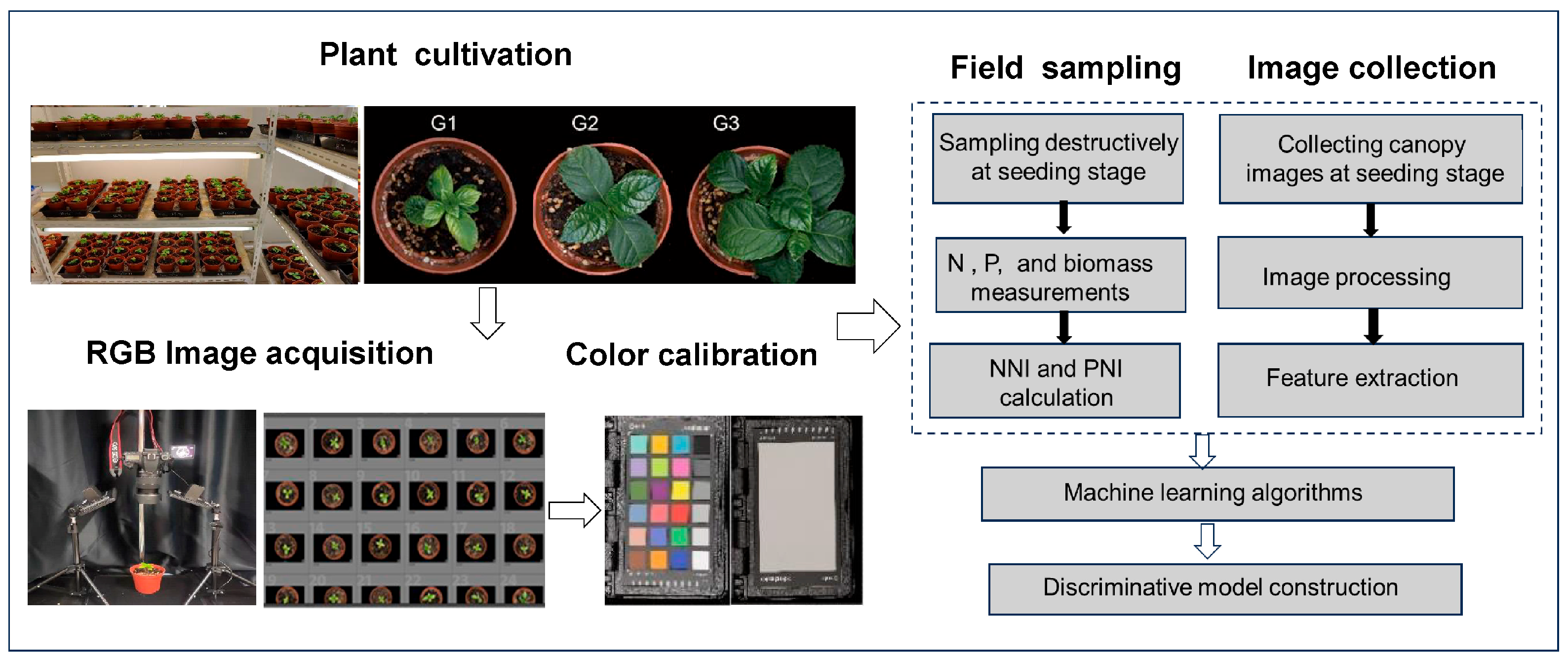
A self-built platform was used, with a commercial camera (EOS 90D, Canon Inc., Tokyo, Japan) mounted at the top center of the bracket. A lens with a focal length of 18–135 mm was used. Dual flat-panel light-emitting diodes (P120C, Godox Co., Ltd., Shenzhen, China) with an illumination of 5000 K color temperature were employed as the sole light source. Each plant was placed on the platform individually, and its image was captured from a top view at a fixed distance of 60 cm. The camera was set to aperture priority (Av) mode, with automatic shutter speed, an equivalent focal length of 50 mm, an aperture of F16, and an ISO of 100. Color and white balance were calibrated using an X-Rite Color Checker Passport (X-Rite, Inc., Grand Rapids, MI, USA). The photo output format was RAW (image resolution: 6960 × 4640), which was then converted to an uncompressed PNG format for image analysis. Consequently, a total of 339 images were acquired across all treatments throughout the G0 to G3 growth periods. The research flowchart is shown in Figure 1.

2.2.2. Image Segmentation

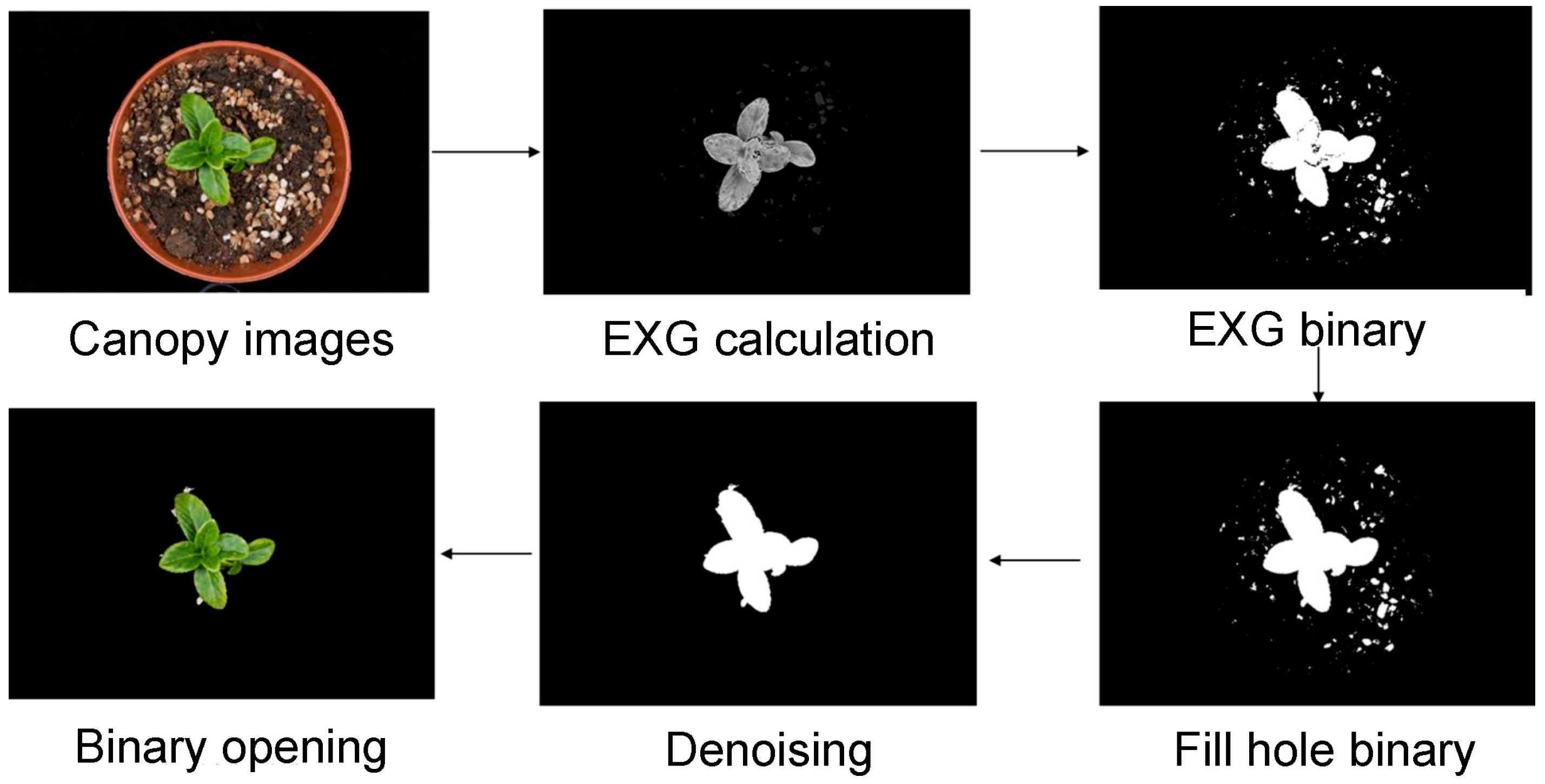
Image processing was performed following a previously reported method [17], involving calculation of the excess green index (ExG) and grayscale conversion. As shown in Figure 2, the workflow details are as follows: (1) ExG calculation: original images were transformed using the 2G-R-B formula, with two thresholds set (minimum = 40, maximum = 200). (2) EXG binary: Divide 0 or 255 according to the threshold to obtain the EXG segmentation binary image. (3) Fill hole binary: Hole filling using the flooding algorithm. (4) Denoising: Use morphological processing to remove isolated small areas and delete areas with a minimum connected area size of less than 300,000. (5) Binary opening: take the intersection of the processed binary image and the original image. Hence, the final segmentation of canopy images was acquired.
A total of 65 phenotypic traits were extracted from each plant image, including 45 color traits, 6 texture traits, and 14 morphological traits [17,20] (Supplementary Table S1). Color traits were derived from transformations of the RGB, Lab, and HSV color spaces. Texture traits were extracted using the gray-level co-occurrence matrix (GLCM) algorithm [21]. Morphological traits describe the shape of the target plant region, including features such as the convex hull, bounding box, perimeter, and eccentricity, which were derived from the plant contour.

2.3. Analytical Reference Measurements

2.3.1. Quality Traits Determination

After image acquisition, three canopy samples were collected at each sampling stage (G1, G2, and G3) to determine above-ground biomass and N and P contents at the seedling stage. The canopy samples were oven-dried at 105 °C for 30 min, followed by drying at 70 °C to constant weight [22]. The dried samples were finely ground and analyzed for N and P contents using the Kjeldahl method [23] and the molybdenum blue colorimetric method [24], respectively.
At the final harvest (G3 stage), SPAD values, soluble protein content, and soluble sugar content were determined using the second fully expanded leaves from the shoot apex. Data are presented as the mean of three replicates, with three plants per treatment. SPAD values were measured using a portable chlorophyll meter (SPAD-502, Minolta Co., Ltd., Tokyo, Japan). Soluble protein content was determined using the Coomassie brilliant blue method, and soluble sugar content was determined using the anthrone colorimetric method. Statistical analysis was performed using one-way analysis of variance (ANOVA) in SPSS 22. Differences among fertilizer treatments were considered significant at p < 0.05, and Duncan’s multiple range test was used for post hoc comparisons. Additionally, the biomass, concentrations of N and P in plant tissues were determined on a dry weight (DW) basis, while SPAD values, soluble protein content, and soluble sugar content were measured on a fresh weight (FW) basis.

2.3.2. Calculation of NNI and PNI

The data were analyzed to determine the critical nitrogen concentration (Nc) following the method proposed by Justes et al. (1994) [25]. Nc (mg·g−1, DM) represents the minimum N concentration required to achieve maximum plant growth. The NNI was calculated as the ratio of the actual shoot N concentration (Nt) to Nc. One-way ANOVA was performed to distinguish between N-limiting and non-N-limiting growth conditions. was used to distinguish N-limiting and non-N-limiting growth conditions. N-limiting conditions were defined as those in which shoot biomass increased with N supplementation, whereas non-N-limiting conditions were defined as those in which additional N application did not further increase shoot biomass. Using data from non-N-limiting treatments, regression analysis was performed to examine the relationship between shoot biomass (g·plant−1 DM) and shoot N concentration (mg·g−1, DM), thereby determining Nc at each sampling stage. Similarly, the PNI was calculated as the ratio of the actual shoot P concentration (Pt) to the reference P concentration (Pc), where Pc (mg·g−1, DM) was derived from non-P-limiting treatments following the same approach [26].

2.4. Model Development and Validation

2.4.1. Data Preprocessing

Samples were classified into deficient, optimal, and surplus categories based on the calculated NNI and PNI values. Theoretically, an NNI or PNI value > 1 indicates nutrient surplus, a value < 1 indicates deficiency, and a value of 1 denotes optimal nutritional status [27]. However, a value of exactly 1 is rarely observed in practice. For this reason, threshold ranges centered on 1 have been widely adopted in field studies to define the optimal status, such as 0.9 < NNI ≤ 1.1 [28] and 0.95–1.05 [29]. In this study, samples were grouped into three nutritional classes according to their NNI/PNI values: deficient (NNI/PNI ≤ 0.9), optimal (0.9 < NNI/PNI ≤ 1.1), and surplus (NNI/PNI > 1.1).
Given the imbalanced class distribution of the original dataset, random oversampling was applied during model development to balance class representation; this approach increases the number of minority-class samples without altering the original feature distribution. To further improve model training performance, all 65 phenotypic trait values were normalized using the auto-scaling method.

2.4.2. Discriminant Model Construction

The dataset was randomly split into a training set (80%) and a testing set (20%). Model development was conducted using 10-fold cross-validation, with 15% of the training data used as a validation set in each fold. Based on the 65 extracted phenotypic features, four machine learning models—CNN, SVM, RF, and PNN—were developed to predict the nutrient status of H. macrophylla. PNN was included specifically as a probabilistic classifier well-suited for multi-class classification tasks with limited training samples.
The hyperparameters of the SVM and RF models were optimized using grid search combined with 10-fold cross-validation. For the SVM models, both N and P predictions employed the radial basis function (RBF) kernel. The N model achieved optimal performance with C = 74 and γ = 0.09 (training score = 0.8364), whereas the P model used C = 4 and γ = 0.03 (training score = 0.8265). For the RF models, both N and P predictions were built using 150 decision trees with a maximum depth of 12. The N model used min_samples_split = 3, min_samples_leaf = 2, and max_features = 15 (training score = 0.8339), while the P model used min_samples_split = 2, min_samples_leaf = 7, and max_features = 20 (training score = 0.8244).
The CNN architecture consisted of two convolutional layers, two pooling layers, a flatten layer, one fully connected hidden layer, and an output layer, with detailed configurations provided in Supplementary Table S2. While CNNs are typically applied to raw images, this study used handcrafted phenotypic features (color, texture, and morphology) as input. This approach reduced background noise introduced after image segmentation and mitigated overfitting, particularly given the limited dataset size (339 images). Accordingly, the CNN’s performance reflects its ability to model nonlinear interactions among phenotypic traits, rather than exploiting spatial feature representations from raw images.
Model training employed the categorical cross-entropy loss function and the Adam optimizer. To enhance model robustness and prevent overfitting, a dropout layer (rate = 0.4) was incorporated into the CNN architecture. In addition, an early-stopping callback was implemented to monitor validation loss during model training.

2.4.3. Performance Evaluation and Feature Contribution Analysis

The model performances were evaluated using overall accuracy, precision, recall, F1-score, and Cohen’s Kappa coefficient (κ), as explained in Equations (1)–(5).
Overall   accuracy = TP + TN TP + TN + FP + FN
Precision = TP TP + FP
R e c a l l = TP TP + FN
F 1 - s c o r e = 2 × Precision × Recall Precision + Recall
κ = p 0 p e 1 p e
where TP denotes the true positive, TN denotes the true negative, FP denotes the false positive, FN denotes the false negative, p0 represents the observed agreement, and pₑ represents the expected agreement.
To assess the contribution of individual features to model performance, permutation importance (PI) was calculated. Among the four models, the CNN model was not suitable for PI-based feature importance analysis due to its architectural characteristics. This limitation arises from the CNN’s intrinsic end-to-end feature-learning mechanism, which does not allow for an explicit association between output predictions and individual handcrafted input variables
The software versions used in this study were OpenCV 4.5.5 for image processing, MATLAB R2018b for the PNN model, and Python 3.9 with Scikit-learn for the CNN, SVM, and RF models. The hardware configuration consisted of an Intel Core i7-10700K CPU (3.8 GHz), an NVIDIA GeForce RTX 3080 GPU (10 GB), and 32 GB of RAM.

3. Results

3.1. Quality Traits

3.1.1. Biomass, N, and P Concentration

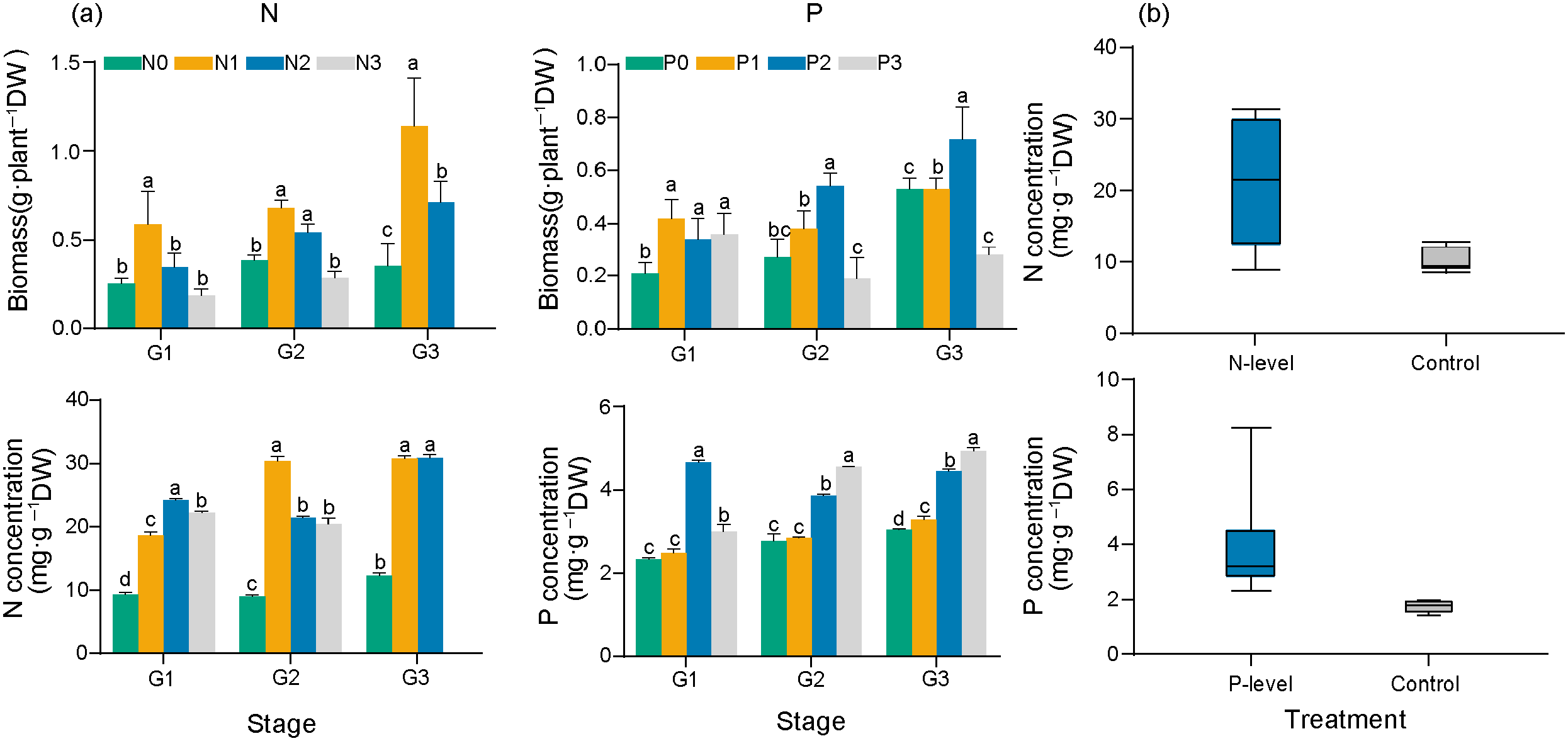
Figure 3a illustrates the accumulation of shoot biomass, N content, and P content in H. macrophylla. Shoot biomass increased under the N1 and N2 treatments but decreased under N0 and N3. At the G3 growth stage, the highest biomass (1.14 g·plant−1) was observed under N1, whereas all shoots died under N3. This mortality is likely attributable to excessive N supply, which can induce severe physiological stress, including osmotic stress, metabolic imbalance, and impaired photosynthesis. N treatments significantly affected shoot N concentration, which increased sharply from N0 to N2 but slightly declined under N3 across all growth stages.
Similarly, shoot biomass was significantly influenced by P fertilization, with the highest biomass (0.72 g·plant−1) recorded under P2 at the G3 stage. Biomass generally increased with rising P application rates, except under the P3 treatment. From G1 to G3, shoot P concentration showed an overall positive response to increasing P application rates. Furthermore, shoot N concentration exhibited a wider variation range (9.08–30.89 mg·g−1) than shoot P concentration (2.34–4.94 mg·g−1), with both consistently higher than those in the control treatment (Figure 3b).

3.1.2. SPAD, Soluble Protein, and Soluble Sugar

As shown in Table 2, N application significantly affected leaf SPAD values (F = 26.44, p < 0.0001) and soluble protein content (F = 104.23, p < 0.0001), but had no significant effect on soluble sugar content (p > 0.05) at the G3 stage. With increasing N supply, both SPAD values and soluble protein content peaked at the N1 level and then declined. This pattern suggests that moderate N availability supports chlorophyll synthesis and protein accumulation, whereas excessive N may cause nutrient imbalance, leading to reduced chlorophyll and protein levels.
Similarly, P application significantly influenced leaf SPAD values (F = 7.55, p = 0.0005) and soluble protein content (F = 69.62, p < 0.0001), while soluble sugar content was unaffected (p > 0.05). Unlike N treatments, no consistent trend was observed for SPAD, soluble protein, or soluble sugar with increasing P supply; however, all three parameters reached their maximum values under the P3 treatment. This response may be associated with temporarily enhanced metabolic activity under high P supply, potentially supporting chlorophyll accumulation, protein synthesis, and soluble sugar production (Table 2).

3.2. Nutrition Index

Table 3 presents the calculated NNI and PNI values of H. macrophylla at each sampling stage. Under N treatments, N0 was classified as the N-limiting condition, and Nc values derived from N1 and N2 were 12.12, 23.31, and 31.39 mg·g−1 across the sampling stages. Similarly, for P treatments, P0 was identified as the P-limiting condition, with Pc values calculated from P1 and P2 yielding 3.51, 3.93, and 4.61 mg·g−1, respectively. Based on NNI and PNI results, both N0 and P0 exhibited deficient nutritional status across all growth stages. Notably, the nutritional indices tended to decrease as the growth stage progressed; at the G1 stage, seedlings were more likely to exhibit surplus nutrition in response to fertilizer application.

3.3. Discrimination Model Development and Validation

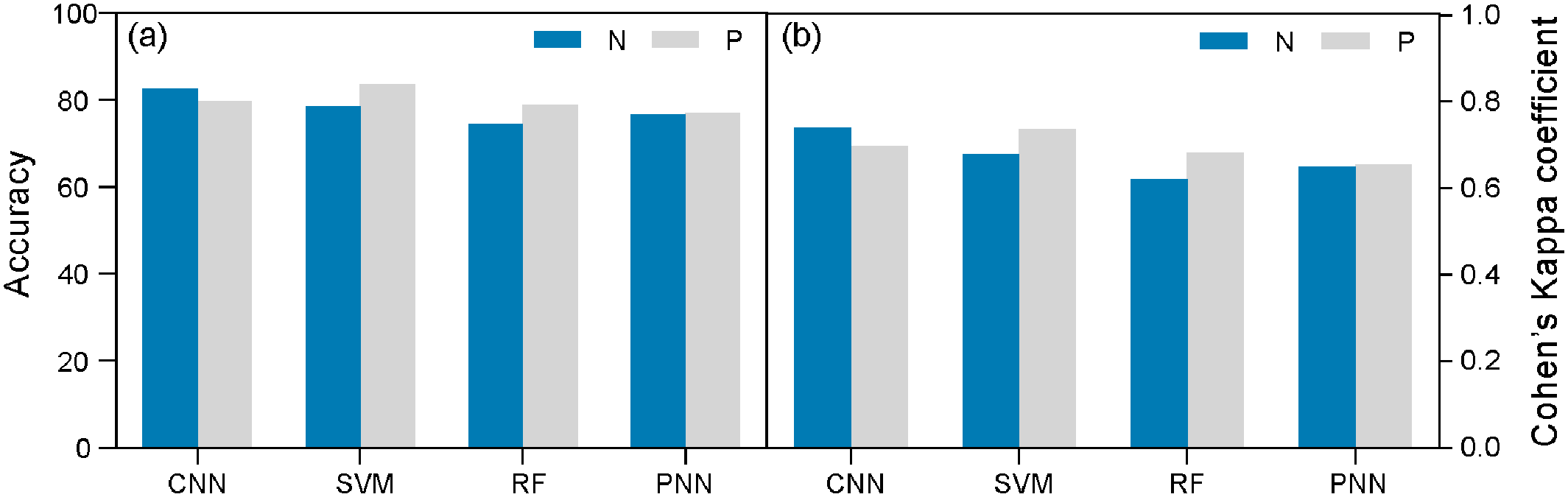
After analyzing the biological responses of H. macrophylla to N and P treatments and calculating NNI/PNI for nutritional status labeling, we further developed and validated ML models to discriminate nutrient status based on phenotypic traits. The prediction accuracy and Cohen’s Kappa coefficient (κ) of all four models are presented in Figure 4. For N prediction, CNN achieved the highest accuracy (82.65%) and κ value (0.7392); for P prediction, SVM achieved the highest accuracy (83.65%) and κ value (0.7357). Additionally, except for the CNN model, the prediction performance for P was superior to that for N in the SVM, RF, and PNN models.
Additional metrics, including precision, recall, and F1-score, were further calculated to evaluate model performance. As shown in Table 4, for both N and P predictions across all models (CNN, SVM, RF, and PNN), the precision, recall, and F1-score values were satisfactory for the surplus status. However, the lowest values were obtained for the optimal status, indicating inferior performance. This phenomenon can be attributed to the fact that the optimal level is adjacent to both high and low levels, making it less distinguishable than the other two levels.
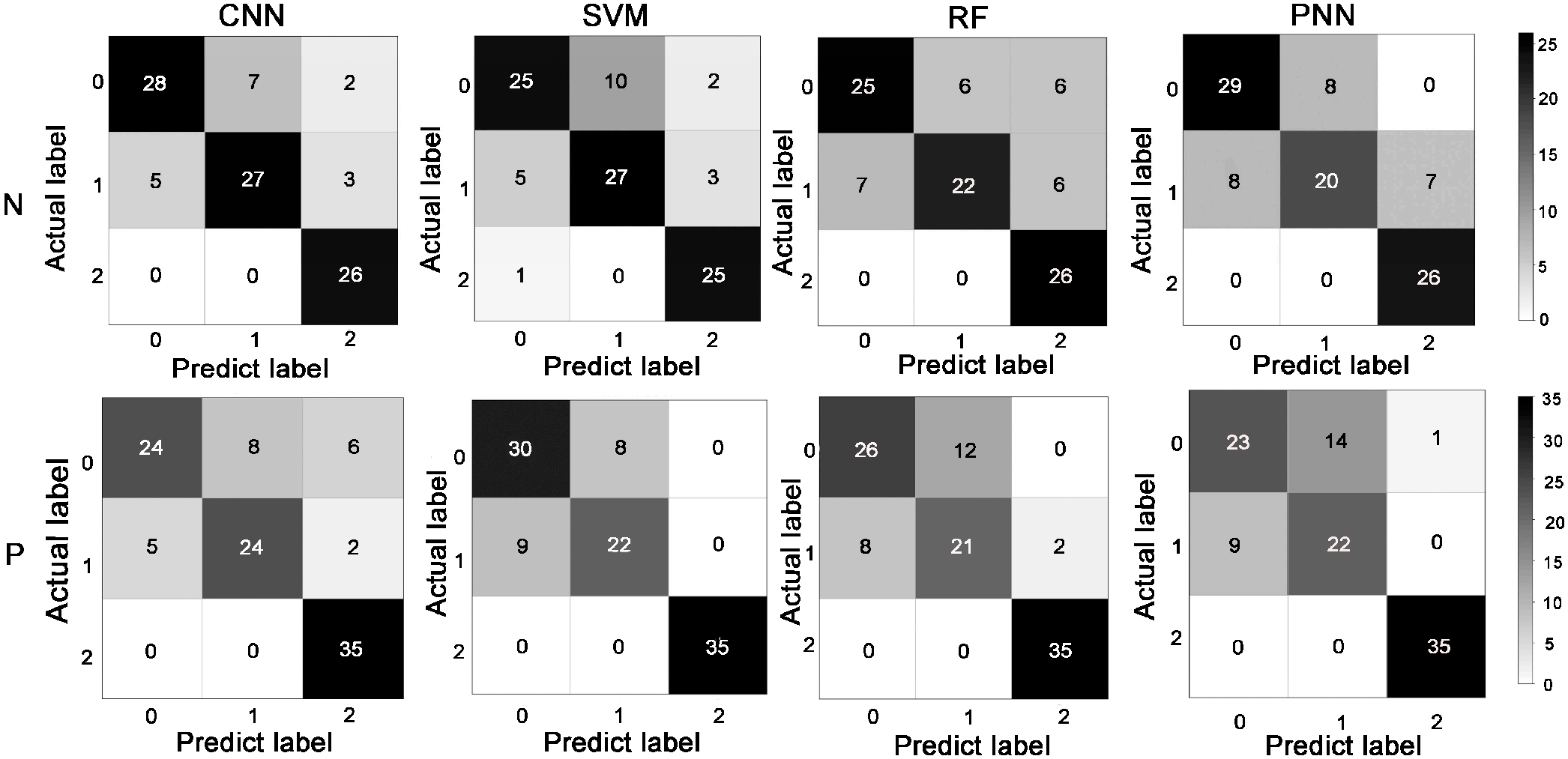
Confusion matrices were constructed to validate the four models, with results presented in Figure 5. All tested confusion matrices showed that both the N surplus class and P surplus class achieved the highest correct classification rates. Taking the CNN model as an example, for N prediction, the classification accuracies for deficient, optimal, and surplus classes were 75.68%, 77.14%, and 100%, respectively. For P prediction, the corresponding values were 63.16%, 77.42%, and 100%.
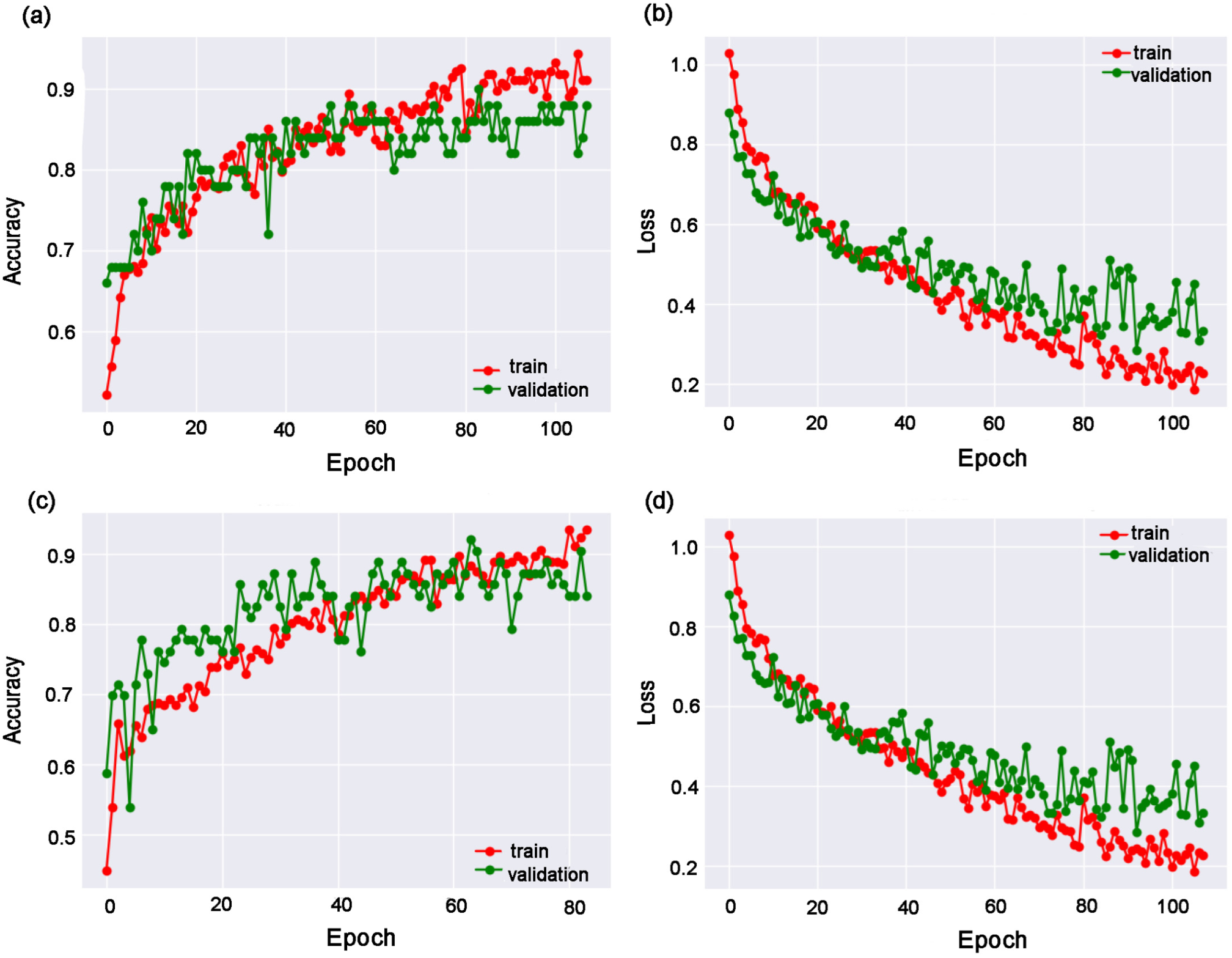
The CNN model was trained separately for N and P predictions, with early termination based on validation metrics to avoid overfitting. Based on the CNN model’s training results, the accuracy curves and loss function curves for N and P nutritional status were plotted, as shown in Figure 6. For N prediction, the validation accuracy was 0.8061 (Figure 6a); training was terminated early at Epoch = 108, as validation accuracy and loss stabilized when Epoch > 80 (Figure 6b). For P prediction, the validation accuracy was 0.7981 (Figure 6c). The model converged faster than for N prediction: training terminated at Epoch = 84, with validation metrics stabilizing when Epoch > 50 (Figure 6d).
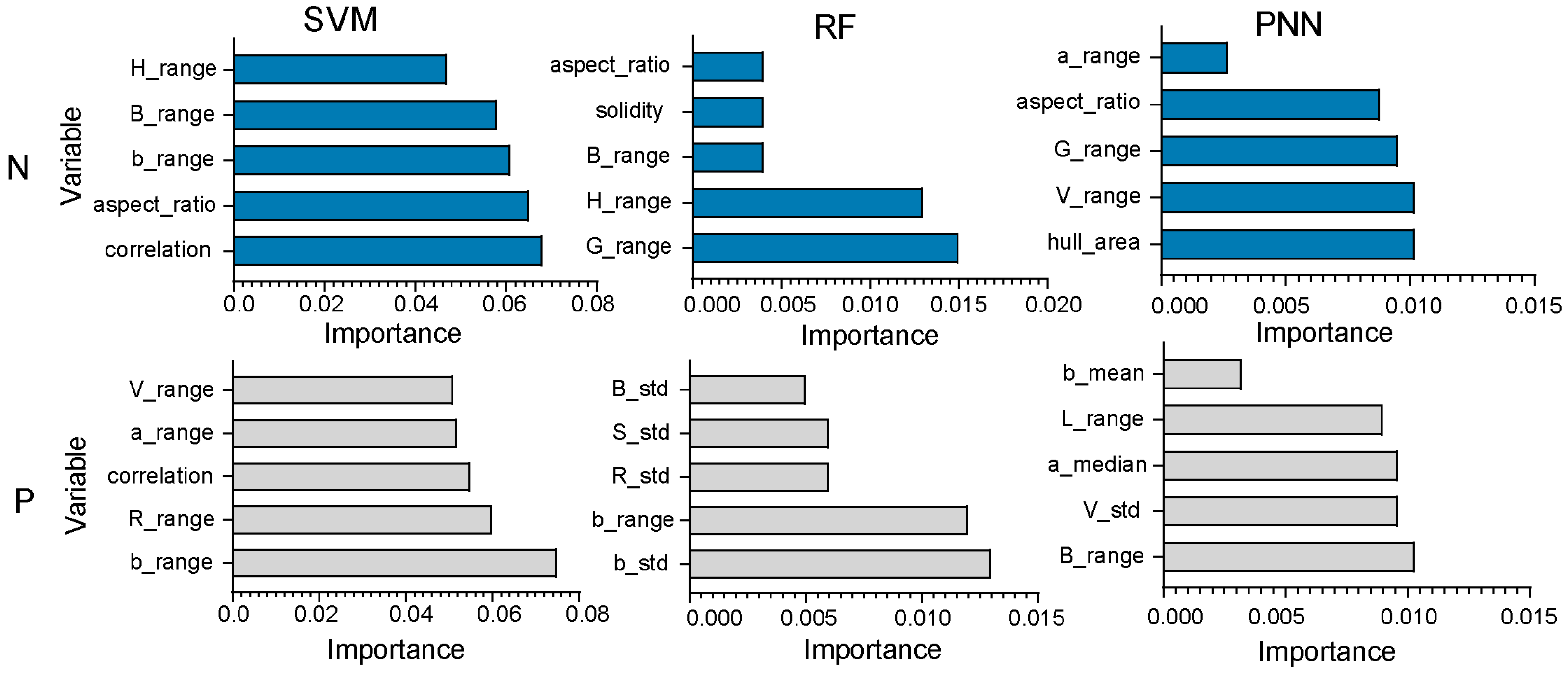
Figure 7 lists the top five most contributory traits for each model. Definitions of each trait can be referred to in Table S1. Different models exhibited distinct preferences regarding trait types. Among the top five traits, color traits appeared more frequently than morphological and texture traits, indicating that plant color traits are more closely related to N and P nutritional status. The most frequently occurring traits among the top five of all developed models were B_range, b_range, and aspect_range. For N prediction, the SVM model included only one texture trait (correlation), whereas the RF and PNN models incorporated three morphological traits each (aspect ratio for RF; solidity and hull area for PNN). For P prediction, the SVM model also contained a single texture trait, namely correlation.

4. Discussion

4.1. Effects of N and P Fertilization on Quality Traits

In this study, N and P treatments significantly influenced the quality traits of H. macrophylla. Among N treatments, N1 produced the highest biomass, followed by N2, N0, and N3, whereas for P treatments, biomass peaked under P2, followed by P1, P0, and P3. Moderate N or P supply promoted nutrient absorption and biomass accumulation, while deficient or excessive supply inhibited growth. Excessive N and P (N3 and P3) caused toxicity, resulting in reduced biomass or shoot death, likely due to nutrient imbalance, increased substrate salinity, osmotic stress, impaired root function, and decreased photosynthetic efficiency [30,31]. Similar findings have been reported for other woody and herbaceous species [32,33,34]. Specifically, Wang et al. (2022) [22] identified 1.5 g N/plant as optimal for H. macrophylla, with rates above 2 g N/plant causing toxicity, and Shreckhise et al. (2019) [4] recommended 0.3–0.6 g P per 3.8 L container for maximal growth, roughly half the conventional nursery-crop application rate.
From the G1 to G3 stages, in H. macrophylla, both N and P concentrations remained increased with shoot biomass accumulation, presumably due to the low-rate, high-frequency fertilization regime in our pot experiment, which is consistent with the findings of Xiong et al. (2019) [17]. This fertilization approach may improve nutrition absorption and utilization, resulting in a faster accumulation of nutrition content than shoot biomass. Plant nutrition indices are widely recognized for their high potential in diagnosing nutritional status and serve as key indicators for guiding rational fertilization. Our results revealed that the NNI and PNI exhibited distinct nutritional statuses at different growth stages under the same treatment; for instance, hydrangea seedlings were more prone to N surplus at the G1 stage. It can be mainly explained by the dilution effect associated with rapid biomass accumulation [35]. This finding facilitates accurate judgment of actual nutritional status and precise labeling of relevant images of H. macrophylla, making it imperative to promptly adjust fertilization strategies based on real-time plant nutritional status across growth stages.

4.2. Optimization of Machine Learning Algorithms

ML has become a standard approach for image-based classification tasks [36]. In this study, four ML models (CNN, SVM, RF, and PNN) were evaluated for predicting N and P status in hydrangea. CNN achieved the highest overall accuracy for N diagnosis (82.65%), whereas SVM performed best for P diagnosis (83.65%). These results are consistent with previous studies demonstrating the effectiveness of both CNN and SVM in plant nutrient diagnosis. For example, Ghosal et al. (2018) [37] reported high accuracy in iron and potassium nutrient deficiency classification using CNN, while Azimi et al. (2021) [38] identified SVM as the best-performing conventional ML method for N stress classification in sorghum. Although CNN has often been reported to outperform conventional ML methods in nutrient deficiency identification [16], it did not show a clear advantage over SVM in the present study and required greater model complexity.
Across all models, N and P surplus classes consistently achieved higher classification accuracies than deficient and optimal classes. This is likely because excessive N or P supply induces pronounced physiological stress and pigment-related changes, including altered chlorophyll and carotenoid synthesis associated with disrupted carbon–nitrogen metabolism [30,31], resulting in more distinct phenotypic signatures that are readily captured by RGB images. CNN outperformed other models in N diagnosis, likely because its convolutional architecture effectively captured complex nonlinear variations in leaf color and morphology associated with N deficiency or surplus [39]. In contrast, SVM showed superior performance in P diagnosis, as P deficiency typically induces relatively persistent visual symptoms, such as purple or reddish leaf coloration caused by anthocyanin accumulation [40], which aligns well with SVM’s strength in identifying optimal separating hyperplanes.
In our study, the optimal nutritional class consistently exhibited the lowest classification accuracy across all models, which can be attributed to two main limitations. First, plant nutritional status diagnosis depends on critical nutrient concentrations (Nc/Pc). Unlike major cereal crops such as rice, maize, and wheat, for which species-specific Nc/Pc dilution curves have been well established [41,42,43], H. macrophylla lacks validated Nc/Pc dilution curves. Moreover, Nc/Pc curve parameters are influenced by variables such as year, cultivar, and agronomic management [9]. When coupled with the unstable growth dynamics of early seedlings, these factors collectively increase uncertainty in Nc/Pc estimation. Second, plants with NNI or PNI values approaching 1 display subtle, continuous phenotypic variations, making them inherently difficult to distinguish from marginally deficient or surplus individuals when relying solely on RGB-derived features. To further enhance model robustness, future studies should integrate multi-source data and perform validation under diverse environmental conditions.

4.3. Feasibility of Using RGB to Estimate Nutrition Status

Existing studies have demonstrated the feasibility of RGB-based approaches for plant nutritional status estimation. Yuan et al. (2016) [44] reported that the R and B channels can occasionally outperform the G channel in this regard. Beyond raw RGB features, color space transformations have also been widely explored. Prey et al. (2018) [45] used the HSV color space to quantify the proportion of green pixels, while Rorie et al. (2011) [46] derived the Dark Green Color Index (DGCI) from HSV and successfully applied it to N status assessment in early-stage maize, reporting strong correlations between DGCI and leaf N concentration (R2 = 0.82–0.89).
In this study, we extracted three phenotypic features (color, texture, and morphology) from RGB images and compared their predictive performance for hydrangea N and P nutritional status. Among the top five contributing features, color traits appeared more frequently than morphological and texture traits, indicating a stronger correlation with N or P status. This dominance of color features arises from the intrinsic link between nutrient status and leaf pigment metabolism. N deficiency primarily reduces chlorophyll content through altered pigment biosynthesis and degradation, resulting in lighter green leaves, whereas P deficiency induces sustained anthocyanin accumulation, leading to purple or reddish coloration. These pigment-driven changes alter leaf reflectance in the visible spectrum and are therefore effectively captured by RGB-derived color features [47].
In contrast, texture and morphological features are more sensitive to illumination and imaging geometry, potentially reducing their robustness in nutrient status estimation [45]. The most frequent top-five features in our study were B_range, b_range, and aspect_range, which align with the findings of Rahadiyan et al. (2023) [16]. In their work, multi-feature combinations (RGB, GLCM, Hu moments, and centroid distance) were used for chili nutrient deficiency identification, and the combination of color, texture, and shape features was confirmed to improve classification accuracy. Such results reveal the limitations of using leaf color traits alone for nutritional evaluation, emphasizing that texture and morphological traits are indispensable for accurate nutrient status prediction.

4.4. Practical Application, Limitations, and Future Research

This study demonstrates the feasibility of using RGB image-based phenotypic features combined with ML for low-cost, non-destructive nutrient diagnosis in H. macrophylla seedlings. However, it was conducted under controlled imaging and lighting conditions using a single cultivar, with a relatively small dataset including limited trait replicates or images, and random oversampling to address class imbalance, which may introduce uncertainty. Practical application may require model calibration under natural light and more diverse samples. Future work will focus on expanding datasets, field validation, alternative strategies for class imbalance, and exploring multi-sensor and real-time applications to enhance robustness and applicability.

5. Conclusions

(1)
RGB image-based phenotypic features combined with ML provide an effective, rapid, and non-destructive method for estimating N and P status in H. macrophylla seedlings, enabling early-stage nutrient monitoring.
(2)
Among the models, CNN achieved the highest accuracy for N prediction (82.65%), while SVM performed best for P prediction (83.65%).
(3)
Color-related traits were the most informative predictors, particularly B_range, b_range, and aspect_range, outperforming morphological and texture traits.
(4)
The approach provides practical guidance for nursery fertilization and promotes sustainable nutrient use through precise early-stage nutrient management.

Supplementary Materials

The following supporting information can be downloaded at https://www.mdpi.com/article/10.3390/agronomy16030373/s1. Table S1: Phenotypic features extracted from images; Table S2: The structure of CNN model.

Author Contributions

Conceptualization, J.Q. and J.Y.; methodology, J.Y. and Q.L.; software, J.Q. and Z.L.; validation, J.Q. and J.Y.; formal analysis, J.Y., Q.L., Z.L. and Q.X.; investigation, J.Y. and Q.X.; resources, J.Q.; data curation, J.Q. and Q.L.; writing—original draft preparation, J.Y.; writing—review and editing, J.Q. and Q.L.; visualization, J.Y., Z.L. and Q.X.; supervision, J.Q.; project administration, J.Y.; funding acquisition, J.Q. All authors have read and agreed to the published version of the manuscript.

Funding

This research was funded by the Special Fund for Scientific Research of Shanghai Landscaping and City Appearance Administrative Bureau (G242423, G262423).

Data Availability Statement

Data will be made available on request.

Conflicts of Interest

The authors declare no conflicts of interest.

References

  1. Anderson, N.; Weiland, J.; Pharis, J.; Gagné, W.; Janiga, E.; Rosenow, M.J. Comparative Forcing of Hydrangea macrophylla ‘Bailer’ as a Florist’s Hydrangea. Sci. Hortic. 2009, 122, 221–226. [Google Scholar] [CrossRef]
  2. USDA National Agricultural Statistics Service. Census of Horticultural Specialties. 2019. Available online: https://www.nass.usda.gov/Publications/AgCensus/2017/Online_Resources/Census_of_Horticulture_Specialties/index.php (accessed on 10 January 2026).
  3. Guo, P.-T.; Shi, Z.; Li, M.-F.; Luo, W.; Cha, Z.-Z. A Robust Method to Estimate Foliar Phosphorus of Rubber Trees with Hyperspectral Reflectance. Ind. Crops Prod. 2018, 126, 1–12. [Google Scholar] [CrossRef]
  4. Shreckhise, J.H.; Owen, J.S.; Niemiera, A.X. Growth Response of Hydrangea macrophylla and Ilex crenata Cultivars to Low-Phosphorus Controlled-Release Fertilizers. Sci. Hortic. 2019, 246, 578–588. [Google Scholar] [CrossRef]
  5. Broschat, T.K. Nitrate, Phosphate, and Potassium Leaching from Container-Grown Plants Fertilized by Several Methods. HortScience 1995, 30, 74–77. [Google Scholar] [CrossRef]
  6. Yi, J.; Krusenbaum, L.; Unger, P.; Hüging, H.; Seidel, S.J.; Schaaf, G.; Gall, J. Deep Learning for Non-Invasive Diagnosis of Nutrient Deficiencies in Sugar Beet Using RGB Images. Sensors 2020, 20, 5893. [Google Scholar] [CrossRef]
  7. Taha, M.F.; Abdalla, A.; ElMasry, G.; Gouda, M.; Zhou, L.; Zhao, N.; Liang, N.; Niu, Z.; Hassanein, A.; Al-Rejaie, S.; et al. Using Deep Convolutional Neural Network for Image-Based Diagnosis of Nutrient Deficiencies in Plants Grown in Aquaponics. Chemosensors 2022, 10, 45. [Google Scholar] [CrossRef]
  8. Zhao, B.; Ata-Ul-Karim, S.T.; Liu, Z.; Ning, D.; Xiao, J.; Liu, Z.; Qin, A.; Nan, J.; Duan, A. Development of a Critical Nitrogen Dilution Curve Based on Leaf Dry Matter for Summer Maize. Field Crops Res. 2017, 208, 60–68. [Google Scholar] [CrossRef]
  9. Li, X.; Ata-UI-Karim, S.T.; Li, Y.; Yuan, F.; Miao, Y.; Yoichiro, K.; Cheng, T.; Tang, L.; Tian, X.; Liu, X.; et al. Advances in the Estimations and Applications of Critical Nitrogen Dilution Curve and Nitrogen Nutrition Index of Major Cereal Crops. A Review. Comput. Electron. Agric. 2022, 197, 106998. [Google Scholar] [CrossRef]
  10. Zhao, B.; Liu, Z.; Ata-Ul-Karim, S.T.; Xiao, J.; Liu, Z.; Qi, A.; Ning, D.; Nan, J.; Duan, A. Rapid and Nondestructive Estimation of the Nitrogen Nutrition Index in Winter Barley Using Chlorophyll Measurements. Field Crops Res. 2016, 185, 59–68. [Google Scholar] [CrossRef]
  11. Liebisch, F.; Bünemann, E.K.; Huguenin-Elie, O.; Jeangros, B.; Frossard, E.; Oberson, A. Plant Phosphorus Nutrition Indicators Evaluated in Agricultural Grasslands Managed at Different Intensities. Eur. J. Agron. 2013, 44, 67–77. [Google Scholar] [CrossRef]
  12. Jiang, F.; Lu, Y.; Chen, Y.; Cai, D.; Li, G. Image Recognition of Four Rice Leaf Diseases Based on Deep Learning and Support Vector Machine. Comput. Electron. Agric. 2020, 179, 105824. [Google Scholar] [CrossRef]
  13. Pagola, M.; Ortiz, R.; Irigoyen, I.; Bustince, H.; Barrenechea, E.; Aparicio-Tejo, P.; Lamsfus, C.; Lasa, B. New Method to Assess Barley Nitrogen Nutrition Status Based on Image Colour Analysis: Comparison with SPAD-502. Comput. Electron. Agric. 2009, 65, 213–218. [Google Scholar] [CrossRef]
  14. Sun, Y.; Tong, C.; He, S.; Wang, K.; Chen, L. Identification of Nitrogen, Phosphorus, and Potassium Deficiencies Based on Temporal Dynamics of Leaf Morphology and Color. Sustainability 2018, 10, 762. [Google Scholar] [CrossRef]
  15. Chen, S.; Qin, S.; Wang, Y.; Ma, L.; Lv, X. Smartphone-Based Estimation of Cotton Leaf Nitrogen: A Learning Approach with Multi-Color Space Fusion. Agronomy 2025, 15, 2330. [Google Scholar] [CrossRef]
  16. Rahadiyan, D.; Hartati, S.; Wahyono; Nugroho, A.P. Feature Aggregation for Nutrient Deficiency Identification in Chili Based on Machine Learning. Artif. Intell. Agric. 2023, 8, 77–90. [Google Scholar] [CrossRef]
  17. Xiong, X.; Zhang, J.; Guo, D.; Chang, L.; Huang, D. Non-Invasive Sensing of Nitrogen in Plant Using Digital Images and Machine Learning for Brassica Campestris Ssp. Chinensis L. Sensors 2019, 19, 2448. [Google Scholar] [CrossRef]
  18. Liu, Z.-Y.; Qi, J.-G.; Wang, N.-N.; Zhu, Z.-R.; Luo, J.; Liu, L.-J.; Tang, J.; Cheng, J.-A. Hyperspectral Discrimination of Foliar Biotic Damages in Rice Using Principal Component Analysis and Probabilistic Neural Network. Precis. Agric. 2018, 19, 973–991. [Google Scholar] [CrossRef]
  19. Senan, N.; Aamir, M.; Ibrahim, R.; Taujuddin, N.S.A.M.; Wan, W.H.N. An Efficient Convolutional Neural Network for Paddy Leaf Disease and Pest Classification. Int. J. Adv. Comput. Sci. Appl. 2020, 11, 116–122. [Google Scholar] [CrossRef]
  20. Guo, D.; Juan, J.; Chang, L.; Zhang, J.; Huang, D. Discrimination of Plant Root Zone Water Status in Greenhouse Production Based on Phenotyping and Machine Learning Techniques. Sci. Rep. 2017, 7, 8303. [Google Scholar] [CrossRef] [PubMed]
  21. Haralick, R.M.; Shanmugam, K.; Dinstein, I. Textural Features for Image Classification. IEEE Trans. Syst. Man Cybern. 1973, SMC-3, 610–621. [Google Scholar] [CrossRef]
  22. Wang, X.; Hu, Y.; Liaquat, F.; Zhang, X.; Ye, K.; Qin, J.; Liu, Q. Effects of Nitrogen Exponential Fertilization on Growth and Nutrient Concentration of Hydrangea macrophylla Seedlings. Phyton 2022, 91, 395–407. [Google Scholar] [CrossRef]
  23. Li, T.; Zhu, Z.; Cui, J.; Chen, J.; Shi, X.; Zhao, X.; Jiang, M.; Zhang, Y.; Wang, W.; Wang, H. Monitoring of Leaf Nitrogen Content of Winter Wheat Using Multi-Angle Hyperspectral Data. Int. J. Remote Sens. 2021, 42, 4672–4692. [Google Scholar] [CrossRef]
  24. Zhang, Y.; Wang, T.; Li, Z.; Wang, T.; Cao, N. Based on Machine Learning Algorithms for Estimating Leaf Phosphorus Concentration of Rice Using Optimized Spectral Indices and Continuous Wavelet Transform. Front. Plant Sci. 2023, 14, 1185915. [Google Scholar] [CrossRef]
  25. Justes, E.; Mary, B.; Meynard, J.-M.; Machet, J.-M.; Thelier-Huche, L. Determination of a Critical Nitrogen Dilution Curve for Winter Wheat Crops. Ann. Bot. 1994, 74, 397–407. [Google Scholar] [CrossRef]
  26. Cadot, S.; Bélanger, G.; Ziadi, N.; Morel, C.; Sinaj, S. Critical Plant and Soil Phosphorus for Wheat, Maize, and Rapeseed after 44 Years of P Fertilization. Nutr. Cycl. Agroecosyst. 2018, 112, 417–433. [Google Scholar] [CrossRef]
  27. Lemaire, G.; van Oosterom, E.; Sheehy, J.; Jeuffroy, M.H.; Massignam, A.; Rossato, L. Is Crop N Demand More Closely Related to Dry Matter Accumulation or Leaf Area Expansion during Vegetative Growth? Field Crops Res. 2007, 100, 91–106. [Google Scholar] [CrossRef]
  28. Cilia, C.; Panigada, C.; Rossini, M.; Meroni, M.; Busetto, L.; Amaducci, S.; Boschetti, M.; Picchi, V.; Colombo, R. Nitrogen Status Assessment for Variable Rate Fertilization in Maize through Hyperspectral Imagery. Remote Sens. 2014, 6, 6549–6565. [Google Scholar] [CrossRef]
  29. Xia, T.; Miao, Y.; Wu, D.; Shao, H.; Khosla, R.; Mi, G. Active Optical Sensing of Spring Maize for In-Season Diagnosis of Nitrogen Status Based on Nitrogen Nutrition Index. Remote Sens. 2016, 8, 605. [Google Scholar] [CrossRef]
  30. Malhotra, H.; Vandana; Sharma, S.; Pandey, R. Phosphorus Nutrition: Plant Growth in Response to Deficiency and Excess. In Plant Nutrients and Abiotic Stress Tolerance; Hasanuzzaman, M., Fujita, M., Oku, H., Nahar, K., Hawrylak-Nowak, B., Eds.; Springer: Singapore, 2018; pp. 171–190. ISBN 978-981-10-9044-8. [Google Scholar]
  31. Zhang, Y.; Yu, S.; Li, Z.; Chang, T.; Xu, Q.; Xu, H.; Zhang, J. Effects of excessive nitrogen fertilizer and soil moisture deficiency on antioxidant enzyme system and osmotic adjustment in tomato seedlings. Int. J. Agric. Biol. Eng. 2022, 15, 127–134. [Google Scholar] [CrossRef]
  32. Kraus, H.T.; Warren, S.L.; Bjorkquist, G.J.; Lowder, A.W.; Tchir, C.M.; Walton, K.N. Nitrogen:Phosphorus:Potassium Ratios Affect Production of Two Herbaceous Perennials. HortScience 2011, 46, 776–783. [Google Scholar] [CrossRef]
  33. Ristvey, A.G.; Lea-Cox, J.D.; Ross, D.S. Nitrogen and Phosphorus Uptake Efficiency and Partitioning of Container-Grown Azalea During Spring Growth. J. Am. Soc. Hortic. Sci. 2007, 132, 563–571. [Google Scholar] [CrossRef]
  34. Kim, Y.-T.; Ha, S.T.T.; In, B.-C. Development of a Longevity Prediction Model for Cut Roses Using Hyperspectral Imaging and a Convolutional Neural Network. Front. Plant Sci. 2024, 14, 1296473. [Google Scholar] [CrossRef]
  35. Russell, G.C.; Smith, A.D.; Pittman, U.J. The Effect of Nitrogen and Phosphorus Fertilizers on the Yield and Protein Content of Spring Wheat Grown on Stubble Fields in Southern Alberta. Can. J. Plant Sci. 1958, 38, 139–144. [Google Scholar] [CrossRef]
  36. Barbedo, J.G.A. Detection of Nutrition Deficiencies in Plants Using Proximal Images and Machine Learning: A Review. Comput. Electron. Agric. 2019, 162, 482–492. [Google Scholar] [CrossRef]
  37. Ghosal, S.; Blystone, D.; Singh, A.K.; Ganapathysubramanian, B.; Singh, A.; Sarkar, S. An Explainable Deep Machine Vision Framework for Plant Stress Phenotyping. Proc. Natl. Acad. Sci. USA 2018, 115, 4613–4618. [Google Scholar] [CrossRef]
  38. Azimi, S.; Kaur, T.; Gandhi, T.K. A Deep Learning Approach to Measure Stress Level in Plants Due to Nitrogen Deficiency. Measurement 2021, 173, 108650. [Google Scholar] [CrossRef]
  39. Mishra, S.; Levengood, H.; Fan, J.; Zhang, C. Plants Under Stress: Exploring Physiological and Molecular Responses to Nitrogen and Phosphorus Deficiency. Plants 2024, 13, 3144. [Google Scholar] [CrossRef]
  40. Li, H.; He, K.; Zhang, Z.; Hu, Y. Molecular Mechanism of Phosphorous Signaling Inducing Anthocyanin Accumulation in Arabidopsis. Plant Physiol. Biochem. 2023, 196, 121–129. [Google Scholar] [CrossRef]
  41. Huang, S.; Miao, Y.; Cao, Q.; Yao, Y.; Zhao, G.; Yu, W.; Shen, J.; Yu, K.; Bareth, G. A New Critical Nitrogen Dilution Curve for Rice Nitrogen Status Diagnosis in Northeast China. Pedosphere 2018, 28, 814–822. [Google Scholar] [CrossRef]
  42. Zhou, L.; Feng, H.; Zhao, W. Plastic Film Mulching Affects the Critical Nitrogen Dilution Curve of Drip-Irrigated Maize. Field Crops Res. 2021, 263, 108055. [Google Scholar] [CrossRef]
  43. Yao, B.; Wang, X.; Lemaire, G.; Makowski, D.; Cao, Q.; Liu, X.; Liu, L.; Liu, B.; Zhu, Y.; Cao, W.; et al. Uncertainty Analysis of Critical Nitrogen Dilution Curves for Wheat. Eur. J. Agron. 2021, 128, 126315. [Google Scholar] [CrossRef]
  44. Yuan, Y.; Chen, L.; Li, M.; Wu, N.; Wan, L.; Wang, S. Diagnosis of Nitrogen Nutrition of Rice Based on Image Processing of Visible Light. In Proceedings of the 2016 IEEE International Conference on Functional-Structural Plant Growth Modeling, Simulation, Visualization and Applications (FSPMA), Qingdao, China, 7–11 November 2016; pp. 228–232. [Google Scholar]
  45. Prey, L.; Von Bloh, M.; Schmidhalter, U. Evaluating RGB Imaging and Multispectral Active and Hyperspectral Passive Sensing for Assessing Early Plant Vigor in Winter Wheat. Sensors 2018, 18, 2931. [Google Scholar] [CrossRef] [PubMed]
  46. Rorie, R.L.; Purcell, L.C.; Karcher, D.E.; King, C.A. The Assessment of Leaf Nitrogen in Corn from Digital Images. Crop Sci. 2011, 51, 2174–2180. [Google Scholar] [CrossRef]
  47. Kior, A.; Yudina, L.; Zolin, Y.; Sukhov, V.; Sukhova, E. RGB Imaging as a Tool for Remote Sensing of Characteristics of Terrestrial Plants: A Review. Plants 2024, 13, 1262. [Google Scholar] [CrossRef]
Figure 1. The research flowchart.
Agronomy 16 00373 g001
Figure 2. Image processing flow.
Agronomy 16 00373 g002
Figure 3. (a) Accumulation of biomass (g·plant−1 DW), N concentration (mg·g−1 DW), and P concentration (mg·g−1 DW) in the shoot. (b) The variation in N and P concentrations. Data represent the average value ± standard deviation (n = 3), and those with the different letters at the same growth stage are significantly different (p < 0.05).
Agronomy 16 00373 g003
Figure 4. Evaluation result for different models. (a) The prediction accuracy and (b) Cohen’s Kappa coefficient (κ).
Agronomy 16 00373 g004
Figure 5. Confusion matrices for N and P prediction of four models. The 0, 1, and 2 indicated deficient, optimal, and surplus, respectively.
Agronomy 16 00373 g005
Figure 6. Training results of the CNN model. (a) Training and validation accuracy for N status prediction; (b) training and validation loss for N status prediction; (c) training and validation accuracy for P status prediction; (d) training and validation loss for P status prediction.
Agronomy 16 00373 g006
Figure 7. Top five most contributing traits of each developed model.
Agronomy 16 00373 g007
Table 1. Fertilizer treatments of H. macrophylla ‘Hanatemari’.
NO.TreatmentEach Nutrient Consumption (g·pot−1)Fertilizing Amount (g·pot−1)
NP2O5K2OUreaCalcium superphosphateK2SO4
T1N000.30.802.071.48
T2N10.40.30.80.862.071.48
T3N2 and P20.80.30.81.722.071.48
T4N31.20.30.82.582.071.48
T5P00.800.81.7201.48
T6P10.80.150.81.721.031.48
T7P30.80.450.81.723.101.48
T8CK000.8001.48
P and K application rates are expressed as P2O5 and K2O (standard agronomic notation), while P and K contents in plant tissues are presented as elemental concentrations.
Table 2. SPAD, soluble protein, and soluble sugar content at G3 stage.
TreatmentsSPADSoluble Sugar
(mg g−1FW)
Soluble Protein
(mg g−1FW)
N-levelN029.38 ± 4.34 c5.93 ± 1.17 a1.03 ± 0.02 b
N147.23 ± 4.72 a6.52 ± 0.91 a3.06 ± 0.24 a
N239.94 ± 3.60 b5.70 ± 0.44 a2.80 ± 0.21 a
N332.24 ± 6.57 c7.15 ± 0.01 a2.79 ± 0.01 a
P-levelP038.95 ± 3.65 b5.88 ± 0.64 ab2.98 ± 0.45 b
P139.78 ± 4.31 b6.31 ± 0.64 ab2.26 ± 0.05 c
P239.94 ± 3.60 b5.70 ± 0.44 b2.80 ± 0.21 b
P346.17 ± 3.75 a8.06 ± 2.08 a4.99 ± 0.02 a
Data of the table represent the average value ± standard deviation (n = 3), and those with different letters in the same column are significantly different (p < 0.05).
Table 3. NNI and PNI in H. macrophylla at different treatments.
IndexTreatmentsG1G2G3
NNIN00.77 0.39 0.39
N11.54 1.30 0.98
N21.99 0.92 0.98
N31.83 0.88
PNIP00.67 0.70 0.66
P10.71 0.72 0.71
P21.33 0.98 0.97
P30.85 1.16 1.07
NNI or PNI > 1.1, excessive N or P nutrition; 0.9 < NNI or PNI ≤ 1.1, optimal N or P nutrition; NNI or PNI ≤ 0.9, deficient N or P nutrition. “—” indicates missing data due to all shoots dying.
Table 4. Precision, recall, and F1-score results for evaluating the performance of machine learning classifiers in discriminating N and P nutritional status.
Model N P
CNNPrecisionRecallF1-ScorePrecisionRecallF1-Score
deficient0.84850.75680.80000.82760.63160.7164
optimal0.79410.77140.78260.75000.77420.7619
surplus0.83871.00000.91230.81401.00000.8974
SVM
deficient0.80650.67570.73530.76920.78950.7792
optimal0.72970.77140.75000.73330.70970.7213
surplus0.83330.96150.89291.00001.00001.0000
RF
deficient0.78120.67570.72460.76470.68420.7222
optimal0.78570.62860.69840.63640.67740.6562
surplus0.68421.00000.81250.94591.00000.9722
PNN
deficient0.78380.78380.78380.71880.60530.6571
optimal0.71430.57140.63490.61110.70970.6567
surplus0.78791.00000.88140.97221.00000.9859
Disclaimer/Publisher’s Note: The statements, opinions and data contained in all publications are solely those of the individual author(s) and contributor(s) and not of MDPI and/or the editor(s). MDPI and/or the editor(s) disclaim responsibility for any injury to people or property resulting from any ideas, methods, instructions or products referred to in the content.