Article

Soil Enzymes and Stable Isotopes as Suitable Soil–Plant Indicators of Ecosystem Functionality in Mediterranean Forests


1
Research Institute on Terrestrial Ecosystems (IRET), National Research Council (CNR), Via Moruzzi 1, 56124 Pisa, Italy
2
National Biodiversity Future Center (NBFC), 90133 Palermo, Italy
3
Joint Research Centre (JRC), European Commission, 21027 Ispra, Italy
*
Authors to whom correspondence should be addressed.
Agronomy 2026, 16(3), 374; https://doi.org/10.3390/agronomy16030374
Submission received: 19 December 2025 / Revised: 28 January 2026 / Accepted: 30 January 2026 / Published: 3 February 2026
(This article belongs to the Section Soil and Plant Nutrition)

Abstract

Monitoring the soil–plant system in forest ecosystems is crucial for preserving their ecological functions and services. This study assessed carbon and nitrogen stable isotopes and ecoenzymatic stoichiometry as suitable indicators for characterizing the soil–plant system as a functional unit of ecological processes. To this end, in June 2021 six plots (1 m2 each) were selected in two typical Mediterranean forest ecotypes: a coastal stone pine forest (Pinus pinea L., PF) and a meso-hygrophilous broadleaf forest (RV). Soil samples (0–15 and 15–30 cm depth) and litter samples (40 × 40 cm) were collected and characterized in terms of physical, chemical and biochemical properties. t-tests revealed significant differences between RV and PF, indicating distinct microbial nutrient acquisition strategies. The higher C:N ratio in PF suggested lower litter quality and greater recalcitrance to microbial decomposition. Consistently, RV showed a more pronounced 13C and 15N enrichment from litter to SOM down to a 30 cm depth, confirming faster organic matter decomposition and mineralization. Enzyme activity patterns supported these findings. The higher β-glucosidase and butyrate esterase activities in RV reflected its greater microbial potential to activate biogeochemical cycles. Both forests exhibited a higher microbial demand for C and P than for N to maintain ecological stoichiometric balance, with stronger C limitation at the surface and P limitation in the subsoil, particularly in RV soil. This integrated monitoring approach provides insights into nutrient cycling and ecosystem resilience and offers tools to evaluate ecosystem functionality under changing environmental conditions, supporting sustainable forest management.

1. Introduction

Mediterranean forests represent about 1.8% of worldwide forests, mainly located in the Mediterranean basin, and they host high levels of plant and animal diversity [1]. These ecosystems show vulnerability to climate change as well as to management policies that affect their biodiversity and the future provision of ecosystem services [2,3]. The Park of San Rossore extends over about 4800 ha on a sand dune system in the northern part of the Tuscany region (Italy) and hosts different plant communities of high ecological value, so the park is included in the world network of biosphere reserves (UNESCO) [4]. The main vegetation types include an old stone pine plantation on consolidated sand dunes and a meso-hygrophilous broadleaf forest in depressions. Stone pine forests have been historically planted for dune stabilization and sea–wind protection as well as for wood products and pine nuts [4,5]. The meso-hygrophilous broadleaf forest is situated in the sandy belt along the dunes (retrodunal area), which remains consistently humid throughout the summer.
At a small scale, there is a noticeable zonation pattern of plants in coastal dune ecosystems due to the strong ecological gradients caused by variations in abiotic conditions [6].
Although these environments have high biological and ecological values, they are threatened by human disturbance and climate change. The evaluation of ecosystem functionality through the application of suitable ecological indicators can enable the selection of appropriate conservation and management strategies. These ecological indicators should provide an indirect measure of specific ecosystem processes and functions, being easy to measure, sensitive to environmental stress and disturbances, and suitable for the prediction of changes [7,8,9]. Ecological indicators of soil–plant systems can be useful for evaluating the carbon and nutrient cycles in the environment, including soil enzymes and stable isotopes. Soil microorganisms can be effective indicators, as they quickly respond to environmental changes by altering community composition or activities (e.g., soil enzymes), often preceding changes in soil physical and chemical properties [10]. In particular, microorganisms are involved in the production of extracellular enzymes as a foraging strategy, including β-glucosidase (BG), acid phosphatase (AP) and N-acetyl-β-D-glucosaminidase (NAG), which are the enzymes most studied as proxies for soil C, P and N cycles, respectively. BG catalyzes the hydrolysis of cellulose residues in plant debris, producing glucose that is an energy-C source for microbial growth and activity. AP catalyzes the hydrolysis of esters and anhydrides of phosphoric acid, while NAG is a N-acquiring enzyme from chitin and peptidoglycan [11,12]. The application of ecoenzymatic stoichiometry theory (EST) links enzyme activities to microbial nutrient and energy requirements, as well as to resource availability and quality, to assess carbon and nutrient limitations in the environment [13,14,15,16]. According to the EST approach, microbial nutrient limitation can be estimated by deviations from the global mean ratio of C-, N- and P-acquiring enzyme activities (1:1:1) [14,15]. Changes in microbial nutrient limitation control the rate and efficiency of organic matter decomposition and immobilization, thus influencing the balance between the C pool stored and CO2 emissions. The quantification of microbial limitation under specific environmental conditions and spatial scales contributes to the evaluation and prediction of C and nutrient cycles driven by microorganisms [17]. The EST approach has been successfully applied as an indicator of microbial nutrient limitations in sediments [18], natural soils [19,20,21] and agricultural soils [22,23,24].
In addition, carbon and nitrogen stable isotopes in soil components are valuable tools for studying C and N biogeochemical cycles, providing insights into the sources, transformations and pathways of these elements across multiple ecosystem types, as well as into their linkage with climate change and anthropogenic impacts [25,26].
The aim of this study is to evaluate the suitability of stable C and N isotopes in plant litter and soil, together with soil microbial carbon and nutrient limitations expressed through ecoenzymatic stoichiometry, as indicators for characterising the soil–plant functional unit in Mediterranean forests. To this end, we tested the sensitivity of these indicators in two forest ecotypes of high biological and ecological value that coexist within the same stand: an old coastal pine forest and a meso-hygrophilous broadleaf forest.

2. Materials and Methods

2.1. Study Area

The study was carried out in the Regional Park of Migliarino, San Rossore, Massaciuccoli, central Italy, (43.732022 N, 10.290910 E), 4 m above sea level. The park is included in the Natura 2000 site Selva Pisana (IT5170002), and it extends over a coastal alluvial plain, characterized by a coastal dune system, i.e., foredune, interdune, and backdune habitats [27].
The southern part of the park, delimited by the Arno River, is characterized by wetlands, a network of ponds directly connected to the dune system, originating from the deposition of sediments at the river mouth. In this scenario, superficial aquifers provide a constant water supply, especially in depressions where wetlands occur. The park hosts a forest mainly composed of even-aged pine stands historically managed through cuttings with a rotation age of 90 years, plantations, or seeding [5].
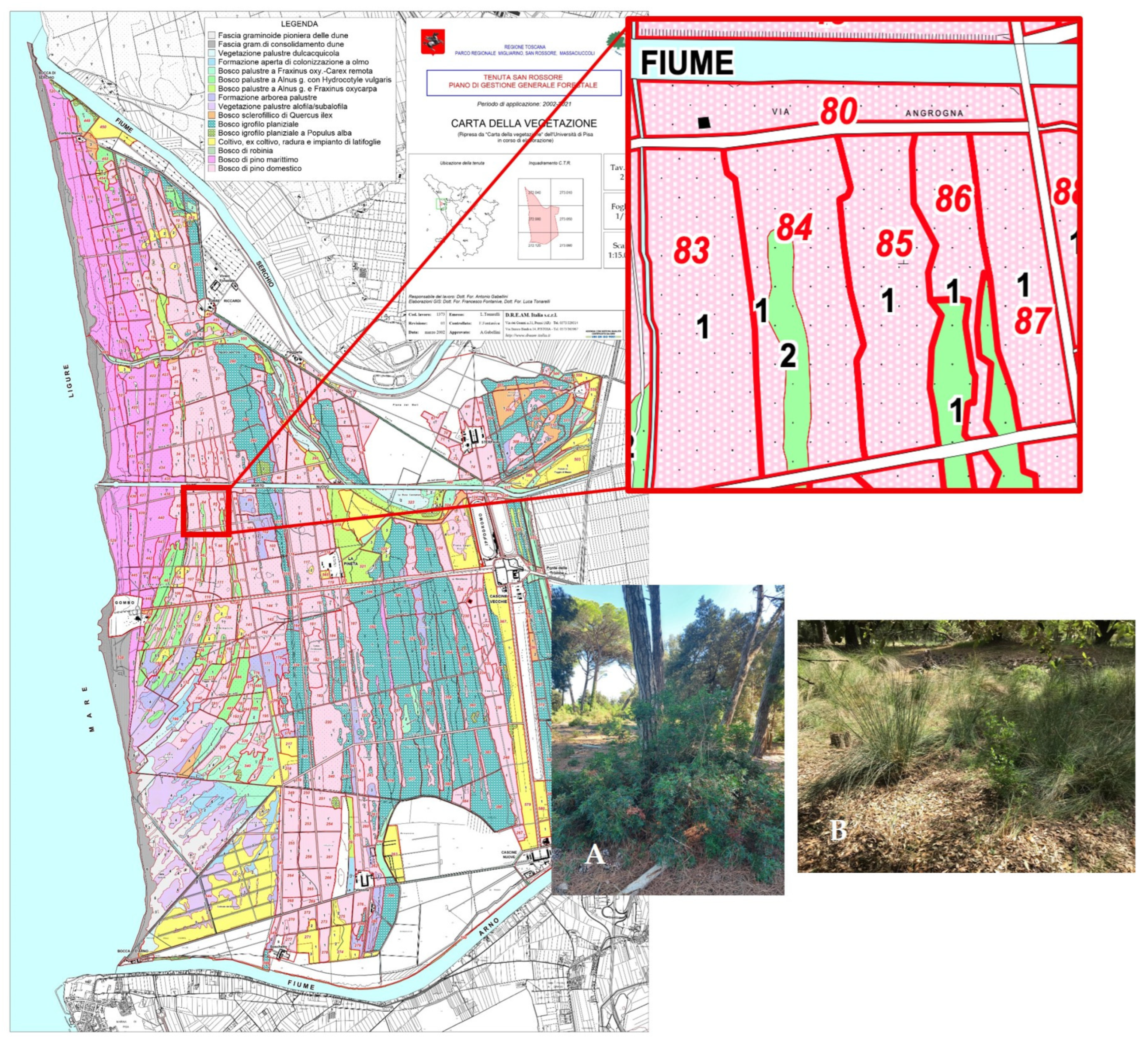
In the study area, two typical Mediterranean forest ecotypes within the Regional Park were selected: a coastal stone pine forest (PF), dominated by Pinus pinea L., and a meso-hygrophilous broadleaf forest located in humid retrodunal depressions, mainly composed of retrodunal depressed plain vegetation (RV), dominated by Alnus glutinosa (L.) Gaertn and Fraxinus angustifolia Vahl subsp. oxycarpa (M. Bieb. ex Willd.) Franco & Rocha Afonso (Figure 1). The observed variations in plant species richness between the two study areas (dunal and retrodunal) can be attributed to the different small-scale abiotic conditions, which determine a strong ecological gradient and marked vegetation zonation.
In the pine forest area, plant species experience more severe abiotic conditions that limit the establishment of highly specialized herbaceous species. However, in the plain of the retrodunal depression, the severity of these conditions decreases, allowing meso-hygrophilous plant communities to reach greater biodiversity.
The following climatic traits characterize the location: mean annual temperature: 15.3 °C, mean annual precipitation: 950 mm, mean annual radiation: 175 W m−2.

2.2. Soil and Plant Litter Sampling

In a homogeneous area of each ecotype, litter (size 40 × 40 cm) was collected in June 2021 in six random sampling plots (1 m2) for each selected ecotype (PF and RV). The distance between plots ranged between 100 and 300 m. After the litter removal, three soil subsamples were collected in each plot at 0–15 cm and 15–30 cm depths and mixed to obtain one composite soil sample for each plot (6 soil samples for each ecotype). Before physical, chemical and biochemical analysis, litter samples were oven-dried at 50 °C and ground to a fine powder, while soil samples were air-dried and sieved at 2 mm.

2.3. Soil Physical Characterization

In dried soil samples the electrical conductivity (EC) and pH were determined on water extract, 1:5 and 1:2.5 (w:v), respectively, using specific electrodes (ASA-SSSA, 1996). The size distribution of aggregates (0.02–2000 μm) was measured using a laser granulometer, the Mastersizer 2000 (Malvern Panalytical Ltd., Malvern, UK), equipped with a wet-sample dispersion unit. Afterwards, soil samples were sonicated in the granulometer recirculation system and measured again. Ultrasound was applied until the size distribution of dispersed particles was constant. The aggregate granulometric curve was compared to the curve obtained at the end of ultrasound application. Following Rawlins et al. [28], we refer to the difference in MWD (µm) of these two size distributions as disaggregation reduction, DR, a quantitative estimate of aggregate stability.

2.4. N and C Concentrations and Stable Isotopes

Carbon and nitrogen concentrations (%C and %N) and isotope compositions (δ13C and δ15N) were determined for the plant litter, soil samples and soil organic matter fractions. All samples were dried and subsequently ground to a fine powder with a mortar. An aliquot of dry powder (0.5–2 mg) of litter and soil samples was then directly used for %N and δ15N analyses, while soil subsamples of about 100 mg were treated with hydrochloric acid to remove carbonates before %C and δ13C determinations. Analyses of 13C/12C and 15N/14N isotope ratios were performed using an isotope ratio mass spectrometer (Isoprime, GV, Cheadle, UK) connected to an elemental analyzer (NA1500; Carlo Erba, Milan, Italy). The isotopic compositions were expressed as δ notation vs. VPDB for δ13C and vs. atmospheric N2 for δ15N, according to the expression: δ = (Rs − Rstd)/Rstd × 1000, where Rs is the isotope ratio of the sample and Rstd is the isotope ratio of the international standard. In particular, IAEA-CH6 sucrose and IAEA-600 caffeine were used for scale normalization of measured δ13C values to the VPDB scale; IAEA-600 caffeine and USGS40 glutamic acid were used for scale normalization of measured δ15N to the atmospheric N2 scale. The precision values of measurements, expressed as standard deviations, were determined against replicate measurements (n = 10) for IAEA standards for each considered element and were better than ±0.1‰ for both δ13C and δ15N.

2.5. Enzyme Activities and Stoichiometry

β-glucosidase (BG; EC 3.2.1.21), acid phosphatase (AP; EC 3.1.3.2), and N-acetyl-β-D-glucosaminidase (NAG, EC 3.2.1.14) hydrolytic enzyme activities and butyrate esterase enzyme activity were analyzed at a 0–15 cm soil depth, according to the fluorometric method proposed by Marx et al. and Vepsäläinen et al. [29,30]. Briefly, a moist sample was treated with 25 mL Na-acetate buffer (pH 5.5). A suspension was obtained by treating a sample with an UltraTurrax homogenizer (IKA, Staufen, Germany) for 1 min at 9600 g. Aliquots of 100 μL were withdrawn and dispensed into a 96-well microplate. Finally, 100 μL of 1 mM substrate solution was added, giving a final substrate concentration of 500 μM. Fluorescence (excitation: 360 nm; emission: 450 nm) was measured after 0, 30, 60, 120, and 180 min of incubation, with an automated fluorimetric plate-reader (Infinite F200 pro TECAN, Männedorf, Switzerland). The enzyme activities (BG, AP and NAG) were normalized to TOC and log-transformed.
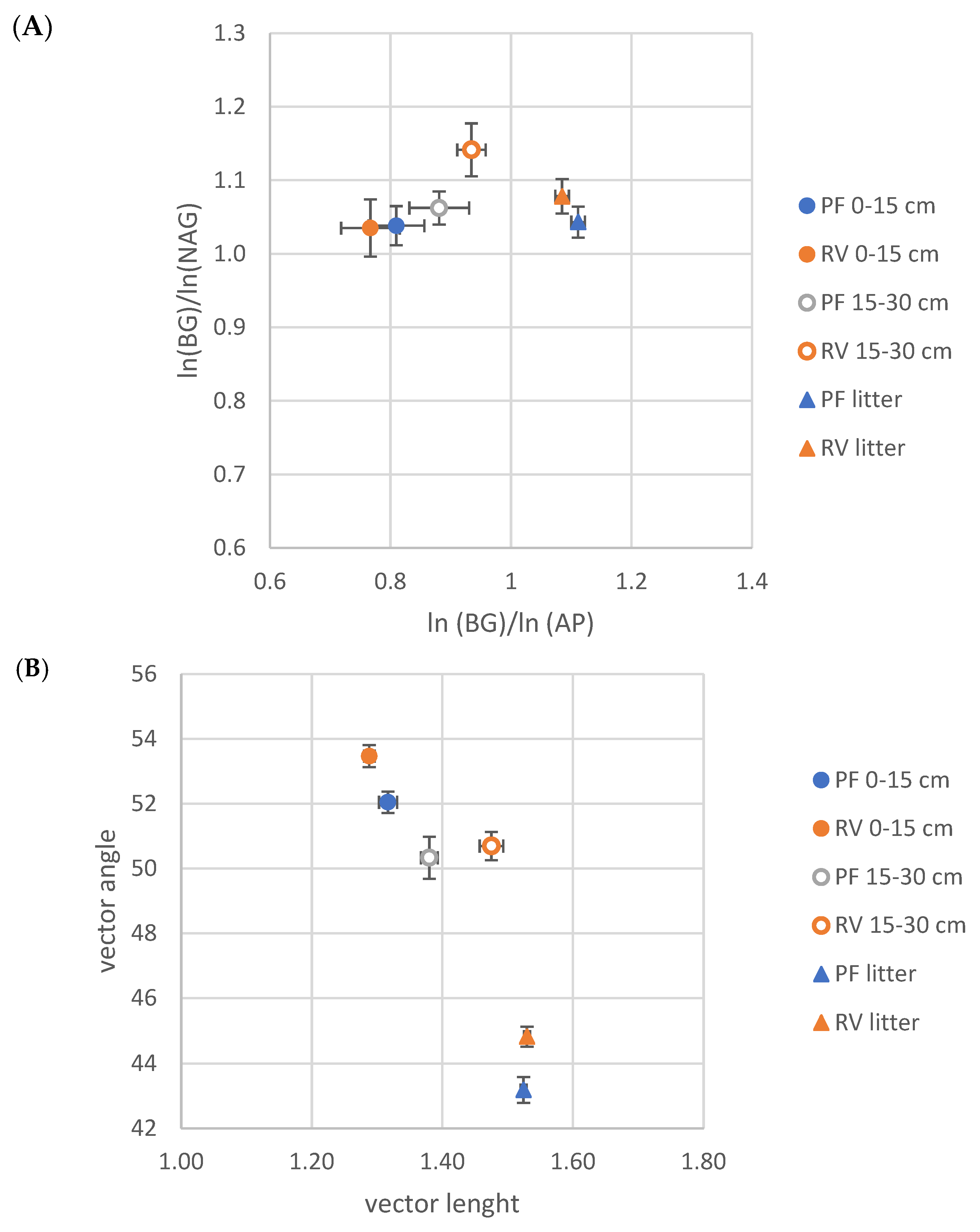
Vector analysis was used to indicate microbial resource limitations [11]. A longer vector represents a greater carbon (C) limitation, while a vector angle greater than 45° indicates phosphorus (P) limitation. Vector length and angle were calculated according to the method described by Wang et al. [31] as follows:
V L = ( l n B G / l n B G + l n N A G ) 2 + ( l n B G / ln B G + l n A P ) 2
V D = D e g r e e s ( A T A N 2 l n B G / l n B G + l n A P ,   l n B G / l n B G + l n N A G )
Greater values for VL indicate greater C-limitation vs. N/P limitation; a VD < 45° indicates N-limitation, while a VD > 45° indicates P limitation.

2.6. Statistical Analysis

The statistical analysis was performed using R software (4.5.2 version). After confirmation of the normality (Shapiro–Wilk normality test) and homoscedasticity (Bartlett test) of the data, differences in soil and litter properties were subjected to a one-tail t-test. Data not normally distributed and with unequal variances were log-transformed prior to statistical analysis.

3. Results

3.1. Litter and Soil Properties

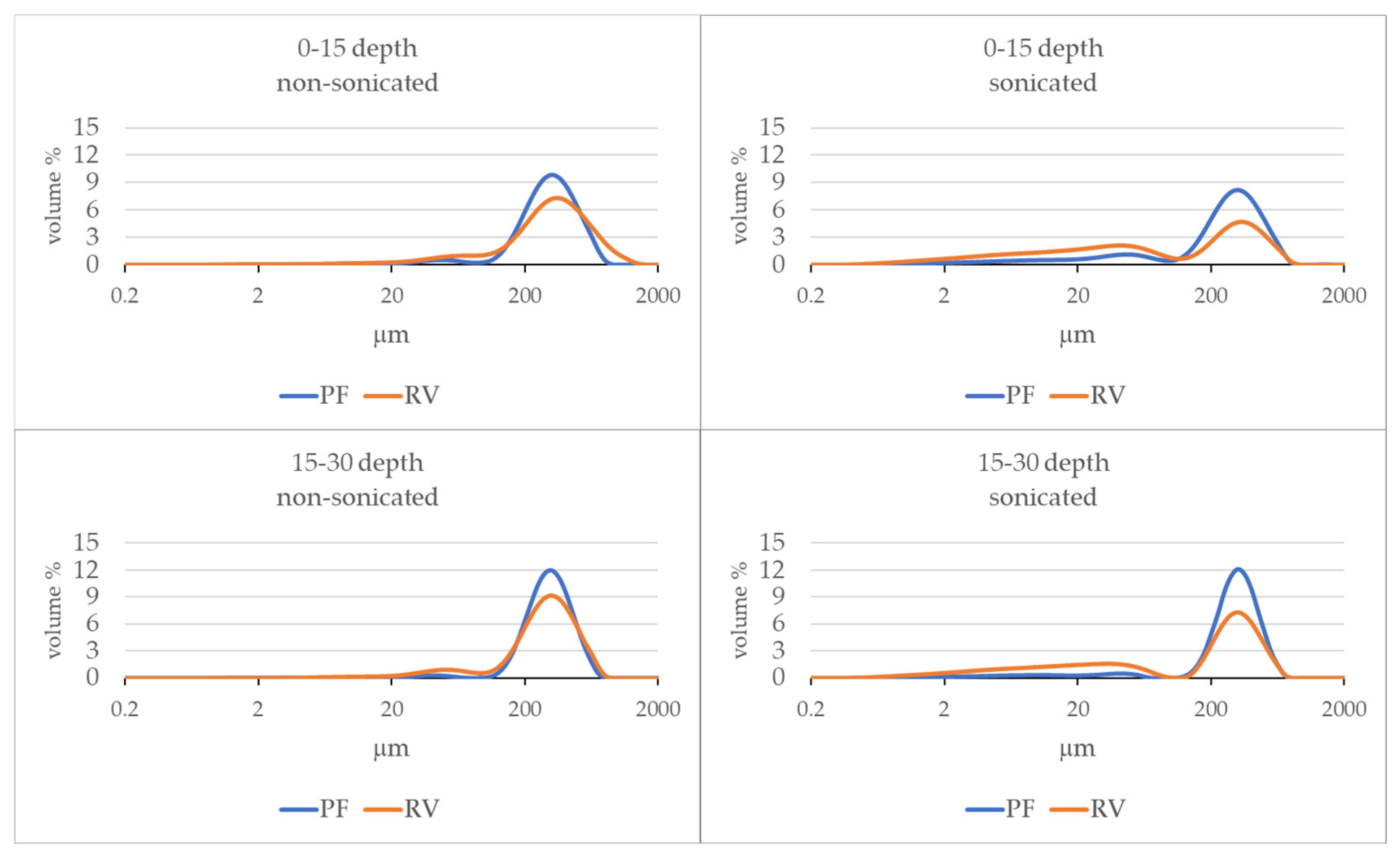
The particle size distributions of the two forest soils at depths of 0–15 and 15–30 cm are shown in Figure 2. Based on the graphs of sonicated samples, the PF soil exhibited a sandy texture, whereas the RV soil showed a sandy loam texture. The comparison of the size distributions of sonicated and non-sonicated samples revealed that the RV soil had a more aggregated structure compared to PF. Moreover, both forest soils showed greater stability in their surface layer (Figure 2).
The chemical properties of soil and litter samples collected from the two forest sites (PF and RV) are summarized in Table 1. Litter from PF exhibited higher total organic carbon (TOC) and lower total nitrogen (TN) compared to RV. The lower TN content in PF was also observed in the soil samples at both depths (0–15 cm and 15–30 cm). Similarly, electrical conductivity (EC) was lower in PF than in RV at both soil depths. However, no significant differences in soil TOC content were detected between the two forests at either depth. The TOC/TN ratio in both litter and soil samples was higher in PF than in RV (Table 1). The vertical distribution of TN and TOC in the soil profiles displayed a decrease from the topsoil (0–15 cm) to the subsoil (15–30 cm) in both forest ecosystems.

3.2. Carbon and Nitrogen Stable Isotopes

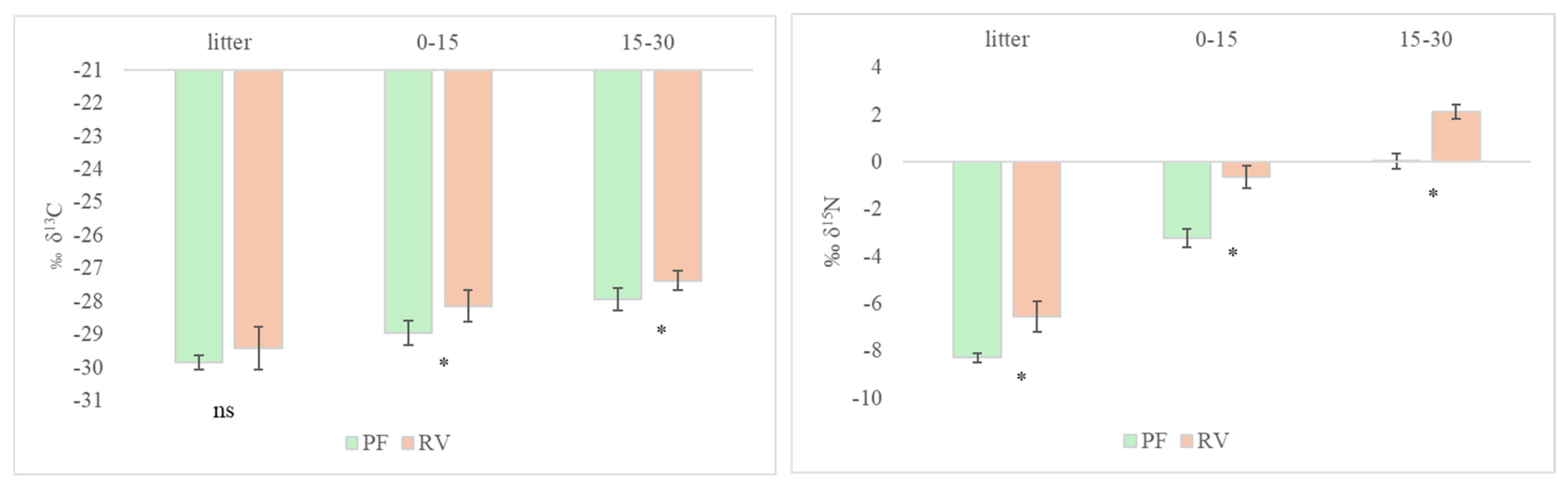
The isotope compositions of C and N in litter and soil samples are reported in Figure 3. The δ13C values of the litter did not differ significantly between PF and RV, whereas the δ15N values were significantly higher in RV compared to PF. An increasing trend in both δ13C and δ15N was observed from the litter to the 15–30 cm depth soil samples in both forest ecosystems; however, RV showed significantly enriched values at both the 0–15 cm and 15–30 cm depths compared to PF.

3.3. Enzyme Activities and Stoichiometry

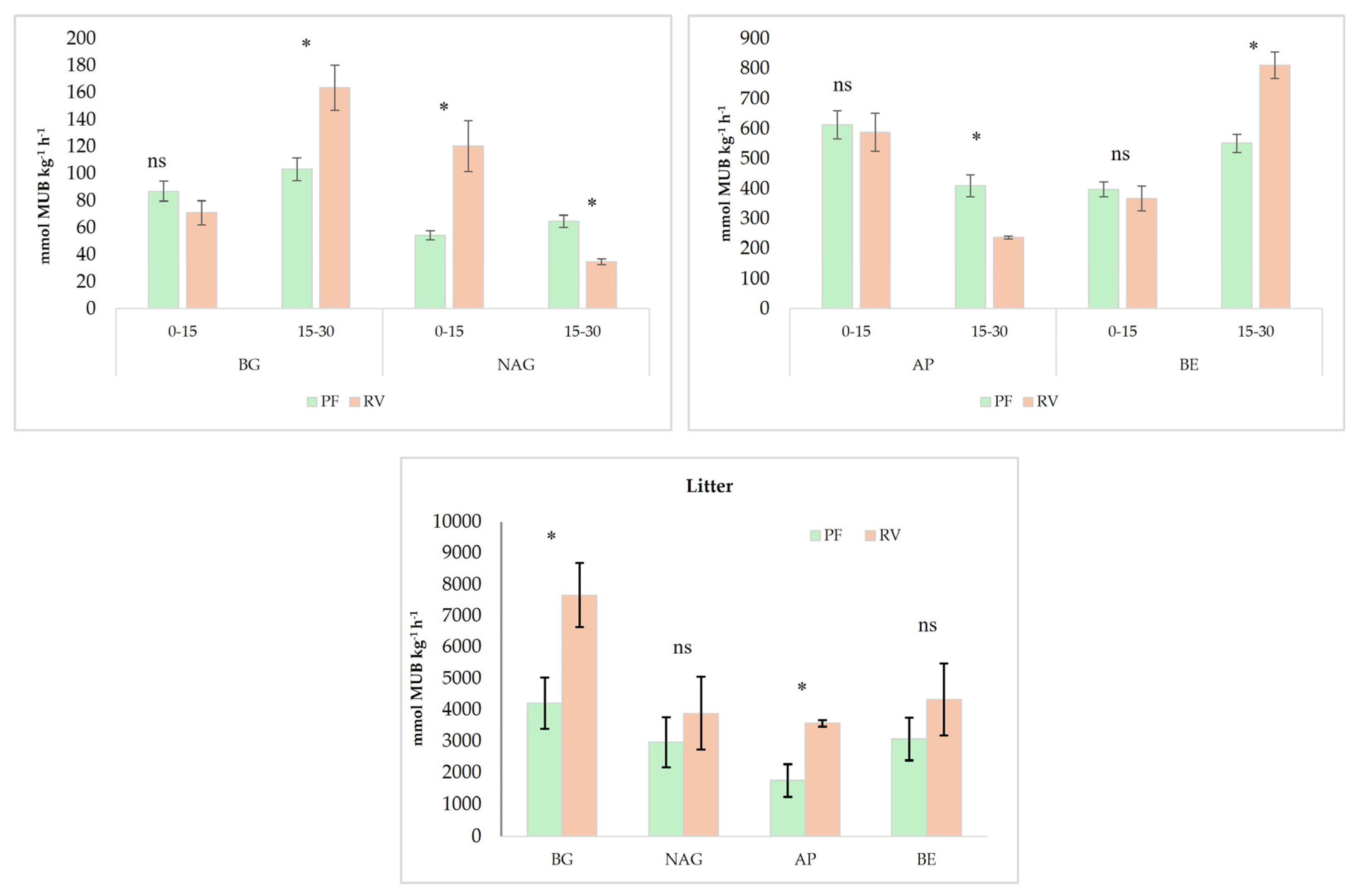
In the litter, the BG and AP activities were higher in RV than in PF. Regarding soil enzyme activities, the main differences among ecotypes were observed at the subsurface layer (15–30 cm). Specifically, RV soil showed higher BG and BE activities and lower NAG and AP activities than PF. At the surface layer (0–15 cm), only NAG was statistically higher in RV compared to PF, and no significant differences were observed between the two ecotypes at the surface layer (0–15 cm) for BG, AP, and BE activities (Figure 4).
Lower values of the ratio ln(BG)/ln(AP) were observed in the surface layer, while higher values of the ratio ln(BG)/ln(NAG) were observed at the subsurface layer, particularly in RV (Figure 5). In both forests, litter exhibited stoichiometric ratio values greater than 1.
The vector angle (VA) of both forest soils was greater than 45°, with higher values in the surface soil layer than in the subsoil (Figure 5B). VA was below 45° in litter samples, with lower values observed in the PF forest. The RV forest exhibited greater differences between surface and subsurface soils compared to PF for ecoenzyme stoichiometry.

4. Discussion

Soil aggregation and water-stable aggregates are usually related to C content [32]. However, given that the soil carbon content is similar in the two ecotypes, the greater aggregate stability observed in RV is likely attributable to its higher proportion of finer mineral particles [33].
The stable isotopes and enzyme activities were sensitive indicators of the functionality of the two forest ecotypes. In particular, these indicators can reflect soil–plant multifunctionality and ecosystem processes, thus providing a better understanding of drivers and interactions affecting the soil–plant system. The uniformity of δ13C in the plant litter layer between the two forest ecotypes suggested that plants did not differ in carbon isotope discrimination and relied on a similar isotopic CO2 source during photosynthetic assimilation [34]. Conversely, the lower δ15N of plant litter in PF than RV indicates possible differences in availability, sources and forms of soil nitrogen between the two forest ecotypes. Several factors can explain this result, including differences in inorganic or organic nitrogen sources, root depth, and mycorrhizal-derived nitrogen [35,36]. Furthermore, the lower soil pH in PF compared to RV could reduce nitrification, leading to changes in the ratio between nitrate and ammonium N forms [37].
The increase in δ13C and δ15N from litter to soil indicated an enrichment in the heavier isotopes 13C and 15N during plant litter decomposition due to the loss of C- and N-containing compounds. A gradual 13C and 15N enrichment is usually observed with soil depth [38,39,40]. However, it is worth noting that RV showed a more pronounced 13C and 15N enrichment from litter to SOM down to the 30 cm depth, suggesting a faster SOM decomposition and mineralization rate compared to PF [41]. This may be partly attributed to differences in the physical form and biochemical quality of the litter inputs, which influence microbial activity and isotope fractionation in the two ecotypes. In particular, PF exhibited poorer litter quality, as indicated by its higher C:N ratio. Such lower quality could be related to the high content of recalcitrant compounds in the P. pinea litter, which are more resistant to decomposition than those in the RV litter [42,43]. In addition, the lower values of δ15N in PF confirmed lower decomposition, mineralization, nitrification, and denitrification rates than in RV, as these soil processes typically discriminate against the heavier 15N isotope [44]. The higher C:N ratio in PF litter reflected microbial nitrogen limitation, as highlighted by a lower VD, limiting nitrogen mineralization and increasing nitrogen immobilization in microbial biomass [45]. In addition to litter quality, other factors may contribute to the contrasting isotopic profiles between RV and PF, including differences in microbial community composition, dissolved organic carbon (DOC) transport, and soil physical properties [46]. Soil characteristics such as clay content and aggregate stability strongly affect SOM δ13C and δ15N signatures. Fine-textured and aggregate-rich soils—such as those in RV—typically exhibit higher δ13C and δ15N values and greater enrichment with depth because soil aggregates preferentially stabilize the 13C- and 15N-enriched products of microbial decomposition [47]. In contrast, coarse-textured soils like PF offer weaker physical protection, resulting in smaller isotopic variations in soil depth [46]. Furthermore, fine-textured soils provide a greater specific surface area and higher cation exchange capacity, enhancing the sorption and stabilization of 13C-enriched DOC within soil aggregates. Finally, soil texture also determines nitrogen loss pathways. The high permeability and low chemical reactivity of sandy soils promote a rapid leaching of DOC and mineral N (often relatively 14N-rich), which induces an isotopic enrichment of the remaining nitrogen pool.
Vegetation, through litter inputs and decomposition, can also affect soil enzyme activities, leading to changes in soil microorganisms and their metabolic patterns.
The higher stimulation of soil organic matter decomposition in RV relative to PF is supported by the enzymatic activity patterns. Butyrate esterase activity (BE) has been used as an indicator of overall soil microbial activity [48], while β-glucosidase enzyme activity reflects the ability of soil to hydrolyze low-molecular-weight carbohydrates [49]. The higher activity of these enzymes at the 15–30 cm layer of RV compared to PF suggests a greater microbial potential to activate biogeochemical cycles and decompose organic matter.
Additionally, RV showed higher surface (0–15 cm) activity of N-acetylglucosaminidase, an enzyme involved in the nitrogen cycle, indicating enhanced microbial utilization and assimilation of nitrogen through enzyme production.
Enzyme stoichiometry revealed a higher microbial demand for C and P relative to N to maintain ecological stoichiometric balance [14]. Microbial P limitation may be linked to microbial requirements, since P is an essential element for microbial growth [44]. In particular, P limitation was higher in the 0–15 cm soil layer, whereas C limitation was more pronounced in the 15–30 cm layer, especially in RV soil.
Although TOC levels in the soils of both ecotypes were not significantly different, the vector length (VL) was higher in RV at the subsurface layer (15–30 cm), confirming that the relative degree of microbial C limitation was higher in RV than in PF [50].
However, the lower AP activity in RV compared to PF at the 15–30 cm soil layer may indicate a higher availability of inorganic P, which is the product of AP-mediated hydrolysis [51]. At the same time, the RV forest exhibited higher AP activity in the litter layer, suggesting that microbial communities invest more in phosphorus acquisition. In both forests, litter stoichiometric ratios greater than 1 confirm that litter, especially in RV, may have alleviated soil microbial P limitation, consistent with previous findings [52].
The vector angle, an indicator used to assess whether soil microorganisms are limited by N or P availability [53], exceeded 45° in both forest soils, with higher values in the 0–15 cm soil layer compared to the subsoil. This pattern reflects a decline in P limitation with increasing depth [54]. Subsoils typically exhibit low P availability due to reduced SOM content and strong P binding to clay particles [31]. At the 15–30 cm layer, the decline in microbial biomass and activity may further slow P cycling. Overall, microbial carbon and nutrient limitations reflect the long-term adaptation of microbial communities to the site-specific soil and environmental conditions [55].

5. Conclusions

This study highlighted the effectiveness of ecoenzymatic stoichiometry and stable isotope analysis as suitable soil–plant indicators for assessing ecosystem functionality, in terms of carbon and nutrient cycles, in coastal Mediterranean forests. The observed differences between the pine (PF) and broadleaf (RV) forests highlighted the influence of vegetation and environmental conditions on soil–plant functionality and microbial nutrient dynamics. The δ13C and δ15N signatures reflected the rate of decomposition and mineralization of organic matter, while enzyme activities indicated the microbial capacity to activate biogeochemical cycles and maintain stoichiometric balance. Future research should integrate these indicators with broader biogeochemical assessments to improve predictive models of ecosystem functionality related to management strategies and climate change, including cross-scale measurements and season dynamics.

Author Contributions

Conceptualization, R.P., N.A., A.D. and G.M.; methodology, S.D., F.V. and E.P.; investigation, S.D., F.V., C.M., A.S., R.P., M.S., N.A., A.D., G.M. and E.P.; data curation, S.D., F.V., A.S. and E.P.; writing—original draft preparation, S.D., F.V., A.S. and E.P.; writing—review and editing, S.D., R.P., G.M. and C.M.; visualization, S.D., F.V., A.S. and E.P.; supervision, S.D., E.P. and F.V. All authors have read and agreed to the published version of the manuscript.

Funding

This research was funded by the National Recovery and Resilience Plan (NRRP), Mission 4, Component 2, Investment 1.4—Call for Tender No. 3138 of 16 December 2021, rectified by Decree No. 3175 of 18 December 2021 of the Italian Ministry of University and Research funded by the European Union—NextGenerationEU, project code CN_00000033, Concession Decree No. 1034 of 17 June 2022 adopted by the Italian Ministry of University and Research, CUPB83C22002930006, project title: “National Biodiversity Future Center—NBFC”.

Data Availability Statement

The raw data supporting the conclusions of this article will be made available by the authors on request.

Acknowledgments

We thank the Regional Park of San Rossore, Migliarino, Massaciuccoli, for their collaboration, the authorization to collect soil and litter samples, and their valuable support in logistics and management of the activities. The authors wish to thank Luciano Spaccino, Carlotta Volterrani and Irene Tunno for their assistance in plant sample preparation and carbon and nitrogen stable isotope analysis.

Conflicts of Interest

The authors declare no conflicts of interest.

References

  1. Thierry, G.; Geneviève, M.; Richard, J.; Robin, D.; Didier, G. Mediterranean forests, land use and climate change: A social-ecological perspective. Reg. Environ. Change 2018, 18, 623–636. [Google Scholar] [CrossRef]
  2. Morán-Ordóñez, A.; Ameztegui, A.; De Cáceres, M.; de-Miguel, S.; Lefèvre, F.; Brotons, L.; Coll, L. Future trade-offs and synergies among ecosystem services in Mediterranean forests under global change scenarios. Ecosyst. Serv. 2020, 45, 101174. [Google Scholar] [CrossRef]
  3. Hidalgo-Triana, N.; Solakis, A.; Casimiro-Soriguer, F.; Choe, H.; Navarro, T.; Perez-Latorre, A.V.; Thorne, J.H. The high climate vulnerability of western Mediterranean forests. Sci. Total Environ. 2023, 895, 164983. [Google Scholar] [CrossRef]
  4. Arduini, I.; Cardelli, R.; Bertacchi, A. The forest of San Rossore (Tuscany, Italy): A call for its conservation through a multidisciplinary approach. EGU Gen. Assem. 2020, EGU2020-20738. [Google Scholar] [CrossRef]
  5. Travaglini, D.; Garosi, C.; Logli, F.; Parisi, F.; Ursumando, I.; Vettori, C.; Paffetti, D. Stand structure and natural regeneration in a coastal Stone pine (Pinus pinea L.) forest in Central Italy. In Ninth International Symposium, Monitoring of Mediterranean Coastal Areas: Problems and Measurement Techniques; Firenze University Press: Florence, Italy, 2022; pp. 775–784. [Google Scholar] [CrossRef]
  6. Tordoni, E.; Bacaro, G.; Weigelt, P.; Cameletti, M.; Janssen, J.A.M.; Acosta, A.T.R.; Bagella, S.; Filigheddu, R.; Bergmeier, E.; Buckley, H.L.; et al. Disentangling native and alien plant diversity in coastal sand dune ecosystems worldwide. J. Veg. Sci. 2021, 32, e12861. [Google Scholar] [CrossRef]
  7. Lehmann, J.; Bossio, D.A.; Kögel-Knabner, I.; Rilling, M.C. The concept and future prospects of soil health. Nat. Rev. Earth Environ. 2020, 1, 544–553. [Google Scholar] [CrossRef]
  8. Dale, V.H.; Beyeler, S.C. Challenges in the development and use of ecological indicators. Ecol. Indic. 2001, 1, 3–10. [Google Scholar] [CrossRef]
  9. Karaca, A.; Cetin, S.C.; Turgay, O.C.; Kizilkaya, R. Soil enzymes as indication of soil quality. In Soil Enzymology; Springer: Berlin/Heidelberg, Germany, 2010; pp. 119–148. [Google Scholar] [CrossRef]
  10. Das, S.K.; Varma, A. Role of enzymes in maintaining soil health. In Soil Enzymology; Springer: Berlin/Heidelberg, Germany, 2010; pp. 25–42. [Google Scholar] [CrossRef]
  11. Moorhead, D.L.; Sinsabaugh, R.L.; Hill, B.H.; Weintraub, M.N. Vector analysis of ecoenzyme activities reveal constraints on coupled C., N and P dynamics. Soil. Biol. Biochem. 2016, 93, 1–7. [Google Scholar] [CrossRef]
  12. Adetunji, A.T.; Lewu, F.B.; Mulidzi, R.; Ncube, B. The biological activities of β-glucosidase, phosphatase and urease as soil quality indicators: A review. J. Soil. Sci. Plant Nutr. 2017, 17, 794–807. [Google Scholar] [CrossRef]
  13. Moorhead, D.; Cui, Y.; Sinsabaugh, R.; Schimel, J. Interpreting patterns of ecoenzymatic stoichiometry. Soil. Biol. Biochem. 2023, 180, 108997. [Google Scholar] [CrossRef]
  14. Sinsabaugh, R.L.; Hill, B.H.; Shah, J.J.F. Ecoenzymatic stoichiometry of microbial organic nutrient acquisition in soil and sediment. Nature 2009, 462, 795–798. [Google Scholar] [CrossRef]
  15. Sinsabaugh, R.L.; Shah, J.J.F.; Hill, B.H.; Elonen, C.M. Ecoenzymatic stoichiometry of stream sediments with comparison to terrestrial soils. Biogeochemistry 2012, 111, 455–467. [Google Scholar] [CrossRef]
  16. Kunito, T.; Moro, H.; Mise, K.; Sawada, K.; Otsuka, S.; Nagaoka, K.; Fujita, K. Ecoenzymatic stoichiometry as a temporally integrated indicator of nutrient availability in soils. Soil. Sci. Plant Nutr. 2024, 70, 246–269. [Google Scholar] [CrossRef]
  17. Cui, Y.; Moorhead, D.L.; Peng, S.; Sinsabaugh, R.L. New insights into the patterns of ecoenzymatic stoichiometry in soil and sediment. Soil. Biol. Biochem. 2023, 177, 108910. [Google Scholar] [CrossRef]
  18. Vannucchi, F.; Peruzzi, E.; Doni, S.; Manzi, D.; Azzini, L.; Pathan, S.I.; Pietramellara, G.; Arfaioli, P.; Nicese, F.P.; Masciandaro, G.; et al. Biological assessment of green waste and dredged sediment co-composting for nursery plant cultivation. Appl. Sci. 2024, 14, 5767. [Google Scholar] [CrossRef]
  19. Giannini, V.; Peruzzi, E.; Masciandaro, G.; Doni, S.; Macci, C.; Bonari, E.; Silvestri, N. Comparison among different rewetting strategies of degraded agricultural peaty soils: Short-term effects on chemical properties and ecoenzymatic activities. Agronomy 2020, 10, 1084. [Google Scholar] [CrossRef]
  20. Wu, Y.; Chen, W.; Li, Q.; Guo, Z.; Li, Y.; Zhao, Z.; Zhai, J.; Liu, G.; Xue, S. Ecoenzymatic stoichiometry and nutrient limitation under a natural secondary succession of vegetation on the Loess Plateau, China. Land Degrad. Dev. 2021, 32, 399–409. [Google Scholar] [CrossRef]
  21. Pan, Y.; Zhang, Z.; Zhang, M.; Huang, P.; Dai, L.; Ma, Z.; Liu, J. Climate vs. nutrient control: A global analysis of driving environmental factors of wetland plant biomass allocation strategy. J. Clean. Prod. 2023, 406, 136983. [Google Scholar] [CrossRef]
  22. He, L.; Lu, S.; Wang, C.; Mu, J.; Zhang, Y.; Wang, X. Changes in soil organic carbon fractions and enzyme activities in response to tillage practices in the Loess Plateau of China. Soil Tillage Res. 2021, 209, 104940. [Google Scholar] [CrossRef]
  23. Cui, H.; Mo, C.Y.; Chen, P.F.; Lan, R.; He, C.; Lin, J.D.; Jiang, Z.H.; Yang, J.P. Impact of rhizosphere priming on soil organic carbon dynamics: Insights from the perspective of carbon fractions. Appl. Soil Ecol. 2023, 189, 104982. [Google Scholar] [CrossRef]
  24. Shen, F.; Liu, N.; Shan, C.; Li, J.; Wang, M.; Wang, Y.; Yang, L. Soil extracellular enzyme stoichiometry reveals the increased P limitation of microbial metabolism after the mixed cultivation of Korean pine and Manchurian walnut in Northeast China. Eur. J. Soil Biol. 2023, 118, 103539. [Google Scholar] [CrossRef]
  25. Choi, W.J.; Müller, C.; Zaman, M.; Nannipieri, P. Stable isotopes for the study of soil C and N under global change. Biol. Fertil. Soils 2023, 59, 485–486. [Google Scholar] [CrossRef]
  26. Macci, C.; Vannucchi, F.; Scartazza, A.; Masciandaro, G.; Doni, S.; Peruzzi, E. Soil–Plant Indicators for Assessing Nutrient Cycling and Ecosystem Functionality in Urban Forestry. Urban. Sci. 2025, 9, 82. [Google Scholar] [CrossRef]
  27. Psuty, N.P. The Coastal Foredune: A Morphological Basis for Regional Coastal Dune Development. In Coastal Dunes; Springer: Berlin/Heidelberg, Germany, 2008; pp. 25–45. [Google Scholar] [CrossRef]
  28. Rawlins, B.; Wragg, J.; Lark, R. Application of a novel method for soil aggregate stability measurement by laser granulometry with sonication. Eur. J. Soil Sci. 2013, 64, 92–103. [Google Scholar] [CrossRef]
  29. Marx, M.C.; Wood, M.; Jarvis, S.C. A microplate fluorimetric assay for the study of enzyme diversity in soils. Soil Biol. Biochem. 2001, 33, 1633–1640. [Google Scholar] [CrossRef]
  30. Vepsäläinen, M.; Kukkonen, S.; Vestberg, M.; Sirviö, H.; Niemi, R.M. Application of soil enzyme activity test kit in a field experiment. Soil Biol. Biochem. 2001, 33, 1665–1672. [Google Scholar] [CrossRef]
  31. Wang, Y.; Gunina, A.; Long, F.; Sun, T. Forms of nitrogen deposition shift soil microbial resource limitation and carbon use efficiency in temperate forest. Catena 2025, 261, 109505. [Google Scholar] [CrossRef]
  32. Even, R.; Cotrufo, M. The ability of soils to aggregate, more than the state of aggregation, promotes protected soil organic matter formation. Geoderma 2024, 442, 116760. [Google Scholar] [CrossRef]
  33. Wagner, S.; Cattle, S.R.; Scholten, T. Soil-aggregate formation as influenced by clay content and organic-matter amendment. J. Plant Nutr. Soil Sci. 2007, 170, 173–180. [Google Scholar] [CrossRef]
  34. Scartazza, A.; Vaccari, F.P.; Bertolini, T.; Di Tommasi, P.; Lauteri, M.; Miglietta, F.; Brugnoli, E. Comparing integrated stable isotope and eddy covariance estimates of water-use efficiency on a Mediterranean successional sequence. Oecologia 2014, 176, 581–594. [Google Scholar] [CrossRef] [PubMed]
  35. Robinson, D. δ15N as an integrator of the nitrogen cycle. Trends Ecol. Evol. 2001, 16, 153–162. [Google Scholar] [CrossRef]
  36. Sheng, W.; Yu, G.; Fang, H.; Liu, Y.; Wang, Q.; Chen, Z.; Zhang, L. Regional patterns of 15N natural abundance in forest ecosystems along a large transect in eastern China. Sci. Rep. 2014, 4, 4249. [Google Scholar] [CrossRef]
  37. Amare, S.; Haile, M.; Birhane, E. Changes in Ammonium-to-Nitrate Ratio along Faidherbia albida Tree Age Gradients in Arenosols. Nitrogen 2024, 5, 529–543. [Google Scholar] [CrossRef]
  38. Wynn, J.; Bird, M.; Wong, V. Rayleigh distillation and the depth profile of 13C/12C ratios of soil organic carbon from soils of disparate texture in Iron Range National Park, Far North Queensland, Australia. Geochim. Cosmochim. Acta 2005, 69, 1961–1973. [Google Scholar] [CrossRef]
  39. Hobbie, E.A.; Ouimette, A.P. Controls of nitrogen isotope patterns in soil profiles. Biogeochemistry 2009, 95, 355–371. [Google Scholar] [CrossRef]
  40. Philben, M.; Bowering, K.; Podrebarac, F.A.; Laganière, J.; Edwards, K.; Ziegler, S.E. Enrichment of 13C with depth in soil organic horizons is not explained by CO2 or DOC losses during decomposition. Geoderma 2022, 424, 116004. [Google Scholar] [CrossRef]
  41. Scartazza, A.; Huarancca Reyes, T.; Bretzel, F.; Pini, R.; Guglielminetti, L.; Calfapietra, C. Has COVID-19 Lockdown Affected C and N Level and Isotope Composition in Urban Soils and Plant Leaves. Ecosyst. Health Sustain. 2023, 9, 0117. [Google Scholar] [CrossRef]
  42. Gołębiewski, M.; Tarasek, A.; Sikora, M.; Deja-Sikora, E.; Tretyn, A.; Niklińska, M. Rapid microbial community changes during initial stages of pine litter decomposition. Microb. Ecol. 2019, 77, 56–75. [Google Scholar] [CrossRef]
  43. Prescott, C.E.; Vesterdal, L. Decomposition and transformations along the continuum from litter to soil organic matter in forest soils. For. Ecol. Manag. 2021, 498, 119522. [Google Scholar] [CrossRef]
  44. Craine, J.M.; Brookshire, E.N.J.; Cramer, M.D.; Hasselquist, N.J.; Koba, K.; Marin-Spiotta, E.; Wang, L. Ecological interpretations of nitrogen isotope ratios of terrestrial plants and soils. Plant Soil 2015, 396, 1–26. [Google Scholar] [CrossRef]
  45. Zechmeister-Boltenstern, S.; Keiblinger, K.M.; Mooshammer, M.; Peñuelas, J.; Richter, A.; Sardans, J.; Wanek, W. The application of ecological stoichiometry to plant–microbial–soil organic matter transformations. Ecol. Monogr. 2015, 85, 133–155. [Google Scholar] [CrossRef]
  46. Bird, M.; Kracht, O.; Derrien, D.; Zhou, Y. The effect of soil texture and roots on the stable carbon isotope composition of soil organic carbon. Aust. J. Soil Res. 2003, 41, 77–94. [Google Scholar] [CrossRef]
  47. Scartazza, A.; Gavrichkova, O.; Pini, R.; D’Acqui, L.P. Physically protected organic matter drives soil carbon sequestration potential of a managed grassland ecosystem in Italian Alps. Geoderma Reg. 2023, 34, e00686. [Google Scholar] [CrossRef]
  48. Wittmann, C.; Kähkönen, M.A.; Ilvesniemi, H.; Kurola, J.; Salkinoja-Salonen, M.S. Areal activities and stratification of hydrolytic enzymes involved in the biochemical cycles of carbon, nitrogen, sulphur and phosphorus in podsolized boreal forest soils. Soil Biol. Biochem. 2004, 36, 425–433. [Google Scholar] [CrossRef]
  49. Eivazi, F.; Tabatabai, M. Factors affecting glucosidase and galactosidase in soils. Soil Biol. Biochem. 1990, 22, 891–897. [Google Scholar] [CrossRef]
  50. Sun, Y.; Chen, X. Differential responses of soil extracellular enzyme activity and stoichiometry to precipitation changes in a poplar plantation. Environ. Res. 2024, 241, 117565. [Google Scholar] [CrossRef]
  51. Condron, L.M.; Turner, B.L.; Cade-Menun, B.J.; Sims, J.; Sharpley, A. Chemistry and dynamics of soil organic phosphorus. In Phosphorus: Agriculture and the Environment; Wiley: Hoboken, NJ, USA, 2005; pp. 87–121. [Google Scholar] [CrossRef]
  52. Meng, Y.; Li, P.; Xiao, L.; Liu, J.; Zhang, C.; Yang, S.; Zhang, X.; Wang, Y.; Wang, T.; Wang, R. Differences in the home-field effects of litter decomposition modulate changes in soil microbial nutrient limitations: Insights from eco-enzyme stoichiometry. Catena 2025, 258, 109289. [Google Scholar] [CrossRef]
  53. Moorhead, D.L.; Rinkes, Z.L.; Sinsabaugh, R.L.; Weintraub, M.N. Dynamic relationships between microbial biomass, respiration, inorganic nutrients and enzyme activities: Informing enzyme-based decomposition models. Front. Microbiol. 2013, 4, 233. [Google Scholar] [CrossRef] [PubMed]
  54. Cui, Y.; Fang, L.; Guo, X.; Han, F.; Ju, W.; Ye, L.; Tan, W.; Zhang, X. Natural grassland as the optimal pattern of vegetation restoration in arid and semi-arid regions: Evidence from nutrient limitation of soil microbes. Sci. Total Environ. 2019, 648, 388–397. [Google Scholar] [CrossRef]
  55. Jing, X.; Chen, X.; Fang, J.; Ji, C.; Shen, H.; Zheng, C.; Zhu, B. Soil microbial carbon and nutrient constraints are driven more by climate and soil physicochemical properties than by nutrient addition in forest ecosystems. Soil Biol. Biochem. 2020, 141, 107657. [Google Scholar] [CrossRef]
Figure 1. Map of the study area (red rectangle) showing the distribution of Pinus pinea L. forest (pink, photo (A)) and meso-hygrophilous broadleaved forest with retrodunal depressed plain vegetation (green, photo (B)).
Agronomy 16 00374 g001
Figure 2. Particle size distribution of non-sonicated and sonicated soil samples collected at the depths of 0–15 and 15–30 cm in the coastal stone pine forest (PF) and in the meso-hygrophilous broadleaf forest (RV).
Agronomy 16 00374 g002
Figure 3. Litter and soil carbon and nitrogen stable isotope compositions detected in the coastal stone pine forest (PF) and a meso-hygrophilous broadleaf forest (RV). Asterisks represent a significant difference of p < 0.05. ns = not significant.
Agronomy 16 00374 g003
Figure 4. Enzyme activities detected in the coastal stone pine forest (PF) and a meso-hygrophilous broadleaf forest (RV) at 0–15 cm and 15–30 cm soil layers and in litter. Asterisks represent a significant difference of p < 0.05. ns = not significant. BG: β-glucosidase activity, NAG: N-acetyl-β-D-glucosaminidase activity, AP: acid phosphatase activity, BE: butyrate esterase activity.
Agronomy 16 00374 g004
Figure 5. (A) Enzyme stoichiometry of the relative proportions of carbon (C) to nitrogen (N) acquisition vs. C to phosphorus (P) acquisition detected in the coastal stone pine forest (PF) and a meso-hygrophilous broadleaf forest (RV). (B) Scatterplot of vector angle and vector length detected in soil and litter samples. BG = β-1,4-glucosidase; NAG = β-1,4-N-acetylglucosaminidase; AP = acid phosphatase.
Agronomy 16 00374 g005
Table 1. Leaf litter and soil (at 0–15 cm and 15–30 cm) chemical properties measured in the coastal stone pine forest (PF) and in the meso-hygrophilous broadleaf forest (RV). Asterisks represent a significant difference of p < 0.05. ns = not significant.
Litter 0–15 cm 15–30 cm
PFRV PFRV PFRV
pH 6.0 ± 1.237.6 ± 0.24ns6.9 ± 1.288.2 ± 0.19ns
EC 0.7 ± 0.493.1 ± 0.62*1.0 ± 0.311.6 ± 0.20*
TOC49 ± 0.846 ± 0.7*2.7 ± 1.692.7 ± 1.80ns0.4 ± 0.140.4 ± 0.17ns
TN0.7 ± 0.050.9 ± 0.16*0.13 ± 0.040.33 ± 0.19*0.03 ± 0.010.09 ± 0.06*
TOC/TN70 ± 5.452 ± 9.2*21.3 ± 13.868.7 ± 2.77*12.9 ± 3.664.9 ± 1.48*
EC = electrical conductivity (dS m−1); TOC = total organic carbon (%); TN = total nitrogen (%).
Disclaimer/Publisher’s Note: The statements, opinions and data contained in all publications are solely those of the individual author(s) and contributor(s) and not of MDPI and/or the editor(s). MDPI and/or the editor(s) disclaim responsibility for any injury to people or property resulting from any ideas, methods, instructions or products referred to in the content.