





-
Declination and Segmentation in Children with Childhood Apraxia of Speech -
The Relation of Slavic Verb Prefixes to Perfective Aspect -
Language Use and Attitudes Among Ukrainian Refugees in Canada: Do They Differ by Participants’ Age? -
Exploring the Cooperative Principle in Cross-Cultural Contexts: A Corpus-Based Pragmatic Study of International Students Learning Romanian
Journal Description
Languages
Languages
is an international, multidisciplinary, peer-reviewed, open access journal on interdisciplinary studies of languages published monthly online by MDPI. The European Society for Transcultural and Interdisciplinary Dialogue (ESTIDIA) is affiliated with Languages and its members receive discounts on the article processing charges.
- Open Access— free for readers, with article processing charges (APC) paid by authors or their institutions.
- High Visibility: indexed within Scopus, ESCI (Web of Science), ERIH Plus, and other databases.
- Journal Rank: JCR - Q2 (Linguistics) / CiteScore - Q1 (Language and Linguistics)
- Rapid Publication: manuscripts are peer-reviewed and a first decision is provided to authors approximately 55.2 days after submission; acceptance to publication is undertaken in 9.6 days (median values for papers published in this journal in the second half of 2025).
- Recognition of Reviewers: reviewers who provide timely, thorough peer-review reports receive vouchers entitling them to a discount on the APC of their next publication in any MDPI journal, in appreciation of the work done.
- Journal Cluster of Human Thought and Cultural Expression: Culture, Histories, Humanities, Languages, Literature and Religions.
Impact Factor:
1.2 (2024);
5-Year Impact Factor:
1.2 (2024)
Latest Articles
Alternations in Third Person Accusative Proclitics and Definite Articles in Some Southern Italian Dialects
Languages 2026, 11(4), 73; https://doi.org/10.3390/languages11040073 - 9 Apr 2026
Abstract
Several southern Italian dialects show a systematic alternation in the forms of the third person object clitic between proclisis and enclisis; moreover, in proclisis, the object clitic and the definite article have different forms that alternate between prevocalic and preconsonantal contexts. On the
[...] Read more.
Several southern Italian dialects show a systematic alternation in the forms of the third person object clitic between proclisis and enclisis; moreover, in proclisis, the object clitic and the definite article have different forms that alternate between prevocalic and preconsonantal contexts. On the whole, the distribution of forms constitutes a varied and complex picture, which has often been treated in terms of allomorphy. In particular, this article examines the arrangement of proclitic forms in the Neapolitan variety in which the forms are distributed according to three different patterns. The article explores the possibility of analysing the alternations in purely phonological terms, using the representational tools of “floating melody”, “stress space” and “virtual geminate”. The results obtained are encouraging: while some alternations have proven to be allomorphic in nature, a unified phonological explanation has been developed for challenging issues, including the so-called “l-deletion” and the corresponding vowel lengthening.
Full article
(This article belongs to the Special Issue Morpho(phono)logy/Syntax Interface)
Open AccessArticle
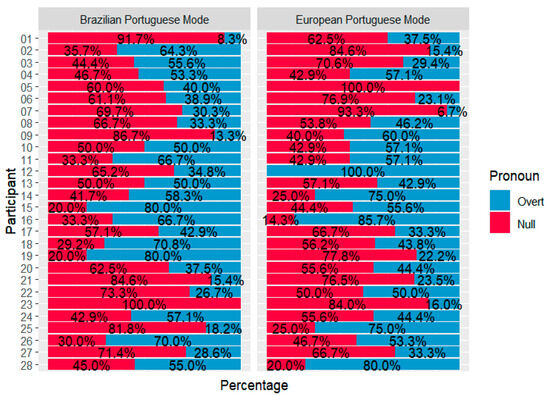
Tracking Pragmatic Contexts of Pronominal Subjects: Acquisition and Attrition in Brazilian–European Portuguese Late-Sequential Bidialectals
by
Ronan Pereira, Catarina Rosa and Mariana Silva
Languages 2026, 11(4), 72; https://doi.org/10.3390/languages11040072 - 3 Apr 2026
Abstract
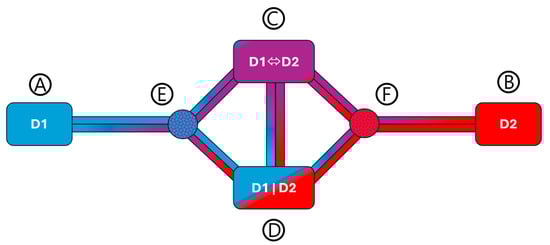
This study investigates cross-dialectal influence in native Brazilian Portuguese (BP) immigrants in Portugal regarding the pragmatic distribution of pronominal subjects within a novel framework of second dialect acquisition and first dialect attrition, the Bidialectal Dynamics Model (BDM). Twenty-eight immigrants completed a spontaneous oral
[...] Read more.
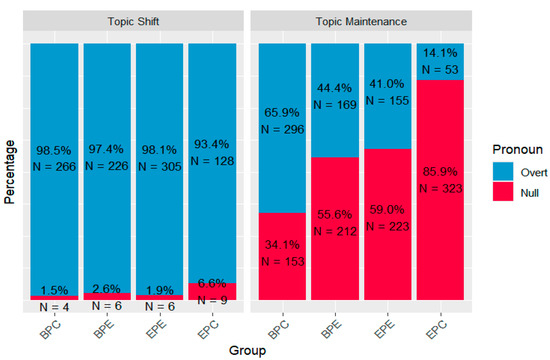
This study investigates cross-dialectal influence in native Brazilian Portuguese (BP) immigrants in Portugal regarding the pragmatic distribution of pronominal subjects within a novel framework of second dialect acquisition and first dialect attrition, the Bidialectal Dynamics Model (BDM). Twenty-eight immigrants completed a spontaneous oral production task in both BP and European Portuguese (EP). Two control groups (24 BP speakers in Brazil and 24 EP speakers in Portugal) did the same in their respective native varieties only. All groups favored overt subjects for topic shift. For topic maintenance, BP speakers in Brazil preferred overt subjects despite omitting more pronouns in this context than in topic shift, while EP speakers strongly favored null subjects. At the group level, immigrants produced fewer null subjects than EP controls and more than BP controls, suggesting bidirectional cross-dialectal influence. At the individual level, profiles varied: most participants displayed bidirectional cross-dialectal influence, some maintained their native preferences, others used their second dialect across the board, and only a few displayed target-like behavior. Following the BDM, it is argued that this cross-dialectal influence stems from the co-activation of dialects’ overlapping grammars, particularly in the lexicon, and the different profiles observed reflect bidialectals’ diverse and dynamic environments.
Full article
(This article belongs to the Special Issue Determining the Scope, Nature and Causes of Attrition in Adult L1 Grammars)
►▼
Show Figures

Figure 1
Open AccessArticle
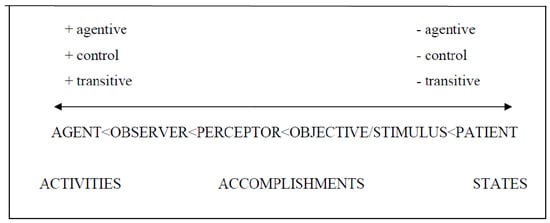
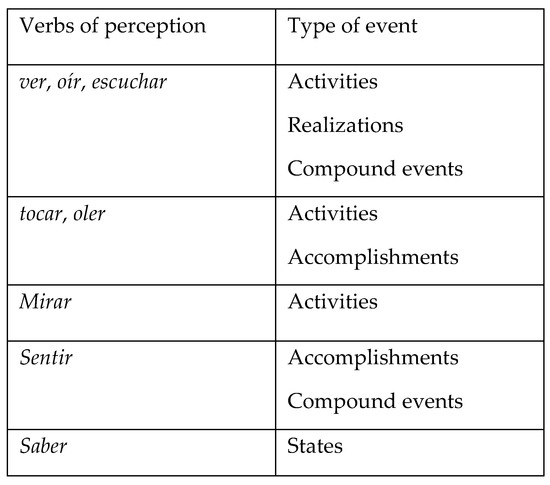
The Grammatical Properties of Perception Verbs: A Reflection Based on Some Recurring Oppositions
by
Jorge Fernández Jaén
Languages 2026, 11(4), 71; https://doi.org/10.3390/languages11040071 - 3 Apr 2026
Abstract
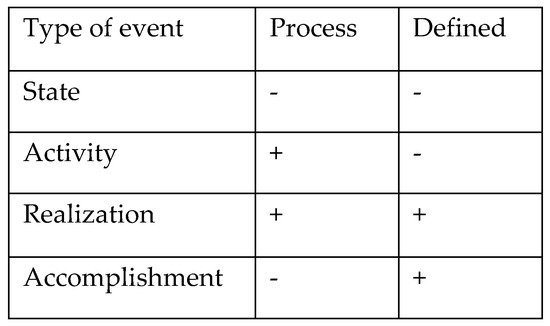
Verbs of perception show complex linguistic behavior, both grammatically and in semantic terms. Owing to their connection with perceptual processes (sight, hearing, smell…), they always operate in a heterogeneous way, since these types of verbs must code highly diverse events. In light of
[...] Read more.
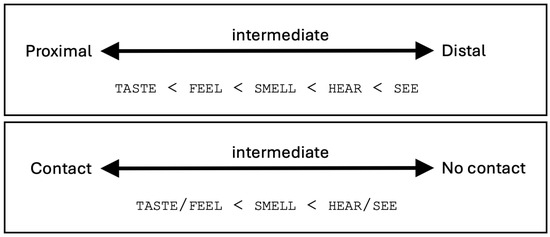
Verbs of perception show complex linguistic behavior, both grammatically and in semantic terms. Owing to their connection with perceptual processes (sight, hearing, smell…), they always operate in a heterogeneous way, since these types of verbs must code highly diverse events. In light of all the above, the specialized literature has tried to systematize the use of these verbs during the last few years, for the purpose of identifying the overall patterns which govern their utilization in natural languages. To that end, numerous authors chose to formulate dichotomous oppositions (for example, active vs passive perception), aiming to describe the syntax of verbs of perception rigorously. The aim of our paper is to critically analyze such dichotomies, which will allow us to ascertain how verbs of perception relate to grammar (type of transitivity, resultative nature of perception, aspectual typology of events, link between perception and space, etc.). This work will additionally provide evidence that, contrary to what has been argued at times, the dichotomies proposed by scholars are quite gradual or prototypical rather than rigid. In short, the aim sought with our study consists of offering an up-to-date review about a topic of great interest—namely, the methodology to analyze verbs of perception—insofar as these verbs stand out for being one of the most frequently used lexical categories in all languages around the world.
Full article
(This article belongs to the Special Issue Recent Developments on the Semantics of Perception Verbs)
►▼
Show Figures

Figure 1
Open AccessArticle
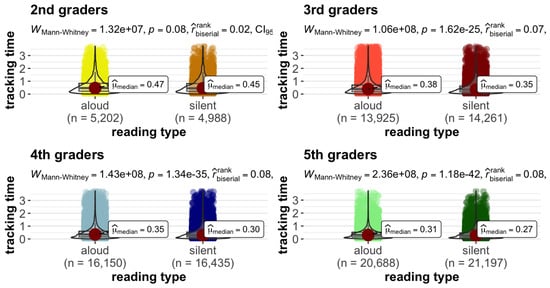
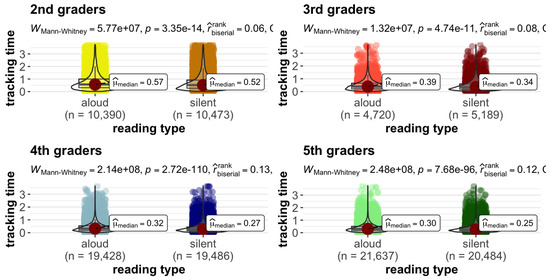
Comparable Reading Development in Bulgarian and Italian: Cross-Linguistic Insights from a Finger-Tracking Study
by
Claudia Marzi, Marcello Ferro, Andrea Nadalini, Vito Pirrelli, Maria Todorova, Tsvetana Dimitrova, Valentina Stefanova, Hristina Kukova and Svetla Koeva
Languages 2026, 11(4), 70; https://doi.org/10.3390/languages11040070 - 2 Apr 2026
Abstract
►▼
Show Figures
Transparent orthographies, such as Bulgarian and Italian, feature highly consistent grapheme-phoneme correspondences, enabling rapid acquisition of decoding skills. Despite belonging to different language families and using distinct scripts (i.e., Cyrillic vs. Latin), these languages provide an ideal framework to investigate whether orthographic transparency
[...] Read more.
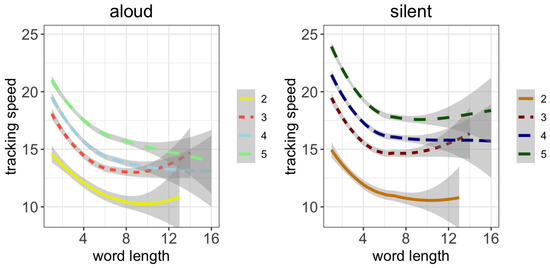
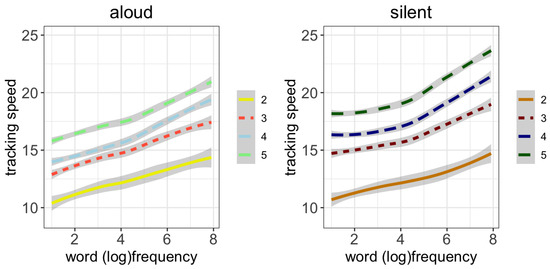
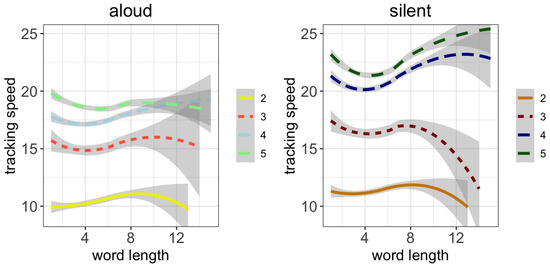
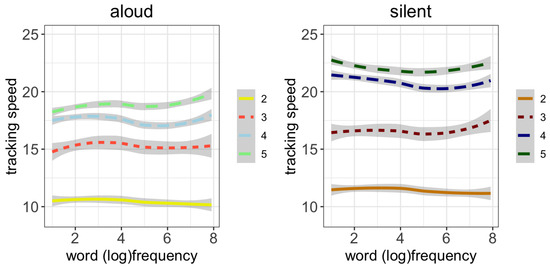
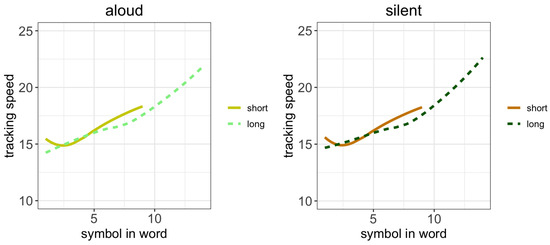
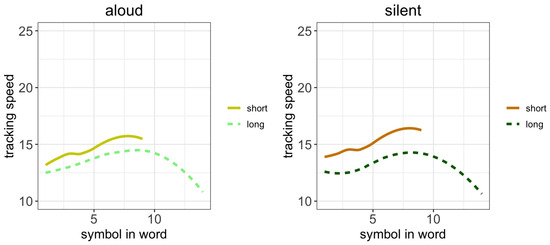
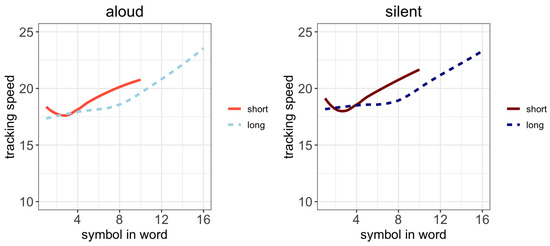
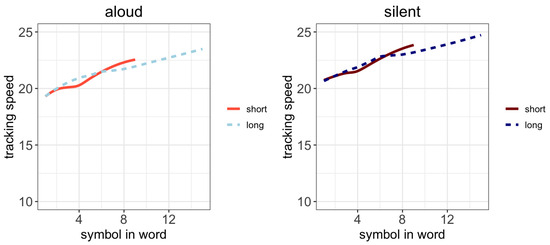
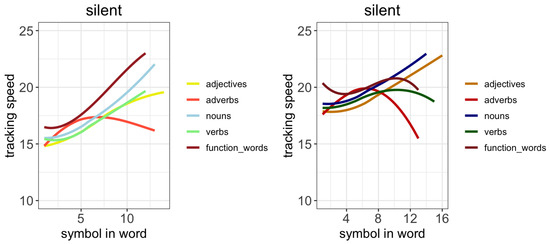
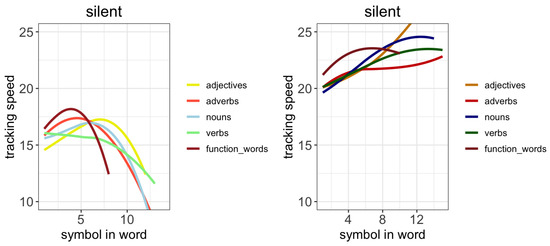
Transparent orthographies, such as Bulgarian and Italian, feature highly consistent grapheme-phoneme correspondences, enabling rapid acquisition of decoding skills. Despite belonging to different language families and using distinct scripts (i.e., Cyrillic vs. Latin), these languages provide an ideal framework to investigate whether orthographic transparency can outweigh script differences in shaping reading development. We conducted a cross-sectional study with primary school children from Grades 2 to 5 in Bulgaria and Italy. Reading performance was recorded using a novel finger-tracking technique, which allows the capture of temporal dynamics of reading in a portable, low-cost, and classroom-friendly format. Measures of reading time and text comprehension accuracy were compared across grades and languages. Developmental trajectories for both speed and comprehension accuracy showed remarkable similarity across Bulgarian and Italian, with both languages exhibiting steady improvement from grade 2 to grade 5. Our cross-linguistic results showed that reading development in primary school children follows both universal and language-specific trajectories. While broad developmental trajectories were similar, cross-linguistic differences emerged in the impact of morphological complexity, pointing to both universal and language-specific mechanisms. Our findings indicate that orthographic transparency may exert a stronger influence on early reading development than script type, even across languages from different families. The study also highlights the potential of finger-tracking for large-scale literacy research. Establishing comparable developmental benchmarks in transparent orthographies may inform cross-linguistic screening tools and early interventions.
Full article

Figure 1
Open AccessArticle
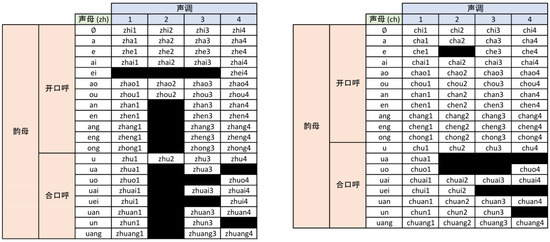
Perception and Production of the Aspiration Contrast in Mandarin Retroflex Affricates [tʂ] and [tʂh] by Adult Spanish Speakers Learning Mandarin Chinese: An Exploratory Study
by
Guilherme Galhoz Maria Roque and Quanzhen Zhang
Languages 2026, 11(4), 69; https://doi.org/10.3390/languages11040069 - 2 Apr 2026
Abstract
►▼
Show Figures
This exploratory study examines the perception and production of the aspiration contrast in Mandarin voiceless retroflex affricates zh [tʂ] and ch [tʂh] by ten adult Spanish speakers (three Peruvian, seven Chilean) at Nanjing University. Participants completed a perception identification task and
[...] Read more.
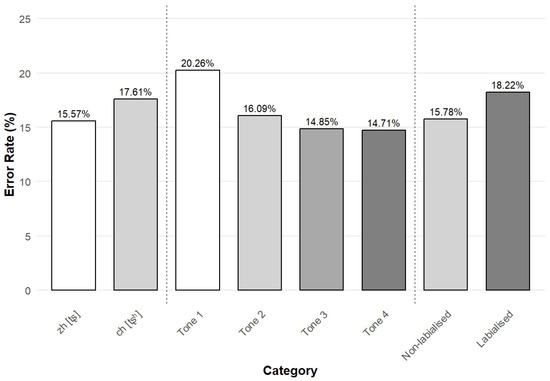
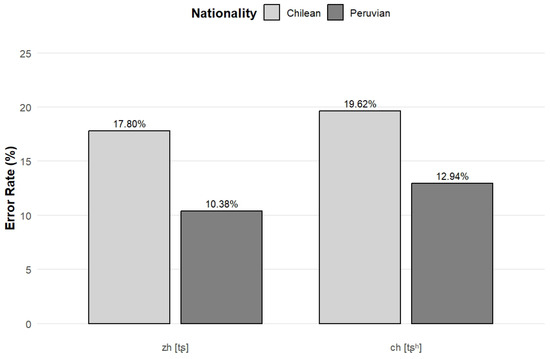
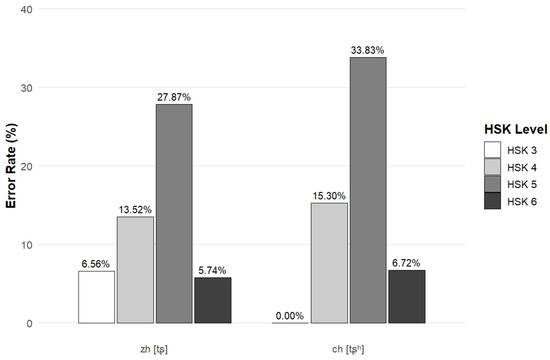
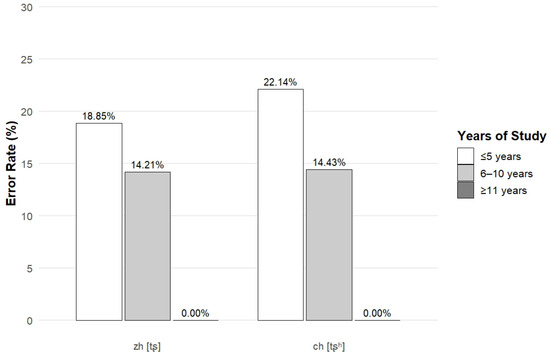
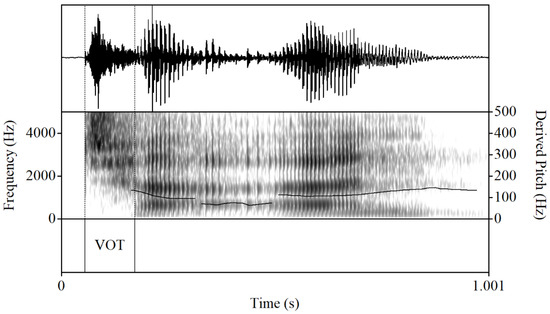
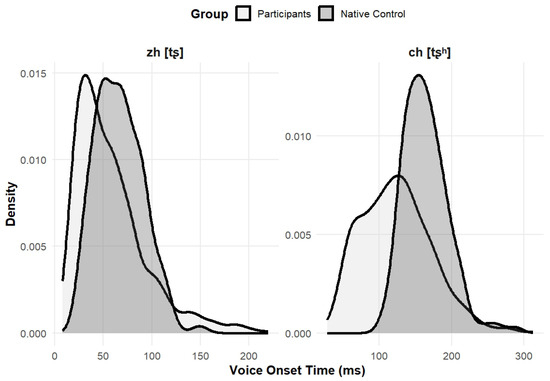
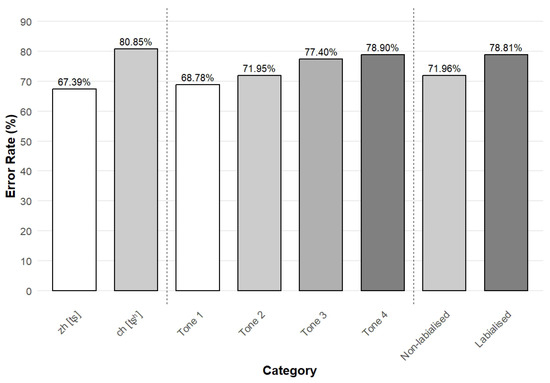
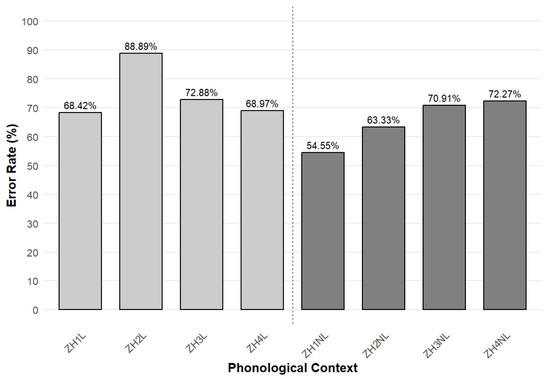
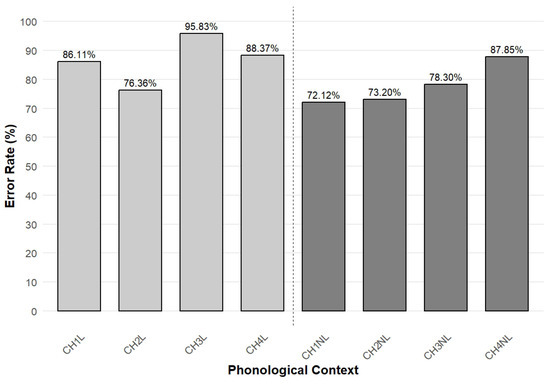
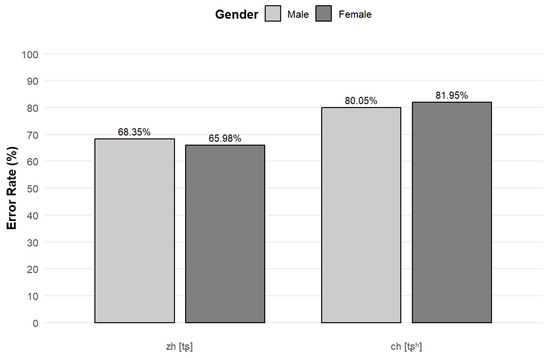
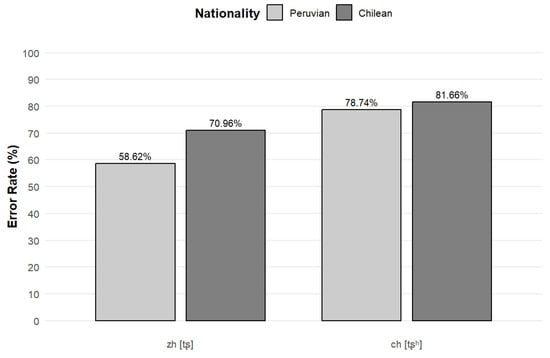
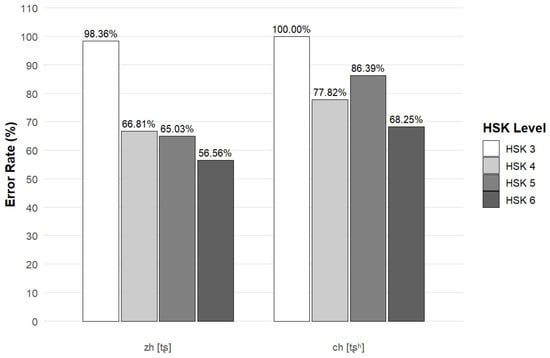
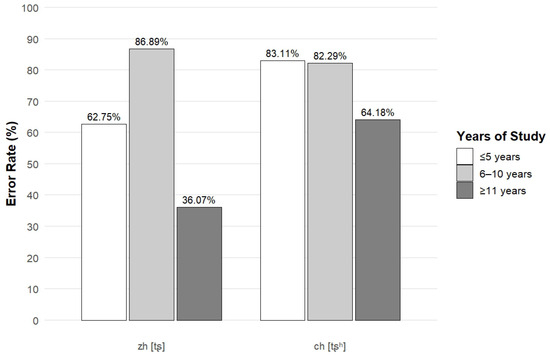
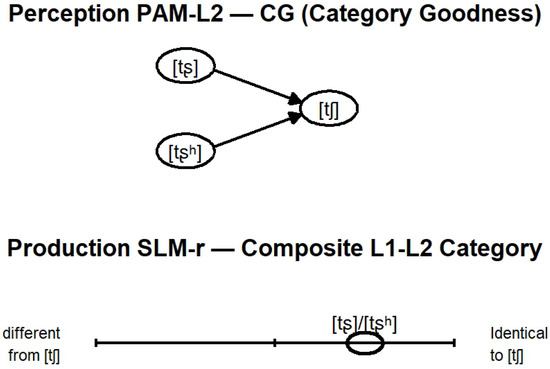
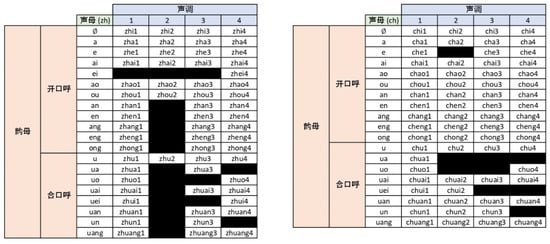
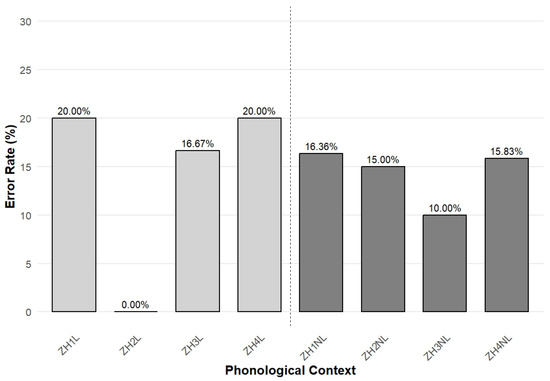
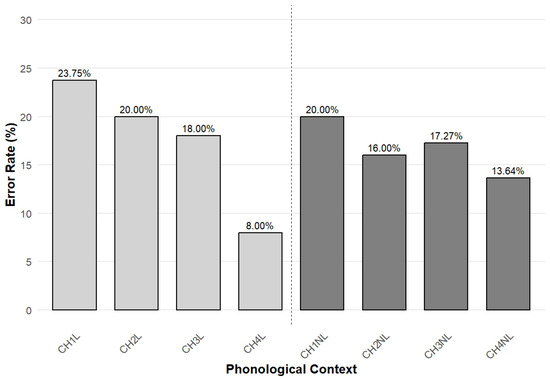
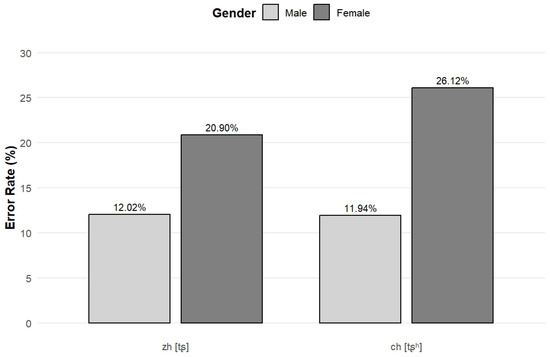
This exploratory study examines the perception and production of the aspiration contrast in Mandarin voiceless retroflex affricates zh [tʂ] and ch [tʂh] by ten adult Spanish speakers (three Peruvian, seven Chilean) at Nanjing University. Participants completed a perception identification task and a production reading task using the same set of 128 syllables. Voice Onset Time (VOT) measurements from the production task were converted to binary classifications for cross-modality comparison. Perception accuracy was moderately high (zh [tʂ]: 84.43%; ch [tʂh]: 82.39%), whilst production accuracy was substantially lower (zh [tʂ]: 32.61%; ch [tʂh]: 19.15% within native VOT ranges). Participants maintained the aspiration contrast (zh [tʂ] = 58 ms, ch [tʂh] = 125 ms) but consistently underproduced VOT compared to native speakers (zh [tʂ] = 67 ms, ch [tʂh] = 164 ms). Perception patterns align with Category Goodness (CG) assimilation within PAM-L2: both Mandarin sounds map to Spanish [tʃ] but with different goodness-of-fit, enabling moderate discrimination. Production follows SLM-r predictions, with learners developing a Composite L1–L2 Category that maintains the aspiration contrast but fails to establish new phonetic categories. The small sample size (n = 10) precluded robust statistical testing of individual differences. The perception–production asymmetry supports independent modality development in L2 phonetic acquisition.
Full article

Figure 1
Open AccessArticle
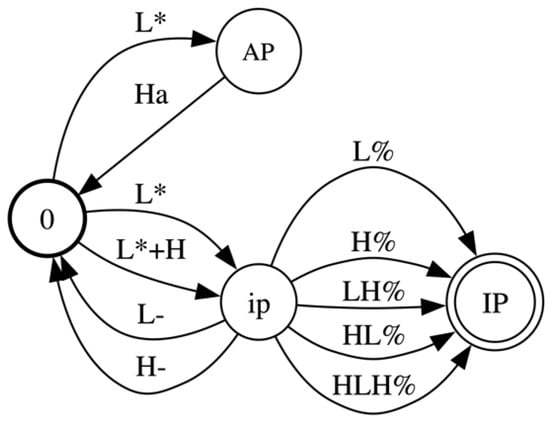
Phonological Choices Drive F0 Range Expansion and Lengthening in Bengali and English Infant-Directed Speech
by
Kristine M. Yu, Sameer ud Dowla Khan and Megha Sundara
Languages 2026, 11(4), 68; https://doi.org/10.3390/languages11040068 - 1 Apr 2026
Abstract
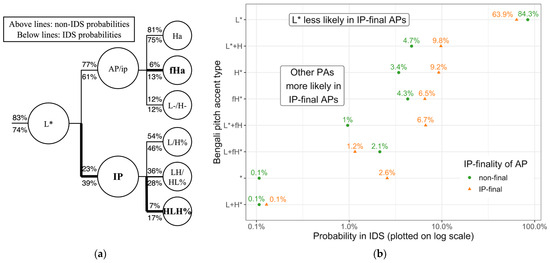
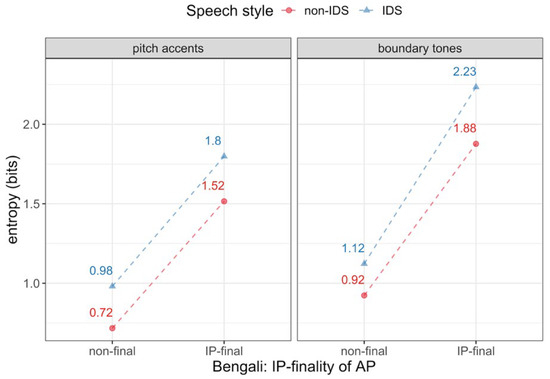
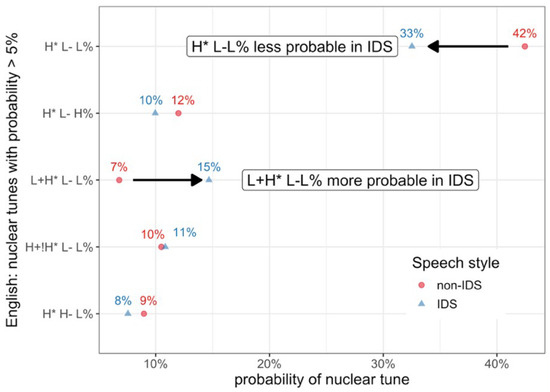
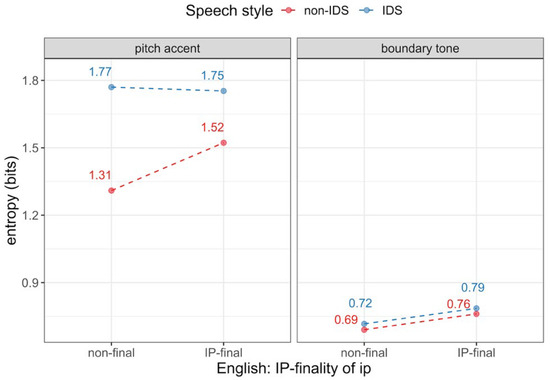
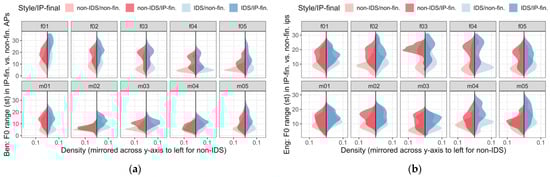
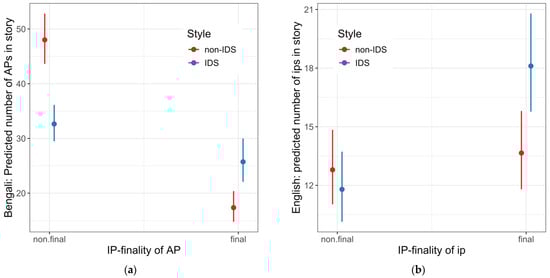
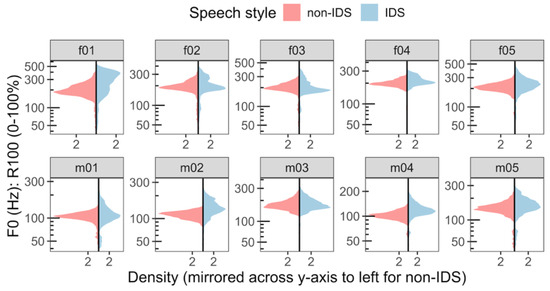
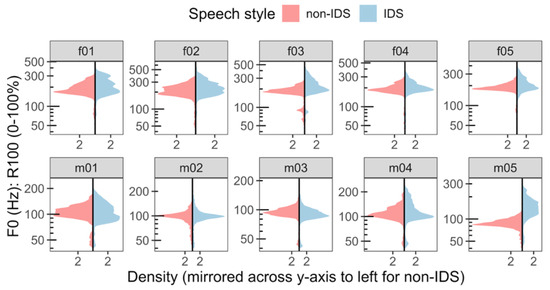
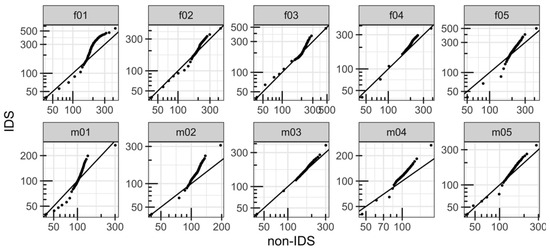
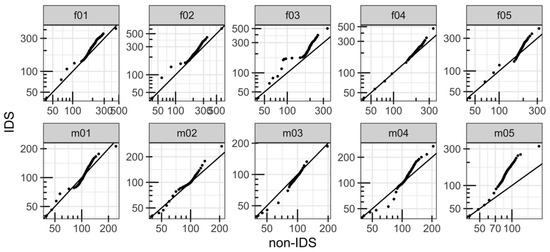
This study builds on a small body of work, all on Japanese, demonstrating how intonational phonology is critical for understanding prosodic modifications in infant-directed speech (IDS) relative to adult-directed speech. We performed similar analyses on simulated infant-directed speech vs. reading of a story
[...] Read more.
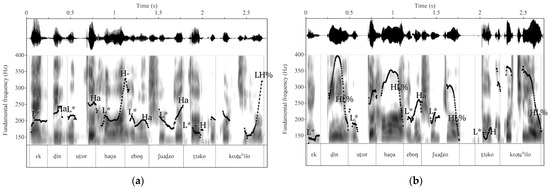
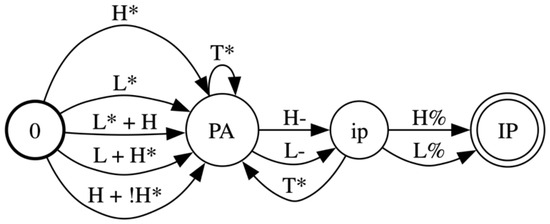
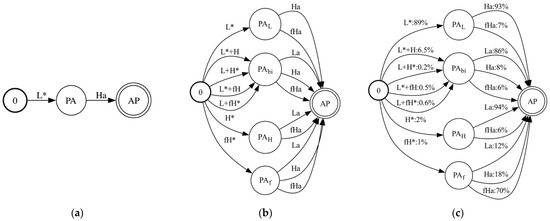
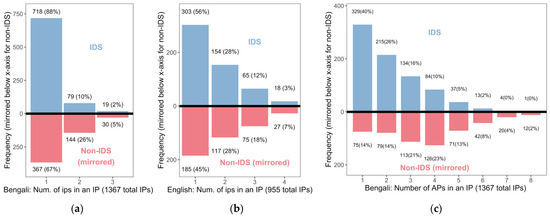
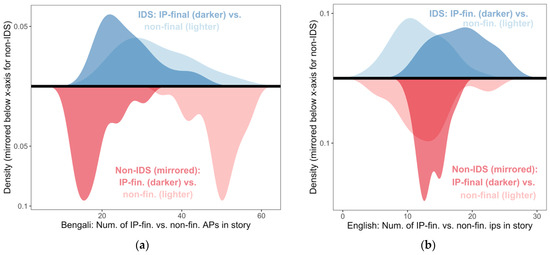
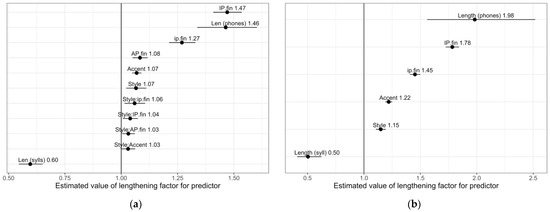
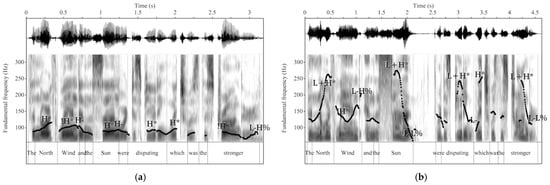
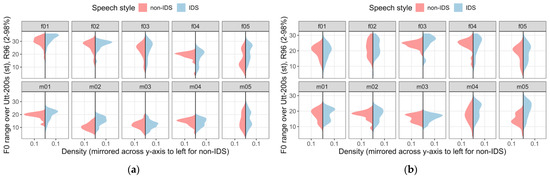
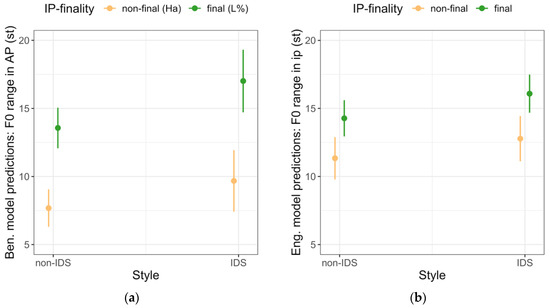
This study builds on a small body of work, all on Japanese, demonstrating how intonational phonology is critical for understanding prosodic modifications in infant-directed speech (IDS) relative to adult-directed speech. We performed similar analyses on simulated infant-directed speech vs. reading of a story in English and Bengali: two languages that – unlike Japanese – both have stress and do not use fundamental frequency (F0) to signal changes in word-level meaning, but that have two very different intonational grammars. These differences allowed us to disentangle previous hypotheses about intonational exaggeration in IDS being concentrated in a particular part of the melody. We tested hypotheses that state this locus of exaggeration is either at: the final position in the melody (final in the intonational phrase), the most unpredictable part of the melody, or in pragmatically informative tones. Our results support the first hypothesis. We found that the phonological choices of speakers to chunk the story into shorter, larger prosodic constituents drive intonational exaggeration in IDS. This is because the intonational phrase-final position in both languages is the site of greatest pre-boundary lengthening and F0 range expansion. We also demonstrate: (i) quantification of predictability in intonational melodies using probabilistic finite state automaton representations of intonational grammars and (ii) F0 statistical analyses that are robust and scalable to large, naturalistic IDS corpora.
Full article
(This article belongs to the Special Issue Advances in the Acquisition of Prosody)
►▼
Show Figures

Figure 1
Open AccessEditorial
Honoring Past Successes and Embracing New Opportunities in Linguistic Research: Languages Broadens Its Scope
by
Anthony Pak-Hin Kong and John Nerbonne
Languages 2026, 11(4), 67; https://doi.org/10.3390/languages11040067 - 1 Apr 2026
Abstract
Just as Anthony entered his second year as Co-Editor-in-Chief of Languages, he extended a warm welcome to John Nerbonne as Co-Editor-in-Chief beginning in 2026 [...]
Full article
Open AccessArticle
The Decline of French in Education Across Europe, the Middle East, and Africa
by
Marko Modiano
Languages 2026, 11(4), 66; https://doi.org/10.3390/languages11040066 - 1 Apr 2026
Abstract
In this study, the role French maintains in education is assessed across Europe, Africa, and the Middle East. Statistics on the numbers of L1 users, those who have French as an additional language, as well as other demographic data, are used to chart
[...] Read more.
In this study, the role French maintains in education is assessed across Europe, Africa, and the Middle East. Statistics on the numbers of L1 users, those who have French as an additional language, as well as other demographic data, are used to chart trends in acquisition patterns across these three regions. The decline in the learning of traditional additional languages is juxtaposed with Englishization. What languages are utilized in school as the language of instruction, as well as what foreign languages are promoted in educational systems, has a profound impact on patterns of second-language acquisition. Here, in all three regions, English is gaining ground at the expense of other languages in primary and secondary school, as well as in higher education, and one result of this historic shift in the acquisition of additional languages is that English is now significantly reducing the importance of French in Francophone Africa.
Full article
Open AccessArticle
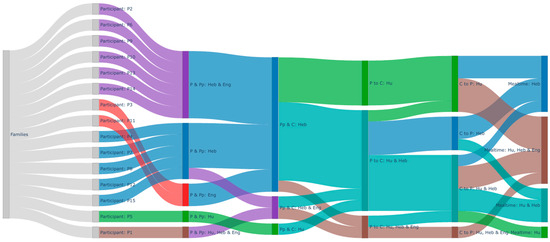
Majority Language Influence and Heritage Language Maintenance in a Small Transnational Community: Hungarian-Hebrew Families in Israel
by
Orsolya Bilgory-Fazakas and Sharon Armon-Lotem
Languages 2026, 11(4), 65; https://doi.org/10.3390/languages11040065 - 1 Apr 2026
Abstract
In a globalised and interconnected world, transnational families must navigate heritage language (HL) practices within dominant majority languages (ML), often with limited institutional support. Focusing on a small and understudied community of Hungarian-speaking transnational families in Israel, this study explores how HL development
[...] Read more.
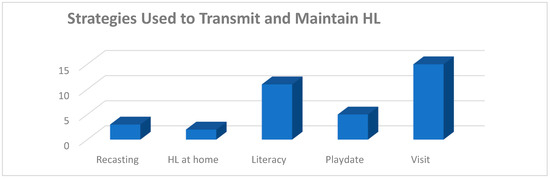
In a globalised and interconnected world, transnational families must navigate heritage language (HL) practices within dominant majority languages (ML), often with limited institutional support. Focusing on a small and understudied community of Hungarian-speaking transnational families in Israel, this study explores how HL development is maintained and negotiated within the framework of family language policy in a dynamic multilingual environment. Fifteen Hungarian-speaking parents from bilingual Hungarian-Hebrew families participated in semi-structured sociolinguistic interviews conducted in Hungarian. A mixed-methods approach was used to analyze the interview data. Quantitative analysis was used to identify the distribution and relative frequency of language use across families. At the same time, qualitative analyses show how parental ideologies and strategies relate to HL development. The findings show that while HL input remains central in parental speech, children frequently respond using both HL and ML, indicating a dynamic bilingual repertoire and a translanguaging orientation. Overall, HL development is negotiated, maintained through cultural and emotional ties, flexible bilingual practices and dynamic family language policies.
Full article
(This article belongs to the Special Issue A Citizen’s Perspective on Code-Switching: Language Attitudes and Language Ideologies)
►▼
Show Figures

Figure 1
Open AccessArticle
From ‘See’ to ‘If’: The Grammaticalization of Visual Perception Verbs in Hlai
by
Hui-chi Lee
Languages 2026, 11(4), 64; https://doi.org/10.3390/languages11040064 - 1 Apr 2026
Abstract
This study examines the grammaticalization of visual perception verbs in Hlai, a Kra–Dai language spoken on Hainan Island. Based on original fieldwork data, the paper identifies two core verbs of visual perception, zo33 and laai55, which differ systematically in their
[...] Read more.
This study examines the grammaticalization of visual perception verbs in Hlai, a Kra–Dai language spoken on Hainan Island. Based on original fieldwork data, the paper identifies two core verbs of visual perception, zo33 and laai55, which differ systematically in their semantic profiles and diachronic developments. While both verbs encode basic visual perception, zo33 exhibits a broader range of activity-oriented meanings (e.g., ‘watch’, ‘read’, ‘visit’, ‘judge’) and has developed a tentative marker function. In contrast, laai55 patterns as an experience-type perception verb and has undergone a distinct grammaticalization pathway, developing into a conditional conjunction meaning ‘if’ and, in combination with negation, an ‘otherwise’ marker. Adopting a typological framework of perception verbs and a model of semantic extension, this study demonstrates that the two verbs diverge not only in aspectual type (activity vs. experience) but also in their susceptibility to functional reanalysis. A comparative analysis with Mandarin and Hainan Min suggests that the tentative use of zo33 is plausibly contact-induced, whereas the conditional development of laai55 lacks a clear parallel in the contact languages and is more likely to represent a language-internal innovation. The findings contribute to the documentation of Hlai and to cross-linguistic discussions of perception verbs, semantic change, and the typology of conditional marking.
Full article
(This article belongs to the Special Issue Recent Developments on the Semantics of Perception Verbs)
Open AccessArticle
Corpus and Experimental Analysis of Passive Structures in Garrusi Kurdish
by
Hiwa Asadpour and Masoumeh Zarei
Languages 2026, 11(4), 63; https://doi.org/10.3390/languages11040063 - 31 Mar 2026
Abstract
►▼
Show Figures
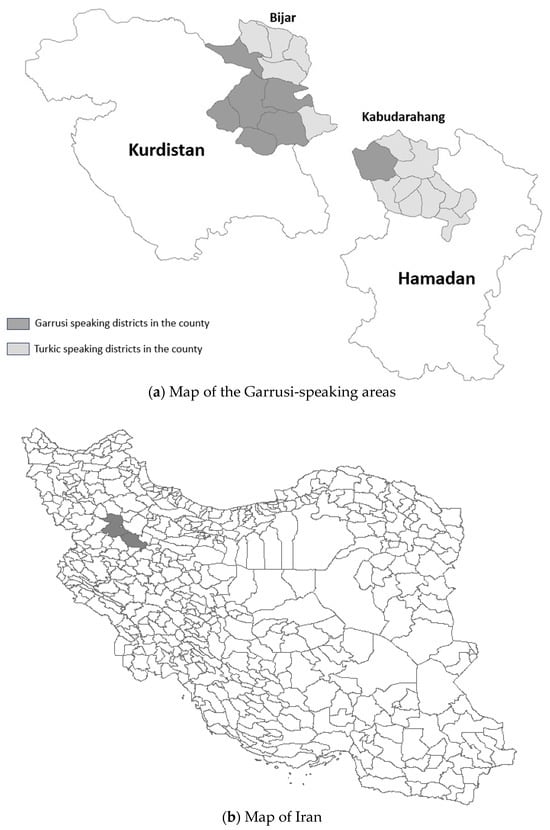
In this study, we investigate the formation of passive structures in Garrusi Kurdish across two datasets: experimental and narrative free speech. For our data collection, we interviewed 30 native speakers of this language variety, located in Mehraban District in Hamadan Province, Iran. For
[...] Read more.
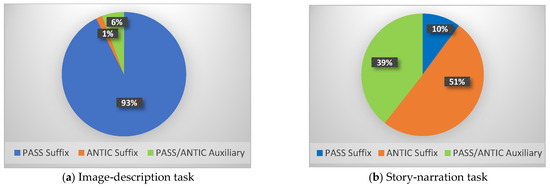
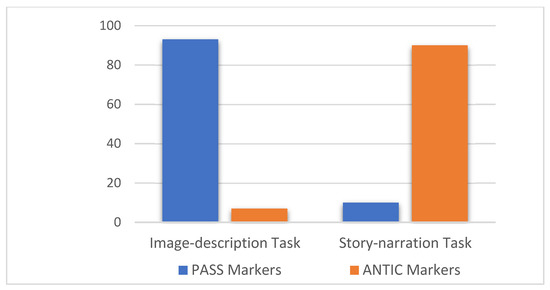
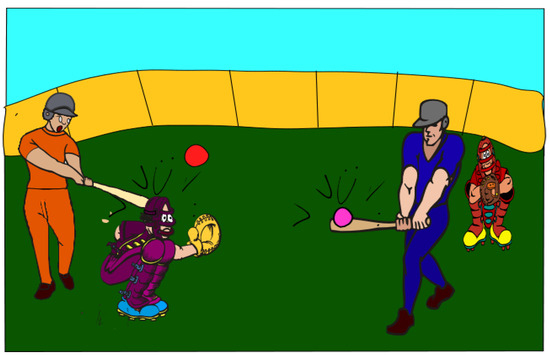
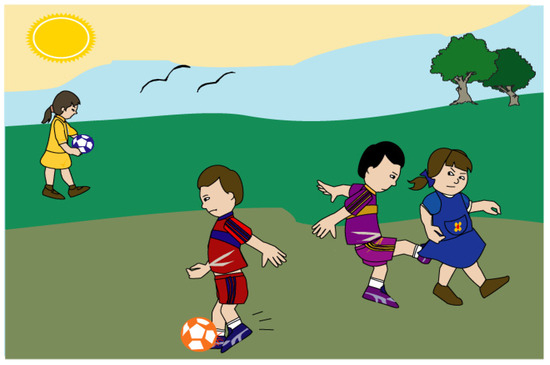
In this study, we investigate the formation of passive structures in Garrusi Kurdish across two datasets: experimental and narrative free speech. For our data collection, we interviewed 30 native speakers of this language variety, located in Mehraban District in Hamadan Province, Iran. For our methodology, we conducted an image-description task and a story-narration task. In the first controlled task, the speakers were asked to describe 20 event-oriented pictures prompted by questions relating to the intended construction. In the free narrative task, the speakers were asked to renarrate the film “The Pear Story.” According to our observations, the choice of voice and the use of passive structures vary depending on the context. Our investigations show that passive is a context-oriented and contact-sensitive feature in Mehraban Garrusi Kurdish. In the controlled descriptive context, where the actor was intentionally ignored, the speakers tended to use passive verbal structures, specifically the prototypical form. However, in the free narrative context, where they were allowed to freely renarrate what they observed, they tended to express active predications in the presence of the animate actor, resorting to anticausative forms with patientive subjects affected by inanimate actors. We also found that the rare emergence of the non-prototypical passive suffix, the non-passivization of certain verbal forms, and the exceptional existence of agent phrases in passive diathesis were products of contact-induced change occurring in interaction with Chaharduli Kurdish, Shahsevan Turkic, and Standard Persian.
Full article

Figure 1
Open AccessArticle
Learner Engagement and Writing Performance in Assessment as Learning L2 Writing
by
Lu Wang
Languages 2026, 11(4), 62; https://doi.org/10.3390/languages11040062 - 31 Mar 2026
Abstract
►▼
Show Figures
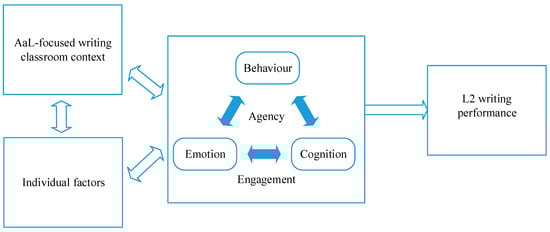
While previous studies on assessment as learning (AaL) in second language (L2) writing have mainly focused on writing teachers’ practices and perceptions of AaL, scant research has examined the relation between students’ engagement and writing performance in an AaL context. To fill the
[...] Read more.
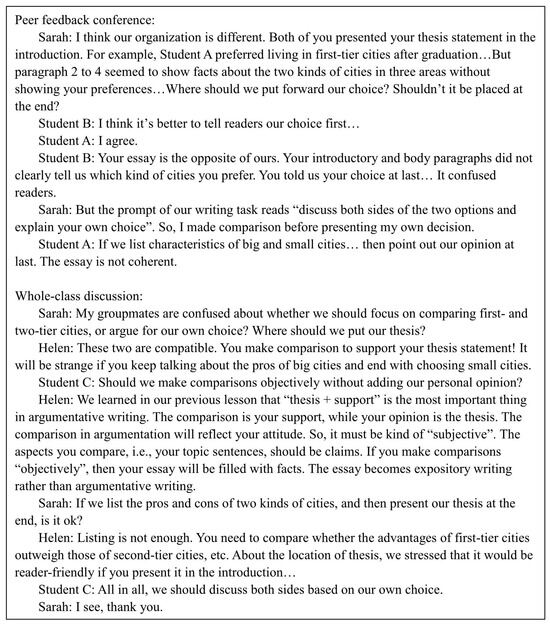
While previous studies on assessment as learning (AaL) in second language (L2) writing have mainly focused on writing teachers’ practices and perceptions of AaL, scant research has examined the relation between students’ engagement and writing performance in an AaL context. To fill the void, this study examined how students’ engagement related to their writing performance. Drawing on writing drafts, interviews, verbal reports, observation field notes, and documents, cross-case analyses of two focal students demonstrated that learner engagement in an AaL context was positively associated with improvements in writing performance. The student who demonstrated greater reciprocity in collaborating with teachers and peers in the AaL context, as well as proactivity in taking charge of her learning in L2 writing, showed greater improvements in content, organization, and language of argumentative writing.
Full article

Figure 1
Open AccessArticle
Beyond Sociodemographics: Attitudinal and Personality Predictors of Lexical Change
by
Adrian Leemann, Simon Kistler and Fabian Tomaschek
Languages 2026, 11(3), 61; https://doi.org/10.3390/languages11030061 - 23 Mar 2026
Abstract
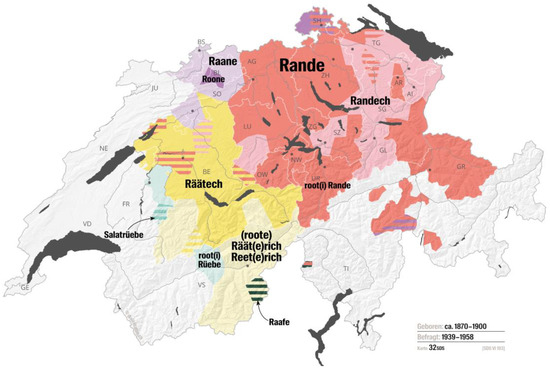
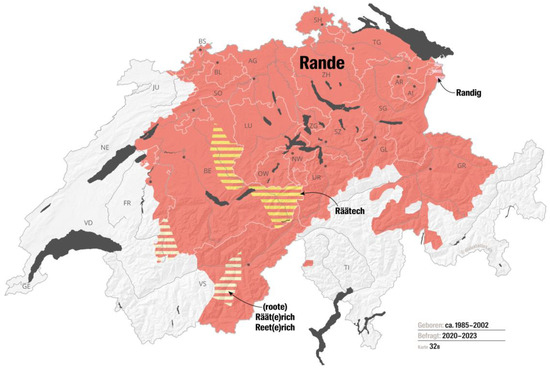
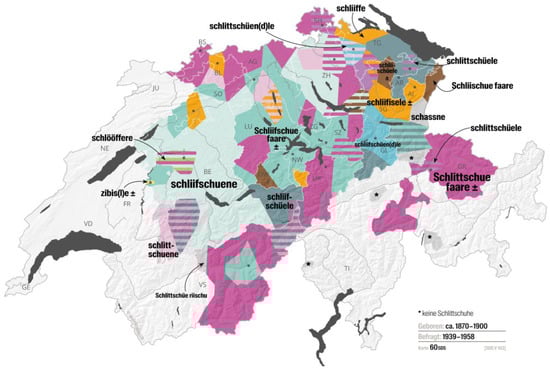
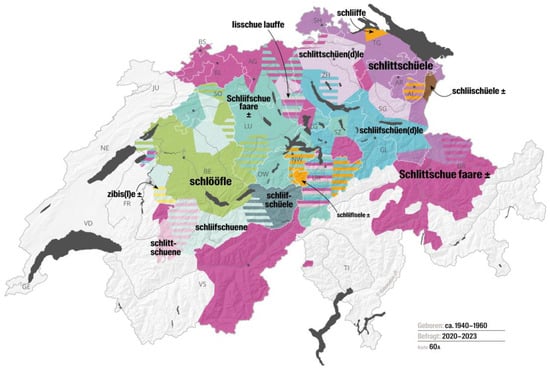
Moving beyond traditional sociodemographic models, this study investigates the psychometric drivers of lexical change. Using Swiss German as a case study, we compare historical data from the Sprachatlas der deutschen Schweiz (1939–1958) with a recent large-scale app-based survey (N = 1013) to quantify
[...] Read more.
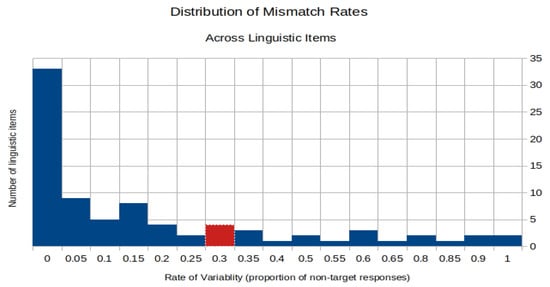
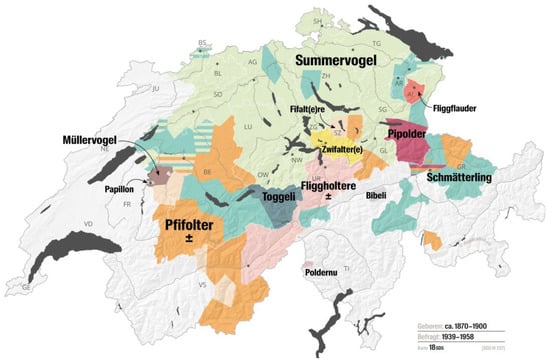
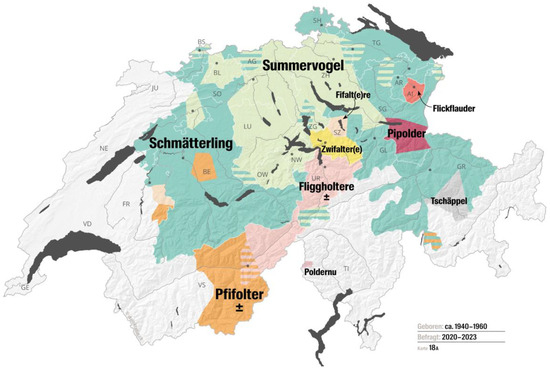
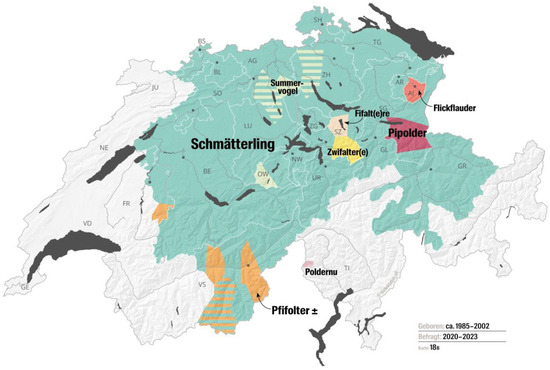
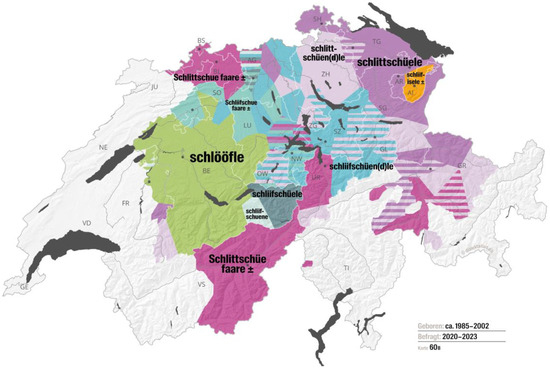
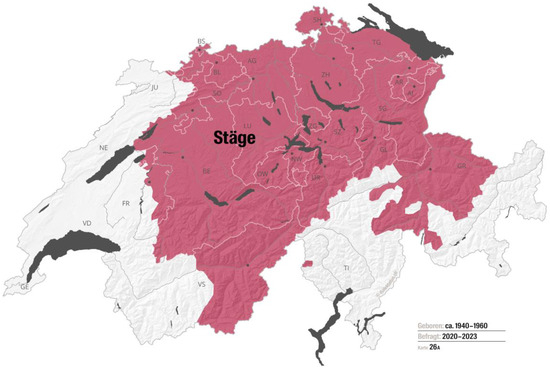
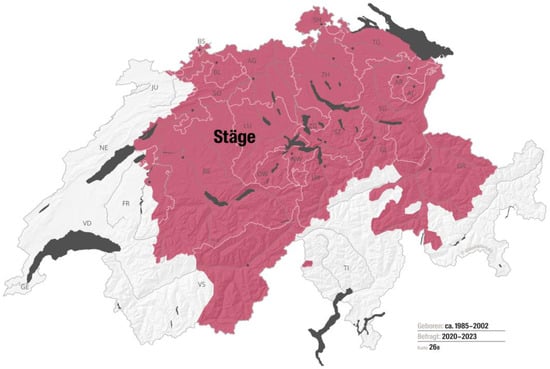
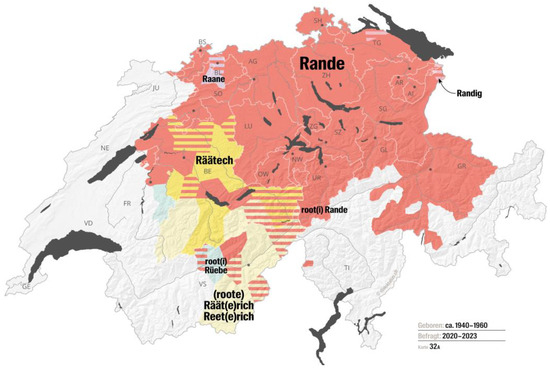
Moving beyond traditional sociodemographic models, this study investigates the psychometric drivers of lexical change. Using Swiss German as a case study, we compare historical data from the Sprachatlas der deutschen Schweiz (1939–1958) with a recent large-scale app-based survey (N = 1013) to quantify trajectories over the past century. We identify four distinct mechanisms: exogenous convergence (Schmetterling), endo-normative leveling (Rande), endogenous innovation and divergence (schlittschuhlaufen), and diachronic persistence (Stäge). For the locally rooted speakers in our dataset, structural analysis indicates that traditional variables carry less weight than expected. While age remains the primary vertical predictor, psychological factors outperform traditional variables (e.g., gender, social networks) in this environment of ubiquitous exposure. Multivariate models demonstrate that lexical choices are strongly influenced by individual disposition: traits such as agreeableness accelerate the adoption of supraregional forms, whereas a strong local identity functions as a “brake” against standardization. Ultimately, while macro-factors create the pressure for change, individual micro-factors determine whether it takes hold. A speaker’s attitude acts as a “filter” and their personality as a “gate,” deciding whether they accept or resist new forms. These findings challenge purely structural accounts, suggesting that for these locally rooter speakers, even without high physical mobility, lexical change is shaped by a psychometric architecture.
Full article
(This article belongs to the Special Issue Advances in Variationist Linguistics on German—Focus on Lexis and Pragmatics)
►▼
Show Figures

Figure 1
Open AccessArticle
Regional Variation in Mood Use in Spanish: A Comparison Among Three Spanish-Speaking Regions
by
Silvia Tort-Ranson and Aarnes Gudmestad
Languages 2026, 11(3), 60; https://doi.org/10.3390/languages11030060 - 20 Mar 2026
Abstract
The current investigation, couched within variationist sociolinguistics, has the purpose of advancing knowledge of regional variation in mood use (the subjunctive and indicative contrast) in Spanish. Prior cross-dialectal research has reported that mood use in Spanish varies geographically. To contribute to the understanding
[...] Read more.
The current investigation, couched within variationist sociolinguistics, has the purpose of advancing knowledge of regional variation in mood use (the subjunctive and indicative contrast) in Spanish. Prior cross-dialectal research has reported that mood use in Spanish varies geographically. To contribute to the understanding of mood variation in Spanish, this study explored a range of sociolinguistic independent variables across three Spanish-speaking regions. The participant pool (N = 107) consisted of Spanish speakers residing in three metropolitan areas (Rosario, Argentina; Barcelona, Spain; and Seville, Spain). The analysis substantiated evidence of geographical variation in the frequency of use of verbal moods, the governors (e.g., preferir que ‘to prefer that’) that exhibited categorical and variable use, and the influence of time reference on mood use. These results provide additional insights into the presence of regional variation in mood use and reinforce the value of cross-dialectal analyses with the same type of data and mood-use contexts.
Full article
Open AccessArticle
Between Worlds: Two Portraits of Language Knowledge, Belonging, and Cultural Connection Among Spanish Heritage Speakers
by
Abdulrahman Almalki, Alaina Smith, Idoia Elola and Heather Kaplan
Languages 2026, 11(3), 59; https://doi.org/10.3390/languages11030059 - 19 Mar 2026
Abstract
Heritage speakers’ language acquisition is a complex process that is affected by linguistic, social, cultural, and affective factors. Studies on heritage speakers (HSs) have primarily focused on challenges HSs face in the classroom and scarcely investigated these challenges outside of instructional settings. This
[...] Read more.
Heritage speakers’ language acquisition is a complex process that is affected by linguistic, social, cultural, and affective factors. Studies on heritage speakers (HSs) have primarily focused on challenges HSs face in the classroom and scarcely investigated these challenges outside of instructional settings. This study addresses this gap by exploring the lived experiences of two young adult Spanish HSs outside of educational settings through a series of interviews to create personal narratives of their HL and experiences. Through Narrative Interpretative Phenomenological Analysis (NIPA), three main themes emerged from these narratives: (1) Spanish heritage language (HL) knowledge and language use, (2) emotional factors that hinder language knowledge and language use, and (3) self-positioning towards SHL and culture. The findings indicated that the participants’ experiences with their Spanish heritage language (SHL) were profoundly impacted by the nature of language input they received, hostile environments, and negative interactions with members of their communities, which led to emotional distress and communicative avoidance. This situated study also offers potential conceptual and community-based implications for the Spanish HSs.
Full article
Open AccessArticle
Tamil Speakers in Switzerland: An Intergenerational and Typological Perspective
by
S. Rajamathangi, Anita Auer and Gurujegan Murugesan
Languages 2026, 11(3), 58; https://doi.org/10.3390/languages11030058 - 18 Mar 2026
Abstract
Since the mid-1980s, many Tamils left their homeland because of the civil war in Sri Lanka (1983–2009) and for other reasons and settled in different countries. More than 40,000 Tamil migrants have come to Switzerland since then, and Tamil is spoken as a
[...] Read more.
Since the mid-1980s, many Tamils left their homeland because of the civil war in Sri Lanka (1983–2009) and for other reasons and settled in different countries. More than 40,000 Tamil migrants have come to Switzerland since then, and Tamil is spoken as a heritage language by second- and third-generation speakers who were born and raised in Switzerland. Within this context, it is the aim of the current study to shed light on the difference between Tamil spoken in the first generation (migrant language) and the second generation (heritage language) in the Swiss German and Swiss French parts of Switzerland. We therefore study Tamil, which is part of the Dravidian language family, in different majority language contexts, i.e., a Germanic language and a Romance language, respectively. While some research on Tamil in a diaspora setting already exists on migrated Tamil communities in Lancaster, California (US), East London (UK) and Toronto (Canada), the focus on Switzerland and contact with German and French has not previously been investigated. The data under investigation, which stems from 20 speakers in total (i.e., 5 first-generation and 5 second-generation speakers from the Swiss German and the Swiss French parts respectively), was collected in 2024 by way of a semi-structured interview based on a sociolinguistic questionnaire and a linguistic test. The data serves as the basis for the intergenerational and typological comparison. The analysis reveals systematic intergenerational differences across several morphosyntactic domains, including agreement, negation pattern, case marking, and subject pro-drop. While first-generation speakers retain greater access to dialect-specific and register-sensitive patterns, second-generation speakers show increased reliance on discourse-pragmatic cues and reduced sensitivity to morphologically encoded distinctions. These findings highlight the role of register, input conditions, and discourse context in shaping heritage Tamil across generations in Switzerland.
Full article
(This article belongs to the Special Issue From Migrant to Heritage Languages: Transgenerational Language Change in Diasporic Communities)
►▼
Show Figures

Figure 1
Open AccessArticle
The Back-and-Forth of assim que in the History of Portuguese
by
Aroldo Leal de Andrade and Glayson Martins Oliveira
Languages 2026, 11(3), 57; https://doi.org/10.3390/languages11030057 - 16 Mar 2026
Abstract
This paper investigates the diachronic development of the sequence assim que (lit. ‘such that’) in the history of Portuguese, with a comparative perspective on the parallel construction así que in Spanish. A corpus-based approach was employed, analyzing approximately 1800 tokens from the Corpus
[...] Read more.
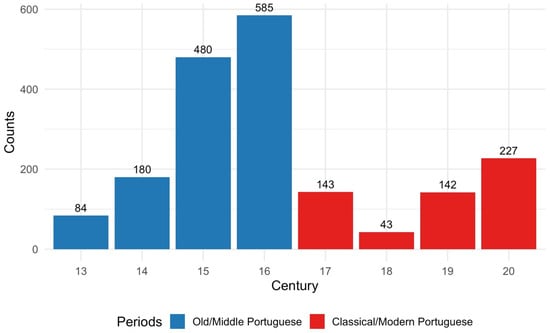
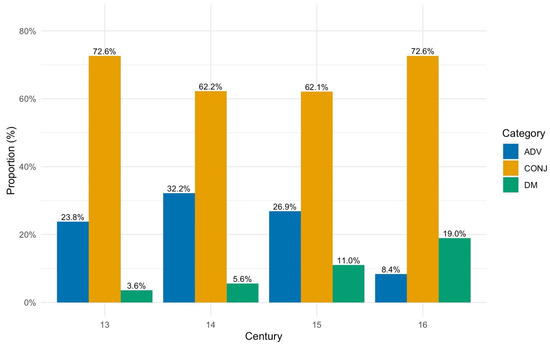
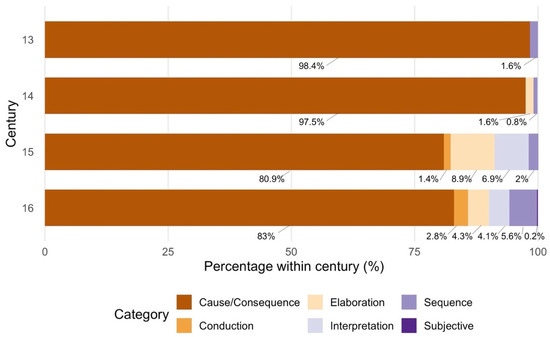
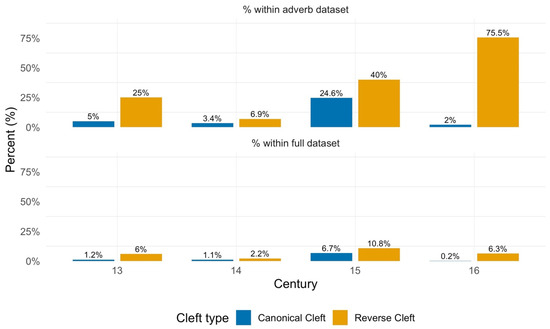
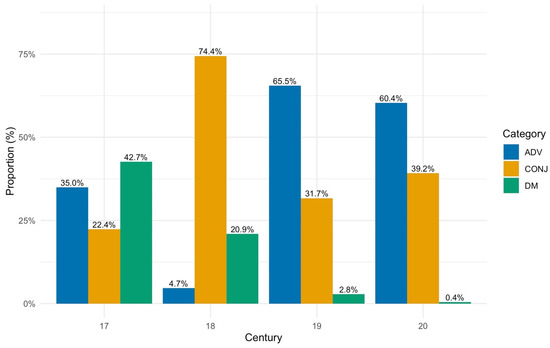
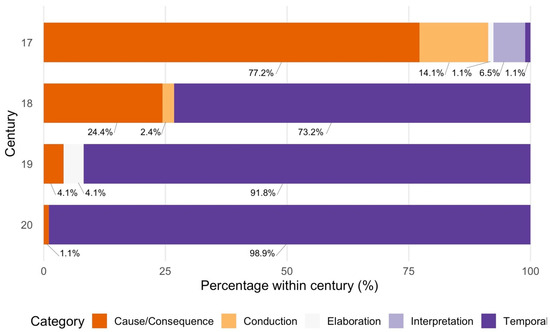
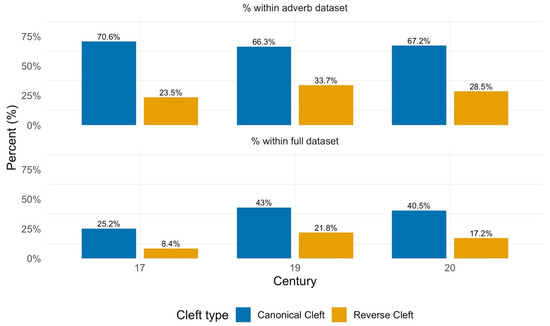
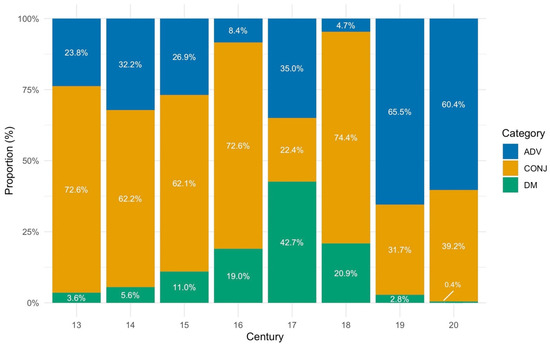
This paper investigates the diachronic development of the sequence assim que (lit. ‘such that’) in the history of Portuguese, with a comparative perspective on the parallel construction así que in Spanish. A corpus-based approach was employed, analyzing approximately 1800 tokens from the Corpus do Português: Historical Genres, spanning eight centuries of written European Portuguese. The results show that assim que remained highly analyzable until the end of the Old Portuguese period, with the adverb assim often followed by a complement or result clause. The grammaticalization of assim que appears to have evolved partly independently from standalone assim. While Portuguese and Spanish share many uses of the construction, modern European Portuguese has diverged, with assim que losing its status as a discourse marker. This change is best explained by the frequent use of cleft constructions (e.g., foi assim que), which reanalyzed que as a subordinating connector, undoing the earlier single-unit interpretation. These findings suggest that even deeply entrenched grammaticalization processes may undergo retraction when the semantic analyzability of component elements allows it.
Full article
(This article belongs to the Special Issue Romance Historical Syntax: Special Issue on Syntactic Analyzability in Diachrony)
►▼
Show Figures

Figure 1
Open AccessArticle
The Geography of Meaning: Investigating Semantic Differences Across German Dialects
by
Alfred Lameli and Matthias Hahn
Languages 2026, 11(3), 56; https://doi.org/10.3390/languages11030056 - 16 Mar 2026
Abstract
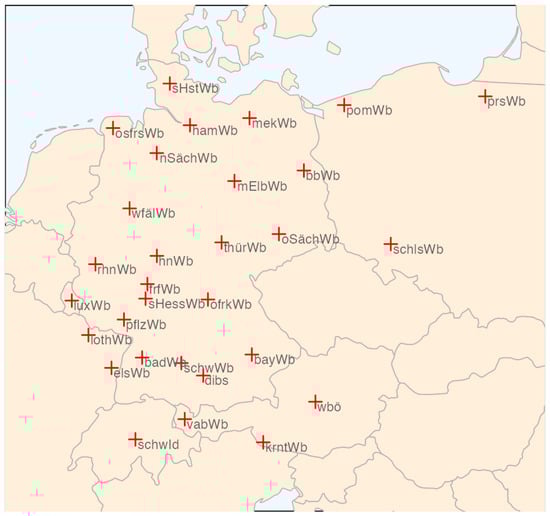
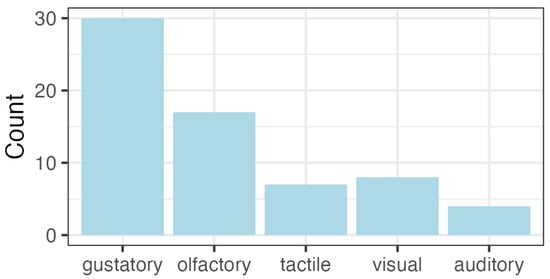
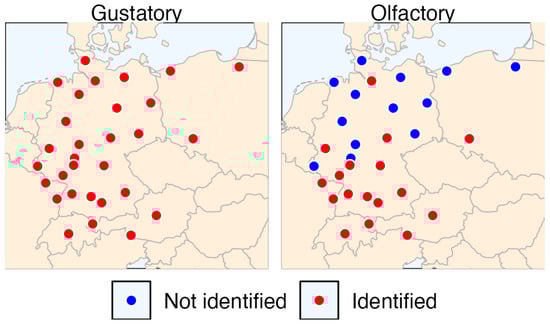
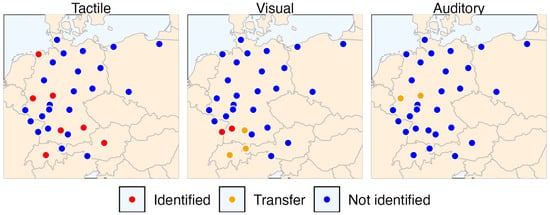
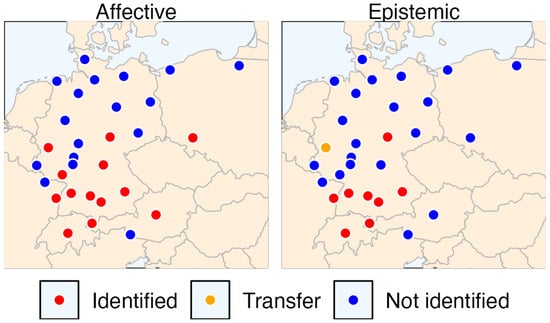
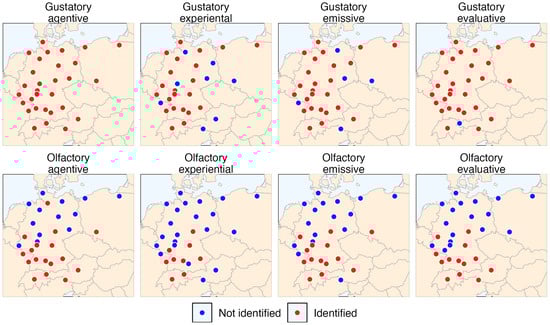
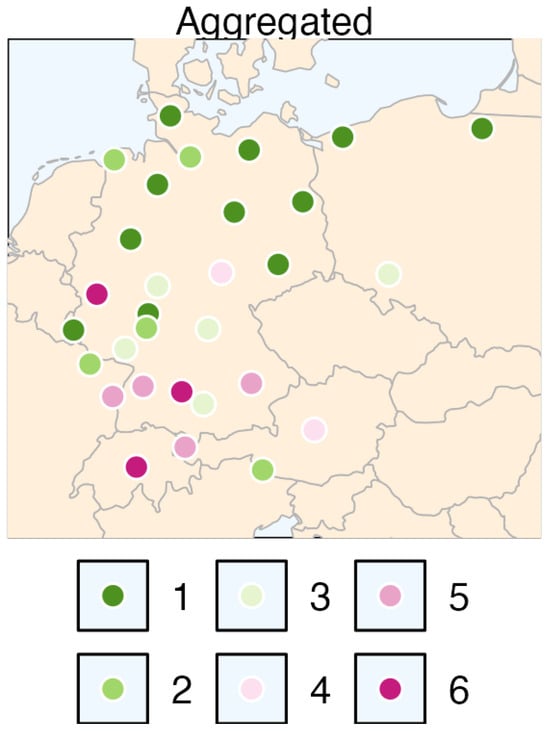
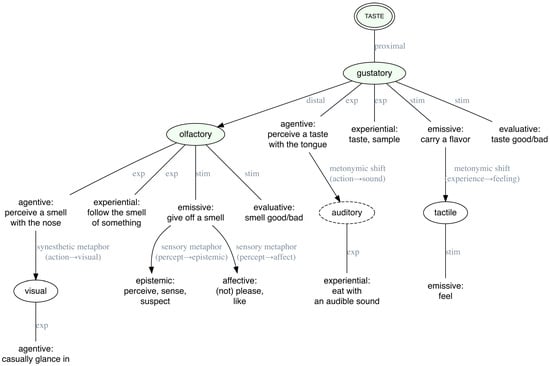
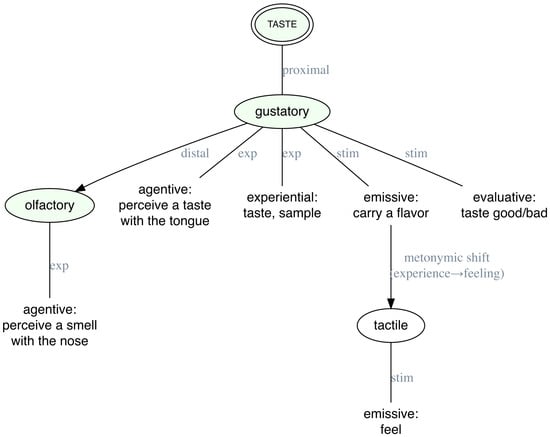
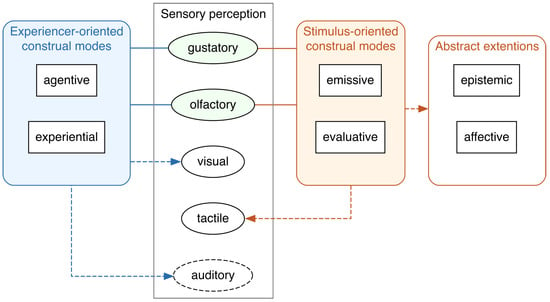
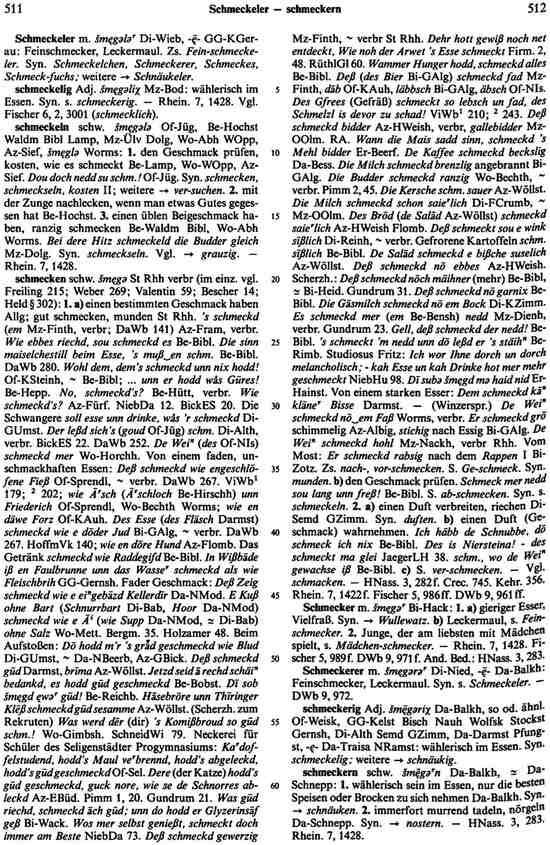
This study reconstructs the geography of meaning of the German perception verb schmecken on the basis of 30 major dialect dictionaries, treating them as a distributed semantic corpus and coding attestations as binary variables reflecting the presence or absence of semantic options. Combining
[...] Read more.
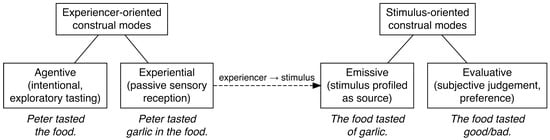
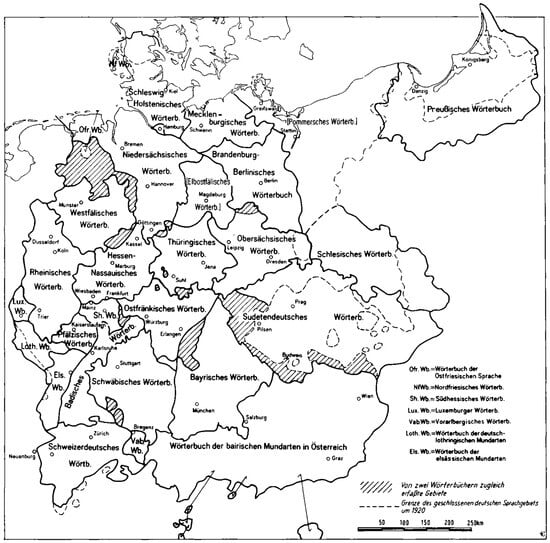
This study reconstructs the geography of meaning of the German perception verb schmecken on the basis of 30 major dialect dictionaries, treating them as a distributed semantic corpus and coding attestations as binary variables reflecting the presence or absence of semantic options. Combining a construal-based framework with spatial modeling, the analysis shows that the polysemy of schmecken is structured by three mutually reinforcing forces: embodied sensory organization, construal-based perspectivization, and regionally patterned areal dynamics. The gustatory–olfactory axis forms the semantic core of the verb, from which tactile, visual, affective, and epistemic extensions emerge. These extensions align with systematic pathways constrained by agentive, experiential, emissive, and evaluative construals, demonstrating that semantic extension is channeled through specific construal modes—notably emissive and agentive—rather than determined by sensory modality alone. A detailed areal analysis reveals a pronounced north–south divide. While Low German dialects conform to the cross-linguistically more common tendency to avoid colexifying taste and smekk—itself the outcome of historical change rather than uninterrupted differentiation—Upper German varieties preserve a typologically rare gustatory–olfactory cluster and exhibit the richest range of cross-modal and abstract extensions. The resulting semantic graph formalizes how regional varieties activate different subsets of a lexeme’s semantic potential and demonstrates that semantic networks themselves display spatial organization. The study thus provides an empirically grounded reconstruction of a German geography of meaning and illustrates how dialect data illuminate the interplay between embodied cognition, construal-based lexical architecture, and areal dynamics.
Full article
(This article belongs to the Special Issue Advances in Variationist Linguistics on German—Focus on Lexis and Pragmatics)
►▼
Show Figures

Figure 1
Open AccessArticle
Psych Light Verb Constructions in Old Catalan: Patterns and Contrasts with Present-Day Catalan
by
Jordi Ginebra Serrabou
Languages 2026, 11(3), 55; https://doi.org/10.3390/languages11030055 - 16 Mar 2026
Abstract
This study aims, first, to contribute to our understanding of the regularities of light verb constructions (LVCs) by identifying syntactic–semantic patterns and, secondly, to provide data and reflections on how syntactic analyzability and semantic compositionality interact to shape the diachronic evolution of LVCs.
[...] Read more.
This study aims, first, to contribute to our understanding of the regularities of light verb constructions (LVCs) by identifying syntactic–semantic patterns and, secondly, to provide data and reflections on how syntactic analyzability and semantic compositionality interact to shape the diachronic evolution of LVCs. To this end, the paper analyzes and describes, through corpus research, a subset of LVCs from Old Catalan—psych LVC or those denoting emotional states—and compares them with those from Contemporary Catalan. The main contrast between Old Catalan and Contemporary Catalan in this domain is that Contemporary Catalan tends to place the Experiencer in non-localist positions. Localist metaphors no longer structure the form–meaning pairing of Catalan psych LVCs. Once these metaphorical extensions no longer link P(sych)LVCs to their dominating construction, what remains can be described as a situation of vacuous analyzability: linguistic chains that are syntactically analyzable but lack semantic pairing.
Full article
(This article belongs to the Special Issue Romance Historical Syntax: Special Issue on Syntactic Analyzability in Diachrony)
Open AccessArticle
The Pathway from Taste to Epistemic Flavors: Modal Semantics of Italian mi sa
by
Andrea Miglietta and Eva-Maria Remberger
Languages 2026, 11(3), 54; https://doi.org/10.3390/languages11030054 - 16 Mar 2026
Abstract
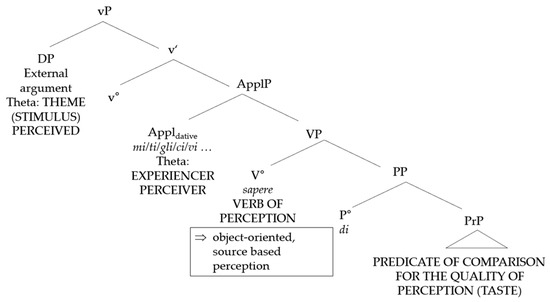
In (colloquial) Italian, the fixed expression mi sa functions as an evidential/epistemic marker, requiring the dative 1SG clitic experiencer and the 3SG default form of the verb sapere. Mi sa diachronically develops from the verb for taste/smell, sapere, which is still
[...] Read more.
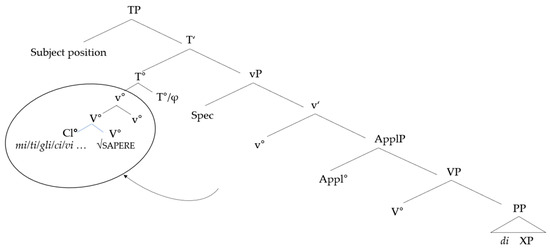
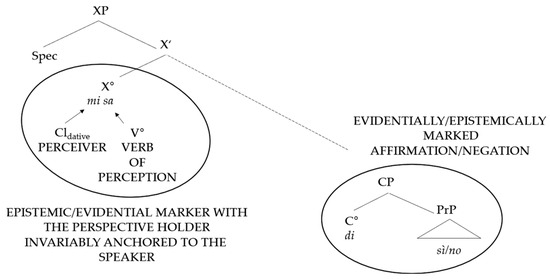
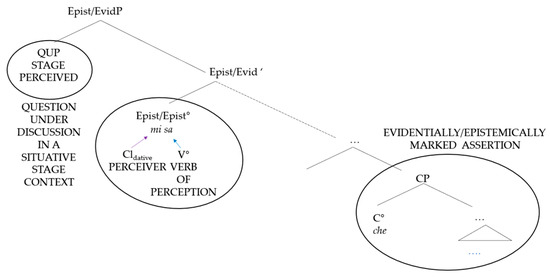
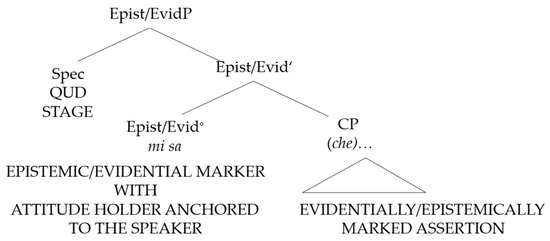
In (colloquial) Italian, the fixed expression mi sa functions as an evidential/epistemic marker, requiring the dative 1SG clitic experiencer and the 3SG default form of the verb sapere. Mi sa diachronically develops from the verb for taste/smell, sapere, which is still productive in contemporary Italian, and the structure that it projects. This comprises an obligatory PP introduced by di encoding the type/quality of taste/smell (often metaphorically extended); a subject expressing the perceived entity; and an optional dative experiencer. We systematically analyzed data from the KIParla corpus, comparing the distribution of mi sa to the distribution of one of the most frequent Italian epistemic verb forms, namely, credo ‘I believe’. This study aimed to establish how the original perceptual meaning of mi sa influences its epistemic meaning. The results suggest that the persistence of the original object-oriented perception verb makes mi sa more likely to appear in particular contexts, i.e., events/situations that are known by the speaker through an inferential-like process. Furthermore, mi sa can only rarely be uttered out of the blue and seems to need a situative context (a stage), often containing an explicit QUD.
Full article
(This article belongs to the Special Issue Recent Developments on the Semantics of Perception Verbs)
►▼
Show Figures

Figure 1
Journal Menu
► ▼ Journal Menu-
- Languages Home
- Aims & Scope
- Editorial Board
- Topical Advisory Panel
- Instructions for Authors
- Special Issues
- Topics
- Article Processing Charge
- Indexing & Archiving
- Editor’s Choice Articles
- Most Cited & Viewed
- Journal Statistics
- Journal History
- Journal Awards
- Society Collaborations
- Editorial Office
- 10th Anniversary
Journal Browser
► ▼ Journal BrowserHighly Accessed Articles
Latest Books
E-Mail Alert
News
Topics
Topic in
Behavioral Sciences, Languages, Neurology International
Language Disorders in Autism Spectrum Disorders (ASDs)
Topic Editors: Vasiliki Zarokanellou, Maria Andreou, Katerina PapanikolaouDeadline: 30 June 2026
Special Issues
Special Issue in
Languages
The Impacts of Phonetically Variable Input on Language Learning
Guest Editor: Kiwako ItoDeadline: 25 April 2026
Special Issue in
Languages
Grammatical Deficits in Children with Language Disorder
Guest Editors: Judith Rispens, Agnes LukacsDeadline: 30 April 2026
Special Issue in
Languages
Innovative Methods in Endangered Language Documentation
Guest Editors: K. David Harrison, Lisa LimDeadline: 1 May 2026
Special Issue in
Languages
East Asian Perspectives on the Acquisition of Argument Structure
Guest Editors: Jidong Chen, Yasuhiro ShiraiDeadline: 15 May 2026