
Tamil Speakers in Switzerland: An Intergenerational and Typological Perspective

Abstract
1. Introduction
2. Theoretical Background
2.1. Intergenerational Language Change
2.2. Swiss Tamil Project
Data Collection in Switzerland
3. Data and Method of the Current Case Study
3.1. Data Used for the Case Study
Speaker Profiles
3.2. Methods Applied in This Case Study
3.3. Analytical Framework
| 1. | ne:tu | vajal-la | ra:mu | oru | karuga-th-ai | pa:-t-a:n |
| Yesterday | field-loc | Ramu.3sgm.nom | one | karugam.3sgn-obl-acc | see-pst-3sgm | |
| Yesterday, Ramu saw a karugam in the field. | ||||||
4. Preliminary Results and Discussion
4.1. Group-Level Comparisons
- Generation
- Region
- Gender
4.2. Morphosyntactic Features—Data Analysis and Discussion
4.2.1. Pronominal Systems
| 2. | uva-kkum | theriy.um |
| she.med-dat | know.hab.3sn | |
| ‘She also knows.’ | ||
| 3. | uva-ta:n | ena-kku | sonn-a-val |
| she.med-foc | I-dat | tell.pst-rel.3sgf | |
| ‘She is the one who told me.’ | |||
| 4.a. | uthu | edu |
| that.med | take.imp | |
| ‘Take this one.’ (1st Gen) | ||
| b. | ethu | eduk-an-um |
| which | take-pres-2sg | |
| ‘Which one should I take?’ (2nd Gen) | ||
| 5. | uvai-ya | sonn-a-vai | na:n | e:n | ke:k-an-um |
| they.med-emph | say.pst-rel-3pl | I.sg | why | listen-pres-1sg | |
| ‘Why should I listen to what they said?’ | |||||
4.2.2. Plural Morphology
Third-Person Plural Agreement on the Verb
| 6.a. | kuma:r-nda | snehidar-gal | chennai-yil | ve:lai | sey-yinam |
| b. | kuma:r-in | snehidar-gal | chennai-yil | ve:lai | seyr-a:ŋga |
| Kumar.3sgm-gen | friend-3pl | Chennai-loc | work | do.pres.3pl.rat | |
| ‘Kumar’s friends work in Chennai.’ | |||||
Gender-Marked Third-Person Plural Pronoun and Verbal Agreement
Plural Marking in Quantified Noun Phrases
| 7.a. | na:n | na:lu | puthagam-∅ | vech-irukk-e:n-nu | kuma:r | so-nn-a:n |
| I.1sg | four | book-∅ | keep.adv.ptcp-be.pres-1sg-comp | kumar.3sgm.nom | say-pst-3sgm | |
| ‘Kumar said I have four books’ | ||||||
| b. | na:n | na:lu | puthagan-kal | vaith-iru.kkir-e:n | endru | kuma:r | so-nn-a:n |
| I.1sg | four | book-3pl | keep.adv.ptcp-be.pres-1sg | comp | kumar.3sgm.nom | say-pst-3sgm | |
| ‘Kumar said I have four books’ | |||||||
4.2.3. Negation Patterns
Existential vs. Equative Negation
| 8.a. | aŋga | tanni | illa |
| there | water | be.ext.neg | |
| ‘There is no water there.’ | |||
| b. | bala | oru | samajalka:ran | alla |
| Bala.3sgm.nom | one | cook.nom.3sgm | be.equ.neg | |
| ‘Bala is not a cook.’ (Used in Old Tamil and Jaffna Tamil) | ||||
| c. | bala | oru | samajalka:ran | illa |
| Bala.3sgm.nom | one | cook.nom.3sgm | be.equ.neg | |
| ‘Bala is not a cook.’ (Used in Modern Tamil) | ||||
Agreement in Negated Dative-Subject Constructions
| 9. | ena-kku | avan-ai | teriy-a:-thu |
| 1sg-dat | he.3sg-acc | know-neg-n | |
| ‘I don’t know him.’ | |||
| 10. | na:n | un | kanna:diy-ai | ka:n-a-yilla |
| 1sg.nom | your | spectacles-acc | see-inf-neg | |
| ‘I didn’t see your spectacles.’ | ||||
4.2.4. Binding Interpretation
| 11. | mi:na | [aval | idli-ai | sa:pi-tt-a:l-nnu] | so-nn-a:l. |
| Meena.3sgf.nom | she.3sgf.nom | idli.3sgn-acc | eat-pst-3sgf-comp | tell-pst-3sgf | |
| ‘Meena said she ate the idli.’ | |||||
| 12. | mi:na | aval-ai | kanna:Di-le | pa:r-t-a:l. |
| Meena.3sgf.nom | she-acc | mirror-loc | see-pst-3sgf | |
| ‘Meena saw her in the mirror.’ | ||||
4.2.5. Subject pro-Drop
| 13. | Context: A father is looking for his daughter Meena and asks his wife where she is. Meena enga irukka? (‘Where is Meena?’) |
| a. | ava pallikku poiyirukka ‘She has gone to school.’ |
| b. | pallikku poiyirukka ‘(She) has gone to school.’ |
4.2.6. Case Marking Variation
Differential Object Marking
| 14. | me:ri | tan | to:zhiy-ai | pa:r-t-a:l |
| Mary.3sgf.nom | self.3sg | friend-acc | see-pst-3sgf | |
| ‘Mary saw her friend.’ | ||||
| 15.a. | me:ri | vanna:thupoochi-∅ | pidi-tu | vilaja:du-r-aa: |
| Mary.3sgf.nom | butterfly-∅ | catch-adv.ptcp | play-pres-3sgf | |
| ‘Mary is catching butterfly and playing.’ | ||||
| b. | me:ri | antha | vanna:thupoochi-ai | pidi-tu | vilaja:du-r-a: |
| Mary.3sgf.nom | that.dem | butterfly-acc | catch-adv.ptcp | play-pres-3sgf | |
| ‘Mary is catching that butterfly and playing.’ | |||||
Case Marking: Genitive and Instrumental Case
- Genitive case marking
| 16. | ba:lu-(nda) | talayi-la | thoppi | iru-kku |
| Balu.3sgm.gen | head-loc | hat.3sgn | be-pres.3sgn | |
| ‘The hat is on Balu’s head.’ | ||||
- Instrumental vs. associative case marking
| 17. | me:ri | bae:tt-a:l | avan-ai | adi-t-a:l |
| Mary.3sgf.nom | bat-inst | he-acc | hit-pst-3sgf | |
| ‘Mary hit him with a bat.’ | ||||
4.3. General Discussion
5. Conclusions
Author Contributions
Funding
Institutional Review Board Statement
Informed Consent Statement
Data Availability Statement
Acknowledgments
Conflicts of Interest
Abbreviations
| ACC | accusative |
| CHG | Swiss German-speaking region |
| CHF | Swiss French-speaking region |
| DAT | dative |
| DEF | definite |
| DOM | differential object marking |
| F | feminine |
| FUT | future |
| GEN | genitive |
| INST | instrumental |
| JT | Jaffna Tamil |
| LOC | locative |
| M | masculine |
| N | neutral |
| NEG | negation |
| NOM | nominative |
| PL | plural |
| POL | politeness |
| PRES | present |
| PROG | progressive |
| PST | past |
| ADV.PTCP | adverbial participle |
| RAT | rational (humans) |
| SG | singular |
| SST | standard spoken Tamil |
| 1GEN | first generation |
| 2GEN | second generation |
| 3 | third person |
Appendix A

| Item.No | Questions | English Translation |
|---|---|---|
| 39a | idu tanni illa | This is not water |
| 39b | idu tanni alla | This is not water |
| 40a | ba:la: oru samayalka:ran illa | Bala is not a cook |
| 40b | ba:la: oru samayalka:ran alla | Bala is not a cook |
| 32a | mi:na [ba:nu tan-ai pathi pesi-n-a:l-nnu] so-n-a:l | Meena said Banu talked about herself. |
| 14b | …ribbon kattirukka | She (Medial) is wearing a ribbon |
| 18a | avalgal mi:na:kku parisu… | They (3PlF) gave Meena a gift |
| 18b | avangal mi:na:kku parisu… | They (3PlM) gave Meena a gift |
| 4a | ne:tu, ra:mu vajala oru … pa:ta:n | Yesterday, Ramu saw a karugam in the field. |
| 31b | mi:na : [aval iDli-ai sa:pi-TT-a:l-nnu] son-n-a:l. | Meena said she ate idli |
| 31a | mi:na aval-ai kanaDi-le pa:r-t-a :l. | Meena saw her in the mirror |
| 11 | Meri … pidithu dinamum vilayaduva: | Mary catches butterflies and plays everyday |
| 34b | mi:na:-ukku pe:na: parisa: koDu-tt-e:n | (I) gave meena a pen as a gift |
| 34c | pe:na: parisa: koDu-tt-e:n | gave a pen as a gift |
| 35b | tamil paLLikku pojirukka: | (She) went to Tamil school |
| 10b | avan ippo : oru … veTTura:n. | Now, he is cutting a tree |
| 4b | innaikku ka:laila, irandu … pa:ta:n | Today, he saw two karugams |
| 5 | sivappu toppi ja:r talajila irukku? | Who is wearing the red cap? |
| 8b | mi :na : ra :mu-vai … aDitta:L | Meena hit Ramu with the bat |
| 10a | kuma:r dinamum ka:TTukku … veTTa po:va:n | Kumar goes to the forest daily to cut trees. |
| 1 | We thank an anonymous reviewer for helpful comments on the interpretation of the term Swiss Tamil and for encouraging a clearer discussion of the sociolinguistic factors and diachronic developments that may influence the distribution of the features examined in this study. |
| 2 | Negation in Tamil is realised through multiple verbal strategies (Schiffman, 1999; Lehmann, 1989). The form illai is historically a copular-existential negator (anga illai ‘there is not’), but in contemporary Tamil it also functions as a sentential negator when combined with an infinitival verb (e.g., pa:kk-a-illai see-inf-neg ‘did not see’). In contrast, -a:thu is a bound verbal negation suffix that occurs with finite predicates and is typically associated with non-nominative subject constructions, such as dative or instrumental subjects (e.g., ena-kku pidikk-a:tu I.1sg-dat ‘does not like’, enn-a:l mudiy-a:thu I.1sg-inst can-neg.n ‘I cannot do it’). The suffix -thu/-du reflects default neuter agreement. Unlike illai, -a:thu cannot function independently and is restricted to specific morphosyntactic environments. |
| 3 | |
| 4 | Throughout the paper, references to elicited sentences from the linguistic task are indicated by “Item No.” followed by a number (see Table 4). These item numbers refer specifically to sentences used in the elicitation task. By contrast, numbered examples without any label are used for illustrative linguistic examples drawn from the literature or constructed for discussion in this paper. |
| 5 | Tamil grammatical descriptions distinguish nouns primarily in terms of rational vs. irrational categories rather than animacy. Humans form a distinct class, while animals and infants form another class, a distinction relevant for plural marking and differential object marking (Schiffman, 1999; Lehmann, 1989). |
| 6 | We thank an anonymous reviewer for suggesting the comparison with Sri Lanka Malay and for encouraging us to situate the present findings within a broader perspective on contact-induced restructuring in South Asian languages. |
References
- Albirini, A., & Benmamoun, E. (2022). Arabic diglossia and heritage Arabic speakers. In E. Saiegh-Haddad, L. Laks, & C. McBride (Eds.), Handbook of literacy in diglossia and in dialectal contexts: Psycholinguistic, neurolinguistic, and educational perspectives (pp. 361–379). Springer. [Google Scholar]
- Ansaldo, U. (2008). Sri Lanka Malay revisited: Genesis and classification. In Lessons from documented endangered languages (pp. 13–42). John Benjamins Publishing Company. [Google Scholar]
- Bialystok, E. (2001). Bilingualism in development: Language, literacy, and cognition. Cambridge University Press. [Google Scholar]
- Brown, J. R. (2022). The verticalization model of language shift: The great change in American communities. Oxford University Press. [Google Scholar]
- Brown, J. R., & Bousquette, J. (2018). Heritage languages in North America: Sociolinguistic approaches. Journal of Language Contact, 11, 201–207. [Google Scholar] [CrossRef]
- Canagarajah, A. S. (2008). Language shift and the family: Questions from the Sri Lankan Tamil diaspora. Journal of Sociolinguistics, 12, 143–176. [Google Scholar] [CrossRef]
- Canagarajah, A. S. (2013). Reconstructing heritage language: Resolving dilemmas in language maintenance for Sri Lankan Tamil migrants. International Journal of the Sociology of Language, 222, 131–155. [Google Scholar] [CrossRef]
- Canagarajah, A. S. (2019). Changing orientations to heritage language: The practice-based ideology of Sri Lankan Tamil diaspora families. International Journal of the Sociology of Language, 255, 9–44. [Google Scholar] [CrossRef]
- Chomsky, N. (1981). Lectures on government and binding. Foris. [Google Scholar]
- Curdt-Christiansen, X. L. (2018). Family language policy. In J. W. Tollefson, & M. Pérez-Milans (Eds.), The oxford handbook of language policy and planning (pp. 420–441). Oxford University Press. [Google Scholar]
- Dagamseh, M. M. (2020). Language maintenance, shift and variation: Evidence from jordanian and palestinian immigrants in christchurch, New Zealand [Ph.D. thesis, University of Canterbury]. [Google Scholar]
- Fagyal, Z., Kibbee, D., & Jenkins, F. (2006). French: A linguistic introduction. Cambridge University Press. [Google Scholar]
- Filipović, J., & Jovanović, A. (2025). Family language policy of Serbian as a heritage language in the USA diaspora context: Reversing language shift. Current Issues in Language Planning, 1–25. Available online: https://www.tandfonline.com/doi/10.1080/14664208.2025.2524788 (accessed on 8 March 2026).
- Fishman, J. A. (1964). Language maintenance and language shift as a field of inquiry. Linguistics, 9, 32–70. [Google Scholar]
- Gair, J. W., & Suseendirarajah, S. (1981). Some aspects of the Jaffna Tamil verbal system. International Journal of Dravidian Linguistics, 10, 370–384. [Google Scholar]
- Giles, H., Bourhis, R. Y., & Taylor, D. M. (1977). Towards a theory of language in ethnic group relations. In H. Giles (Ed.), Language, ethnicity and intergroup relations (pp. 307–348). Academic Press. [Google Scholar]
- Hulsen, M. E. H. (2000). Language loss and language processing: Three generations of Dutch migrants in New Zealand [Ph.D. thesis, Radboud University Nijmegen]. [Google Scholar]
- König, E., & van der Auwera, J. (1995). The Germanic languages. Routledge. [Google Scholar] [CrossRef]
- Lehmann, T. (1989). A grammar of modern Tamil. Pondicherry Institute of Linguistics and Culture. [Google Scholar]
- Mayer, M. (1969). Frog, where are you? Dial Books for Young Readers. [Google Scholar]
- Montrul, S. (2015). The acquisition of heritage languages. Cambridge University Press. [Google Scholar]
- Montrul, S. (2022). Native speakers, interrupted: Differential object marking and language change in heritage languages (pp. 261–280). Cambridge University Press. [Google Scholar]
- Montrul, S., & Polinsky, M. (2011). Why not heritage speakers? Linguistic Approaches to Bilingualism, 1, 58–62. [Google Scholar] [CrossRef]
- Montrul, S., & Polinsky, M. (2019). Introduction to heritage language development. In M. Schmid, & B. Köpke (Eds.), The oxford handbook of language attrition (pp. 419–433). Oxford University Press. [Google Scholar]
- Montrul, S., & Sánchez-Walker, N. (2013). Differential object marking in child and adult Spanish heritage speakers. Language Acquisition, 20(2), 109–132. [Google Scholar] [CrossRef]
- Montrul, S., & Silva-Corvalán, C. (2019). The social context contributes to the incomplete acquisition of aspects of heritage languages. Studies in Second Language Acquisition, 41, 269–273. [Google Scholar] [CrossRef]
- Nordhoff, S. (2009). A grammar of upcountry Sri Lanka Malay [Ph.D. thesis, University of Amsterdam]. LOT Publications. Available online: https://www.lotpublications.nl/Documents/226_fulltext.pdf (accessed on 5 March 2026).
- Nordhoff, S. (2013). Synchronic grammar of Sri Lanka Malay. In The genesis of Sri Lanka Malay: A case of extreme language contact (pp. 13–49). Brill. [Google Scholar]
- Pauwels, A. (2016). Language maintenance and shift. Cambridge University Press. [Google Scholar]
- Polinsky, M. (1997). Cross-linguistic parallels in language loss. Southwest Journal of Linguistics, 14, 87–123. [Google Scholar]
- Polinsky, M. (2018). Heritage languages and their speakers. Cambridge University Press. [Google Scholar]
- Potowski, K. (2013). Language maintenance and shift. In R. Bayley, R. Cameron, & C. Lucas (Eds.), The Oxford handbook of sociolinguistics (pp. 321–339). Oxford University Press. [Google Scholar]
- Purkarthofer, J. (2020). Intergenerational challenges: Of handing down languages, passing on practices, and bringing multilingual speakers into being. In A. C. Schalley, & S. A. Eisenchlas (Eds.), Handbook of home language maintenance and development (pp. 130–150). De Gruyter Mouton. [Google Scholar]
- Putnam, M. T., & Sánchez, L. (2013). What’s so incomplete about incomplete acquisition? Linguistic Approaches to Bilingualism, 3, 478–508. [Google Scholar] [CrossRef]
- Raña-Risso, R., & Barrera-Tobón, C. (2018). On the relationship between subject placement and overt pronouns in the Spanish of New York City bilinguals. Journal of Language Contact, 11, 324–347. [Google Scholar] [CrossRef]
- Riehl, C. M. (2021). The interplay of language awareness and bilingual writing abilities in heritage language speakers. Languages, 6, 94. [Google Scholar] [CrossRef]
- Rothman, J. (2009). Understanding the nature and outcomes of early bilingualism. International Journal of Bilingualism, 13, 155–163. [Google Scholar] [CrossRef]
- Schiffman, H. F. (1999). A reference grammar of spoken Tamil. Cambridge University Press. [Google Scholar]
- Scontras, G., Fuchs, Z., & Polinsky, M. (2015). Heritage language and linguistic theory. Frontiers in Psychology, 6, 1545. [Google Scholar] [CrossRef] [PubMed]
- Seals, C. A., & Shah, S. (Eds.). (2017). Heritage language policies around the world. Routledge. [Google Scholar]
- Silva-Corvalán, C. (1994). Language contact and change: Spanish in Los Angeles. Oxford University Press. [Google Scholar]
- Suseendirarajah, S. (1967). A descriptive study of Ceylon Tamil: With special reference to Jaffna Tamil [Ph.D. thesis, Annamali University]. [Google Scholar]
- Suseendirarajah, S. (1979). Some archaisms and peculiarities in Sri Lanka Tamil. Reprint from the Second Volume of the International Conference Seminar of Tamil Studies, Jaffna, 1974. Thirumakal Press. Available online: https://noolaham.net/project/756/75574/75574.pdf (accessed on 8 March 2026).
- Thananjayarajasingham, S. (1977). The pronoun and adverbial systems in Ceylon Tamil. Acta Orientalia Kobenhavn, 38, 67–76. [Google Scholar]
- Wiese, H., Alexiadou, A., Allen, S., Bunk, O., Gagarina, N., Iefremenko, K., Martynova, M., Pashkova, T., Rizou, V., Schroeder, C., Shadrova, A., Szucsich, L., Tracy, R., Tsehaye, W., Zerbian, S., & Zuban, Y. (2022). Heritage speakers as part of the native language continuum. Frontiers in Psychology, 12, 717973. [Google Scholar] [CrossRef] [PubMed]
- Wilden, E. (2018). A grammar of old tamil for students. Collection Indologie 137, NETamil Series 3. Institut Français de Pondichéry & École française d’Extrême-Orient. [Google Scholar]

| Code | Canton | Homeland Dialect | Age | Year of Migration | Languages Known |
|---|---|---|---|---|---|
| M61CHF17072024 | Vaud (CHF) | Jaffna | 61 | 1988 | Tamil, Basic French |
| F60CHF17072024 | Vaud (CHF) | Jaffna | 60 | 1990 | Tamil, Sinhala, English |
| F49CHF31072024 | Vaud (CHF) | Jaffna | 49 | 1993 | Tamil, Basic French |
| F57CHF31072024 | Vaud (CHF) | Jaffna | 57 | 1991 | Tamil, English, French |
| F26CHF23072024 | Vaud (CHF) | Jaffna | 26 | 2015 (18 years old) | Tamil, French, English |
| M27CHG17082024 | Uri (CHG) | Jaffna | 27 | 2015 (19 years old) | Tamil, German |
| F54CHG06112024 | Aargau (CHG) | Upcountry | 54 | 1995 | Tamil, German |
| F55CHG11112024 | Bern (CHG) | Colombo | 55 | 1998 | Tamil, English, German |
| F45CHG11112024 | Bern (CHG) | Jaffna | 45 | 2000 | Tamil, German |
| M27CHG26082024 | Bern (CHG) | Batticoala | 27 | 2005 (8 years old) | German, Tamil, English |
| Code | Canton | Homeland Dialect | Age | Attended Heritage Tamil School | Languages Known |
|---|---|---|---|---|---|
| M21CHF17072024 | Vaud (CHF) | Jaffna | 21 | No | French, Tamil, English |
| F27CHF21062024 | Vaud (CHF) | Jaffna | 27 | KG to 5 | French, Tamil, English |
| F24CHF11072024 | Vaud (CHF) | Jaffna/ Colombo | 24 | KG to 12 | French, Tamil, English, Sinhala, German and Spanish |
| F31CHF22072024 | Vaud (CHF) | Jaffna | 31 | Yes, but stopped around 11 years old | French, Tamil, English |
| M25CHF25062024 | Vaud (CHF) | Jaffna | 25 | KG to 10 | French, Tamil, English and German |
| F23CHG06112024 | Aargau (CHG) | Upcountry | 23 | KG to 10 | (Swiss) German, Tamil, English |
| F23CHG07102024 | Bern (CHG) | Colombo | 23 | KG to 12 | (Swiss) German, Tamil, English |
| F25CHG17102024 | Aargau (CHG) | Jaffna | 25 | KG to 12 | (Swiss) German, Tamil, English |
| M28CHG26112024 | Bern (CHG) | Jaffna/ Tricanmolee | 28 | KG to 10 | (Swiss) German, Tamil, English |
| M27CHG06082024 | Basel (CHG) | Jaffna | 27 | KG to 12 | (Swiss) German, Tamil, English |
| Feature | Homeland Variety | 1st Gen (Migrant) | 2nd Gen (Heritage) |
|---|---|---|---|
| Plural marking in quantified contexts | Plural suffix (-kal/gal) regularly omitted (in spoken form) after numerals or quantifiers but obligatory in written form | Consistent with spoken form | Mix of spoken and written |
| 3PL agreement on verb for rational nouns | -inam suffix used (e.g., varuv-inam, they will come) | Consistent with homeland | Consistent with homeland; elicited forms vary by register |
| Case alternation (instrumental vs. sociative) | Instrumental is marked by suffix -a:l or postposition ‘vechu’ | Consistent with homeland by all speakers | Consistent with homeland by most speakers but some marked with sociative -o:da |
| Genitive marking | Obligatory (-nda) | Obligatory | Obligatory but dropped by a few |
| Differential object marking (DOM) on irrational nouns | Based on specificity and definiteness | Not marked | Mostly consistent |
| Oblique marker on Noun | Example: puthagam > puthaga-n-kal puthagam > puthaga-t-ai | Consistent with homeland | A few do overgeneralisation. Example: puthagam > puthagam-kal puthagam > puthagam-ai |
| Demonstrative pronouns (3-way distinction) | ivan/uvan/avan (prox./medial/distal) | Medial used contextually (e.g., gossip or disrespect) | Medial absent; only proximal/distal used |
| Negation patterns (illa vs. alla) | illa = existential, alla = equative | alla used in different context; replaced by illa in both distributions | alla absent; replaced by illa in both distribution |
| Agreement in dative subject negated verb | Agreement marked (e.g., teriy-a:-du know-neg-3sgn) | Consistent with homeland | Agreement omitted by a few speakers |
| Binding of reflexive and 3SG pronoun | ta:n and aval/avan | Ambiguous interpretation is not available | Ambiguous interpretation is available |
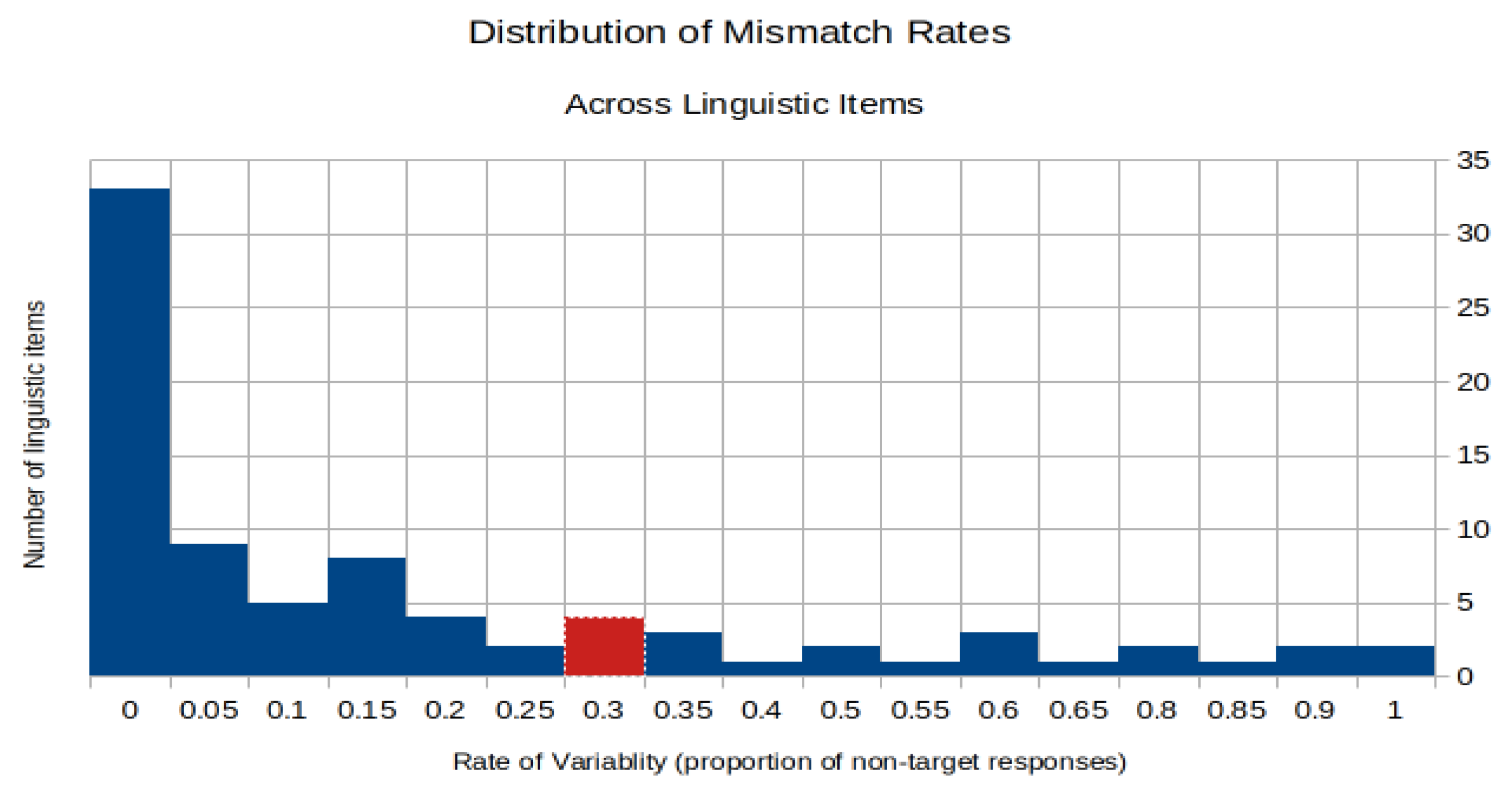
| Item No | No of Expected Responses | No of Varying Responses | Sample Size | Rate of Variability | Task Type | Target Structure |
|---|---|---|---|---|---|---|
| 39a | 0 | 20 | 20 | 1 | GJT | Existential negation |
| 40a | 0 | 20 | 20 | 1 | GJT | Existential negation |
| 32a | 2 | 18 | 20 | 0.9 | IT | Long distance and local binding |
| 14b | 2 | 18 | 20 | 0.9 | PT | Medial pronoun |
| 18a | 3 | 17 | 20 | 0.85 | PT | 3plf agreement |
| 39b | 4 | 16 | 20 | 0.8 | GJT | Equative negation |
| 40b | 4 | 16 | 20 | 0.8 | GJT | Equative negation |
| 4a | 7 | 13 | 20 | 0.65 | WT | dom marked in definite noun |
| 31b | 8 | 12 | 20 | 0.6 | PT | Pronoun binding with matrix subject or outside the clause |
| 18b | 8 | 12 | 20 | 0.6 | PT | 3plm agreement |
| 31a | 2 | 11 | 20 | 0.55 | IT | Pronoun binding with reflexive argument (mirror) |
| 11 | 10 | 10 | 20 | 0.5 | PT | dom marked in unmarked |
| 34b | 12 | 8 | 20 | 0.4 | GJT | Subject pronoun drop |
| 34c | 13 | 7 | 20 | 0.35 | GJT | Subject pronoun drop |
| 35b | 13 | 7 | 20 | 0.35 | GJT | Subject pronoun drop |
| 10b | 13 | 7 | 20 | 0.35 | PT | dom in irrational noun |
| 4b | 12 | 6 | 20 | 0.3 | PT | Plural marking in quantified noun phrases |
| 5 | 14 | 6 | 20 | 0.3 | PT | gen unmarked in marked |
| 8b | 13 | 6 | 20 | 0.3 | PT | Instrumental marked with sociative |
| 10a | 14 | 6 | 20 | 0.3 | PT | dom marked in irrational noun |
| Comparison | Groups Compared | χ2 Value | p-Value | Interpretation |
|---|---|---|---|---|
| Generation | First vs. Second | 0.53 | 0.47 | No significant difference in mismatch rates |
| Region | CHF vs. CHG | 3.60 | 0.059 | Marginal trend; not statistically significant |
| Gender | Female vs. Male | 0.20 | 0.65 | No meaningful difference |
| Reference Type | Pronoun 3sgf | Pronoun 3sgm | Pronoun 3sgn | Pronoun 3pl |
|---|---|---|---|---|
| Proximal | ival She | ivan he | ithu this | ivai they |
| Medial | uval She | uvan he | uthu that | uvai they |
| Distal | aval She | avan he | athu that | avai they |
| Category | Subgroup | Responses with Medial Pronoun | Responses Without Medial Pronoun |
|---|---|---|---|
| Gender | Male | 0 | 7 |
| Female | 2 | 11 | |
| Generation | First | 2 | 8 |
| Second | 0 | 10 | |
| Region | CHF | 2 | 8 |
| CHG | 0 | 10 |
| Tense | Jaffna Tamil Form | Standard Spoken Tamil Form |
|---|---|---|
| Present | seyr-inam/sey-yinam do.pres-3pl | seyr-a:ŋga do.pres-3pl |
| Past | seyt-inam do.pst-3pl | seyt-a:ŋga do.pst-3pl |
| Future | seyv-inam do.fut-3pl | seyv-a:ŋga do.fut-3pl |
| Category | Subgroup | Responses with JT Form | Responses with SST Form | Responses with Both JT and SST Forms | Responses with Invariant Form |
|---|---|---|---|---|---|
| seyy-inam | seyr-a:ŋga | ||||
| Gender | Male | 2 | 3 | 1 | 1 |
| Female | 1 | 8 | 4 | 0 | |
| Generation | First | 1 | 4 | 5 | 0 |
| Second | 2 | 7 | 0 | 1 | |
| Region | CHF | 2 | 4 | 3 | 1 |
| CHG | 1 | 7 | 2 | 0 |
| Gender | 3pl Pronoun (Jaffna Tamil) | Standard Spoken Tamil |
|---|---|---|
| Masculine | avangal kodut-a:ngal 3plm give.pst-3plm | Not available |
| Feminine | avalgal kodut-a:lgal/kodut-ave 3plf give.pst-3plf | Not available |
| Neutral | avargal kodut-inam 3pl give.pst-3pl.rat.pol | avaŋgal kodut-a:ŋgal 3pl give.pst-3pl.rat.pol |
| Category | Subgroup | Responses with Gender-Marked Form | Responses with Neutral Form |
|---|---|---|---|
| Gender | Male | 0 | 7 |
| Female | 3 | 10 | |
| Generation | First | 1 | 9 |
| Second | 2 | 8 | |
| Region | CHF | 2 | 8 |
| CHG | 1 | 9 |
| Noun | Generation | Spoken Variety-Aligned | Written Variety-Aligned |
|---|---|---|---|
| wug | First | 10 | 0 |
| Second | 4 | 6 | |
| karugam | First | 7 | 3 |
| Second | 2 | 8 | |
| puthagam | First | 6 | 4 |
| Second | 3 | 7 | |
| mi:n | First | 5 | 5 |
| Second | 3 | 7 |
| Category | Subgroup | Equative Negation by illa | Equative Negation by alla | ||
|---|---|---|---|---|---|
| Yes | No | Yes | No | ||
| Gender | Male | 7 | 0 | 1 | 6 |
| Female | 13 | 0 | 3 | 10 | |
| Generation | First | 10 | 0 | 3 | 7 |
| Second | 10 | 0 | 1 | 9 | |
| Region | CHF | 10 | 0 | 2 | 8 |
| CHG | 10 | 0 | 2 | 8 | |
| Category | Subgroup | Responses with Meena/Someone Else | Responses with Meena | Responses with Someone Else |
|---|---|---|---|---|
| Gender | Male | 3 | 3 | 1 |
| Female | 5 | 7 | 1 | |
| Generation | First | 1 | 7 | 2 |
| Second | 7 | 3 | 0 | |
| Region | CHF | 3 | 6 | 1 |
| CHG | 5 | 4 | 1 |
| Category | Subgroup | Responses with Someone Else | Responses with Meena | Responses with Meena/Someone Else |
|---|---|---|---|---|
| Gender | Male | 1 | 3 | 3 |
| Female | 1 | 8 | 4 | |
| Generation | First | 1 | 9 | 0 |
| Second | 1 | 2 | 7 | |
| Region | CHF | 1 | 7 | 3 |
| CHG | 1 | 4 | 4 |
| Category | Subgroup | (34b) | (34c) | (35b) | |||
|---|---|---|---|---|---|---|---|
| Yes | No | Yes | No | Yes | No | ||
| Gender | Male | 3 | 4 | 4 | 3 | 4 | 3 |
| Female | 9 | 4 | 9 | 4 | 9 | 4 | |
| Generation | First | 6 | 4 | 6 | 4 | 7 | 3 |
| Second | 6 | 4 | 7 | 3 | 6 | 4 | |
| Region | CHF | 5 | 5 | 5 | 5 | 5 | 5 |
| CHG | 7 | 3 | 8 | 2 | 8 | 2 | |
| Category | Subgroup | DOM Present in Definite Marked (Item 4a) | DOM Marked in Discourse Salient (Item 11) | ||
|---|---|---|---|---|---|
| Yes | No | Yes | No | ||
| Gender | Male | 2 | 5 | 2 | 5 |
| Female | 5 | 8 | 8 | 5 | |
| Generation | First | 3 | 7 | 4 | 6 |
| Second | 4 | 6 | 6 | 4 | |
| Region | CHF | 2 | 8 | 5 | 5 |
| CHG | 5 | 5 | 5 | 5 | |
| Category | Subgroup | Genitive Present | Genitive Dropped |
|---|---|---|---|
| Gender | Male | 5 | 2 |
| Female | 9 | 4 | |
| Generation | First | 8 | 2 |
| Second | 6 | 4 | |
| Region | CHF | 5 | 5 |
| CHG | 9 | 1 |
| Category | Subgroup | Instrumental Used | Associative Used |
|---|---|---|---|
| Gender | Male | 6 | 1 |
| Female | 10 | 3 | |
| Generation | First | 10 | 0 |
| Second | 6 | 4 | |
| Region | CHF | 7 | 3 |
| CHG | 9 | 1 |
Disclaimer/Publisher’s Note: The statements, opinions and data contained in all publications are solely those of the individual author(s) and contributor(s) and not of MDPI and/or the editor(s). MDPI and/or the editor(s) disclaim responsibility for any injury to people or property resulting from any ideas, methods, instructions or products referred to in the content. |
© 2026 by the authors. Licensee MDPI, Basel, Switzerland. This article is an open access article distributed under the terms and conditions of the Creative Commons Attribution (CC BY) license.
Share and Cite
Rajamathangi, S.; Auer, A.; Murugesan, G. Tamil Speakers in Switzerland: An Intergenerational and Typological Perspective. Languages 2026, 11, 58. https://doi.org/10.3390/languages11030058
Rajamathangi S, Auer A, Murugesan G. Tamil Speakers in Switzerland: An Intergenerational and Typological Perspective. Languages. 2026; 11(3):58. https://doi.org/10.3390/languages11030058
Chicago/Turabian StyleRajamathangi, S., Anita Auer, and Gurujegan Murugesan. 2026. "Tamil Speakers in Switzerland: An Intergenerational and Typological Perspective" Languages 11, no. 3: 58. https://doi.org/10.3390/languages11030058
APA StyleRajamathangi, S., Auer, A., & Murugesan, G. (2026). Tamil Speakers in Switzerland: An Intergenerational and Typological Perspective. Languages, 11(3), 58. https://doi.org/10.3390/languages11030058