Article

The Pathway from Taste to Epistemic Flavors: Modal Semantics of Italian mi sa

by
Andrea Miglietta
and
Eva-Maria Remberger
*
Department of Romance Studies, University of Vienna, 1090 Vienna, Austria
*
Author to whom correspondence should be addressed.
Languages 2026, 11(3), 54; https://doi.org/10.3390/languages11030054
Submission received: 19 December 2025 / Revised: 16 February 2026 / Accepted: 2 March 2026 / Published: 16 March 2026
(This article belongs to the Special Issue Recent Developments on the Semantics of Perception Verbs)

Abstract

In (colloquial) Italian, the fixed expression mi sa functions as an evidential/epistemic marker, requiring the dative 1SG clitic experiencer and the 3SG default form of the verb sapere. Mi sa diachronically develops from the verb for taste/smell, sapere, which is still productive in contemporary Italian, and the structure that it projects. This comprises an obligatory PP introduced by di encoding the type/quality of taste/smell (often metaphorically extended); a subject expressing the perceived entity; and an optional dative experiencer. We systematically analyzed data from the KIParla corpus, comparing the distribution of mi sa to the distribution of one of the most frequent Italian epistemic verb forms, namely, credo ‘I believe’. This study aimed to establish how the original perceptual meaning of mi sa influences its epistemic meaning. The results suggest that the persistence of the original object-oriented perception verb makes mi sa more likely to appear in particular contexts, i.e., events/situations that are known by the speaker through an inferential-like process. Furthermore, mi sa can only rarely be uttered out of the blue and seems to need a situative context (a stage), often containing an explicit QUD.

1. Introduction

In colloquial Italian, the fixed expression mi sa (che) encodes the epistemic and evidential positioning of the speaker regarding the truth conditions of the propositional content of the sentence (1). This expression is composed of two invariable elements: the first-person singular dative clitic mi, and the third-person singular present-tense form of the verb sapere, a verb that has inherited from the Latin verb săpĕre a meaning that is ambiguous, referring to both ‘taste/smell’ and ‘know’. According to Serianni (2012), the epistemic verbal expression mi sa (+CP) stems diachronically from the use of the construction mi sa (+PP) (2), where sapere expresses a perceptual experience (i.e., a “non-visual sensory” source for direct evidentiality, cf. Aikhenvald, 2004; see Viberg, 1983, for a typology of perception verbs). This diachronic change shows some of the characteristics of grammaticalization patterns, as described by Heine (1993): fixation (from a completely productive syntactic structure to an invariable expression); semantic bleaching (from a concrete meaning to a more abstract one); change in complementation (from a PP to a CP); inability to appear under the scope of negation; etc. (cf. §4).
(1)Misachedomanipioverà.
me.dattaste.3sgthattomorrowrain.fut.3sg
‘I think that it will rain tomorrow.’
(2)Lazuppamisa/glisapevadisale.
thesoupme.dattaste.3sghim.datknow.ipf.3sgofsalt
‘The soup tastes salty to me/tasted salty to him.’
On the other hand, mi sa extends its range of syntactic positions, appearing not only in sentence-initial but also medial ((3) and (4)) and final (5) positions, like adverbs or pragmatic markers. Hence, it has syntactic mobility; it can take scope over various elements, and its interpretation changes into an epistemic or evidential meaning (cf. §4). Both grammaticalization and pragmaticalization processes are hence of interest.
(3)
prendiamo la macchina poi alla mattina andiamo mi sa a comprare dei palloncini qualcosa(KIParla_KPN004)
‘we take the car and then in the morning we go, I think, to buy some balloons or something’
(4)la sfiga coi vicini ce l’ abbiamo mi sa nel di enne a(KIParla_TOD2016)
‘the bad luck with our neighbors we have it, I think, in the DNA’
(5)sono tutti vecchi mi sa(KIParla_KPN031)
‘they’re all old, I think’
Although research on discourse markers in Italian is increasing, the literature on mi sa to date is quite limited: it is discussed by Serianni (2012) and Riccioni et al. (2022), but there is no mention by Bazzanella (1995) or Sansò (2020). Serianni (2012) placed mi sa in the context of the first-person singular verbal form of credere, ‘believe’, which prompted Riccioni et al. (2022) to conduct a study that compares mi sa with several (un)knowledge expressions on a scale of uncertainty. As a result, they came to the conclusion that mi sa is a synonym of credo (‘I believe’) and penso (‘I think’). Schneider (2007) classifies mi sa as a mitigator, like credo, but states explicitly that mi sa is “not an epistemic RPC [Reduced Parenthetical Clause]”. Our study shows that there are noticeable differences between mi sa and credo and that a more fine-grained distinction in the realm of epistemicity—which, in our approach, includes several subcategories, among which is evidentiality—is required for a proper analysis of mi sa.
As a consequence, in the present study, we compare the distribution, interpretation, and pragmatic functions of epistemic/evidential mi sa with the distribution of credo (Giorgi & Pianesi, 2005), one of the most frequent epistemic complement-taking Italian verbs. This comparison is carried out using the KIParla corpus (Mauri et al., 2019; a larger dataset than that analyzed by Riccioni et al., 2022). Hence, the quantitative and qualitative analyses presented in Section 5, Section 6 and Section 7 exclusively use data from this corpus; some additional data from the Repubblica Corpus (Baroni et al., 2004) and (occasional) judgments made by native speakers (for unproblematic data like (1) and (2)) are used for explanatory reasons. Our analysis is embedded in a generative grammar model and aims to answer the following two main research questions:
  • How does the original perceptual meaning of mi sa influence its epistemic value?
  • How does the fixed internal morphosyntax of mi sa, with the complement clause representing the at-issue content and the dative experiencer inherited from the theta grid of perceptual sapere, influence its distribution?
From a semantic point of view, mi sa is expected to have a meaning closer to evidentiality (with perception representing a “firsthand experience”—see Willett, 1988) and a specific degree of speaker uncertainty. From a syntactic perspective, mi sa is expected to show some of the functional features of credo and be concerned with phenomena connected to the left periphery (Cinque, 1999), such as complementizer deletion. Because of its invariable morphosyntax and bleached meaning, it is also expected to be found in parenthetical positions, a key feature concerning the development of pragmatic values.
After this introduction, we will discuss some crosslinguistic tendencies of taste verbs within the class of perception verbs (§2). Section 3 discusses the morphosyntactic and semantic properties of our taste verb constructions. In Section 4, the pattern of grammaticalization from verb of perception to epistemic marker is outlined. Section 5, Section 6 and Section 7 are dedicated to the corpus study: Section 5 explains the methodology adopted, Section 6 describes the results of the study, and Section 7 provides a discussion of the results. A proposal for an analysis of the development from perception verb to epistemic marker based on argument structure is given in Section 8. Section 9 contains our conclusions.

2. The Perception of Taste: General Tendencies

2.1. Perception Verbs Analyzed Cross-Linguistically

Perception verbs encode first-hand experience, i.e., a sensory experience directly linked to an experiencer. First-hand experience is also the first of the grammatical categories in languages which need to grammatically mark the source of knowledge of assertions, i.e., evidentiality, and perceptive verbs can serve as a basis of evidential marking (Aikhenvald, 2004; Aikhenvald & Storch, 2013; Willett, 1988; a.o.).
The five perceptual senses usually encoded in language are sight (visual perception), hearing (auditory perception), touch (feeling), smell (olfactory perception) and taste (gustatory perception) (see Kaiser, 2021, p. 2; Viberg, 1983, etc.). Typological work, such as the lexical study by Viberg (1983), who analyzed a sample of 53 languages from 14 extended language families, established a typology of perception verbs, in which taste is at the lower end of the sense–modality hierarchy, which represents the senses higher in the hierarchy as being more frequent and diachronically more stable; furthermore, Viberg (1983) also showed that in evidential systems, taste is cross-linguistically more rarely employed as an evidential marker than the higher-ranked senses. Although it has since been shown that this hierarchy is not valid for all languages, it can be observed as a tendency:
(6)Hierarchy of perception verbs (Viberg, 1983)
sight > hearing > touch > {smell, taste}
Counterexamples come from Aikhenvald (2004), Aikhenvald and Storch (2013), and others.1 One important aspect of the hierarchy in (6) is that smell and taste often go together as one sensory perception, an observation that can be explained by the biological properties of the human body, wherein taste is basically a perception of four (or maybe five—see umami) possible types via the makeup of the human tongue, which can be enriched by the capacities of olfactory cells located in the upper nasal cavity to receive molecules transported either by the air through the nostrils or by the direct connection between the oral and nasal cavities.
Taste, moreover, presupposes that the element “tasted” is in direct contact with the tongue in the human oral cavity. touch also needs direct contact, but this contact is not restricted to a specific area of the body. With smell, the contact can be direct or indirect,2 whereas sight and hearing can take place at a distance. With vision, the “access to the relevant experience” (Kaiser, 2021, p. 3) is less constrained.
It has also been observed that visual perception often develops into a cognitive-related meaning (Kaiser, 2021, referring to Sweetser, 1990), as can be seen from the use of verbs encoding what was originally visual perception as mental-state verbs (for instance I see ‘I understand’). Verbs of vision have thus also been claimed to be more “objective”, since experience via the human visual sense varies less and thus is also more objective as a phenomenon (Kaiser, 2021, p. 3 referring to Korsmeyer, 1999), whereas smell and taste “are typically regarded as conveying more subjective information and as involving more variable percepts across people” (Kaiser, 2021, p. 3).
Turning to syntactic properties, we can note that perception verbs can have varying and even alternating3 argument structures, possibly with a agentive vs. experiencer vs. stimulus subject:
(7)The thematic roles of the subject of English perception verbs:
  • Agentive: watch, look at, listen to, touch, feel, smell, taste:
    Engl. John [+ag] deliberately looks at the women coming out of the church.
  • Experiencer: see, hear, feel, smell:
    Engl. John (*deliberately) sees the women coming out of the church.
  • Stimulus: look, sound, feel, taste:
    Engl. The women coming out of the church all look sad.
Type (7a) is an intentional activity performed by an agentive subject, whereas Type (7b) is a non-intentional experience, and both types are called “experiencer-based” by Viberg (1983, p. 126); in type (7c), he calls the verb a copula (as in e.g., This hat looks good), and since the subject is the stimulus, it is called a “source-based” perception verb (Viberg, 1983, p. 126).
Whitt (2010, 2011) instead distinguishes between object-oriented and subject-oriented perception verbs in the sense that the subject, usually the topic of the clause, is either the object of perception (the perceived stimulus, such as the soup/die Suppe in the English phrase the soup tastes good and the German phrase die Suppe schmeckt gut—see also 8a,b and 9a) or the subject of perception (the perceiver, such as Mary/Maria in the English phrase Mary tastes the soup and German phrase Maria kostet die Suppe—see also 8c, 9c).
To sum up, differences in the expression of perceptual verbs are found in the type of sensory modality, which can be direct (proximal), distant, or both, which then leads to different levels of subjectivity (Kaiser, 2021). Verbs of perception also appear in different argument–structural configurations of perceiver and perceived, with the thematic role of the subject being agentive (=> perceiver), an experience (=> perceiver), or the stimulus (=> perceived). Furthermore, the perceiver can also remain unexpressed, i.e., only optionally realized.
As shown above, perception verbs are generally prone to developing further semantic extensions into verbs of cognition and evidential markers. In this case, object- or source-oriented perception verbs seem to have a tendency towards developing evidential and modal values, as will be seen in the case of mi sa investigated here.

2.2. The Perception of Taste

As noted in Section 2.1, taste is a proximal sense and seems to vary between different sentient individuals; i.e., it is more subjective than sight, which is a distant sense and thus more “objective”. Smell is between the two, depending on the way through which the molecules of smell reach the nasal cavity, i.e., from the oral cavity (and thus proximal) or via the air (i.e., transported over a distance).
For taste, we must further distinguish between the entity perceived and the specific quality of taste. The perceived entity usually has to enter the experiencer’s oral cavity. The quality of taste is usually a predicate or part of the predicate; i.e., it is expressed by an adjective (8b) or a prepositional phrase (8a, 9a). However, in the agentive, subject-oriented transitive construction, the quality of taste is not relevant (8c).
(8)English
a.This soup tastes of salt/salty.intransitive
b.This soup tastes good.intransitive
c.Mary [+ag] tastes the soup.transitive
(9)Italian
a.Questa zuppa sa di sale.intransitive
b.*Questa zuppa sa buono/sa bene.
c.Maria prova/assaggia [+ag]/*sa la zuppa.transitive
(10)English
a.This soup tastes of salt/salty to me.
b.For me/to me, this soup tastes of salt/salty.
(11)Italian
a.Questa zuppa (mi/gli) sa di sale.
b.Per me/a me, la zuppa sa di sale.
Note that in the intransitive constructions (8a, 9a), the perceiver is not present but can be activated by a prepositional phrase (10a,b; 11b) or, in Italian, a dative (11a). Whereas English allows more variation and alternations, the Italian predicate under discussion in our paper, namely, sapere di, as the origin of the epistemic marker mi sa, only functions as an object-oriented, source-oriented intransitive verb with an obligatorily present predicate for the quality of taste and an optional experiencer. The copulative use of a taste verb does not exist in Italian (9b), and for the agentive, subject- and experiencer-oriented construction, other verbs (like provare and assaggiare) have to be chosen (9c).

3. Morphosyntactic and Semantic Properties of Taste Verb Constructions

In this section, the morphosyntactic and semantico-pragmatic properties of the taste verb sapere di will be investigated, namely, the subject (§3.1), the obligatorily present quality of taste (§3.2), and the optional perceiver (§3.3), as well as metaphorical extensions that are quite frequent and depart from the original meaning of gustatory perception towards figurative meanings more easily translated into English via cognitive predicates like ‘to give the impression of’ or ‘to recall sth.’ (§3.4).

3.1. The Subject

The subject of sapere di is the stimulus for the sensory perception that encodes the perceived entity. The subject is usually a third person for obvious reasons, but first- and second-person subjects are possible, especially in Italian summer hits for the beach, where everybody can taste of sea salt (as in the pop song by Biagio Antonacci, Ti ricordi di me4). However, the verb seems to have a defective paradigm, since it hardly ever appears in compound tenses and instead, as a true state verb, only appears in the simple tenses (the present, imperfect, and possibly future), which is probably a grammatical constraint of lexical aspect. In the very rare (and questionable) examples in which the verb is in the compound perfect, the auxiliary is always avere ‘have’, which indicates that sapere di is probably an unergative verb.

3.2. The Quality of Taste

As shown above, the DP introduced by sapere di is obligatory (12a). The DP introduced by di cannot be pronominalized by ne-cliticization (Blumenthal & Rovere, 1998: s.v., cf. 12b, c):
(12)a.*Lazuppamisa.
thesoupcl.1sg.dattaste.3sg
b.Questazuppasadisale.
thesouptaste.3sgofsalt.
c.*Questazuppanesa.
thesoupcl.parttaste.3sg
The impossibility of substituting di + sale in (12b) with the partitive clitic ne (12c) shows that the constituent encoding the quality of taste is not an internal argument. Furthermore, this DP-complement of di has no specific reference but acts as a predicate for the quality of taste; see also the following selection of predicative elements (nouns and adjectives) following sapere di extracted from the Repubblica corpus (Baroni et al., 2004):
(13)Sapere di(La Repubblica)
… sale, tappo, polvere, vino, mare, pesce, acqua, pomata, lampone, amaro, buono, muschio, miele, pomodori, glicine, birra e salsiccia, riso, gin, spaghetti, hamburger, muffa, incenso, yogurt, lavanda….
‘… salt, cork, dust, wine, sea, fish, water, hair grease, raspberry, bitter, good, musk, honey, tomatoes, glycine, beer and sausage, rice, gin, spaghetti, hamburger, mold, incense, yoghurt, lavender…’
While these are all still typical qualities of tastes, we will see in Section 3.4 that both the perceived subject and the quality of taste can be easily used in figurative language, with the additional consequence that the quality of taste is not restricted to predicative nouns and adjectives.

3.3. The Optional Experiencer/Perceiver of the Taste

The role and status of the dative are very interesting, since in the epistemic construction mi sa, it is invariably fixed to the speaker, whereas in the original taste construction sapere di, it is optional. This would also be worth analyzing in the context of other epistemic expressions containing a dative, a topic that we cannot discuss in detail in this paper, wherein the development from the original perception construction to epistemic marker is in the focus of the analysis. As perception verbs often allow non-expression of the perceiver, the latter must then be interpreted depending on the context (see Kaiser, 2021).
The perceiver is realized optionally and therefore does not seem to be part of the argument structure of the predicate. Nevertheless, it has a clear thematic role, namely, the role of the experiencer. In most of the examples, the perceiver is realized by a clitic pronoun, which can appear in all persons; however, a full PP is also possible (14a). The perceiver can also be questioned (14b).
(14)a.Alcuocolazuppasapevadisale.
to-thecookthesouptaste.ipf.3sgofsalt
‘To the cook, the soup tasted salty.
b.Achisadisalelazuppa?(A Mario.)
towhomtaste.3sgofsaltthesoup(to Mario)
‘To whom does the soup taste salty? (To Mario.)’
Similar constituents that have a quasi-argument status but are optional comprise high applicative datives.5 The status of applicatives in Italian is not completely clear, since there is some regional variation, e.g., the requirement for them to be realized only as a clitic or otherwise (Roberge & Troberg, 2009, p. 164 for Romance). However, since high applicatives are not provided by the argument structure of the predicate either, we will assume that the optionally realized experiencer in the taste construction with sapere di is in precisely the position of the high applicative, i.e., in a position above the VP within the little vP (cf. Folli & Harley, 2006, p. 136 for Italian).

3.4. Metaphoric Extensions

The perception verb sapere di often is used metaphorically, i.e., in cases where the subject cannot be a stimulus of a taste perception and the DP selected by di does not encode a taste but instead various kinds of semantic and syntactic predicates. In many of these cases, sapere di is best translated as ‘to give the impression of’ or ‘to remind [someone] of something’ (15):
(15)Metaphorically extended uses of sapere di:(La Repubblica)
a.una visione che sa di stampa di primo Ottocento
‘a vision that is reminiscent of the press of the early 19th c.’
b.tutto intorno sa di abbandono
‘all around gives the impression of desolation’
c.mi sa di ‘perdona loro che non sanno quel che fanno’
‘it sounds to me like “Forgive them for they know not what they do”’
As you can see, in (15a), the subject visione (‘vision’) even contradicts the semantics of taste since vision is a noun derived from a visual perception verb and is interpreted as a mental state of cognition. Even in (15b), the impression rendered by sapere di cannot be of taste but must instead have been perceived via vision. In (15c), with the subject unexpressed (but retrievable from the context), the predicate consists of a quote from the bible, which is surely not a quality of taste but somehow a cognitive association with something that the quote stands for. This metaphoric use of the taste verb construction offers the kind of context that could also be responsible for the shift from perception to epistemicity.

4. From Taste to Epistemicity—The Pattern of Grammaticalization

In contemporary Italian, both sentences (16) and (17), in which the sequence mi sa appears, are grammatical.
(16)Questo vino mi sa di tappo.
‘This wine tastes corky to me.’
(17)mi sa che non ti piacerà(KIParla_BOA3019)
‘I think you won’t like it.’
In (16), the sequence is composed of a perception verb, sapere di (‘to taste of’), accompanied by an optional dative experiencer, and both the verb and the dative have a productive inflection. In (17) mi sa is a fixed expression which adds a meaning of “epistemicity” to the sentence6 (Boye, 2012). According to Serianni (2012) and Cialdini (2012), the form with the epistemic meaning has diachronically developed from the perception verb through at least one intermediate stage. In this intermediate structure, which is no longer productive, both the inflectable verb (see seppe ‘it tasted’ in the passato remoto in (18)) and the dative (either a clitic or a PP—see all’ambasciatore ‘to the ambassador’ in (18)) are accompanied by an evaluative adjective (see agrissimo ‘extremely bitter’ in (18)) or adverb and can introduce a subordinate clause introduced by che ‘that’.7
(18)Alla Repubblica e all’ambasciatore seppe agrissimo che di nuovo avesse il governatore di Milano per via dei turcimani denunciato, ecc.(Siri, 1677, taken from Serianni, 2012, p. 22)
‘It bitterly galled the republic and the ambassador that once again the governor of Milan had complained because of the Turks, etc.’
From this intermediate stage, the epistemic expression mi sa became fixed throughout the 20th century. In this evolution from perception verb to marker of epistemicity, at least three of the hallmarks of grammaticalization/pragmaticalization8 can be recognized, namely, decategorialization, semantic change, and distributional change. Decategorialization (Hopper, 1991; Heine, 1993; Travis, 2006) is the process through which a linguistic element loses the distinctive features of its lexical category. The consequences of this process are evident in at least two features of the epistemic mi sa. The first is the morphological invariance of both the verb and the dative; i.e., the verb is fixed in the third-person singular of the present indicative, and the dative is obligatorily a clitic pronoun in the first person singular (19). The second is the impossibility of finding this form within the scope of negation (20) (cf. Cruschina & Remberger, 2008).
(19)a.Mi sa che deve ancora arrivare.
‘I think s/he hasn’t arrived yet.’
b.*Mi sapeva che saresti arrivato.
‘I thought you would come.’
c.*A Marco/gli sa che deve ancora arrivare.
‘Marco/he thinks s/he hasn’t arrived yet.’
(20)a.Mi sa che non viene.
‘I think s/he is not coming.’
b.*Non mi sa che viene.
‘I don’t think he is coming.’
A further sign of grammaticalization can be found in the semantic change from perception to epistemic meaning. This development can be subsumed into the process of subjectification described by Traugott (1989), specifically into tendency III, through which “Meanings tend to become increasingly based in the speaker’s subjective belief state/attitude toward the proposition” (Traugott, 1989, p. 35). Closer examination reveals that the trigger for this shift can reasonably be located in the overt expression of the dative experiencer with the perception verb. In fact, the perception verb alone, sapere di (‘to taste of’), expresses a fully-fledged assertion and as such can be challengeable (21). The expression of a dative experiencer relativizes the truth of the proposition to an individual (Lasersohn, 2005; Stephenson, 2007). As such, the proposition still constitutes an assertion, but it is closely linked to the experiencer’s “epistemic privilege”, i.e., her/his privileged perspective on her/his internal state; hence, the proposition is less prone to being challenged through contradiction (22). It is from this relativized truth that the epistemic meaning developed, which signals that the speaker’s commitment toward the proposition within the scope of mi sa is lower than knowledge. At this point, mi sa indicates that the speaker cannot meet the Gricean maxim of quality, so the proposition is not meant to be added to the Common Ground (Stalnaker, 1978), and challenging it results in oddness (23).
(21)A:Ti piace questo vino?
‘Do you like this wine?’
B:Non molto, sa un po’ di tappo.
‘Not much, it tastes a bit corky.’
C:Non è vero, non sa di tappo!!
‘That’s not true, it doesn’t taste corky!!’9
(22)A:Ti piace questo vino?
‘Do you like this wine?’
B:Non molto, mi sa un po’ di tappo.
‘Not really, it tastes a bit corky to me.’
C:#Non è vero, non ti sa di tappo!!
‘#That’s not true, it doesn’t taste corky to you!!’
(23)A:Ti piace questo vino?
‘Do you like this wine?’
B:Non molto, mi sa che ci è caduto il tappo dentro.
‘Not much, I think the cork fell inside.’
C:#Stai dicendo una bugia, non ci è caduto il tappo dentro!!
‘#You’re lying, the cork didn’t fall inside!!’
Among the possible different epistemic meanings, mi sa indicates that the speaker does not know the truth value of the proposition, but s/he is nonetheless biased towards its truth. This meaning is made clear by the last trace of grammaticalization/pragmaticalization displayed by mi sa, namely, distributional change. Epistemic mi sa can show parenthetical distribution and indeed often does in our data; e.g., it can follow the clause over which it takes scope (24). This distribution is considered by Hooper (1975) to be a prerogative of “assertive predicates”, which imply that “the speaker or subject of the sentence has an affirmative opinion regarding the truth value of the complement proposition” (Hooper, 1975, p. 95). This affirmative opinion must nonetheless be lower than knowledge to bring about the displacement (Benton & Van Elswyk, 2019).
(24)ah ma è famoso mi sa(KIParla_PTD006)
‘Ah but he’s famous, I think.’
The epistemic meaning of mi sa, resulting from the process of grammaticalization/pragmaticalization, has been described in the literature in different ways. Bozzone Costa (1991) underlines the non-factive nature of mi sa, while Orletti (1995) assigns the expression two meanings, hypothetical and inferential, which derive from some sensory proof. In a recent study, Riccioni et al. (2022) placed mi sa together with the verbs credo (‘I believe’) and penso (‘I think’), stating that the three express the same kind of uncertainty, namely, low uncertainty. This parallel had already been drawn by Serianni (2012), who described mi sa as a synonym of credere (‘believe’) and pensare (‘think’), with a more restricted distribution. In this respect, mi sa exclusively pertains to the informal register of the spoken language and sounds odd in what the author calls “a more demanding statement”, as shown in examples (25) and (26) taken from Serianni (2012, p. 18).
(25)Credo/Penso che De Mauro sia il più grande linguista italiano del secondo Novecento.
‘I believe/I think that De Mauro is the greatest Italian linguist of the second half of the twentieth century.’
(26)?Mi sa che De Mauro è il più grande linguista italiano del secondo Novecento.
Mi sa that De Mauro is the greatest Italian linguist of the second half of the twentieth century.’

5. Methodology and Data: The Corpus Study

This corpus study aims to establish the evidential/epistemic meaning of mi sa through an examination of spoken production data. To do so, we compare the distribution of mi sa and credo in the Italian spoken corpus KIParla, searching for meaningful differences that allow these two meanings, which have been unified in previous studies, to be distinguished.
The KIParla corpus of spoken Italian (Mauri et al., 2019) is an open-access and expanding corpus of spoken language produced in a variety of situations (e.g., spontaneous conversations, semi-structured interviews, university lectures and exams, etc.) by speakers of different ages and education levels. At the time of consultation, July 2025, the corpus included approximately 2 million words. The queries utilized are the fixed sequences “mi sa” and “credo” (i.e., the first-person singular present indicative form of the verb credere). The search was conducted without the preselection of any metadata; all the occurrences retrieved by the queries, regardless of their sociolinguistic features, were included in our analysis. From the occurrences retrieved, only those that are comparable were considered for the analysis. Therefore, only those examples in which mi sa has epistemic/evidential meaning, and only those examples in which credo takes scope over a finite clause, were further annotated. The final set of analyzed data consists of sentences in which mi sa and credo take scope over three types of sentences: embedded finite clauses introduced by the complementizer che; embedded finite clauses that are not introduced by a complementizer, i.e., instances of complementizer deletion (Giorgi & Pianesi, 2005); and host clauses, i.e., cases in which mi sa and credo are found in parenthetical positions (Schneider, 2007). These occurrences were annotated by two annotators, who discussed doubtful cases, either agreeing on an annotation or discarding the occurrence. The final number of occurrences taken into account in the analysis was 239 for mi sa and 257 for credo.
These examples were classified following a semantic annotation derived from that first proposed by Herbeck (2021). This classification is based on five categories, description, mind self, mind other, evaluation, and unreal, which aim to disentangle the meaning of the epistemic expression by describing the semantics of the proposition under its scope. This kind of annotation, focusing on the status of the modalized proposition, proves to be very useful in dealing with corpus data, where cues defining epistemic/evidential meanings such as degree of certainty and the source of information (cf. Boye, 2012) are mostly concealed in a broad context or not explicitly expressed. Furthermore, although these categories do not correlate with degrees of certainty, a tendential connection between them and types of evidence can be drawn. In what follows, the semantic categories are described, with one example with mi sa and one with credo for each.
  • DESCRIPTIONS: These are objectively falsifiable propositions describing directly perceivable reality, e.g., states, places, and past events. This information is often based on uncertain direct evidence or memory.
(27)TO091:quand’ è l’ ultima voltà che l’ ho sentita?//Boh(KIP_TOA3012)
‘When was the last time I heard from her?’
TO085:che ne so io?
‘How should I know?’
TO091:Mi sa quando c’eri pure tu che ci siamo viste lì al bar
‘I think it was when you were there too, when we saw each other at the bar.’
(28)credo ci sia il quarantaquattro e un altro pullman però non ti so dire di più(KIParla_PTA013)
‘I think there’s the forty-four and another bus, but I can’t tell you any more than that.’
  • MIND SELF: These propositions express the emotional situation, state of mind, or personality traits of the speaker, accessed through introspection.
(29)mi sa che non me lo ricordo(KIParla_BOC1001)
‘I don’t think I remember that.’
(30)no perchè non sono fatto pereh spostarmi da solo e per questi grandi cambiamenti credo(KIParla_PTD021)
‘No, because I am not made for moving on my own and for these big changes, I think.’
  • MIND OTHER: These propositions depict the emotional situation or state of mind of someone other than the speaker. This piece of knowledge is arguably accessed through an inference based on direct evidence (ranging from someone’s appearance to her/his mood or attitude).
(31)mi sa che sei un po’ stanca(KIParla_BOA3013)
‘I think you’re a bit tired.’
(32)porti michilino parleremo di lui credo che oramai sia pronto(KIParla_BOD1001)
‘Bring Michilino! We’ll talk about him. I think he’s ready now.’
  • EVALUATION: These are propositions with an evaluative predicate (e.g., important, good, bad, and convenient) or that constitute a comparison between two entities. This information expresses the speaker’s doxastic judgment.
(33)quindi lui ha detto alla fine della fiera qui mi sa che//conviene che la compriamo una ca[sa](KIParla_PBB032)
‘So he said, at the end of the day, I think we should buy a house here.’
(34)credo che sia un buon posto per lavorare(KIParla_PTA001)
‘I think it’s a good place to work.’
  • UNREAL: These are propositions expressing unfulfilled events, e.g., future, conditional, and counterfactual events. This kind of knowledge is accessed by means of inference or prediction.
(35)se gli dici di no mi sa che lo fa comunque(KIParla_KPN025)
‘If you tell him no, I think he’ll do it anyway.’
(36)non credo che sarete in tanti al primo appello(KIParla_BOA1001)
‘I don’t think there will be many of you at the first roll call.’

6. Results

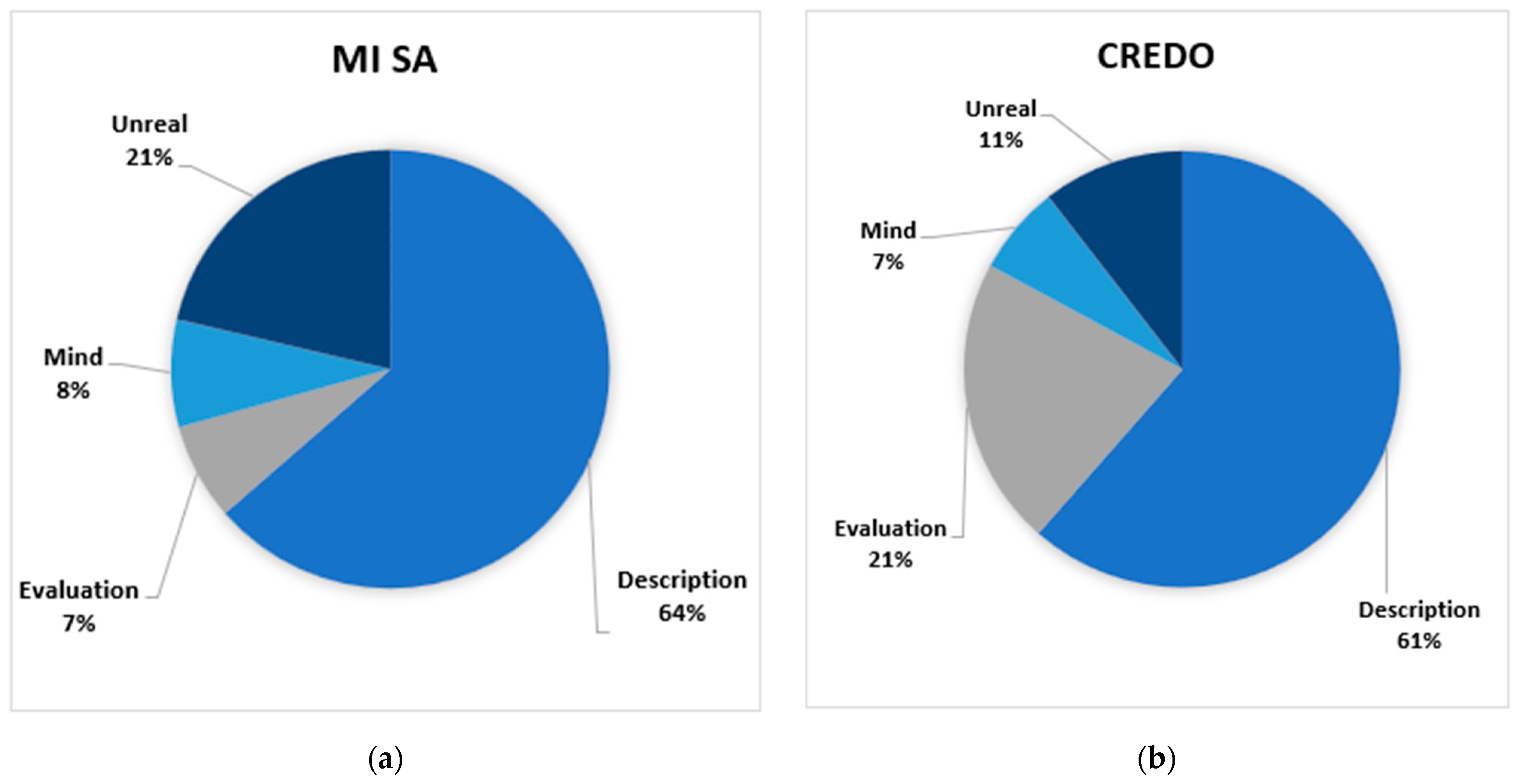
The results of our research show that the distribution of epistemic mi sa differs from the distribution of credo with respect to our annotation categories. Table 1 shows the number of occurrences for each category. On the one hand, propositions pertaining to the categories description, mind self, and mind other are evenly found under the scope of credo and mi sa. On the other hand, a difference in distribution can be found with propositions of the categories unreal and evaluation. In particular, propositions of the category unreal are more often found in the corpus under the scope of mi sa, while propositions of the category evaluation are more often found under the scope of credo. The difference in frequency relating to the evaluation category is more pronounced.
Propositions expressing a “description” constitute more than half of the occurrences within the scope of both mi sa and credo. This high rate can likely be attributed to the structure of the data in the corpus, which more often refers to events or situations that occurred or are occurring in the actual world. In the case of lectures, exams, and, to an extent, semi-structured interviews, the matter at stake mostly consists of falsifiable facts, events, and situations accessed through memory. Furthermore, in the retrieved spontaneous conversations, the speakers tend to discuss factual reality more often than personal opinions, feelings, or predictions. The structure of the data might also be the reason for the low frequency of propositions falling into the categories of mind self and mind other. These are the categories that correspond to the lowest frequency across both mi sa and credo, which could simply be a product of the fact that feelings and personal mental states are, in general, less discussed than other topics. By contrast, the frequency with respect to the categories evaluation and unreal does vary across mi sa and credo. To understand whether this difference in frequency is statistically significant, the chi-square test was run. The categories of mind self and mind other were combined so that the test could be applied, with no category displaying fewer than 10 occurrences. We decided to merge these two categories because they are the most compatible with respect to their semantics and also the two with the lowest number of occurrences. The result indicates that the difference in the distribution between mi sa and credo according to the semantics of the proposition under their scope is highly significant (X2 = 27.0498, p < 0.00001—the result is significant at p < 0.05). This suggests that the subtle meaning difference between mi sa and credo may be captured by means of the categories unreal and evaluation (Figure 1).

7. Discussion

In this section, we try to provide an explanation of the differences in the data; i.e., we try to account for the fact that in KIParla, credo more often takes scope over propositions pertaining to the category evaluation, while mi sa more often takes scope over propositions pertaining to the unreal category. What both results seem to show is that mi sa takes scope over a narrower set of meanings than credo. In fact, while credo can take scope over propositions expressing doxastic certainty about opinions and counterfactual events, mi sa tend to take scope over propositions referring to the actual state of affairs.

7.1. The Evaluation Category

Our evaluation category includes sentences containing an evaluative predicate or a comparison and hence propositions that express some doxastic judgment on the part of the speaker. The category encompasses two different kinds of doxastic meanings that belong to propositional attitude verbs such as credere, as described by Mari (2016), namely, expressive and inquisitive meaning. Expressive credere represents the “solipsistic mental state” of the speaker, who expresses her/his belief regardless of the facts, as in example (37) taken from Mari (2016, p. 66). This type of meaning expresses doxastic certainty over opinions. Inquisitive credere is used when a matter of fact is at stake, i.e., when the proposition is objectively either true or false. This meaning conveys that there are objective reasons in the world from which the speaker draws her conclusion and adds a layer of epistemic uncertainty about these matters of fact to the existing doxastic certainty concerning opinions. This meaning is shown by example (38) translated in example (39), both taken from Mari (2016, p. 66). In her work, these two meanings are linked to the mood of the complement clause, an aspect on which we remain agnostic with our data.
(37)Credo davvero che sei un cretino.
‘I really believe that you are stupid.’
(38)Credo davvero che tu sia un cretino.
(39)All things considered, I really believe that you are stupid.
In the KIParla corpus, credo has both these meanings. It is found in contexts where it expresses doxastic certainty about opinions that are not based on a contextually salient matter of fact, i.e., expressive meaning (40). And it is also found in contexts where it expresses epistemic uncertainty about some contextually salient matter of fact, i.e., inquisitive meaning (41).
(40)il vecchio nietzche diceva che la vita senza la musica sarebbe un errore//credo che sia una delle cose più belle che abbia scritto(KIParla_TOD1002)
‘The old Nietzsche said that life without music would be a mistake. I think that’s one of the most beautiful things he ever wrote.’
(41)TOI013io ho anche i videogiochi ma credo che lui mi superi comunque//nel senso che ho iniziato da piccolo con la play uno(KIParla_PTD021)
‘I also have video games, but I think he beats me anyway. In the sense that I started when I was little with PlayStation One.’
TOI012sì no
‘Yes no.’
TOI013play due play quattro però ne ha provati molti di più lui.
‘PlayStation Two, PlayStation Four, but he has tried many more than me.’
TOI012eh io sono stato videogiocatore professionista per un anno quindi ho dovuto
‘Eh I have been a professional player for one year so I had to.’
In example (40), the corpus of Nietzsche’s production, of which the quoted sentence would be the best exemplar, is not part of the discussion; the judgment represents a conviction on the part of the speaker, whose falsifiability is irrelevant. In example (41), on the other hand, the judgment resulting from the comparison is presented as based on a matter of fact, i.e., the fact that the other person was previously a professional player.
Mi sa, in contrast, is found in our data in contexts where it adds epistemic uncertainty to the doxastic judgment on the basis of some contextually salient matter of fact, i.e., inquisitive meaning (42), (43); it is never found expressing doxastic certainty over opinions. In example (42), the doxastic judgment (the first mi sa in the example) of the speaker refers to a highly salient matter of fact coinciding with the topic of the conversation, i.e., what has been discussed at the meeting. In example (43), the matter of fact on which the judgment is based is something visually perceivable, namely, the wet patch under the speaker’s armpit.
(42)eh io volevo proprio andare però//ci sono andati i miei amici dell’ udu//infatti mi leggerà il resoconto vediamo un po’ come siamo messi//mi sa male comunque//mi sa che sono molto di destra(KIParla_TOA3010)
‘Eh I really wanted to go, but… my friends from the UDU went… in fact he’ll read me the report, let’s see how we’re doing. I have a bad feeling about it anyway, I think they’re very right-wing.’
(43)TOI113bisogna tener duro poi qui dentro per sto registratore qua che dobbiam tenere chiuso fa un caldo porco//vuoi suicidarti sotto la mia ascella?(KIParla_PTB023)
‘We have to hang in there in here because of this tape recorder that we have to keep closed. It’s boiling hot in here. Do you want to kill yourself under my armpit?’
TOR007no
‘No.’
TOI113dai eh
‘Come on, eh?’
TOR007no perchè mi sa che sono messa peggio io guarda
‘No, because I think I’m worse off, look.’
Therefore, a possible explanation for our quantitative results, showing that credo takes scope over propositions with evaluative meanings more frequently than mi sa, and in a statistically relevant way, could lie in the fact that credo can express a wider range of evaluative meanings than those expressed by mi sa. Mi sa only takes scope over doxastic judgments predicated on something salient in the context, hence adding epistemic uncertainty over a matter of fact to the doxastic conviction. Moreover, credo takes scope over doxastic judgments expressing the speaker’s conviction presented as unrelated to any matter of fact. This wider set of contexts increases the number of doxastic judgments under the scope of credo, potentially bringing about a specialization (Aronoff & Lindsay, 2016) through which credo is more frequently used in doxastic contexts in general, including those that fit the meaning of mi sa.

7.2. The Unreal Category

The unreal category contains all those propositions expressing unfulfilled events. Therefore, it comprises at least three more fine-grained categories: future-oriented, conditional, and counterfactual events. As mentioned above, most of the productions retrieved from the corpus refer to the actual state of affairs, which, in our analysis, translates into a large number of sentences falling into the description category. The higher rate at which unreal propositions are found under the scope of mi sa can be explained in terms of the specialization of mi sa and credo to distinct meanings, with those belonging to mi sa being rooted in actual reality and hence more frequent in this corpus. In fact, mi sa seems to be specialized to future-oriented events, i.e., plans (44) and predictions (45) that are rooted in the present state of affairs. Mi sa can take scope over conditional events (35) and counterfactuals, but it does so more rarely: 44 of the 51 unreal sentences under the scope of mi sa are plans or predictions rooted in the present state of affairs. On the other hand, credo can take scope over predictions of future events, but it seems specialized to conditional (46) and counterfactual events (47): 17 of the 27 unreal sentences under the scope of credo are conditional or counterfactual events. This difference in use between the two expressions could bring about a phenomenon of specialization, according to which mi sa is preferred in contexts concerning plans and predictions rooted in the present state of affairs, although credo is not excluded.
(44)son tornata a casa però mi sa che la prossima settimana torno su a verona (KIParla_KPN002)
‘I’m back home, but I think I’ll be going back to Verona next week.’
(45)PKP127che cosa è stato?(KIParla_KPS021)
‘What was that?’
PKP125è una tegola
‘It’s a tile.’
PKP126un pezzo di tegola
‘A piece of tile.’
PKP125qua un giorno mi sa che finiamo come il terremoto di//amatrice
‘I think one day we’ll end up like the Amatrice earthquake.’
(46)grazie al cielo non ho mai avuto il piacere perché credo mi butterebbe l’ acido in faccia(KIParla_BOA3016)
‘Thank goodness I’ve never had the pleasure because I think s/he would throw acid in my face.’
(47)se qualcuno me l’avesse insegnata ora starei facendo ctf credo che mi sarebbe piaciuto(KIParla_KPS009)
‘If someone had taught me it, I’d be doing CTF now. I think I would have liked it.’
These results show once more how the use of mi sa is predominantly rooted in some fact in the actual world; i.e., it expresses epistemic uncertainty about the consequence of something that is happening in the present.

7.3. Some Conclusions

The goal of this corpus study on the use of epistemic mi sa in spoken production was to gain a better understanding of the epistemic meaning of mi sa, disentangling it from the meaning of credo, with which it had previously been paired in the literature. The results show that the difference in the use of the two expressions is rooted in the semantics of the modalized proposition. Mi sa, unlike credo, seems to be predominantly connected to some matters of fact in the actual world. In fact, mi sa never expresses pure doxastic certainty but instead always adds a layer of epistemic uncertainty to judgments based on a salient matter of fact. Furthermore, mi sa seems to be specialized to future-oriented events described as consequential to the present state of affairs, tending not to take scope over counterfactual events. This connection to the actual world reveals the “persistence” (Hopper, 1991; Hopper & Traugott, 2003) of the perception verb in the epistemic marker, i.e., the traces of the original meaning that survive the semantic change and influence the use of the grammaticalized element. As the perception verb is predicated on some sensory perceivable reality, the epistemic marker takes scope over a predication presented as the consequence of an actual matter of fact.
With this in mind, we might have a more refined perspective to address the oddness of the example (26) proposed by Serianni (2012), repeated below.
(26)?Mi sa che De Mauro è il più grande linguista italiano del secondo Novecento.
Mi sa that De Mauro is the greatest Italian linguist of the second half of the twentieth century.’
Since mi sa does not express doxastic certainty, the sentence sounds odd, at least if it is pronounced out of the blue. In fact, its felicity could arguably be fixed by inserting it into a context that provides the matter of fact, the sensory proof that justifies the predication over which mi sa expresses epistemic unsettledness (48).
(48)SCENARIO: Eva and Andrea are two students of linguistics. For their exam on “History of European linguistics after World War II”, they must prepare a presentation on some eminent European linguist of the second half of the 20th century. They decide to present about the greatest linguists in that time frame from France, Germany, and Italy. To decide who is the most prominent linguist from each of the three countries, they are consulting the “Atlas of European linguists. Volume III—from 1950 to 2000”. They spent ages deciding which of the French and German linguists would be the greatest. They examined and compared the career of each scholar, just to realize that the more influential the linguist is, the higher the number of pages dedicated to her/him in the book. For Italian, they want to cut it short, so looking at the index, Eva says:
Mi sa che De Mauro è il più grande linguista italiano del secondo Novecento.
Therefore, as the scenario in (48) is intended to show, the example provided by Serianni is odd if uttered out of the blue but can be felicitous in a context that provides the evidence for the modalized assertion. This contrast could follow from some pragmatic constraint on predications expressing epistemic uncertainty. That is, if the precondition for assertion is the knowledge of the truth of the proposition, a sentence overtly expressing the lack of knowledge is felicitous only if elicited from something salient in the discourse or in the context, e.g., if it contributes to answering the question under discussion.

7.4. A Discourse-Pragmatic Property of mi sa

We have already seen that epistemic mi sa—like credo—has forward and backward scope properties. In any case, mi sa always marks the constituents over which it scopes as uncertain information. It has also been shown in Section 4 and Section 7.3 that mi sa is not really possible out of the blue; instead, it needs a situative context (which could also be called a stage, cf. Erteschik-Shir, 1997) that contains a—often explicit—Question Under Discussion (QUD; Roberts, 2012). This also becomes very obvious in our constructed example in (48), where the QUD is made explicit: “which of the […] linguists is the greatest”. Mi sa then gives an answer to this question but marks it with epistemic uncertainty (which is often made explicit by non lo so ‘I don’t know,’ etc., in the proceeding or following verbal context).
The epistemically modalized answer to the QUD can appear in different forms. It appears with ellipsis of the given part of the question for a constituent QUD (49) or in the form of a full clause that adds new aspects, e.g., exemplifications, modifications, or corrections, to the QUD. Additionally, in a case that was not studied in the preceding section (§4-6) since we restricted our analysis to mi sa (che), the epistemic marker mi sa can also appear as the introduction to an affirmation (di sì) (50) or negation (di no) for a polar QUD.
(49)Constituent QUD with the answer epistemically marked by mi sa:(KiParla_KPC009)
PKP089eh dopo quando mi ha detto in quel modo allora ho detto vedi che allora
‘And then, when s/he told me in that way, I said look that after all’
PKP088ma te l’ha raccontato chi. [QUD: ‘Who told or didn’t tell the story?’]
‘But who told you that?’
PKP089no mi l~ la monica perchè non gliel’ha detto mi sa michela
‘not to me …Monica because she didn’t tell her MI SA Michela.’
(50)Polar QUD with the answer mi sa di sì:(KiParla_KPN031)
PKP036era dopo il giappone?//no forse era prima del giappone la pizza
‘Was it before Japan? no maybe it was before Japan the pizza’
PKP033eh
‘Eh’
PKP037davvero?[QUD: ‘Was it really before Japan?’]
‘Really?’
PKP033è da prima che ci sto pensando ma secondo me sì
‘It is from before that I’m thinking about it but in my opinion yes’
PKP036mi sa di sì sai
‘MI SA yes you know?’
As for the type of epistemic meaning, the “persistence” of the original object-oriented perception verb’s semantics makes it more likely to appear in contexts in which a QUD is tentatively answered through inferential-like processes, connected to matters of fact in the present speech context. However, the question of how to establish proper criteria that allow us to identify the exact contribution of the situative context to the epistemic inference has yet to be systematically explored.

8. Analysis: An First Proposal Based on Argument Structure

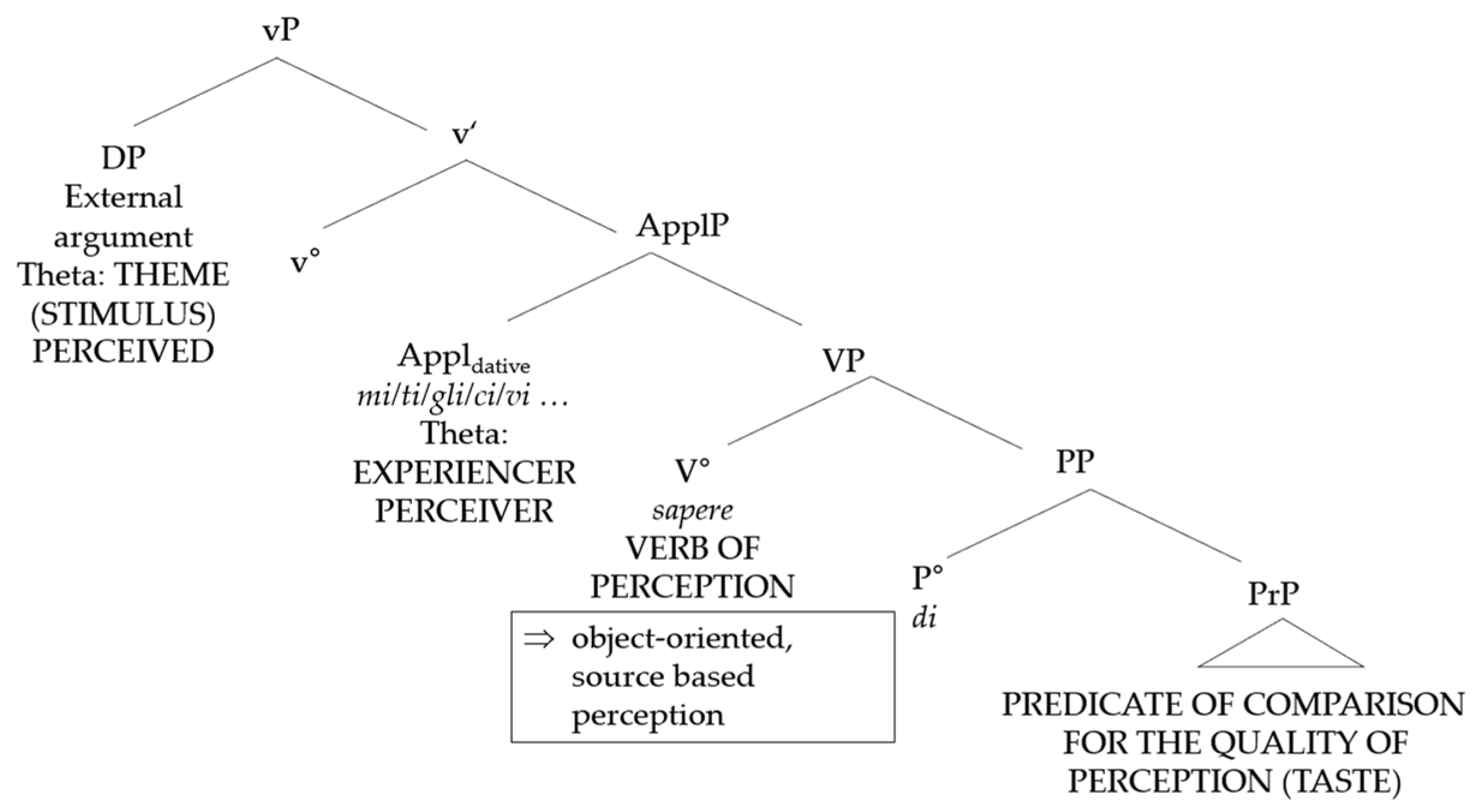
In Section 2, we investigated the argument structure of the perception verb sapere di, which is the origin of the epistemic marker mi sa. The subject and external argument of this perception verb constitute the entity that serves as a stimulus for the perception. The quality of taste is part of the predicate sapere di. We represent the optional realization of the experiencer in the position of high applicatives as proposed for Italian or Romance by Folli and Harley (2006, p. 136) and Roberge and Troberg (2009, p. 164). Thus, the argument structure of sapere di can be represented as in Figure 2.11
The subject has the thematic role of a theme, since sapere di is an object-oriented (Whitt, 2010, 2011) and source-based (Viberg, 1983) perception verb. Since the quality of taste is part of the predicate, sapere di + taste, it cannot be omitted.
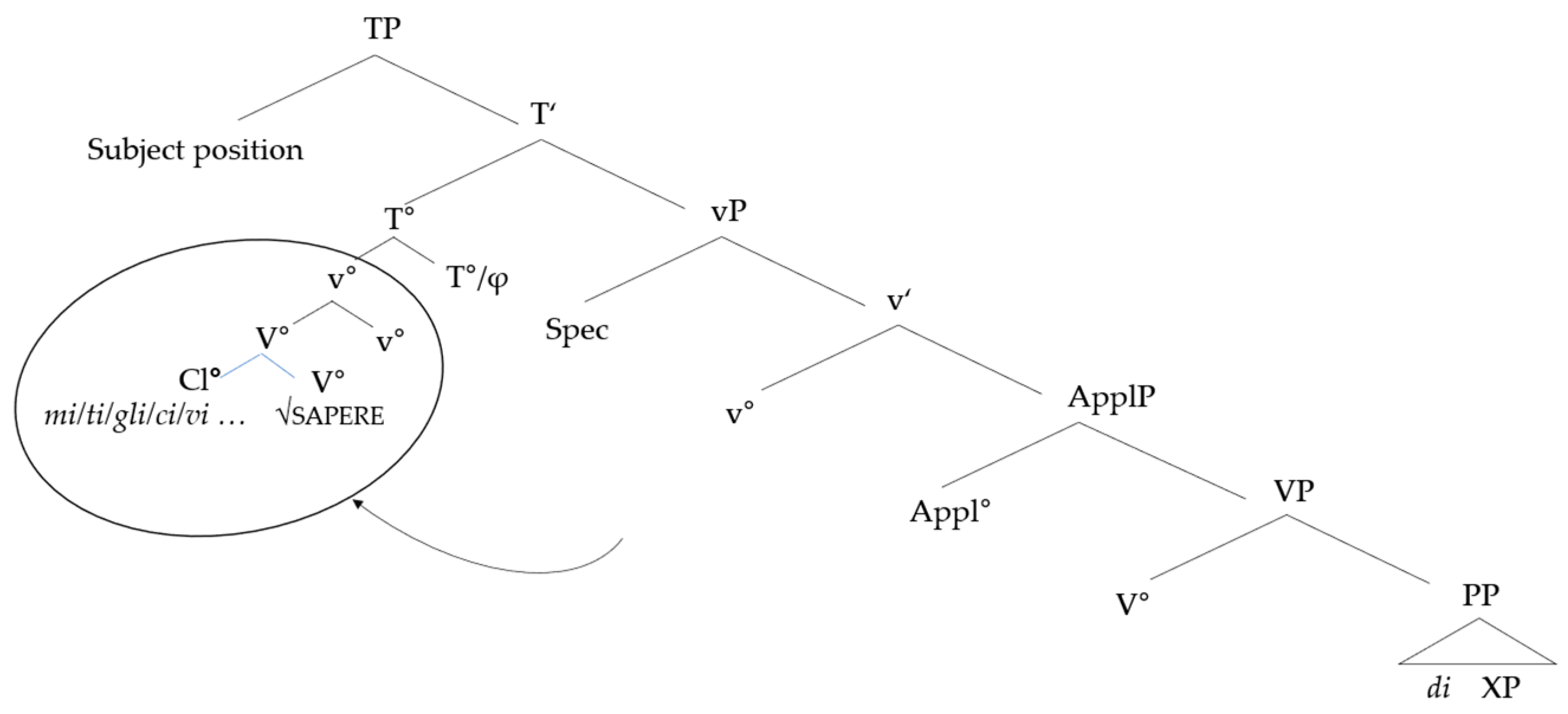
As the syntactic derivation proceeds, verb movement to little v° and T° takes place, the subject moves to [Spec, TP] and agrees with the verb, whereas the applicative, when it is a clitic pronoun, has to attach to the finite verb in a proclitic position, as in Figure 3.
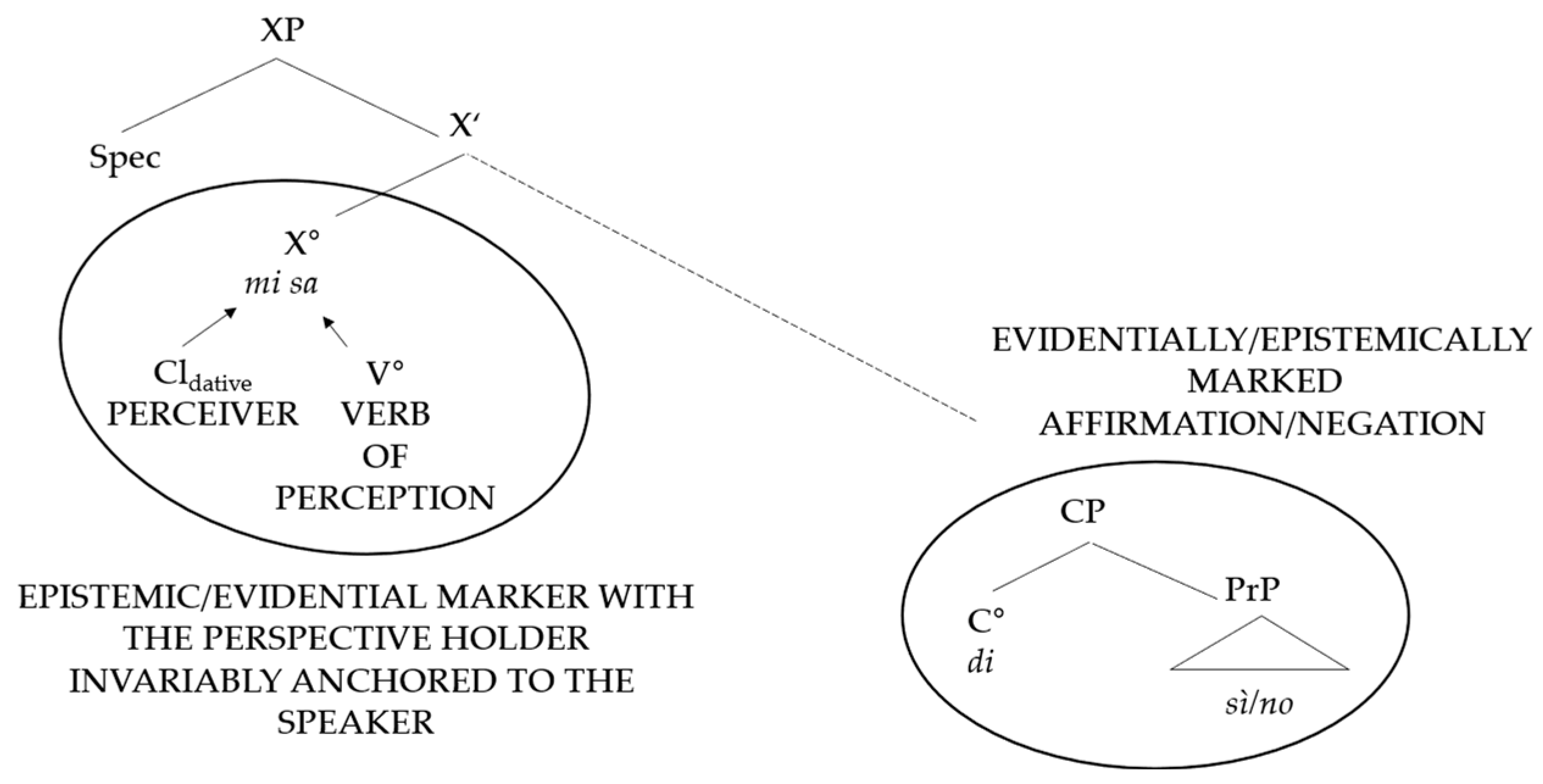
Therefore, the clitic and the verb build a complex head in an adjacent position. Now, the experiencer in the first person is naturally the most frequent overtly appearing experiencer, since it indicates the speaker who has direct, proximal access to what s/he perceives, whereas other persons are less frequent and mostly appear in narratives (e.g., free indirect discourse). This opens the path towards the grammaticalization of mi sa and its reinterpretation as a single element connected to the epistemic state of the speaker. The perspective holder now becomes obligatory. In affirmative or negated epistemically marked answers to the QUD, the new marker can be interpreted as sitting in a functional category that is higher than its original position, as in Figure 4.
In examples like (24), the former predicate sapere di has developed into a fixed and invariable expression encoding epistemically marked affirmation or negation.
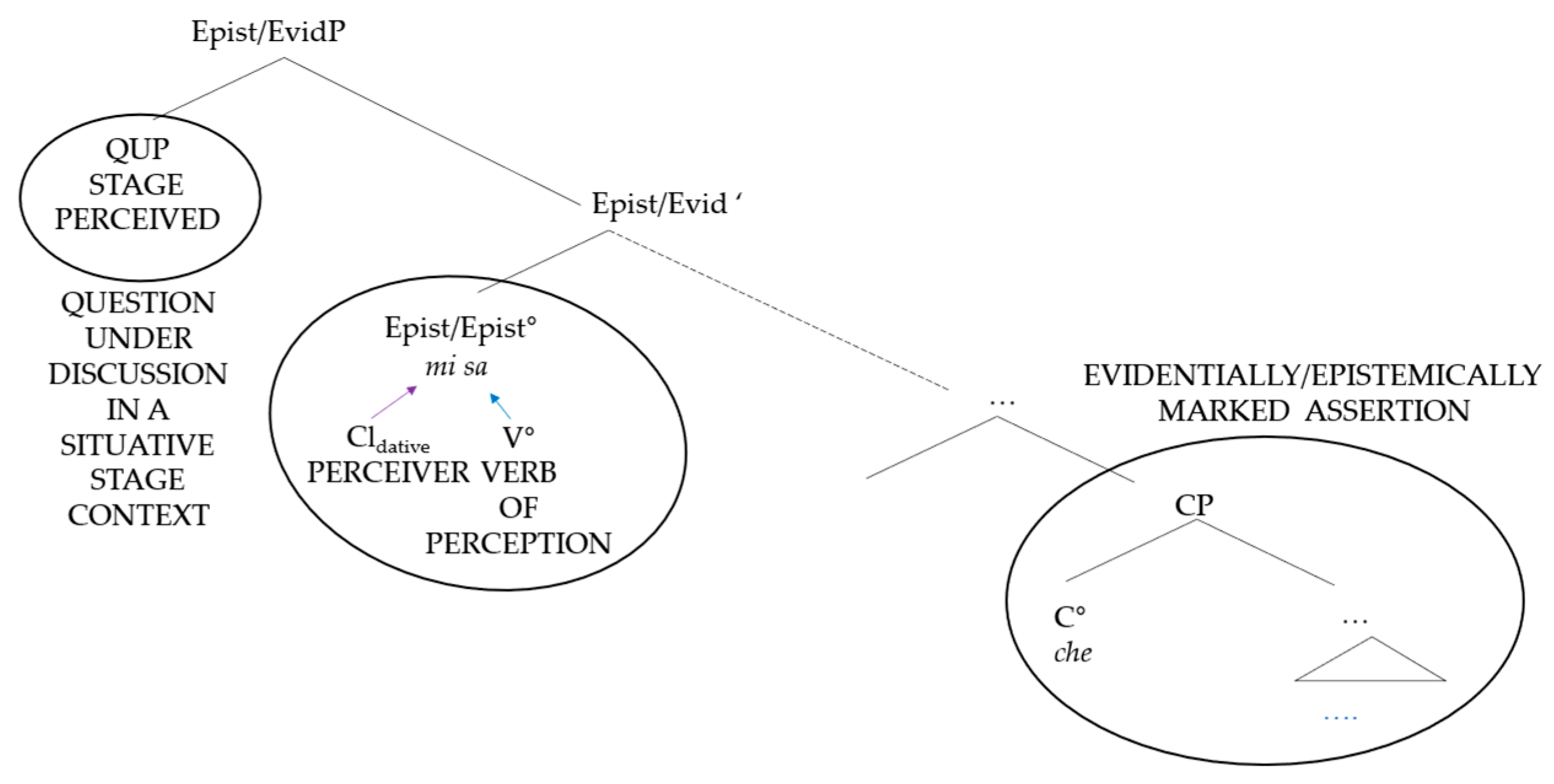
The new position of mi sa can be assumed to be Cinque’s epistemic or evidential projection (Moodevidential, Modepistemic, see Cinque, 1999), the epistemic or evidential projection in Speas and Tenny’s (2003) speech act phrase (SAP), or some other similar projections proposed in recent syntactic theory, in which mi sa occupies the position of head (cf. also Cruschina & Remberger, 2018, for their “C-constructions”). The former stimulus, the subject of the original sapere di, is no longer visible, whereas the CP followed by mi sa, as in Figure 5, contains the main—epistemically marked—assertion of the utterance. The latter contains, as our study shows, fewer cases of “evaluations” and more futurate (“unreal”) or non-anterior (“descriptions”) complements than credo. This means that the stimulus now has to be available in the contextual environment of the speech act and the assertion that relates to it has to be inferred by the speaker. Indeed, we have already seen that the stage context of mi sa usually contains a QUD whose answer can thus be inferred from something present in the situation of the speech act. It is therefore consistent to assume that, as the former stimulus for the perception of the quality of taste, the QUD in the situative stage context is the covert “subject” of the epistemic modalization of the assertion.
Moreover, the “taste” perceived is no longer expressed; what remains instead is an epistemic value inferred from something present in the situative context (the former stimulus). As a fixed adverbial-like expression, the newly born marker can climb up the tree and develop new mobility, particularly when it appears in parenthetical positions, the derivation of which still requires further research. The formerly embedded CP loses che—another open issue to be discussed—and acquires main-clause status, containing the main proposition.

9. Conclusions

To conclude, our paper offers a substantial corpus study of the so-far under-investigated colloquial Italian discourse marker mi sa, comparing it with the Italian credo (‘I believe/I think’). On the basis of the corpus data from KIParla, the semantic properties of mi sa were investigated in detail, and significant, previously unnoticed differences between mi sa and the Italian verb for belief credo were identified. Furthermore, the grammaticalization of mi sa from a perceptual verb of taste to an epistemic discourse marker was outlined.
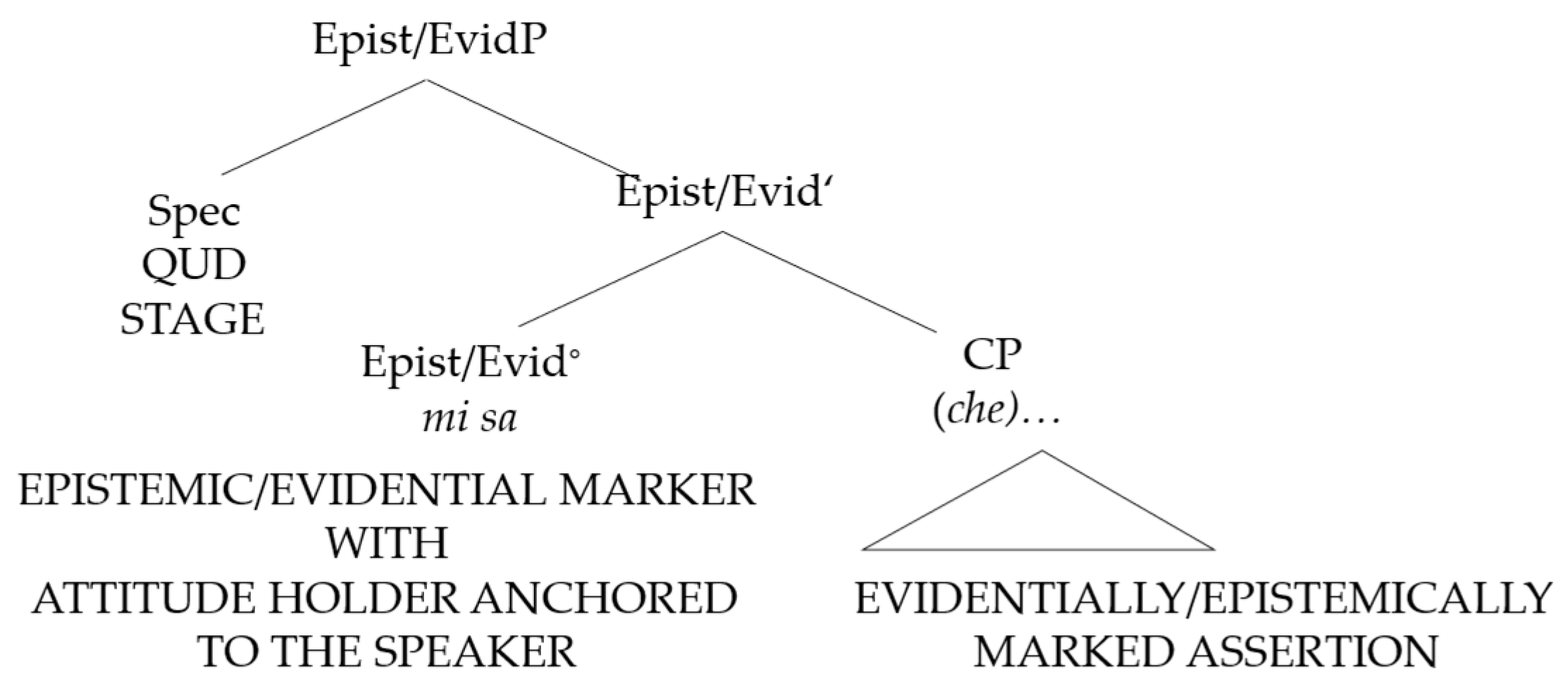
Mi sa ends up as a grammaticalized invariable epistemic/evidential marker in the left periphery, invariably encoding the speaker as the perspective holder (see Figure 6).
As might have become clear based on the data analyzed in our paper, mi sa is thus highly context-dependent: Besides the need to establish reliable criteria for the identification of the context-dependent QUD, there are multiple other aspects still requiring further study, such as the development of parenthetical positions, the loss of che, the corresponding (forward and backward) scope properties of mi sa, the possible ellipsis of contextual retrievable material, and the information-structural partition of the content of the utterance. With regard to the syntactic analysis, in many recent proposals, a finer-grained upper-left periphery that serves as an interface to the speech act itself has been proposed (cf. Speas & Tenny, 2003; Wiltschko, 2021; Miyagawa, 2022; Krifka, 2023, a.o.). Therefore, an investigation of the mechanisms of feature checking between mi sa and higher functional categories such as those encoding the perspective of the speaker; the connection to the speaker’s mental state; and the evidence for the modalized assertion, among other issues, would be a welcome follow-up to our paper, which must thus be seen as an first theoretical approach to the development of the taste verb sapere di into the epistemic marker mi sa.

Author Contributions

Conceptualization, methodology, analysis and writing, A.M. and E.-M.R.; A.M. is particularly responsible for Section 4, Section 5, Section 6, Section 7, Section 7.1, Section 7.2 and Section 7.3; E.-M.R. is particularly responsible for Section 1, Section 2, Section 3, Section 7.4, and Section 8. Both authors are responsible for Section 9. Supervision, project administration and funding acquisition, E.-M.R. All authors have read and agreed to the published version of the manuscript.

Funding

This research was funded by the Austrian Science Fund (FWF), 10.55776/F1003, Language between Redundancy and Deficiency (subproject P08: Fading Reference—The pragmaticalization of pronoun+verb).

Institutional Review Board Statement

Not applicable.

Informed Consent Statement

Not applicable.

Data Availability Statement

The original data presented in the study are openly available in KiParla at http://www.kiparla.it (accessed on 1 July 2025) and the Repubblica Corpus at http://sslmit.unibo.it/repubblica (accessed on 24 August 2025).

Acknowledgments

We thank audience of the SLE 2026 workshop “The syntax and semantics of perception” in Bordeaux and of the CIDSM 2025 in Chieti for their reactions and input. We also would like to thank two anonymous reviewers for their valuable comments. All remaining errors are ours.

Conflicts of Interest

The authors declare no conflicts of interest.

Abbreviations

The following abbreviations are used in this manuscript:
agagent
ApplPapplicative phrase
clclitic
CPcomplementizer phrase
datdative
DPdeterminer phrase
EvidPevidential phrase
EpistPepistemic phrase
futfuture
ipfimperfect
partpartitive
PPprepositional phrase
PRpredicate phrase
SAPspeech act phrase
sgsingular
Specspecifier
TPtense phrase
vP“little” verb phrase
VPverb phrase
QUDquestion under discussion

Notes

1
Aikhenvald and Storch (2013, p. 20) state that Viberg’s hierarchy is “based on false parameters of typological variation and on a dubious assumption of intrafield polysemies.” They cite several examples of languages that contradict this unidirectional hierarchy, such as Vedic, for which they maintain that auditory perception is higher-ranked (Aikhenvald & Storch, 2013, p. 2).
2
An anonymous reviewer noted that a further distinction between smell and taste would be that smell can rely on shared experience, and this “shareability” would make it more “objective” than taste.
3
The alternating verbs are marked in bold.
4
The song goes […] Ti ricordi davvero di me?/O ti ricordi perché?/I sentieri di pietra correvo e ridevo a te/ti baciavo e sapevi di sale/e di cose belle da fare… ‘do you really remember me?/Or do you remember why?/The paths of stone I was running and laughing at you/I kissed you and you had the taste of salt and of nice things to do …’.
5
The distinction between higher applicatives and lower datives goes back to Pylkkänen (2008). High applicatives are additional arguments, which are not part of the event structure but typically encode viewpoint holders (see also the so-called “ethical datives”) introducing an attitudinal relation between them and the event.
6
In this contribution, we do not delve into the distinction between epistemic and evidential meaning. Here, we use the hyperonym for both terms provided by Boye (2012); in the rest of the work, we more often refer to the notion of epistemic modality, since it is the one more widely used in in studies on Italian, especially those analyzing the meaning of credo.
7
Of course, a thorough, systematic and data-based study of the development of epistemic mi sa from the taste verb sapere di is still a desideratum to be carried out in future studies.
8
The term pragmaticalization is used in the literature to describe the diachronic development of modal particles and discourse markers, which exhibit peculiar characteristics relative to canonical grammaticalized elements, e.g., optionality, widening in scope, and a lack of bondedness (Norde, 2009; Diewald, 2011; Heine, 2013, among others). A fully fledged differentiation between grammaticalization and pragmaticalization presupposes a clear-cut distinction between grammatical and discourse-related functions, and the consequential attribution of markers of epistemicity to either of the two categories. A thorough exploration of this categorization falls outside the interests of this research. Nonetheless, the concept of pragmaticalization turns out to be useful for our case study because it comprises one of the features resulting from the diachronic change of mi sa, i.e., syntactic mobility.
9
Note, however, that the challenge can be easily cancelled or neutralized, since it is possible to reconcile the two obviously contradicting sentences, admitting that both can be true, by adding the overt perspective holders—B could continue the dialogue by saying the following:
(i)
B: Non sa di tappo per me, ma sa di tappo per te.
Cf. also Koelbel (2004) for the notion of “faultless disagreement”.
10
This study excludes infinitival complement clauses, which are frequently selected by credo and more rarely by mi sa and could in principle correlate with some of our semantic categories. To establish whether or not this exclusion has any impact on the results, we ran a different experiment adding this type of complement (for credo). These were 23 extra examples distributed fairly evenly across the semantic categories, and the difference in the distribution of mi sa and credo with respect to our semantic categories was still highly significant (X2 = 27.4103, p < 0.00001).
11
Of course, the figures presented here are simplifications of the syntactic derivations and mainly serve as visualizations for the “persistence” of the argument structure of the original taste verb in the epistemic marker studied here.

References

  1. Aikhenvald, A. (2004). Evidentiality. Oxford University Press. [Google Scholar]
  2. Aikhenvald, A., & Storch, A. (2013). Linguistic expression of perception and cognition: A typological glimpse. In A. Aikhenvald, & A. Storch (Eds.), Perception and cognition in language and culture (pp. 1–46). Brill. [Google Scholar]
  3. Aronoff, M., & Lindsay, M. (2016). Competition and the lexicon. In Livelli Di Analisi e Fenomeni Di Interfaccia, Atti del XLVII congresso internazionale della Società di Linguistica Italiana, Fisciano, Salerno, 26–28 September 2013 (pp. 39–52). Bulzoni Editore. [Google Scholar]
  4. Baroni, M., Bernardini, S., Comastri, F., Piccioni, L., Volpi, A., Aston, G., & Mazzoleni, M. (2004). Introducing the “la Repubblica” corpus: A large, annotated, TEI(XML)-compliant corpus of newspaper Italian. Proceedings of LREC 2004. Repubblica-Corpus. Available online: http://sslmit.unibo.it/repubblica (accessed on 24 August 2025).
  5. Bazzanella, C. (1995). I segnali discorsivi. In L. Renzi, G. Salvi, & A. Cardinaletti (Eds.), Grande grammatica italiana di consultazione, Vol. 3: Tipi di frase, deissi, formazione delle parole (pp. 225–257). Il Mulino. [Google Scholar]
  6. Benton, M. A., & Van Elswyk, P. (2019). Hedged assertion. In S. Goldberg (Ed.), The Oxford handbook of assertion. Oxford University Press. [Google Scholar]
  7. Blumenthal, P., & Rovere, G. (1998). PONS Wörterbuch der italienischen Verben: Konstruktionen, Bedeutungen, Übersetzungen. Klett. [Google Scholar]
  8. Boye, K. (2012). Epistemic meaning. De Gruyter Mouton. [Google Scholar] [CrossRef]
  9. Bozzone Costa, R. (1991). L’espressione della modalità non fattuale nel parlato colloquiale (con particolare riferimento agli usi del futuro). Quaderni Del Dipartimento Di Linguistica e Letterature Comparate, 7, 25–73. [Google Scholar]
  10. Cialdini, F. (2012). Accademia della crusca—Mi sa che…. Available online: https://accademiadellacrusca.it/it/consulenza/mi-sa-che/742 (accessed on 3 May 2025).
  11. Cinque, G. (1999). Adverbs and functional heads. Oxford University Press. [Google Scholar]
  12. Cruschina, S., & Remberger, E.-M. (2008). Hearsay and reported speech: Evidentiality in Romance. Rivista Di Grammatica Generativa, 33, 99–120. [Google Scholar]
  13. Cruschina, S., & Remberger, E.-M. (2018). Speaker-oriented syntax and root clause complementizers. Linguistic Variation, 18(2), 336–358. [Google Scholar] [CrossRef]
  14. Diewald, G. (2011). Pragmaticalization (defined) as grammaticalization of discourse functions. Linguistics, 49, 390. [Google Scholar] [CrossRef]
  15. Erteschik-Shir, N. (1997). The dynamics of focus structure. Cambridge University Press. [Google Scholar]
  16. Folli, R., & Harley, H. (2006). Benefactives aren’t goals in Italian. In J. Doetjes, & P. González (Eds.), Romance languages and linguistic theory 2004: Selected papers from ‘Going Romance’, Leiden, 9–11 December 2004 (pp. 121–142). John Benjamins. [Google Scholar]
  17. Giorgi, A., & Pianesi, F. (2005). Credo (I Believe): Epistemicity and the syntactic representation of the speaker. Working Papers of Linguistic, 15, 105–152. [Google Scholar]
  18. Heine, B. (1993). Auxiliaries: Cognitive forces and grammaticalization. Oxford University Press. Available online: https://archive.org/details/auxiliariescogni0000hein (accessed on 1 March 2026).
  19. Heine, B. (2013). On discourse markers: Grammaticalization, pragmaticalization, or something else? Linguistics, 51, 1247. [Google Scholar] [CrossRef]
  20. Herbeck, P. (2021). Perspectival factors and pro-drop: A corpus study of speaker/addressee pronouns with creer ‘think/ believe’ and saber ‘know’ in spoken Spanish. Glossa: A Journal of General Linguistics, 6(1), 1. [Google Scholar] [CrossRef]
  21. Hooper, J. B. (1975). On assertive predicates. In J. P. Kimball (Ed.), Syntax and semantics (Vol. 4, pp. 91–124). Academic Press. [Google Scholar]
  22. Hopper, P. J. (1991). On some principles of grammaticization (B. Heine, & E. C. Traugott, Eds.; Vol. 19, pp. 17–36). John Benjamins. [Google Scholar] [CrossRef]
  23. Hopper, P. J., & Traugott, E. C. (2003). Grammaticalization (2nd ed.). Cambridge University Press; Cambridge Core. [Google Scholar] [CrossRef]
  24. Kaiser, E. (2021). Consequences of sensory modality for perspective taking: Comparing visual, olfactory and gustatory perception. Frontiers in Psychology, 12, 701486. [Google Scholar] [CrossRef]
  25. Koelbel, M. (2004). Faultless disagreement. Proceedings of the Aristotelian Society, 104, 55–73. [Google Scholar] [CrossRef]
  26. Korsmeyer, C. (1999). Making sense of taste: Food and philosophy. Cornell University Press. [Google Scholar]
  27. Krifka, M. (2023). Layers of assertive clauses: Propositions, judgements, commitments, acts. In J. M. Hartmann, & A. Wöllstein (Eds.), Propositionale argumente im sprachvergleich/Propositional arguments in cross-linguistic research: Theorie und empirie/Theoretical and empirical issues (pp. 116–183). Narr. [Google Scholar]
  28. Lasersohn, P. (2005). Context dependence, disagreement, and predicates of personal taste. Linguistics and Philosophy, 28(6), 643–686. [Google Scholar] [CrossRef]
  29. Mari, A. (2016). Assertability conditions of epistemic (and fictional) attitudes and mood variation. Proceedings from Semantics and Linguistic Theory, 26, 81. [Google Scholar] [CrossRef]
  30. Mauri, C., Ballarè, S., Goria, E., Cerruti, M., & Suriano, F. (2019). KIParla corpus: A new resource for spoken Italian. In R. Bernardi, R. Navigli, & G. Semeraro (Eds.), Proceedings of the 6th Italian conference on computational linguistics CLiC-it. CEUR Workshop Proceedings. Available online: http://www.kiparla.it (accessed on 1 July 2025).
  31. Miyagawa, S. (2022). Syntax in the tree tops. MIT Press. [Google Scholar] [CrossRef]
  32. Norde, M. (2009). Degrammaticalization. Oxford University Press. [Google Scholar]
  33. Orletti, F. (1995). Modalità epistemica ed epistemologia in Medina: Analisi di un caso. In A. Giacalone Ramat, & G. Crocco Galèas (Eds.), From pragmatics to syntax. Modality in second language acquisition (pp. 365–384). Narr. [Google Scholar]
  34. Pylkkänen, L. (2008). Introducing arguments. MIT Press. [Google Scholar]
  35. Riccioni, I., Zuczkowski, A., Burro, R., & Bongelli, R. (2022). The Italian epistemic marker mi sa [to me it knows] compared to so [I know], non so [I don’t know], non so se [I don’t know whether], credo [I believe], penso [I think]. PLoS ONE, 17, e0274694. [Google Scholar] [CrossRef]
  36. Roberge, Y., & Troberg, M. (2009). The high applicative syntax of the dativus commodi/incommodi in Romance. Probus, 21(2), 247–287. [Google Scholar] [CrossRef]
  37. Roberts, C. (2012). Information structure: Towards an integrated formal theory of pragmatics. Semantics and Pragmatics, 5(6), 1–69. [Google Scholar] [CrossRef]
  38. Sansò, A. (2020). I segnali discorsivi. Carocci. [Google Scholar]
  39. Schneider, S. (2007). Reduced parenthetical clauses: A corpus study of spoken French, Italian and Spanish (1st ed.). J. Benjamins. [Google Scholar]
  40. Serianni, L. (2012).  Mi sa. Bollettino di Italianistica, 9(2), 18–23. [Google Scholar]
  41. Siri, V. (1677). Memorie recondite di Vittorio Siri dall’anno 1601. fino all’anno 1641. National Central Library of Rome. [Google Scholar]
  42. Speas, P., & Tenny, C. (2003). Configurational properties of point of view roles. In A. M. Di Sciullo (Ed.), Asymmetry in grammar 1 (pp. 315–344). John Benjamins. [Google Scholar] [CrossRef]
  43. Stalnaker, R. (1978). Assertion. In P. Cole (Ed.), Syntax and semantics (Vol. 9, pp. 315–332). Academic Press. [Google Scholar]
  44. Stephenson, T. (2007). Judge dependence, epistemic modals, and predicates of personal taste. Linguistics and Philosophy, 30(4), 487–525. [Google Scholar] [CrossRef]
  45. Sweetser, E. (1990). From etymology to pragmatics: Metaphorical and cultural aspects of semantic structure. Cambridge University Press. [Google Scholar]
  46. Traugott, E. C. (1989). On the rise of epistemic meanings in English: An example of subjectification in semantic change. Language, 65, 31–55. [Google Scholar] [CrossRef]
  47. Travis, C. E. (2006). Dizque: A Colombian evidentiality strategy. Linguistics, 44, 1297. [Google Scholar] [CrossRef]
  48. Viberg, Å. (1983). The verbs of perception: A typological study. Linguistics, 21(1), 123–162. [Google Scholar] [CrossRef]
  49. Whitt, R. J. (2010). Evidentiality, polysemy, and the verbs of perception in English and German. Peter Lang. [Google Scholar]
  50. Whitt, R. J. (2011). (Inter)Subjectivity and evidential perception verbs in English and German. Journal of Pragmatics, 43(1), 347–360. [Google Scholar] [CrossRef]
  51. Willett, T. (1988). A crosslinguistic survey of the grammaticization of Evidentiality. Studies in Language, 12(1), 51–97. [Google Scholar] [CrossRef]
  52. Wiltschko, M. (2021). The grammar of interactional language. Cambridge University Press. [Google Scholar]
Figure 1. The graph in (a) shows the distribution of the semantic categories within the scope of mi sa. The graph in (b) shows the distribution of the semantic categories within the scope of credo.
Languages 11 00054 g001
Figure 2. Argument structure of the original taste verb construction.
Languages 11 00054 g002
Figure 3. Syntactic derivation of the original taste verb construction.
Languages 11 00054 g003
Figure 4. Syntactic derivation of epistemic mi sa di sì/di no.
Languages 11 00054 g004
Figure 5. Syntactic derivation of epistemic mi sa che….
Languages 11 00054 g005
Figure 6. The epistemic marker mi sa (che)….
Languages 11 00054 g006
Table 1. Distribution of mi sa vs. distribution of credo according to the semantic categories.10
DescriptionMind SelfMind OtherEvaluationUnrealTotal
mi sa15263.6%73%125%177.1%5121.3%239100%
credo15861.5%31.2%145.4%5521.4%2710.5%257100%
Disclaimer/Publisher’s Note: The statements, opinions and data contained in all publications are solely those of the individual author(s) and contributor(s) and not of MDPI and/or the editor(s). MDPI and/or the editor(s) disclaim responsibility for any injury to people or property resulting from any ideas, methods, instructions or products referred to in the content.