
The Back-and-Forth of assim que in the History of Portuguese

Abstract
1. Introduction
- (1)
- É provável que o criminoso mude o e-mail e número de telefone associados a uma conta assim que consegue o acesso. (Público, 23 February 2023)‘It is likely that the criminal will change the email and phone number associated with an account as soon as they gain access.’
- (2)
- No había aire acondicionado, así que había que buscarse la vida.(El País, 14 August 2025)‘There was no air conditioning, so you had to make do on your own.’
2. Previous Studies
2.1. Assim/Assim que in Portuguese
| (3) | Et | si | adsi | non | fecerit, | per | hi | cadat… |
| and | if | thus | not | has.done | by | these | may.fall.3sg | |
| ‘And if he does not do so, let him fall because of these…’ | ||||||||
- (4)
- mais los ángeos chegaron/dizendo: “Estad’, estade!/ca non quér Santa María/que a vós assí levedes.” (Afonso X, 13th century/2021, p. 102)‘But the angels arrived/saying: “Wait, wait!/because Saint Mary does not wish/you to take her (the soul) away in this way.”’
- (5)
- e porẽ lhe rogava que lhe outorgasse de lhe chamarẽ rey de Portugal, e que lhe assi o chamasse ẽ suas cartas e privilégios. (Crónica Geral de Espanha, 1344, p. 1776)‘And for that reason, he asked them to grant him permission to be called King of Portugal, and that he might be addressed as such in their letters and privileges.’
- (6)
- chorava e nom sabia porquê, disse assi: —Senhora Santa Maria, madre de piedade, socorre-me e nom me leixe ainda morrer. (Demanda do Santo Graal, 1210–1240, p. 1776)‘He wept and knew not why, and said thus: —Lady Saint Mary, mother of mercy, help me, and do not let me die yet.’
- (7)
- E quando amanhece as mais das vezes está o ceo todo cuberto de nuuẽs, & assi as mais das manhaãs choue nestas partes… (Historia da Provincia de Santa Cruz, Gandavo, 1576, p. 1777)‘And when day breaks, most of the time the sky is completely covered with clouds, and therefore it rains on most mornings in these regions…’
- (8)
- começou o cavallo bullir rijamente coma as maãos e com os pees; e permeando assi rijamente, açertou o canello da ferradura da maão ho teçido dhuma fivalla… (Crónica de Dom Fernando, Lopes, 1436–1443, p. 155)‘The horse began to thrash its legs and feet vigorously; and, kicking so violently, it struck the shin against a metal buckle…’
- (9)
- —André, e não tem nenhuma outra história assim que você ficou sabendo que você possa me contar? (Iboruna Corpus, 21st century, p. 192)‘—André, isn’t there any other story like that one that you heard and could tell me?’
- (10)
- —ai não de amigo ahh… é muito triste… porque assim o amor pode não durar pra sempre mas pra mim a amizade… é pra sempre… porque você conhece a pessoa… (Iboruna Corpus, 21st century, p. 193)‘—Oh no, not from a friend, uhm… that’s really sad… because, like, love might not last forever, but for me friendship… it’s forever… because you really get to know the person…’
- (11)
- Fôram os mortos no lugar da briga 25 olandeses, & os mais dos uiuos firidos da espada, & frecha, fogindo com tanto desacordo, que largando os mosquetes, não puxauaõ das espadas. Assi se recolheraõ os nossos carregados dos despojos das armas do inimigo. (Jornada dos Vassalos, Guerreiro, 1625, p. 114)‘Twenty-five Dutchmen were killed at the site of the fight, and the survivors, wounded by swords and arrows, fled in such disorder that they abandoned their muskets and did not even draw their swords. Thus, our men withdrew, laden with the enemy’s spoils.’
- (12)
- Quem duuida disso? que como de tres tirando huu, não fica ternario, assi tirando de hua substancia o que é proprio da substancia da cousa, já não fica a mesma cousa. (Desengano dos Perdidos, Leão, 1573, p. 115)‘Who doubts this? Just as, when one is subtracted from three, it is no longer a triad, so when what is proper to a substance is removed from it, it is no longer the same thing.’
- (13)
- Per aazo do cuydado que ei porque som pastor das almas, o meu coraçõ padece os negocios dos homẽs segraes […] E, assy que entendo aquello que padeço e ẽtendo aquello que perdy, faze-sse a mĩ mays graue aquello que soffro. (O Orto do Esposo, 14th–15th c., as cited in Santos & Silva, 2019, p. 62)‘Because of the care I bear, as I am a shepherd of souls, my heart suffers from the affairs of worldly men […] And thus, as I understand what I endure and realize what I have lost, what I suffer becomes all the more grievous to me.’
- (14)
- Não foi preciso que os sucessos verificassem aquele vaticínio, porque Vossa Majestade assim que veio ao mundo, só com se mostrar, disse o que havia de ser. (Reflexões sobre a vaidade dos homens, Aires, 18th century, as cited in Santos & Silva, 2019, pp. 63–64)‘It was not necessary for events to confirm that prophecy, because Your Majesty, as soon as you came into the world, merely by appearing, revealed what you were destined to be.’
2.2. Así/Así que in Spanish
- (15)
- Ese es uno de los problemas, pero hay otros. Así, el progresivo deterioro de la capacidad lingüística de los españoles. (El dardo en la palabra, Lázaro Carreter, 1997, as cited in Martín Zorraquino & Portolés Lázaro, 1999, p. 4105)‘That is one of the problems, but there are others. For instance, the progressive deterioration of the linguistic ability of Spaniards.’
- (16)
- —Padre, si me condenaste a la soledad, ¿por qué no me arrancaste los ojos? Así no lo hubiera visto. (La hija de Rappaccini, Paz, 1983, as cited in Martín Zorraquino & Portolés Lázaro, 1999, p. 4106)‘—Father, if you condemned me to solitude, why didn’t you tear out my eyes? That way I would not have seen it.’
- (17)
- así used cataphorically to introduce a subordinate clause → así…que with a modal/consecutive or final/consecutive meaning → fully grammaticalized así que (in its continuous form).
- (18)
- discontinuous consecutive connector → continuous consecutive connector → discursive connector → continuative (sequential) marker → verbal filler.
- (19)
- Encara es otorgado mas a los infançones. que pueden escaliar… Enpero assi que por aquesta compra no desfagan el cabo maso… (Fueros de Aragón, 1247)‘It is still granted more to the noblemen, who can climb… But so that, with this purchase, they must not undo the end of the hammer…’
- (20)
- Et aun a esta piedra otra uertud que da muy grand alegria al coraçon assi que el que la cata de mannana andara alegre todo aquel dia (Lapidario, Afonso X, 1253)‘And moreover, this stone possesses another virtue: it brings great joy to the heart, so that whoever looks at it in the morning will be cheerful throughout the day.’
- (21)
- Diós sea conmigo, y cayó muerto en el suelo, y así que cayó lo arrebataron sus enemigos. (Fragmentos de una historia de Nueva Galicia, Tello, 1650, p. 126)‘God be with me—and he fell dead to the ground, and as soon as he fell, his enemies seized him.’
- (22)
- Así que calmó un poco su primera cólera, subió a ver a su hija. (Suprema Ley, Gamboa, 1896, p. 217)‘As soon as his first anger subsided a little, he went upstairs to see his daughter.’
- (23)
- —Así que utilizas las bolsas de plástico para la basura.‘—So you use plastic bags for the trash!’
- (24)
- —Estás hecho todo un hombre, no se puede dudar. Ahora tenés un coche muy lindo. Así que el departamento... ¿tenés el departamento en el centro para una oficina? (El Habla Culta de Buenos Aires, 20th century, as cited in Hennemann & Schlaak, 2015, p. 13)‘You have really become quite the man, there is no doubt about it. Now you have got a very nice car. So, the apartment... you’ve got the apartment downtown for an office?’
- (25)
- [Context: The interlocutor questions the speaker about how he feels about his coming of age]—Claro, pero no se siente nada especial, ¿no? Es un año no más... Es un año solamente entre diecisiete y dieciocho... Así que...‘—Sure, but you don’t feel anything special, right? It’s just a year... only a year between seventeen and eighteen... so...’
3. Grammaticalization, Pragmaticalization and Analyzability
- Compositional meaning: assi(m)/así functions as an adverb and que as a connector.
- Non-compositional meaning I: assi(m)/así que functions as a conjunction.
- Non-compositional meaning II: assi(m)/así que functions as a discourse marker.
- They are often followed by a pause.
- They tend to occur in sentence-initial position.
4. Materials and Methods
4.1. Corpus and Data Retrieval
- assy|assi|assim + que
- assy|assi|assim + é|he|foi|foy|sendo
- Tratado da Sciencia Cabala (‘Treatise on the Science of Kabbalah’), by Francisco Manuel de Melo, considered as 17th-century rather than 18th-century material;
- O Livro da Montaria (‘Book of the Hunt’), by D. João I, considered as 15th-century, rather than 18th-century material.
- 1.
- Instances of independent assim + que, where que functions as an expletive conjunction expressing an optative or injunctive meaning, since these cases do not contribute to the grammaticalization of the consecutive meaning of assim que, as in (26) (cf. a list of the full text titles in Appendix A).11
- (26)
- e nam no fazendo assim que eses lauradores nam ssejam costrangidos pera o pagarem a djnheiro (14:Manuel:1498)‘and by not doing so, those plowmen will not be forced to pay it in money’
- 2.
- Instances in which assim is preceded by a modifier, such as tanto (‘so much’), likely represent compositional adverbial structures that did not undergo the syntactic reanalysis leading to the formation of the connector assim que. The presence of a modifier indicates that assim retains its lexical and syntactic autonomy in these contexts, suggesting that such constructions fall outside the grammaticalization pathway that produced the complex conjunction. Accordingly, we analyzed tanto assim in (27) as a complex adverb followed by a consecutive clause introduced by que:
- (27)
- Tanto assim que Santo Inácio disse que, se alguém jejuasse aos domingos ou sábados, excepto os da Semana Santa, esse tal era matador de Cristo. (16:Bernardes:Floresta)‘So much so that Saint Ignatius said that if anyone fasted on Sundays or Saturdays, except during those of Holy Week, that person was a slayer of Christ.’
4.2. Data Classification: General Aspects
- assim was classified as an anaphor or cataphor;
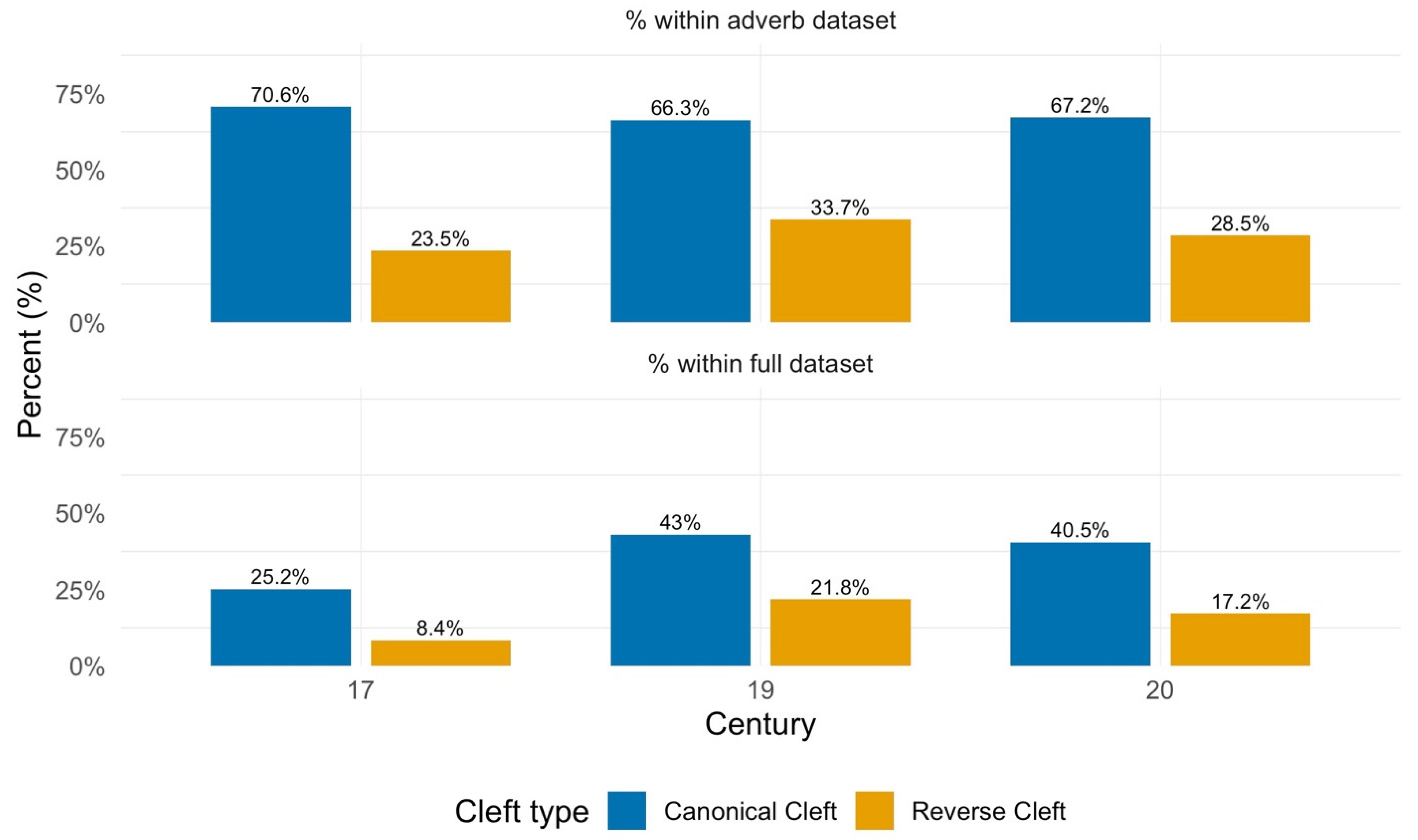
- que was classified according to the type of clause it introduced, e.g., a complement, relative, adverbial, or embedded cleft clause—either canonical (‘ser’ + assim + que) or reverse (assim + é + que).
- the semantic/pragmatic link connecting the clause introduced by assim que with the related unit (clause or discourse segment), and
- the rhetorical relation connecting the clause introduced by assim que with the related unit.
- a change in the discourse topic;
- a shift in the polyphonic source;
- the beginning of a new stage in the narrative, marked by a different communicative intention.
- (28)
- Logo à tarde acodirão trinta pessoas nobres... [e baptizou-os]. [Assim que neste dia baptizou duzentos.] (15:Frois:Japam)‘Later in the afternoon, thirty noble people arrived... [and he baptized them]. [Thus, on that day he baptized two hundred (people).]’
- (29)
- [quando eu livre minha alma de vossa mão, não na podereis livrar da presença do Senhor, porque ninguem pode fugir de sua vista nem de sua mão escapar vivo ou morto, que seu dominio e sobelos vivos e mortos.] [Assim que milhor sera que animosamente moura, e deixe ao meu povo exemplo de constancia...] (15:Usque:Israel)‘[when I have freed my soul from your hand, you will not be able to deliver it from the presence of the Lord, for no one can flee from His sight nor escape His hand, living or dead, since His dominion extends over both the living and the dead.] [Therefore, it will be better that I die courageously and leave my people an example of constancy...]’
4.3. Data Classification: Rhetorical Structure Theory
5. Results: The Back-and-Forth of assi(m) que
5.1. Assi(m) que in Old and Middle Portuguese
- (30)
- a.
- Andados seis ãnos do reynado deste rey Vuallya—que foy na era de quatrocentos e sesenta e dous ãnos—, aveo assim que Costancio patricio evyou dizer per suas cartas a rey Vuallia que lhe rogava que fosse ajudar os d’Espanha contra os barboros que os assenhoreavam mallamente. (14:CIPM:Demanda)‘Six years having passed in the reign of this King Vualia, which corresponded to the year 462, it happened thus that Constantius, the patrician, sent word by his letters to King Vualia, asking him to go help the people of Spain against the barbarians, who were oppressing them severely.’
- b.
- Et sse uosso senhor outra uez acó enviar seu messageyro, çerto seia que nuca lle aló tornará, Et a uós, conde, digo assý que uos gardedes de nõ estar mais en Salamjna… (14:CIPM:Demanda)‘And if your lord sends his messenger here again, let him be certain that he will never return from there. And to you, count, I say thus: take care not to remain any longer in Salamina…’
- (31)
- E os da outra parte não se atreverõ a viir empos elles ne de os cometer de nem uma guysa mas ficarom em seu outeyro que avyam tomado e teveronno. E steveron assim que nõ lydarom aquelles dous dias. (13:CIPM:CGEsp)‘And those on the other side did not dare to come against them nor attack them in any way, but remained on the hill they had taken and held. And they stayed so, such that they did not fight for those two days.’
- (32)
- e da outra parte passava huu barco de gente e seendo em meo do rio com grande arebatamento da agua começou se torvar o barco, assi que o que regia o barco desesperou de poderem sair em terra (15:FlosSanct)‘And on the other side, a boat carrying people was crossing, and when it reached the middle of the river, the strong current began to overturn it, so that the person steering the boat despaired of their being able to reach the shore’
- (33)
- empero suas proprias entenções nunca son senom en servirem bem a seus senhores e fazerem-lhes prazer, en tal guisa que, pollo prazer e serviço que lhes assi fazem, possam vir a aver delles bem. Assi que as entençõys non som iguaaes em bondade… (14/17:DJoao:Montaria)‘yet their own intentions are never anything but to serve their lords well and to please them, in such a way that, through the favor and service they thus render, they may come to receive some good from them. Therefore, the intentions are not equal in goodness…’
- (34)
- E assi andado ja ouve per muitas terras, assi que ouve chegado a Terena, u a Virgen fez muito miragr’ onrrado… (12:Mettman:CantigasSM3)‘And so, having already traveled through many lands, he thus arrived in Terena, where the Virgin performed a miracle for him, one of great honor…’
- (35)
- E a ssegunda maneira he como quãdo aiutam dous moesteyros ou duas eygreias en um de guisa que nõ he sometuda umã a outra mais que som yguaes assim que os que som mõges ou uelogos da umma som esse mesmo da outra & esse mesmo da outra & todalas cousas que am som comunaes tanbe aos ums como aos outros (13:Afonso:Partida1)‘And the second manner is when two monasteries or two churches assist one another in such a way that neither is subordinate to the other, but they are equals. Thus, those who are monks or clerics of one belong also to the other, and vice versa; and all the things they possess are common to both groups’
- (36)
- E se a virgem se calar nõ pecca: empero os taes aueran tribullaçom da carne Mas eu os perdo. assim que ysto digo Irmaãos ho tempo he breue (14:SantaMaria:Evangelhos)‘And if the virgin remains silent, she does not sin; however, such people will have trouble in the flesh. But I pardon them. In sum, I say to you, brothers: the time is short’
- (37)
- porque hera muito estimado & amado de todolos bõos da corte… se foram allgus fidallgos & gemtis homes da corte, os quaes rrequererão liçemça a ell rrey pera ho hir servir aquella çidade. assim que amtre os que foram do rregno & os que la estavã heram na çidade CC de cavallo. (14:CondeMeneses)‘because he was greatly esteemed and loved by all the honorable men of the court… some noblemen and gentlemen of the court went to him and requested the king’s permission to go serve him in that city. Thus, among those who came from the kingdom and those who were already there, there were two hundred horsemen in the city.’
- (38)
- Fidalgo: —Rijamente m’apertais e fazeis-me mentiroso que eu gabei-vos doutro jeito e s’eu tornar ao desfeito nam será proveito vosso.Ourives: —Assi que o meu saleiro peito?Fidalgo: —Ele é dos mais maus saleiros que eu em minha vida comprei.(15:Vicente:Obra1)‘Nobleman: —You press me too hard and make me out to be a liar, for I praised you differently before; and if I take back what I said, it will not be to your advantage.Goldsmith: —So (should I) offer my saltcellar?Nobleman: —It is one of the worst saltcellars I have ever bought in my life.’
- (39)
- E sse este amor & temor tẽdes bem ante vossos olhos sem duuida vos sooes no caminho que dereytamente vos leuara ao lugar onde vos chamamos. scilicet aas virtudes. Hora së duuida he assy que toda pesoa que bem ama deos. o deue mostrar per obras segundo elle mesmo diz no euãgelho… (15:Pisan:Cristina)‘And if you keep this love and fear clearly before your eyes, you will undoubtedly be on the path that will directly lead you to the place to which we call you, namely, to the virtues. Now, undoubtedly, it is thus that every person who truly loves God must show it by deeds, as He Himself says in the Gospel…’
- (40)
- E todo he muy graue mal e sinal de mayor. Oo, Senhor Jhesu Christo, leuãta-te e esperta-te, porque dormes e te esqueeces, Senhor, das nossas pobrezas e da nossa tribulaçom! Leuãta-te, Senhor, e nõ nos dessenpares ataa a fim! E, pois assy he que ẽnos tenpos dagora he theudo por sandeu aquelle que leixa muy pouca fazenda por seruir a nosso Senhor… (14:Maler:Orto)‘And all this is a very grave evil and a sign of something even worse. O Lord Jesus Christ, rise and awaken, for why do You sleep and forget, Lord, our poverty and our tribulation? Rise, Lord, and do not abandon us until the end! And since it is thus, in these times, anyone who leaves even a small portion of his possessions to serve our Lord is considered a madman…’
5.2. Assi(m) que in Classical and Modern Portuguese
- (41)
- & como taes, sempre ficão com o sabor da primeira agoa, que recebèrão, ainda que depois lhe lancem outra mais, ou menos saborosa. [Assim que V. R. A. chegar ao tempo da adolescencia, & nelle industriado na Doutrina Christãa; sem cujos documentos, & comprehensão não està idoneo para os empregos de seus espirituaes affectos;] [lembrese, que o amor de Deos he o primeiro mandamento da Ley Divina]… (16:Prazeres:Abedario)‘and as such, they always retain the taste of the first water they received, even if afterwards other water—more or less flavorful—is poured into them. [As soon as V. R. A. reaches adolescence, and is instructed in Christian Doctrine—without whose teachings and understanding you will not be fit for the duties of its spiritual affections—] [remember that the love of God is the first commandment of the Divine Law]…’
- (42)
- e assim o fez ao sermao, acabado o qual foi António Vaz queixar-se a el-Rei contra o Figueiredo, [que lhe disse] [assim que ele se pôs de joelhos]: —Folguei muito de vos ouvir. (17:Morais:Apotegmas)‘And so he did at the sermon, and after it ended, António Vaz went to complain to the King against Figueiredo, [who said to him] [as soon as he knelt down]:—I was very pleased to hear you.’
5.3. Analysis of the Diachronic Change Involving assi(m) que
- (43)
- o que o seu coração nos poderia contar d’interessante, d’original, d’inédito, provàvelmente o pudor lhe proibiu que o revelasse, e é assim que muitas vezes esta hipocrisia imposta dá aos livros de mulher a possibilidade de parecerem ter sido escritos por um homem. (18:Almeida:Gatos5)‘What your heart might have revealed to us—what is interesting, original, or previously unknown—was probably restrained by modesty; and it is in this way that such imposed hypocrisy often allows a woman’s book to appear as if it were written by a man’
- (44)
- Maria: —E bem sabeis, querida mãe, que eu ando há tanto tempo para ir àquele convento para conhecer a tia D. Joana.Jorge: —Sóror Joana: assim é que se chama agora. (18:Garrett:Sousa)‘Maria: —And you well know, dear mother, that I have been wanting for so long to go to that convent to meet Aunt D. Joana.‘Jorge: —Sister Joana: that is what she is called now.’
- Assim (relational dependent schema):
Semantic nucleus Profiling of Manner with contextual dependence Extension potential Deictic, Anaphoric or Cataphoric
- Assim que1 (resultative schema)
Relation Event A → Result B Orientation Cataphoric Processing Prospective scanning Inferential load Strong causal inference
- Assim que2 (immediate temporal schema)
Relation Event A → Result B Orientation Anaphoric with deictic persistence Processing Sequential scanning Inferential load Low causal inference
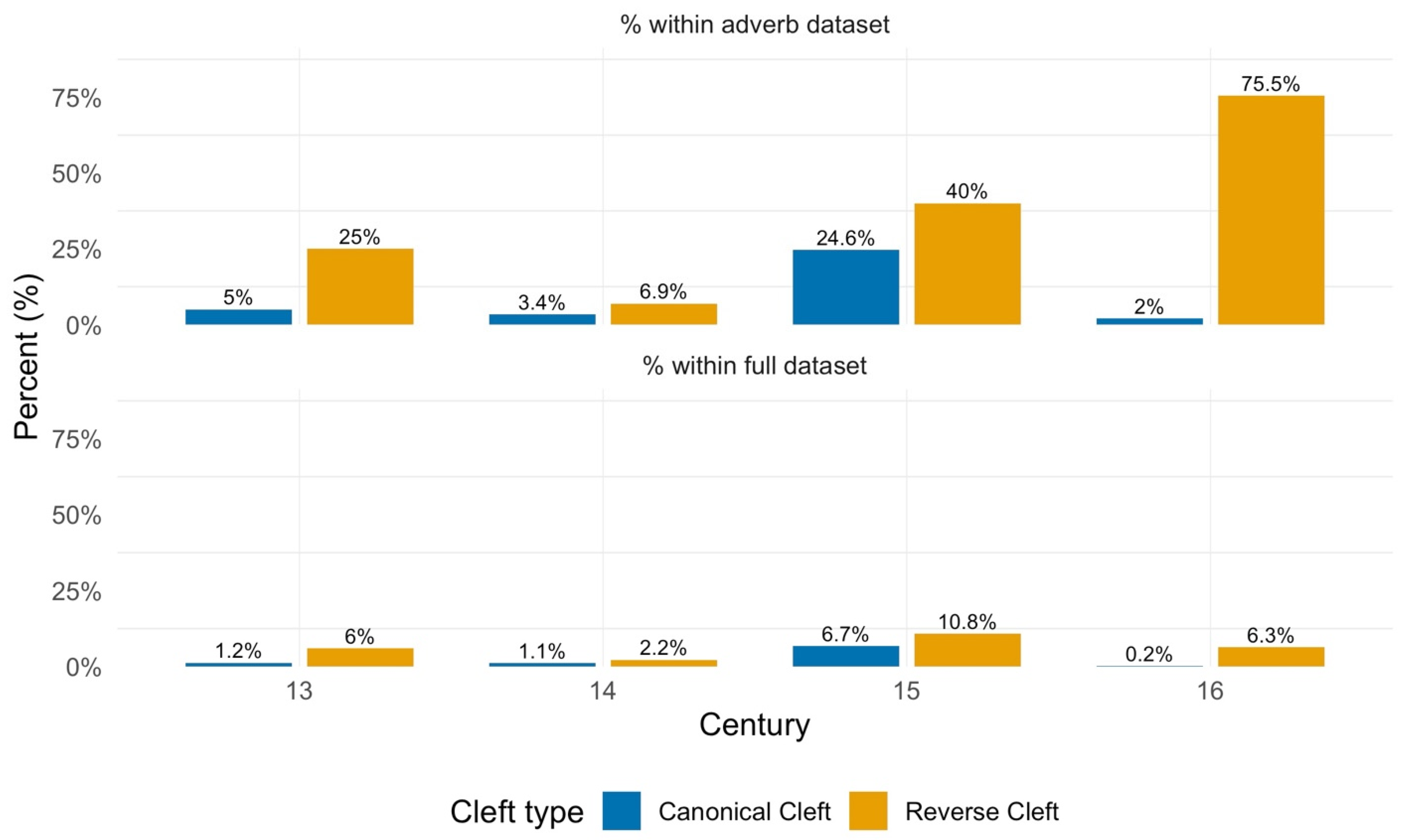
- É assim que/Assim é que (cleft frames)
Structure Copula (variable position), Assim, Que-clause - o
- Assim (adverb)
Semantic nucleus Profiling of Manner, [+Anaphoric], [+Deictic] Function Highlighting how an action or event occurred in relation to the previous context. - o
- Que-clause
Function Specifying the event or action described.
6. Discussion
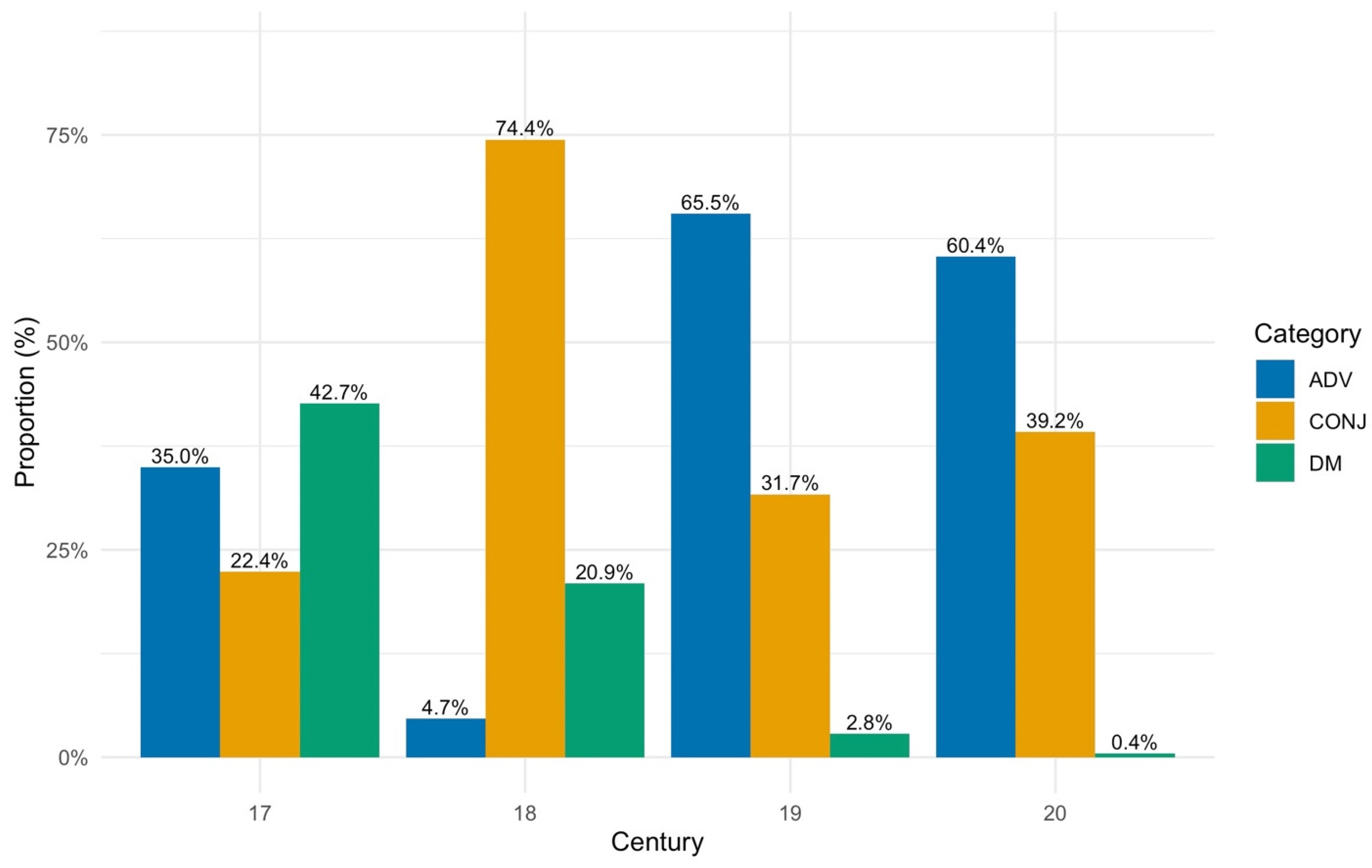
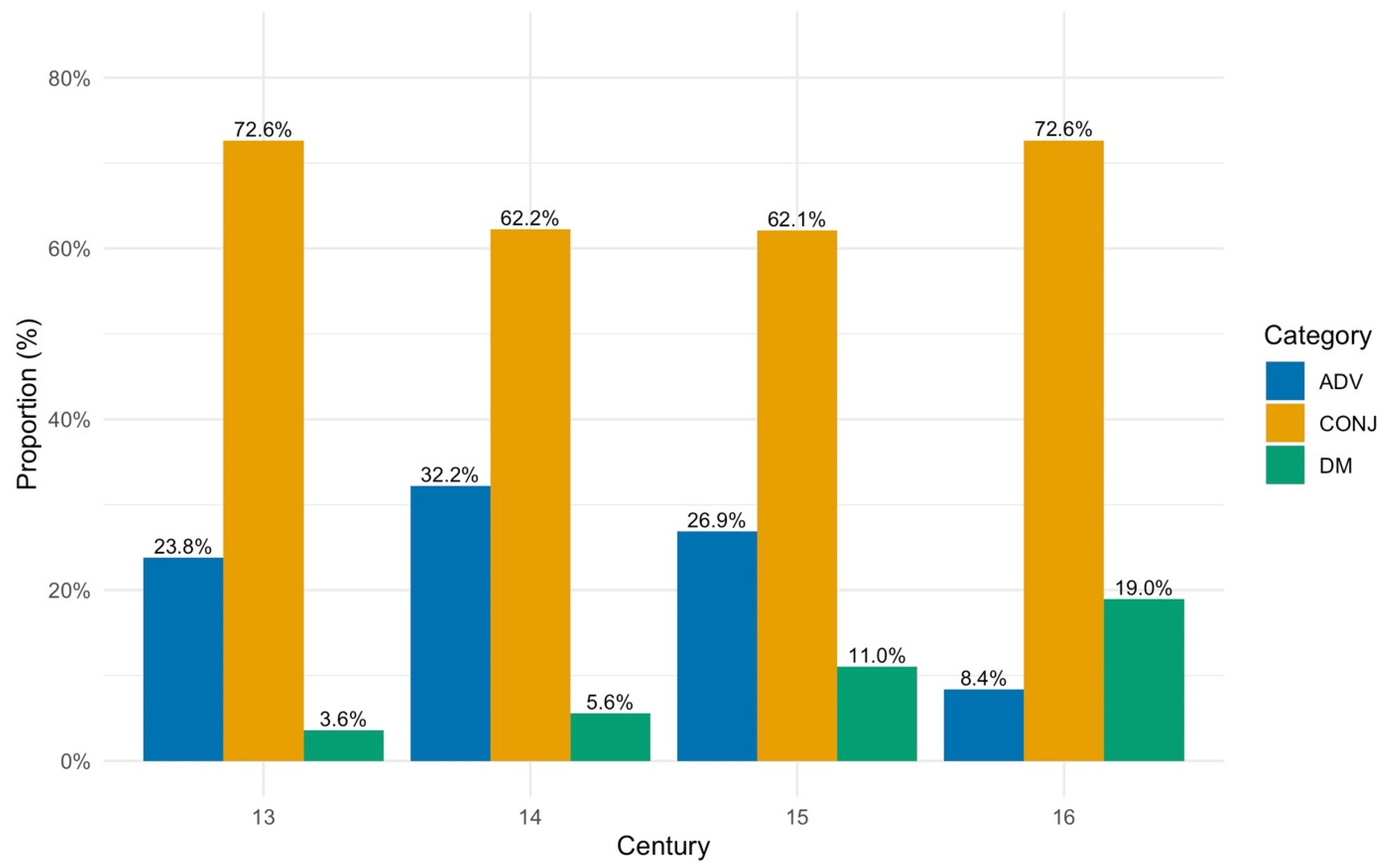
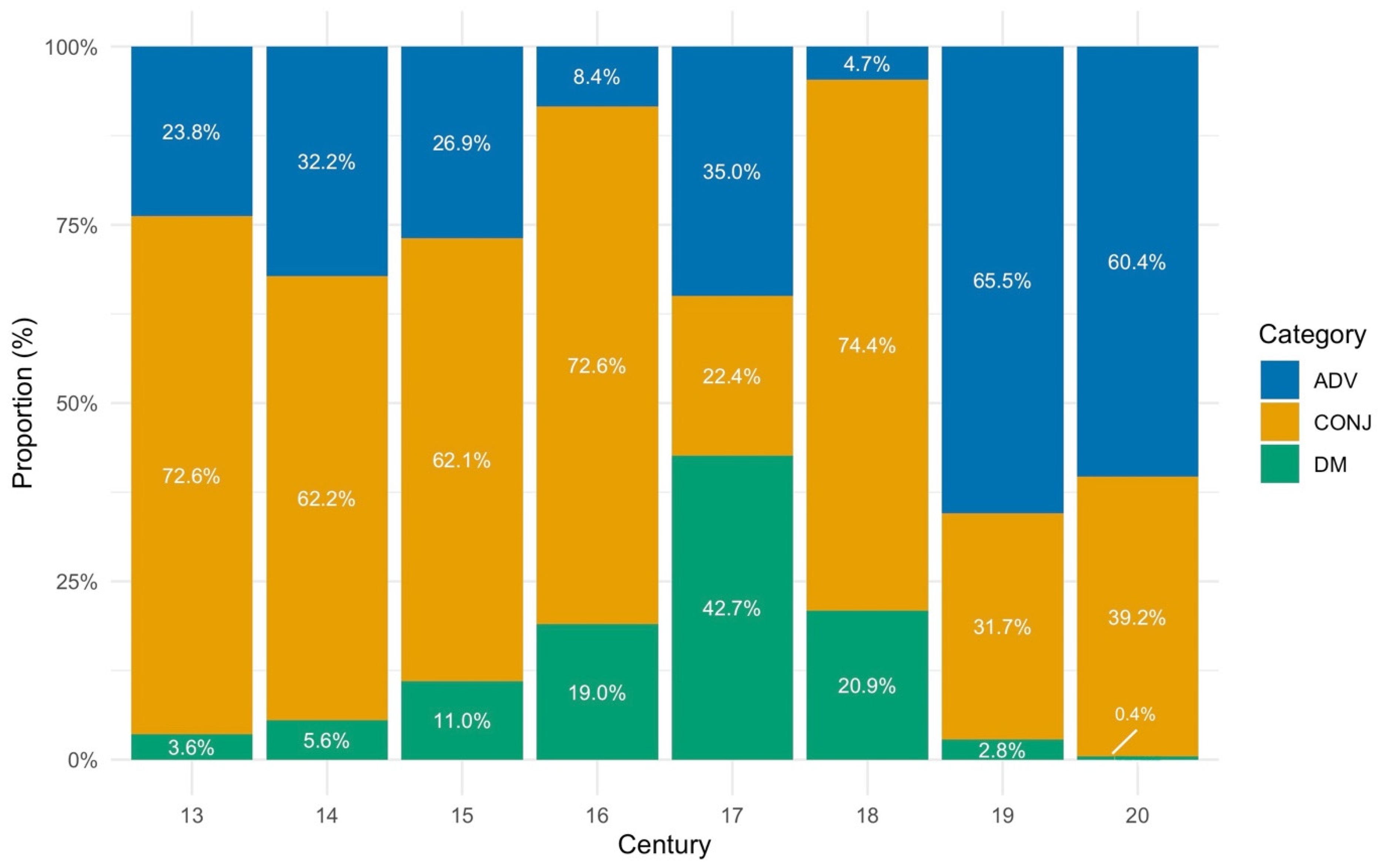
- the maintenance of the subordinating function of assim que;
- increased semantic specialization;
- the weakening or loss of causal inference; and
- the strengthening of temporal profiling.
- (45)
- a.
- Porque o finamento d’elrrei fora feito muito simprezmente e não suas exequias como deveram, hordenou a rrainha de mandar chamar todollos senhores e fidallgos do rregno que vehessem ao saimento do mes, pera sse fazer o mais honrradamente que podesse; e foi assim que o fezerom ho melhor que pôde ser, como compria à honrra d’elrrei; (14:Lopes:Fernando)‘Because the king’s burial had been conducted very simply and not with the funeral rites that were due, the queen ordered all the lords and noblemen of the kingdom to be summoned to attend the month-later procession,17 so that it could be conducted as honorably as possible. And so they did it in the best possible way, as was fitting for the king’s honor.’
- b.
- [Almançor] amava outrossy os seus, ẽtanto que todos se trabalhavã em fazer serviço. E assi foy que, des o ryo de Doyro, que entom era en comarca antre os mouros e os cristãos, todo correrom e destruyrõ ataa o ryo que chamã Escola. (13:CIPM:CGEsp)‘He [Almanzor] loved his own people (i.e., the Moors) so much that all worked hard to serve him. Thus, from the Douro River—which at the time marked the border between the Moors and the Christians—they advanced, destroying everything along the way up to the river now called the Escola.’
7. Final Remarks
Author Contributions
Funding
Institutional Review Board Statement
Informed Consent Statement
Data Availability Statement
Acknowledgments
Conflicts of Interest
Appendix A. List of Text Abbreviations

| Abbreviation | Text | Source |
|---|---|---|
| 12:Mettman:CantigasSM3 | Cantigas de Santa Maria, vol. 3, Afonso X [Edited by Walter Mettman] | Scanned text |
| 13:Afonso:Partida1 | Primeira Partida, Afonso X | Scanned text |
| 13:CIPM:CGEsp | Crónica Geral de Espanha de 1344 (Ms. L) | CIPM * |
| 14:CIPM:Demanda | A Demanda do Santo Graal, 15th-century | CIPM * |
| 14:CondeMeneses | Crónica do Conde D. Pedro de Meneses, Zurara | CIPM * |
| 14/17:DJoao:Montaria | Livro da Montaria, Dom João I | University of Aveiro |
| 14:Lopes:Fernando | Crónica de Dom Fernando, Lopes | Scanned text |
| 14:Maler:Orto | Orto do Esposo [Edited by Bertil Maler] | CIPM * |
| 14:Manuel:1498 | Forais Manuelinos, 1498 | FCT ** |
| 14:SantaMaria:Evangelhos | Euangelhos e epistolas con suas exposições en romãce, Santa Maria | University of Minho |
| 15:FlosSanct | Flos Sanctorum | Scanned text |
| 15:Frois:Japam1 | Historia de Japam, Part 1, Fróis | University of Aveiro |
| 15:Lucena:SFXavier | Historia da vida do Padre S. Francisco Xavier, Lucena | University of Aveiro |
| 15:Pisan:Cristina | O espelho de Cristina, Pisan | University of Minho |
| 15:Usque:Israel | Consolaçam às Tribulações de Israel, Usque | Scanned text |
| 15:Vicente:Obra1 | Obra Completa, Part 1, Vicente, | University of Lisbon |
| 16:Bernardes:Floresta | Nova Floresta, Bernardes | CTB *** |
| 16:Prazeres:Abedario | Abedario Real e Regia Instrucçam de Principes Lusitanos, Prazeres | University of Aveiro |
| 17:Aires:Vaidade | Reflexões sobre a Vaidade dos Homens, Aires | CTB *** |
| 17:Morais:Apotegmas | Colecção política de apotegmas, Morais | Scanned text |
| 18:Almeida:Gatos5 | Os Gatos, Volume 5, Almeida | University of Aveiro |
| 18:Garrett:Sousa | Frei Luís de Sousa, Garrett | University of Aveiro |
Appendix B. Complementary Tables with Data Classification
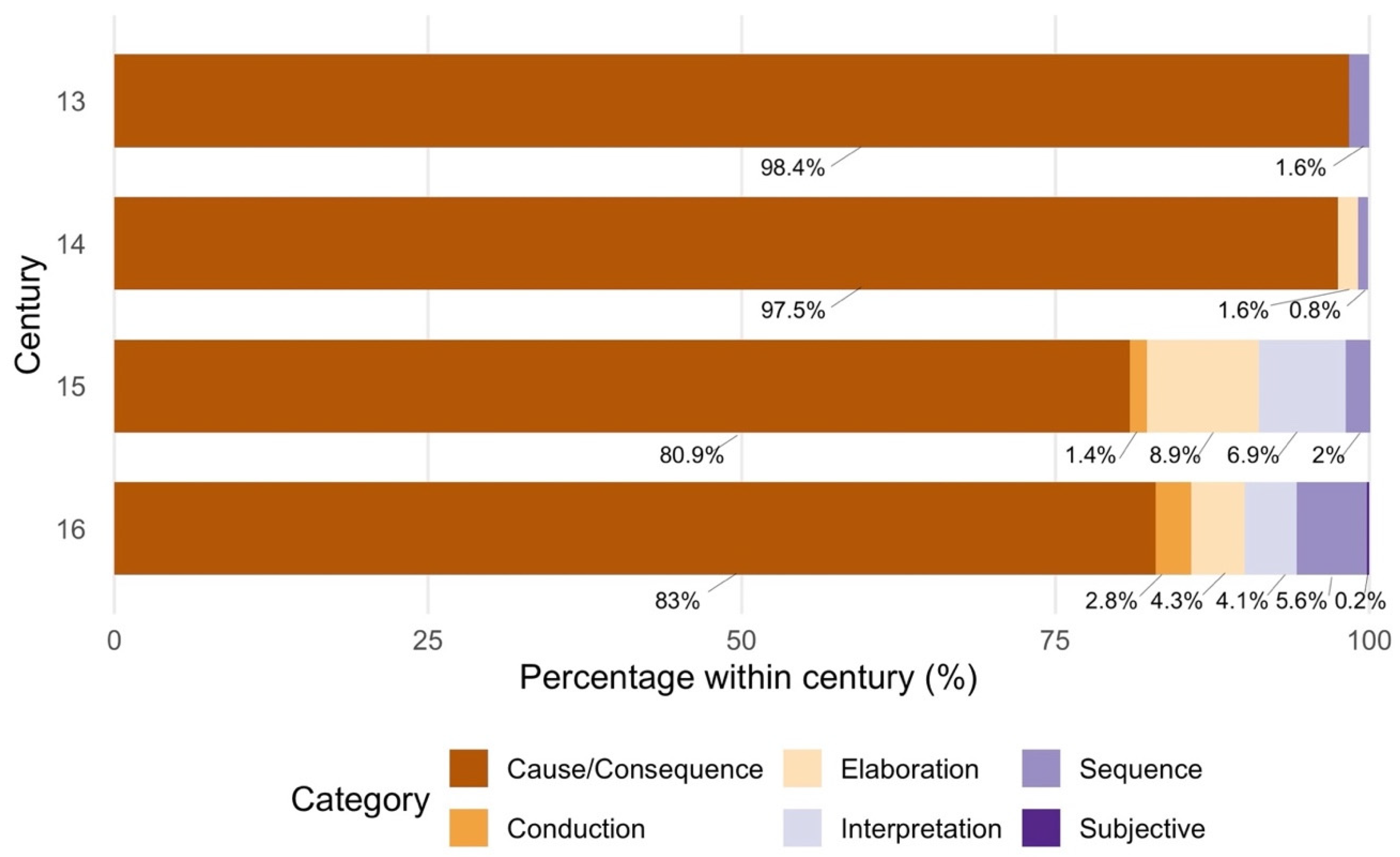
| Link | Relation | 13th Century | 14th Century | 15th Century | 16th Century | ||||
|---|---|---|---|---|---|---|---|---|---|
| Cause/ consequence | Cause | — | — | 1 | 0.3% | — | |||
| Condition | — | — | — | 1 | 0.2% | ||||
| Enablement | — | 1 | 0.8% | 10 | 2.8% | 18 | 3.3% | ||
| Evidence | — | — | 5 | 1.4% | 12 | 2.2% | |||
| Justify | — | 2 | 1.6% | 5 | 1.4% | 6 | 1.1% | ||
| Purpose | 3 | 4.7% | — | 7 | 2.0% | 10 | 1.9% | ||
| Result | 60 | 93.7% | 102 | 83.6% | 251 | 71.7% | 392 | 73.1% | |
| Conduction | Preparation | — | — | 2 | 0.6% | — | |||
| Summary | — | — | 2 | 0.6% | 15 | 2.8% | |||
| Restatement | — | — | 1 | 0.3% | 4 | 0.7% | |||
| Elaboration | Background | — | — | 4 | 1.1% | 2 | 0.4% | ||
| Elaboration | — | 2 | 1.6% | 27 | 7.7% | 20 | 3.7% | ||
| Interpretation | Evaluation | — | — | 23 | 6.5% | 22 | 4.1% | ||
| Motivation | — | — | 6 | 1.7% | 3 | 0.5% | |||
| Sequence | Sequence | 1 | 1.6% | 1 | 0.8% | 6 | 1.7% | 30 | 5.6% |
| Subjective | Topic-shift | — | — | — | 1 | 0.2% | |||
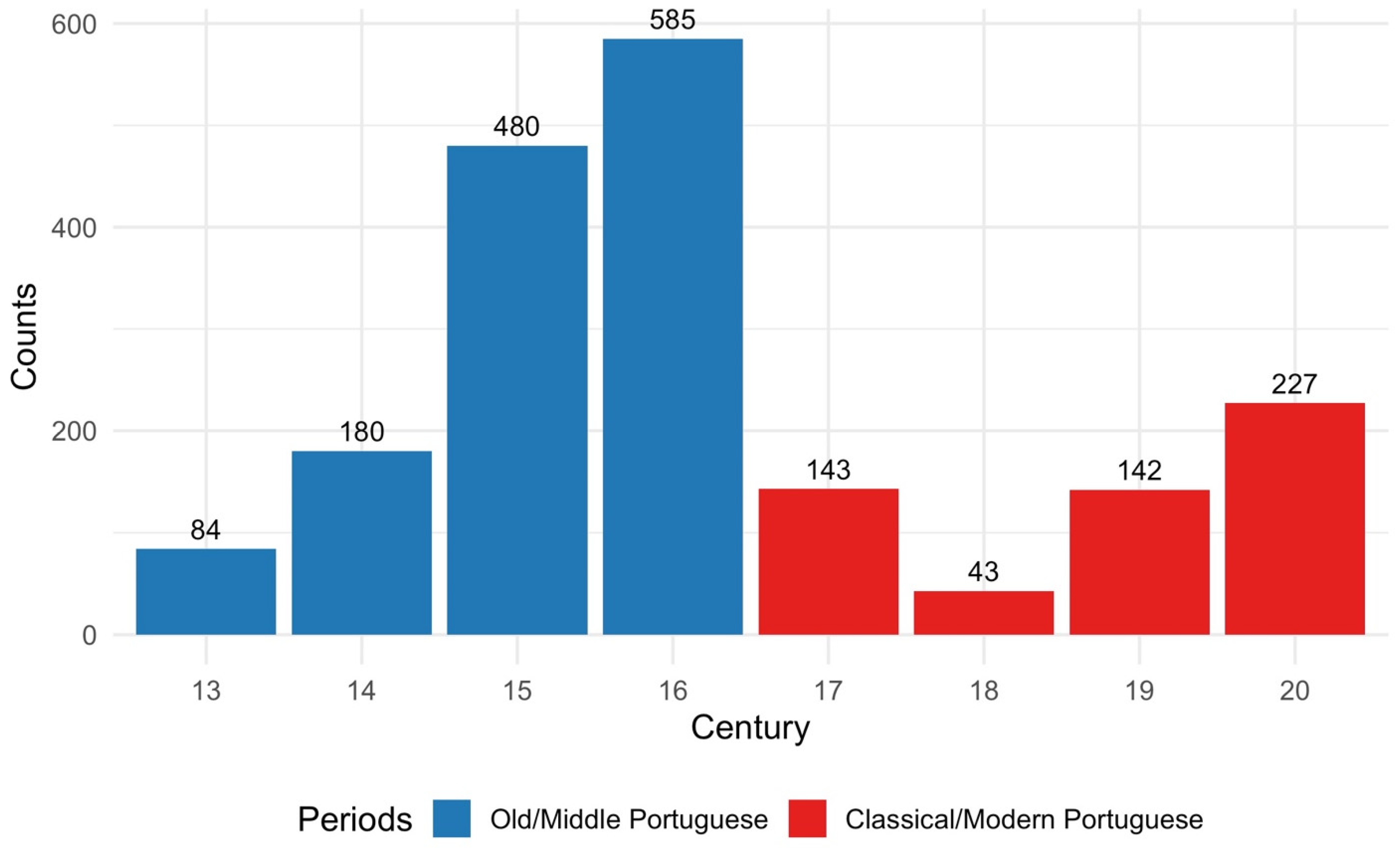
| Total | 64 | 122 | 350 | 536 | |||||
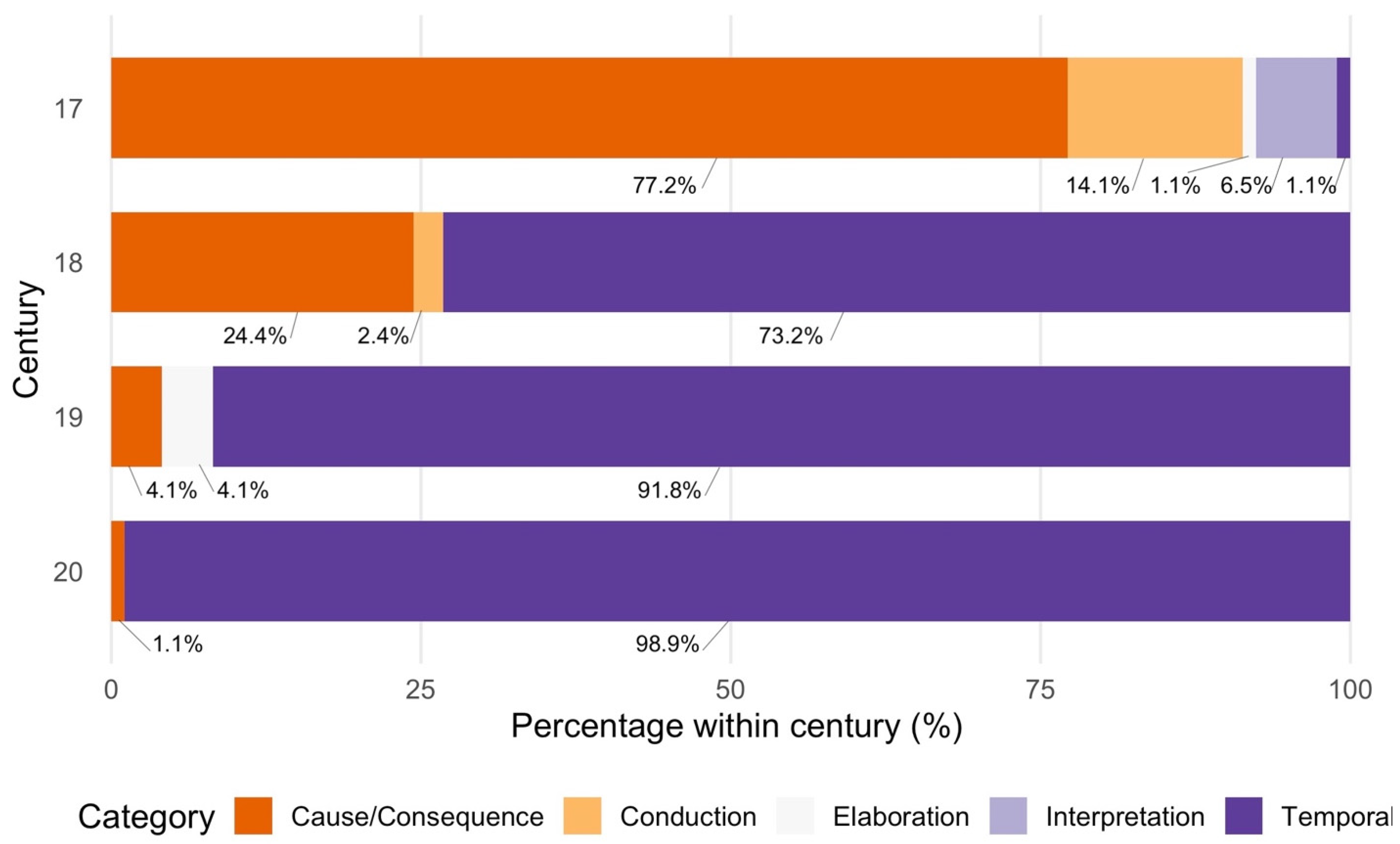
| Link | Relation | 17th Century | 18th Century | 19th Century | 20th Century | ||||
|---|---|---|---|---|---|---|---|---|---|
| Cause/ consequence | Cause | — | — | — | — | ||||
| Condition | — | — | — | — | |||||
| Enablement | 1 | 1.1% | — | — | — | ||||
| Evidence | 6 | 6.5% | — | — | — | ||||
| Justify | 2 | 2.2% | 1 | 2.4% | — | — | |||
| Purpose | — | — | — | — | |||||
| Result | 58 | 62.4% | 9 | 21.9% | 2 | 4.1% | 1 | 1.1% | |
| Conduction | Preparation | — | — | — | — | ||||
| Summary | 12 | 12.9% | 1 | 2.4% | — | — | |||
| Restatement | — | — | — | — | |||||
| Contrast | Antithesis | 1 | 1.1% | — | — | — | |||
| Elaboration | Background | — | — | 2 | 4.1% | — | |||
| Elaboration | 1 | 1.1% | — | — | — | ||||
| Interpretation | Evaluation | 6 | 6.5% | — | — | — | |||
| Motivation | 5 | 5.4% | — | — | — | ||||
| Sequence | Temporal | 1 | 1.6% | 30 | 73.2% | 45 | 91.8% | 89 | 98.9% |
| Total | 93 | 41 | 49 | 90 | |||||
| 1 | Other intermediary, mostly short-lived, uses of assim are reported in the cited works, including its use as a correlative conjunction. |
| 2 | According to Lopes-Damasio (2008), assi could also be used in optative and deprecatory formulas, also referred to as volitive expressions. However, in (i) its function is cataphoric, as it points to the motive for the help:
|
| 3 | The following abbreviations are used for the corpora cited: CDP = Corpus do Português (Davies & Ferreira, 2006); Iboruna Corpus = Electronic excerpts from the Portuguese of São Paulo State (Gonçalves, 2007), representing Southeastern Brazilian Portuguese. |
| 4 | See also Lopes-Damasio (2011) for other another constructional view, which analyzes assim is combination with other words. |
| 5 | A parallel study showing the productivity of adverb + que in Spanish, as well as other sequences involving que, is Barra Jover (2002), conducted within a formal framework. I thank an anonymous reviewer for this observation. |
| 6 | Rodríguez Molina (2015) discusses the various historical forms of así in Spanish, which could vary and appear as sí, asín, ansí, ansina, asina, among others. |
| 7 | We thank an anonymous reviewer for drawing our attention to this fact. |
| 8 | While subjectification is a mechanism through which meanings become more speaker-centered, intersubjectification shifts them toward the hearer, both in epistemic and social terms (cf. Traugott, 1995). It is important to emphasize that intersubjectification—as the explicit representation of attention to the hearer’s attitudes—arises from and crucially depends on subjectification; that is, it functions as a subsequent stage. |
| 9 | Nor did we include authors who were born in Portugal and spent long periods in Brazil, such as António José da Silva. |
| 10 | This decision was made primarily to ensure that the sentences in our database correspond to the remaining data from the century in which they were originally written. Unfortunately, this greatly reduced the amount of data available for the 18th century. |
| 11 | The corpus data are accompanied by this reference pattern, with optional elements in brackets:
Centuries are indicated using the first two digits of the year (14 = 14xx, i.e., 15th century). |
| 12 | For Cause and Result, we did not consider the distinction between volitional and non-volitional, as proposed in Mann and Thompson (1988). Another relevant adaptation is that we disregarded the originally proposed relation Joint, since it did not appear in our data, and treated Temporal Succession as a separate rhetorical relation distinct from Sequence. The difference between the two is explained in Section 5. |
| 13 | In Modern Portuguese, a clause introduced by assim que can also be parenthetically intercalated within a sentence, often appearing alongside other adjunct phrases.
|
| 14 | Pons Bordería (2014, p. 124) also proposes that paradigmatic pressure was one of the causes for the pragmaticalization of Spanish o sea as a discourse marker. We thank an anonymous reviewer for suggesting the volume which contains that chapter. |
| 15 | We thank an anonymous reviewer for suggesting a deeper analysis of this issue. |
| 16 | The few occurrences of sendo assim que may be analyzed as ser + cataphor assim + insubordinate que. Interestingly, they are concentrated in a few texts from the 16th century:
|
| 17 | To be more precise, the term saimento do mes referred to the mass held a month after someone’s death. |
| 18 |
References
- Afonso X. (2021). Cantigas de Santa Maria: Texto crítico completo (J.-M. Montero Santalha, Ed.). (Original work published 13th century). Available online: https://www.academia.edu/50870774/Cantigas_de_Santa_Maria_Texto_crítico_completo_2021_ (accessed on 10 July 2025).
- Andrade, A. L. d., & Antonio, J. D. (2024). Brazilian portuguese wh-clefts in a multilevel analytic perspective. Pragmatics, 35, 475–503. [Google Scholar] [CrossRef]
- Barra Jover, M. (2002). Propiedades léxicas y evolución sintáctica. El desarrollo de los mecanismos de subordinación en español. Toxosoutos. [Google Scholar]
- Bartol Hernández, J. A. (1986). Oraciones consecutivas y concessivas en las siete partidas. Ediciones Universidad de Salamanca. [Google Scholar]
- Braga, M. L., Kato, M. A., & Mioto, C. (2015). As construções-Q no português brasileiro falado: Relativas, clivadas e interrogativas. In M. A. Kato, & M. do Nascimento (Eds.), Gramática do português falado no Brasil, Vol. 2: A construção da sentença (pp. 187–227). Contexto. [Google Scholar]
- Bravo Cladera, N. (2005). Y, pero, así que y es que: Un estudio de su uso en las interacciones del español de jóvenes bilingües y unilingües [Studia Romanica Upsaliensa] (Vol. 70). Acta Universitatis Upsaliensis. Available online: https://uu.diva-portal.org/smash/get/diva2:164818/FULLTEXT01.pdf (accessed on 25 September 2025).
- Castro, I. (2006). Introdução à história do português (2nd ed.). Colibri. [Google Scholar]
- Davies, M., & Ferreira, M. (2006). Corpus do Português: Historical genres. Available online: http://www.corpusdoportugues.org/hist-gen/ (accessed on 10 October 2025).
- Dufter, A. (2009). Clefting and discourse organization: Comparing Germanic and Romance. In A. Dufter, & D. Jacob (Eds.), Focus and background in Romance languages (pp. 83–121). John Benjamins. [Google Scholar]
- Fuentes Rodríguez, C. (1985). Sintaxis oracional: Las oraciones consecutivas en español. Ediciones Alfar. [Google Scholar]
- Galves, C. (2020). Relaxed V2 in Classical Portuguese. In R. Woods, & S. Wolfe (Eds.), Rethinking verb second (pp. 368–396). Oxford University Press. [Google Scholar] [CrossRef]
- Givón, T. (1979). On understanding grammar. Academic Press. [Google Scholar]
- Givón, T. (1995). Functionalism and grammar. John Benjamins. [Google Scholar]
- Gonçalves, S. C. L. (2007). Banco de dados Iboruna: Amostras eletrônicas do português falado no interior paulista. Available online: http://www.alip.ibilce.unesp.br (accessed on 25 September 2025).
- Guzmán Herrera, A. R. (2014). Luego, así que y apenas: Marcadores pragmáticos, de inmediatez y de consecución [Doctoral dissertation, Universidad Nacional Autónoma de México]. [Google Scholar]
- Haspelmath, M. (2004). On directionality in language change with particular reference to grammaticalization. In O. Fischer, M. Norde, & H. Perridon (Eds.), Up and down the cline: The nature of grammaticalization (pp. 17–44). John Benjamins. [Google Scholar] [CrossRef]
- Hennemann, A., & Schlaak, C. (2015). Así que als diskursmarker. Ein fall von adfunktionalisierung. Universität Potsdam. Available online: http://nbn-resolving.de/urn:nbn:de:kobv:517-opus4-75412 (accessed on 10 March 2025).
- Herman, J. (2000). Vulgar Latin (R. Wright, Trans.; 2nd ed.). The Pennsylvania State University Press. (Original work published 1967). [Google Scholar]
- Hopper, P. J., & Traugott, E. C. (2003). Grammaticalization (2nd ed.). Cambridge University Press. [Google Scholar]
- Kato, M. A., & Ribeiro, I. (2009). Cleft sentences from old Portuguese to modern Portuguese. In A. Dufter, & D. Jacob (Eds.), Focus and background in Romance languages (pp. 123–154). John Benjamins. [Google Scholar]
- Lahousse, K., & Lamiroy, B. (2012). Word order in French, Spanish and Italian: A grammaticalization account. Folia Linguistica, 46, 387–416. [Google Scholar] [CrossRef]
- Langacker, R. W. (1987). Foundations of cognitive grammar (Vol. 1). Stanford University Press. [Google Scholar]
- Langacker, R. W. (1991). Foundations of cognitive grammar (Vol. 2). Stanford University Press. [Google Scholar]
- Langacker, R. W. (2008). Cognitive grammar: A basic introduction. Oxford University Press. [Google Scholar]
- Longhin, S. R. (1999). As construções clivadas: Uma abordagem diacrônica [Master’s thesis, Universidade Estadual de Campinas]. [Google Scholar]
- Longhin-Thomazi, S. R. (2006). Gramaticalização, (inter)subjetivização e modalidade epistêmica: O caso de assim. Estudos Linguísticos, XXXV, 1772–1779. [Google Scholar]
- Lopes-Damasio, L. R. (2008). A emergência do marcador discursivo assim sob a ótica da gramaticalização [Master’s thesis, Universidade Estadual Paulista]. [Google Scholar]
- Lopes-Damasio, L. R. (2011). Diacronia dos processos constitutivos do texto relativos a assim: Um novo enfoque da gramaticalização [PhD dissertation, Universidade Estadual Paulista]. [Google Scholar]
- Machado, J. P. (1967). Dicionário etimológico da língua portuguesa (2nd ed., Vol. 1). Editorial Confluência. [Google Scholar]
- Mann, W. C., & Thompson, S. A. (1988). Rhetorical structure theory: Toward a functional theory of text organization. Text, 8, 243–281. [Google Scholar] [CrossRef]
- Martelotta, M. E. (2004). Operadores argumentativos e marcadores discursivos. In M. E. Martelotta, S. J. Votre, & M. M. Cezário (Eds.), Gramaticalização (pp. 325–344). Faculdade de Letras da UFRJ. [Google Scholar]
- Martín Zorraquino, M. A., & Portolés Lázaro, J. (1999). Los marcadores del discurso. In I. Bosque, & V. Demonte (Eds.), Gramática descriptiva de la lengua española (Vol. 3, pp. 4051–4213). Espasa. [Google Scholar]
- Narbona Jiménez, A. (1978). Las proposiciones consecutivas en español medieval. Publicaciones de la Universidad de Granada. [Google Scholar]
- Norde, M. (2009). Degrammaticalization. Oxford University Press. [Google Scholar]
- Pons Bordería, S. (2014). Paths of grammaticalization in Spanish o sea. In C. Ghezzi, & P. Molinelli (Eds.), Discourse and pragmatic markers from Latin to the Romance languages (pp. 109–136). Oxford University Press. [Google Scholar] [CrossRef]
- RAE/ASALE. (2009). Nueva gramática de la lengua española. Espasa-Calpe. [Google Scholar]
- Rodríguez Molina, J. (2014). Adverbios y locuciones adverbiales de manera. In C. Company Company (Ed.), Sintaxis histórica de la lengua española (Vol. 1, pp. 733–937). Universidad Nacional Autónoma de México/Fondo de Cultura Económica. [Google Scholar]
- Rodríguez Molina, J. (2015). El adverbio así en español medieval: Variantes morfofonéticas. In J. M. García Martín, T. Bastardín Candón, & M. Rivas Zancarrón (Eds.), Actas del IX congreso internacional de historia de la lengua Española (pp. 1049–1064). Iberoamericana/Vervuert. [Google Scholar]
- Santos, M. P. K. d., & Silva, T. d. S. (2019). Conectores advindos da construção [XQUE]conect no português: Uma visão construcional de mudança. LaborHistórico, 5, 53–69. [Google Scholar] [CrossRef]
- Silveira, D. M. (2014). Clivadas e pseudo-clivadas na história do português: Uma análise diacrônica das estruturas de foco e implicações da gramática V2 [Master’s thesis, Universidade Estadual de Campinas]. [Google Scholar]
- Souza, E. R. F. d. (2009). Gramaticalização dos itens linguísticos assim, já e aí no português brasileiro [Doctoral dissertation, Universidade Estadual de Campinas]. [Google Scholar]
- Stede, M., Taboada, M., & Das, D. (2017). Annotation guidelines for rhetorical structure. University of Potsdam and Simon Fraser University. Available online: https://www.sfu.ca/%7Emtaboada/docs/research/RST_Annotation_Guidelines.pdf (accessed on 20 March 2025).
- Traugott, E. C. (1995). Subjectification in grammaticalisation. In D. Stein, & S. Wright (Eds.), Subjectivity and subjectivisation (pp. 31–54). Cambridge University Press. [Google Scholar]
- Traugott, E. C., & König, E. (1991). The semantics-pragmatics of grammaticalization revisited. In E. C. Traugott, & B. Heine (Eds.), Approaches to grammaticalization (Vol. 1, pp. 189–218). John Benjamins. [Google Scholar]
- Traugott, E. C., & Trousdale, G. (2013). Constructionalization and constructional changes. Oxford University Press. [Google Scholar]
- Williams, E. B. (1962). From Latin to Portuguese: Historical phonology and morphology of the Portuguese language (2nd ed.). Philadelphia University Press. [Google Scholar]
- Wischer, I. (2000). Grammaticalization versus lexicalization. In O. Fischer, A. Rosenbach, & D. Stein (Eds.), Pathways of change: Grammaticalization in English (pp. 355–370). John Benjamins. [Google Scholar] [CrossRef]



| Nexus | Relation | Example in English |
|---|---|---|
| Cause/consequence | Cause | [Mayer Jochen Wagner reacted with surprise, too.]N [After all, just on Monday the community council had agreed to expand the village of Diepensee.]S |
| Condition | [If the sanitary facilities are still not available in the coming season,]S [Radewege is in danger of losing the competition for attracting boats to the campground.]N | |
| Enablement | [Replace the spark plugs.]N [A square key wrench can be found right under the cap.]S | |
| Evidence | [And now even our state government seems determined to remove this apparent equality between the two subjects.]N [Stolpe, Reiche and others do say Yes to the possible compromise offered by the Karlsruhe court, but they also decree: There cannot be any voluntary subject area LER/Religion.]S | |
| Justify | [I will never eat this cake]N [because I have diabetes.]S (CE) | |
| Purpose | [In order to protect their troops,]S [the U.S. do not comment on news reports on the start of a ground operation in Afghanistan.]N | |
| Reason | [With each new day of air raids, the military operations of the U.S. lose more and more credibility.]N [By means of comprehensive area-wide destruction you can’t hit the Taliban, nor can you eliminate bin Laden.]S | |
| Result | [It was raining heavily;]N [therefore, we stayed indoors.]S (CE) | |
| Solutionhood | [With the anti-smoker regulations being passed, many pubs will be caught in a trap.]S [They should start looking into possibilities for having separate rooms.]N | |
| Conduction | Preparation | [One thing is evident:]S [With each day of air raids, the mili- tary operations of the U.S. lose more and more credibility.]N |
| Summary | [The project faced many delays, budget issues, and staffing problems.]N [In short, it did not succeed.]S (CE) | |
| Restatement | [The mayor gave all the information to the councillors,]N [kind of filling them in completely.]S | |
| Comparison | Antithesis | [At one point they seemed to have succeeded.]S [But the buyer didn’t pay.]N |
| Contrast | [My first car was small.]N [The second was already a sizable limousine.]N | |
| Concession | [Sanitary facilities nowadays are a standard on big campgrounds.]S [But Radewege has a hard time with upgrading to such standards.]N | |
| Elaboration | Background | [Until 1984, Burkina Faso was called Obervolta.]S [According to an EMNID poll, many Europeans today believe that they are two different countries.]N |
| Circumstance | [When Veag came under pressure because of the deregulation of the electricity market,]S [they compensated for this by squeezing their suppliers.]N | |
| Elaboration | [Diepensee will relocate.]N [No question about that.]S | |
| Interpretation | Evaluation | [Its past seemed to shadow the big hotel like a curse.]S [For many years the Potsdam local court had tried to find a buyer, without success.]N |
| Interpretation | [Now for the first time we bought a Cadillac.]N [That probably makes us part of the bourgeoisie.]S | |
| Motivation | [Running the Olympic Games are a win-win situation for any city.]S [Berlin must now apply for the 2026 games!]N | |
| Sequence | Sequence | [At nine o’clock the teacher entered the classroom.]N [Five minutes later she announced that a test will be written.]N |
| Temporal (succession) | [She had left her house in a hurry,]S [and then she arrived at the station.]N (CE) | |
| Subjective/ Dialogical | Hesitation | [We could approve the proposal today.]N [Well… I’m not sure if that’s the best decision.]S |
| Inference | [All the shops were closed, and the streets were empty.]S [It must have been a public holiday.]N | |
| Topic-shift | [We’ve finished discussing the budget.]S [Now, let’s talk about next quarter’s marketing strategy.]N |
Disclaimer/Publisher’s Note: The statements, opinions and data contained in all publications are solely those of the individual author(s) and contributor(s) and not of MDPI and/or the editor(s). MDPI and/or the editor(s) disclaim responsibility for any injury to people or property resulting from any ideas, methods, instructions or products referred to in the content. |
© 2026 by the authors. Licensee MDPI, Basel, Switzerland. This article is an open access article distributed under the terms and conditions of the Creative Commons Attribution (CC BY) license.
Share and Cite
Andrade, A.L.d.; Oliveira, G.M. The Back-and-Forth of assim que in the History of Portuguese. Languages 2026, 11, 57. https://doi.org/10.3390/languages11030057
Andrade ALd, Oliveira GM. The Back-and-Forth of assim que in the History of Portuguese. Languages. 2026; 11(3):57. https://doi.org/10.3390/languages11030057
Chicago/Turabian StyleAndrade, Aroldo Leal de, and Glayson Martins Oliveira. 2026. "The Back-and-Forth of assim que in the History of Portuguese" Languages 11, no. 3: 57. https://doi.org/10.3390/languages11030057
APA StyleAndrade, A. L. d., & Oliveira, G. M. (2026). The Back-and-Forth of assim que in the History of Portuguese. Languages, 11(3), 57. https://doi.org/10.3390/languages11030057