


You are currently on the new version of our website. Access the old version .

Vision, Volume 6, Issue 4

2022 December - 21 articles

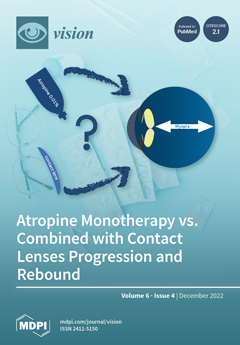
Cover Story: The most effective approach to myopia management is a global concern and is discussed on all platforms. Of equal importance is when and how to cease treatment without generating a rebound response. Myopia is a multifactorial disease, so there is no single answer to these questions. The contribution presented here includes 85 children aged 10.34 ± 2.27 followed over three years. The decrease in myopia progression and rebound effect using topical low-dose atropine compared to combined treatment with contact lenses for myopic control was monitored. In this cohort, monotherapy and combination therapy were clinically effective in decreasing myopia progression. A low rebound effect was found after therapy cessation. View this paper
  • Issues are regarded as officially published after their release is announced to the table of contents alert mailing list .
  • You may sign up for email alerts to receive table of contents of newly released issues.
  • PDF is the official format for papers published in both, html and pdf forms. To view the papers in pdf format, click on the "PDF Full-text" link, and use the free Adobe Reader to open them.

Articles (21)

  • Systematic Review
  • Open Access
6 Citations
2,559 Views
12 Pages

Cholesterols, Apolipoproteins, and Their Associations with the Presence and Severity of Diabetic Retinopathy: A Systematic Review

  • Soefiandi Soedarman,
  • King Hans Kurnia,
  • Alberthus Donni Budi Prasetya and
  • Muhammad Bayu Sasongko

16 December 2022

Serum apolipoproteins have been reported as a more significant marker for diabetic retinopathy (DR) compared with serum cholesterols. This article aims to review the associations between serum cholesterols and apolipoproteins, and the presence and se...

  • Article
  • Open Access
4 Citations
2,445 Views
8 Pages

Scheimpflug-Derived Corneal Lower and Higher Order Aberrations Post Intrastromal Corneal Ring Segments for Keratoconus

  • Roberta M. van den Berg,
  • Arthur B. van den Berg,
  • Maya Dodhia,
  • Michel Shahid,
  • Alessandro A. Jammal,
  • Denise de Freitas and
  • Karolinne M. Rocha

14 December 2022

Intrastromal corneal ring segments (ICRS) improve corneal topographic symmetry and reduce corneal aberrations through regularization of the corneal surface, thereby functioning as a viable surgical intervention for patients with keratoconus. This stu...

  • Article
  • Open Access
5 Citations
4,379 Views
10 Pages

Prosopagnosia, Other Specific Cognitive Deficits, and Behavioral Symptoms: Comparison between Right Temporal and Behavioral Variant of Frontotemporal Dementia

  • Christos Koros,
  • Ion Beratis,
  • Stavroula Matsi,
  • Anastasia Bougea,
  • Anastasios Bonakis,
  • Ioannis Papatriantafyllou,
  • Efthalia Angelopoulou,
  • Elisabeth Kapaki,
  • Leonidas Stefanis and
  • Sokratis G. Papageorgiou

13 December 2022

Right temporal variant of frontotemporal dementia (rtv-FTD) represents an uncommon and recently described frontotemporal dementia (FTD) entity presenting with symptoms in many ways comparable to those of the frontal or behavioral variant of FTD (bv-F...

  • Article
  • Open Access
14 Citations
3,749 Views
11 Pages

13 December 2022

(1) Introduction: We analysed epithelial changes after the treatment of moderate myopia with transepithelial photorefractive keratectomy. (2) Materials and Methods: We used optical coherence tomography data and analysed changes in the stroma and epit...

  • Article
  • Open Access
15 Citations
7,307 Views
10 Pages

Low-Concentration Atropine Monotherapy vs. Combined with MiSight 1 Day Contact Lenses for Myopia Management

  • Nir Erdinest,
  • Naomi London,
  • Itay Lavy,
  • David Landau,
  • Dror Ben Ephraim Noyman,
  • Nadav Levinger and
  • Yair Morad

12 December 2022

Objectives: To assess the decrease in myopia progression and rebound effect using topical low-dose atropine compared to a combined treatment with contact lenses for myopic control. Methods: This retrospective review study included 85 children aged 10...

  • Article
  • Open Access
4 Citations
3,559 Views
7 Pages

Femtosecond Laser-Assisted Cataract Surgery: Analysis of Surgical Phases and Comparison with Standard Phacoemulsification in Uncomplicated Cataracts

  • Antonio Baldascino,
  • Matteo Mario Carlà,
  • Federico Giannuzzi,
  • Francesco Boselli,
  • Tomaso Caporossi,
  • Gloria Gambini,
  • Antonio Villano,
  • Aldo Caporossi and
  • Stanislao Rizzo

7 December 2022

The aim of this work is to compare the time of surgical phases and the cumulative dissipated energy (CDE) of the phacoemulsification phase in femtosecond laser-assisted cataract surgery (FLACS) and in standard surgical procedures of phacoemulsificati...

  • Article
  • Open Access
1 Citations
5,547 Views
12 Pages

Does Father Christmas Have a Distinctive Facial Phenotype?

  • Thomas Wright,
  • Chris Law,
  • Ben Wright and
  • Barry Wright

2 December 2022

We investigated whether Father Christmas has a distinguishable facial phenotype by performing a cross-sectional cohort study examining the facial feature vectors of all publicly available photographs obtained from a google image search of individuals...

  • Article
  • Open Access
2 Citations
2,617 Views
12 Pages

Clinical Outcomes of the Implementation of IOP Monitoring, in and out of Office Time, to 1500 Patients—A Cohort Study

  • Sevasti Tsironi,
  • Diamantis Almaliotis,
  • Panagiota Ntonti,
  • Georgios Sidiropoulos,
  • Evangelia Theodoridou,
  • Efstratios Theofrastou,
  • Sofia Karachrysafi,
  • Eleni Psimenidou,
  • Anastasia Sarafi and
  • Elie Fadel
  • + 2 authors

21 November 2022

Background: The aim of this study was to present the clinical outcomes of IOP monitoring in and out of office time and determine its value in our clinical practice. Material and methods: We reviewed the records of 1500 patients (glaucoma suspects or...

  • Review
  • Open Access
16 Citations
4,783 Views
10 Pages

18 November 2022

This review aimed to quantify the effect of therapeutic application of virtual reality (VR) on cognitive function in individuals with mild cognitive impairment (MCI). We searched for randomized controlled trials involving VR in the interventions prov...

of 3

Get Alerted

Add your email address to receive forthcoming issues of this journal.

XFacebookLinkedIn
Vision - ISSN 2411-5150