Skip Content
You are currently on the new version of our website. Access the old version .

Recycling, Volume 6, Issue 3

2021 September - 20 articles

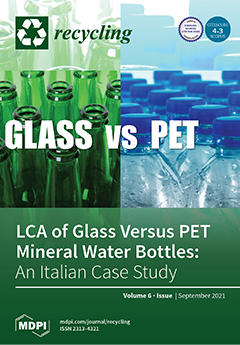
Cover Story: Due to the environmental problem of marine plastic pollution, many people reject plastic packaging in favour of other alternatives, especially glass, which is usually considered the most sustainable solution. However, to avoid a problem-shifting issue, adopting a holistic approach is needed for the sustainability evaluation of systems using a life-cycle thinking perspective. For this purpose, life cycle assessment (LCA) is the most-used methodology to compare the potential impacts occurring during all the life cycle phases. Therefore, the study proposes an LCA application to the environmental comparison of two packaging systems for drinking water, reusable glass bottles and PET bottles, to identify the most environmentally sound alternative based on a real case of an Italian mineral water company. View this paper.
  • Issues are regarded as officially published after their release is announced to the table of contents alert mailing list .
  • You may sign up for email alerts to receive table of contents of newly released issues.
  • PDF is the official format for papers published in both, html and pdf forms. To view the papers in pdf format, click on the "PDF Full-text" link, and use the free Adobe Reader to open them.

Articles (20)

  • Review
  • Open Access
39 Citations
8,009 Views
21 Pages

Conceptualising the Circular Economy Potential of Construction and Demolition Waste: An Integrative Literature Review

  • Vasilios Papastamoulis,
  • Kerry London,
  • Yingbin Feng,
  • Peng Zhang,
  • Robert Crocker and
  • Petros Patias

15 September 2021

Traditionally, construction and demolition waste (CDW) materials have been considered to be unwanted, surplus, or wastage materials or materials with zero value. Such a conceptualisation only embraces a negative aspect, which underpins the disposal o...

  • Article
  • Open Access
44 Citations
7,119 Views
20 Pages

15 September 2021

Construction waste (CW) is a prime contributor to the stream of total waste worldwide. One of the biggest challenges of the construction industry is to minimise CW and to develop practices of a more sustainable nature for its management and recycling...

  • Article
  • Open Access
32 Citations
7,400 Views
17 Pages

8 September 2021

The utilization of geopolymer 3D printing for construction products in recent years has been exceptionally substantial, owing to their low carbon dioxide emissions, high-performance properties such as durability, and good thermal and mechanical prope...

  • Review
  • Open Access
7 Citations
4,829 Views
16 Pages

Industrial Symbiosis through the Use of Biosolids as Fertilizer in Romanian Agriculture

  • Lucian-Ionel Cioca,
  • Alina-Oana Ciomoş,
  • Daiana Șeitoar,
  • Roxana Maria Druță and
  • Geanina Maria David

7 September 2021

Biosolids’ use in agriculture is an example of industrial symbiosis. The application of biosolids (BS) in agriculture is considered one of the most sustainable sewage sludge (SS) management options, but the quality of biosolids has to meet certain re...

  • Article
  • Open Access
18 Citations
10,241 Views
22 Pages

Effect of Hard Plastic Waste on the Quality of Recycled Polypropylene Blends

  • Patrizio Tratzi,
  • Chiara Giuliani,
  • Marco Torre,
  • Laura Tomassetti,
  • Roberto Petrucci,
  • Antonio Iannoni,
  • Luigi Torre,
  • Salvatore Genova,
  • Valerio Paolini and
  • Gabriella Di Carlo
  • + 1 author

1 September 2021

The recycling of plastic waste is undergoing fast growth due to environmental, health and economic issues, and several blends of post-consumer and post-industrial polymeric materials have been characterized in recent years. However, most of these res...

  • Article
  • Open Access
1 Citations
3,489 Views
13 Pages

Following the Fukushima Daiichi Nuclear Power Plant (FDNPP) accident caused by the 2011 Tōhoku earthquake and tsunami, radioactive caesium (r-Cs) was detected in the ash generated by municipal solid waste (MSW) incineration facilities in Fukushima Pr...

  • Review
  • Open Access
43 Citations
16,206 Views
14 Pages

Toner waste is one of the major electronic waste materials posing serious environmental threat and health hazards. Globally, only about 20–30% of toner waste is recycled, while the remaining percentage is dumped in landfills. Recycling options are li...

  • Article
  • Open Access
5 Citations
4,748 Views
17 Pages

The depletion of natural resources and global warming have increased in severity globally. In the industrial field, assembly products, such as electronic products, should be disassembled for recycling and reuse to deal with these problems. Reuse and...

  • Article
  • Open Access
33 Citations
6,266 Views
21 Pages

Detection of Brominated Plastics from E-Waste by Short-Wave Infrared Spectroscopy

  • Giuseppe Bonifazi,
  • Ludovica Fiore,
  • Riccardo Gasbarrone,
  • Pierre Hennebert and
  • Silvia Serranti

In this work, the application of Short-Wave Infrared (SWIR: 1000–2500 nm) spectroscopy was evaluated to identify plastic waste containing brominated flame retardants (BFRs) using two different technologies: a portable spectroradiometer, providing spe...

  • Review
  • Open Access
113 Citations
26,409 Views
28 Pages

Electrochemical Approaches for the Recovery of Metals from Electronic Waste: A Critical Review

  • Varun Rai,
  • Daobin Liu,
  • Dong Xia,
  • Yamuna Jayaraman and
  • Jean-Christophe P. Gabriel

Electronic waste (e-waste) management and recycling are gaining significant attention due to the presence of precious, critical, or strategic metals combined with the associated environmental burden of recovering metals from natural mines. Metal reco...

  • Article
  • Open Access
7 Citations
5,535 Views
17 Pages

Based on mass and energy balance calculations, this work investigates the possibility of recovering heat and nutrients (nitrogen and phosphorus) from municipal sewage sludge using pyrolysis or combustion in combination with a gas scrubbing technology...

  • Article
  • Open Access
11 Citations
3,808 Views
15 Pages

In this work, monopolymer blends of virgin polypropylene and photo-oxidized polypropylene were prepare and characterized. The polypropylene samples were subjected to accelerated ageing to simulate the effects of outdoor exposure of polypropylene. Aft...

  • Article
  • Open Access
47 Citations
27,808 Views
13 Pages

LCA of Glass Versus PET Mineral Water Bottles: An Italian Case Study

  • Carmen Ferrara,
  • Giovanni De Feo and
  • Vincenza Picone

Due to the serious problem of plastic pollution in aquatic environment, many people reject plastic packaging in favour of glass containers which are considered more sustainable. To avoid misjudgements, the sustainability assessment of packaging alter...

  • Feature Paper
  • Article
  • Open Access
58 Citations
9,956 Views
10 Pages

Laboratory Properties of Waste PET Plastic-Modified Asphalt Mixes

  • Nuha Mashaan,
  • Amin Chegenizadeh and
  • Hamid Nikraz

Commercial polymers have been used in pavement modification for decades; however, a major drawback of these polymers is their high cost. Waste plastic polymers could be used as a sustainable and cost-effective additive for improving asphalt propertie...

  • Article
  • Open Access
5 Citations
9,628 Views
23 Pages

Multilayer packaging is an important part of the packaging market, but it is not recyclable with conventional methods since it is made of different thermodynamically immiscible materials. In this work, it was shown that it is possible to produce a PE...

  • Article
  • Open Access
16 Citations
7,544 Views
18 Pages

A Gap Analysis of Ship-Recycling Practices in Indonesia

  • Sunaryo Sunaryo,
  • Eko Djatmiko,
  • Siti Fariya,
  • Rafet Kurt and
  • Sefer Gunbeyaz

Ship recycling is gaining attention in Indonesia due to the increase in end-of-life ships and uneconomical nationally flagged ships, and is considered a prospective source of economic development and employment opportunity, and yet conceivably poses...

  • Article
  • Open Access
28 Citations
9,081 Views
15 Pages

Estimating the Cost-Competitiveness of Recycling-Based Geopolymer Concretes

  • Annastiina Rintala,
  • Jouni Havukainen and
  • Mariam Abdulkareem

The cement industry is a major contributor to greenhouse gas emissions on a global scale. Consequently, there has been an increasing interest, in both academia and business, in low-carbon concretes in which Ordinary Portland Cement (OPC) is partially...

  • Article
  • Open Access
5 Citations
3,979 Views
18 Pages

The potential of using cold water brown macroalgae Fucus vesiculosus for biocrude production via non-catalytic supercritical hydrothermal liquefaction (HTL) was studied. Demineralization, residue neutralization, and high value-added product (alginate...

  • Article
  • Open Access
38 Citations
8,322 Views
20 Pages

This work investigates the effect of ground rubber tire (GRT) particle size and their concentration on the morphological, mechanical, physical, and thermal properties of thermoplastic elastomer (TPE) blends based on recycled high-density polyethylene...

  • Article
  • Open Access
4 Citations
3,684 Views
16 Pages

Using Artificial Intelligence for Optimizing Natural Frequency of Recycled Concrete for Mechanical Machine Foundation

  • Maha M. A. Lashin,
  • Aamir Khokhar,
  • Fadwa Alrowais,
  • Areej Malibari and
  • Wafaa Saleh

This paper investigates the mechanical properties of two different types of recycled concrete, which use wood and rubber, relative to those characteristics of pure concrete, in terms of maximum load and natural frequencies. This paper contributes to...

Get Alerted

Add your email address to receive forthcoming issues of this journal.

XFacebookLinkedIn
Recycling - ISSN 2313-4321