You are currently viewing a new version of our website. To view the old version click .

Recycling, Volume 6, Issue 2

June 2021 - 20 articles

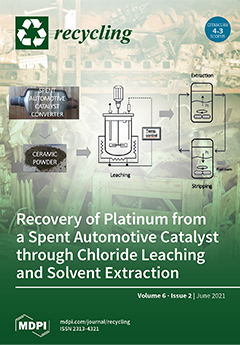
Cover Story: Recycling of critical metals from spent devices is a requirement for the sustainability of the planet and to establish a circular economy. This is an article on the development of a leaching scheme to allow high platinum recoveries and minimize aluminum dissolution, facilitating the application of solvent extraction. The replacement of some of the hydrochloric acid by calcium chloride in the leaching step did not compromise the platinum recovery (in the range 75–85%). The tested thiodiglycolamide derivative—N,N’-dimethyl-N,N’-dicyclohexylthiodiglycolamide—in toluene revealed a substantial loading capacity for both platinum and iron after contact with the spent automotive catalyst leaching solution; however, iron scrubbing and platinum stripping from the organic phases were not successful and, thus, needed improvement. View this paper
  • Issues are regarded as officially published after their release is announced to the table of contents alert mailing list .
  • You may sign up for email alerts to receive table of contents of newly released issues.
  • PDF is the official format for papers published in both, html and pdf forms. To view the papers in pdf format, click on the "PDF Full-text" link, and use the free Adobe Reader to open them.

Articles (20)

  • Article
  • Open Access
7 Citations
3,874 Views
15 Pages

Mechanical Properties of Tin Slag Mortar

  • Nathaniel Olukotun,
  • Abdul Rahman Mohd Sam,
  • Nor Hassana Abdul Shukor Lim,
  • Muyideen Abdulkareem,
  • Isa Mallum and
  • Olukotun Adebisi

The increased demand for cement mortar due to rapid infrastructural growth and development has led to an alarming depletion of fine aggregate. This has prompted the need for a more sustainable material as a total/partial replacement for natural fine...

  • Article
  • Open Access
21 Citations
4,348 Views
26 Pages

This work addresses the rehabilitation of water contaminated with atrazine, entrapping it in a permeable and sustainable barrier designed with waste materials (sepiolite) and with biomaterials (cork and pine bark). Atrazine adsorption was assessed by...

  • Article
  • Open Access
19 Citations
5,876 Views
12 Pages

Fungi and Circular Economy: Pleurotus ostreatus Grown on a Substrate with Agricultural Waste of Lavender, and Its Promising Biochemical Profile

  • Simone Di Piazza,
  • Mirko Benvenuti,
  • Gianluca Damonte,
  • Grazia Cecchi,
  • Mauro Giorgio Mariotti and
  • Mirca Zotti

The increasing production of essential oils has generated a significant amount of vegetal waste that must be discarded, increasing costs for farmers. In this context, fungi, due to their ability to recycle lignocellulosic matter, may be used to turn...

  • Article
  • Open Access
19 Citations
7,279 Views
17 Pages

Appraisal of Households’ Knowledge and Perception towards E-Waste Management in Limpopo Province, South Africa

  • Solomon E. Uhunamure,
  • Nthaduleni S. Nethengwe,
  • Karabo Shale,
  • Virginia Mudau and
  • Matjutla Mokgoebo

The generation of electronic waste (e-waste) is increasing at an alarming rate in South Africa. This waste stream is also emanating from household appliances due to beneficial attributes accrued to the use of these electronic devices. At the same tim...

  • Review
  • Open Access
67 Citations
15,704 Views
32 Pages

Extraction of Valuable Elements from Red Mud with a Focus on Using Liquid Media—A Review

  • Dmitry Zinoveev,
  • Liliya Pasechnik,
  • Mikhail Fedotov,
  • Valery Dyubanov,
  • Pavel Grudinsky and
  • Andrey Alpatov

Bauxite residue, known as red mud, is a by-product of alumina production using the Bayer process. Currently, its total global storage amounts to over 4.6 billion tons, including about 600 million tons in Russia. The total global storage of red mud oc...

  • Article
  • Open Access
5 Citations
3,501 Views
18 Pages

Physical and Mechanical Properties of Sustainable Hydraulic Mortar Based on Marble Slurry with Waste Glass

  • Bartolomeo Megna,
  • Dionisio Badagliacco,
  • Carmelo Sanfilippo and
  • Antonino Valenza

This paper aims to propose and characterize a sustainable hydraulic mortar entirely obtained by the reuse of waste materials, with marble slurry coming from quarries in the north-western Sicily and glass powder coming from a waste collection plant in...

  • Article
  • Open Access
5 Citations
3,477 Views
9 Pages

Shrub species play a critical ecological role in ecosystems, covering significant areas. However, with the current development of vegetation cover, conditioned by climate change, certain species have acquired a dominant role, which suffocates the oth...

  • Review
  • Open Access
50 Citations
9,450 Views
14 Pages

The Necessity of Recycling of Waste Li-Ion Batteries Used in Electric Vehicles as Objects Posing a Threat to Human Health and the Environment

  • Agnieszka Sobianowska-Turek,
  • Weronika Urbańska,
  • Anna Janicka,
  • Maciej Zawiślak and
  • Jędrzej Matla

The automotive industry is one of the fastest-growing sectors of the modern economy. Growing customer expectations, implementing solutions related to electromobility, and increasingly stringent legal restrictions in the field of environmental protect...

  • Feature Paper
  • Review
  • Open Access
58 Citations
16,174 Views
16 Pages

Construction and demolition waste (C&DW) has a deleterious impacts on sustainability not only in developing countries but also in developed nations. For example, Australia generated more than 27 million tonnes of C&DW in 2018–2019; however, o...

  • Article
  • Open Access
30 Citations
7,109 Views
15 Pages

Recycling Potential for Non-Valorized Plastic Fractions from Electrical and Electronic Waste

  • Laura Strobl,
  • Thomas Diefenhardt,
  • Martin Schlummer,
  • Tanja Leege and
  • Swetlana Wagner

This paper describes a study for waste of electrical and electronic equipment (WEEE) to characterise the plastic composition of different mixed plastic fractions. Most of the samples studied are currently excluded from material recycling and arise as...

of 2

Get Alerted

Add your email address to receive forthcoming issues of this journal.

XFacebookLinkedIn
Recycling - ISSN 2313-4321