

You are currently viewing a new version of our website. To view the old version click .

Beverages, Volume 6, Issue 1

March 2020 - 19 articles

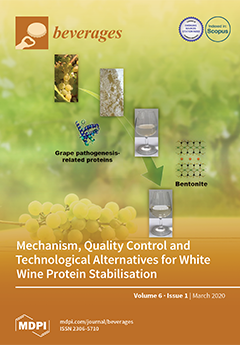
Cover Story: Grape pathogenesis-related proteins (thaumatin-like proteins and chitinases) are the main cause of white wine protein instability. This overview resumes and discusses the different aspects involved in wine protein instability—namely, grape and wine protein profile characterisation, wine protein instability mechanisms, and stability tests that can be used to predict wine protein instability and to recommend the most appropriate technological approach to remove the unstable proteins. Despite the many technological solutions that have been studied in recent years, it can be concluded that sodium bentonite is presently the most efficient and used treatment to remove unstable proteins from white wines. View this paper.
  • Issues are regarded as officially published after their release is announced to the table of contents alert mailing list .
  • You may sign up for email alerts to receive table of contents of newly released issues.
  • PDF is the official format for papers published in both, html and pdf forms. To view the papers in pdf format, click on the "PDF Full-text" link, and use the free Adobe Reader to open them.

Articles (19)

  • Review
  • Open Access
55 Citations
17,165 Views
28 Pages

White Wine Protein Instability: Mechanism, Quality Control and Technological Alternatives for Wine Stabilisation—An Overview

  • Fernanda Cosme,
  • Conceição Fernandes,
  • Tânia Ribeiro,
  • Luís Filipe-Ribeiro and
  • Fernando M. Nunes

Wine protein instability depends on several factors, but wine grape proteins are the main haze factors, being mainly caused by pathogenesis-related proteins (thaumatin-like proteins and chitinases) with a molecular weight between 10~40 kDa and an iso...

  • Review
  • Open Access
100 Citations
25,943 Views
39 Pages

Membrane-Based Operations in the Fruit Juice Processing Industry: A Review

  • Carmela Conidi,
  • Roberto Castro-Muñoz and
  • Alfredo Cassano

The fruit juice industry is one of the food sectors that has invested the most in the implementation of new technologies, such as non-thermal technologies. Among them, membrane processes are considered today well-established separation techniques to...

  • Article
  • Open Access
10 Citations
4,387 Views
7 Pages

Determination of Macroelements, Transition Elements, and Anionic Contents of Commercial Roasted Ground Coffee Available in Jordanian Markets

  • Sati Y. Al-Dalain,
  • Moawiya A. Haddad,
  • Salvatore Parisi,
  • Mousa Atallah Al-Tarawneh and
  • Haitham Qaralleh

Coffee is one of the most common drinks worldwide. Due to the variability of elements composition, coffee is important for human health. The aim of this study is to assess the concentration of certain selected elements of commercial samples of roaste...

  • Review
  • Open Access
26 Citations
13,958 Views
19 Pages

Biogenic Amines in Alcohol-Free Beverages

  • Giuliana Vinci and
  • Lucia Maddaloni

Biogenic amines are ubiquitous bioactive compounds that are synthesized by living organisms and perform essential functions for their metabolism. In the human diet, their excessive intake can cause food poisoning. In food, especially in alcohol-free...

  • Review
  • Open Access
191 Citations
45,678 Views
19 Pages

Kombucha is a fermented functional beverage that started as a homemade beverage and grew into a commercial product in the U.S. by the turn of this century. The number of companies producing kombucha, as well as the variety of kombucha products, is in...

  • Article
  • Open Access
8 Citations
9,662 Views
21 Pages

Understanding Australian Wine Consumers’ Preferences for Different Sparkling Wine Styles

  • Naomi Verdonk,
  • Renata Ristic,
  • Julie Culbert,
  • Karma Pearce and
  • Kerry Wilkinson

This study investigated the perceptions and preferences of Australian wine consumers towards different styles of sparkling wine, including French Champagne and Australian sparkling white, red and rosé wine, Moscato and Prosecco. An online surv...

  • Review
  • Open Access
47 Citations
8,767 Views
25 Pages

An Approach of the Madeira Wine Chemistry

  • Rosa Perestrelo,
  • Catarina Silva,
  • Carolina Gonçalves,
  • Mariangie Castillo and
  • José S. Câmara

25 February 2020

Madeira wine is a fortified Portuguese wine, which has a crucial impact on the Madeira Island economy. The particular properties of Madeira wine result from the unique and specific winemaking and ageing processes that promote the occurrence of chemic...

  • Article
  • Open Access
59 Citations
9,084 Views
9 Pages

25 February 2020

There is an increasing demand for non-dairy probiotic carriers such as fruit and vegetable juices. Probiotic Lactobacillus sanfranciscensis is predominantly used in the bakery industry, and its efficacy in fruit juices has not been studied sufficient...

  • Review
  • Open Access
17 Citations
16,168 Views
11 Pages

21 February 2020

Nutritional and ergogenic aid supplementation is prevalent within athletic or general fitness populations, and is only continuing to gain momentum. Taken in isolation or as a combination, amino acid (AA) supplementation has the potential to increase...

  • Article
  • Open Access
5 Citations
5,304 Views
11 Pages

17 February 2020

In traditional method sparkling wine production, to carry out a successful second alcoholic fermentation, yeast are acclimatized to stressful base wine conditions. Base wines typically have low pH, low nutrient concentrations, high acid concentration...

of 2

Get Alerted

Add your email address to receive forthcoming issues of this journal.

XFacebookLinkedIn
Beverages - ISSN 2306-5710