

You are currently on the new version of our website. Access the old version .

Separations, Volume 11, Issue 2

February 2024 - 28 articles

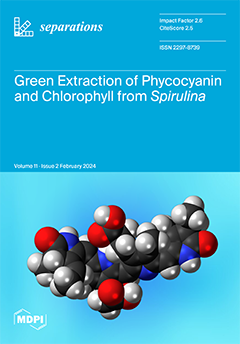
Cover Story: The extraction of substances with potential applications in the food, pharmaceutical, and cosmetic industries is the subject of increased research interest. Ultrasonic extraction as an environmentally friendly "green" method is one of the most preferred for isolating biologically active compounds from plants. It is economical and saves time while producing high-quality extracts. On the other hand, with microwave extraction, the process is significantly accelerated, which is due to the thermal effect caused by microwaves. This, in turn, carries the risk of destructive processes that can affect the extractable substance due to the rapid increase in temperature. In this study, ultrasonic and microwave extraction were used to obtain phycocyanin from Spirulina, and the advantages of both techniques were demonstrated. View this paper
  • Issues are regarded as officially published after their release is announced to the table of contents alert mailing list .
  • You may sign up for email alerts to receive table of contents of newly released issues.
  • PDF is the official format for papers published in both, html and pdf forms. To view the papers in pdf format, click on the "PDF Full-text" link, and use the free Adobe Reader to open them.

Articles (28)

  • Review
  • Open Access
7 Citations
4,910 Views
30 Pages

In new food formulations, carotenoids and phenolic compounds are likely to be the most sought after food ingredients according to their bioactivity, nutraceutical, nutritional value, and compatibility properties once incorporated into food formulatio...

  • Article
  • Open Access
11 Citations
4,271 Views
15 Pages

Efficient Removal of Tetracycline by Metal–Organic Framework ZIF-67 and Its Mechanism

  • Shengyang Zheng,
  • Yaping Xu,
  • Xu Yao,
  • Chenzhe Wang,
  • Ping Liu,
  • Haitao Zhao,
  • Jianbing Lu and
  • Jing Ju

The widespread use of tetracycline (TC) poses potential hazards to ecosystems and human health. In this study, ZIF-67 was successfully synthesized using a room-temperature static synthesis method and applied to the efficient removal of TC from water....

  • Article
  • Open Access
3 Citations
2,408 Views
11 Pages

Essential Oils from Azorean Cryptomeria japonica Female Cones at Different Developmental Stages: Variations in the Yields and Chemical Compositions

  • Alexandre Janeiro,
  • Ana Lima,
  • Filipe Arruda,
  • Tanner Wortham,
  • Tânia Rodrigues,
  • José Baptista and
  • Elisabete Lima

Cryptomeria japonica (Thunb. ex L.f.) D. Don (Cupressaceae) is widely cultivated in the Azores archipelago (Portugal) for landscaping and timber production, generating a huge amount of biomass residues. Among these, female cones (FC) emerge as a sour...

  • Article
  • Open Access
14 Citations
4,671 Views
23 Pages

In this study, we biosynthesized the stable silver nanoparticles (AgNPs) from Momordica cymbalaria leaves to evaluate their antioxidant, antibacterial, cytotoxic, and photocatalytic properties. Initially, we screened the bioactive compounds from M. c...

  • Article
  • Open Access
1 Citations
2,628 Views
14 Pages

Optimization of the Reaction between 5-O-Caffeoylquinic Acid (5-CQA) and Tryptophan—Isolation of the Product and Its Evaluation as a Food Dye

  • Patroklos Vareltzis,
  • Panagiota Karatsioli,
  • Ioannis Kazakos,
  • Anna-Maria Menelaou,
  • Konstantina Parmaxi and
  • Vangelis Economou

The food industry is seeking a stable, non-toxic red dye as a substitute for synthetic pigments. This can result from the reaction between 5-O-Caffeoylquinic acid (5-CQA) and tryptophan (TRP). This study explores the reaction kinetics under ultrasoun...

  • Article
  • Open Access
2 Citations
3,402 Views
17 Pages

Stability and Reactivity of Guaiacylglycerol-β-Guaiacyl Ether, a Compound Modeling β-O-4 Linkage in Lignin

  • Zeinab Rabiei,
  • Andrew Simons,
  • Magdalena Folkmanova,
  • Tereza Vesela,
  • Ondrej Uhlik,
  • Evguenii Kozliak and
  • Alena Kubátová

Lignin, a complex and abundant biopolymer, is a major constituent of plant cell walls. Due to its chemical and structural complexity, lignin degradation is a challenging task for both natural and engineered systems. Therefore, investigation of lignin...

  • Article
  • Open Access
2 Citations
3,751 Views
15 Pages

Cross-Contamination of Ignitable Liquid Residues on Wildfire Debris—Effects of Packaging and Storage on Detection and Characterization

  • Nadin Boegelsack,
  • James Walker,
  • Court D. Sandau,
  • Dena W. McMartin,
  • Jonathan M. Withey and
  • Gwen O’Sullivan

Producing defensible data for legal proceedings requires strict monitoring of sample integrity. In fire debris analysis, various approved packaging and storage solutions are designed to achieve this by preventing cross-contamination. This study exami...

  • Article
  • Open Access
22 Citations
16,672 Views
14 Pages

Extraction of Phycocyanin and Chlorophyll from Spirulina by “Green Methods”

  • Krastena Nikolova,
  • Nadezhda Petkova,
  • Dasha Mihaylova,
  • Galia Gentscheva,
  • Georgi Gavrailov,
  • Ivaylo Pehlivanov and
  • Velichka Andonova

Phycocyanin is a pigment–protein complex from the group of phycobiliproteins obtained from Spirulina (Arthrospira platensis), with possibilities for various applications in food and pharmaceutical technologies. It is a natural colorant for food...

  • Article
  • Open Access
3 Citations
2,201 Views
17 Pages

Spatially and Temporally Resolved Analysis of Bleeding in a Centrifugal Partition Chromatography Rotor

  • Felix Buthmann,
  • Philip Laby,
  • Djamal Hamza,
  • Jörg Koop and
  • Gerhard Schembecker

Centrifugal Partition Chromatography (CPC) is a separation technique that utilizes immiscible liquid phases to purify compounds. The selection of solvents in Liquid–Liquid Chromatography offers flexibility and optimization possibilities for spe...

  • Article
  • Open Access
2,789 Views
14 Pages

Development and Validation of HPLC-FLD Analysis of Perampanel in MEPS-Processed Rat Plasma Sample

  • Ayah Nader Abu-shark,
  • Ashok K. Shakya,
  • Safwan M. Al-Adwan and
  • Rajashri R. Naik

Perampanel, a novel α-amino-3-hydroxy-5-methyl-4-isoxazolepropionic acid (AMPA) receptor antagonist, is registered for the adjunctive treatment of patients (aged ≥ 12 years) with refractory partial-onset seizures. A simple high-performance l...

of 3

Get Alerted

Add your email address to receive forthcoming issues of this journal.

XFacebookLinkedIn
Separations - ISSN 2297-8739