You are currently viewing a new version of our website. To view the old version click .

Languages, Volume 7, Issue 4

December 2022 - 71 articles

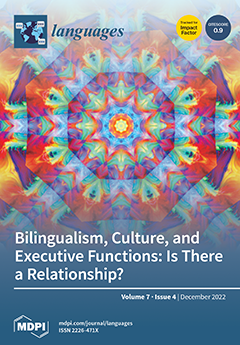
Cover Story: The relationship between executive functions (EFs) and bilingualism has been characterised by optimism for a bilingual advantage until the last decade, when a steady stream of articles reported failure to find a consistently positive effect for bilingualism. This paper examines the possible effect of culture among bilingual studies on EFs by first contextualising how bilingual EFs are studied and outlining the absence of culture as a macro variable, followed by a discussion on how culture and language are often conflated. This paper directs attention to emerging research that tracks the importance of culture as a separate variable from language and discusses why macro culture and individual monoculturalism or biculturalism need to be carefully elucidated as a factor that can interact with the bilingual experience in shaping EFs. View this paper
  • Issues are regarded as officially published after their release is announced to the table of contents alert mailing list .
  • You may sign up for email alerts to receive table of contents of newly released issues.
  • PDF is the official format for papers published in both, html and pdf forms. To view the papers in pdf format, click on the "PDF Full-text" link, and use the free Adobe Reader to open them.

Articles (71)

  • Article
  • Open Access
2,540 Views
27 Pages

29 November 2022

Noun–noun concatenations can differ along two parameters. They can be compounds, i.e., single words, or constructs, i.e., constituents, and they can have modificational non-heads or referential non-heads. Of the four logical possibilities, one...

  • Article
  • Open Access
4 Citations
13,723 Views
10 Pages

The Nature and Function of Languages

  • Franco Fabbro,
  • Alice Fabbro and
  • Cristiano Crescentini

28 November 2022

Several studies in philosophy, linguistics and neuroscience have tried to define the nature and functions of language. Cybernetics and the mathematical theory of communication have clarified the role and functions of signals, symbols and codes involv...

  • Article
  • Open Access
1 Citations
2,964 Views
22 Pages

27 November 2022

This work tests the effect of heritage language background on imitation and discrimination of prevoicing in word-initial stops. English speakers with heritage languages of Spanish (where prevoicing is obligatorily present) or Cantonese (where prevoic...

  • Article
  • Open Access
1 Citations
2,152 Views
21 Pages

24 November 2022

This paper aims to study the meanings of passive auditory perception verbs in Catalan (sentir) and French (entendre) with regards to diachronic semantic change and from the point of view of cognitive semantics. These verbs do not originally encode th...

  • Article
  • Open Access
2,221 Views
31 Pages

24 November 2022

In this overview paper, I discuss data from child languages available in the literature that instantiate errors of commission. I focus on three constructions involving movement to the left periphery of the clause: the production of aux-doubling (wher...

  • Article
  • Open Access
8 Citations
10,472 Views
38 Pages

23 November 2022

Bilingual speakers often engage in code-switching, that is the use of lexical items and grammatical features from two languages in one sentence. Malaysia is a particularly interesting context for the study of code-switching because Malay-English code...

  • Article
  • Open Access
2 Citations
2,929 Views
19 Pages

23 November 2022

A large body of research has indicated that young second language (L2) learners often have problems with spelling, such as letter omission and mis-ordering. To give due attention to this issue, a duoethnographic study was undertaken by two researcher...

  • Article
  • Open Access
3,296 Views
15 Pages

23 November 2022

This article is set in the framework of typological and functional studies on interrogativity, and focuses on the study of Guaraní, based on primary data collected in Formosa (Argentina). Interrogative constructions encode the speaker’s...

  • Article
  • Open Access
8 Citations
5,343 Views
26 Pages

21 November 2022

Dynamic Assessment (DA) is recommended for testing bilinguals as it tests the child’s learning potential and not her or his previously acquired language knowledge. Thus, it allows language difficulties to be distinguished from difficulties rela...

of 8

Get Alerted

Add your email address to receive forthcoming issues of this journal.

XFacebookLinkedIn
Languages - ISSN 2226-471X