



Next Issue
Volume 10, December
Previous Issue
Volume 10, October


Languages, Volume 10, Issue 11 (November 2025) – 19 articles
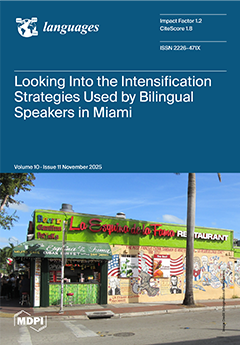
Cover Story (view full-size image): Situations of language contact can result in various outcomes. It is important to study various types of contact situations in order to better understand which factors contribute to the ways in which these outcomes concretely manifest in language. This study investigates the contact effects of codeswitching and linguistic convergence in the speech of the English–Spanish bilingual community of Miami, making use of intensification as a testing ground. Intensification constitutes an analytic–synthetic conflict site between the grammars of English and Spanish with regard to the concrete strategies preferably used in both languages. In settings of bilingual language use and codeswitching, it is of interest to observe which intensifying strategies speakers use when they have two diverging systems of intensification at their disposal. View this paper
  • Issues are regarded as officially published after their release is announced to the table of contents alert mailing list.
  • You may sign up for e-mail alerts to receive table of contents of newly released issues.
  • PDF is the official format for papers published in both, html and pdf forms. To view the papers in pdf format, click on the "PDF Full-text" link, and use the free Adobe Reader to open them.
Order results
Result details
Select all
Export citation of selected articles as:
18 pages, 433 KB  
Article
A Corpus-Based Study of Syntactic Complexity in L2 Japanese Writing: Insights from Usage-Based Approaches
by Yue Ma and Xiao Han
Languages 2025, 10(11), 286; https://doi.org/10.3390/languages10110286 - 17 Nov 2025
Viewed by 529
Abstract
Recent research on second language (L2) writing has increasingly emphasized syntactic complexity as a key indicator of L2 writing proficiency. From an emergentist usage-based view, drawing on data from the B-JAS corpus, the study conducted both a longitudinal comparison across proficiency levels and [...] Read more.
Recent research on second language (L2) writing has increasingly emphasized syntactic complexity as a key indicator of L2 writing proficiency. From an emergentist usage-based view, drawing on data from the B-JAS corpus, the study conducted both a longitudinal comparison across proficiency levels and a cross-sectional comparison between advanced learners and native speakers to investigate the features and development trends of syntactic complexity in L2 Japanese writing. Two indices were employed to measure syntactic complexity: the clause ratio (a large-grained index) and the ratio of different types of subordinate clauses (a fine-grained index). The results showed that learners had a higher clause ratio and greater use of te-form clauses at the advanced level than at the intermediate level. However, their use of relative clauses was lower, and their use of te-form clauses was significantly higher than that of native speakers. These findings reveal a syntactic usage tendency among learners, marked by an underuse of relative clauses and an overuse of te-form clauses. From a usage-based perspective, attentional biases from Chinese, frequency-based entrenchment, and the semantic ambiguity of te-form structures may primarily drive the observed syntactic usage patterns. Full article
31 pages, 2152 KB  
Article
Reassessing the Learner Englishes–New Englishes Continuum: A Lexico-Grammatical Analysis of TAKE in Written and Spoken Englishes
by Yating Tao and Gaëtanelle Gilquin
Languages 2025, 10(11), 285; https://doi.org/10.3390/languages10110285 - 13 Nov 2025
Viewed by 481
Abstract
This study reexamines Learner Englishes (LEs)–New Englishes (NEs) continuum by considering intervarietal variation, mode differences, and multiple linguistic levels. Relying on comparable written and spoken corpus data, we investigate the valency patterns and senses of the verb TAKE across two LEs (Mainland Chinese [...] Read more.
This study reexamines Learner Englishes (LEs)–New Englishes (NEs) continuum by considering intervarietal variation, mode differences, and multiple linguistic levels. Relying on comparable written and spoken corpus data, we investigate the valency patterns and senses of the verb TAKE across two LEs (Mainland Chinese English (MCE) and Belgian French-speaking English (BFE)) and two NEs (Singapore English (SgE) and Hong Kong English (HKE)) within the Extra- and Intra-territorial Forces (EIF) Model. The study examines whether internal linguistic factors, namely, mode (writing and speech) and linguistic levels (valency patterns and senses), influence the variety positioning along the LEs-NEs continuum and whether this positioning reflects the expected proximity cline to native English (NativeE) (BFE > MCE > HKE > SgE) established within the EIF Model. Our quantitative results reveal that individual varieties intermingle depending on mode and linguistic levels rather than occupying stable positions along the LEs-NEs continuum. Dendrogram analyses yield distinct variety clustering patterns that contradict the expected proximity cline to NativeE. Qualitatively, we identify some shared linguistic features across LEs and NEs that suggest common underlying language learning strategies. These results contribute to variationist linguistics by demonstrating that English varieties exhibit dynamic development trajectories shaped by language-internal factors (e.g., mode and linguistic levels). We propose refining the EIF Model to incorporate language-internal dimensions, thereby bridging the gap between LEs and NEs through a more nuanced theoretical framework. Full article
Show Figures

Figure 1

20 pages, 446 KB  
Article
Bantu Verbal Extensions Between Morphology and Syntax
by Gloria Cocchi
Languages 2025, 10(11), 284; https://doi.org/10.3390/languages10110284 - 13 Nov 2025
Viewed by 481
Abstract
Bantu languages represent a typical example of how morphology and syntax are deeply intertwined. Indeed, these agglutinative languages employ affixes, hence morphemes, to express relations that in other languages—like Italian or English—are conveyed by independent words, in syntax. In particular, in this work, [...] Read more.
Bantu languages represent a typical example of how morphology and syntax are deeply intertwined. Indeed, these agglutinative languages employ affixes, hence morphemes, to express relations that in other languages—like Italian or English—are conveyed by independent words, in syntax. In particular, in this work, I am going to discuss Bantu causative and applicative constructions, which are formed by means of verbal extensions, i.e., affixes that adjoin to verb stems in order to derive complex syntactic structures. Through the comparison with other languages, in particular Italian and English, we will argue that a biclausal analysis of Bantu causatives is tenable and, even more, this analysis can be extended to applicative and ditransitive verbs, taking into consideration the different behaviour of symmetrical and asymmetrical Bantu languages. Finally, we will discuss the peculiar situation of Italian, which behaves like symmetrical Bantu languages as concerns object pronominalization in the complex constructions under analysis; we will conclude that the co-occurrence of clitic pronouns is linked to their different morphological forms, which suggests that they occupy different positions in the clitic/affix string, underlying once more how morphology and syntax feed each other. Full article
(This article belongs to the Special Issue Morpho(phono)logy/Syntax Interface)
17 pages, 353 KB  
Article
Spanglish in the US, Belize and Gibraltar: On the Importance of Comparative Research
by Osmer Balam
Languages 2025, 10(11), 283; https://doi.org/10.3390/languages10110283 - 12 Nov 2025
Viewed by 568
Abstract
Even though it has been previously suggested that Spanglish is not exclusive to the US, research on this sociolinguistic phenomenon has focused on the US Hispanophone context, thus providing a limited understanding of how the US compares to Belize and Gibraltar, two language [...] Read more.
Even though it has been previously suggested that Spanglish is not exclusive to the US, research on this sociolinguistic phenomenon has focused on the US Hispanophone context, thus providing a limited understanding of how the US compares to Belize and Gibraltar, two language contact situations where Spanglish is also attested. This paper fills this gap by bringing together insights from scholarship on these three contexts where Spanish has been in prolonged contact with English. To this end, this article highlights some of the key debates and discussions regarding Spanglish. It also introduces the reader to some similarities between the US, Belize and Gibraltar and posits that there are Spanglish phenomena, which necessarily entail the reevaluation of the role that structural hybridity plays in Spanglish. Lastly, through an overview of comparative analyses that have been conducted more recently, we illustrate the importance of this work in elucidating our knowledge of the remarkable patterns of uniformity and variability that characterize the dynamic nature of Spanglish varieties in different parts of the world today. Full article
19 pages, 4038 KB  
Article
Action Schemas Can Account for Prototypical and Non-Prototypical Palm-Up Open Hand Gestures
by Alan Cienki, Maíra Avelar and Olga Iriskhanova
Languages 2025, 10(11), 282; https://doi.org/10.3390/languages10110282 - 12 Nov 2025
Viewed by 460
Abstract
Palm-Up Open Hand (PUOH) gestures are often treated in the literature as one type that can perform different functions. However, the focus on the palm orientation and handshape has led to a puzzle in terms of explaining the several functions that these gestures [...] Read more.
Palm-Up Open Hand (PUOH) gestures are often treated in the literature as one type that can perform different functions. However, the focus on the palm orientation and handshape has led to a puzzle in terms of explaining the several functions that these gestures serve—functions that are not exclusive to PUOHs. We propose an alternative account by introducing action schemas as an explanatory and analytical tool. Action schemas are described based on how they are produced motorically (e.g., involving extension or rotation at certain joints), drawing on a kinesiological descriptive system, rather than in terms of how the hands look (e.g., palm orientation and handshape). Consequently, action schemas can account for variation in the forms of a given type of gesture based on differences in the effort with which it was produced or how fully the action schema was performed. We use recordings of a set of conversations in Russian to describe the action schemas of Offering (with a sub-category of Side-Offering) and of Spreading hands. The fact that not all instances involve upwardly oriented palms or open hands is shown not to be a problem for this analysis, but a natural outcome of the range of gesture tokens manifesting these action schemas. Full article
(This article belongs to the Special Issue Non-representational Gestures: Types, Use, and Functions)
Show Figures

Figure 1

19 pages, 1182 KB  
Article
Phonetic Attrition Beyond the Segment: Variability in Transfer Effects Across Cues in Voiced Stops
by Divyanshi Shaktawat
Languages 2025, 10(11), 281; https://doi.org/10.3390/languages10110281 - 7 Nov 2025
Viewed by 548
Abstract
Previous research shows that L2 learning can cause non-nativeness in the L1 of adult learners. These effects vary across segments, even across members of the same natural class (e.g., voiceless or voiced stops) differing in the presence or absence of transfer, the direction [...] Read more.
Previous research shows that L2 learning can cause non-nativeness in the L1 of adult learners. These effects vary across segments, even across members of the same natural class (e.g., voiceless or voiced stops) differing in the presence or absence of transfer, the direction (‘assimilation’ toward L2 or ‘dissimilation’ away from it), and the magnitude of shift. However, little is known about how multiple phonetic cues within a single segment jointly exhibit transfer, or about the cross-linguistic linkages formed at this fine-grained, cue-specific level of phonetic structure. This study investigates phonetic backward transfer by analyzing production of three cues, voice onset time, voicing during closure, and relative burst intensity, across voiced stops /b d g/. Conducted among first-generation bilingual Indian immigrants in Glasgow, it explores how their native varieties (Hindi and Indian English) are influenced by the dominant host variety (Glaswegian English) with reference to the revised Speech Learning Model and its predictions of assimilation, dissimilation, and no change. Two control groups (Indians and Glaswegians) and an experimental group (Glasgow Indians) were recorded reading in English and Hindi words containing the three voiced stops. Findings reveal cue-specific variability, highlighting the multidimensional nature of CLI and challenging segment-level generalizations in models of phonetic transfer. Full article
Show Figures

Figure 1

21 pages, 1025 KB  
Article
The Role of Prosody and Information Structure in Licensing Ellipsis: Particle Stranding Ellipsis in Japanese
by Mizuki Sakamoto and Jo Wakashiba
Languages 2025, 10(11), 280; https://doi.org/10.3390/languages10110280 - 4 Nov 2025
Viewed by 794
Abstract
Japanese noun phrases typically consist of nouns and particles, but there is an ellipsis phenomenon called Particle Stranding Ellipsis (PSE) where nouns are elided with a particle left. A PF-based deletion analysis of PSE has been proposed, but there are several criticisms against [...] Read more.
Japanese noun phrases typically consist of nouns and particles, but there is an ellipsis phenomenon called Particle Stranding Ellipsis (PSE) where nouns are elided with a particle left. A PF-based deletion analysis of PSE has been proposed, but there are several criticisms against it. Thus, it remains elusive what condition is imposed on the licensing of PSE. In this paper, we will formulate a finer-grained phonological theorization of PSE. Our analysis employs a phonological constraint, StrongStart, and information structural factors like givenness and foci, and characterizes PSE as an edge deletion applying to pragmatically given materials at the left edge of intonation phrases. Under this analysis, information structure plays an important role in ellipsis licensing: givenness feeds and foci bleed PSE. We demonstrate that this analysis can handle data that is problematic for the previous string deletion approach. Full article
24 pages, 2108 KB  
Article
The Effects of Self-Access Web-Based Pragmatic Instruction and L2 Proficiency on EFL Students’ Email Request Production and Confidence
by Sonia López-Serrano, Alicia Martínez-Flor and Ariadna Sánchez-Hernández
Languages 2025, 10(11), 279; https://doi.org/10.3390/languages10110279 - 31 Oct 2025
Viewed by 756
Abstract
The present study pursued three objectives: (i) to examine whether self-access web-based instruction could significantly improve EFL students’ ability to formulate pragmatically appropriate email requests; (ii) to determine whether L2 proficiency influenced students’ pragmatic performance and their gains following instruction; and (iii) to [...] Read more.
The present study pursued three objectives: (i) to examine whether self-access web-based instruction could significantly improve EFL students’ ability to formulate pragmatically appropriate email requests; (ii) to determine whether L2 proficiency influenced students’ pragmatic performance and their gains following instruction; and (iii) to explore changes in learners’ confidence when evaluating the appropriateness of their own email requests. Sixty-eight first-year English Studies students at a Spanish university completed a five-week intervention integrated into their curriculum. Their L2 proficiency was assessed using the Oxford Placement Test, which categorized them into B1 (n = 22), B2 (n = 23), and C1 (n = 23) levels. Using a pre–post-test design, learners’ performance was assessed through email tasks varying in imposition, and their confidence was measured via Likert-scale ratings. Results showed statistically significant improvements across all dimensions of an analytic rubric—particularly in request appropriateness and organization—indicating that self-access instruction effectively enhanced learners’ pragmatic competence. Gains were similar across the three proficiency groups, with B2 students showing slightly higher though not statistically significant improvements. Participants also reported significantly increased confidence in evaluating their own email appropriateness post-intervention. Findings support the integration of self-access pragmatic resources into EFL curricula to develop academic communication skills in higher education contexts. Full article
Show Figures

Figure 1

25 pages, 3707 KB  
Article
Scope Without Scope Economy in Null Argument Constructions
by Bum-Sik Park and Sei-Rang Oh
Languages 2025, 10(11), 278; https://doi.org/10.3390/languages10110278 - 31 Oct 2025
Viewed by 485
Abstract
Building on Fox’s Scope Economy, Takahashi proposes an analysis of scope interactions in Japanese null argument constructions. Scope Economy prevents covert scope-shifting operations such as Quantifier Raising (QR) from being semantically vacuous. Equating scrambling of Japanese null arguments with QR, Takahashi argues that [...] Read more.
Building on Fox’s Scope Economy, Takahashi proposes an analysis of scope interactions in Japanese null argument constructions. Scope Economy prevents covert scope-shifting operations such as Quantifier Raising (QR) from being semantically vacuous. Equating scrambling of Japanese null arguments with QR, Takahashi argues that null arguments are also subject to Scope Economy and thus exhibit the same scope asymmetries observed in English VP-ellipsis. In this paper, we examine Korean null argument constructions, which exhibit the same patterns as their Japanese counterparts, and argue that Takahashi’s Scope Economy-based account falls short of capturing the full range of scope facts. Specifically, we show that scope asymmetries persist even when Scope Economy-violating scrambling takes place. This problem is not confined to null argument constructions but also arises in fragments. We argue that Schwarzschild’s GIVENness constraint, in conjunction with Parallelism, accounts for scope patterns in Korean null argument constructions, without recourse to Scope Economy. We further suggest that the proposed analysis can extend to English, thereby undermining the necessity of Scope Economy in both languages. Full article
22 pages, 4168 KB  
Review
How a Simple Increase in the Number of Items Can Enhance the Reliability of Linguistic Judgments: The Case of Island Experiments
by Gert-Jan Thomas Schoenmakers
Languages 2025, 10(11), 277; https://doi.org/10.3390/languages10110277 - 31 Oct 2025
Viewed by 527
Abstract
Replication is an important aspect of experimental research and it is therefore crucial that participant-level measures (e.g., judgment scores) are reliable. Reliability refers to the precision of measurement and thus informs the replicability of experiments: more precise measurements are more dependable for future [...] Read more.
Replication is an important aspect of experimental research and it is therefore crucial that participant-level measures (e.g., judgment scores) are reliable. Reliability refers to the precision of measurement and thus informs the replicability of experiments: more precise measurements are more dependable for future reference. Formally defined as the ratio of true score variance to the total variance, reliability can be achieved by fine-tuning the measurement instrument or by collecting a sufficiently large number of observations per participant, as averaging over more items reduces the influence of random item-specific noise and yields a more precise estimate of participants’ true scores. The present paper uses Generalizability Theory to estimate the reliability of participant scores in 52 distinct datasets from studies that used comparable experimental designs to investigate different types of island effects in different languages. Effect sizes (DD-scores) are commonly reported and used for comparative purposes in discussions on island effects. The present paper argues that caution is warranted when island effect sizes are compared: the analyses reveal that participant-level reliability in island experiments is moderate, but that increasing the number of items to six per condition enhances measurement precision. Full article
(This article belongs to the Special Issue New Trends in Syntactic Islands)
Show Figures

Figure 1

23 pages, 470 KB  
Article
Dizque in Andean Spanish and Beyond
by Gabriel Martínez Vera
Languages 2025, 10(11), 276; https://doi.org/10.3390/languages10110276 - 30 Oct 2025
Viewed by 481
Abstract
This paper examines the reportative evidential dizque in Andean Spanish as spoken in Ecuador and Peru. Taking, as a starting point, the synchronic and diachronic syntactic analyses of this type of markers in Romance that have been discussed in the literature, I propose [...] Read more.
This paper examines the reportative evidential dizque in Andean Spanish as spoken in Ecuador and Peru. Taking, as a starting point, the synchronic and diachronic syntactic analyses of this type of markers in Romance that have been discussed in the literature, I propose an analysis that makes explicit how their syntax is mapped into semantics, and provide a semantics that captures the evidential and lack of certainty implications of dizque. I argue that expressions with dizque must be uttered when reportative evidence is available to the speaker, and, building on previous literature, that the lack of certainty flavor that these expressions have is a not-at-issue entailment. I show a number of consequences that follow from this kind of approach. I further point out how my proposal can capture the cross-Romance variation that is found in this domain, and discuss some key differences between dizque and other reportative evidentials cross-linguistically in connection to the expression of lack of certainty. Full article
(This article belongs to the Special Issue Shifting Borders: Spanish Morphosyntax in Contact Zones)
28 pages, 1560 KB  
Article
Intensification Strategies in English–Spanish Bilingual Speech: Examining Lexical and Morphological Markers in Miami Bilinguals’ Discourse
by Simon A. Claassen, Renata Enghels and M. Carmen Parafita Couto
Languages 2025, 10(11), 275; https://doi.org/10.3390/languages10110275 - 30 Oct 2025
Viewed by 1005
Abstract
This paper investigates the speech variety of the English–Spanish community of Miami, which features a high degree of English–Spanish bilingualism. Specifically, it explores intensification, a site of analytic–synthetic conflict between English and Spanish grammars. English predominantly uses lexical-analytic strategies (e.g., very beautiful, [...] Read more.
This paper investigates the speech variety of the English–Spanish community of Miami, which features a high degree of English–Spanish bilingualism. Specifically, it explores intensification, a site of analytic–synthetic conflict between English and Spanish grammars. English predominantly uses lexical-analytic strategies (e.g., very beautiful, a big house) for intensification, whereas Spanish employs more morphological-synthetic markers (e.g., guapísimo ‘very beautiful’, un casón ‘a big house’). Concretely, the current study aims to investigate whether Miami bilinguals have preferences in terms of the language or strategy of choice to express intensification and whether these preferences are influenced by intralinguistic (e.g., semantic-pragmatic function of the intensifier) or extralinguistic factors (e.g., speakers’ proficiency in, acquisition of, and attitudes toward both languages). To this end, an empirical study is conducted on three corpora, one bilingual and two monolingual ones. In this study, a wide variety of both analytic and synthetic intensifiers is found. The qualitative and quantitative findings reveal that Miami bilinguals use more English than Spanish intensifiers and favor analytic intensifiers over synthetic ones. However, among the Spanish intensifiers, the proportion of synthetic forms is significantly higher than among the English intensifiers. Full article
28 pages, 1964 KB  
Article
Aspectual Architecture of the Slavic Verb and Its Nominal Analogies
by Petr Biskup
Languages 2025, 10(11), 274; https://doi.org/10.3390/languages10110274 - 29 Oct 2025
Viewed by 515
Abstract
It has been argued that there are analogies between the nominal domain and the verbal domain in natural languages. Most approaches dealing with these analogies in Slavic languages investigate them from the semantic and aspectual points of view. In contrast to them, this [...] Read more.
It has been argued that there are analogies between the nominal domain and the verbal domain in natural languages. Most approaches dealing with these analogies in Slavic languages investigate them from the semantic and aspectual points of view. In contrast to them, this article focuses on morphosyntactic parallels. It investigates all five aspectual markers of verbal predicates: prefixes, the secondary imperfective, the semelfactive morpheme, the iterative -a and the habitual suffix. The analysis follows the Distributed Morphology framework. This article addresses the question of which morphosyntactic correspondences these aspectual markers have in the nominal domain. It is argued that the iterative secondary imperfective is a parallel of the nominal number projection and that the habitual morpheme in North Slavic languages is the counterpart of the nominal determiner. Verbal prefixes are analogous to nominal classifiers, and in addition, lexical prefixes parallel the nominal complement, and superlexical prefixes correspond to adjectival modifiers of the nominal domain. The internal iterative -a, as a spell-out of the verbal categorizing head, is analogous to the categorizing head of nouns. Thus, it is argued that Slavic also has event-internal and event-external pluractional markers. The semelfactive morpheme parallels the singulative (diminutive) marker of the nominal domain, and we argue that these markers adjoin to the root before the categorizing head. This argues against the standard claim that semelfactives are derived from iteratives (multiplicatives). Full article
29 pages, 1961 KB  
Article
Developing an AI-Powered Pronunciation Application to Improve English Pronunciation of Thai ESP Learners
by Jiraporn Lao-un and Dararat Khampusaen
Languages 2025, 10(11), 273; https://doi.org/10.3390/languages10110273 - 28 Oct 2025
Viewed by 1382
Abstract
This study examined the effects of using specially designed AI-mediated pronunciation application in enhancing the production of English fricative consonants among Thai English for Specific Purposes (ESP) learners. The research utilized a quasi-experimental design involving intact classes of 74 undergraduate students majoring in [...] Read more.
This study examined the effects of using specially designed AI-mediated pronunciation application in enhancing the production of English fricative consonants among Thai English for Specific Purposes (ESP) learners. The research utilized a quasi-experimental design involving intact classes of 74 undergraduate students majoring in Thai Dance and Music Education, divided into control (N = 38) and experimental (N = 36) groups. Grounded in Skill Acquisition Theory, the experimental group received pronunciation training via a custom-designed AI application leveraging automatic speech recognition (ASR), offering ESP contextualized practices, real-time, and individualized feedback. In contrast, the control group underwent traditional teacher-led articulatory and teacher-assisted feedback. Pre- and post-test evaluations measured pronunciation for nine target fricatives in ESP-relevant contexts. The statistical analyses revealed significant improvements in both groups, with the AI-mediated group demonstrating substantially greater gains, particularly on challenging sounds absent in Thai, such as /θ/, /ð/, /z/, /ʃ/, and /h/. The findings underscore the potential of AI-driven interventions to address language-specific phonological challenges through personalized, immediate feedback and adaptive practices. The study provides empirical evidence for integrating advanced technology into ESP pronunciation pedagogy, informing future curriculum design for EFL contexts. Implications for theory, practice, and future research are discussed, emphasizing tailored technological solutions for language learners with specific phonological profiles. Full article
Show Figures

Figure 1

19 pages, 653 KB  
Article
Parallels Between Second Language Mastery and Musical Proficiency: Individual Differences in Auditory Phonological Pattern Recognition
by Markus Christiner and Christine Groß
Languages 2025, 10(11), 272; https://doi.org/10.3390/languages10110272 - 27 Oct 2025
Viewed by 672
Abstract
Research has shown that language ability can vary enormously depending on variables such as musical ability, musical training, and second and/or foreign language experience. In this study, we simulated initial foreign language learning conditions in which learners must recognize and match unfamiliar language [...] Read more.
Research has shown that language ability can vary enormously depending on variables such as musical ability, musical training, and second and/or foreign language experience. In this study, we simulated initial foreign language learning conditions in which learners must recognize and match unfamiliar language input. We recruited 500 participants with different levels of foreign language experience, different levels of musical training and different socio-economic backgrounds. Their auditory phonological pattern recognition ability, short-term memory (STM) capacity, musical ability, musical self-estimation, educational status, and socio-economic status (SES) were assessed. Both overall and group-specific analyses were conducted to investigate the impact of these variables. For the group-specific analysis, participants were assigned to four groups based on the presence or absence of musical training and extensive foreign language experience. For the overall analysis, regression models were applied to the entire sample to examine the combined effects of all variables. Group-specific analyses revealed that both musical training and extensive foreign language experience contributed to individual differences in the ability to recognize phonological patterns in unintelligible auditory stimuli. A key finding was that musical training appeared to have a stronger influence on auditory phonological pattern recognition than extensive foreign language experience, particularly in the early stages of language learning. This suggests that musical training may exert a greater impact on initial phonetic acquisition processes than extensive foreign language proficiency, especially when the language stimuli are relatively poor in linguistic content. The overall analysis revealed that musical variables, short-term memory capacity, socioeconomic status, and educational status all contributed to individual differences in auditory phonological pattern recognition. Notably, the most significant finding of the overall analysis was the association between SES and auditory phonological pattern recognition in unfamiliar speech—a result that challenges the notion of aptitude measures as stable and environment-independent and highlights the potential influence of environmental factors on this capacity. Full article
Show Figures

Figure 1

32 pages, 30971 KB  
Article
When Language Maintenance Means Language Shift: Tibetan as an Heritage Language in Amdo Families in France
by Camille Simon
Languages 2025, 10(11), 271; https://doi.org/10.3390/languages10110271 - 26 Oct 2025
Viewed by 906
Abstract
This paper explores the initial steps of transgenerational language change in exile by comparing the varieties of “Common” Tibetan as spoken by parents born in Amdo, Tibet, and by their teenager children, born in Tibet or in South Asia, who arrived in France [...] Read more.
This paper explores the initial steps of transgenerational language change in exile by comparing the varieties of “Common” Tibetan as spoken by parents born in Amdo, Tibet, and by their teenager children, born in Tibet or in South Asia, who arrived in France at an early age and who have spent all or most of their schooling in France. In these families, the parents speak a variety of Amdo Tibetan as their first language, which does not allow for inter-comprehension with “Common” Tibetan. They have acquired “Common” Tibetan during their stay in South Asia before they moved to France. The paper follows a descriptive approach to analyze the structural (dis)similarities between the parents’ and the children’s varieties of “Common” Tibetan. It also documents intra-generational variation (1) within the parents’ generation, where we can observe a variable extent of retention for Amdo Tibetic features, and (2) within the children’s generation, where variation is usually due more to the (often contact-induced) linguistic changes than to the retention of some of their parents’ linguistic features. Full article
Show Figures

Figure 1

15 pages, 307 KB  
Article
Evaluative Morphology and the Syntax of Adjectives in Italian
by Denis Delfitto and Chiara Melloni
Languages 2025, 10(11), 270; https://doi.org/10.3390/languages10110270 - 24 Oct 2025
Viewed by 509
Abstract
This paper addresses a well-known puzzle at the intersection of morphology and syntax: the categorical exclusion of adjectives modified by evaluative morphology from prenominal position in Italian. While Italian allows many adjectives to occur both pre- and postnominally, adjectives like piccolino, ‘little-dim’, [...] Read more.
This paper addresses a well-known puzzle at the intersection of morphology and syntax: the categorical exclusion of adjectives modified by evaluative morphology from prenominal position in Italian. While Italian allows many adjectives to occur both pre- and postnominally, adjectives like piccolino, ‘little-dim’, are strictly postnominal (cane piccolino, lit. ‘dog little-dim’ vs. *piccolino cane, ‘little-dim dog’), a distribution not fully explained by their proposed predicative or intersective nature. Drawing on degree semantics and trope theory, we argue that this constraint arises from an incompatibility between two distinct interpretive strategies. Prenominal adjectives undergo a syntactically driven semantic shift, whereby the noun triggers a trope-based interpretation of the adjective, redefining the meaning of the A-N complex. In contrast, evaluative morphology operates through a pragmatically driven strategy, contributing speaker-oriented, context-sensitive meaning to the adjective. Crucially, these two strategies are mutually exclusive: an adjective modified by evaluative morphology has already undergone pragmatic reinterpretation and cannot simultaneously participate in the compositional syntactic process required for prenominal placement. This explains why adjectives with evaluative suffixes are excluded from prenominal contexts, despite often yielding intersective interpretations postnominally. Our proposal accounts for this distributional asymmetry without resorting to stipulations and suggests that certain interpretive procedures are not recursively applicable across syntax and pragmatics. Ultimately, this study sheds new light on a principled interface constraint linking syntactic distribution, morphological derivation and pragmatic interpretation. Full article
(This article belongs to the Special Issue Morpho(phono)logy/Syntax Interface)
19 pages, 562 KB  
Article
Constructive Dynamic Syntax
by Stergios Chatzikyriakidis
Languages 2025, 10(11), 269; https://doi.org/10.3390/languages10110269 - 23 Oct 2025
Viewed by 433
Abstract
This paper explores the integration of constructive type theory in the tradition of Martin Löf into Dynamic Syntax. Full article
(This article belongs to the Special Issue The Development of Dynamic Syntax)
20 pages, 1691 KB  
Article
Towards an Integrative Approach to EFL and ESL: Comparing English in Cyprus and Greece
by Sarah Buschfeld
Languages 2025, 10(11), 268; https://doi.org/10.3390/languages10110268 - 23 Oct 2025
Viewed by 664
Abstract
As has repeatedly been pointed out in recent years, the categories ESL/Outer Circle and EFL/Expanding Circle should not be considered as clear-cut as traditionally assumed. Consequently, recent research has made first attempts for an integrative approach to Englishes traditionally ascribed to one of [...] Read more.
As has repeatedly been pointed out in recent years, the categories ESL/Outer Circle and EFL/Expanding Circle should not be considered as clear-cut as traditionally assumed. Consequently, recent research has made first attempts for an integrative approach to Englishes traditionally ascribed to one of these categories. The paper at hand introduces the Extra- and Intra-territorial Forces Model (EIF Model) as a successful attempt to bridge the traditional gap between the two categories and shows how the model works in practice by implementation to the cases of Greece and Cyprus. These two countries are particularly interesting for the application of this framework since their linguistic ecologies, with Greek and English in contact, are essentially similar. From a historical perspective, however, they are fundamentally different; Cyprus is a former colony of the British Empire, whereas Greece has never experienced British colonization. Therefore, the two countries offer the perfect basis for putting the traditional categories of EFL and ESL to the test and for illustrating how more recent models of World Englishes, such as the EIF Model, might offer more flexible theoretical alternatives to earlier, often more rigid theoretical approaches. Full article
Show Figures

Figure 1

Previous Issue
Next Issue
Back to TopTop
