

You are currently viewing a new version of our website. To view the old version click .

Antioxidants, Volume 14, Issue 4

April 2025 - 129 articles

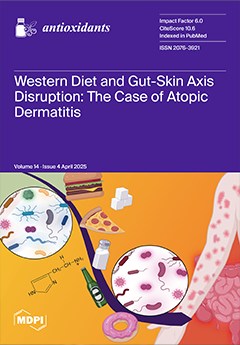
Cover Story: The exposome encompasses all the environmental factors that a person is exposed to throughout their lifetime, interacting with genetics to shape human health. Diet, a key exposome factor, strongly affects inflammatory and immune conditions like atopic dermatitis (AD). By modulating skin health, immunity, and the microbiome, diet can drive or mitigate AD. To clarify this relationship, we conducted a broad literature search focusing on the interplay between the Western diet (WD), nutrients, contaminants, and additives and AD. Findings show that a WD has impacts on epithelial barrier integrity, microbiota balance, and AD severity. As diet plays a pivotal role in AD prevention and management, tailored nutrition and broader exposome-based interventions may reduce disease burden and improve outcomes. View this paper
  • Issues are regarded as officially published after their release is announced to the table of contents alert mailing list .
  • You may sign up for email alerts to receive table of contents of newly released issues.
  • PDF is the official format for papers published in both, html and pdf forms. To view the papers in pdf format, click on the "PDF Full-text" link, and use the free Adobe Reader to open them.

Articles (129)

  • Article
  • Open Access
1,227 Views
27 Pages

Ammonia nitrogen is a common contaminant in aquatic environments, and its potential toxicity to organisms has attracted extensive attention. However, few studies have comprehensively evaluated the negative impacts of ammonia stress on cold-water fish...

  • Review
  • Open Access
5 Citations
12,563 Views
35 Pages

Advanced glycation end-products (AGEs) cause blood vessel damage and induce diabetic complications in various organs, such as the eyes, kidneys, nerves, and skin. As glycation stress causes aesthetic, physical, and functional changes in the skin, gly...

  • Article
  • Open Access
1 Citations
1,475 Views
13 Pages

Collagen plays a crucial role in platelet activation and thrombosis, yet the underlying mechanisms involving reactive oxygen species (ROS) remain incompletely understood. This study investigated how collagen modulates ROS generation and platelet aggr...

  • Article
  • Open Access
2 Citations
1,143 Views
22 Pages

Sulfate transporters (SULTRs) are key players that regulate sulfur acquisition and distribution within plants, thereby influencing cellular redox hemostasis under pathogen attacks, such as Alternaria brassicicola (Ab). In this study, a total of 23 Bo...

  • Article
  • Open Access
2 Citations
1,891 Views
24 Pages

Hyperthermia and nitrogenous pollutants like ammonia and nitrite are common risk factors that adversely affect fish health and pose significant threats to the aquaculture industry. However, the impacts of high temperatures on the accumulation of nitr...

  • Article
  • Open Access
1 Citations
1,477 Views
18 Pages

Competitive Ligand-Induced Recruitment of Coactivators to Specific PPARα/δ/γ Ligand-Binding Domains Revealed by Dual-Emission FRET and X-Ray Diffraction of Cocrystals

  • Shotaro Kamata,
  • Akihiro Honda,
  • Sayaka Yashiro,
  • Chihiro Kaneko,
  • Yuna Komori,
  • Ayumi Shimamura,
  • Risa Masuda,
  • Takuji Oyama and
  • Isao Ishii

Peroxisome proliferator-activated receptors (PPARs), composed of the α/δ/γ subtypes, are ligand-activated nuclear receptors/transcription factors that sense endogenous fatty acids or therapeutic drugs to regulate lipid/glucose metab...

  • Article
  • Open Access
3 Citations
2,117 Views
23 Pages

Cell-Permeable Microprotein from Panax Ginseng Protects Against Doxorubicin-Induced Oxidative Stress and Cardiotoxicity

  • Bamaprasad Dutta,
  • Shining Loo,
  • Antony Kam,
  • Xiaoliang Wang,
  • Na Wei,
  • Kathy Qian Luo,
  • Chuan-Fa Liu and
  • James P. Tam

(1) Background: Doxorubicin (DOX) is a frontline chemotherapeutic, but its side-effects from oxidative stress, leading to cardiotoxicity, pose significant challenges to its clinical use. We recently discovered a novel family of proteolysis-resistant,...

  • Review
  • Open Access
18 Citations
15,427 Views
44 Pages

Advanced Glycation End Products in Disease Development and Potential Interventions

  • Yihan Zhang,
  • Zhen Zhang,
  • Chuyue Tu,
  • Xu Chen and
  • Ruikun He

Advanced glycation end products (AGEs) are a group of compounds formed through non-enzymatic reactions between reducing sugars and proteins, lipids, or nucleic acids. AGEs can be generated in the body or introduced through dietary sources and smoking...

  • Article
  • Open Access
919 Views
20 Pages

In Vitro Structural Characteristics and Antioxidant and Expectorant Activities of Polysaccharides from Citri grandis fructus immaturus

  • Jingwen Li,
  • Suifen Mo,
  • Yingshan Feng,
  • Yan Xiang,
  • Chen Ni,
  • Qing Luo,
  • Jing Zhou,
  • Yujia Wang,
  • Ruoting Zhan and
  • Ping Yan

The aim of this study was to investigate the structural characteristics of four polysaccharides derived from Citri grandis fructus immaturus and their antioxidant and expectorant activities. ECP1 fraction passing through a 500 kDa dialysis bag (ECP1A...

  • Article
  • Open Access
1 Citations
1,181 Views
23 Pages

Background: Blueberry anthocyanin such as Cyanidin-3-O-glucoside may help prevent Alzheimer’s disease. We aimed to investigate the preventive and therapeutic effects of Cyanidin-3-O-glucoside against Aβ1–42-induced apoptosis of SH-SY...

of 13

Get Alerted

Add your email address to receive forthcoming issues of this journal.

XFacebookLinkedIn
Antioxidants - ISSN 2076-3921