

You are currently viewing a new version of our website. To view the old version click .

Galaxies, Volume 10, Issue 5

October 2022 - 12 articles

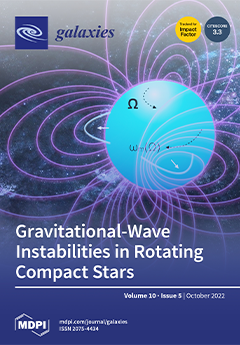
Cover Story: Neutron stars are known to withstand very fast rotation. The current record holders, for example, rotate around their axis of rotation more than 700 times per second. At such high rotational frequencies, neutron stars are no longer spherically symmetric objects but may build up mass multipole moments, causing them to begin emitting gravitational waves via the onset of gravitational–radiation reaction (GRR)-driven instabilities. We have calculated the rotational periods at which this happens. They depend on the temperature and mass of a neutron star and are found to be reached before mass shedding from the equator makes the star unstable. This makes neutron stars interesting candidates in the search for sources of gravitational waves. View this paper
  • Issues are regarded as officially published after their release is announced to the table of contents alert mailing list .
  • You may sign up for email alerts to receive table of contents of newly released issues.
  • PDF is the official format for papers published in both, html and pdf forms. To view the papers in pdf format, click on the "PDF Full-text" link, and use the free Adobe Reader to open them.

Articles (12)

  • Article
  • Open Access
3 Citations
2,579 Views
11 Pages

Diverse Polarimetric Features of AGN Jets from Various Viewing Angles: Towards a Unified View

  • Yuh Tsunetoe,
  • Shin Mineshige,
  • Tomohisa Kawashima,
  • Ken Ohsuga,
  • Kazunori Akiyama and
  • Hiroyuki R. Takahashi

21 October 2022

Here, we demonstrate that polarization properties show a wide diversity depending on viewing angles. To simulate images of a supermassive black hole and surrounding plasma, we performed a full-polarimetric general relativistic radiative transfer base...

  • Review
  • Open Access
8 Citations
5,231 Views
23 Pages

20 October 2022

The magnetic field is believed to play a critical role in the bulk acceleration and propagation of jets produced in active galactic nuclei (AGN). Polarization observations of AGN jets provide valuable information about their magnetic fields. As a res...

  • Article
  • Open Access
2,531 Views
27 Pages

17 October 2022

We aim to establish a rough first prospect on the potential of certain biorelevant solvents (water, ammonia, and methane) being present in liquid form inside the uppermost few meters of several modeled rocky and icy surfaces of hypothetical bodies or...

  • Article
  • Open Access
19 Citations
3,848 Views
27 Pages

Spirality: A Novel Way to Measure Spiral Arm Pitch Angle

  • Deanna Shields,
  • Benjamin Boe,
  • Casey Pfountz,
  • Benjamin L. Davis,
  • Matthew Hartley,
  • Ryan Miller,
  • Zac Slade,
  • M. Shameer Abdeen,
  • Daniel Kennefick and
  • Julia Kennefick

17 October 2022

We present the MATLAB code Spirality, a novel method for measuring spiral arm pitch angles by fitting galaxy images to spiral templates of known pitch. Computation time is typically on the order of 2 min per galaxy, assuming 8 GB of working memory. W...

  • Article
  • Open Access
20 Citations
3,185 Views
20 Pages

20 September 2022

Recent experimental and ab initio theory investigations of the 208Pb neutron skin thickness have the potential to inform the neutron star equation of state. In particular, the strong correlation between the 208Pb neutron skin thickness and the pressu...

  • Article
  • Open Access
12 Citations
2,543 Views
14 Pages

Fundamental Properties of Late-Type Stars in Eclipsing Binaries

  • Juan Carlos Morales,
  • Ignasi Ribas,
  • Álvaro Giménez and
  • David Baroch

17 September 2022

Evidence from the analysis of eclipsing binary systems revealed that late-type stars are larger and cooler than predicted by models, and that this is probably caused by stellar magnetic activity. In this work, we revisit this problem taking into acco...

  • Article
  • Open Access
5 Citations
3,140 Views
15 Pages

Mass-Accreting Pulsating Components of Algols

  • David Mkrtichian,
  • Khemsinan Gunsriviwat,
  • Holger Lehmann,
  • Chris Engelbrecht,
  • Andrew Tkachenko and
  • Victor Nazarenko

16 September 2022

We present a review of the latest results of studies of the class of mass-accreting pulsating components of semi-detached eclipsing binaries known as oEA stars. The application of the techniques of asteroseismology to this class of stars unlocks new...

  • Article
  • Open Access
3 Citations
2,553 Views
21 Pages

Properties of MAXI J1348-630 during Its Second Outburst in 2019

  • Riya Bhowmick,
  • Dipak Debnath,
  • Kaushik Chatterjee,
  • Arghajit Jana and
  • Sujoy Kumar Nath

7 September 2022

The newly discovered galactic black hole candidate (BHC) MAXI J1348-630 showed two major outbursts in 2019, just after its discovery. Here, we provide a detailed spectral and temporal analysis of the less-studied second outburst using archive data fr...

  • Article
  • Open Access
3 Citations
3,306 Views
23 Pages

Gravitational-Wave Instabilities in Rotating Compact Stars

  • Eric L. Bratton,
  • Zikun Lin,
  • Fridolin Weber,
  • Milva G. Orsaria,
  • Ignacio F. Ranea-Sandoval and
  • Nathaniel Saavedra

30 August 2022

It is generally accepted that the limit on the stable rotation of neutron stars is set by gravitational-radiation reaction (GRR) driven instabilities, which cause the stars to emit gravitational waves that carry angular momentum away from them. The i...

of 2

Get Alerted

Add your email address to receive forthcoming issues of this journal.

XFacebookLinkedIn
Galaxies - ISSN 2075-4434