



Galaxies, Volume 10, Issue 5 (October 2022) – 12 articles
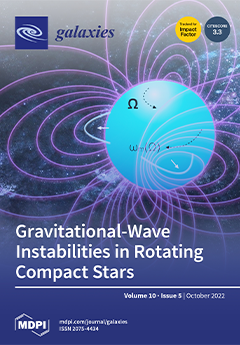
Cover Story (view full-size image):
Neutron stars are known to withstand very fast rotation. The current record holders, for example, rotate around their axis of rotation more than 700 times per second. At such high rotational frequencies, neutron stars are no longer spherically symmetric objects but may build up mass multipole moments, causing them to begin emitting gravitational waves via the onset of gravitational–radiation reaction (GRR)-driven instabilities. We have calculated the rotational periods at which this happens. They depend on the temperature and mass of a neutron star and are found to be reached before mass shedding from the equator makes the star unstable. This makes neutron stars interesting candidates in the search for sources of gravitational waves. View this paper
- Issues are regarded as officially published after their release is announced to the table of contents alert mailing list.
- You may sign up for e-mail alerts to receive table of contents of newly released issues.
- PDF is the official format for papers published in both, html and pdf forms. To view the papers in pdf format, click on the "PDF Full-text" link, and use the free Adobe Reader to open them.
Previous Issue
Next Issue
