

You are currently on the new version of our website. Access the old version .

Water, Volume 17, Issue 24

2025 December-2 - 152 articles

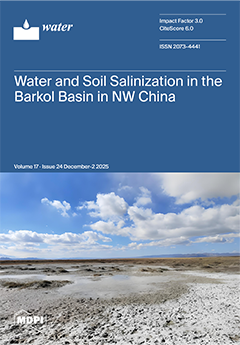
Cover Story: Identifying the key drivers of water and soil salinization in arid regions is crucial for managing basin-scale water–salt balance. Although mineral dissolution, evaporation, and transpiration collectively drive salinization processes, distinguishing their individual contributions remains challenging. This study innovatively combined deuterium excess with hydrochemical analyses. Results show that mineral dissolution is the dominant salinity source in the Barkol Basin's groundwater, rivers, and lake. However, sustained evapotranspiration of shallow groundwater drives surface salt accumulation, making wetlands and lakeshores the ultimate salt sinks. Effective management should therefore focus on regulating groundwater flow paths and water-table depths to control salt mobilization. View this paper
  • Issues are regarded as officially published after their release is announced to the table of contents alert mailing list .
  • You may sign up for email alerts to receive table of contents of newly released issues.
  • PDF is the official format for papers published in both, html and pdf forms. To view the papers in pdf format, click on the "PDF Full-text" link, and use the free Adobe Reader to open them.

Articles (152)

  • Article
  • Open Access
422 Views
19 Pages

Hydrogeochemical Characteristics and Groundwater Quality in Chengde Bashang Area, China

  • Wei Xu,
  • Yan Dong,
  • Xiaohua Tian,
  • Zizhao Cai,
  • Hao Zhai and
  • Siyang Qin

18 December 2025

This study aims to investigate hydrogeochemical characteristics and groundwater quality in the Bashang Area in Chengde and to discuss factors controlling the groundwater quality. A total of 91 groundwater samples were collected and a fuzzy synthetic...

  • Article
  • Open Access
389 Views
22 Pages

18 December 2025

Hydraulic structures, particularly water intakes, are often affected by undesirable bedload depositions that can significantly reduce their operational efficiency and lifespan. Based on three-dimensional computational fluid dynamics, this study prese...

  • Article
  • Open Access
429 Views
20 Pages

Three-Dimensional Field Investigation of Mixing Dynamics in a River Confluence Using a Mixing Proximity Index (MPI)

  • Suin Choi,
  • Seogyeong Lee,
  • Dongsu Kim,
  • Ilwon Seo,
  • Yongmuk Kang and
  • Boseong Jeong

18 December 2025

High-resolution in situ field measurements capturing seasonal 3D mixing dynamics at river confluences are scarce, yet this understanding is essential for effective water-quality management and pollutant-transport prediction in river–lake system...

  • Article
  • Open Access
324 Views
14 Pages

18 December 2025

Accurately predicting the peak impact force exerted by landslides on bridge piers is crucial for evaluating structural safety. However, the reliability of such predictions is frequently undermined by the spatial variability and uncertainty inherent i...

  • Article
  • Open Access
465 Views
22 Pages

Removal of Cr(VI) from an Aqueous Solution via a Metal Organic Framework (Ce-MOF-808)

  • Hongfei Zhang,
  • Ming Zou,
  • Haixin Zhang,
  • Naoto Miyamoto and
  • Naoki Kano

18 December 2025

Hexavalent chromium (Cr(VI)) is a carcinogenic and highly mobile pollutant in aquatic environments. In this study, three cerium-based metal–organic frameworks (Ce-UiO-66, Ce-UiO-66-NO2, and Ce-MOF-808) were synthesized and evaluated for their a...

  • Article
  • Open Access
557 Views
23 Pages

18 December 2025

Predicting dam inflow is critical for human life safety, water resource management, and hydroelectric power generation. While machine learning (ML) models address complex, nonlinear hydrological problems, quantum machine learning (QML) offers greater...

  • Article
  • Open Access
486 Views
20 Pages

18 December 2025

The SCS-CN (Soil Conservation Service Curve Number) model is important for flood forecasting as it provides a relatively simple and widely used methodology for estimating the amount of surface runoff from a rainfall event, which is a crucial input in...

  • Article
  • Open Access
373 Views
22 Pages

Iron-Coated Pine Bark as Biosorbents for Textile Wastewater Treatment: A Sustainable Approach

  • Pedro Gonçalves,
  • Ariana Pintor,
  • Olivia S. G. P. Soares,
  • Manuel F. R. Pereira,
  • Cidália M. S. Botelho and
  • Ricardo M. Ferreira

18 December 2025

Dyes are widely used in textile processing and are frequently discharged without adequate treatment, posing risks to aquatic ecosystems through reduced water quality, toxicity to organisms, and long-term environmental degradation. To address the need...

  • Article
  • Open Access
502 Views
22 Pages

Integrated Hydrogeochemical, Isotopic, and Geophysical Assessment of Groundwater Salinization Processes in the Samba Dia Coastal Aquifer (Senegal)

  • Amadou Sarr,
  • Seyni Ndoye,
  • Axel L. Tcheheumeni Djanni,
  • Mathias Diedhiou,
  • Mapathe Ndiaye,
  • Serigne Faye,
  • Corinne Sabine Corbau,
  • Arnaud Gauthier and
  • Philippe Le Coustumer

18 December 2025

This study provides a detailed assessment of groundwater salinization in the Quaternary aquifer of the Samba Dia region, Senegal, using an integrated approach that combines hydrochemical, stable isotopic (δ2H, δ18O), and electrical resist...

  • Article
  • Open Access
461 Views
28 Pages

18 December 2025

Using the Danjiangkou Reservoir resettlement as a case study, this research adopts a policy lifecycle perspective to examine the evolutionary mechanisms of livelihood transformation and institutional adaptation under large-scale hydraulic development...

of 16

Get Alerted

Add your email address to receive forthcoming issues of this journal.

XFacebookLinkedIn
Water - ISSN 2073-4441