Article

Three-Dimensional Field Investigation of Mixing Dynamics in a River Confluence Using a Mixing Proximity Index (MPI)


1
Department of Civil and Environmental Engineering, Dankook University, 152 Jukjeon-ro, Yongin-si 16890, Gyeonggi-do, Republic of Korea
2
Department of Civil and Environmental Engineering, Seoul National University, 1 Gwanak-ro, Seoul 08826, Republic of Korea
*
Author to whom correspondence should be addressed.
Water 2025, 17(24), 3596; https://doi.org/10.3390/w17243596
Submission received: 4 November 2025 / Revised: 15 December 2025 / Accepted: 16 December 2025 / Published: 18 December 2025
(This article belongs to the Section Hydraulics and Hydrodynamics)

Abstract

High-resolution in situ field measurements capturing seasonal 3D mixing dynamics at river confluences are scarce, yet this understanding is essential for effective water-quality management and pollutant-transport prediction in river–lake systems. To address this gap, this study investigates the confluence of the North and South Han Rivers in the Paldang Reservoir. We introduce and apply a novel mixing proximity index (MPI) to quantify the degree of mixing and water-mass origin based on 3D electrical conductivity and temperature data. Seasonal field campaigns, conducted with an acoustic Doppler current profiler and multi-parameter sensors, revealed distinct hydrodynamic behaviors: strong summer stratification suppressed vertical mixing; winter momentum asymmetry induced persistent flow separation despite minimal temperature differences; and spring conditions fostered rapid mixing, barring some residual unmixed deep layers. The MPI effectively delineated shear layers and identified unmixed water zones, providing an enhanced understanding of mixing dynamics beyond the capabilities of traditional tracer- or statistics-based metrics. These findings highlight the combined influence of density differences, tributary momentum, and dam operations on confluence mixing, offering practical insights for water-resource management and improving 3D hydrodynamic model validation.

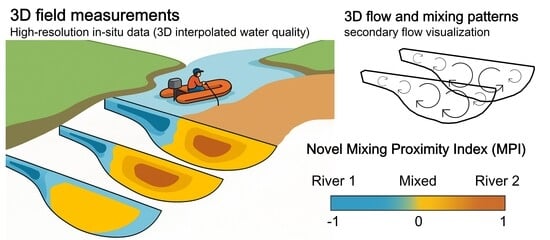
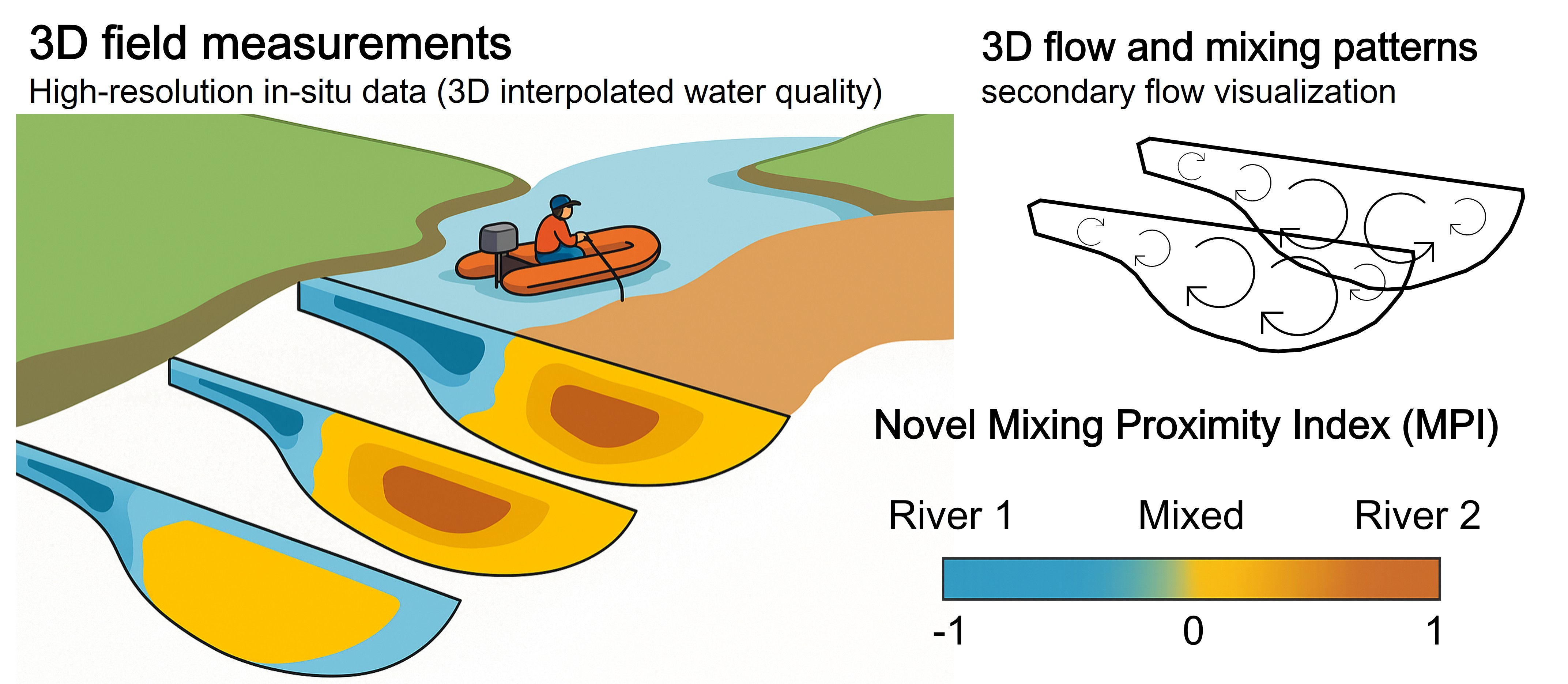
Graphical Abstract

1. Introduction

A river confluence, the junction where distinct water bodies meet, involves a critical exchange of momentum and energy. This exchange generates complex 3D flow patterns characterized by rapid variations in velocity structure and water-quality properties [1,2,3,4,5,6]. These mixing processes strongly influence sediment transport, nutrient and contaminant dispersion, and aquatic-habitat formation [7,8,9,10,11]. Consequently, understanding confluence mixing characteristics is fundamental not only from hydraulic and ecological perspectives but also for water-resource management. This importance is further amplified in large riverine lakes that serve as drinking-water sources [12].
However, confluence mixing behavior is highly complex. It is governed by the nonlinear interactions among multiple factors, including discharge ratio, depth difference, confluence angle, channel curvature, and density currents induced by temperature or concentration gradients [13,14,15]. Notably, even a slight density difference of Δρ ≈ 0.05% (≈0.5 kg/m3) from temperature variations can induce a density current [16]. This current can separate the upper and lower layers, thereby delaying complete mixing over long distances [17]. Such density-driven flows significantly influence intake water quality and bottom-layer oxygen distribution; however, quantitative field-based analyses of these phenomena remain limited.
Previous field studies on river confluences, based on in situ measurements, have primarily focused on small-scale [15,18,19,20] and medium-scale junctions [21]. By contrast, field investigations of large-scale confluences (width > 1 km) are scarce; most prior work in these settings has relied on numerical simulations [16,17,22,23]. Numerical models predict that even small density contrasts can produce lock-exchange-type two-layer separation across the entire channel width. This separation can be intensified by thermal stratification, particularly in deep, slow-flowing regions—such as those where rivers enter a lake. However, to the best of our knowledge, no field observations have definitively confirmed these simulated processes under real conditions.
Moreover, previous studies have not only failed to capture mixing dynamics in large confluences through direct observation but have also lacked robust methodologies for quantitative evaluation. While several indices exist, they are often limited by ambiguities in defining a representative velocity (U) and reliance on 2D cross-sectional data. Furthermore, these metrics lack a direct measure of proximity to complete mixing, thereby restricting physical interpretability. For instance, the densimetric Froude number ( F r d ) and Richardson number (Ri) compare the relative magnitudes of density gradient and shear to infer mixing potential; however, their utility in confluences is reduced by the uncertainty in defining a representative velocity [16,24,25]. Similarly, standard-deviation-based indices, which use lateral temperature or suspended-sediment concentration distributions [20,21], can describe partial mixing but fail to account for vertical stratification or quantify the degree of approach to a thoroughly mixed state.
To overcome these limitations, this study proposes the mixing proximity index (MPI). The MPI uses electrical conductivity (EC) as an approximately conservative tracer to quantify mixing by comparing the observed EC at each point with a theoretical fully mixed value derived from the discharge-weighted inflow composition [14]. The index provides an intuitive range from −1 to +1, indicating how close a given water parcel is to either tributary’s origin and pinpointing the location of the mixing interface. The MPI is particularly effective and intuitive for assessing conditions where density currents or stratification induce significant vertical separation of water masses.
This study applies the MPI to analyze confluence mixing characteristics by integrating three key components. First, we obtained simultaneous hydraulic and water-quality measurements, including vertical profiles, using an Acoustic Doppler Current Profiler (ADCP) and multi-parameter sensors for EC and temperature. Second, our analysis focused on a large-scale confluence (approximately 1300 m wide), representing a unique stratified riverine lake environment. The system exhibits hybrid hydrodynamics: residence times are sufficient for lacustrine stratification to develop yet short enough to sustain riverine mixing dynamics. Third, the proposed MPI provides a physically interpretable and intuitively quantitative indicator of mixing, capturing dynamics that are missed by conventional conditional or variance-based metrics.

2. Materials and Methods

2.1. Field Measurement Methods

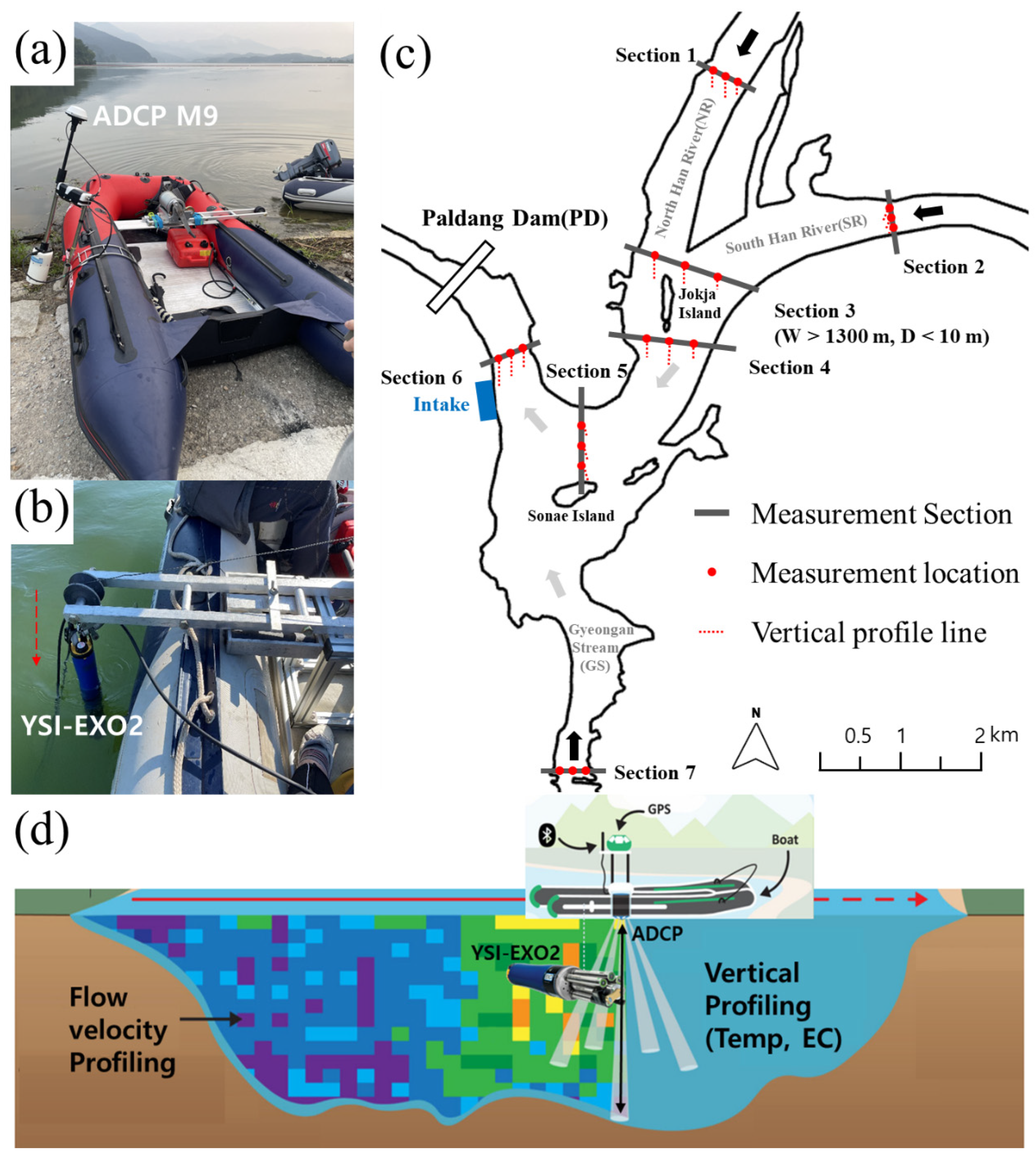
Field measurements were conducted using a rubber boat equipped with a SonTek M9 ADCP (SonTek, San Diego, CA, USA, Figure 1a) and YSI EXO2 (YSI Incorporated, Yellow Springs, OH, USA) multi-parameter water-quality sensor (Figure 1b). The boat traversed each cross-section slowly to capture data. The ADCP recorded flow velocity, water depth, and GPS coordinates at 1 s intervals. Simultaneously, the YSI EXO2 sensor continuously measured water temperature (resolution 0.001 °C) and EC (resolution 0.01 µS/cm) at the same interval. The SonTek ADCP M9 (measurement range 0.06–40 m, accuracy ± 0.002 m/s, resolution 0.001 m/s, and cell size 0.02–4 m) is well-suited for large-river applications.
Measurement sections were established to comprehensively capture confluence characteristics and the influence of PD inflows. These included upstream cross-sections to characterize incoming river properties (sections 1, 2, and 7), sections immediately downstream to examine mixing (sections 3 and 4), a downstream meandering zone (section 5), and the terminal stagnant zone near PD (section 6). Vertical profiles were obtained at three lateral points (left, mid, and right banks) for each section. GPS positioning ensured that measurements were repeated at identical locations (Figure 1d).
Water-quality sensors were calibrated in situ with standard solutions immediately before measurement to minimize drift errors. The resulting raw (unfiltered) data showed high stability and consistency. YSI sensor depth data served as the reference, and all YSI measurements were synchronized with ADCP–GPS coordinates to determine accurate 3D positions. This integrated dataset was subsequently interpolated using 3D kriging to analyze spatial distributions and mixing behavior.
The study site, Paldang Reservoir, is a riverine lake formed by the confluence of the North Han River (NR) and South Han River (SR), which together contribute over 98% of the total inflow. With an average residence time of approximately five days, the hydrodynamic characteristics of the inflowing rivers are directly reflected throughout the reservoir. The section immediately downstream of the confluence is over 1300 m wide but less than 10 m deep, creating a shallow, large-scale inflow zone that behaves hydraulically as a river confluence. This unique setting exhibits the combined effects of confluence mixing and seasonal stratification (Figure 1c). Consequently, the Paldang Reservoir represents a rare field site where riverine flow dynamics coexist with lacustrine stratification. This interaction creates a complex hydro-environment setting, offering a valuable opportunity to investigate mixing behavior within a hybrid river–lake context [26].

2.2. MPI

While various water-quality indicators (e.g., temperature, dissolved oxygen) are used in confluence studies, electrical conductivity (EC) has proven to be the most effective tracer for mixing [27]. Previous studies have often quantified mixing using the standard deviation reduction rate or a normalized mixing index (m) downstream of the confluence [20,24]. However, these approaches are static or statistical, failing to capture the dynamic effects of discharge ratio, density contrast, and transient 3D flow structures.
A quantitative assessment requires a reference value for the fully mixed condition, yet identifying the exact location of complete mixing in the field is challenging. Mixing length varies with density, velocity, and bathymetry, and continuous boat-based observation becomes impractical when this length exceeds several kilometers.
In large riverine systems where mixing lengths often exceed the range of feasible field monitoring, identifying the precise location of complete mixing is impractical. To address this limitation, this study proposes a theoretical fully mixed value ( E C i d e a l ) based on the conservation of mass, calculated as the discharge-weighted mean of the upstream inflows. Although this approach assumes negligible external inputs (e.g., minor tributaries or atmospheric exchange), it provides a robust and physically consistent baseline for quantitative analysis. Unlike a simple discharge-weighted tracer, which only provides a bulk mixed value, the MPI uses  E C i d e a l  as a reference to quantify how closely each water parcel aligns with either tributary’s source. Therefore, the MPI is defined as the relative deviation of the observed local EC from this theoretical ideal.
The ideal mixed conductivity is computed as
E C i d e a l = ( E C 1 × Q 1 ) + ( E C 2 × Q 2 ) Q 1 + Q 2 ,
where  Q 1 Q 2  and  E C 1 E C 2  denote the discharges and EC values of Tributaries 1 and 2, respectively. The MPI at a given location is then defined as
M P I = 1 + E C o b s E C 1 E C i d e a l E C 1       , i f E C o b s E C i d e a l
M P I = E C o b s E C i d e a l E C 2 E C i d e a l                             , i f E C o b s E C i d e a l
The MPI ranges from −1 (dominance of Tributary 1) to +1 (dominance of Tributary 2). Values near 0 represent an ideal fully mixed state. The MPI can be applied to cross-sections, plan views, or vertical profiles. In this study, the mean absolute MPI along the vertical profile was used as a representative indicator of whole-depth mixing, enabling a quantitative description of vertical heterogeneity.
As mixing progresses downstream, the mean MPI should approach 0. Persistently large values may imply abnormal hydrodynamics, such as external inflows or long water residence times. Unlike visual estimations, the MPI numerically defines the mixing interface, providing a clear quantitative threshold. It can be applied to estimate mixing length, monitor dominant water-mass zones, determine sampling points, and evaluate relative water-quality contributions. Ultimately, the MPI serves as a versatile indicator for evaluating mixing intensity, detecting mixing boundaries, and diagnosing water-mass dominance.

2.3. Spatial Interpolation: 3D Kriging

Hydraulic and water-quality data collected in rivers (e.g., temperature, EC, velocity, and depth) are typically obtained at spatially irregular locations. Estimating values at unsampled points through spatial interpolation is therefore essential for a quantitative assessment of the river’s overall state. While techniques such as 3D inverse distance weighting (3D IDW) are fast, and 3D radial basis function (3D RBF) interpolation is flexible, both methods have limitations in representing the spatial correlation between measurement points.
By contrast, 3D kriging is a geostatistical approach that quantitatively incorporates spatial correlation into its predictions. Kriging is known to maintain high accuracy even with datasets characterized by irregular sampling and anisotropy [28,29]. It produces optimal estimates for unsampled locations by explicitly modeling the spatial dependence structure. This method is particularly effective for resolving fine-scale spatial patterns of velocity and water-quality distributions in rivers and lakes that exhibit strong 3D variability [30].
The reliability of the 3D kriging interpolation was confirmed via leave-one-out cross-validation. RMSEs remained low across all seasonal campaigns—ranging from 1.1 to 2.4 µS/cm for EC and 0.01 to 0.28 °C for temperature—representing less than 1% of the total spatial variability. Furthermore, standardized RMSE values (0.48–0.90) indicated that the model provided a reasonable estimate of prediction uncertainty. These results demonstrate that the interpolation successfully resolved principal spatial gradients without introducing excessive smoothing.

2.4. Secondary-Flow Analysis

The SonTek ADCP M9 primarily measures streamwise and vertical velocity components. To fully characterize the 3D circulation at the confluence, the spanwise velocity component was also derived. To isolate the secondary flow, the measured velocity vectors at each cross-section were rotated to align with the cross-sectional mean flow direction; the component normal to this axis was then defined as the secondary-flow velocity.
While the Rozovskii method is widely used to reconstruct helical motions by defining a local flow direction for each vertical [21,31,32,33], it imposes a constraint of zero net lateral discharge. This assumption can introduce artifacts when the water column exhibits significant unidirectional lateral flow [34]. Because such flow patterns were observed in this study, we adopted the cross-section-averaged rotation method to ensure a physically consistent decomposition of the velocity field without these distortions.
This approach allowed us to reconstruct the secondary-flow cells and cross-sectional circulation structures that develop downstream of the confluence and in adjacent curved reaches. These patterns are fundamental to mixing dynamics, influencing shear-layer location and persistence, and modulating vertical exchange between inflows. While the MPI provides a quantitative assessment of mixing degree, secondary-flow analysis serves as a complementary diagnostic tool to reveal the physical mechanisms—such as momentum exchange, helical vortices, and recirculating eddies—that govern stratification breakdown and mixing enhancement.
ADCP velocity data were post-processed using Velocity Mapping Software (VMS, version 3.0; [35]) to aggregate and smooth velocity measurements, thereby enhancing the clarity of flow patterns. This allowed for detailed visualization of secondary circulation, identification of mixing boundaries, and interpretation of how complex 3D hydrodynamics influence confluence-scale mixing.
Raw ADCP ensembles were pre-processed using RiverSurveyor Live (version 4.3), which applies standard quality-control algorithms, including screening for beam correlation, signal-to-noise ratio, and percent-good data, as well as orientation consistency checks and surface/bottom blanking. Boat motion was removed using bottom-tracking—or GPS referencing where bottom-tracking was unavailable—to derive accurate earth-referenced flow-velocities.

3. Results

3.1. Hydraulic and Water-Quality Characteristics of Inflowing Rivers

To assess seasonal variations in density-current formation at the confluence, three field campaigns were conducted: summer (August, Case 1), winter (December, Case 2), and spring (April, Case 3). Table 1 summarizes the mean discharge, water temperature, and EC observed in each tributary during these measurements. Among the three tributaries, Gyeongan Stream (GS) consistently exhibited the highest EC. However, its discharge was negligible compared to NR and SR, contributing only 0.6, 3.6, and 6.7% of the total inflow in Cases 1–3, respectively. Given this minor contribution, its influence on the large-scale mixing dynamics in Paldang Lake was considered minimal.
Incorporating GS into the discharge-weighted EC calculation resulted in only negligible deviations in the theoretical mixed value ( E C i d e a l ). The inclusion of GS shifted  E C i d e a l  by less than 1 µS/cm in summer and by approximately 4–5 µS/cm in winter. Even in spring, when GS discharge was relatively higher, the deviation was limited to roughly 17 µS/cm. Considering the primary EC contrast of 125 µS/cm between the NR and SR, this contribution accounts for only ~14% of the total tracer gradient.
Moreover, observations in section 7 indicate that the GS inflow forms a shallow, laterally extensive stagnant zone immediately upon entering the reservoir, effectively isolating it from the primary NR–SR mixing interface. Therefore, excluding GS from the ideal-mixing formulation (Equation (1)) introduces negligible deviations in both  E C i d e a l  and the MPI and does not compromise the interpretation of the large-scale mixing behavior discussed in this study.
A key feature observed across all campaigns was that the SR consistently exhibited higher EC than the NR. The difference ranged from approximately 150 µS/cm in summer to 80 µS/cm in winter and 95 µS/cm in spring. This pattern aligns with earlier findings attributing the higher EC of the SR to its limestone-dominated basin geology, which contrasts with the granite-dominated NR watershed [35]. Water temperature differences also varied seasonally. In summer, the SR was slightly warmer than the NR (28.2 °C vs. 27.7 °C), whereas in winter it was cooler (4.9 °C vs. 5.8 °C). In spring, the two tributaries showed almost identical temperatures (16.0 °C). These variations are likely driven by atmospheric temperature and the relative distances from upstream dams, which influence heat exchange during transit.
Case 1 (summer, high flow) was characterized by large discharges, with the SR contributing approximately 15% more discharge than the NR (199.5 m3/s vs. 162.0 m3/s). Elevated atmospheric temperatures led to elevated water temperatures in both rivers (SR: 28.2 °C; NR: 27.7 °C), corresponding to a reference thermal density contrast of Δρ ≈ 0.14 kg/m3 based on the depth-averaged temperature difference. Under these conditions, a density difference driven by both temperature and EC gradients was expected to enhance stratification, while high flow velocities simultaneously influenced momentum exchange and mixing.
Case 2 (winter, low flow) showed a contrasting pattern. The NR delivered nearly twice the discharge of the SR (208.4 m3/s vs. 107.9 m3/s), likely owing to hydropower releases continuing during the dry period. Both rivers had low water temperatures (<6 °C), but the SR was cooler (4.9 °C) than the NR (5.8 °C) owing to its longer travel distance and subsequent increased cooling, yielding a small reference thermal density contrast of Δρ ≈ 0.02 kg/m3. Here, the dominant factor was the significant momentum imbalance, which was expected to influence secondary-flow formation and downstream mixing.
Case 3 (spring, transitional flow) occurred after a rainfall event that temporarily increased discharges. Inflows were nearly balanced (NR 152.1 m3/s, SR 137.8 m3/s) and water temperatures were identical (16 °C), leading to negligible density differences, with an estimated Δρ ≈ 0 kg/m3 based on depth-averaged temperature. This case provided a suitable reference for analyzing mixing behavior under minimal density contrasts, allowing for a clear comparison with the stratified conditions observed in Cases 1 and 2.
It should be noted that these thermal density contrasts were estimated from depth-averaged temperatures and therefore represent only reference-level indicators. Given the pronounced vertical temperature gradients observed in all seasons, the actual density structure varied substantially with depth.
The theoretical post-confluence EC, calculated as a discharge-weighted average (Equation (1)), was 169 µS/cm in Case 1, 118.3 µS/cm in Case 2, and 219.4 µS/cm in Case 3. The particularly low value in winter reflects the dominance of the low-EC NR, highlighting the significant effect of inflow proportions on the ideal mixing condition.

3.2. Measurement Results

To analyze seasonal mixing behavior, vertical water-quality profiles from the inflowing rivers and key reservoir sites were interpolated using 3D kriging. Temperature was used as an indicator of the density distribution controlling stratification, whereas EC served as a tracer to identify water-mass origin and mixing outcomes.
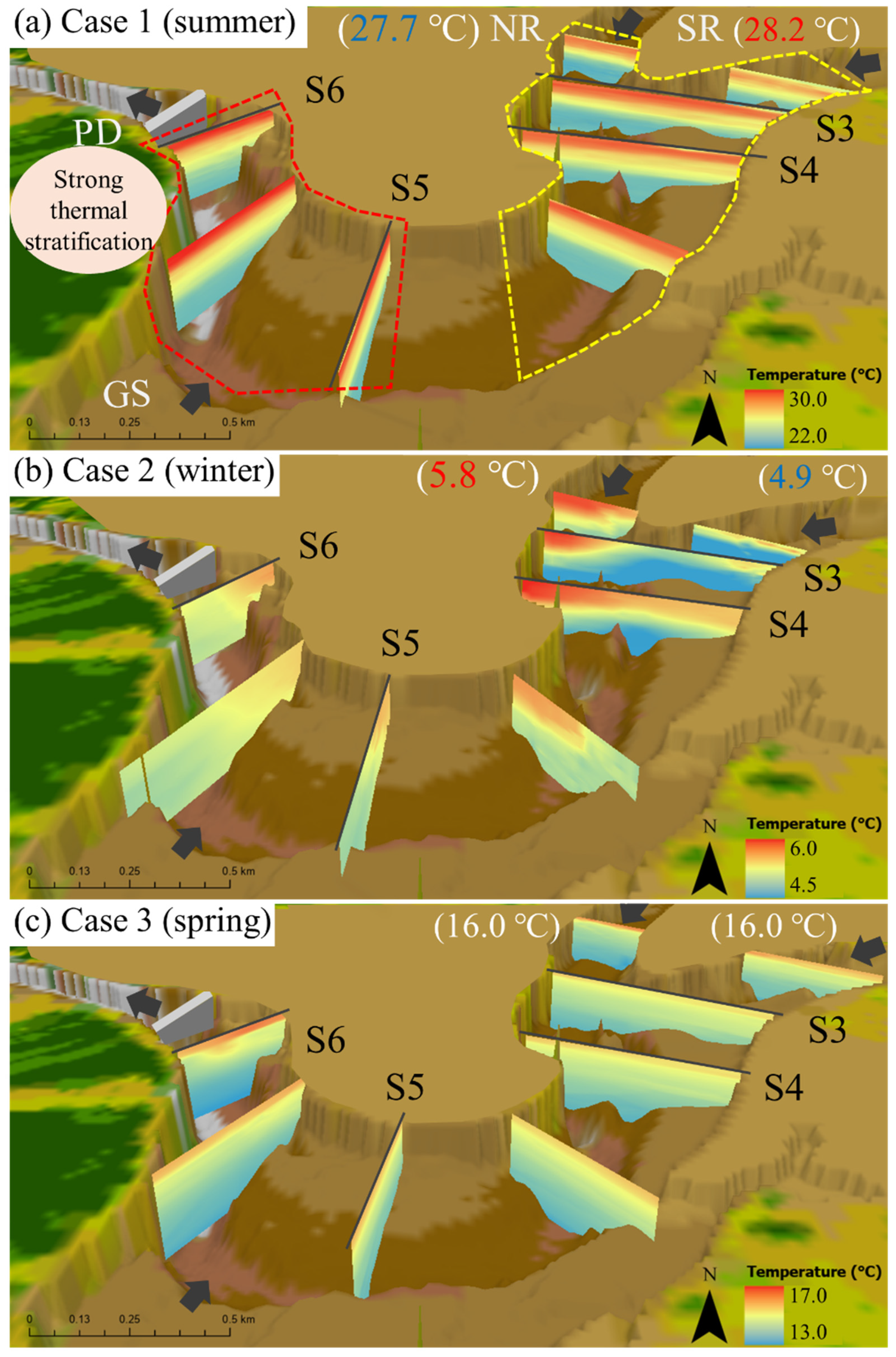
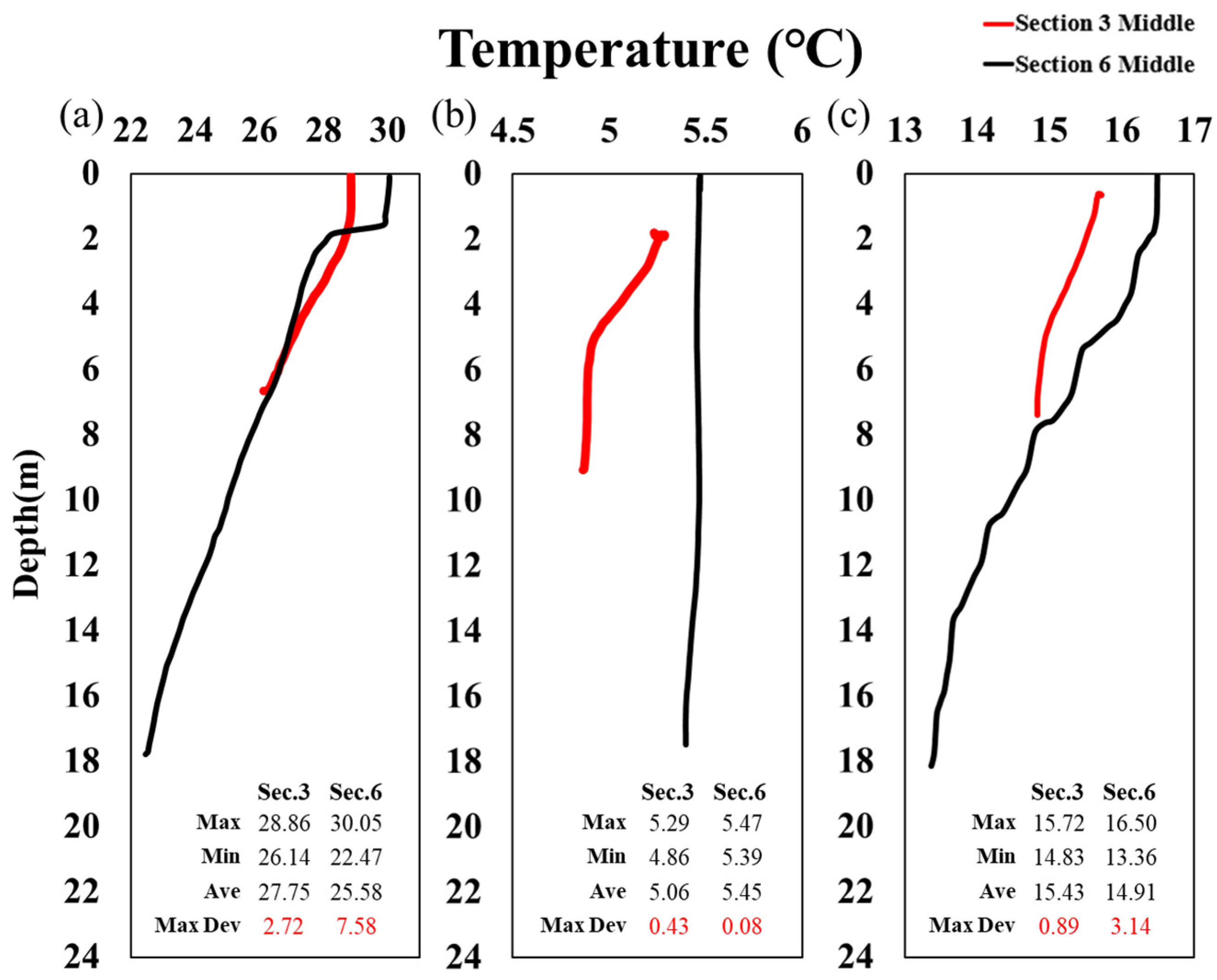
In summer (Case 1, Figure 2a), intense solar radiation and high air temperatures created a pre-existing vertical temperature structure strong enough to generate stratification even before the confluence. The largest temperature gradient occurred within the upper 1–2 m, and this stratification intensified downstream toward the Paldang Dam (PD) area. This vertical structure delineated two distinct regions: a “river zone” (yellow dashed line) characterized by continuous flow and active mixing, and a “lake zone” (red dashed line) where stagnant flow allowed for pronounced, temperature-driven stratification. Immediately downstream of the junction, a clear density current developed owing to the NR–SR density contrast. As stratification deepened downstream, the two water masses remained separated for an extended period (Figure 2a, S5 and S6). This trend was most evident in vertical temperature profiles comparing the river zone (section 3) and the lake zone (section 6) (Figure 3a). At the center point just after the confluence, warm surface inflow from the NR generated a pronounced vertical gradient that persisted within the lake zone. A sharp thermocline developed within the top ~2 m owing to direct solar heating, producing a maximum temperature deviation (Max Dev) of 2.72 °C in the river zone, which expanded to 7.58 °C in the lake zone. Thus, summer mixing behavior is governed by the combined effects of density currents and thermal stratification. Unlike typical river confluences, where rapid mixing occurs, the density-induced separation here was stabilized and prolonged by stratification.
In winter (Case 2, Figure 2b), the NR inflow was, on average, 0.9 °C warmer than the SR (Table 1), satisfying the condition for density-current formation. With uniformly low air temperatures, surface heating was negligible, allowing a strong density current to develop immediately after the confluence. A clear vertical temperature gradient was observed in the river zone, but this gradient nearly vanished in the lake zone as vertical homogenization progressed (Figure 3b; river zone Max Dev: 0.43 °C, lake zone: 0.08 °C). This indicates that winter mixing is dominated by density currents under suppressed stratification, and the temperature gradient induced by this flow gradually weakens downstream.
In spring (Case 3, Figure 2c), the mean inflow temperature difference between the NR and SR was only approximately 0.1 °C (Table 1), which was insufficient to generate a density current. A weak vertical temperature gradient appeared just downstream in the river zone, interpreted as the onset of thermally induced stratification under rising air temperatures (Figure 3c). This stratification strengthened downstream, becoming distinct in the lake zone (river zone, Max Dev: 0.89 °C, lake zone: 3.14 °C). Therefore, in spring, negligible inflow temperature differences prevented density-current development, and stratification driven by atmospheric heating dominated from the confluence onward.
Overall, vertical separation was evident in all three seasons but resulted from different mechanisms: in summer, the combined effects of density currents and stratification suppressed mixing; in winter, density currents alone maintained layer separation; and in spring, stratification developed solely from atmospheric heating. These seasonal contrasts define the key hydrodynamic characteristics of this riverine-lake confluence and form the basis for interpreting the MPI analysis.
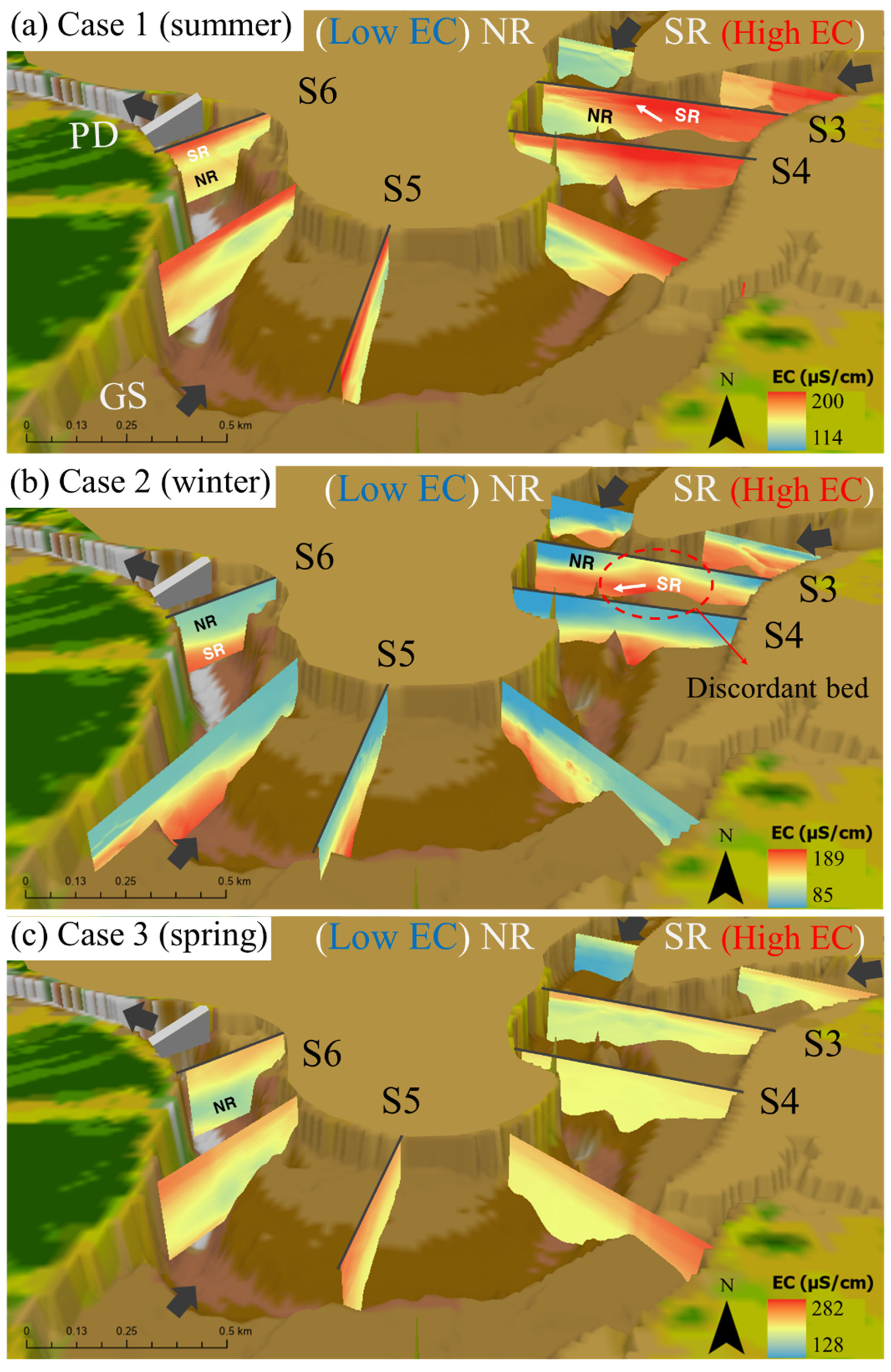
Unlike temperature, EC directly distinguishes the origin of inflowing waters and thus plays a key role in interpreting seasonal mixing behavior. Figure 4 presents the 3D interpolated EC distributions, visualizing the contribution and separation of each water mass.
In summer (Figure 4a), the high-EC water mass from the SR spread over the low-EC NR water, propagating along the surface immediately downstream of the confluence (sections 3 and 4). As the flow entered the meandering reach (section 5), the surface-to-bottom EC difference became more pronounced, and this separated pattern persisted downstream to the PD area. Although high discharge and velocity during the flood season would normally promote rapid mixing, our measurements showed enhanced separation. This behavior is attributed to strong stratification, which stabilized the density-current-induced separation and suppressed vertical mixing.
In winter (Figure 4b), the EC distribution exhibited a reversed thermal pattern compared to summer; the NR water mass (warmer but lower EC) rapidly expanded along the surface toward the left bank. In downstream sections 5 and 6, the EC gradient and vertical separation persisted, even after the mean temperature differences had nearly disappeared. This persistence suggests that the density current persisted under cold, low-velocity conditions, even without stratification, consistent with previous findings [30,32]. Moreover, the SR inflow (colder, higher EC) entered along the bed, forming a subsurface density current, a pattern influenced by a strong local bed-step of about 5 m (Figure 4a, S3). Although this step was expected to enhance mixing by lifting the NR water, field data indicated it had a minimal effect. Consequently, winter mixing was dominated by density currents and momentum asymmetry, characterized by slow dissipation and prolonged vertical segregation.
In spring (Figure 4c), identical inflow temperatures precluded density current formation, and the EC distribution indicated rapid mixing. Both water masses mixed quickly from section 3 onward, and by section 4, the EC field became nearly homogeneous. This pattern corresponds to MPI values approaching 0, indicating nearly complete mixing within a short distance. However, locally elevated surface EC appeared after section 5, likely reflecting the influence of the high-EC GS inflow. By contrast, low-EC water persisted in the deep layer near PD, implying that unmixed NR water either reached the area directly or was a residual from a previous event.
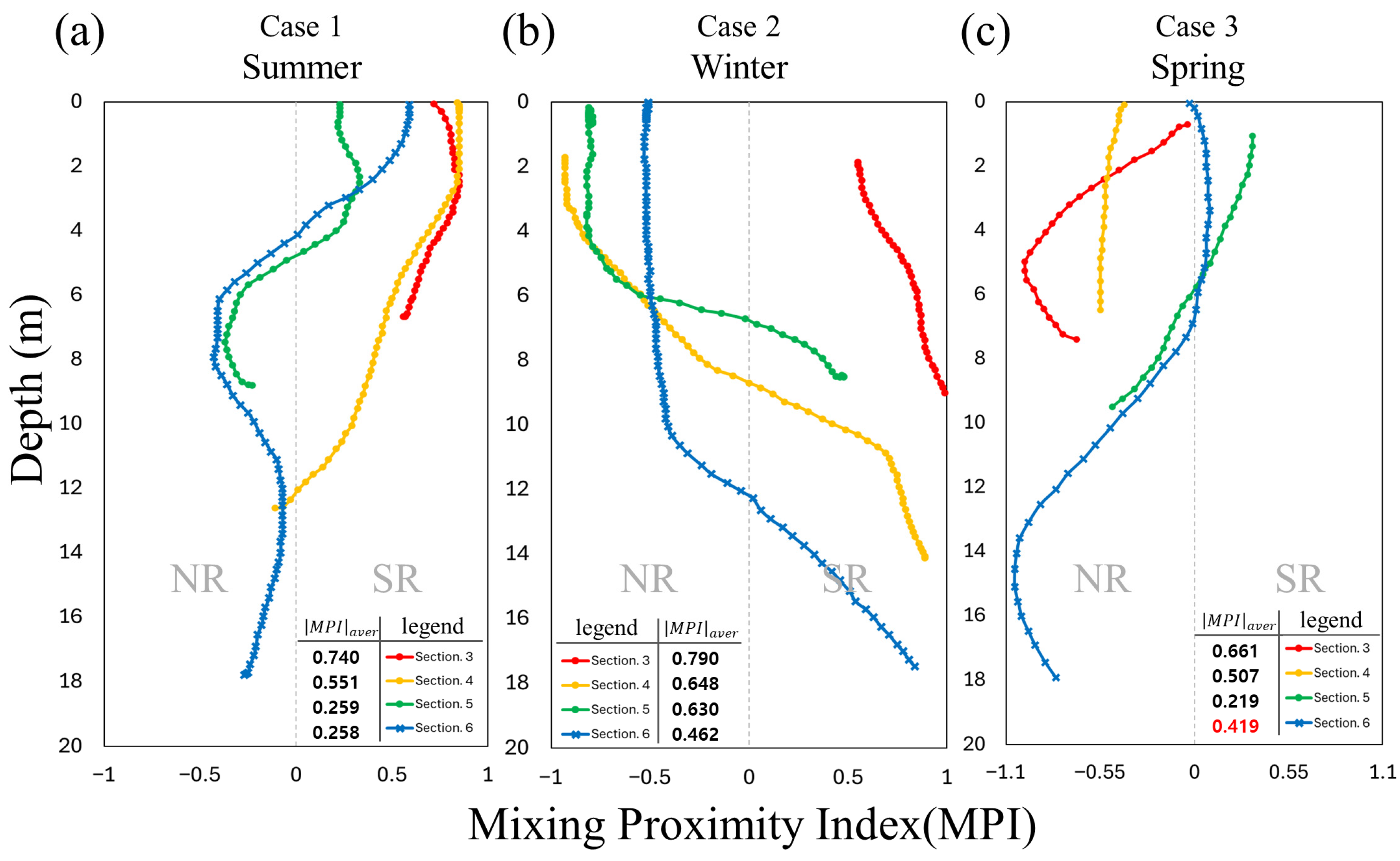
The MPI results quantitatively support the seasonal differences identified in the temperature and EC distributions. The MPI was computed at the central point of each cross-section, and the mean absolute value (|MPI|) along the vertical profile was used to quantify the overall mixing intensity.
In summer (Case 1, Figure 5a), the SR water mass dominated the water column immediately downstream (section 3), resulting in a high |MPI| of 0.74. This value decreased rapidly downstream, reaching approximately 0.26 in sections 5 and 6. This indicates that despite high discharge, strong stratification stabilized the density-current-induced separation and inhibited vertical mixing. In section 6, although the averaged |MPI| suggested mixing had progressed, the vertical structure actually exhibited three distinct layers: an SR-dominant surface, an NR-dominant middle, and a mixed intermediate layer. Thus, the reduction in the average MPI did not imply complete mixing but rather a quasi-equilibrium separation, demonstrating the MPI’s ability to capture vertical heterogeneity.
In winter (Case 2, Figure 5b), the NR water mass spread rapidly along the surface at section 3, but the SR water mass remained dominant overall. Downstream, |MPI| gradually declined to approximately 0.46 at section 6. This pattern reveals that, under unstratified conditions, the initial separation caused by density currents persisted for an extended period owing to low temperatures and slow flow, with mixing progressing only gradually. Thus, the MPI quantitatively illustrates both the persistence of density-driven separation and its slow attenuation.
In spring (Case 3, Figure 5c), rapid mixing occurred from the confluence onward, with |MPI| decreasing significantly to 0.22 at section 5. However, in section 6, the upper layer exhibited complete mixing (MPI ≈ 0), whereas the deep layer retained strong NR characteristics (MPI approaching −1). This suggests that some of the NR water mass either traveled downstream without mixing or remained from a previous inflow event, reflecting the combined influence of reservoir hydrodynamics and dam operations.
Overall, the MPI successfully distinguished the seasonal mechanisms: mixing suppression by stratification in summer, delayed dissipation of density currents in winter, and rapid mixing with localized residuals in spring. Therefore, the MPI functions not only as a mixing-rate indicator but also as a quantitative, adaptive diagnostic tool capable of describing seasonal contrasts and identifying nonsteady flow structures.
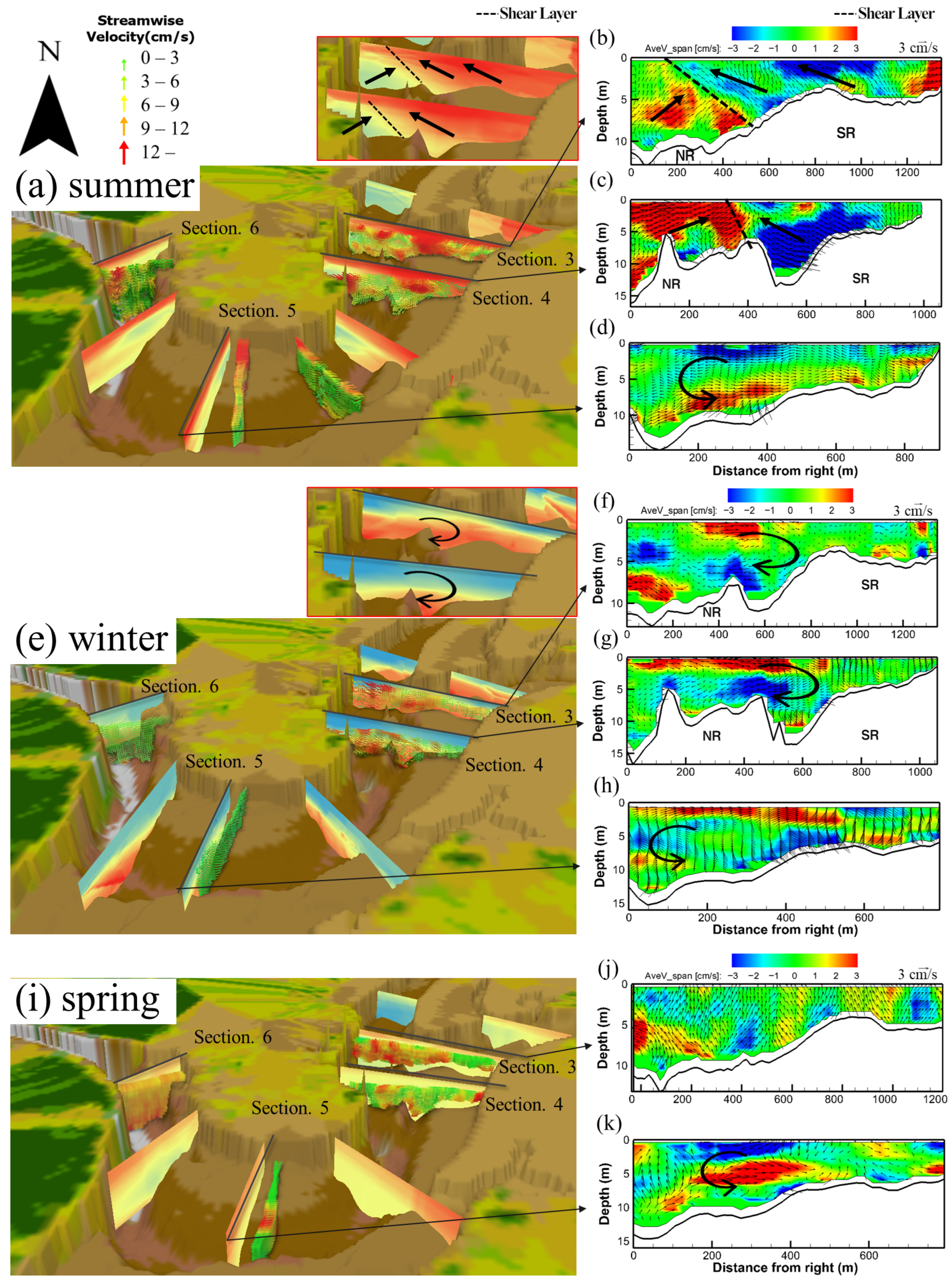
Finally, the streamwise velocity field was visualized in 3D (Figure 6) to analyze secondary-flow patterns, which are key mechanisms influencing shear-layer formation and turbulent diffusion at confluences [18,36,37]. Distinct secondary circulation patterns were observed seasonally.
In summer (Case 1, Figure 6a–d), a strong shear boundary formed at section 3 as the NR and SR flows collided (Figure 6b), shifting leftward downstream(Figure 6c). The flow showed layered separation, with SR dominating the surface and NR the mid-depth. This structure, which is consistent with the presence of a density current, appears to have been stabilized by thermal stratification, which reduced vertical mixing and contributed to the persistence of vertical segregation despite the high-discharge conditions. In section 5 (Figure 6d), pronounced meandering appears to have induced a single-rotational secondary cell that drove SR surface water toward the left bank, creating lateral asymmetry. Near the PD area, only localized vortices appeared, and three distinct layers (surface, middle, deep) retained their separate water-mass characteristics (Figure 5a).
In winter (Case 2, Figure 6e–h), the momentum dominance of the NR, combined with meander amplification, appears to have generated a large-scale counterclockwise secondary circulation (Figure 6f). NR water spread rapidly leftward along the surface, whereas SR water was displaced downward near the right bank. This flow is consistent with the persistence of density-current-induced separation even under minimal temperature contrasts, and EC gradients persisted downstream (Figure 2b and Figure 3b). In section 4, this counterclockwise vortex intensified, becoming the dominant feature of the cross-section and reducing local turbulence (Figure 6g). In section 5, strong wind forces (up to 9.9 m/s) generated a localized rightward surface flow (Figure 6h), but its influence was confined to the upper 5 m, whereas the deeper layers sustained the counterclockwise motion, thereby favoring the retention of SR-origin water in the deep layer rather than enhancing vertical mixing. Substantial mixing only occurred upon reaching section 6 (Figure 4b).
In spring (Case 3, Figure 6i–k), the overall flow velocity was weak (<0.041 m/s), and no distinct shear boundary developed at section 3; only random, localized motions were observed (Figure 6j). This pattern is consistent with relatively rapid mixing under conditions of negligible stratification and weak density-current effects. However, in section 5, a counterclockwise vortex appeared (Figure 6k), identical in rotation to that observed in summer and winter, suggesting that the PD bend exerts a structural influence on the flow pattern. The recurrence of this pattern across all seasons suggests that the reservoir’s morphological configuration plays a persistent structural role in shaping the mixing dynamics.
In summary, summer mixing is consistent with suppression associated with the combined effects of density currents and stratification; winter mixing is consistent with delayed attenuation associated with momentum asymmetry and curvature-induced amplification; and spring mixing is consistent with relatively rapid mixing, though structural geomorphic factors (like the bend at section 5) appear to recurrently influence flow patterns irrespective of season.

4. Discussion

This study presented a rare field-based investigation of mixing characteristics in a large-scale river–lake confluence, integrating temperature, EC, velocity, and a newly developed MPI. The results demonstrated that confluence mixing behavior varies considerably by season, governed by the combined effects of physical and structural factors. These findings have significant implications for both hydrodynamic understanding and drinking-water-source management.
A critical component of MPI interpretation is the analysis of its downstream spatial evolution. While the MPI is typically expected to decrease monotonically in standard river confluences as mixing progresses, the Paldang system exhibits complex behavior driven by the transition from river-dominated flow (sections 3–5) to lake-dominated hydrodynamics (sections 5 and 6). In the high-momentum riverine zone (sections 3–5), both the mean MPI and vertical profile heterogeneity show a significant downstream reduction. Conversely, in the transition to the lake zone (sections 5 and 6), weakened advection and increased residence time allow residual water masses to persist, significantly slowing the rate of MPI decay. Despite this zonal disparity, MPI profiles across all seasons converge toward zero (Figure 5), confirming progressive mixing at the system scale while highlighting the hydraulic distinctiveness of the river–lake interface. These downstream variations establish the physical framework necessary for understanding the seasonal mixing mechanisms.
The most salient finding is the contrasting dominance of seasonal mixing mechanisms. In summer, high discharge and velocity, which would typically favor strong turbulence, were insufficient to overcome intense thermal stratification. This stratification stabilized the density-current-induced separation, thereby suppressing vertical mixing. By contrast, in winter, the absence of stratification was offset by low temperatures and sluggish flow, which delayed the dissipation of density currents and maintained water-mass separation for an extended period. In spring, negligible temperature differences prevented density-current formation, enabling rapid mixing, although residual NR-origin water remained in the deep layers. In summary, the seasons exhibited “mixing suppression by stratification” (summer), “prolonged persistence of density currents” (winter), and “rapid mixing with partial retention” (spring).
Although the relative discharge contribution of the Gyeongan Stream (GS) increases during spring (approximately 6.7%), its influence does not appear to have materially altered the dominant NR–SR mixing structure. If the GS inflow had exerted a substantive effect, a distinct increase in near-surface EC should have been evident downstream of the pronounced local bed step. However, the spring MPI profiles show no such surface-dominant high-EC signature; instead, the upper layer remains nearly fully mixed (MPI ≈ 0). This suggests that the GS inflow did not significantly interact with or modify the primary NR–SR mixing interface. Nevertheless, we acknowledge that localized GS influence may have existed in limited areas where vertical profiling was not feasible.
By integrating multiple parameters, this study clarified complex processes that a single variable cannot explain. Temperature revealed stratification dynamics but not water origin; EC traced source contributions but could not quantify the mixing progression. The velocity field provided the physical mechanisms, explaining shear-layer development and secondary-flow patterns. The MPI, in particular, proved superior to conventional indicators by bridging these gaps. Unlike conventional variance-based indices, the MPI effectively captures vertical heterogeneity. Crucially, it revealed that a decrease in the mean index does not necessarily imply complete mixing; rather, it may indicate a stable, stratified two-layer equilibrium. Furthermore, the MPI’s sign effectively distinguished between source-water dominance, while its magnitude quantified the degree of mixing. As a result, the MPI serves as an integrated diagnostic tool for both mixing efficiency and water-mass dominance.
The analysis also revealed significant geomorphic and structural influences. At section 5, meander curvature consistently induced a counterclockwise secondary circulation across all seasons, while structural recirculation near the PD enhanced water-mass separation. These results demonstrate that confluence mixing is controlled not only by seasonal density and discharge contrasts but also by the interaction of topographic and structural factors. Such dynamics directly affect the selective-withdrawal strategy at the Seoul water-intake facilities located near section 6 (Figure 1). In summer, SR-dominant surface flow may transport high EC and nutrient concentrations to the intake zone. In winter and spring, the long-term retention of NR-origin deep water could lead to oxygen depletion and degraded water quality. Therefore, a quantitative diagnosis of dominant water masses and mixing states using the MPI and EC can directly inform operational intake management and predictive water-quality modeling.
Despite its utility in characterizing these system-specific behaviors, the MPI is subject to inherent limitations. First, the index employs EC as a quasi-conservative tracer; however, because EC is sensitive to temperature variations and minor lateral inflows, the assumption of strict conservation may not always hold. Second, as a fundamental two-end-member formulation, the current MPI cannot be reliably applied to confluences with more than two major tributaries, where defining the proximity to a specific source becomes ambiguous. Finally, the method requires a distinct EC contrast between the primary inflows; when this gradient is negligible or comparable to temperature-driven variability, the index cannot robustly delineate mixing boundaries. In addition, because the MPI is derived from discharge-weighted EC, its uncertainty inherently reflects the combined uncertainties of both discharge measurement and EC sensing. This sensitivity may become relatively more pronounced under low-gradient conditions, where even small EC measurement uncertainties can exert a disproportionate influence on the MPI values.
The findings of this study contrast with those of previous research in key ways. While small- and medium-scale confluence studies reported rapid flood-season mixing, the present research reveals that in large, stratified confluences, this mixing can be substantially inhibited. Moreover, this work provides in situ confirmation for numerical predictions that even a small density difference (Δρ ≈ 0.5 kg/m3) can trigger lock-exchange-type vertical separation, bridging the gap between model predictions and field evidence.
However, this study had several limitations, which must be acknowledged. First, measurements were limited to three short-term campaigns, constraining temporal continuity. Second, because our MPI implementation used EC as the sole tracer, future extensions incorporating additional quasi-conservative parameters may improve robustness. To address situations where EC alone is insufficient for capturing complex mixing dynamics, the MPI framework could be extended to incorporate additional tracers, such as turbidity to proxy sediment-driven density effects and dissolved oxygen to indicate vertical exchange and stratification breakdown. Such multi-parameter MPI variants would allow separation of thermal, chemical, and sediment-driven mixing processes and help reduce ambiguity in systems where EC contrast is weak or influenced by non-conservative processes. Applying the MPI to other large-scale confluences, such as the Nakdong–Nam River or Yangtze–Poyang Lake systems, combined with continuous monitoring and high-resolution modeling, will help validate its generalizability.
In summary, the mixing behavior at the Paldang River–Lake confluence is governed by the complex, nonlinear interactions among seasonal (thermal and hydraulic) and structural (geomorphic and dam-induced) factors. The proposed MPI is an effective and practical tool for quantitatively diagnosing these processes, offering valuable insights into large riverine-lake mixing and drinking-water quality management.

5. Conclusions

This study, based on field observations, quantitatively investigated the seasonal mixing behavior at the confluence of the NR and SR, which forms the Paldang Reservoir, a large riverine lake. Unlike previous studies that primarily relied on numerical simulations, this study integrated 3D velocity fields from an ADCP with in situ temperature and EC data. We applied the MPI to delineate inter-river mixing boundaries quantitatively and intuitively, providing a methodological framework that reflects the dual nature of river–lake systems. Uncertainties associated with EC sensing, ADCP profiling, and 3D kriging interpolation were quantitatively evaluated. As the magnitudes of these potential errors are negligible relative to the primary physicochemical contrasts between the NR and SR, they do not compromise the interpretation of the large-scale mixing behavior.
The seasonal findings revealed distinct hydrodynamic regimes. In summer, density currents were stabilized by intense thermal stratification, which effectively suppressed vertical mixing. Despite the high discharge characteristic of this season, stratification counteracted turbulent mixing, reinforcing vertical layering and causing SR-dominant surface water to persist near the PD.
In winter, the momentum dominance of the NR, combined with meander curvature, generated a large-scale counterclockwise secondary circulation in the absence of stratification. This circulation sustained the density current by physically separating NR surface water from SR deep water, a segregation pattern corroborated by both EC distributions and MPI signatures.
In spring, negligible inter-tributary temperature differences precluded density-current formation, promoting rapid mixing. However, anthropogenic dam regulation and short hydraulic residence times resulted in the localized retention of unmixed NR-origin water in deep layers.
The proposed MPI effectively quantified these distinct regimes, capturing both the intensity and direction of mixing. Crucially, the index revealed that reduced MPI values in summer represented stratification-stabilized separation rather than complete mixing, whereas in winter and spring, the metric accurately tracked delayed density-current decay and localized residual flows, respectively. Thus, the MPI functions as a versatile diagnostic tool for identifying water-mass dominance, mixing interfaces, and transient retention structures, provided there is a sufficient tracer gradient and consideration of system-specific hydrodynamics.
Overall, the Paldang Reservoir is a complex river–lake hybrid system where riverine flow and lacustrine stratification interact. This study provides a rare empirical validation of confluence mixing in such an environment, bridging the gap between theoretical modeling and in situ observation. Future studies should extend MPI applications to other tracers (e.g., dissolved oxygen, turbidity, and suspended sediments) and to other large confluence systems (e.g., the Nakdong–Nam River and the Yangtze–Poyang Lake) to verify its generalizability. Moreover, coupling this approach with high-resolution numerical models can further improve predictive capabilities.
In conclusion, the mixing behavior observed at this confluence likely is governed by the combined influence of seasonal thermal–hydraulic factors and structural geomorphic controls. The proposed MPI provides an effective quantitative tool for diagnosing these interactions, offering a robust framework for managing water quality and optimizing selective withdrawal in complex riverine–lacustrine environments worldwide.

Author Contributions

Conceptualization, S.C. and D.K.; methodology, S.C., S.L., Y.K. and B.J.; software, D.K.; validation, S.C. and S.L.; formal analysis, S.C. and S.L.; investigation, D.K. and I.S.; resources, D.K. and I.S.; data curation, S.C. and Y.K.; writing—original draft preparation, S.C.; writing—review and editing, S.L. and D.K.; visualization, S.C.; supervision, D.K.; project administration, D.K.; funding acquisition, I.S. All authors have read and agreed to the published version of the manuscript.

Funding

This research was funded by the Korea Environment Industry & Technology Institute (KEITI) through the Smart Water-supply Service Research Program, funded by the Korea Ministry of Climate, Energy and Environment (MCEE) (RS-2024-00397970).

Data Availability Statement

The data presented in this study are available on request from the corresponding author. The data are not publicly available due to project confidentiality agreements.

Acknowledgments

During the preparation of this manuscript, the authors used ChatGPT (OpenAI, GPT-5, 2025 version) to assist in English editing, improving readability, and refining technical phrasing. The authors have reviewed and edited the output and take full responsibility for the content of this publication.

Conflicts of Interest

The authors declare no conflicts of interest. The funders had no role in the design of the study; in the collection, analyses, or interpretation of data; in the writing of the manuscript; or in the decision to publish the results.

Abbreviations

The following abbreviations are used in this manuscript:
ADCPAcoustic Doppler current profiler
ECElectrical conductivity
GSGyeongan Stream
MPIMixing proximity index
NRNorth Han River
PDPaldang Dam
SRSouth Han River

References

  1. Best, J.L. The Morphology of River Channel Confluences. Ph.D. Thesis, University of Leeds, Leeds, UK, 1986. [Google Scholar]
  2. Best, J.L. Flow dynamics at river channel confluences. Geol. Soc. Lond. Spec. Publ. 1987, 35, 27–37. [Google Scholar] [CrossRef]
  3. Best, J.L. Sediment transport and bed morphology at river channel confluences. Sedimentology 1988, 35, 481–498. [Google Scholar] [CrossRef]
  4. Best, J.L.; Roy, A.G. Mixing-layer distortion at the confluence of channels of different depth. Nature 1991, 350, 411–413. [Google Scholar] [CrossRef]
  5. Biron, P.M.; Roy, A.G.; Best, J.L. Shear layer turbulence at an unequal-depth channel confluence. J. Hydraul. Res. 1993, 31, 449–468. [Google Scholar] [CrossRef]
  6. Biron, P.M.; Lane, S.N.; Roy, A.G. Spatial patterns of water surface topography at a river confluence. Earth Surf. Process. Landf. 2002, 27, 913–928. [Google Scholar] [CrossRef]
  7. Ashmore, P.E.; Parker, G. Confluence scour in coarse braided streams. Water Resour. Res. 1983, 19, 392–402. [Google Scholar] [CrossRef]
  8. Best, J.L.; Rhoads, B.L. Sediment transport, bed morphology and the sedimentology of river channel confluences. In Sediment Transport and River Morphodynamics; Elsevier: Amsterdam, The Netherland, 2008; pp. 357–382. [Google Scholar]
  9. Boyer, C.; Roy, A.G.; Best, J.L. Morphology and flow structures in a natural river confluence. J. Geophys. Res. Earth Surf. 2006, 111, F04007. [Google Scholar] [CrossRef]
  10. Canelas, O.B.; Ferreira, R.M.L.; Guillén-Ludeña, S.; Alegria, F.C.; Cardoso, A.H. Three-dimensional flow structure at fixed 70° open-channel confluence with bed discordance. J. Hydraul. Res. 2020, 58, 434–446. [Google Scholar] [CrossRef]
  11. Hester, E.T.; Young, K.I.; Widdowson, M.A. Mixing of surface and groundwater induced by riverbed dunes: Implications for hyporheic zone definitions and pollutant reactions. Water Resour. Res. 2013, 49, 5221–5237. [Google Scholar] [CrossRef]
  12. Choi, S.; Kim, D.; Seo, I. Stratified features in Paldang lake considering induced density currents and seasonal thermal effect. J. Korea Water Resour. Assoc. 2024, 57, 99–110. [Google Scholar] [CrossRef]
  13. Rhoads, B.L.; Kenworthy, S.T. Flow Structure at an Asymmetrical Stream Confluence. Geomorphology 1995, 11, 273–293. [Google Scholar] [CrossRef]
  14. Laraque, A.; Guyot, J.L.; Filizola, N.; Seyler, P. Mixing processes in the Amazon River at the confluence of the Negro and Solimões Rivers. Hydrol. Process. 2009, 23, 3131–3140. [Google Scholar] [CrossRef]
  15. Riley, J.D.; Rhoads, B.L.; Parsons, D.R.; Johnson, K.K. Influence of junction angle on three-dimensional flow structure and bed morphology at confluent meander bends. Earth Surf. Process. Landf. 2015, 40, 252–271. [Google Scholar] [CrossRef]
  16. Duguay, J.; Biron, P.M.; Lacey, J. Aerial observations and numerical simulations confirm density-driven streamwise vortices at a river confluence. Water Resour. Res. 2022, 58, e2021WR031527. [Google Scholar] [CrossRef]
  17. Horna-Muñoz, D.; Constantinescu, G.; Rhoads, B.; Lewis, Q.; Sukhodolov, A. Density effects at a concordant-bed natural river confluence. Water Resour. Res. 2020, 56, e2019WR026217. [Google Scholar] [CrossRef]
  18. Rhoads, B.L.; Sukhodolov, A.N. Spatial and temporal structure of shear layer turbulence at a stream confluence. Water Resour. Res. 2004, 40, W06304. [Google Scholar] [CrossRef]
  19. Riley, J.D.; Rhoads, B.L. Flow structure and channel morphology at a natural confluent meander bend. Geomorphology 2012, 163–164, 84–98. [Google Scholar] [CrossRef]
  20. Lewis, Q.W.; Rhoads, B.L. Rates and patterns of thermal mixing at a small stream confluence under variable incoming flow conditions. Hydrol. Processes 2015, 29, 4442–4456. [Google Scholar] [CrossRef]
  21. Rhoads, B.L.; Johnson, K.K. Three-dimensional flow structure, morphodynamics, suspended sediment, and thermal mixing at an asymmetrical river confluence of a straight tributary and curving main channel. Geomorphology 2018, 323, 51–69. [Google Scholar] [CrossRef]
  22. Baranya, S.; Napoli, E.; Jozsa, J. Field and numerical study of river confluence flow structures. In Proceedings of the RiverFlow 2010, Braunschweig, Germany, 8–10 September 2010; pp. 233–244. [Google Scholar]
  23. Constantinescu, G.; Miyawaki, S.; Rhoads, B.; Sukhodolov, A.; Kirkil, G. Structure of turbulent flow at a river confluence with momentum and velocity ratios close to 1: Insight provided by an Eddy-resolving numerical simulation. Water Resour. Res. 2011, 47, W05507. [Google Scholar] [CrossRef]
  24. Xu, L.; Yuan, S.; Tang, H.; Qiu, J.; Xiao, Y.; Whittaker, C.; Gualtieri, C. Mixing dynamics at the large confluence between the Yangtze River and Poyang Lake. Water Resour. Res. 2022, 58, e2022WR032195. [Google Scholar] [CrossRef]
  25. van Rooijen, E.; Mosselman, E.; Sloff, K.; Uijttewaal, W. The Effect of Small Density Differences at River Confluences. Water 2020, 12, 3084. [Google Scholar] [CrossRef]
  26. Kwon, S.; Seo, I.W.; Kim, D. Effects of hydropeaking by an upstream dam on thermal mixing in a riverine lake. J. Hydrol. 2024, 633, 130992. [Google Scholar] [CrossRef]
  27. Pouchoulin, S.; Le Coz, J.; Mignot, E.; Gond, L.; Riviere, N. Predicting transverse mixing efficiency downstream of a river confluence. Water Resour. Res. 2020, 56, e2019WR026367. [Google Scholar] [CrossRef]
  28. Matheron, G. Principles of Geostatistics. Econ. Geol. 1963, 58, 1246–1266. [Google Scholar] [CrossRef]
  29. Chiles, J.-P.; Delfiner, P. Geostatistics: Modeling Spatial Uncertainty; Wiley Series in Probability and Statistics; Wiley: New York, NY, USA, 1999; ISBN 978-0-471-08315-3. [Google Scholar]
  30. Goovaerts, P. Geostatistics for Natural Resources Evaluation; Applied Geostatistics Series; Oxford University Press: New York, NY, USA, 1997; ISBN 978-0-19-511538-3. [Google Scholar]
  31. Rhoads, B.L.; Kenworthy, S.T. Time-averaged flow structure in the central region of a stream confluence. Earth Surf. Process. Landf. 1998, 23, 171–191. [Google Scholar] [CrossRef]
  32. Choi, S.; Kim, D.; Kim, Y.; Lyu, S. Hydraulic Mixing Characteristics at a Large-Scale Confluence of Nakdong and Nam River. J. Korea Water Resour. Assoc. 2023, 56, 1015–1026. [Google Scholar] [CrossRef]
  33. Szupiany, R.N.; Amsler, M.L.; Best, J.L.; Parsons, D.R. Comparison of fixed-and moving-vessel flow measurements with an aDp in a large river. J. Hydraul. Eng. 2007, 133, 1299–1309. [Google Scholar] [CrossRef]
  34. Lane, S.N.; Bradbrook, K.F.; Richards, K.S.; Biron, P.M.; Roy, A.G. Time-averaged flow structure in the central region of a stream confluence: A discussion. Earth Surf. Process. Landf. J. Br. Geomorphol. Res. Group 1999, 24, 361–367. [Google Scholar] [CrossRef]
  35. Kim, D.; Winkler, M.; Muste, M. A GIS-based Computational tool for multidimensional flow velocity by acoustic doppler current profilers. J. Phys. Conf. Ser. 2015, 622, 012024. [Google Scholar] [CrossRef]
  36. Best, J.L.; Reid, I. Separation zone at open-channel junctions. J. Hydraul. Eng. 1984, 110, 1588–1594. [Google Scholar] [CrossRef]
  37. Rhoads, B.L.; Sukhodolov, A.N. Field investigation of three-dimensional flow structure at stream confluences: 1. Thermal mixing and time-averaged velocities. Water Resour. Res. 2001, 37, 2393–2410. [Google Scholar] [CrossRef]
Figure 1. Field measurement setup and study area. (a) SonTek M9 Acoustic Doppler Current Profiler (ADCP) mounted on a rubber boat. (b) YSI EXO2 multi-parameter sensor. (c) Map of the Paldang Reservoir confluence, showing the North Han River (NR), South Han River (SR), Gyeongan Stream (GS), Paldang Dam (PD), and the seven cross-sectional measurement sections. (d) Schematic of the in situ measurement method, illustrating simultaneous ADCP velocity profiling and YSI vertical profiling for temperature and EC.
Water 17 03596 g001
Figure 2. Three-dimensional interpolated temperature distributions for (a) Case 1 (summer), (b) Case 2 (winter), and (c) Case 3 (spring). These visualizations illustrate seasonal differences in thermal structure and buoyant characteristics. The yellow dashed line demarcates the active-flow “river zone,” while the red dashed line indicates the stagnant “lake zone” where stratification is enhanced.
Water 17 03596 g002
Figure 3. Vertical temperature profiles for (a) summer, (b) winter, and (c) spring, measured at the center of section 3 (river zone, red line) and section 6 (lake zone, black line). The plots compare the thermal structure just after the confluence with the stagnant zone near the dam, with key statistics (Max, Min, Avg, Max Dev) provided for each profile.
Water 17 03596 g003
Figure 4. Three-dimensional interpolated EC distributions for (a) Case 1 (summer), (b) Case 2 (winter), and (c) Case 3 (spring). The low-EC NR and high-EC SR are the primary inflows. The plots visualize the seasonal differences in water-mass origin and mixing.
Water 17 03596 g004
Figure 5. Vertical profiles of the Mixing Proximity Index (MPI) at downstream sections for (a) Case 1 (summer), (b) Case 2 (winter), and (c) Case 3 (spring). The mean absolute MPI (|MPI|) for each section is listed in the legend, quantifying the degree of mixing (smaller values = more mixing). The sign of the MPI indicates water origin: negative values (NR dominance) and positive values (SR dominance).
Water 17 03596 g005
Figure 6. Seasonal 3D velocity fields and secondary-flow structures. (a,e,i) 3D visualizations of streamwise velocity for summer, winter, and spring. (bd) Summer cross-sections at Sections 3, 4, and 5. (fh) Winter cross-sections at Section 3, Section 4, and Section 5. (j,k) Spring cross-sections at Section 3 and Section 5. Vectors indicate secondary flow (spanwise and vertical velocity), and the color contour represents spanwise velocity direction.
Water 17 03596 g006
Table 1. Summary of inflow hydraulic and water-quality characteristics for the three seasonal campaigns (Case 1: Summer, Case 2: Winter, Case 3: Spring). Data include mean water temperature, electrical conductivity (EC), discharge, and streamwise velocity for the North Han (NR), South Han (SR), and Gyeongan (GS) rivers, along with atmospheric conditions and the calculated theoretical mixed EC.
CaseWater Temperature (°C)Electrical Conductivity (μS/cm)Discharge (m3/s)Streamwise Velocity (m/s)Averaged
Air Temperature (°C)
Max
Air Velocity
(m/s)
E C i d e a l
(μS/cm)
1
(Summer)
North Han27.7124162.00.01028.43.6169.3
South Han28.2206199.50.012
Gyeongan27.52992.00.018
2
(Winter)
North Han5.890208.40.0475.29.9118.3
South Han4.9173107.90.080
Gyeongan5.024011.90.013
3
(Spring)
North Han16.0160152.10.03612.14.6219.4
South Han16.0285137.80.041
Gyeongan16.648020.70.031
Disclaimer/Publisher’s Note: The statements, opinions and data contained in all publications are solely those of the individual author(s) and contributor(s) and not of MDPI and/or the editor(s). MDPI and/or the editor(s) disclaim responsibility for any injury to people or property resulting from any ideas, methods, instructions or products referred to in the content.