


Abstract
This study provides a detailed assessment of groundwater salinization in the Quaternary aquifer of the Samba Dia region, Senegal, using an integrated approach that combines hydrochemical, stable isotopic (δ2H, δ18O), and electrical resistivity tomography (ERT) techniques. Fourteen high-resolution ERT profiles, along with comprehensive chemical and isotopic analyses, were performed to identify the main causes of salinity and their spatial distribution. Results show that groundwater salinization in the area is primarily driven by three mechanisms: seawater intrusion, surface salt leaching, and ion exchange. Hydrochemical facies evolution diagrams, ionic ratios, and isotopic signatures helped differentiate marine-influenced zones from inland salinization areas. ERT imaging also mapped the three-dimensional extent and geometry of saline interfaces, confirming zone-specific mixing of seawater and freshwater. The findings indicate that salinization of the coastal aquifer has worsened over the past twenty years, mainly due to human activities and climate variability. This study recommends a sustainable monitoring strategy to support aquifer management, focusing on accurately identifying vulnerable zones and enabling adaptive resource planning in semi-arid Senegal.
1. Introduction
In coastal and continental aquifers in arid and semi-arid regions, the presence of saltwater often irreversibly threatens the future of water resources [1,2]. Coastal regions, characterized by considerable economic development and high population density, are fragile environments in many ways. Increases in groundwater salinity result from water–rock interactions, evaporation, and the infiltration of saline surface water driven by sea-level rise, climatic changes, and shoreline erosion. Natural influxes from the sea via rivers and estuaries further contribute to salinity [3], but intensified salinization is also driven by human activities, including over-extraction and pollution [4,5,6]. In the Samba Dia area of central-western Senegal, groundwater from the Quaternary sand aquifer sustains local communities and agriculture, yet faces compounded stresses including recurring rainfall deficits [7,8,9,10,11], excessive extraction for crop irrigation and rural population demands [8,12,13]. These impacts have led to reduced reserves and upwelling of saltwater in the system, raising concerns for both quantity and quality [13]. Understanding the origin of salinity is crucial for effective aquifer management and protection. Seawater intrusion is widely recognized as the main process responsible for coastal aquifer salinization globally [14,15,16,17,18]. In addition, sea spray deposition, high evaporation rates, and anthropogenic pollution further complicate the occurrence of saline groundwater [19,20]. Multiple salinization mechanisms require advanced investigative approaches [17,21,22,23,24]. Many researchers around the world have studied coastal aquifers using the same hydrogeochemical, isotopic and geophysical tools to identify the various processes responsible for groundwater mineralization and to map the extent of salinisation. This is the case in the semi-arid coastal zone of northern Patagonia, Argentina [23], where the various methodologies applied have enabled interpretation of the factors and mechanisms responsible for groundwater salinisation. In north-western Iran, the potential impacts of the hypersaline Lake Urmia on coastal groundwater resources have been highlighted [22], and in India, in the Godavari delta basin, Gurunadha Rao et al. [21] have assessed seawater intrusion by integrating these tools. Traditional hydrochemical analysis, while effective for characterizing mineralization and identifying certain salinity sources [25,26,27,28], is limited in distinguishing between mechanisms and mapping the spatial extent of intrusion and recharge zones. Recent advances include combining hydrochemical data with environmental tracers such as stable isotopes (δ2H, δ18O) and geophysical imaging, particularly electrical resistivity tomography (ERT). These integrated approaches allow researchers to identify water origin signatures, delineate freshwater–saltwater mixing, and visualize the subsurface geometry of salinized zones for more accurate management [29,30]. Previous studies in the region have emphasized marine intrusion and surface salt leaching but lacked tools to thoroughly map the distribution and intensity of salinization [19,31,32]. Stakeholders and the public require more accurate, scientifically established data and maps to optimize the use and management of this fragile aquifer resource.
Despite existing research highlighting the importance of both marine intrusion and surface salt leaching processes in the Saloum basin, critical gaps remain in understanding and managing coastal aquifer salinization in the Samba Dia area. Previous studies relied predominantly on hydrochemical approaches, which, while valuable for characterizing groundwater mineralization, are limited in their ability to distinguish complex salinization mechanisms and delineate intrusion and recharge zones with precision. Furthermore, the lack of integrated, high-resolution tools has restricted the accurate mapping of the spatial distribution, intensity, and temporal evolution of salinity. Thus, this study aims to provide several new insights by combining hydrogeochemistry, stable isotopes (δ2H, δ18O), and geophysical electrical resistivity tomography (ERT), allowing for the simultaneous (i) identification of water origin; (ii) mixing processes and (iii) spatial imaging of salinity interfaces. It allows the visualization of the three-dimensional structure and depth extent of salinized zones, overcoming limitations of previous one-dimensional chemical analyses. By introducing new mapping techniques, this study provides a much more accurate, data-driven basis for identifying vulnerable zones, monitoring intrusion fronts, and delineating recharge areas—key advances for aquifer monitoring and sustainable management in semi-arid coastal contexts.
2. Study Area
2.1. Geographic Location and Climate
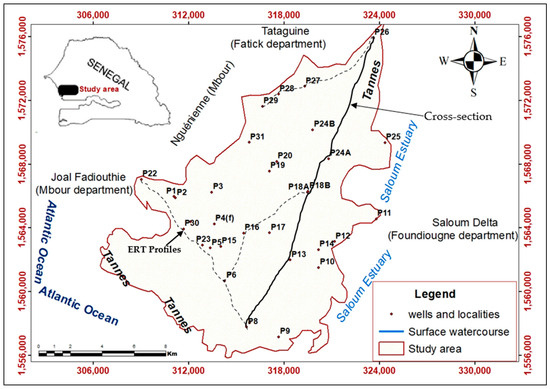
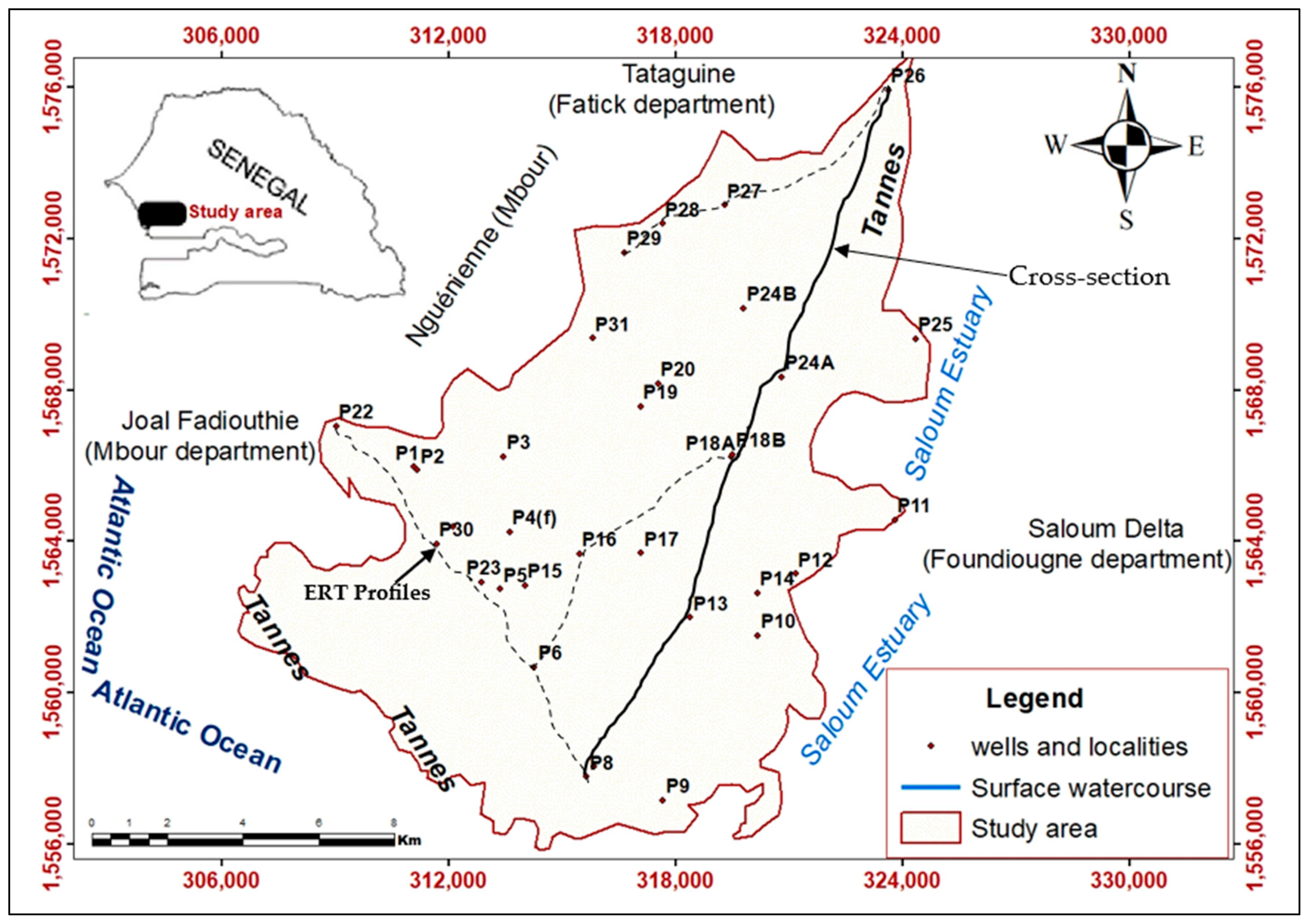
The Samba Dia study area (Figure 1) is located in central-western Senegal, covering approximately 194 km2 between longitudes 16°38′ to 16°50′ W and latitudes 14°05′ to 14°15′ N. It is bordered by the Atlantic Ocean to the west and various tributaries of the Saloum estuary to the east. Administratively, it is part of the commune of Fimela, in the Fatick Department. The region has a tropical climate, influenced by oceanic conditions and constant maritime trade winds, resulting in moderate temperatures (monthly averages of 20 °C minimum and 30 °C maximum) and relatively high humidity throughout the year (annual average of 60%, peaking at 96%). Rainfall averages 600 mm per year, falling predominantly between July and October, and the landscape is characterized by shrub savannah with thorny, woody species and herbaceous cover. These geographical and climatic features significantly influence both the quantity and quality of groundwater resources. Proximity to the ocean and estuarine tributaries increases the risk of seawater intrusion, especially during periods of drought or over-abstraction. Seasonal rainfall patterns directly affect recharge rates, with prolonged dry spells leading to lower aquifer levels and greater vulnerability to the upwelling of saline water. High humidity and temperature contribute to evaporation, which can concentrate dissolved salts and accelerate mineralization processes within the aquifer. The gentle slope toward the estuary further facilitates the lateral movement of saline water into freshwater zones. Collectively, these factors heighten the region’s groundwater’s susceptibility to quantity reduction and quality degradation, underscoring the need for careful resource monitoring and management.
Figure 1.
Location of the study area, sampling network, 2D Electric Resistivity Tomography (ERT) profiles and cross-section (Figure S1).
2.2. Geology and Hydrogeology
The Samba Dia area is located in the western region of the Senegalo-Mauritanian sedimentary basin, consisting of a sequence of formations from the Maastrichtian to the Quaternary, as revealed by surface outcrops and deep drilling records [8,33,34]. The Maastrichtian layer is marked by clays and sands, while the Paleocene and Eocene beds are dominated by limestone, marl, and clay formations, where groundwater quality tends to vary from brackish to saline in deeper levels [30,35]. The Mio-Plio-Quaternary formations, which host the primary Samba Dia aquifer, consist of detrital soils with interbedded clay, sand, ferruginous gravels, shells, and pebbles [8,9,36]. The unconfined Quaternary sand aquifer is the only one used to meet the drinking water needs of the population. This aquifer system has an average thickness of 20 m, extending up to 40 m in the southern sector near Ndagane [8]. Hydrogeological parameters indicate an average transmissivity of m2/s, effective porosity of 22%, and average permeability of about m/s as mentioned by Sarr in 1982 [8]. A piezometric dome is situated in the central part of the area, creating variable hydraulic gradients and directing groundwater flow toward the estuarine tributaries and the ocean—natural boundaries for groundwater movement [32]. These geological and hydrogeological features profoundly influence the availability and quality of local water resources. High permeability and variable gradients make the aquifer both productive and susceptible to rapid contaminant transport. The detrital composition and structural layering facilitate vertical and lateral water movement but also enable marine intrusion and surface salt leaching, particularly in low-lying or coastal zones. Furthermore, the predominance of clays and marls at depth restricts vertical recharge and increases groundwater residence time—raising the likelihood of mineral dissolution, ion exchange reactions, and sustained salinity accumulation. Such characteristics can induce consequences for water resources by increasing vulnerability to seawater intrusion and salinization in peripheral zones. This results in variable water quality, with central dome areas hosting fresher water, while edges are prone to mixing and contaminant influx. Elevated concentrations of dissolved ions, particularly sodium, chloride, and sulfates, diminish suitability for drinking and irrigation. There is also a risk of sustained declines in aquifer reserves if recharge rates are surpassed by exploitation or if the saline front progresses unchecked. Overall, the geology and hydrogeology of Samba Dia necessitate careful monitoring and management to prevent deterioration of both groundwater quantity and quality amidst natural and human-induced pressures.
3. Materials and Methods
3.1. Study Workflow
The study methodology consisted of the following steps:
- Groundwater sampling was conducted in 31 shallow wells (2–12 m depth), selected based on proximity to suspected saline interfaces and local surface salt zones.
- Physicochemical parameters, including temperature, electrical conductivity, pH, and TDS, were measured in situ.
- Major ion concentrations were analyzed by ion chromatography, with quality control performed via ion balance checks (<±5% error).
- Stable isotope ratios (δ18O and δ2H) were determined using laser spectroscopy, with reported precisions of ±0.1‰ and ±1‰, respectively.
- The ERT surveys were conducted to map subsurface resistivity variations indicative of groundwater salinity. Details of the data acquisition, array configuration, and inversion procedures are provided in Section 3.3.
- Hydrogeochemical data, isotopic signatures, and geophysical results were integrated through spatial mapping and multivariate analyses to interpret salinization dynamics and identify dominant salinity sources.
3.2. Hydrochemical and Isotopic Investigations
To evaluate the geochemical evolution of salinity in the Samba Dia aquifer, a hydrochemical and isotopic characterization was conducted on 33 samples collected in March 2021 from shallow wells (2–12 m deep). The samples were selected based on their location: in the center of the aquifer, in peripheral areas near saline interfaces, and close to the coastline and tannes (areas of surface salts). On-site measurements of physicochemical parameters (Temperature (T°), electrical conductivity (EC), potential hydrogen (pH), and Total dissolved Solid (TDS)) were taken during sample collection using a portable multiparameter WTW (Model: Multi 350i/SET, Weilheim, Germany). Some wells were purged before sampling due to infrequent use. Carbonate species were analyzed titrimetrically using a 0.05 M solution, while ions such as Ca2+, Mg2+, Na+, K+, NO3−, SO42−, Cl−, F−, and Br− were analyzed by AQUION-DIONEX ion chromatography at the Geology Department of Cheikh Anta Diop University in Dakar. Exchange processes involved the use of AS14 A-AERS 500 columns for anions and CS12 A-CERS 500 for cations. The accuracy of the chemical analysis was validated through ion balance calculations, which showed errors of ±5% or less. Water stable isotope analyses (δ18O and δ2H) were performed at the Laboratory of Radio-Analyses and Environment (LRAE) at the National School of Engineers of Sfax (Tunisia) using laser absorption spectrometry with a LGR DLT 100. Results are expressed as delta values in ‰ VSMOW (Vienna Standard Mean Oceanic Water), with measurement uncertainties of ±0.1‰ for δ18O and 1‰ for δ2H. Isotopic data were interpreted relative to local [37,38] and global [39] meteoric water line references.
Spatial distribution maps of CE, Cl, and Na were created to examine the spatial evolution of salinity. To identify the source(s) of salinity and the mechanisms of salinization of groundwater, Stuyfzand classification [40] and Hydrochemical Facies Evolution Diagram, HFE-D [41], adapted to studying salinization or freshening, are used. This Stuyfzand classification represents water type using a symbol that encodes several pieces of information [40,42]. The first code, based on chloride content (Table 1), is considered in this study. The HFE-Diagram helps reveal the hydrochemical facies types of groundwater and indicates whether saltwater intrusion occurs in a freshwater environment or freshwater infiltration takes place in a saltwater environment.
Table 1.
Main water types by chloride.
Several geochemical ratios, Na/Cl, Br/Cl, SO4/Cl [20,25,28], and environmental isotopes were used in binary diagrams to identify potential mechanisms influencing the overall geochemical composition of groundwater.
3.3. Geophysical Investigations
The geophysical investigation relied on ERT [43], a method suitable for characterizing and mapping soil materials [44,45]. A potential difference is measured at the surface after injecting electric current, allowing the computation of apparent resistivity values that are later inverted to obtain a proxy of the petrophysical features of the subsurface—i.e., formation resistivity [46].
The three main electrical resistivity survey methods are resistivity sounding (RDS), resistivity profiling (RP), and electrical imaging (ERT) [47,48,49]. Among them, ERT provides a two-dimension representation of subsurface resistivity and is particularly effective for identifying salinity gradients, aquifer geometry, and lithological variations [47,48,49,50,51,52,53].
For this study, surveys were conducted in the Samba Dia area using an ABEM Terrameter LS Lund system. The instrument combines profiling and sounding through a sequence of automatically controlled electrodes spaced at fixed intervals. Each electrode has a unique address, allowing current injection and potential measurements according to predefined quartets [54].
Fourteen 2D ERT profiles, each 100 m long with 51 electrodes spaced at 5 m intervals, were collected at the start of the rainy season (July 2021). Two array configurations—dipole–dipole and Wenner–Schlumberger—were used to achieve complementary sensitivity: the dipole–dipole array improved lateral resolution, while the Wenner–Schlumberger array enhanced depth penetration and signal-to-noise ratio [55,56,57,58].
Data were processed and inverted using the PyGIMLi (Python Geophysical Inversion and Modelling Library, version 1.5.0, running under Python 3.14.0) software [59], involving quality control, geometric factor corrections, and smoothness-constrained least-squares inversion. The resulting 2D resistivity models differentiate between freshwater-bearing formations (high resistivity) and saline or clay-rich zones (low resistivity).
4. Results and Discussions
4.1. Hydrochemistry and Water Stable Isotopes
Chemical, physicochemical, and Isotope data for this study are listed in Table 2 and Table S1. The results obtained were used to explore hydrogeochemical processes in groundwater and to identify mechanisms driving salinization.
Table 2.
Chemical, physicochemical and isotope data.
4.1.1. Electrical Conductivity and Chloride
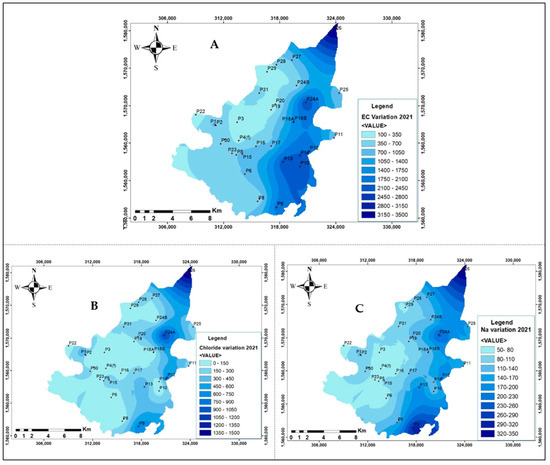
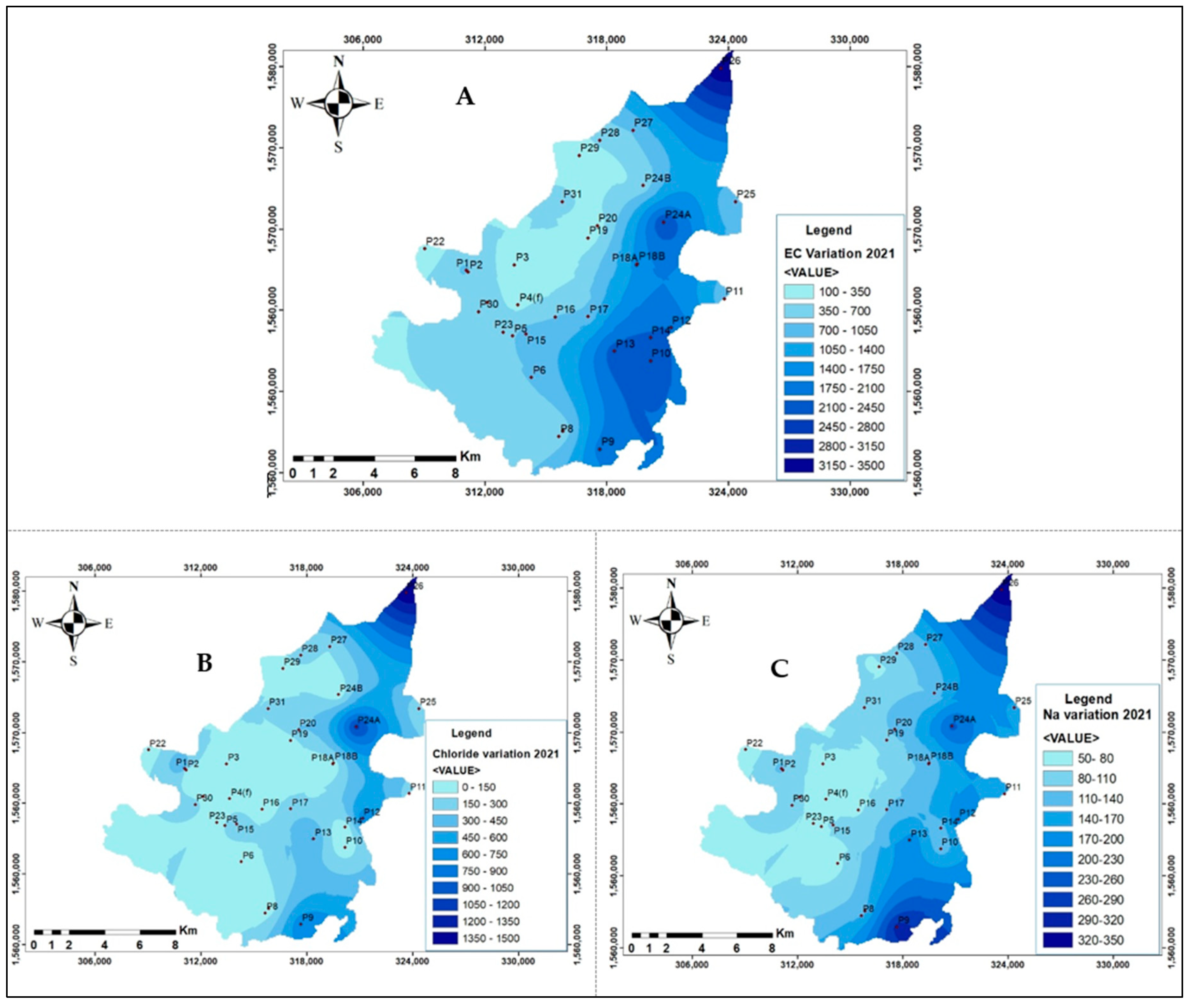
The spatial distribution of salinity (Figure 2), expressed as electrical conductivity (EC), shows significant variations in groundwater mineralization across the study area. EC values range from 107 to 25,200 μS·cm−1, with a mean value of 1930 μS·cm−1 and SD = 4396.8, highlighting the heterogeneity of the aquifer’s hydrochemistry. Chloride concentrations range from 13.3 to 818 mg·L−1 (mean = 515 mg·L−1; SD = 1431 mg·L−1), indicating multiple sources of salinization within the area. The distribution of conductivity shows high values along a south-east to north-east axis in the coastal zone, reflecting marine influence, while wells in the center of the study area exhibit low electrical conductivities, with a minimum of approximately 107 μS·cm−1. The spatial distributions of chloride and sodium follow nearly identical trends to electrical conductivity, confirming the dominance of these ions in the mineralization process.
Figure 2.
Spatial repartition maps of EC (A), Cl (B), and Na (C).
4.1.2. Salinity Origin: Use of Hydrochemical Facies Evolution Diagram and Classification of Stuyfzand
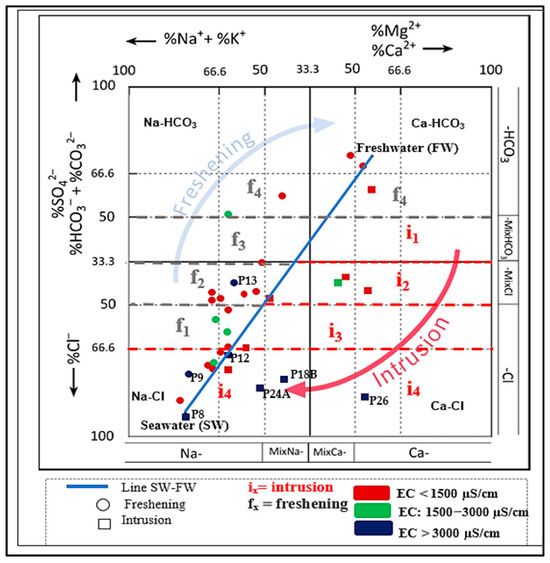
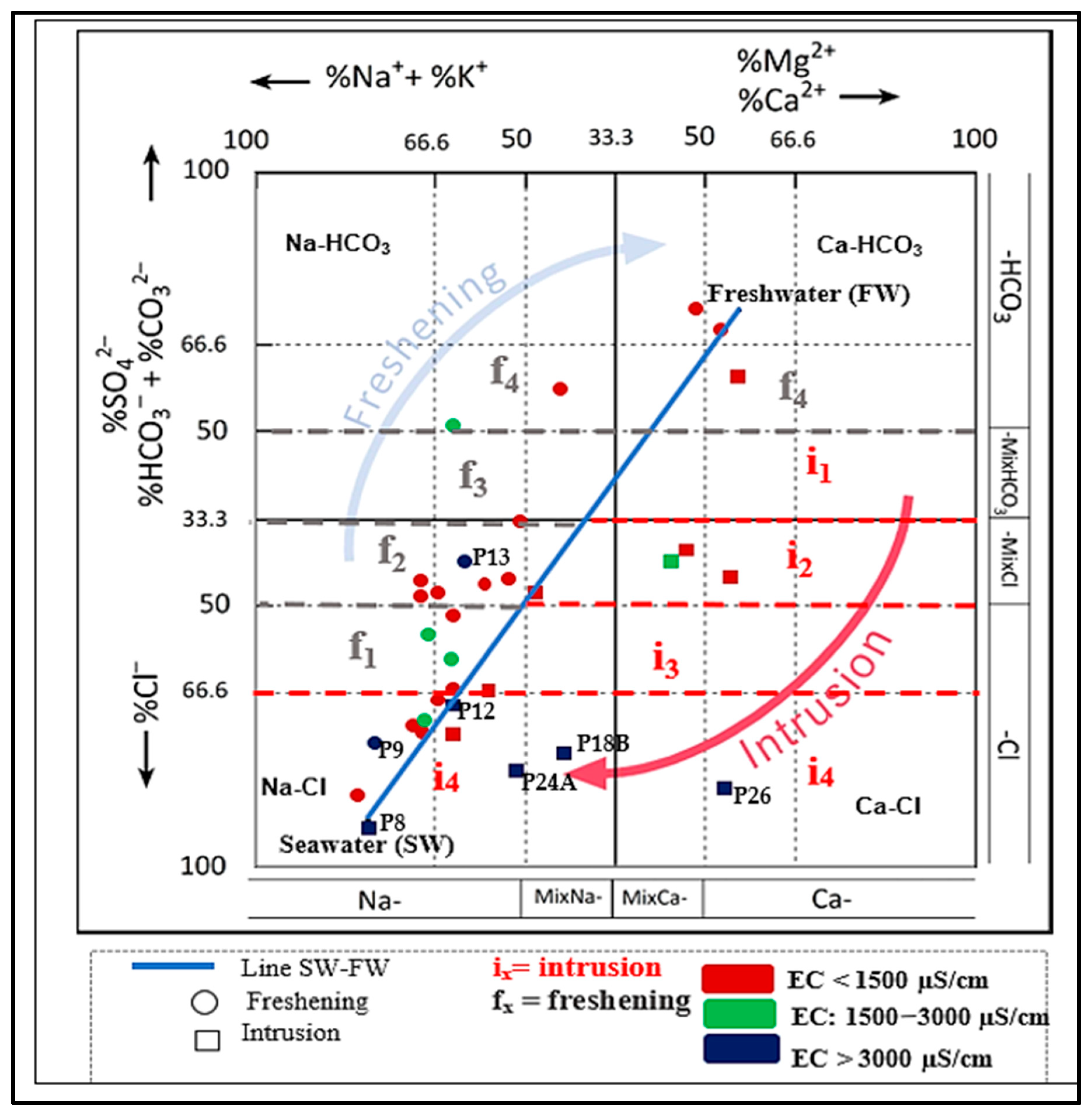
The representation of major element concentrations in local waters on the Hydrochemical Facies Evolution Diagram (HFE-D) (Figure 3) shows that the dominant chemical facies is sodium chloride Na-Cl (69%). However, some wells may have the same facies but be located on opposite sides of the mixing line SW-FW (Figure 3), and therefore not have the same phase. Thus, the hydrochemical facies is not necessarily directly related to the intrusion or refreshment phase. The NaCl water type is encountered in wells near salty surface waters, where electrical conductivities and chloride concentrations are medium to high, or even very high. Other facies identified in the groundwater include calcium bicarbonate (CaCO3), calcium chloride (CaCl), sodium bicarbonate (NaHCO3), and several mixed facies. The mixing effects between freshwater and saltwater, as well as the degree of mixing, are clearly shown in this diagram. Samples are grouped into the i2 + i4 (45%) and f1 + f2 + f4 (55%) substages. Those in the i2 + i4 substages belong to the NaCl (10), CaCl (1), Mix NaCl (1), Mix CaMix Cl (2), and CaMix Cl (1) water types.
Figure 3.
Representation of groundwater samples on the HFE-D.
These wells are either in the middle of the intrusion phase (P2, P5, P22, P18B, and P16) with mixed facies, in the advanced intrusion phase (P26) with a CaCl facies, at the end of the intrusion with a NaCl facies (P8, P24A, P28, P12, P18A) and high salinity values. During the different stages of intrusion, salinity increases as reverse ion-exchange reactions between Na and Ca occur [60]. HCO3 is also gradually replaced by Cl. The nitrate concentration in the study area varies from 2.86 to 883.79 mg/L. High nitrate concentrations are found in samples P5, P9, P12, P13, P15, P18B, P24A, and P28. This polluted water, encountered sporadically in these few wells, is most likely due to local contamination at the water sources. Nitrate comes from local human activities such as agricultural practices (usually fertilizers) and the improper disposal of household, animal, and human waste.
Other wells (P20, P9, P17, P1, P11) with NaCl facies are in the early stages of the refreshing phase and are beginning to be affected by recharge. These wells have low to medium salinity, except for P9, whose electrical conductivity exceeds 3000 μS·cm−1, likely due to its proximity to the “tannes”. Samples representative of the refreshment state, belonging to f1 + f2 include NaCl (5), Na-Mix Cl (7), Mix Na-Mix Cl (1) facies. The f4 substage, indicating the end of refreshing, is represented by the bicarbonate facies (P6, P4, P21, and P31). During the f1 and f2 substages, associated with the freshening phase, the aquifer attempts to reach equilibrium [61]. During the refreshing phase, direct ion-exchange reactions cause the water to acquire Na+ and lose Ca2+, until the Na-HCO3 facies forms. Electrical conductivities are below 1500 μS·cm−1 for 82% of samples above the SW-FW line.
Using Stuyfzand’s classification (1986), chloride contents indicate four water types. Groundwater is classified as fresh (F) for 48.5% of samples, fresh to brackish (Fb) for 27.3% of samples, and brackish-saline (Bs) and brackish (B) for 12.1% each. All measuring points in the peripheral zone, where saline surface water bodies are present, cluster into Brackish and Brackish saline water types with NaCl facies. This indicates a significant influence of saline waters on the aquifer, explaining the high electrical conductivities observed.
4.1.3. Na+/Cl− Correlation
Identifying the source of salinity in coastal groundwater can be achieved through various methods. Due to the limitations of these methods, combining multiple approaches is necessary to determine the origin. Therefore, ionic ratios (Na+/Cl−, Br−/Cl−, SO42−/Cl−) are also employed, as in many studies [22,25,28], even though they can be influenced by processes such as water–rock interaction and human activities.
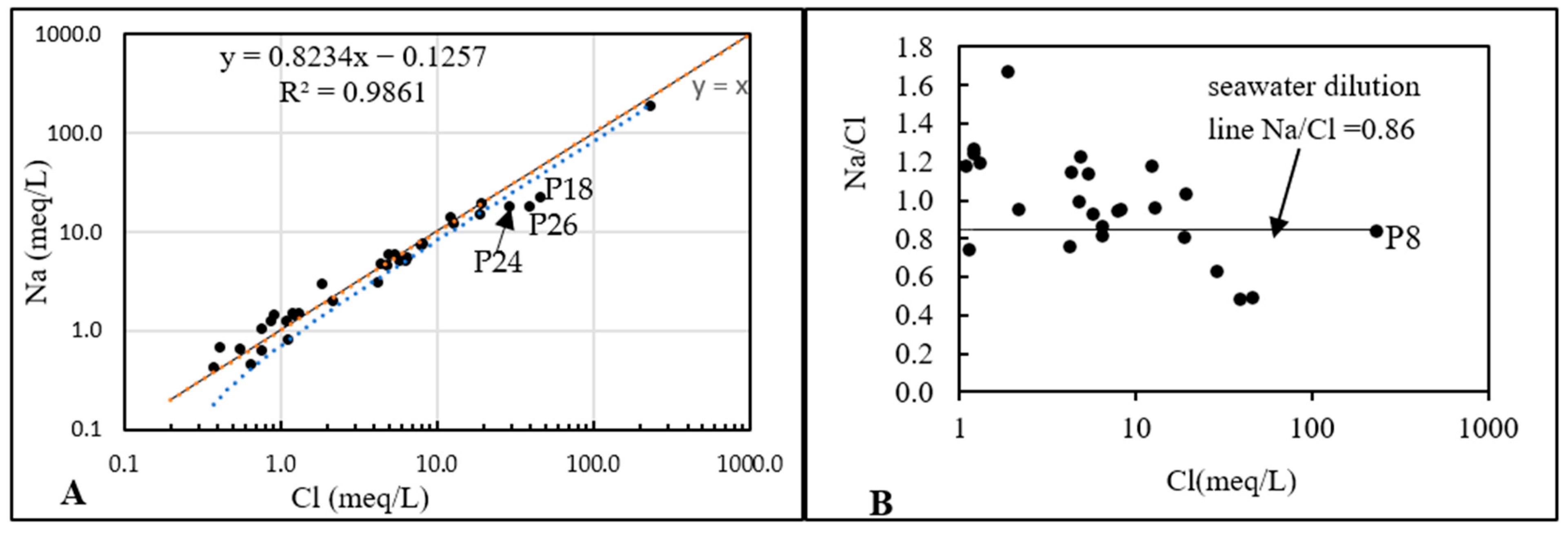
In the area, 25% of samples are brackish or brackish-salty with water rich in NaCl, likely originating from seawater. The Na/Cl ratio, an indicator of marine influence, is used. Typically, this ratio is lower than the marine values (0.86, molar ratio) [62,63,64] in cases of a marine intrusion or early salinization stages. In the Samba Dia aquifer, the Na versus Cl correlation diagram (Figure 4A) exhibits a strong positive correlation (R2 = 0.98). Many samples have an ionic Na/Cl ratio < 0.86 (Figure 4B). Wells affected by marine intrusion correspond to those with a Na/Cl ratio lower than 0.86 and located near the coast. The mixing zone of freshwater/seawater thus includes wells P1 (Kobongoye), P8 and P9 (Ndangane), P12 (Fimela), P13 (Yayeme), P30 (Mbissel), P26 (Djilass), P22 (Fadial), and P23 (Samba Dia mka). Saline intrusion may be intensified by the presence of permeable sandy formations in the aquifer, leading to high concentrations of these elements in some wells, such as NDangane (P8), with 230 meq/L of chloride.
Figure 4.
Correlation diagrams Na vs. Cl (A), Na/Cl vs. Cl (B) of analyzed samples.
For other wells with high chloride levels, salinity may be explained by factors other than chloride [65], such as leaching of saline soils, halite dissolution, and reverse ion exchange. In most cases, the high Na/Cl (Na/Cl ratio greater than 1) signature is found in wells located in the central part of the area, as well as in other wells far from the coastline. This high ratio can be attributed to an excess of Na+ observed in some water samples [66], whether with high or low mineralization, which could result from silicate weathering and/or cation exchange on clay minerals [67] as seen with the HFE-Diagram (Figure 3).
4.1.4. Br−/Cl− Correlation
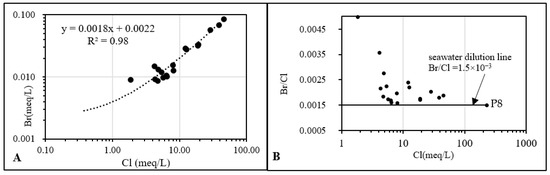
In hydrological systems, these two ions are relatively conservative, making the ratio Br/Cl fairly constant (1.5 × 10⁻³) in present-day seawater. This distinguishes seawater from the remains of evaporated seawater or hypersaline waters [68], as well as from the dissolution products of evaporites and anthropogenic sources like wastewater effluents [69]. Consequently, this ratio is often used as a reliable indicator of the origin of salinity [24,25,70,71,72,73,74,75]. In our study, bromides were detected in 19 of the 33 samples. For the other samples, the contents were below LOD (0.05 mg L−1). The Br versus Cl correlation diagram (Figure 5A) shows a strong positive correlation (R2 = 0.98), indicating a common origin [75]. The Br/Cl versus Cl diagram indicates that most groundwater samples have Br/Cl values between 1.5 and 1.7 ‰, positioned above the seawater dissolution line (Figure 5B). According to Custodio and Alcala [25], both ions originate solely from seawater intrusion when the molar concentration ratio remains similar to that of seawater. Therefore, the wells P8, P9, P11, P12, P25, and P26, located on the coast or near inlets and with a ratio close to that of seawater, are influenced by marine intrusion. In Figure 5B, some samples exhibit higher Br/Cl ratios than seawater, explained by bromide enrichment from sea spray on infiltrated rainwater [71] and/or bromine enrichment following halite precipitation in evaporitic zones [16].
Figure 5.
Relationship between Br and Cl (A), Br/Cl and Cl (B) of the analyzed samples in the study region.
4.1.5. SO42−/Cl− Correlation
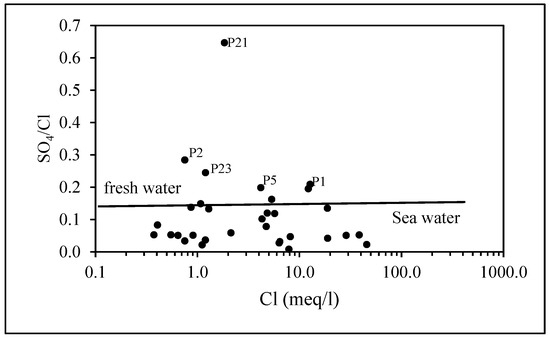
In coastal aquifers, marine intrusion can be evaluated through the SO4/Cl ratio [76]. During the process of seawater intrusion, the ionic ratio of SO4 to Cl typically decreases (SO4/Cl < 0.13) as the percentage of seawater in the mixture increases [64,77]. When the SO4/Cl ratio surpasses 0.13, the influence of seawater can be reasonably excluded. In the Samba Dia Quaternary aquifer, numerous samples fall below the established line representing SO4/Cl = 0.13. Nevertheless, not all such points necessarily indicate seawater intrusion. Given their proximity to the coast, wells P9, P8, P22, P24A, P26, and P28 are identified as being affected by salinization attributable to seawater intrusion. The low SO4/Cl ratios, coupled with high Cl contents, in these samples support the presence of seawater intrusion. In contrast, other sites with an SO4/Cl ratio < 0.13 but far from marine influence may experience salinization due to processes such as dissolution, mineral precipitation, or ion exchange. For a group of samples (P1, P2, P5, P13, P21, P23, P30, P8) from wells close to areas known locally as “tannes”, the SO4/Cl ratio is higher than that of seawater (Figure 6). Enrichment of SO4 in these localities could be related to leaching of acid sulfate soils found in “tannes” [78].
Figure 6.
SO4/Cl vs. Cl diagram for groundwater of the area.
4.1.6. Water Stable Isotopes (δ18O and δ2H)
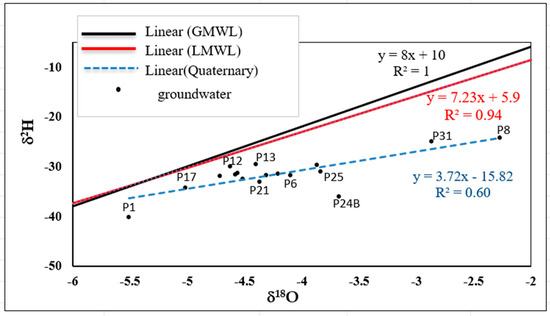
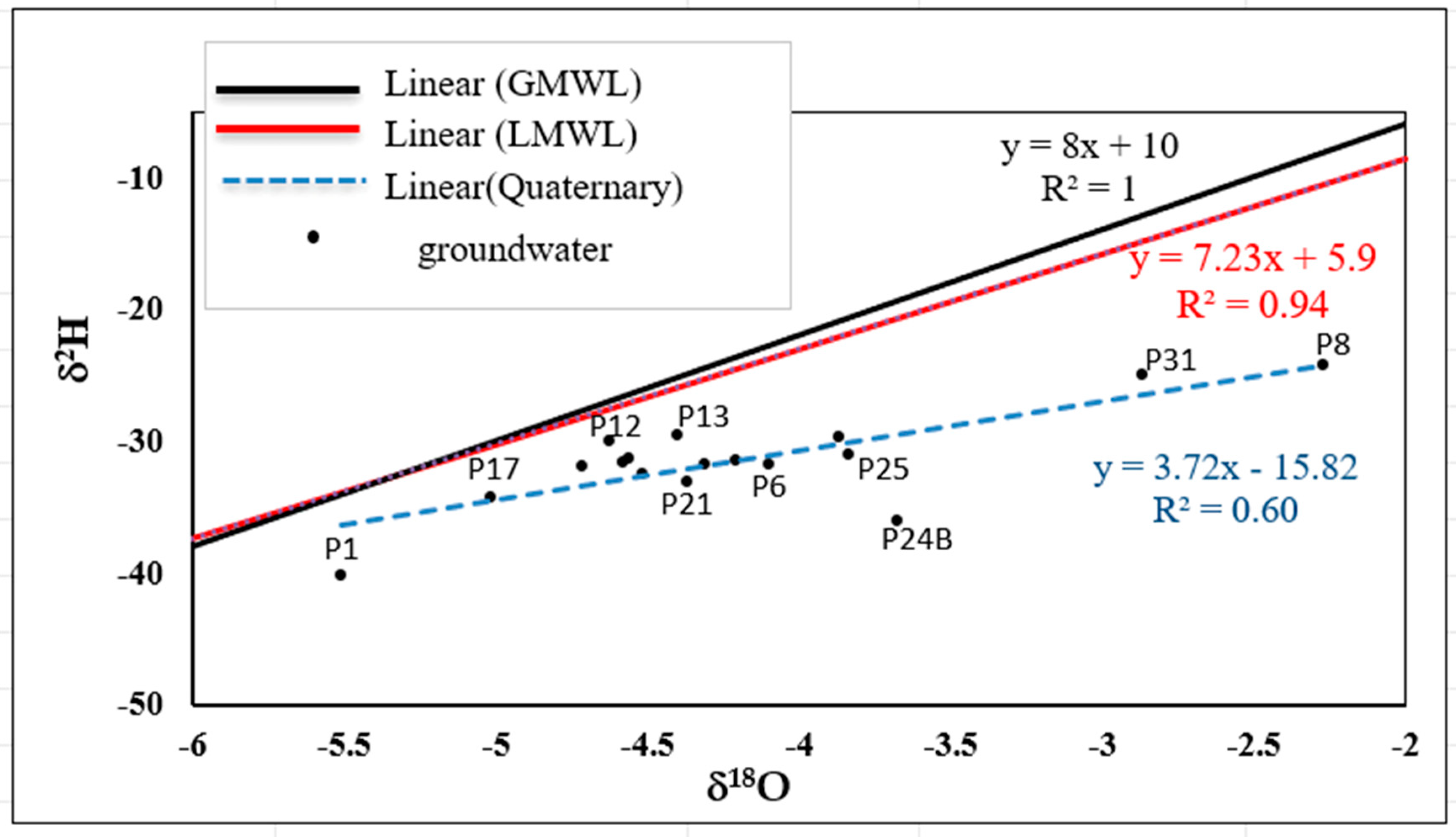
To evaluate the origin of salinity and identify its mechanisms, several studies [16,60,79,80] have used stable isotopes of water molecules. Isotope analysis also provides information on the aquifers’ recharge zones and modes, as well as the mixing of different types of water [61,81]. In our study, we analyzed seventeen samples. The δ18O values range from −5.51 ‰ to −2.27 ‰ with an average of −4.2 ‰, while δ2H values range from −40,2 ‰ to −24.2‰ with an average of −31.5‰ (Table 2). The relationships between δ2H and δ18O are shown in Figure 7 for water collected from the 17 sampling points. The 33 rain samples collected by Madioune [38] define the local meteoric water line (LMWL), which closely matches the meteoric water line identified by Travi [37] and the Global Meteoric Water Line (GMWL) [39].
δ2H = 7.23 δ18O + 5.9
δ2H = 7.93 δ18O + 10.09
δ2H = 8 δ18O + 10
Figure 7.
Relationship between δ18O and δ2H at 17 sampling points.
The rainfall data recorded at stations across the country, which led to Equations (1) and (2), indicate that there is no evaporation signal of the rains when they fall. These two reference lines (Figure 7) were used to characterize the isotopes of Samba Dia groundwater.
Figure 7 shows that the points are below the two reference lines (LMWL and GMWL) and form a regression line δ2H = 3.7δ18O − 15.82. According to Fontes [81], evaporation lines with slopes between 3 and 4 indicate lines with water subject to high evaporation. This slope of 3.7 thus suggests, overall, groundwater that is in heavy isotopes. This enrichment could be due to surface water evaporation before infiltration, to evaporation during its transit through the unsaturated zone, or to evaporation of the water table itself because of the proximity of the groundwater level to the natural ground.
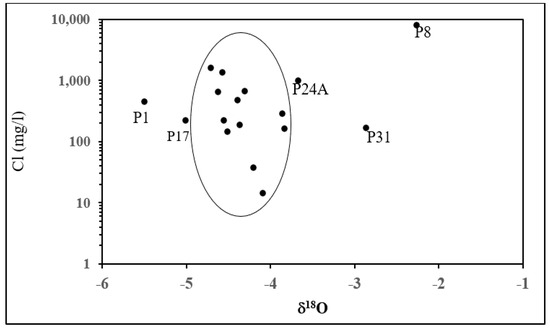
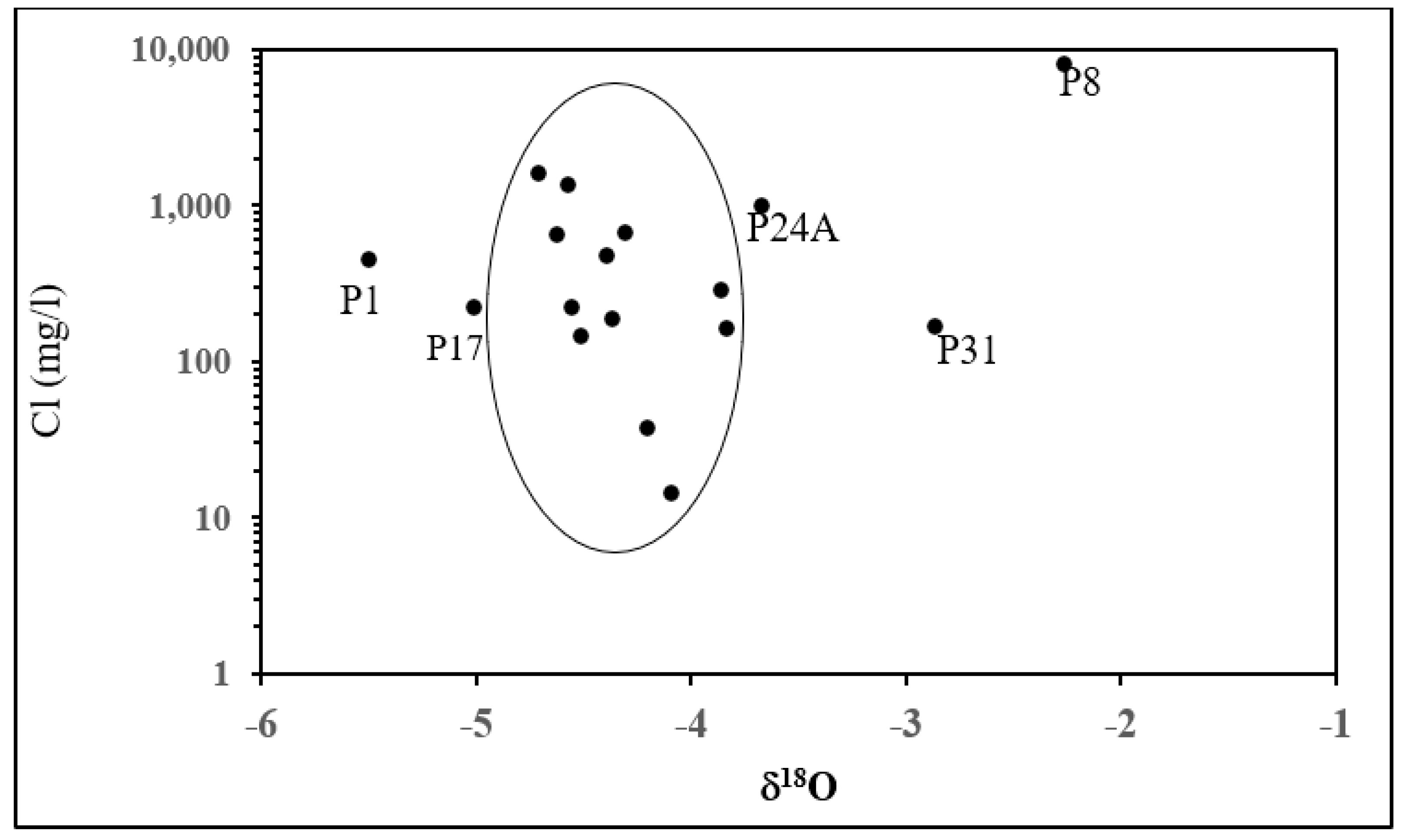
Analysis of the relationship between oxygen and chloride concentrations (Figure 8) shows that these two elements are not correlated. The increase in chloride does not accompany an increase in 18O in most samples (framed wells). The lack of correlation indicates that several processes are responsible for the groundwater mineralization, such as evaporite dissolution (halite, gypsum), water mixing, and ion exchange [61,82]. Additionally, a few groundwater samples (coastal wells: P8, P31, P24A), which are among the most enriched in 18O and 2H, suggest mixing saline water. Two samples (P1 and P17) have 18O contents between −5‰ and −6‰ characteristic of current rainwater. P1, located in the coastal zone at a depth of 3 m, has a higher chloride content (451.3 mg/L). Well, P17, with 227.4 mg/L chloride and situated in the piezometric dome zone, indicates recent recharge.
Figure 8.
Relationship between Cl and δ18O.
4.2. Geophysical
Geophysical techniques, particularly electrical resistivity methods, have become indispensable in investigating aquifer structure, mapping salinization, and characterizing recharge processes. While hydrogeochemical investigations provide valuable insight into water composition and dynamics, they often fail to resolve fine-scale spatial variations or the geometry of critical interfaces, such as the transition between freshwater and saline zones. Non-invasive spatial imaging via ERT yields high-resolution vertical and lateral models of subsurface resistivity that closely match lithology and fluid-salinity distributions. Recent research demonstrates the effectiveness of ERT for mapping seawater intrusion and salt-leaching zones and for supporting adaptive aquifer management in vulnerable coastal settings [44,83,84].
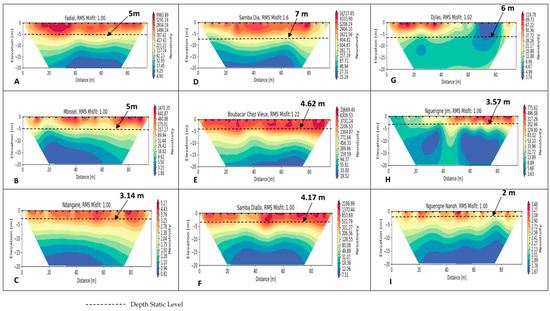
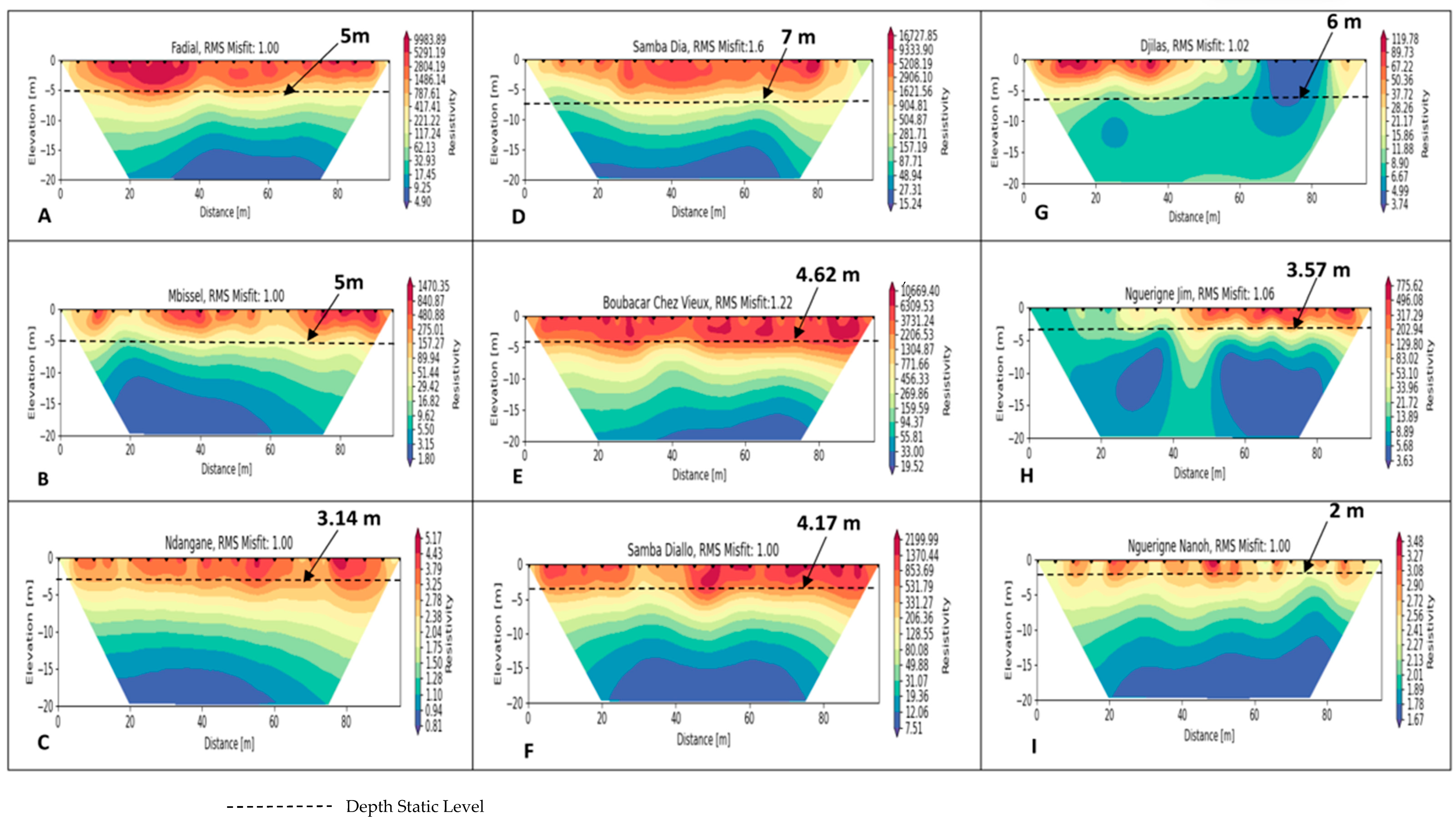
Fourteen 2D ERT profiles were collected across the Samba Dia region during the start of the rainy season (July 2021), covering coastal, central, and northern sectors to reveal the layering of brackish water between surface saline intrusions and deeper fresh layers. The profiles systematically include three main geographic zones: west toward the ocean (Figure 9A–C), center (Figure 9D–F), and north (Figure 9G–I). The spatial variation in resistivity reflects differences in salinization levels between locations, directly supporting the hydrochemical findings of EC and Cl− distributions (Figure 2).
Figure 9.
Electric Resistivity Tomography (ERT) 2D electrical sections to the west towards the sea (A–C), in the center (D–F) and in the northern sector (G–I).
Western Coastal Sector: Low resistivity values ranging from 0.81 to 5.17 Ω·m characterize coastal areas, indicating surface salinization from marine intrusion, as exemplified at Ndangane (P8) where EC exceeds 25,000 μS·cm−1 and Cl− reaches 8184 mg·L−1. At depths exceeding 15 m in Mbissel (P30) and Fadial (P22), low-resistivity zones persist, suggesting the presence of freshwater groundwater overlying deeper saltwater (saline intrusion front), separated by a brackish transition band with resistivity values of 5.5 to 16 Ω·m. This three-layer stratigraphy aligns perfectly with the Na/Cl ratios < 0.86 documented at these wells (P22, P30), confirming marine influence. The HFE-D diagram indicates that wells P8 and P24A are in the advanced intrusion phase, with very high salinity, a signature clearly captured by the ERT-derived low-resistivity anomalies.
Central Sector: The lowest resistivity values (~7.51 Ω·m) indicate brackish water overlying freshwater approximately 10 to 15 m thick, as observed at Samba Dia (P5), Samba Diallo (P17), and Baboucar (P6). Critically, the isotopic and ionic ratios from central zone samples reveal evidence of active rainwater recharge—wells P17 and P6 display δ18O values between −5‰ and −6‰, characteristic of recent precipitation, and HCO3−-dominated facies (freshening phase; f1-f4 substages) consistent with infiltrating meteoric water. The central piezometric dome identified by Sarr et al., 2022 [32] thus represents a critical recharge zone where ERT imaging validates the presence of substantial freshwater reserves beneath weathered brackish surface layers—information crucial for sustainable abstraction planning.
Northern Sector: Resistivity values are among the lowest in the study area, reflecting intense mineralization as evidenced by exceptionally high EC values (Figure 2A). At Djilass (P26), aquifer depth is 6 m with resistivity ranging from 11.88 to 50.36 Ω·m, likely indicating brackish to saline water reaching the surface due to leaching of salt accumulated in “tannes” during dry months—confirmed by the elevated SO4/Cl ratio (0.27) typical of acid sulfate soil leaching. At Ngarigne Jim (P27), lateral resistivity variations rather than depth-dependent stratification suggest local pollution or heterogeneous salt accumulation in the surface soils. Notably, Ngarigne Nanoh (P31), with the shallowest water table (3.6 m), displays the lowest resistivities (1.67–3.48 Ω·m), indicating clayey sand saturated with saltwater and brackish water—a finding corroborated by its HCO3−-dominated facies and intermediate EC (1124 μS·cm−1).
Cross-Disciplinary Integration: By combining ERT imaging with hydrochemical and isotopic indicators, a comprehensive, georeferenced understanding of groundwater quality spatial heterogeneity has been achieved. The resistivity-derived three-layer geometry (surface brackish/saline, transition, fresh) corresponds precisely to the HFE-D evolutionary stages and Na/Cl ratios that distinguish marine intrusion zones (P8, P9, P24A, P26) from recharge zones (P17, P6, P21) and inland leaching areas (P1, P5, P13, P30). The empirical resistivity–EC calibration (R2 = 0.91) enables direct conversion of ERT sections into salinity maps, quantifying intrusion depth and extent. This multidisciplinary approach confirms its distinct value for precisely identifying vulnerable zones affected by marine intrusion, delineating recharge areas critical for future monitoring, and enabling sustainable aquifer management—delivering spatial precision unattainable by hydrochemistry or geophysics alone.
4.3. Applications and Limitations
The integration of hydrochemical characterization, stable isotope analyses (δ18O and δ2H), and ERT has proven effective in delineating the spatial distribution and sources of salinization within the Samba Dia aquifer.
Hydrochemical data and isotopic signatures allowed clear differentiation between salinity caused by marine intrusion and that derived from surface evaporation and acid sulfate soil leaching, as evidenced by the distinct isotopic line regression (δ2H = 3.7δ18O − 15.82) indicating heavy isotope enrichment from evaporation. The ERT surveys complemented this by mapping subsurface resistivity variations that correlate with chemically identified saline zones, enabling detailed imaging of the lateral and vertical extent of salinization.
Nonetheless, each method has limitations. Hydrochemical and isotopic analyses, conducted during a single sampling campaign, provide a temporal snapshot that may not capture seasonal variations or transient processes affecting groundwater chemistry. The isotopic approach requires specialized laboratory facilities and careful interpretation, as mixing and evaporation can introduce errors. The ERT method is inherently non-unique; inversion models produce smooth transitions between layers rather than sharp boundaries, which means interfaces between fresh, brackish, and saline water are approximations rather than exact limits [85]. Additionally, ERT’s depth penetration is limited, and its sensitivity to geological heterogeneities unrelated to salinity complicates interpretation, requiring integration with hydrochemical data to improve reliability.
5. Conclusions
This study presents a pioneering integrated assessment of salinization of the Samba Dia aquifer using a multidisciplinary framework combining hydrogeochemistry, stable isotopes (δ2H, δ18O), and three-dimensional electrical resistivity tomography (ERT). This combined approach represents a significant methodological advancement for coastal aquifer characterization in West Africa. Unlike previous studies in the Saloum basin that relied on limited hydrochemical investigations, this work establishes a unique cross-disciplinary methodology that simultaneously resolves salinization processes at the chemical, isotopic, and spatial-geophysical levels. The integration of 14 high-resolution ERT profiles with 33 geochemical and isotopic measurements provides unprecedented spatial precision in delineating freshwater–saltwater interfaces and recharge zones. The study successfully identifies and spatially separates three distinct salinization mechanisms—seawater intrusion (confirmed by Na/Cl < 0.86), surface salt leaching (elevated SO4/Cl in tannes), and water–rock interactions (cation exchange and mineral dissolution)—using multivariate data (HFE-D classifications and isotopic signatures). This mechanistic resolution was not previously available for the Samba Dia region and exceeds the interpretive power of hydrochemistry alone. The empirical resistivity–EC relationship (R2 = 0.91) developed in this study enables direct conversion of ERT models into salinity maps with unprecedented accuracy. Such a result provides stakeholders with actionable, three-dimensional vulnerability maps identifying:
- Central recharge zones (10–15 m of freshwater, resistivity > 7 Ω·m);
- Peripheral intrusion fronts (resistivity < 5 Ω·m, Na/Cl < 0.86);
- Inland leaching-prone zones (mixed facies, elevated SO4/Cl).
The δ2H-δ18O data (slope 3.7) reveal active recharge from modern precipitation in central zones (P17, P6: δ18O −5 to −6‰) and evaporative enrichment in peripheral areas—findings that quantify the hydroclimatic controls on salinity evolution previously only qualitatively inferred. In terms of Practical Management, this study proposes a sustainable monitoring and management framework based on four aspects, which are (i) identification of priority protection zones (central dome); (ii) seasonal multi-year ERT monitoring protocols; (iii) adaptive withdrawal limits tied to intrusion front positions, (iv) predictive numerical modeling pathways.
This integrated approach directly addresses the critical research gap identified by reviewers—the lack of tools capable of simultaneously diagnosing salinity origin, quantifying spatial extent, and providing georeferenced vulnerability assessments. The methodology is transferable to similar coastal aquifer systems in West Africa and beyond, offering a reproducible best-practice framework for aquifer characterization under climate and anthropogenic stress. The finding that 64% of samples are in the recharge phase (not beyond recovery) while 36% show intrusion signatures provides an evidence-based foundation for intervention strategies, distinguishing between aquifer zones requiring protection, restoration, or controlled abstraction. This represents a marked improvement over previous assessments that lacked such spatial–mechanistic precision. In sum, we aim to successfully demonstrate that integrated geophysical–isotopic–hydrochemical approaches are essential for resolving complex coastal salinization in semi-arid regions and provide a scientifically rigorous, practical framework for sustainable groundwater management in water-scarce environments.
Supplementary Materials
The following supporting information can be downloaded at: https://www.mdpi.com/article/10.3390/w17243590/s1, Figure S1: Cross-section of the geological formation from Djilass to Dangane; Table S1: Complete database; Folder S1: ERT profile coordinates; Folder S2: Geophysical data.
Author Contributions
Conceptualization, A.S., S.N., A.L.T.D., M.N. and S.F. Methodology, A.S., S.N., S.F., A.L.T.D., M.D., M.N., S.F., A.G. and C.S.C.; Software, A.S., S.N., A.L.T.D. and M.N.; Validation, A.S., S.N., A.L.T.D., S.F., P.L.C., A.G. and C.S.C.; Formal Analysis, A.S., S.F. and S.N.; Investigation, A.S., S.N., M.D., A.L.T.D., M.N. and S.F.; Resources, A.S., S.N., A.G., S.F. and P.L.C.; Data Curation, A.S., S.N., A.L.T.D., M.N., M.D., A.G., S.F. and P.L.C.; Writing—Original Draft Preparation, A.S., S.N., C.S.C. and A.L.T.D.; Writing—Review and Editing, S.N., A.L.T.D., P.L.C., A.G., M.D. and C.S.C.; Visualization, S.N., S.F., P.L.C., A.G. and C.S.C.; Supervision, S.N., S.F., P.L.C. and A.G.; Project Administration, S.N., S.F. and P.L.C. Funding Acquisition, all authors. All authors have read and agreed to the published version of the manuscript.
Funding
This research received no external funding.
Data Availability Statement
The data used to support the findings of this study are included within the article or Supplementary Material. If you need complementary information, please contact corresponding author.
Acknowledgments
The authors gratefully acknowledge the assistance for the chemical analyses by the staff of Hydrochemical laboratory of the Cheikh Anta Diop University of Dakar (Senegal). We are grateful to the anonymous reviewers for their insightful remarks and recommendations.
Conflicts of Interest
The authors declare no conflicts of interest.
References
- Morsli, B.; Habi, M.; Bouchekara, B. Study of marine intrusion in coastal aquifers and its repercussions on the land degradation by the use of a multidisciplinary approach. Larhyss J. 2017, 30, 225–237. [Google Scholar]
- Marjoua, A.; Olive, P.; Jusserand, C. Apports des outils chimiques et isotopiques à l’identification des origines de la salinisation des eaux: Cas de la nappe de La Chaouia côtière (Maroc). Rev. Sci. l’eau/J. Water Sci. 1997, 10, 489–505. [Google Scholar]
- Oude Essink, G.H. Improving fresh groundwater supply—Problems and solutions. Ocean Coast. Manag. 2001, 44, 429–449. [Google Scholar] [CrossRef] [Scilit]
- Rapti-Caputo, D. Influence of climatic changes and human activities on the salinization process of coastal aquifer systems. Ital. J. Agron. 2010, 5, 67. [Google Scholar] [CrossRef] [Scilit]
- Vijay, R.; Khobragade, P.; Mohapatra, P.K. Assessment of groundwater quality in Puri City, India: An impact of anthropogenic activities. Environ. Monit. Assess. 2011, 177, 409–418. [Google Scholar] [CrossRef] [Scilit] [PubMed]
- Prusty, P.; Farooq, S.H. Farooq-Seawater intrusion in the coastal aquifers of India—A review. HydroResearch 2020, 3, 61–74. [Google Scholar] [CrossRef] [Scilit]
- Marius, C. Effets de la sécheresse sur l’évolution phytogéographique et pédologique de la mangrove en basse Casamance. Bull. de l’IFAN 1979, 41, 669–691. [Google Scholar]
- Sarr, R. Etude Géologique et Hydrogéologique de la Zone de Joal-Fadiouth (Sénégal). Ph.D. Thesis, Université Cheikh Anta Diop de Dakar, Dakar, Sénégal, 1982; 166p. [Google Scholar]
- Plaud, M. Les Lentilles D’eau Douce des iles du Bas-Saloum; BRGM, SN-CNDEA: Dakar, Sénégal, 1967; 74p. [Google Scholar]
- Leroux, M. La dynamique de la grande sécheresse sahélienne/Dynamics of the Great Sahelian Drought. Rev. Géogr. Lyon 1995, 70, 223–232. [Google Scholar] [CrossRef] [Scilit]
- Gaye, A.T.; Sylla, M.B. Scenarios Climatiques au Sénégal. Laboratoire de Physique de l’atmosphère et de l’océan S F (LPAO-SF); Ecole Supérieure Polytechnique Université Cheikh Anta Diop: Dakar, Sénégal, 2018. [Google Scholar]
- Travi, Y. Origine des fortes teneurs en fluor des eaux souterraines de la nappe paléocène de la région de Mbour (Senegal): Le rôle de l’ion magnésium. C. R. Acad. Sci. Paris 1984, 298, 313–316. [Google Scholar]
- Mudry, J.; Travi, Y. Enregistreurs et indicateurs de l’évolution de l’environnement en zone tropicale. In Sécheresse Sahélienne et Action Anthropique—Deux Facteurs Conjugués de Dégradation des Ressources en eau de l’Afrique de l’Ouest; Sénégal, P., Maire, R., Pomel, S., Salomon, J.-N., Eds.; University of Bordeaux: Bordeaux, France, 1995; pp. 219–234. [Google Scholar] [CrossRef] [Scilit]
- Giménez, E.; Morell, I. Contributions of boron isotopes to understanding the hydrogeochemistry of coastal detritic aquifer of Castellón Plain, Spain. Hydrogeol. J. 2008, 16, 547–557. [Google Scholar] [CrossRef] [Scilit]
- Custodio, E. Coastal aquifers of Europe: An overview. Hydrogeol. J. 2010, 18, 269–280. [Google Scholar] [CrossRef] [Scilit]
- Ben Hamouda, M.F.; Tarhouni, J.; Leduc, C.; Zouari, K. Understanding the origin of salinization of the Plio-quaternary eastern coastal aquifer of Cap Bon (Tunisia) using geochemical and isotope investigations. Environ. Earth Sci. 2011, 63, 889–901. [Google Scholar] [CrossRef] [Scilit]
- Mirzavand, M.; Ghasemieh, H.; Sadatinejad, S.J.; Bagheri, R. An overview on source, mechanism and investigation approaches in groundwater salinization studies. Int. J. Environ. Sci. Technol. 2020, 17, 2463–2476. [Google Scholar] [CrossRef] [Scilit]
- Alessandrino, L.; Gaiolini, M.; Cellone, F.A.; Colombani, N.; Mastrocicco, M.; Cosma, M.; Da Lio, C.; Donnici, S.; Tosi, L. Salinity origin in the coastal aquifer of the Southern Venice lowland. Sci. Total Environ. 2023, 905, 167058. [Google Scholar] [CrossRef] [Scilit] [PubMed]
- Faye, S. Apports des Outils Géochimiques et Isotopiques à L’identification des Sources de Salinité et à L’évaluation du Régime D’écoulement de la Nappe du Saloum. Ph.D. Thesis, Université Cheikh Anta Diop, Dakar, Senegal, 2005; 153p. [Google Scholar]
- Ramatlapeng, G.J.; Atekwana, E.A.; Ali, H.N.; Njilah, I.K.; Ndondo, G.R.N. Assessing salinization of coastal groundwater by tidal action: The tropical Wouri Estuary, Douala, Cameroon. J. Hydrol. Reg. Stud. 2021, 36, 100842. [Google Scholar] [CrossRef] [Scilit]
- Gurunadha Rao, V.V.S.; Rao, G.T.; Surinaidu, L.; Rajesh, R.; Mahesh, J. Geophysical and Geochemical Approach for Seawater Intrusion Assessment in the Godavari Delta Basin, AP, India. Water Air Soil Pollut. 2011, 217, 503–514. [Google Scholar] [CrossRef] [Scilit]
- Amiri, V.; Nakhaei, M.; Lak, R.; Kholghi, M. Geophysical, isotopic, and hydrogeochemical tools to identify potential impacts on coastal groundwater resources from Urmia hypersaline Lake, NW Iran. Environ. Sci. Pollut. Res. 2016, 23, 16738–16760. [Google Scholar] [CrossRef] [Scilit]
- Carol, E.; Perdomo, S.; Álvarez, M.D.P.; Tanjal, C.; Bouza, P. Hydrochemical, Isotopic, and Geophysical Studies Applied to the Evaluation of Groundwater Salinization Processes in Quaternary Beach Ridges in a Semiarid Coastal Area of Northern Patagonia, Argentina. Water 2021, 13, 3509. [Google Scholar] [CrossRef] [Scilit]
- Nefzaoui, F.; Ben Hamouda, M.F.; Carreira, P.M.; Marques, J.M.; Eggenkamp, H.G.M. Evidence for Groundwater Salinity Origin Based on Hydrogeochemical and Isotopic (2H, 18O, 37Cl, 3H, 13C, 14C) Approaches: Sousse, Eastern Tunisia. Water 2023, 15, 1242. [Google Scholar] [CrossRef] [Scilit]
- Alcalá, F.J.; Custodio, E. Using the Cl/Br ratio as a tracer to identify the origin of salinity in aquifers in Spain and Portugal. J. Hydrol. 2008, 359, 189–207. [Google Scholar] [CrossRef] [Scilit]
- Amiri, V.; Nakhaei, M.; Lak, R.; Kholghi, M. Assessment of seasonal groundwater quality and potential saltwater intrusion: A study case in Urmia coastal aquifer (NW Iran) using the groundwater quality index (GQI) and hydrochemical facies evolution diagram (HFE-D). Stoch. Environ. Res. Risk Assess. 2016, 30, 1473–1484. [Google Scholar] [CrossRef] [Scilit]
- Amiri, V.; Nakhaei, M.; Lak, R.; Kholghi, M. Investigating the salinization and freshening processes of coastal groundwater resources in Urmia aquifer, NW Iran. Environ. Monit. Assess. 2016, 188, 233. [Google Scholar] [CrossRef] [Scilit]
- Amiri, V.; Bhattacharya, P.; Nakhaei, M. The hydrogeochemical evaluation of groundwater resources and their suitability for agricultural and industrial uses in an arid area of Iran. Groundw. Sustain. Dev. 2021, 12, 100527. [Google Scholar] [CrossRef] [Scilit]
- Goldman, M.; Gilad, D.; Ronen, A.; Melloul, A. Mapping of seawater intrusion into the coastal aquifer of Israel by the time domain electromagnetic method. Geoexploration 1991, 28, 153–174. [Google Scholar] [CrossRef] [Scilit]
- Ouhamdouch, S.; Bahir, M.; Ouazar, D.; Rafik, A. Hydrochemical characteristics of aquifers from the coastal zone of the Essaouira basin (Morocco) and their suitability for domestic and agricultural uses. Sustain. Water Resour. Manag. 2022, 8, 171. [Google Scholar] [CrossRef] [Scilit]
- Ndoye, S.; Diedhiou, M.; Celle, H.; Faye, S.; Baalousha, M.; Le Coustumer, P. Hydrogeochemical characterization of groundwater in a coastal area, central western Senegal. Front. Water 2023, 4, 1097396. [Google Scholar] [CrossRef] [Scilit]
- Sarr, A.; Ndoye, S.; Faye, S. Caractérisation hydrogéochimique de l’aquifère de Samba Dia (Ouest du Sénégal). Int. J. Innov. Appl. Stud. 2022, 38, 71–85. [Google Scholar]
- Pitaud, G. Etude Hydrogéologique des Calcaires Paléocènes des Calcaires de Mbour. Evaluation des Ressources en eau et des Possibilités d’exploitation; DGHER-DEH, Rapport de synthèse; Ministère de l’équipement du Sénégal: Dakar, Senegal, 1980.
- Bellion, Y.; Guiraud, R. Le bassin sédimentaire du Senegal. Synthèse des connaissances actuelles. In Bureau des Recherches Géologiques et Minières (BRGM) et Direction des Mines et de la Géologie (DMG); Plan minéral de la république du Senegal, Dakar: Dakar, Senegal, 1984; pp. 4–63. Available online: https://fr.scribd.com/document/868100869/Plan-Mineral-1984-Volume1#start_trial (accessed on 12 December 2025).
- Depagne, J.; Mossu, H. Notice Explicative de la Carte Hydrogéologique du Sénégal au 1/500,000 et de la Carte Hydrochimique au 1/1,000,000; BRGM: Orléans, France, 1967. [Google Scholar]
- Tessier, F. Contribution à la stratigraphie et à la paléontologie de la partie ouest du Sénégal (Crétacé et Tertiaire). Bull. Dir. Mines Afr. Occid. 1950, 14, 570. [Google Scholar]
- Travi, Y.; Gac Jean-Yves Fontes, J.C.; Fritz, B. Reconnaissance chimique et isotopique des eaux de pluie au Sénégal. Géodynamique 1987, 2, 43–53. [Google Scholar]
- Madioune, D.H.; Faye, S.; Orban, P.; Brouyère, S.; Dassargues, A.; Mudry, J.; Stumpp, C.; Maloszewski, P. Application of isotopic tracers as a tool for understanding hydrodynamic behavior of the highly exploited Diass aquifer system (Senegal). J. Hydrol. 2014, 511, 443–459. [Google Scholar] [CrossRef] [Scilit]
- Craig, H. Isotopic variations in meteoric waters. Science 1961, 133, 1702–1703. [Google Scholar] [CrossRef] [Scilit]
- Stuyfzand, P.J. A new hydrochemical classification of water types: Principles and application to the coastal dunes aquifer system of the Netherlands. In Proceedings of the 9th Salt Water Intrusion Meeting, Delft, The Netherlands, 12–16 May 1986; pp. 641–655. [Google Scholar]
- Gimenez-Forcada, E. Dynamic of sea water interface using hydrochemical facies evolution diagram. Groundwater 2010, 48, 212–216. [Google Scholar] [CrossRef] [Scilit]
- Ndoye, S.; Razack, M.; Faye, S.; Gaye, C.B. Application des méthodes statistiques multivariées et de la classification de Stuyfzand pour la caractérisation des eaux souterraines de l’aquifère côtier du Saloum, Sénégal. Afr. Sci. 2017, 13, 200–212. [Google Scholar]
- Pilla, G.; Torrese, P. Hydrochemical-geophysical study of saline paleo-water contamination in alluvial aquifers. Hydrogeol. J. 2022, 30, 511–532. [Google Scholar] [CrossRef] [Scilit]
- Kazakis, N.; Pavlou, A.; Vargemezis, G.; Voudouris, K.S.; Soulios, G.; Pliakas, F.; Tsokas, G. Seawater intrusion mapping using electrical resistivity tomography and hydrochemical data. An application in the Coastal Area of Eastern Thermaikos Gulf, Greece. Sci. Total Environ. 2016, 543, 373–387. [Google Scholar] [CrossRef] [Scilit] [PubMed]
- Rainone, M.L.; Rusi, S.; Torrese, P. Mud volcanoes in central Italy: Subsoil characterization through a multidisciplinary approach. Geomorphology 2015, 234, 228–242. [Google Scholar] [CrossRef] [Scilit]
- Loke, M.H.; Barker, R.D. Rapid Least-Squares Inversion of Apparent Resistivity Pseudosections by a Quasi-Newton Method. Geophys. Prospect. 1996, 44, 131–152. [Google Scholar] [CrossRef] [Scilit]
- Loke, M.H.; Acworth, I.; Dahlin, T. A comparison of smooth and blocky inversion methods in 2D electrical imaging surveys. Explor. Geophys. 2003, 34, 182–187. [Google Scholar] [CrossRef] [Scilit]
- Arato, A.; Godio, A.; Sambuelli, L. Staggered grid inversion of cross hole 2-D resistivity tomography. J. Appl. Geophys. 2014, 107, 60–70. [Google Scholar] [CrossRef] [Scilit]
- Torrese, P. Investigating karst aquifers: Using pseudo-3-D electrical resistivity tomography to identify major karst features. J. Hydrol. 2020, 580, 124257. [Google Scholar] [CrossRef] [Scilit]
- Vogelgesang, J.A.; Holt, N.; Schilling, K.E.; Gannon, M.; Tassier-Surine, S. Using high-resolution electrical resistivity to estimate hydraulic conductivity and improve characterization of alluvial aquifers. J. Hydrol. 2020, 580, 123992. [Google Scholar] [CrossRef] [Scilit]
- Uhlemann, S.; Kuras, O.; Richards, L.A.; Naden, E.; Polya, D.A. Polya-Electrical resistivity tomography determines the spatial distribution of clay layer thickness and aquifer vulnerability, Kandal Province, Cambodia. J. Asian Earth Sci. 2017, 147, 402–414. [Google Scholar] [CrossRef] [Scilit]
- Guérin, R. Borehole and surface-based hydrogeophysics. Hydrogeol. J. 2005, 13, 251–254. [Google Scholar] [CrossRef] [Scilit]
- Comte, J.C.; Banton, O. Apport de la tomographie électrique à la modélisation des intrusions salines dans les aquifères côtiers. Exemple des aquifères gréseux des Îles-de-la-Madeleine (Québec, Canada). In Proceedings of the 5e Colloque GEOFCAN, Orléans, France, 20–21 September 2007; pp. 83–86. [Google Scholar]
- Wilson, S.R.; Ingham, M.; McConchie, J.A. The applicability of earth resistivity methods for saline interface definition. J. Hydrol. 2006, 316, 301–312. [Google Scholar] [CrossRef] [Scilit]
- Batayneh, A. Use of Electrical Resistivity Methods for Detecting Subsurface Fresh and Saline Water and Delineating Their Interfacial Configuration: A Case Study of the Eastern Dead Sea Coastal Aquifers, Jordan. Hydrogeol. J. 2006, 14, 1277–1283. [Google Scholar] [CrossRef] [Scilit]
- Kuras, O.; Ogilvy, R.D.; Meldrum, P.I.; Gisbert, J.; Jorreto, S.; Francés, I.; Vallejos, A.; Sánchez Martos, F.; Calaforra, J.M.; Pulido Bosch, A. Monitoring coastal aquifers with Automated Time-Lapse Electrical Resistivity Tomography (ALERT): Initial results from the Andarax delta, SE Spain. In Proceedings of the Gestion Intégrée des Ressources en Eaux et Défis du Développement Durable (GIRE3D), Marrakech, Morocco, January 2006; Available online: https://www.researchgate.net/publication/259228467_Monitoring_coastal_aquifers_with_Automated_time-Lapse_Electrical_Resistivity_Tomography_ALERT_Initial_results_from_the_Andarax_delta_SE_Spain (accessed on 12 December 2025).
- Kok, A. The use of mapping the salinity distribution using geophysics on the Island of Terschelling for groundwater model calibration. In Proceedings of the 20th SWIM Salt Water Intrusion Meeting, Naples, FL, USA, 23–27 June 2008. [Google Scholar]
- Dahlin, T. 2D resistivity surveying for environmental and engineering applications. First Break 1996, 14, 1137. [Google Scholar] [CrossRef] [Scilit]
- Rücker, C.; Günther, T.; Wagner, F.M. PyGIMLi: An open-source library for modelling and inversion in geophysics. Comput. Geosci. 2017, 109, 106–123. [Google Scholar] [CrossRef] [Scilit]
- Bahir, M.; Ouazar, D.; Ouhamdouch, S.; Zouari, K. Assessment of groundwater mineralization of alluvial coastal aquifer of essaouira basin (Morocco) using the hydrochemical facies evolution diagram (HFE-Diagram). Groundw. Sustain. Dev. 2020, 11, 100487. [Google Scholar] [CrossRef] [Scilit]
- Kammoun, S.; Trabelsi, R.; Re, V.; Zouari, K. Coastal Aquifer Salinization in Semi-Arid Regions: The Case of Grombalia (Tunisia). Water 2021, 13, 129. [Google Scholar] [CrossRef] [Scilit]
- Jones, B.F.; Vengosh, A.; Rosenthal, E.; Yechieli, Y. Geochemical investigations. In Seawater Intrusion in Coastal Aquifers; Bear, J., Ed.; Kluwer Academic Publisher: Dordrecht, The Netherlands, 1999; pp. 51–71. [Google Scholar]
- Vengosh, A.; Kloppmann, W.; Marei, A.; Livshitz, Y.; Gutierrez, A.; Banna, M.; Guerrot, C.; Pankratov, I.; Raanan, H. Sources of Salinity and Boron in the Gaza Strip: Natural Contaminant Flow in the Southern Mediterranean Coastal Aquifer. Water Resour. Res. 2005, 41, 2004WR003344. [Google Scholar] [CrossRef] [Scilit]
- Telahigue, F.; Agoubi, B.; Souid, F.; Kharroubi, A. Assessment of seawater intrusion in an arid coastal aquifer, south-eastern Tunisia, using multivariate statistical analysis and chloride mass balance. Phys. Chem. Earth Parts A/B/C 2018, 106, 37–46. [Google Scholar] [CrossRef] [Scilit]
- Hamouda, B. Approche Hydrogéochimique et Isotopique du Système Aquifère Côtier du CAP BON: Cas des Nappes de la côte Orientale et d’El Haouaria, Tunisie. Ph.D. Thesis, Université du Carthage, Tunis, Tunisia, 2014; 209p. [Google Scholar]
- Apello, C.A.J.; Postama, D. Geochemistry Groundwater and Pollution; CRC Press: London, UK, 1993; 536p. [Google Scholar]
- Fontes, J.C.; Andrews, J.N.; Edmunds, W.M.; Guerre, A.; Travi, Y. Pale recharge by the Niger River (Mali) deduced from the groundwater geochemistry. Water Resour. Res. 1991, 27, 199–214. [Google Scholar] [CrossRef] [Scilit]
- Starinsky, A.; Bielski, M.; Ecker, A.; Steinitz, G. Tracing the origin of salts in groundwater by Sr isotopic composition (the Crystalline Complex of the southern Sinai, Egypt). Chem. Geol. 1983, 41, 257–267. [Google Scholar] [CrossRef] [Scilit]
- Vengosh, A.; Pankratov, I. Chloride/Bromide and Chloride/Fluoride Ratios of Domestic Sewage Effluents and Associated Contaminated Ground Water. Groundwater 1998, 36, 815–824. [Google Scholar] [CrossRef] [Scilit]
- Ratnayake, M.S.; Senarathne, S.L.; Diyabalanage, S.; Bandara, C.; Wickramarathne, S.; Chandrajith, R. Processes of Groundwater Contamination in Coastal Aquifers in Sri Lanka: A Geochemical and Isotope-Based Approach. Water 2025, 17, 1571. [Google Scholar] [CrossRef] [Scilit]
- Hsissoua, Y.; Mudry, J.; Mania, J.; Bouchaou, L.; Chauve, P. Utilisation du rapport Br/Cl pour déterminer l’origine de la salinité des eaux souterraines: Exemple de la plaine du Souss (Maroc). Comptes Rendus L’acad. Des Sci.-Ser. IIA-Earth Planet. Sci. 1999, 328, 381–386. [Google Scholar] [CrossRef] [Scilit]
- Kim, Y.; Lee, K.; Koh, D.; Lee, D.; Lee, S.; Park, W.; Koh, G.; Woo, N. Hydrogeochemical and isotopic evidence of groundwater salinization in a coastal aquifer: A case study in Jeju volcanic island, Korea. J. Hydrol. 2003, 270, 282–294. [Google Scholar] [CrossRef] [Scilit]
- Bouzourra, H.; Bouhlila, R.; Elango, L.; Slama, F.; Ouslati, N. Characterization of mechanisms and processes of groundwater salinization in irrigated coastal area using statistics, GIS, and hydrogeochemical investigations. Environ. Sci. Pollut. Res. 2015, 22, 2643–2660. [Google Scholar] [CrossRef] [Scilit] [PubMed]
- Trabelsi, R.; Abid, K.; Zouari, K.; Yahyaoui, H. Groundwater salinization processes in shallow coastal aquifer of Djeffara plain of Medenine, Southeastern Tunisia. Environ. Earth Sci. 2012, 66, 641–653. [Google Scholar] [CrossRef] [Scilit]
- Vengosh, A. Salinization and saline environments. In Environmental Geochemistry, Treatise in Geochemistry; Sherwood Lollar, B., Ed.; Elsevier Science: Amsterdam, The Netherlands, 2003; Volume 9. [Google Scholar]
- Telahigue, F.; Mejri, H.; Mansouri, B.; Souid, F.; Agoubi, B.; Chahla, A.; Kharroubi, A. Assessing seawater intrusion in arid and semi-arid Mediterranean coastal aquifers using geochemical approaches. Phys. Chem. Earth Parts A/B/C 2020, 115, 102811. [Google Scholar] [CrossRef] [Scilit]
- Pulido-Lebouef, P. Seawater intrusion and associated processes in a small coastal complex aquifer (Castell de Ferro, Spain). Appl. Geochem. 2004, 19, 1517–1527. [Google Scholar] [CrossRef] [Scilit]
- Ndoye, S.; Fontaine, C.; Gaye, C.B.; Razack, M. Groundwater Quality and Suitability for Different Uses in the Saloum Area of Senegal. Water 2018, 10, 1837. [Google Scholar] [CrossRef] [Scilit]
- Mohammed, N.; Celle-Jeanton, H.; Huneau, F.; Le Coustumer, P.; Lavastre, V.; Bertrand, G.; Charrier, G.; Clauzet, M.L. Isotopic and geochemical identification of main groundwater supply sources to an alluvial aquifer, the Allier River valley (France). J. Hydrol. 2014, 508, 181–196. [Google Scholar] [CrossRef] [Scilit]
- Carreira, P.M.; Bahir, M.; Salah, O.; Galego Fernandes, P.; Nunes, D. Tracing Salinization Processes in Coastal Aquifers Using an Isotopic and Geochemical Approach: Comparative Studies in Western Morocco and Southwest Portugal. Hydrogeol. J. 2018, 26, 2595–2615. [Google Scholar] [CrossRef] [Scilit]
- Fontes, J.C. Isotopes du Milieu et Cycle des Eaux Naturelles: Quelques Aspects. Ph.D. Thesis, Université de Paris, Paris, France, 1976. [Google Scholar]
- Manu, E.; De Lucia, M.; Akiti, T.T.; Kühn, M. Stable Isotopes and Water Level Monitoring Integrated to Characterize Groundwater Recharge in the Pra Basin, Ghana. Water 2023, 15, 3760. [Google Scholar] [CrossRef] [Scilit]
- Abu Salem, H.S.; Gemail, K.S.; Junakova, N.; Ibrahim, A.; Nosair, A.M. An Integrated Approach for Deciphering Hydrogeochemical Processes during Seawater Intrusion in Coastal Aquifers. Water 2022, 14, 1165. [Google Scholar] [CrossRef] [Scilit]
- Kreis, M.B.; Taupin, J.D.; Patris, N.; Vergnaud-Ayraud, V.; Leduc, C.; Lachassagne, P.; Martins, E.S.P.R. Explaining the groundwater salinity of hard-rock aquifers in semi-arid hinterlands using a multidisciplinary approach. Hydrol. Sci. J. 2025, 68, 2189–2207. [Google Scholar] [CrossRef] [Scilit]
- Binley, A.; Kemna, A. Electrical resistivity tomography. In Hydrogeophysics; Springer: Dordrecht, The Netherlands, 2005; pp. 113–143. [Google Scholar]

Disclaimer/Publisher’s Note: The statements, opinions and data contained in all publications are solely those of the individual author(s) and contributor(s) and not of MDPI and/or the editor(s). MDPI and/or the editor(s) disclaim responsibility for any injury to people or property resulting from any ideas, methods, instructions or products referred to in the content. |
© 2025 by the authors. Licensee MDPI, Basel, Switzerland. This article is an open access article distributed under the terms and conditions of the Creative Commons Attribution (CC BY) license (https://creativecommons.org/licenses/by/4.0/).