You are currently viewing a new version of our website. To view the old version click .

Cells, Volume 8, Issue 11

November 2019 - 168 articles

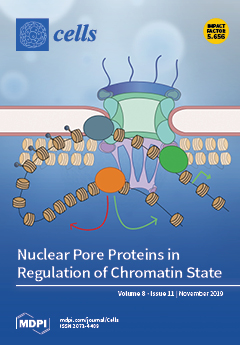
Cover Story: Nuclear pore complexes (NPCs) are large protein assemblies which span the nuclear envelope and regulate nucleocytoplasmic transport. Research over the last 15 years has revealed an additional key function of the NPC and its constituent nucleoporins (Nups) in the regulation of gene expression via physical interactions with the genome. Although many of the precise mechanisms behind the gene regulatory roles of Nups remain enigmatic, one emerging trend is the apparent ability of Nups to influence chromatin structure. In the accompanying review, we discuss recent findings on this topic and highlight how this influence can occur via interactions between specific Nups and both repressive and activating histone modifying machinery, and at the level of chromatin compaction, through conserved interactions of Nups with chromatin remodeling enzymes. View this paper.
  • Issues are regarded as officially published after their release is announced to the table of contents alert mailing list .
  • You may sign up for email alerts to receive table of contents of newly released issues.
  • PDF is the official format for papers published in both, html and pdf forms. To view the papers in pdf format, click on the "PDF Full-text" link, and use the free Adobe Reader to open them.

Articles (168)

  • Review
  • Open Access
17 Citations
5,547 Views
20 Pages

19 November 2019

Increasing evidence suggest the significance of inflammation in the progression of cancer, for example the development of colorectal cancer in Inflammatory Bowel Disease (IBD) patients. Long-lasting inflammation in the gastrointestinal tract causes s...

  • Review
  • Open Access
19 Citations
5,807 Views
20 Pages

Recent Advances in EPAC-Targeted Therapies: A Biophysical Perspective

  • Alveena Ahmed,
  • Stephen Boulton,
  • Hongzhao Shao,
  • Madoka Akimoto,
  • Amarnath Natarajan,
  • Xiaodong Cheng and
  • Giuseppe Melacini

19 November 2019

The universal second messenger cAMP regulates diverse intracellular processes by interacting with ubiquitously expressed proteins, such as Protein Kinase A (PKA) and the Exchange Protein directly Activated by cAMP (EPAC). EPAC is implicated in multip...

  • Article
  • Open Access
21 Citations
7,639 Views
15 Pages

Sex Differences in High Fat Diet-Induced Metabolic Alterations Correlate with Changes in the Modulation of GRK2 Levels

  • Alba C. Arcones,
  • Marta Cruces-Sande,
  • Paula Ramos,
  • Federico Mayor and
  • Cristina Murga

19 November 2019

A differential sex-related sensitivity has been reported in obesity and insulin resistance-related cardio-metabolic diseases, with a lower incidence of these pathologies being observed in young females when compared to age-matched males. However, suc...

  • Review
  • Open Access
55 Citations
8,570 Views
13 Pages

Estrogen Receptors and Melanoma: A Review

  • Emi Dika,
  • Annalisa Patrizi,
  • Martina Lambertini,
  • Nicholas Manuelpillai,
  • Michelangelo Fiorentino,
  • Annalisa Altimari,
  • Manuela Ferracin,
  • Mattia Lauriola,
  • Enrica Fabbri and
  • Elena Campione
  • + 2 authors

19 November 2019

In the last three decades cutaneous melanoma has been widely investigated as a steroid hormone-sensitive cancer. Following this hypothesis, many epidemiological studies have investigated the relationship between estrogens and melanoma. No evidence to...

  • Feature Paper
  • Review
  • Open Access
299 Citations
13,383 Views
20 Pages

19 November 2019

MicroRNAs (miRNAs) are critical regulators of gene expression. As miRNAs are frequently deregulated in many human diseases, including cancer and immunological disorders, it is important to understand their biological functions. Typically, miRNA-encod...

  • Article
  • Open Access
23 Citations
5,797 Views

19 November 2019

The tumor necrosis factor-related apoptosis-inducing ligand (TRAIL) has shown strong and explicit cancer cell-selectivity, which results in little toxicity toward normal tissues, and has been recognized as a potential, relatively safe anticancer agen...

  • Article
  • Open Access
25 Citations
5,333 Views
20 Pages

Identification of Novel Adenylyl Cyclase 5 (AC5) Signaling Networks in D1 and D2 Medium Spiny Neurons using Bimolecular Fluorescence Complementation Screening

  • Trevor B. Doyle,
  • Brian S. Muntean,
  • Karin F. Ejendal,
  • Michael P. Hayes,
  • Monica Soto-Velasquez,
  • Kirill A. Martemyanov,
  • Carmen W. Dessauer,
  • Chang-Deng Hu and
  • Val J. Watts

19 November 2019

Adenylyl cyclase type 5 (AC5), as the principal isoform expressed in striatal medium spiny neurons (MSNs), is essential for the integration of both stimulatory and inhibitory midbrain signals that initiate from dopaminergic G protein-coupled receptor...

  • Article
  • Open Access
11 Citations
4,324 Views
14 Pages

Suppression of Angiogenesis by Targeting Cyclin-Dependent Kinase 7 in Human Umbilical Vein Endothelial Cells and Renal Cell Carcinoma: An In Vitro and In Vivo Study

  • Chung-Sheng Shi,
  • Kuan-Lin Kuo,
  • Mei-Sin Chen,
  • Po-Ming Chow,
  • Shing-Hwa Liu,
  • Yu-Wei Chang,
  • Wei-Chou Lin,
  • Shih-Ming Liao,
  • Chen-Hsun Hsu and
  • Fu-Shun Hsu
  • + 2 authors

19 November 2019

Cancer cells rely on aberrant transcription for growth and survival. Cyclin-dependent kinases (CDKs) play critical roles in regulating gene transcription by modulating the activity of RNA polymerase II (RNAPII). THZ1, a selective covalent inhibitor o...

  • Article
  • Open Access
49 Citations
7,748 Views
21 Pages

The G Protein-Coupled Bile Acid Receptor TGR5 (Gpbar1) Modulates Endothelin-1 Signaling in Liver

  • Caroline Klindt,
  • Maria Reich,
  • Birte Hellwig,
  • Jan Stindt,
  • Jörg Rahnenführer,
  • Jan G. Hengstler,
  • Karl Köhrer,
  • Kristina Schoonjans,
  • Dieter Häussinger and
  • Verena Keitel

19 November 2019

TGR5 (Gpbar1) is a G protein-coupled receptor responsive to bile acids (BAs), which is expressed in different non-parenchymal cells of the liver, including biliary epithelial cells, liver-resident macrophages, sinusoidal endothelial cells (LSECs), an...

  • Article
  • Open Access
10 Citations
5,574 Views
20 Pages

A Novel 3D Scaffold for Cell Growth to Assess Electroporation Efficacy

  • Monica Dettin,
  • Elisabetta Sieni,
  • Annj Zamuner,
  • Ramona Marino,
  • Paolo Sgarbossa,
  • Maria Lucibello,
  • Anna Lisa Tosi,
  • Flavio Keller,
  • Luca Giovanni Campana and
  • Emanuela Signori

19 November 2019

Tumor electroporation (EP) refers to the permeabilization of the cell membrane by means of short electric pulses thus allowing the potentiation of chemotherapeutic drugs. Standard plate adhesion 2D cell cultures can simulate the in vivo environment o...

of 17

Get Alerted

Add your email address to receive forthcoming issues of this journal.

XFacebookLinkedIn
Cells - ISSN 2073-4409