

You are currently viewing a new version of our website. To view the old version click .

Cells, Volume 13, Issue 6

March-2 2024 - 94 articles

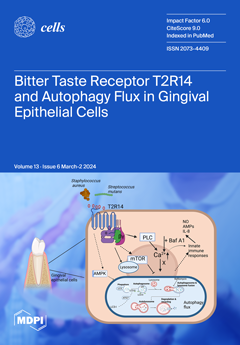
Cover Story: Macroautophagy (autophagy) maintains cellular homeostasis and regulates energy production and innate immunity. The role of the human bitter taste receptors (T2Rs) in autophagy is poorly understood. This study targets T2R14, the taste receptor expressed at significant levels in oral gingival epithelial cells (GECs). Our study reveals that T2R14 downregulates autophagy protein 7 independent autophagy flux in gingival epithelial cells. Further, our results show that Streptococcus mutans quorum sensing molecule (competence stimulating peptide-1) causes robust intracellular calcium release in GECs, which is both T2R14 and autophagy protein 7 dependent. These findings reveal the different mechanisms by which T2Rs influence host-microbe interactions and modulate the oral immune environment. View this paper
  • Issues are regarded as officially published after their release is announced to the table of contents alert mailing list .
  • You may sign up for email alerts to receive table of contents of newly released issues.
  • PDF is the official format for papers published in both, html and pdf forms. To view the papers in pdf format, click on the "PDF Full-text" link, and use the free Adobe Reader to open them.

Articles (94)

  • Article
  • Open Access
7 Citations
4,274 Views
16 Pages

HSP47 Increases the Expression of Type I Collagen in Fibroblasts through IRE1α Activation, XBP1 Splicing, and Nuclear Translocation of β-Catenin

  • So Young Ham,
  • Min Ju Pyo,
  • Moonkyung Kang,
  • Yeon-Soo Kim,
  • Dong Hun Lee,
  • Jin Ho Chung and
  • Seung-Taek Lee

17 March 2024

Heat shock protein 47 (HSP47), also known as SERPINH1, functions as a collagen-specific molecular chaperone protein essential for the formation and stabilization of the collagen triple helix. Here, we delved into the regulatory pathways governed by H...

  • Article
  • Open Access
16 Citations
6,071 Views
13 Pages

PROTAC-Mediated Dual Degradation of BCL-xL and BCL-2 Is a Highly Effective Therapeutic Strategy in Small-Cell Lung Cancer

  • Sajid Khan,
  • Lin Cao,
  • Janet Wiegand,
  • Peiyi Zhang,
  • Maria Zajac-Kaye,
  • Frederic J. Kaye,
  • Guangrong Zheng and
  • Daohong Zhou

17 March 2024

BCL-xL and BCL-2 are validated therapeutic targets in small-cell lung cancer (SCLC). Targeting these proteins with navitoclax (formerly ABT263, a dual BCL-xL/2 inhibitor) induces dose-limiting thrombocytopenia through on-target BCL-xL inhibition in p...

  • Review
  • Open Access
19 Citations
4,149 Views
26 Pages

Immune Cells, Gut Microbiota, and Vaccines: A Gender Perspective

  • Pierluigi Rio,
  • Mario Caldarelli,
  • Monica Chiantore,
  • Francesca Ocarino,
  • Marcello Candelli,
  • Antonio Gasbarrini,
  • Giovanni Gambassi and
  • Rossella Cianci

17 March 2024

The development of preventive and therapeutic vaccines has played a crucial role in preventing infections and treating chronic and non-communicable diseases, respectively. For a long time, the influence of sex differences on modifying health and dise...

  • Article
  • Open Access
3 Citations
2,129 Views
12 Pages

16 March 2024

Activin A is known to impede tubular repair following renal ischemia, whereas exogenous follistatin, an activin A antagonist, has been shown to ameliorate kidney damage in rats. Despite these findings, the precise role of endogenous follistatin in th...

  • Article
  • Open Access
8 Citations
3,527 Views
22 Pages

16 March 2024

Fracture callus formation is a dynamic stage of bone activity and repair with precise, spatially localized gene expression. Metastatic breast cancer impairs fracture healing by disrupting bone homeostasis and imparting an altered genomic profile. Pre...

  • Article
  • Open Access
1 Citations
4,442 Views
15 Pages

Primary Ciliary Dyskinesia and Retinitis Pigmentosa: Novel RPGR Variant and Possible Modifier Gene

  • Noelia Baz-Redón,
  • Laura Sánchez-Bellver,
  • Mónica Fernández-Cancio,
  • Sandra Rovira-Amigo,
  • Thomas Burgoyne,
  • Rai Ranjit,
  • Virginia Aquino,
  • Noemí Toro-Barrios,
  • Rosario Carmona and
  • Eva Polverino
  • + 4 authors

16 March 2024

We report a novel RPGR missense variant co-segregated with a familial X-linked retinitis pigmentosa (XLRP) case. The brothers were hemizygous for this variant, but only the proband presented with primary ciliary dyskinesia (PCD). Thus, we aimed to el...

  • Article
  • Open Access
16 Citations
4,791 Views
14 Pages

Steroidogenesis Upregulation through Mitochondria-Associated Endoplasmic Reticulum Membranes and Mitochondrial Dynamics in Rat Testes: The Role of D-Aspartate

  • Debora Latino,
  • Massimo Venditti,
  • Sara Falvo,
  • Giulia Grillo,
  • Alessandra Santillo,
  • Imed Messaoudi,
  • Mariem Ben Rhouma,
  • Sergio Minucci,
  • Gabriella Chieffi Baccari and
  • Maria Maddalena Di Fiore

16 March 2024

Mitochondria-Associated Endoplasmic Reticulum Membranes (MAMs) mediate the communication between the Endoplasmic Reticulum (ER) and the mitochondria, playing a fundamental role in steroidogenesis. This study aimed to understand how D-aspartate (D-Asp...

  • Review
  • Open Access
40 Citations
9,739 Views
38 Pages

TNF-Related Apoptosis-Inducing Ligand: Non-Apoptotic Signalling

  • Abderrahmane Guerrache and
  • Olivier Micheau

16 March 2024

TNF-related apoptosis-inducing ligand (TRAIL or Apo2 or TNFSF10) belongs to the TNF superfamily. When bound to its agonistic receptors, TRAIL can induce apoptosis in tumour cells, while sparing healthy cells. Over the last three decades, this tumour...

  • Article
  • Open Access
2 Citations
2,330 Views
22 Pages

Characterization of Lysophospholipase D Activity in Mammalian Cell Membranes

  • Yuhuan Xie,
  • Krishna M. Ella,
  • Terra C. Gibbs,
  • Marianne E. Yohannan,
  • Stewart M. Knoepp,
  • Pravita Balijepalli,
  • G. Patrick Meier and
  • Kathryn E. Meier

16 March 2024

Lysophosphatidic acid (LPA) is a lipid mediator that binds to G-protein-coupled receptors, eliciting a wide variety of responses in mammalian cells. Lyso-phospholipids generated via phospholipase A2 (PLA2) can be converted to LPA by a lysophospholipa...

  • Article
  • Open Access
7 Citations
2,737 Views
18 Pages

Neonatal Brains Exhibit Higher Neural Reparative Activities than Adult Brains in a Mouse Model of Ischemic Stroke

  • Ryo Nishiyama,
  • Takayuki Nakagomi,
  • Akiko Nakano-Doi,
  • Yoji Kuramoto,
  • Masahiro Tsuji and
  • Shinichi Yoshimura

15 March 2024

The neonatal brain is substantially more resistant to various forms of injury than the mature brain. For instance, the prognosis following ischemic stroke is generally poor in the elderly but favorable in neonates. Identifying the cellular and molecu...

of 10

Get Alerted

Add your email address to receive forthcoming issues of this journal.

XFacebookLinkedIn
Cells - ISSN 2073-4409