
You are currently viewing a new version of our website. To view the old version click .

Agronomy, Volume 8, Issue 4

April 2018 - 25 articles

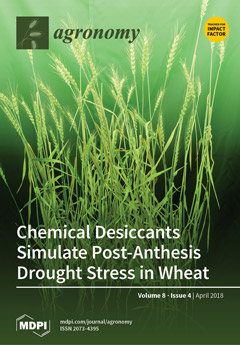
Cover Story: Effective and validated methods to simulate drought can facilitate the screening of breeding materials. We examined the response of the wheat cultivar ‘Norin 61’ under irrigated control, drought after anthesis, and 2% or 4% potassium chlorate (KClO3) at anthesis or grain filling. Both 2% and 4% KClO3 simulated the effect of drought stress. The selection of drought-tolerant genotypes can be aided by the chlorophyll content and δ13C measurement of leaves when 2% or 4% KClO3 is used to simulate drought. View this paper
  • Issues are regarded as officially published after their release is announced to the table of contents alert mailing list .
  • You may sign up for email alerts to receive table of contents of newly released issues.
  • PDF is the official format for papers published in both, html and pdf forms. To view the papers in pdf format, click on the "PDF Full-text" link, and use the free Adobe Reader to open them.

Articles (25)

  • Article
  • Open Access
6 Citations
5,804 Views
15 Pages

Soil and water conservation (SWC) practices in the northern highlands of Ethiopia have important implications for land restoration and biodiversity recovery. The present study determined soil macroinvertebrate (SMI) abundance and diversity in respons...

  • Review
  • Open Access
97 Citations
14,236 Views
24 Pages

Increasing the ability to investigate plant functions and structure through non-invasive methods with high accuracy has become a major target in plant breeding and precision agriculture. Emerging approaches in plant phenotyping play a key role in unr...

  • Article
  • Open Access
8 Citations
5,971 Views
10 Pages

The Opuntia spp., most likely few individuals, were introduced in the Iberian Peninsula in the beginning of the 16th century, after the discovery of America, spreading afterwards throughout the Mediterranean basin. We analysed, for the first time, th...

  • Article
  • Open Access
66 Citations
7,512 Views
13 Pages

Chitosan Coating: A Postharvest Treatment to Delay Oxidative Stress in Loquat Fruits during Cold Storage

  • Giuseppina Adiletta,
  • Maria Silvia Pasquariello,
  • Luigi Zampella,
  • Francesco Mastrobuoni,
  • Marco Scortichini and
  • Milena Petriccione

Loquat is a non-climacteric fruit consumed fresh for its essential nutrients and phytochemical compounds. In this study, the effects of chitosan coating (1% w/v) on changes in the enzymatic antioxidant and membrane damage in three loquat selections (...

  • Article
  • Open Access
50 Citations
10,505 Views
14 Pages

Intercropping has been shown to increase crop yields and improve land utilization in many cases but it is unknown how the interspecies relationship is enhanced with improved crop management schemes. In this study, we investigated the effect of differ...

  • Article
  • Open Access
18 Citations
7,671 Views
10 Pages

The effects of a single basal fertilization with oxamide compared with those of a split application of urea on ammonia volatilization, rice yield, nitrogen (N) accumulation, and N use efficiency were investigated in a field experiment over 2 years. T...

  • Article
  • Open Access
22 Citations
6,988 Views
15 Pages

Phenomics is a new area that offers numerous opportunities for its applicability in plant breeding. One possibility is to exploit this type of information obtained from early stages of the growing season by combining it with genomic data. This opens...

  • Article
  • Open Access
1 Citations
4,337 Views
10 Pages

Physiological and Biochemical Characterization of a Red Escarole Obtained from an Interspecies Crossing

  • Alessandro Natalini,
  • Giacomo Cocetta,
  • Nazzareno Acciarri and
  • Antonio Ferrante

Escarole (Cichorium endivia L.) and radicchio (Cichorium intybus L.) are two important leafy vegetables appreciated by consumers for their sensory attributes, and at the same time, they can be considered a good source of health-promoting secondary me...

  • Article
  • Open Access
35 Citations
10,394 Views
20 Pages

Deficiencies of secondary and micronutrients (SMNs) are major causes of low maize yields in poorly responsive soils. This phenomenon minimizes the agronomic efficiency of N, P and K fertilizers and consequently result in a dwindling economic benefit...

of 3

Get Alerted

Add your email address to receive forthcoming issues of this journal.

XFacebookLinkedIn
Agronomy - ISSN 2073-4395