


Abstract
Phytopathogenic fungi that affect postharvest are a serious problem for agriculture, so this research explores the antifungal potential of three different “rosemary” species growing in Chile through in vitro and in silico assays. The analysis of essential oils (GC/MS) reveals the dominant constituents of Salvia rosmarinus (camphor: 66.96%), Baccharis linearis (lachnophyllum ester: 88.62%) and Fabiana imbricata (an oxygenated sesquiterpene: 43.66%) and shows profiles that differ from chemotypes of the same species from other areas of the world. B. linearis oil was shown to be a versatile antifungal substance, inhibiting Botrytis cinerea and Monilinia fructicola at moderate concentrations; F. imbricata oil stood out as a major inhibitor of mycelial growth of the same isolate of M. fructicola used to test B. linearis oil (EC50 of 15.86 + 0.67 µg/mL) and completely inhibited of its conidial germination. In silico assays confirmed the complexity of interactions of F. imbricata sequiterpenoids with catalytic sites of succinate dehydrogenase and catalase 2, key enzymes in mycelial growth and in maintaining redox homeostasis in the early development of M. fructicola, respectively. The results of this research make F. imbricata a good candidate for the development of a formulation applicable in vivo as an eco-friendly post-harvest antifungal agent.
1. Introduction
Pathogenic fungi are the most significant cause of infectious diseases in plants, impacting crop productivity and post-harvest shelf-life [1,2]. For fruits and vegetables, fungal contamination severely compromises quality attributes—including aspect, nutritional value, and organoleptic properties—while drastically reducing shelf life [3,4]. An associated public health concern is the indirect risk of intoxication or allergic reactions in consumers due to fungal-derived mycotoxins and allergens [5,6]. Among the pathogens of greatest economic impact in fruit production are Monilinia fructicola and Botrytis cinerea [7,8]. M. fructicola, the causal agent of brown rot, and B. cinerea, responsible for grey mold, are notorious for causing devastating pre- and post-harvest losses, primarily affecting stone fruits, berries, and grapes [9,10,11]. Historically, control of these pathogens has relied on synthetic fungicides [12]. This approach is now increasingly restricted, however, due to substantial evidence of the harmful effects these pesticides exert on human health and the environment [13,14]. Furthermore, the emergence of resistant strains of M. fructicola and B. cinerea to principal fungicides has drastically reduced treatment efficacy, making the search for alternatives urgent [15,16,17].
In this context, research has shifted towards developing sustainable control strategies. Plant essential oils (EOs), which are complex mixtures of volatile secondary metabolites, have emerged as a promising alternative, in particular for the control of postharvest fungal diseases of fruit crops [18,19]. These EOs are especially proposed for application against post-harvest fungal pathogens of fruit crops, such as B. cinerea and Monilinia spp. The type of application is crucial for their efficacy; they can be applied in the vapor phase (fumigation) to exploit their volatile organic compounds (VOCs), or through direct contact and incorporation into edible coatings to protect the fruit surface. Furthermore, these biological treatments can be integrated with physical methods, such as heat treatments (HTs), to create a synergistic effect against decay-causing fungi [20,21,22]. This effectiveness is largely due to the fact that EOs are recognized for their potent broad-spectrum antimicrobial activity, biodegradable nature, and often, a multisite mode of action, which could reduce the risk of resistance development [23,24]. A promising bioprospecting strategy is the exploration of native and adapted flora, particularly species with a history of ethnobotanical use [25,26]. In the Chilean flora, a unique case of ethnobotanical convergence exists where three species from distinct botanical families share similar vernacular names associated with “rosemary” (romero), suggesting a historical perception of their aromatic properties. These species are Salvia rosmarinus (Lamiaceae), the traditional “rosemary”; Baccharis linearis (Asteraceae), known as “romerillo”; and Fabiana imbricata (Solanaceae), referred to as “romero pichi” [27,28]. While the EO of S. rosmarinus is well-documented for its biological activity [29], the potential of the Chilean native species requires a more specific analysis. For B. linearis, prior research has confirmed its chemical profile; its EO is rich in monoterpenes and sesquiterpenes, notably β-pinene and limonene, which are compounds with known antimicrobial potential [30]. Interestingly, this plant’s antifungal potential has also been explored indirectly; endophytic fungi isolated from B. linearis roots were shown to produce metabolites, such as alkaloids and phenolics, that significantly inhibit B. cinerea [31]. This suggests the B. linearis ecosystem is a source of bioactive metabolites. However, the direct evaluation of the plant’s essential oil efficacy—as well as that of F. imbricata (whose potential remains unexplored)—against the key post-harvest pathogens M. fructicola and B. cinerea has not been reported.
The objective of this study was initially to identify the chemical composition of the essential oils of S. rosmarinus, B. linearis, and F. imbricata. Subsequently, their antifungal efficacy against two isolates of M. fructicola and B. cinerea was evaluated in vitro. These isolates were specifically selected due to their high impact on the fruit industry in Chile and worldwide, being recovered from infected peaches and nectarines (M. fructicola) and grapevines (B. cinerea), crops that, along with cherries, are highly susceptible to these pathogens and represent key commodities in global agricultural trade. At the same time, an in silico study was used to predict the antifungal potential of their main metabolites.
2. Materials and Methods
2.1. Plant Material
Aerial parts of S. rosmarinus, B. linearis, and F. imbricata were collected during the austral spring of 2024 (November) in the Valparaíso Region, Chile. Specifically, S. rosmarinus was collected in El Retiro, Quilpué (33°02′ S; 71°26′ W); B. linearis in Rautén, Quillota (32°55′ S; 71°20′ W); and F. imbricata in Cerro Las Vizcachas, Olmué (33°05′ S; 71°01′ W). The authenticity of the plant species was confirmed by botanist Patricio Novoa, a senior researcher at the National Botanical Garden of Viña del Mar, Chile, and an expert in Chilean native flora taxonomy. Voucher specimens (Sr-1124, Bl-1124, and Fi-1124) were deposited at the Natural Products and Organic Synthesis Laboratory of Universidad de Playa Ancha, Valparaíso, Chile.
2.2. Extraction of Essential Oils
The EOs of the three plants were obtained by hydrodistillation of fresh aerial parts (500 g) for 5 h using a Clevenger-type apparatus, with 3 L of distilled water (ratio 1:6 w/v), according to the protocol previously described [32]. The process was maintained at a constant boiling temperature until the volume of the oily layer in the graduated tube remained unchanged. Subsequently, the obtained EOs were separated from the aqueous phase, dried over anhydrous sodium sulfate (Na2SO4), filtered, and stored in amber glass vials at 4 °C in the dark until further chemical and biological analysis.
2.3. Chemical Composition of Essential Oils
The EOs were diluted with dichloromethane, and 1 µL of each sample was analyzed using a GC-MS/MS system (GC: model Trace 1300 and MS: model TSQ8000Evo, Thermo Fisher Scientific, Waltham, MA, USA). The instrument operated in electron ionization (EI) mode at 70 eV, equipped with a splitless injector set at 250 °C. The transfer line temperature was maintained at 200 °C. Separation was performed using an Rtx-5 ms capillary column (60 m × 0.25 mm i.d., film thickness 0.25 μm) with helium as the carrier gas at a flow rate of 1.2 mL/min. The oven temperature program was as follows: 40 °C for 5 min, increased to 300 °C at a rate of 5 °C/min, and held for 5 min. The chemical composition of the oils was identified by comparing their mass spectra with the NIST20 library (using a match value > 800 as the acceptance criterion) and confirmed by comparing their retention indices with data published in the literature.
2.4. Fungal Assays
2.4.1. Fungal Species
The study evaluated three fungal isolates: one isolate of B. cinerea and two distinct isolates of M. fructicola (referred to as isolate 1 (S1) and isolate 2 (S2)). All isolates were kindly provided by the Phytopathology Laboratory of the Servicio Agrícola y Ganadero (SAG), Chile, and their species-level identification was confirmed using a PCR assay developed by the SAG Molecular Biology Laboratory. The B. cinerea isolate was recovered from infected grapevines in the Metropolitan Region, Chile. Regarding the M. fructicola isolates, S1 was recovered from infected peaches in commercial orchards in the O’Higgins Region, while S2 was obtained from infected nectarines in the Maipo Province, Metropolitan Region. Cultures were maintained on potato dextrose agar (PDA; DIFCO™, Franklin Lakes, NJ, USA). For the antifungal assays, conidial suspensions were prepared from 5–7-day-old cultures incubated at 23 °C. The conidia were suspended in sterile distilled water and adjusted to a final concentration of 1 × 10⁵ conidia/mL, following the methodology described previously [33,34].
2.4.2. Effect of EOs on Mycelial Growth
The in vitro antifungal activity of the isolated EOs was assessed against M. fructicola and B. cinerea using the radial growth inhibition assay. Commercial fungicides BC-1000® (Chemie, Santiago, Chile) and Mystic® 520 SC (Bayer AG, Dormagen, Germany) served as positive controls. All treatments were evaluated on PDA medium at concentrations ranging from 0 to 250 µg/mL. The amount of added ethanol (1%) was kept constant in both negative control and treatment assays. For each treatment, a 4 mm mycelial plug was inoculated at the center of the plate and incubated at 23 °C in complete darkness for 3 days (B. cinerea) or 5 days (M. fructicola). All treatments were performed in triplicate. Mycelial growth diameters were measured, and inhibition percentages were calculated. The results were expressed as the effective concentration (EC50), determined by regression analysis of the inhibition percentage versus compound concentration using Origin Pro 8 software (OriginLab Corporation, Northampton, MA, USA) [34].
2.4.3. Effect of EOs on Conidial Germination
Conidial germination inhibition was evaluated following the method described previously [34], with modifications. Conidial suspensions were prepared from B. cinerea (6-day-old) and M. fructicola (9-day-old) cultures grown on PDA at 23 °C. A 40 µL aliquot of the suspension (1 × 10⁵ conidia/mL) was spread onto PDA plates supplemented with the essential oils (10–250 µg/mL) using a Drigalski spatula. The plates were incubated at 23 °C for 16 h in the dark, with sterile distilled water serving as the negative control. Conidia were considered germinated when the germ tube length was at least twice the conidial diameter.
The percentage of inhibition of conidial germination (ICG%) was calculated using Equation (1):
where CC: Total conidia germinated in the control and CT: Total conidia germinated in the treatment. The percentage of germinated conidia by randomly examining 100 conidia in the center of each plate by microscopy (40× magnification; LeicaDM500, Leica Microsystems, Wetzlar, Germany). All the measurements were carried out in triplicate.
ICG% = [(CC − CT)/CC] × 100,
2.5. In Silico Assays
2.5.1. Ligand Preparation
The chemical structures of the compounds selected for molecular docking were constructed three-dimensionally using Avogadro software (version 1.2.0n). Initial geometries were generated manually and subsequently optimized by minimizing energy using the MMFF94 force field to obtain stable, low-energy conformations. The final ligand files were prepared and exported in formats suitable for docking analysis using BIOVIA Discovery Studio Visualizer (version 17.2.0; Dassault Systèmes, Paris, France).
2.5.2. Structural Modeling and Validation of MfCat2
This procedure was carried out according to the protocol previously described by Muñoz et al. [35]. The amino acid sequence of catalase 2 from Monilinia fructicola (MfCat2) was obtained from NCBI (FASTA; accession KAA8570148.1). The three-dimensional model was generated using homology modeling [36] with the SWISS-MODEL server, employing the catalase from Botryotinia fuckeliana (chain A, UniProt ID: M7TYR4) as a template, due to its high sequence identity (93.62%) and high GMQE value (0.95). The final model, composed of 522 residues, was exported in PDB format.
The binding site prediction was performed with the PrankWeb server [37], identifying a main pocket with high probability (0.938), whose geometric center was selected for the molecular docking studies. The structural validity of the active site was corroborated by alignment with a crystallized catalase from Helicobacter pylori (PDB ID: 1QQW), demonstrating the spatial conservation of key catalytic residues.
2.5.3. Preparation of the SDH Receptor
This procedure was carried out according to the protocol previously described by Silva et al. [34]. The crystallographic structure of succinate dehydrogenase (SDH) was retrieved from the Protein Data Bank (PDB ID: 2FBW; 2.06 Å resolution). Although this structure corresponds to avian SDH (Gallus gallus), it was selected because the amino acids forming the ubiquinone-binding pocket are highly conserved across eukaryotic organisms, including phytopathogenic fungi [38,39].
In the absence of experimentally resolved fungal SDH structures, avian and mammalian SDH models have been extensively employed in studies investigating the molecular basis of SDHI fungicide activity. These models have proven effective in reproducing key ligand–enzyme interactions and are considered suitable for exploratory docking analyses aimed at mechanistic interpretation rather than definitive structural validation [40,41].
2.5.4. Molecular Docking
Molecular docking simulations were performed using AutoDock 4.2 with the Lamarckian Genetic Algorithm. Protein structures were treated as rigid receptors, while ligands were allowed full conformational flexibility. For each ligand–receptor system, 50 independent docking runs were carried out with a maximum of 25 million energy evaluations, and resulting poses were clustered using an RMSD cutoff of <0.5 Å. The most representative binding mode was selected based on the lowest predicted binding free energy (ΔG) within the most populated cluster.
For SDH, the docking grid was centered at X: 14.37 Å, Y: 15.86 Å, Z: 8.46 Å, with dimensions of 20 × 20 × 20 points. Protocol validation was achieved by re-docking the co-crystallized ligand (CBE), yielding an RMSD of 1.49 Å. Protein–ligand interactions were analyzed using Discovery Studio Visualizer.
3. Results and Discussion
3.1. Chemical Composition of Essential Oils
The hydrodistillation of fresh leaves allowed the extraction of essential oils with distinct chemical profiles. The complete list of identified compounds for all species are provided in Table 1.
Table 1.
Main chemical constituents and chemical classes of the essential oils from the three rosemary species studied.
First, S. rosmarinus yielded a light yellow oil with a yield of 1.0% (v/w). GC-MS analysis identified 22 compounds, accounting for 99.54% of the total oil composition. The chemical profile was strongly dominated by oxygenated monoterpenes. Camphor was the most abundant compound (66.96%), followed by bornyl acetate (8.39%), levoverbenone (6.80%), and endo-borneol (5.36%). Regarding B. linearis, the process yielded a yellow oil with a yield of 1.45% (v/w) with a unique composition dominated by polyacetylenes. Although fewer compounds were identified compared to the other species, the lachnophyllum ester comprised the vast majority of the oil (88.62%). Other minor components included oxygenated sesquiterpenes such as spathulenol (2.53%) and globulol (2.23%). Finally, F. imbricata yielded a light yellow oil with a yield of 0.52% (v/w). Twenty-two compounds were identified, representing 99.13% of the total composition. Unlike S. rosmarinus, the profile of F. imbricata was characterized mainly by oxygenated sesquiterpenes, with (7a-isopropenyl-4,5-dimethyloctahydroinden-4-yl)methanol (43.66%), bulnesol (17.02%), τ-muurolol (5.75%), and sesquithuriferone (5.30%) being the major constituents. Notably, β-costol (3.99%) and γ-eudesmol (2.60%) were also identified in significant amounts.
The chemical profiles obtained for the three EOs revealed significant quantitative and qualitative differences when compared to previous reports. These variations are widely attributed to adaptive responses to specific pedoclimatic conditions, such as water deficit, soil salinity, and solar radiation, which are characteristic of the collection sites in the Valparaíso Region, Chile. The EO of S. rosmarinus analyzed in this study was characterized as a camphor chemotype, with camphor representing 66.96% of the total composition, followed by bornyl acetate (8.39%) and 1,8-cineole (3.09%). This profile contrasts remarkably with literature data from other geographical regions, particularly North Africa. For instance, a recent study on S. rosmarinus collected in the Boulemane region (Morocco) reported a chemical profile dominated by 1,8-cineole (33.17%), followed by camphor (16.54%) and α-pinene (14.46%) [42]. Similarly, samples from the Moroccan Atlas Mountains contained predominantly 1,8-cineole (50.20%) and lower amounts of camphor (18.47%) [43]. The drastic shift from a cineole-rich profile to the camphor-chemotype observed in the present sample from Quilpué suggests a strong influence of environmental stress. It has been documented that the biosynthesis of camphor can be upregulated under conditions of high hydric stress or specific temperature ranges, serving as a defense mechanism. Therefore, the high camphor content likely reflects the plasticity of the species in response to the local semi-arid pedoclimatic conditions. A striking chemical divergence was also observed in the essential oil of B. linearis. Our analysis revealed a composition almost exclusively dominated by the polyacetylene lachnophyllum ester (88.62%). This finding differs significantly from previous reports on B. linearis collected in San Carlos de Apoquindo (Central Chile), which described a profile dominated by monoterpenes and sesquiterpenes such as limonene (16.86%), β-pinene (12.83%), and β-himachalene (11.78%) [44]. While the genus Baccharis is known to produce polyacetylenes, the dominance of this compound in the current sample from Rautén (Quillota), as opposed to the terpene-rich profile found in the pre-Andean foothills, suggests a specific chemotypic variation. The accumulation of polyacetylenes is often associated with antifungal and insecticidal defense strategies in Asteraceae species subjected to specific biotic stress or soil conditions distinct from those in the comparative study. Finally, regarding F. imbricata, the EO was characterized by a high content of oxygenated sesquiterpenes (77.54%), specifically (7a-isopropenyl-4,5-dimethyloctahydroinden-4-yl)methanol (43.66%) and bulnesol (17.02%). This composition aligns with the general observation that the genus Fabiana is rich in sesquiterpenes [28]. However, notable discrepancies appear when compared to trans-Andean populations. Literature reports indicate that F. imbricata leaves from Esquel (Argentina) contained mainly monoterpenes such as tricyclene, camphene, and α-pinene [44]. The shift from a monoterpene-rich profile in Argentina to a sesquiterpene-rich profile in the Valparaíso region supports the hypothesis that geographical barriers, such as the Andes Mountains, and distinct climatic stressors drive the activation of different biosynthetic pathways. This prioritizes the synthesis of heavier, less volatile compounds like sesquiterpenes in the Chilean population to cope with local environmental pressures.
3.2. Antifungal Activity
The antifungal potential of the EOs obtained from S. rosmarinus, B. linearis, and F. imbricata was evaluated against the phytopathogenic fungi B. cinerea and M. fructicola. The results, summarized in Table 2, reveal a heterogeneous response pattern, indicating that the biological activity is strongly dependent on both the fungal strain and the specific chemical profile of each EO. While the commercial fungicides (BC-1000® and Mystic® 520 SC) exhibited the expected high efficacy, the natural extracts displayed varying degrees of inhibition, ranging from complete inactivity to potent fungicidal effects comparable to the commercial controls.
Table 2.
In vitro antifungal activity of EOs and commercial fungicides against Botrytis cinerea and two isolates of Monilinia fructicola.
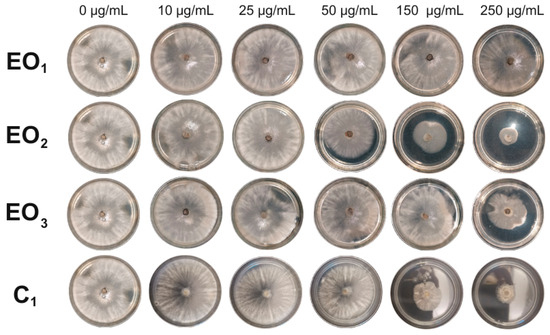
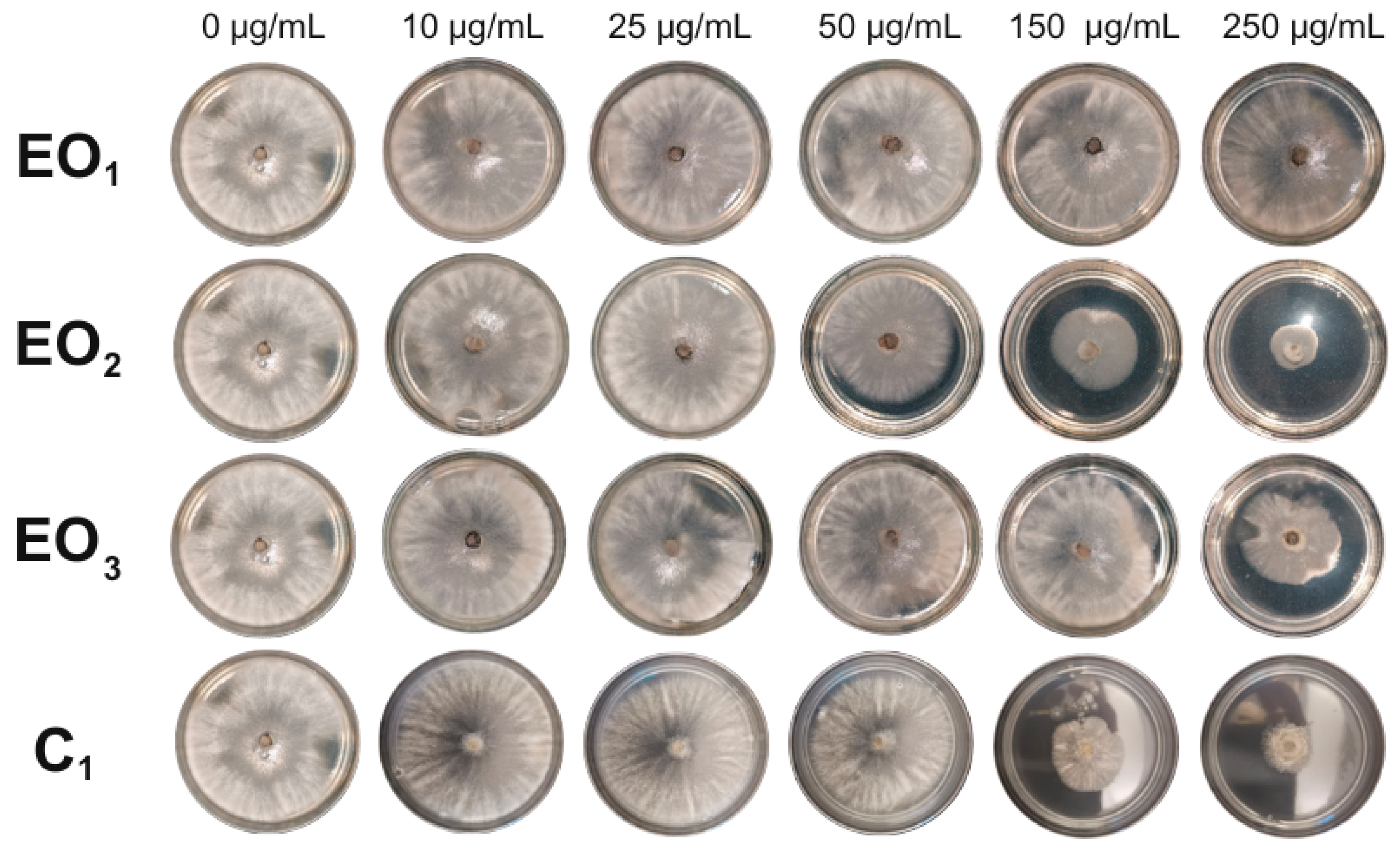
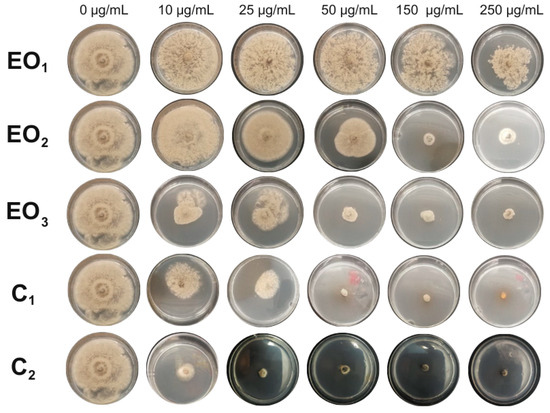
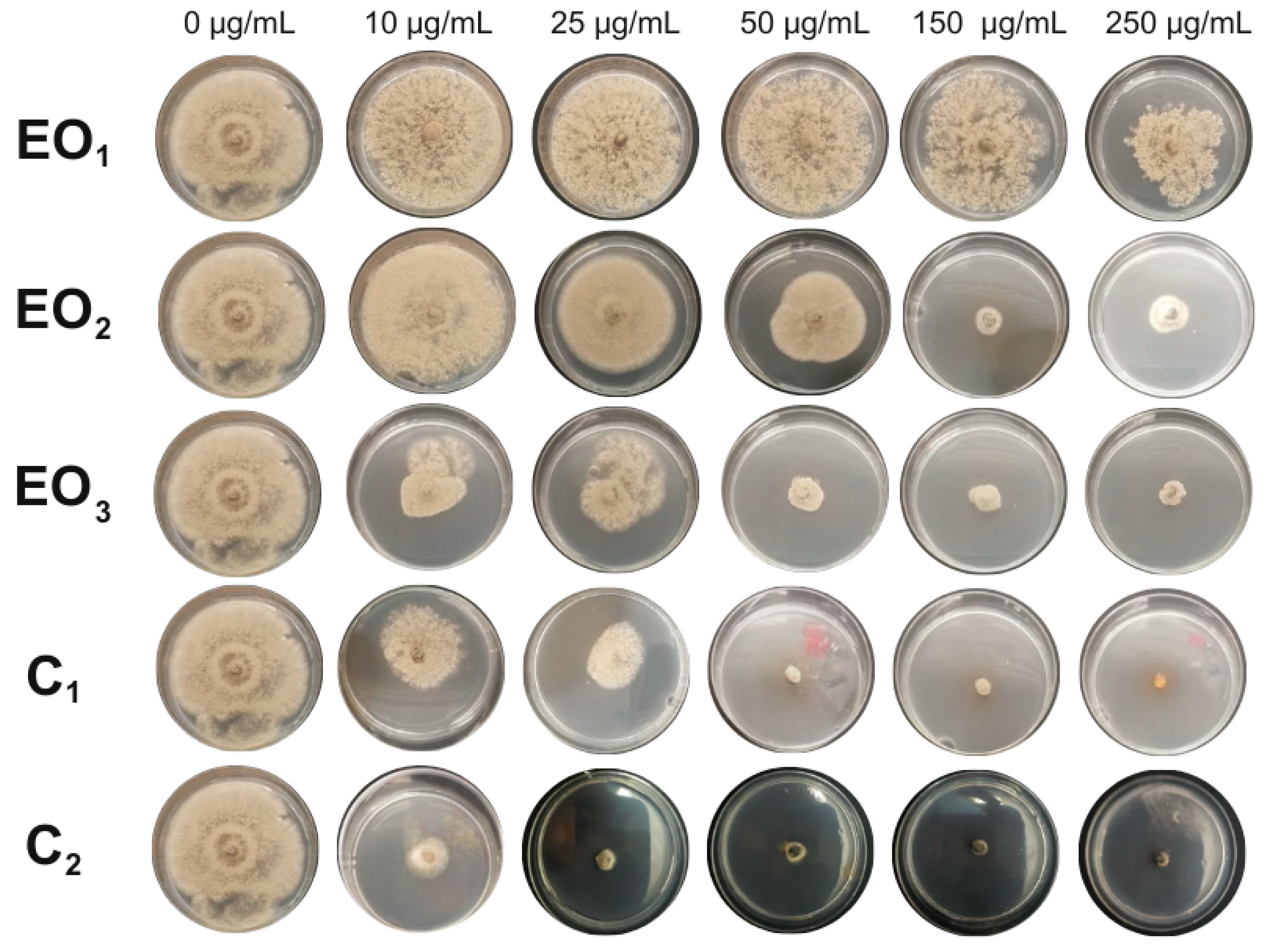
The inhibitory effects on mycelial growth of B. cinerea and M. fructicola S2 compared to the solvent control and commercial fungicides are visually represented in Figure 1 and Figure 2, respectively. Regarding M. fructicola S1, no photographic records are presented as the EOs were found to be inactive at all tested concentrations. In all assays, the solvent control group (negative control) showed no inhibitory effect on fungal growth, confirming that the observed antifungal activity is exclusively due to the EOs and positive controls.
Figure 1.
Effects of EOs and positive control on mycelial growth inhibition of B. cinerea in semi-solid PDA medium. EO1: S. rosmarinus oil, EO2: B. linearis oil, EO3: F. imbricata oil; C1: BC-1000®.
Figure 2.
Effects of EOs and positive controls on mycelial growth inhibition of M. fructicola S2 in semi-solid PDA medium. EO1: S. rosmarinus oil, EO2: B. linearis oil, EO3: F. imbricata oil; C1: BC-1000®, and C2: Mystic® 520 SC.
The evaluation revealed distinct response patterns that can be directly correlated with the specific chemical profiles and major constituents of the EOs. Notably, the EO of S. rosmarinus was inactive against all tested fungal strains at the evaluated concentrations (EC50 > 250 µg/mL). This lack of efficacy contrasts with other studies where rosemary EO showed significant antimicrobial activity, typically associated with high concentrations of 1,8-cineole [42]. However, the chemical characterization of the present Chilean sample revealed it to be a camphor-chemotype (66.96%) with very low cineole content (3.09%). While camphor has shown some antifungal properties in other contexts [45], it is generally considered a weaker inhibitor compared to phenolic monoterpenes like thymol or carvacrol [46]. This difference is primarily attributed to the presence of the hydroxyl group in phenolic compounds, which enhances their ability to disrupt fungal cytoplasmic membranes more effectively than ketone-containing terpenes like camphor [47,48]. Crucially, recent investigations into hydrophobic deep eutectic solvents (HDES) have emerged as a sustainable strategy to enhance the stability and delivery of volatile terpenes [49]. Studies using these systems found that while menthol and thymol-based formulations were highly effective, camphor-based HDES failed to inhibit the growth of M. fructicola and B. cinerea in vapor phase assays [50]. This performance is consistent with the reported biochemical limitations of camphor, which, as a ketone, demonstrates significantly lower inhibition of mycelial growth and key fungal enzymes compared to monoterpene alcohols or phenols [51]. Furthermore, the diverse profile of terpenoids in an oil does not always guarantee high potency if the dominant molecule lacks strong functional groups [52]. This aligns with our findings, suggesting that the high camphor content, despite the presence of minor active compounds like endo-borneol, which possesses intrinsic antifungal activity against Fusarium spp. [53], was insufficient to control the aggressive phytopathogens tested in this study.
On the other hand, B. linearis EO emerged as a versatile candidate. It was the only EO capable of inhibiting B. cinerea (EC50 = 156.07 ± 0.78 µg/mL) and the M. fructicola S2 (EC50 = 84.92 ± 1.0 µg/mL). Although its potency was lower than the commercial organic control BC-1000® against B. cinerea, it demonstrates relevant bioactivity for a crude extract. This consistent activity is strongly attributed to the high concentration of lachnophyllum ester (88.62%) identified in this EO. Polyacetylenes are well-documented for their antifungal properties as key specialized metabolites involved in plant chemical defense [52]; for instance, previous studies have reported that the lachnophyllum ester isolated from Baccharis trinervis exhibits significant fungicidal effects against pathogenic fungi by altering the permeability of the phospholipid bilayer due to its low polarity and long aliphatic chain [54]. This disruptive effect on the membrane is a hallmark of polyacetylenic compounds, which have recently been shown to target fungal cell wall biosynthesis and inhibit essential metabolic enzymes like pectin methyl esterase (PME), further explaining their broad-spectrum efficacy [51,55]. Furthermore, polyacetylenes isolated from roots of Cirsium japonicum have proven effective against B. cinerea, supporting the hypothesis that the lachnophyllum ester is the primary bioactive agent in the B. linearis EO [56]. Similarly, EOs from Erigeron species, which are rich in matricaria and lachnophyllum esters, have shown potent inhibition of mycelial growth in phytopathogens like Fusarium oxysporum, further validating the potential of these alkynes as natural fungicides [57].
In contrast, the EO of F. imbricata displayed a remarkable strain-specific selectivity. While it was inactive against B. cinerea and M. fructicola S1 (EC50 > 250 µg/mL), it exhibited the highest potency among all tested EOs against M. fructicola S2, with an EC50 of 15.86 ± 0.67 µg/mL. This value is notably comparable to the commercial organic control BC-1000® (10.55 ± 1.74 µg/mL) and superior to the synthetic fungicide Mystic® 520 SC for this specific strain. This high activity is likely driven by its rich fraction of oxygenated sesquiterpenes (77.54%). Specifically, τ-muurolol, identified in our sample, has been reported as a potent antifungal agent. Studies on Calocedrus macrolepis var. formosana demonstrated that τ-muurolol strongly inhibited the growth of phytopathogens such as Rhizoctonia solani and F. oxysporum with EC50 values < 50 µg/mL [58]. Additionally, bulnesol (17.02%) and sesquithuriferone (5.30%), both major constituents, contribute significantly to the oil’s efficacy. Bulnesol, in particular, has shown significant efficacy against wood-rotting fungi like Laetiporus sulphureus, reinforcing the antifungal potential of the guaiane skeleton [59]. Furthermore, structurally related sesquiterpenes like globulol have demonstrated strong inhibitory activity against phytopathogens including Alternaria solani and Fusarium graminearum, reinforcing the potential of the sesquiterpene fraction of F. imbricata as a source of selective biofungicides [60]. The synergistic action of these major sesquiterpenes likely facilitates the disruption of the fungal cell membrane.
When comparing the natural extracts with the commercial standards, a clear dichotomy in performance is observed. While B. linearis provides a broader spectrum of action similar to generalist organic fungicides, F. imbricata demonstrates that EOs can achieve potency levels statistically equivalent to synthetic azoles (Mystic®) on susceptible strains. This is a critical finding, as it suggests that specific chemotypes of native flora can offer “synthetic-like” efficacy without the associated environmental burden. However, a shared limitation was observed between the EOs and the commercial organic product BC-1000®: both failed to control the resistant phenotype (S1), whereas the synthetic fungicide retained partial efficacy. This indicates that while EOs are potent alternatives for standard pathogen populations, integrated pest management strategies may still require intervention with synthetic fungicides to control effectively highly resistant fungal strains. Crucially, this highlights the critical intraspecific variability in M. fructicola observed in this study. S1 proved to be highly resistant, showing no sensitivity to the EOs (except for a moderate effect at high concentrations of B. linearis EO) and full resistance to the organic control BC-1000®. Even the synthetic fungicide Mystic® showed a significantly higher EC50 for S1 (33.73 µg/mL) compared to S2 (9.19 µg/mL). This marked difference in phenotype suggests intrinsic differences in susceptibility between the isolates. While the precise molecular mechanisms—such as potential variations in metabolic detoxification or membrane properties—were not characterized in this study [61], the observed resilience of S1 underscores the importance of testing multiple isolates when evaluating novel fungicides to avoid overestimating efficacy.
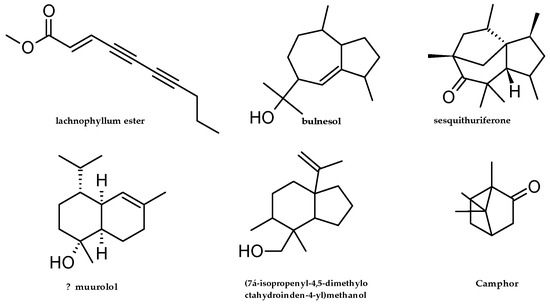
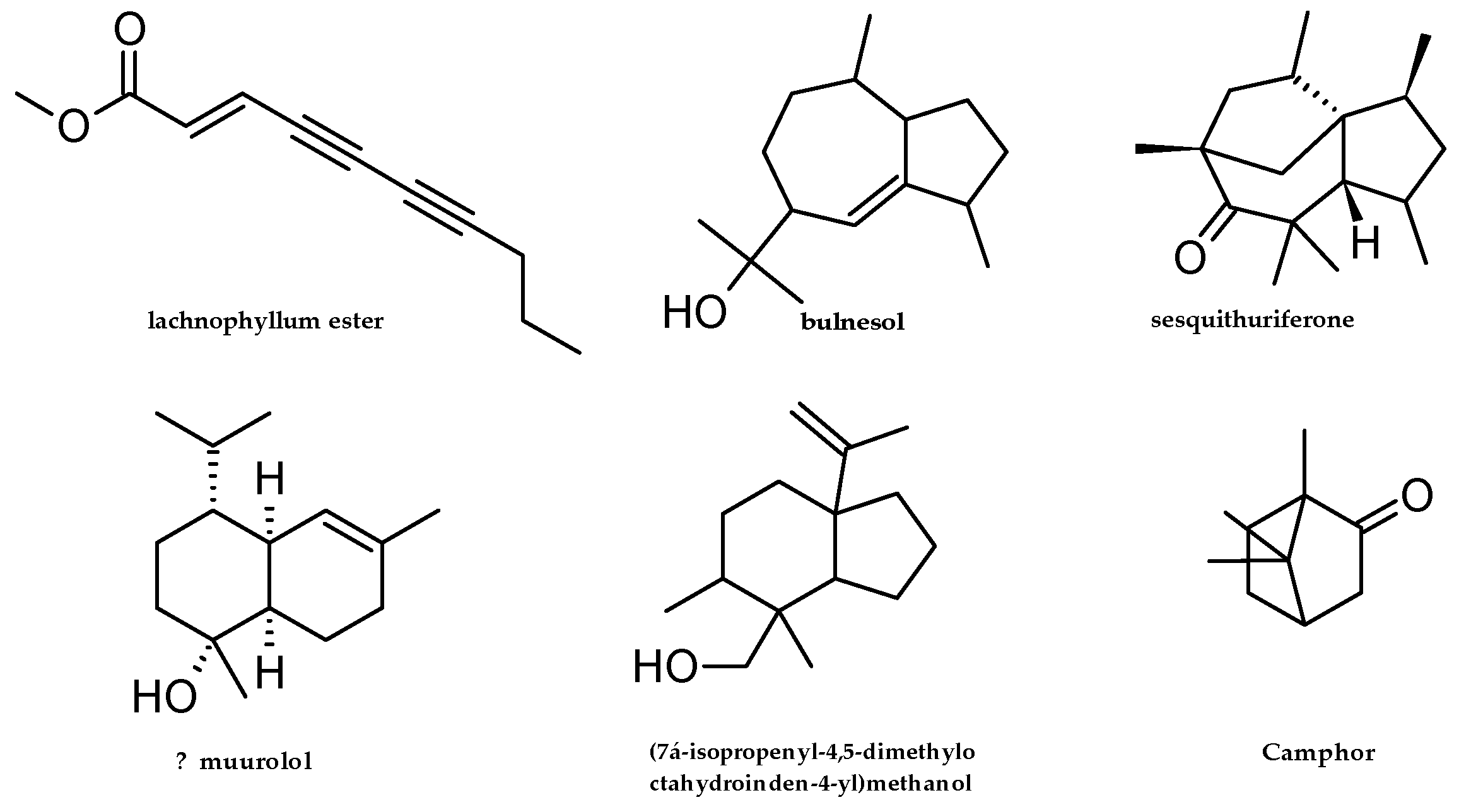
To gain deeper insights into the molecular mechanisms underlying the observed antifungal efficacy—particularly for the bioactive components of B. linearis and F. imbricata—computational studies were performed. Molecular docking analysis was employed to elucidate the binding modes and affinities of key compounds (lachnophyllum ester, bulnesol, sesquithuriferone, and τ-muurolol, (7α-isopropenyl-4,5-dimethyloctahydroinden-4-yl)methanol and camphor, Figure 3) with critical enzymatic targets involved in fungal survival, providing a theoretical framework for the experimental results described above.
Figure 3.
Chemical structures of the key bioactive metabolites selected for molecular docking analysis.
3.3. Molecular Docking Analysis
Molecular docking analysis enabled the prediction of binding affinities and key interactions between the major metabolites of B. linearis and F. imbricata and the target enzymes succinate dehydrogenase (SDH) and catalase 2 of M. fructicola (MfCat2). SDH is a central mitochondrial enzyme that links the TCA cycle with the electron transport chain by oxidizing succinate to fumarate, a reaction essential for ATP production [11]. In pathogenic fungi such as B. cinerea and Monilinia spp., SDH supports the energy demand required for conidial germination and pathogenicity; therefore, its inhibition reduces fungal growth and infectivity, consistent with the efficacy of SDH-inhibiting fungicides like fluopyram and boscalid [62]. Although the crystal structure of fungal SDH is unavailable, docking studies commonly employ the avian SDH model (PDB: 2FBW), as key residues of the ubiquinone-binding site are highly conserved and show approximately 70% sequence identity with Zymoseptoria tritici (formerly Mycosphaerella graminicola) [63,64]. This level of conservation ensures that the structural architecture of the binding pocket remains a reliable template for evaluating ligand interactions in fungal pathogens.”Mycosphaerella graminicola SDH.
MfCat2, the catalase isoform of M. fructicola, is likewise essential for detoxifying H2O2 and maintaining redox homeostasis during early developmental stages. Deletion of MfCat2 results in reduced conidiation, impaired germination, elevated ROS levels, and heightened susceptibility to oxidative stress, underscoring its role in fungal survival [65]. Thus, targeting SDH and MfCat2 represents a rational strategy for interfering with the metabolic and oxidative stress-response pathways critical for Monilinia spp. establishment. Both enzymes have been experimentally linked to fungal development and virulence, supporting their relevance as antifungal targets.
The binding free energies (ΔG) are summarized in Table 3. Among the evaluated compounds, bulnesol and sesquithuriferone exhibited the strongest affinities toward SDH (−8.234 and −8.182 kcal/mol, respectively), followed by τ-muurolol (−7.874 kcal/mol) and lachnophyllum ester (−7.941 kcal/mol). For MfCat2, (7α-isopropenyl-4,5-dimethyloctahydroinden-4-yl)methanol and τ-muurolol displayed the highest affinities (−9.038 and −8.768 kcal/mol), outperforming bulnesol and sesquithuriferone. In contrast, camphor, the main constituent of S. rosmarinus, showed the weakest affinities toward both enzymes (−5.566 to −5.749 kcal/mol), consistent with its lack of antifungal activity observed in vitro.
Table 3.
Binding Energies to SDH and MfCat2 of bioactive metabolites selected.
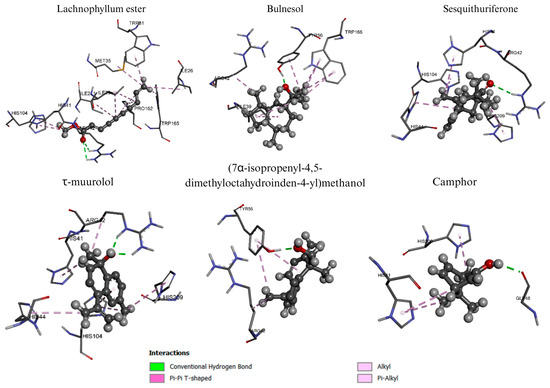
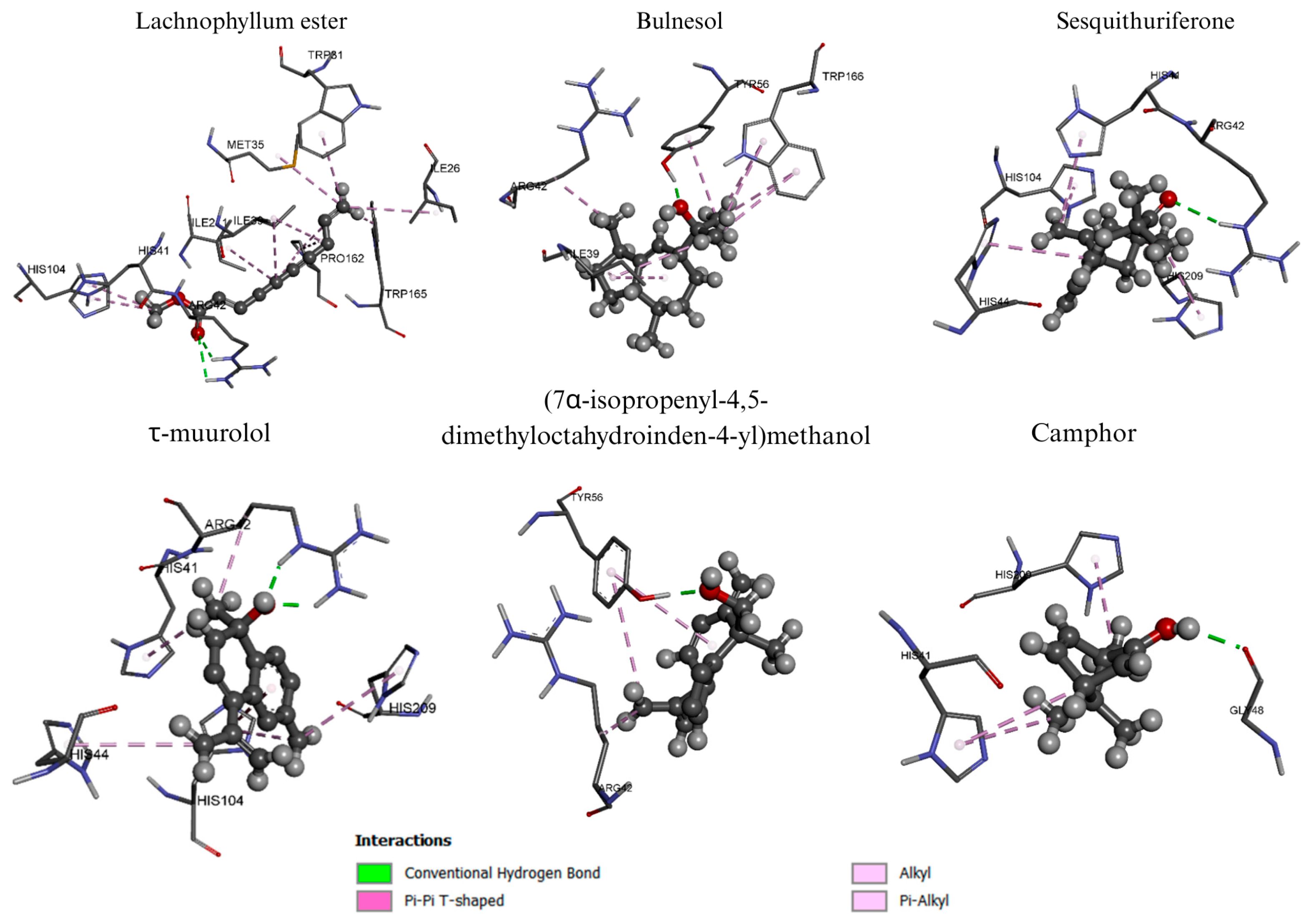
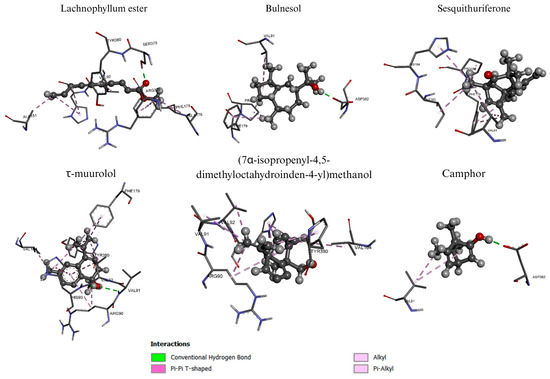
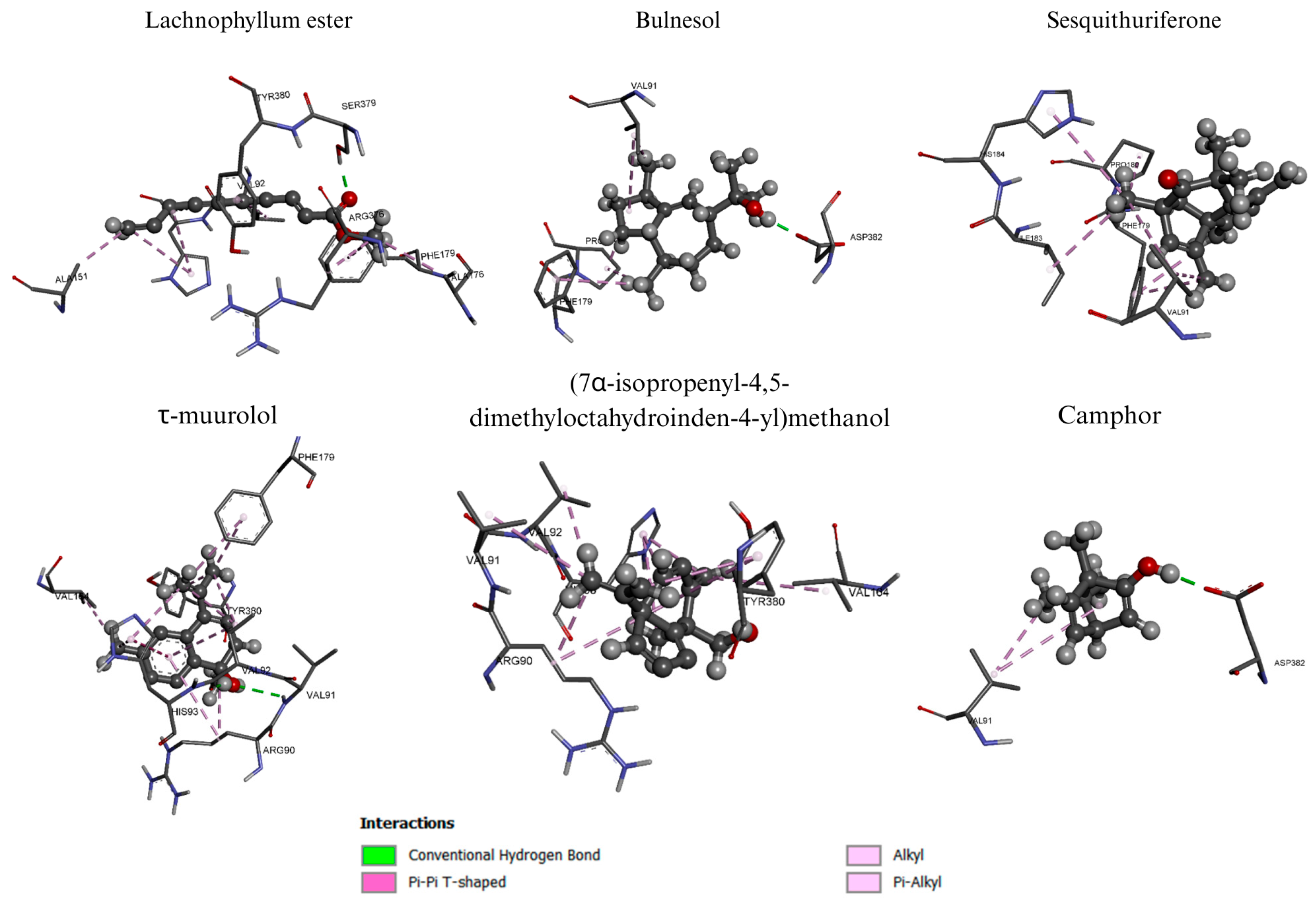
Interaction analyses, shown in Table 4, revealed that the sesquiterpenoids from F. imbricata form multiple hydrophobic contacts with key catalytic residues of SDH (His41, His104, His209, Arg42), and in some cases establish hydrogen bonds with Arg42 or Tyr56 (Figure 4). In MfCat2, most ligands interacted with the proposed catalytic region (Val91, Val92, His93, Phe179, Tyr380), supporting the predicted stability of the complexes. Notably, τ-muurolol engaged in π–π stacking interactions with Tyr380 and His93, while (7α-isopropenyl-4,5-dimethyloctahydroinden-4-yl)methanol formed multiple contacts with Arg90, Val164, and Tyr380 (Figure 5), accounting for its high binding affinity.
Table 4.
Key interactions between the selected bioactive metabolites and the SDH and MfCat2 target enzymes.
Figure 4.
Three-dimensional representations of the interaction of the selected compounds with SDH.
Figure 5.
Three-dimensional representations of the interaction of the selected compounds with MfCat2.
In B. linearis, the high proportion of lachnophyllum ester was reflected in its moderate affinities for both targets and its interactions with key catalytic residues, in agreement with previous reports describing this polyyne as an antifungal and antioxidant metabolite capable of modulating oxidative stress and membrane integrity, effects also observed for other bioactive polyacetylenes [54,56,57,66]. In F. imbricata, the predominant sesquiterpenoids, bulnesol, τ-muurolol, sesquithuriferone and (7α-isopropenyl-4,5-dimethyloctahydroinden-4-yl)methanol, showed the strongest binding affinities toward SDH and MfCat2. This trend is consistent with studies demonstrating that structurally related sesquiterpenoid alcohols exhibit potent antifungal activity and disrupt membrane-associated bioenergetic processes essential for fungal viability [59,67,68].
Taken together, these in silico results suggest that the sesquiterpenes of F. imbricata and the polyine lachnophyllum ester of B. linearis theoretically possess the capacity to bind functional sites in SDH and MfCat2, potentially contributing to the antifungal patterns observed experimentally. However, it is essential to note that these findings are derived from a simplified, static docking approach that does not account for solvent effects, molecular dynamics, or the kinetic parameters governing ligand binding and dissociation. Furthermore, as EOs are complex mixtures, their bioactivity likely involves synergistic effects across multiple cellular targets beyond the enzymes analyzed in this study. The simulations also do not reflect the physicochemical challenges of post-harvest environments—such as compound volatility, oxidative stability, pH variations, or humidity—all of which are critical for practical application. Consequently, these results should be regarded as qualitative and hypothesis-generating, requiring further validation through structural, biochemical, and physiological studies to confirm the proposed interactions and fully elucidate the underlying antifungal mechanisms.
4. Conclusions
This research on three different “rosemary” species from Chile has demonstrated their different chemotypes through GC/MS. The antifungal tests lead us to think that the EO of F. imbricata is a viable option for the development of sustainable agricultural solutions based on natural antifungal products, especially for the management of the phytopathogenic fungus M. fructicola. EO of F. imbricata inhibited significantly the mycelium growth of this fungus and almost completely its conidial germination. The results of in silico assays give us some clues about its possible mechanisms of action, since the sesquiterpenoids contained in this oil show key interactions with the enzymes SDH and MfCat2. On the other hand, moderate activity was found in the oil of B. linearis, highlighting its ability to inhibit B. cinerea and M. fructicola at the same time. The EO of S. rosmarinus showed no activity. Regarding the practical use of these EOs as natural alternatives to synthetic fungicides, we propose their application via vapor fumigation or edible coatings. To avoid phytotoxicity and preserve the quality of high-value crops, concentration and exposure time must be precisely optimized. Consequently, further research is needed to determine the mechanism of action of F. imbricata and ensure its safety for in vivo application.
Author Contributions
Conceptualization, A.M.; methodology, K.D. and E.M.; software, E.M.; validation, A.M., K.D. and E.M.; formal analysis, A.M.; investigation, V.S., C.V., F.V., C.R., N.C., P.G., E.W. and I.M.; resources, A.M.; data curation, K.D. and E.M.; writing—original draft preparation, A.M. and E.M.; writing—review and editing, V.S. and A.M.; visualization, V.S.; supervision, A.M.; project administration, A.M.; funding acquisition, A.M. All authors have read and agreed to the published version of the manuscript.
Funding
This research was funded by Fondecyt Regular, grant number 1230311.
Data Availability Statement
All data are available for scientific community on the manuscript.
Acknowledgments
To the Beca Doctorado Nacional N◦ 21240311 from the Agencia Nacional de Investigación y Desarrollo (ANID) of Chile, Millennium Nucleus Bioproducts, Genomics and Environmental Microbiology (BioGEM), ANID-Milenio-NCN2023_054.
Conflicts of Interest
The authors declare no conflicts of interest.
References
- Bhunjun, C.S.; Phillips, A.J.L.; Jayawardena, R.S.; Promputtha, I.; Hyde, K.D. Importance of Molecular Data to Identify Fungal Plant Pathogens and Guidelines for Pathogenicity Testing Based on Koch’s Postulates. Pathogens 2021, 10, 1096. [Google Scholar] [CrossRef] [Scilit]
- Wang, Q.; Han, Y.; Yu, Z.; Tian, S.; Sun, P.; Shi, Y.; Peng, C.; Gu, T.; Li, Z. Fungi in Horticultural Crops: Promotion, Pathogenicity and Monitoring. Agronomy 2025, 15, 1699. [Google Scholar] [CrossRef] [Scilit]
- Mafe, A.N.; Edo, G.; Makia, R.; Joshua, O.A.; Akpoghelie, P.O.; Gaaz, T.S.; Jikah, A.N.; Yousif, E.; Isoje, E.F.; Igbuku, U.A.; et al. A review on food spoilage mechanisms, food borne diseases and commercial aspects of food preservation and processing. Food Chem. Adv. 2024, 5, 100852. [Google Scholar] [CrossRef] [Scilit]
- Shankar, S.; Mohanty, A.K.; DeEll, J.R.; Carter, K.; Lenz, R.; Misra, M. Advances in Antimicrobial Techniques to Reduce Postharvest Loss of Fresh Fruit by Microbial Reduction. npj Sustain. Agric. 2024, 2, 25. [Google Scholar] [CrossRef] [Scilit]
- Molina-Hernandez, J.B.; Grande-Tovar, C.D.; Neri, L.; Delgado-Ospina, J.; Rinaldi, M.; Cordero-Bueso, G.A.; Chaves-López, C. Enhancing Postharvest Food Safety: The Essential Role of Non-Thermal Technologies in Combating Fungal Contamination and Mycotoxins. Front. Microbiol. 2025, 16, 1543716. [Google Scholar] [CrossRef] [Scilit] [PubMed]
- Khan, R.; Anwar, F.; Ghazali, F.M. A comprehensive review of mycotoxins: Toxicology, detection, and effective mitigation approaches. Heliyon 2024, 10, e28361. [Google Scholar] [CrossRef] [Scilit] [PubMed]
- Zakaria, L. Fungal and Oomycete Diseases of Minor Tropical Fruit Crops. Horticulturae 2022, 8, 323. [Google Scholar] [CrossRef] [Scilit]
- Yang, Y.; Mali, P.; Arthur, L.; Molaei, F.; Atsyo, S.; Geng, J.; He, L.; Ghatrehsamani, S. Advanced technologies for precision tree fruit disease management: A Review. Comput. Electron. Agric. 2025, 229, 109704. [Google Scholar] [CrossRef] [Scilit]
- Cheon, W.; Kim, Y.S.; Balaraju, K.; Kim, B.-S.; Lee, B.-H.; Jeon, Y. Postharvest Control of Botrytis Cinerea and Monilinia Fructigena in Apples by Gamma Irradiation Combined with Fumigation. J. Food Prot. 2016, 79, 1410–1417. [Google Scholar] [CrossRef] [Scilit]
- Dwivedi, M.; Singh, P.; Pandey, A.K. Botrytis fruit rot management: What have we achieved so far? Food Microbiol. 2024, 122, 104564. [Google Scholar] [CrossRef] [Scilit]
- Madrid, A.; Silva, V.; Reyes, C.; Werner, E.; Besoain, X.; Montenegro, I.; Muñoz, E.; Díaz, K. Control of Peach Brown Rot Disease Produced by Monilinia fructicola and Monilinia laxa Using Benzylidene-Cycloalkanones. J. Fungi 2024, 10, 609. [Google Scholar] [CrossRef] [Scilit]
- Zubrod, J.P.; Bundschuh, M.; Arts, G.; Brühl, C.A.; Imfeld, G.; Knäbel, A.; Payraudeau, S.; Rasmussen, J.J.; Rohr, J.; Scharmüller, A. Fungicides: An overlooked pesticide class? Environ. Sci. Technol. 2019, 53, 3347–3365. [Google Scholar] [CrossRef] [Scilit]
- Ahmad, M.F.; Ahmad, F.A.; Alsayegh, A.A.; Zeyaullah, M.d.; AlShahrani, A.M.; Muzammil, K.; Saati, A.A.; Wahab, S.; Elbendary, E.Y.; Kambal, N. Pesticides impacts on human health and the environment with their mechanisms of action and possible countermeasures. Heliyon 2024, 10, e29128. [Google Scholar] [CrossRef] [Scilit]
- Gikas, G.D.; Parlakidis, P.; Mavropoulos, T.; Vryzas, Z. Particularities of fungicides and factors affecting their fate and removal efficacy: A Review. Sustainability 2022, 14, 4056. [Google Scholar] [CrossRef] [Scilit]
- Pagano, M.M.; Oettl, S.; Deltedesco, E.; Pii, Y.; Spitaler, U. Variation in growth, morphology, and fungicide sensitivity among Monilinia species from south tyrol’s alpine orchards. J. Fungi 2025, 11, 690. [Google Scholar] [CrossRef] [Scilit] [PubMed]
- Weber, R.W.S.; Petridis, A. Fungicide resistance in Botrytis spp. And regional strategies for its management in northern european strawberry production. BioTech 2023, 12, 64. [Google Scholar] [CrossRef] [Scilit]
- Abbey, J.A.; Alzohairy, S.A.; Neugebauer, K.A.; Hatlen, R.J.; Miles, T.D. Fungicide Resistance in Botrytis cinerea and Identification of Botrytis Species Associated with Blueberry in Michigan. Front. Microbiol. 2024, 15, 1425392. [Google Scholar] [CrossRef] [Scilit] [PubMed]
- Leiva-Mora, M.; Bustillos, D.; Arteaga, C.; Hidalgo, K.; Guevara-Freire, D.; López-Hernández, O.; Saa, L.R.; Padilla, P.S.; Bustillos, A. Antifungal mechanisms of plant essential oils: A comprehensive literature review for biofungicide development. Agriculture 2025, 15, 2303. [Google Scholar] [CrossRef] [Scilit]
- Liang, H.; Yang, M.; Li, Q.; Zhang, L.; Zhao, X. A comprehensive review of the main components of plant essential oils and the mechanisms responsible for the inhibitory effects on fungal growth and aflatoxin synthesis. Innov. Food Sci. Emerg. Technol. 2024, 96, 103747. [Google Scholar] [CrossRef] [Scilit]
- Álvarez-García, S.; Moumni, M.; Romanazzi, G. Antifungal activity of volatile organic compounds from essential oils against the postharvest pathogens Botrytis cinerea, Monilinia fructicola, Monilinia fructigena, and Monilinia laxa. Front. Plant Sci. 2023, 14, 1274770. [Google Scholar] [CrossRef] [Scilit]
- Allagui, M.B.; Moumni, M.; Romanazzi, G. Antifungal Activity of Thirty Essential Oils to Control Pathogenic Fungi of Postharvest Decay. Antibiotics 2024, 13, 28. [Google Scholar] [CrossRef] [Scilit]
- Di Francesco, A.; Ippolito, A.; Romanazzi, G. Heat treatments for the control of postharvest decay of fresh fruit: Case studies of peach brown rot, kiwifruit gray mold and citrus green and blue molds. Postharvest Biol. Technol. 2026, 231, 113868. [Google Scholar] [CrossRef] [Scilit]
- Lupia, C.; Castagna, F.; Bava, R.; Naturale, M.D.; Zicarelli, L.; Marrelli, M.; Statti, G.; Tilocca, B.; Roncada, P.; Britti, D. Use of essential oils to counteract the phenomena of antimicrobial resistance in livestock species. Antibiotics 2024, 13, 163. [Google Scholar] [CrossRef] [Scilit]
- Falleh, H. Demystifying the power of essential oils: A review of their antibacterial properties and potential as natural food preservatives. EXCLI J. 2025, 24, 828–850. [Google Scholar] [CrossRef] [Scilit]
- Kumar, A.; Kumar, S.; Komal; Ramchiary, N.; Singh, P. Role of traditional ethnobotanical knowledge and indigenous communities in achieving sustainable development goals. Sustainability 2021, 13, 3062. [Google Scholar] [CrossRef] [Scilit]
- Deresa, E.M.; Diriba, T.F. phytochemicals as alternative fungicides for controlling plant diseases: A comprehensive review of their efficacy, commercial representatives, advantages, challenges for adoption, and possible solutions. Heliyon 2023, 9, e13810. [Google Scholar] [CrossRef] [Scilit]
- Martínez, J.L.; Calvo, C.A.; Laurido, C. Medicinal plants used in Chile for the treatment of hypertension and mountain sickness. Afr. J. Tradit. Complement. Altern. Med. 2006, 3, 50–58. Available online: https://journals.athmsi.org/index.php/ajtcam/article/view/137 (accessed on 5 December 2025). [CrossRef] [Scilit]
- Madrid, A.; Avola, R.; Graziano, A.C.E.; Cardile, V.; Russo, A. Fabiana imbricata Ruiz & Pav. (Solanaceae) essential oil analysis in prostate cancer cells: Relevance of reactive oxygen species in proapoptotic activity. J. Ethnopharmacol. 2025, 352, 120162. [Google Scholar] [CrossRef] [Scilit]
- Abd-Elhalim, B.T.; Mohamed, E.S.; Gamar, G.M.; Moawad, H. Biological activities and application of Rosmarinus officinalis extract to improve the preservation and microbial qualities of some local meat products. Sci. Rep. 2025, 15, 30806. [Google Scholar] [CrossRef] [Scilit] [PubMed]
- Concha, J.; Cavieres, L.A.; Sotes, G.J.; Hernandez, V. Essential oil composition of Baccharis linearis (Ruiz & Pav.) Pers. and Baccharis paniculata DC. leaves from Chile. Am. J. Essent. Oils Nat. Prod. 2014, 1, 6–8. [Google Scholar]
- Castro, P.; Parada, R.; Corrial, C.; Mendoza, L.; Cotoras, M. Endophytic Fungi Isolated from Baccharis linearis and Echinopsis chiloensis with Antifungal Activity against Botrytis cinerea. J. Fungi 2022, 8, 197. [Google Scholar] [CrossRef] [Scilit]
- Montenegro, I.; Villarroel, C.; Muñoz, E.; Mena-Ulecia, K.; Silva, V.; Madrid, A. Anticandidal Activity of Clinopodium chilense Essential Oil. Front. Pharmacol. 2025, 16, 1634250. [Google Scholar] [CrossRef] [Scilit]
- Díaz, K.; Werner, E.; Besoain, X.; Flores, S.; Donoso, V.; Said, B.; Caro, N.; Vega, E.; Montenegro, I.; Madrid, A. In Vitro Antifungal Activity and Toxicity of Dihydrocarvone-Hybrid Derivatives against Monilinia fructicola. Antibiotics 2021, 10, 818. [Google Scholar] [CrossRef] [Scilit]
- Silva, V.; Muñoz, E.; Díaz, K.; Molina, P.; Besoain, X.; Montenegro, I.; Rigano, D.; Caro, N.; Madrid, A. An Efficient Microwave Synthesis of 3-Acyl-5-bromoindole Derivatives for Controlling Monilinia fructicola and Botrytis cinerea. Int. J. Mol. Sci. 2025, 26, 9148. [Google Scholar] [CrossRef] [Scilit] [PubMed]
- Muñoz, E.; Díaz, K.; Montenegro, I.; Caro, N.; Reyes, C.; Silva, V.; Madrid, A. Fungicidal potential of 3-acyl-6-bromoindole derivatives: Synthesis, in vitro activity, and molecular docking against Botrytis cinerea and Monilinia fructicola. Agronomy 2025, 15, 2267. [Google Scholar] [CrossRef] [Scilit]
- Nene, T.; Yadav, M.; Yadav, H.S. Plant catalase in silico characterization and phylogenetic analysis with structural modeling. J. Genet. Eng. Biotechnol. 2022, 20, 125. [Google Scholar] [CrossRef] [Scilit] [PubMed]
- Jendele, L.; Krivák, R.; Škoda, P.; Novotný, M.; Hoksza, D. PrankWeb: A web server for ligand binding site prediction and visualization. Nucleic Acids Res. 2019, 47, W345–W349. [Google Scholar] [CrossRef] [Scilit] [PubMed]
- Cui, K.; He, L.; Li, T.; Mu, W.; Liu, F. Development of boscalid resistance in Botrytis cinerea and an efficient strategy for resistance management. Plant Dis. 2021, 105, 1042–1047. [Google Scholar] [CrossRef] [Scilit]
- Li, Z.-W.; Huang, Y.-H.; Wei, G.; Lu, Z.-W.; Wang, Y.-X.; Cui, G.-R.; Wang, J.-Y.; Yu, X.-H.; Fu, Y.-X.; Fan, E.-D.; et al. Cryo-EM structure of the yeast Saccharomyces cerevisiae succinate dehydrogenase provides a template for eco-friendly fungicide discovery. Nat. Commun. 2025, 16, 8936. [Google Scholar] [CrossRef] [Scilit]
- Li, K.; Hong, S.; Yu, Z.; Hong, Z.; Sun, Y.; Cheng, J.; Tang, L.; Wang, Y.; Qi, X.; Fan, Z. Computation-directed molecular design, synthesis, and fungicidal activity of succinate dehydrogenase inhibitors. J. Agric. Food Chem. 2023, 71, 19372–19384. [Google Scholar] [CrossRef] [Scilit]
- Chen, S.; Liu, Z.; Chang, Z.; Zheng, Y.; Wang, X.; Li, N.; Huang, Z.; Zhang, C.; Liu, X. Exploring fungicide sensitivity in soybean stem blight pathogen Diaporthe longicolla, emphasizing genetic variability impact on response to SDHI fungicides fluopyram and pydiflumetofen. J. Fungi 2025, 11, 292. [Google Scholar] [CrossRef] [Scilit]
- Houzi, G.; Allali, A.; Elbouzidi, A.; Taibi, M.; Chebaibi, M.; Zineb, B.K.; Mothana, R.A.; Hawwal, M.F.; Flouchi, R.; Asehraou, A.; et al. Aphicidal and antimicrobial activities of Salvia rosmarinus essential oil and its major compound, 1,8-cineole. Phyton 2025, 94, 1239–1251. [Google Scholar] [CrossRef] [Scilit]
- Annemer, S.; Ez-zoubi, A.; Ez Zoubi, Y.; Satrani, B.; Stambouli, H.; Assouguem, A.; Ullah, R.; Bouayoun, T.; Fettoukh, N.; Farah, A. Optimization and antifungal efficacy against brown rot fungi of combined Salvia rosmarinus and Cedrus atlantica essential oils encapsulated in gum arabic. Sci. Rep. 2023, 13, 19548. [Google Scholar] [CrossRef] [Scilit]
- Gastaldi, B.; Assef, Y.; van Baren, C.; Di Leo, L.; Retta, P.; Bandoni, D.; Arnaldo, L.; González, S.B. Actividad antioxidante en infusiones, tinturas y aceites esenciales de especies nativas de la Patagonia Argentina. Rev. Cuba. Plant. Med. 2016, 21, 51–62. [Google Scholar]
- Cherif, M.C.; Boughendjioua, H.; Caputo, L.; Camele, I.; Tahraoui, T.; De Feo, V.; Elshafie, H.S. FTIR characterization and bioactivity assessment of Cinnamomum camphora essential oil: Antioxidant, anti-enzymatic, and antifungal properties against phytopathogens. Chem. Biodivers. 2025, 22, e00720. [Google Scholar] [CrossRef] [Scilit]
- Tsao, R.; Zhou, T. Antifungal Activity of Monoterpenoids against Postharvest Pathogens Botrytis cinerea and Monilinia fructicola. J. Essent. Oil Res. 2000, 12, 113–121. [Google Scholar] [CrossRef] [Scilit]
- Konuk, H.B.; Ergüden, B. Phenolic -OH group is crucial for the antifungal activity of terpenoids via disruption of cell membrane integrity. Folia Microbiol. 2020, 65, 775–783. [Google Scholar] [CrossRef] [Scilit]
- Mahizan, N.A.; Yang, S.-K.; Moo, C.-L.; Song, A.A.-L.; Chong, C.-M.; Chong, C.-W.; Abushelaibi, A.; Lim, S.-H.E.; Lai, K.-S. Terpene Derivatives as a Potential Agent against Antimicrobial Resistance (AMR) Pathogens. Molecules 2019, 24, 2631. [Google Scholar] [CrossRef] [Scilit] [PubMed]
- Lindokuhle, M.; Tumba, K.; Nkosi, N.; Ngema, T. Terpene-based hydrophobic (D) ESs: A systematic review of physiochemical properties. Chem. Thermodyn. Therm. Anal. 2025, 21, 100249. [Google Scholar] [CrossRef] [Scilit]
- Kukric, T.N.; Ilicic, R.M.; Juric, T.M.; Uka, D.B.; Bagi, F.F.; Duric, S.S.; Popovic, B.M. antifungal efficacy and biofumigation potential of hydrophobic deep eutectic solvents: Postharvest treatment against Monilinia fructicola and Botrytis cinerea. World J. Microbiol. Biotechnol. 2024, 40, 393. [Google Scholar] [CrossRef] [Scilit] [PubMed]
- Marei, G.I.K.; Rasoul, M.A.A.; Abdelgaleil, S.A. Comparative antifungal activities and biochemical effects of monoterpenes on plant pathogenic fungi. Pestic. Biochem. Physiol. 2012, 103, 56–61. [Google Scholar] [CrossRef] [Scilit]
- Zhang, K.; Jiang, Y.; Zhao, H.; Köllner, T.G.; Chen, S.; Chen, F.; Chen, F. Diverse Terpenoids and Their Associated Antifungal Properties from Roots of Different Cultivars of Chrysanthemum Morifolium Ramat. Molecules 2020, 25, 2083. [Google Scholar] [CrossRef] [Scilit]
- Li, H.; Liao, H.; Li, Y.; Qi, Y.; Ni, H.; Zou, Z.; Liu, Z. Chemical composition and antifungal activity of Cinnamomum camphora chvar. Borneol essential oil obtained using solvent-free microwave-assisted method. Arab. J. Chem. 2023, 16, 104996. [Google Scholar] [CrossRef] [Scilit]
- Sobrinho, A.C.N.; Fontenelle, R.O.D.S.; Souza, E.B.D.; Morais, S.M.D. Antifungal and antioxidant effect of the lachnophyllum ester, isolated from the essential oil of Baccharis trinervis (Lam.) Pers., against Dermatophytes Fungi. Rev. Bras. Saúde Prod. Anim. 2021, 22, e2122542021. [Google Scholar] [CrossRef] [Scilit]
- Yao, J.; Huang, S.; He, L.; Wei, S.; Yang, W.; Zhang, Q.; Wang, W.; Yang, X.; Xie, S.; Li, Y.; et al. Antifungal Polyacetylenic Deoxyglycosides Isolated from Endophytic Fungus Xylaria sp. VDL4 Associated with Vaccinium dunalianum. J. Fungi 2025, 11, 209. [Google Scholar] [CrossRef] [Scilit] [PubMed]
- Yoon, M.-Y.; Choi, G.J.; Choi, Y.H.; Jang, K.S.; Cha, B.; Kim, J.-C. Antifungal activity of polyacetylenes isolated from Cirsium japonicum roots against various phytopathogenic fungi. Ind. Crop. Prod. 2011, 34, 882–887. [Google Scholar] [CrossRef] [Scilit]
- Kumar, V.; Mathela, C.S.; Tewari, G.; Singh, D.; Tewari, A.K.; Bisht, K.S. Chemical Composition and Antifungal Activity of Essential Oils from Three Himalayan Erigeron Species. LWT-Food Sci. Technol. 2014, 56, 278–283. [Google Scholar] [CrossRef] [Scilit]
- Chang, H.; Cheng, Y.; Wu, C.; Chang, S.; Chang, T.; Su, Y. Antifungal activity of essential oil and its constituents from Calocedrus macrolepis var. Formosana florin leaf against plant pathogenic fungi. Bioresour. Technol. 2008, 99, 6266–6270. [Google Scholar] [CrossRef] [Scilit]
- Wu, C.-C.; Huang, S.-L.; Ko, C.-H.; Chang, H.-T. Antifungal Sesquiterpenoids from Michelia Formosana Leaf Essential Oil against Wood-Rotting Fungi. Molecules 2022, 27, 2136. [Google Scholar] [CrossRef] [Scilit]
- Tan, M.; Zhou, L.; Huang, Y.; Wang, Y.; Hao, X.; Wang, J. Antimicrobial activity of globulol isolated from the fruits of Eucalyptus globulus Labill. Nat. Prod. Res. 2008, 22, 569–575. [Google Scholar] [CrossRef] [Scilit]
- Kozubowski, L.; Berman, J. The impact of phenotypic heterogeneity on fungal pathogenicity and drug resistance. FEMS Microbiol. Rev. 2025, 49, fuaf001. [Google Scholar] [CrossRef] [Scilit] [PubMed]
- Ferreira, C.; Silva, V.; Muñoz, E.; Valle, G.; Martínez-Lobos, M.; Valdés, F.; Díaz, K.; Montenegro, I.; Godoy, P.; Caro, N.; et al. The Effect of 3′,4′-Methylenedioxychalcone Derivatives on Mycelial Growth and Conidial Germination of Monilinia fructicola: An In Silico and In Vitro Study. Agriculture 2025, 15, 983. [Google Scholar] [CrossRef] [Scilit]
- Fraaije, B.A.; Bayon, C.; Atkins, S.; Cools, H.J.; Lucas, J.A.; Fraaije, M.W. Risk assessment studies on succinate dehydrogenase inhibitors, the new weapons in the battle to control Septoria leaf blotch in wheat. Mol. Plant Pathol. 2011, 13, 263–275. [Google Scholar] [CrossRef] [Scilit] [PubMed]
- Quaedvlieg, W.; Kema, G.H.; Groenewald, J.Z.; Verkley, G.J.; Seifbarghi, S.; Razavi, M.; Mirzadi Gohari, A.; Mehrabi, R.; Crous, P.W. Zymoseptoria gen. nov.: A new genus to accommodate Septoria-like species occurring on graminicolous hosts. Persoonia-Mol. Phylogeny Evol. Fungi 2011, 26, 57–69. [Google Scholar] [CrossRef] [Scilit]
- Chen, S.; Yang, H.; Chen, M.; Liu, W.; Tian, S.; Mu, R.; Jia, F.; Liu, C.; Ma, G.; Sun, X.; et al. Inhibition of Monilinia fructicola Sporulation and Pathogenicity through Eucalyptol-Mediated Targeting of MfCat2 by Streptomyces lincolnensis Strain JCP1-7. Mol. Plant Pathol. 2024, 25, e13484. [Google Scholar] [CrossRef] [Scilit]
- Negri, R. Polyacetylenes from Terrestrial Plants and Fungi: Recent Phytochemical and Biological Advances. Fitoterapia 2015, 106, 92–109. [Google Scholar] [CrossRef] [Scilit]
- Bartikova, H.; Hanusova, V.; Skalova, L.; Ambroz, M.; Bousova, I. Antioxidant, Pro-Oxidant and Other Biological Activities of Sesquiterpenes. Curr. Top. Med. Chem. 2014, 14, 2478–2494. [Google Scholar] [CrossRef] [Scilit] [PubMed]
- Jin, X.; Zhang, M.; Lu, J.; Duan, X.; Chen, J.; Liu, Y.; Chang, W.; Lou, H. Hinokitiol Chelates Intracellular Iron to Retard Fungal Growth by Disturbing Mitochondrial Respiration. J. Adv. Res. 2021, 34, 65–77. [Google Scholar] [CrossRef] [Scilit]

Disclaimer/Publisher’s Note: The statements, opinions and data contained in all publications are solely those of the individual author(s) and contributor(s) and not of MDPI and/or the editor(s). MDPI and/or the editor(s) disclaim responsibility for any injury to people or property resulting from any ideas, methods, instructions or products referred to in the content. |
© 2026 by the authors. Licensee MDPI, Basel, Switzerland. This article is an open access article distributed under the terms and conditions of the Creative Commons Attribution (CC BY) license.