Next Article in Journal
Localized Phosphorus Application Promotes the Growth and Nutrient Content of Pitaya (Hylocereus polyrhizus) Seedlings by Improving Root Morphology
Previous Article in Journal
In Vitro and In Silico Evaluation of Essential Oils from Three “Rosemary” Species Present in Chile as a Sustainable Alternative for Post-Harvest Fungi Control
 
 
Due to scheduled maintenance work on our servers, there may be short service disruptions on this website between 11:00 and 12:00 CEST on March 28th.
Article

Effects of Microbial Coating Agents on Alfalfa Production Performance, Nutritional Quality, Soil Particle Size and Soil Enzyme Activity


Key Laboratory of Grassland Ecosystem of Ministry of Education, College of Pratacultural Science, Gansu Agricultural University, Lanzhou 730070, China
*
Author to whom correspondence should be addressed.
Agronomy 2026, 16(2), 172; https://doi.org/10.3390/agronomy16020172

Submission received: 24 November 2025 / Revised: 22 December 2025 / Accepted: 6 January 2026 / Published: 9 January 2026
(This article belongs to the Section Agricultural Biosystem and Biological Engineering)

Abstract

To screen efficient microbial coating formulations and explore their effects on the growth of alfalfa and soil properties, ‘Gannong No. 3’ alfalfa was used as the experimental material. A single-factor randomized block field experiment was conducted with eight treatments (CK as bare seeds, BC as adhesive filler coated agent, J1-J3 as rhizobium agent, growth-promoting bacteria agent, and rhizobium plus growth-promoting bacteria seed soaking, respectively, B1-B3 as rhizobium, growth-promoting bacteria, and rhizobium plus growth-promoting bacteria coating agents, respectively). This study analyzes the effects of different microbial coating formulations on alfalfa, including its production performance and nutritional quality, as well as on soil properties. Comprehensive analysis shows that the growth-promoting microbial coating (B2) is the optimal formulation. It can simultaneously optimize alfalfa production performance, enhance nutritional quality, improve soil particle composition, and increase soil enzyme activity, achieving a synergistic improvement of both alfalfa and the soil ecosystem. Its application effect is significantly better than other treatments and can provide important theoretical support and practical reference for the development and application of efficient microbial seed coatings in high-quality alfalfa cultivation.

1. Introduction

Microbial resources are regarded as one of the national strategic safety biological resources. They are the world’s largest and underutilized biological resources and have huge industrial application potential [1]. Plant growth-promoting bacteria (PGPB) have a close relationship with the rhizosphere of their host plants and possess functional traits such as phosphate solubilization and nitrogen fixation, which can promote plant growth through these pathways [2,3,4]. At the same time, these strains can also regulate plant growth directly through direct action [5,6].
At the same time, they can also indirectly induce plants to develop resistance, thereby enhancing the plants’ own defense mechanisms to cope with the negative effects of diseases, biotic stress, or abiotic stress [7,8], further promoting the absorption [9] and utilization of mineral nutrients [9], and promoting crop growth to increase yield [10]. They also have significant importance in soil remediation [11]. At present, there are few studies on the application of PGPR as a microbial coating agent to affect the production performance of alfalfa.
Alfalfa (Medicago sativa L.) is a perennial high-yielding leguminous plant and is considered one of the most important forages in the world [12,13,14] because of its high quality, good palatability, and wide adaptability [15,16]. This is of great significance for the development of animal husbandry, ecological improvement, and the adjustment of agricultural and livestock structures in northwest China. Because alfalfa seeds are small and of limited quality, their nutrient reserves are low, and they have weak resistance to salinity and drought, which directly results in low seed germination rates, poor seedling survival, and ultimately severely limits the stable improvement of forage yield and quality. Therefore, coating the seeds before sowing can effectively improve the stress resistance and germination rate of the seeds, reduce sowing losses, thereby improving the planting efficiency of alfalfa and better utilizing its dual value in the fields of animal husbandry and ecology.
Microbial coating agents refer to using materials such as carriers and adhesives to coat exogenous substances (such as PGPR and other active substances) on the seed surface [17], and successfully colonize the rhizosphere or inside the seeds as they germinate, thus exerting a series of growth-promoting and anti-stress effects [18]. Microbial coatings meet the needs of sustainable agricultural development and combine the physical advantages of traditional coatings with the biological functional properties of microorganisms: on the one hand, coatings can improve the physical form of seeds and improve sowing accuracy; on the other hand, their main ingredients are plant beneficial microorganisms (PBM) or their secretions, this inoculation method has the advantages of low dosage, quick effect and strong targeting [19]. A small amount of inoculum is combined with other exogenous components and applied to the seed surface, thereby increasing the amount of microbial inoculum and prolonging the survival time of microorganisms [20]. The functional microorganisms carried in the coating (such as nitrogen-fixing bacteria, stress-resistant growth-promoting bacteria, etc.) can form a symbiotic relationship with plants, which not only continuously provide efficient nutrient supply for seed germination and seedling growth, but also secrete stress-resistant metabolites and regulate plant physiological mechanisms, fundamentally enhancing alfalfa’s ability to adapt to saline-alkali and drought stress, achieving the dual synergy of “physical protection + biological empowerment”. Compared with traditional coating agents, it is safe, efficient, environmentally friendly, and non-toxic to humans and animals. It leads to close contact between plants and microorganisms in the early stages of plant development, allowing them to be effectively released at specific locations [21], thereby enhancing seed vitality, further improving crop nutritional status, regulating plant growth, and increasing soil enzyme activity, thus reducing the use of pesticides and fertilizers and reducing the impact on the environment [22]. It is one of the important ways to improve crop yield and quality and promote sustainable agricultural development.
Hereby, field experiments were conducted in this study. Based on the adhesive (1% polyvinyl alcohol) and filling materials (20% biochar + 80% attapulgite) screened in the laboratory [23], three microbial coating agent treatments were established: rhizobium coating agents (B1), growth-promoting bacteria coating agents (B2), and rhizobium-growth-promoting bacteria coating agents (B3). three seed soaking treatments were established: seed soaking with rhizobium agent (J1), seed soaking with growth-promoting agent (J2), seed soaking with rhizobium + growth-promoting agent (J3). With bare seeds and bare seeds coated with only adhesive and filling materials used as the blank control. A randomized block experiment was designed to study the effects of different microbial coating agent combinations on the production performance, nutritional quality of alfalfa, and changes in soil particle size and soil enzyme activity. The results of this study can provide important theoretical support and practical reference for the development and application of efficient microbial seed coating agents in high-quality alfalfa cultivation [16,17]. It provides a green and sustainable technical pathway for efficient alfalfa cultivation and has significant theoretical and practical value in promoting high-quality development of the forage industry and ecological restoration.

2. Materials and Methods

2.1. Test Materials

The alfalfa variety is ‘Gannong No. 3’, which was purchased from Gansu Chuanglv Grass Industry Company, Lanzhou, China; the adhesive was 1% polyvinyl alcohol (analytical grade), purchased from Shanghai Yuanye Biotechnology Co., Ltd., Shanghai, China; the filling material was 20% biochar + 80% attapulgite, which was purchased from Lingshou Dehang Mineral Products Co., Ltd., Shijiazhuang, China; the biochar was made of corn stalks and purchased from Henan Lize Environmental Protection Technology Co., Ltd., Zhengzhou, China.
Bacillus mojavensis LrM2, Pseudomonas simiae MBQ3, and Sinorhizobium meliloti GAU-123 were provided by the Grassland Microbiology Laboratory, College of Grassland Science, Gansu Agricultural University.

2.2. Experimental Design

2.2.1. Preparation of Microbial Agents

The experimental strains LrM2 and MBQ3 were separately inoculated into LB liquid medium (10 g·L−1 NaCl, 10 g·L−1 tryptone, and 5 g·L−1 yeast extract; pH adjusted to 7.0), while the strain GAU-123 was inoculated into YMA liquid medium (10 g·L−1 mannitol, 3 g·L−1 yeast extract, 0.2 g·L−1 MgSO4, 0.1 g·L−1 NaCl, 0.25 g·L−1 K2HPO4, 0.25 g·L−1 KH2PO4) [24], All liquid media were sterilized in a vertical autoclave at 121 °C. After cooling, subsequent operations were performed in a sterile laminar flow hood. For every 100 mL of LB liquid medium, 100 μL of seed culture was added. The incubator shaker was set to 28 °C and 180 rpm. After 48 h of cultivation, the bacterial concentration was measured using a UV–visible spectrophotometer and adjusted to equal concentrations, with the OD600 value of all three strains ≥ 0.5. Via the plate spreading method, the viable cell count of each strain was determined to be approximately 108 CFU·mL−1.

2.2.2. Preparation of Microbial Coated Seeds

First, according to each treatment group, the corresponding microbial suspension was mixed with the specified binder and filler in predetermined proportions [23]. Added the seeds to the coating machine, then gradually added the mixture to the rotating seed coating machine in batches, continuously tumbled with alfalfa seeds at a fixed speed to ensure uniform contact. The coating process was completed when all seed surfaces were evenly covered with a uniform, particle-free layer of microbial complex.

2.2.3. Overview of the Test Site

The experimental site was located at Huangyang Town Forage Experimental Station (37°55′ N, 102°40′ E), Wuwei, Gansu Agricultural University, with an altitude of about 1530.88 m. It was situated at the eastern end of the Hexi Corridor, the agricultural area was classified as a mid-temperate desert irrigation area. The area featured drought in winter and spring, scorching heat in summer, long sunshine, low precipitation, and high evaporation. The annual average temperature was 7.2 °C, the highest temperature reached 34 °C, and the lowest temperature dropped to −26.8 °C. The annual precipitation ranged from 150 to 170 mm, and the annual evaporation was 2400 mm. The soil type is sandy loam, which corresponds to the Chinese Soil Texture Classification (Kachinsky system) [25]. The total nitrogen content of the 0~20 cm soil layer in the test site was 0.6 g·kg−1, the total phosphorus content was 0.12 g·kg−1, the total potassium content was 8.2 g·kg−1, the alkali hydrolyzable nitrogen content was 30.2 mg·kg−1, the available phosphorus content was determined to be 9.52 mg·kg−1 via the molybdenum-antimony anti-colorimetric method, and the available potassium content was 90.4 mg·kg−1 as measured by the flame photometric method; the pH was 8.66, and the organic matter content was 10.56 g·kg−1.

2.2.4. Test Site Design

The experimental field was established in August 2023. The crop was established using strip sowing, with a seeding rate of 30 kg·hm−2. Rows were spaced 30 cm apart, and seeds were placed at a depth of 2 cm. Protective rows with a width of 0.7 m were set around the experimental area. Field management measures (including irrigation, weeding and disease and pest control) were uniformly conducted in accordance with the local high-yield alfalfa fields. A total of eight microbial coating treatments were established, and each treatment was arranged with three independent replications following a randomized block design, leading to the setup of 24 experimental plots in total. The area of the test plot was 5 m × 3 m = 15 (m2). Various indicators were measured after the alfalfa grew to the first flowering stage (10% flowering) and was mown, as shown in Table 1.

2.3. Measurement Indicators and Methods

The following indicators of the test materials were determined in the year after planting (2024):
(1)
Growth performance
Plant height: During the early flowering stage, 10 plants are randomly selected from each plot and their absolute height is measured, that is, the height from the ground to the top of the plant when straightened, and the average is calculated; Stem diameter: During the early flowering stage, 10 plants are randomly selected from each plot, and their stem thickness is measured using a vernier caliper, and the average is calculated. Number of stem nodes: 10 plants are randomly selected from each plot, and the number of stem nodes of each individual plant is counted; Stem-to-leaf ratio: At the time of mowing, approximately 100 g of fresh grass is randomly sampled from each plot. The stems and leaves are separated, air-dried, and then weighed to calculate the stem-to-leaf ratio (dry weight of stem/dry weight of leaves); Fresh-hay ratio: After the fresh grass yield is measured at cutting, the samples are placed in an oven at 105 °C for 20 min to inactivate enzymes, then dried at 60 °C for 48 h, and reweighed until a constant weight is achieved to obtain the dry grass yield (fresh-to-dry ratio = fresh grass yield/dry grass yield); Hay yield: The side rows and edge sections are removed, 5 cm of stubble is retained, and the plants are mown during the early flowering stage. The yield is calculated as hay yield per unit area.
Hay yield: The side rows and edge sections are removed, 5 cm of stubble is retained, and the plants are mown during the early flowering stage. The yield is calculated as the hay yield per unit area (m2).
(2)
Nutritional Indicators
The nutritional indicators were determined according to “Feed Analysis and Feed Quality Testing Technology” [26] to determine the contents of crude protein (CP), Ether extract, (EE), Neutral detergent fiber (NDF), and Acid detergent fiber (ADF), and the relative feed value (RFV) of the forage was calculated accordingly. The specific determination methods are as follows: CP content is determined by the Kjeldahl method; ADF and NDF contents are determined by the fiber bag filter method; EE content is determined using the FOSS automatic fat analyzer (Soxtec™ 8000, purchased from FOSS Analytical A/S, Hillerød, Denmark).
Dry Matter Digestibility: DDM (%) = 88.9 − (0.77 × ADF);
Dry Matter Intake: DMI (%) = (120/NDF);
Relative Feed Value: RFV (%) = DDM × DMI/1.29.
(3)
Soil particle size determination
Soil particle size determination is measured using a laser particle size analyzer; the classification of soil texture is based on the USDA soil particle size standards [25] and is divided into seven levels. Among them, particles sized 3000~1000 μm are gravel; 1000~250 μm are coarse sand; 250~50 μm are fine sand; 50~2 μm are silt; and particles smaller than 2 μm are clay.
(4)
Determination of soil biological properties
Determination of soil enzyme activity: The soil enzyme activity refers to the enzyme activity determination method of Guan Songyin [27]. The soil urease activity is determined by the sodium phenolate colorimetric method; the soil alkaline phosphatase activity is determined by the disodium benzene phosphate colorimetric method; the soil sucrase activity is determined by the 3,5-dinitrosalicylic acid colorimetric method; the soil catalase activity is determined by the potassium permanganate titration method.

2.4. Data Statistics and Analysis

The test data were statistically processed using Microsoft Excel 2019. Results were expressed as mean and standard error for statistical analysis. One-way analysis of variance (ANOVA) and correlation analysis were conducted using IBM SPSS Statistics for Windows, Version 26.0 (IBM Corp., Armonk, NY, USA) and charts were created using Origin 2022. The Technique for Order Preference by Similarity to Ideal Solution (TOPSIS) [28] was used to comprehensively evaluate the growth-promoting effects of different microbial coatings on alfalfa and their impact on the soil.

3. Results

3.1. Effects of Microbial Coatings Agents on the Production Performance of Alfalfa

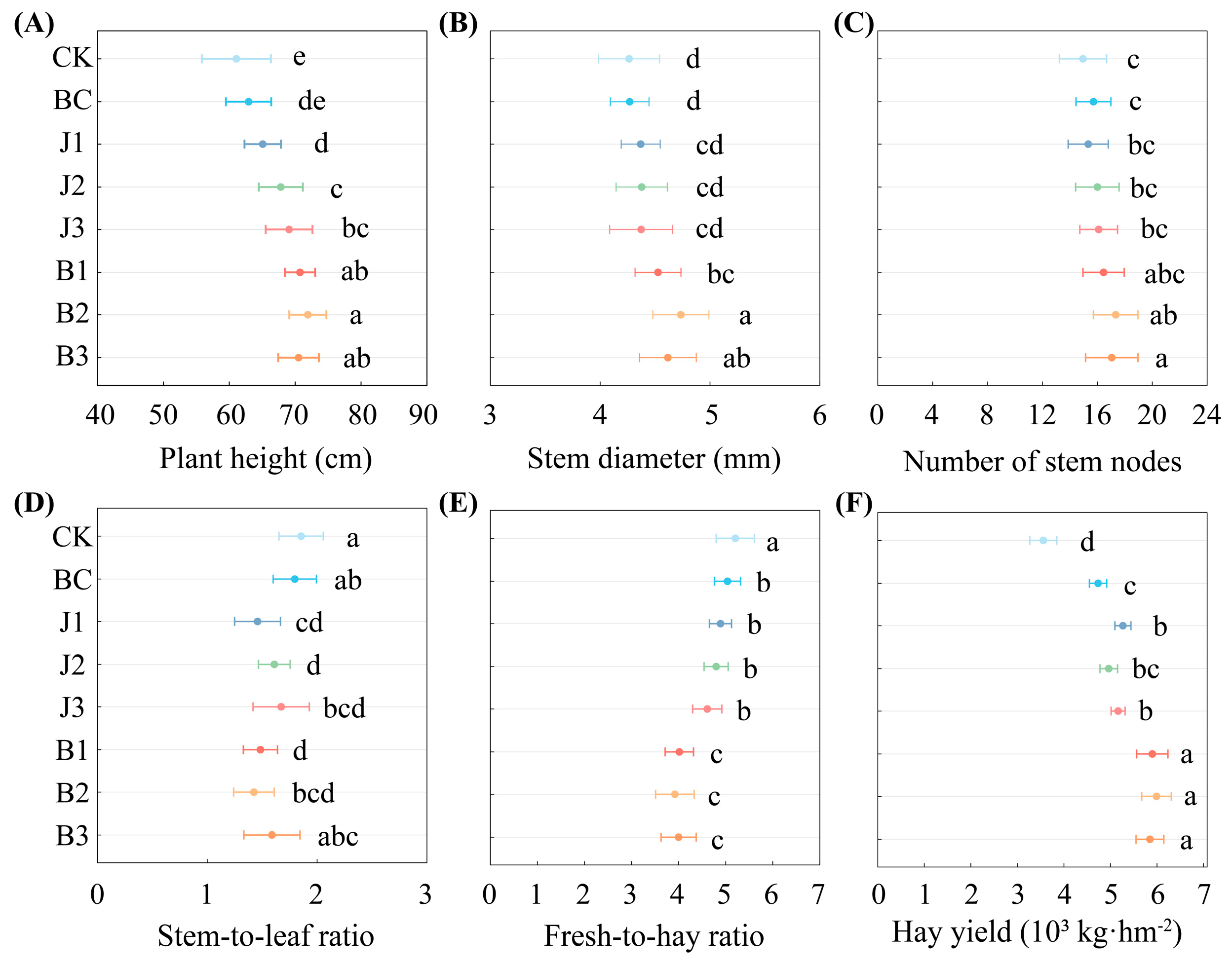
Different treatment groups had a significant positive impact on the growth indicators and yield of alfalfa (p < 0.05), as detailed below:
Regarding plant height (Figure 1A), the height of plants in each treatment group ranged from 61.08 to 71.92 cm, all showing an increase compared to CK. Among them, the J1, J2, J3, B1, B2, and B3 treatments were significantly different from CK (p < 0.05), with B2 showing the best effect, with an average plant height of 71.92 cm, an increase of 17.76% compared to CK.
For stem diameter (Figure 1B), the stem diameter of each treatment ranged from 4.26 to 4.73 mm, all higher than CK. The B1, B2, and B3 treatments were significantly different from CK (p < 0.05), with B2 having the thickest stems at 4.73 mm, an increase of 11.06% compared to CK.
In terms of the number of stem nodes (Figure 1C), each treatment group had 14.95 to 17.29 nodes, all higher than CK. The B2 (growth-promoting bacterial coating) and B3 (rhizobium + growth-promoting bacterial coating) treatments were significantly different from CK (p < 0.05), with B3 showing the highest number of stem nodes at 17.29, an increase of 15.65% compared to CK.
Regarding the stem-to-leaf ratio (Figure 1D), the ratio in each treatment ranged from 1.42 to 1.85, all lower than CK. The J1, J2, J3, B1, and B2 treatments were significantly different from CK (p < 0.05), with B2 (growth-promoting bacterial coating) having the lowest stem-to-leaf ratio at 1.42, a reduction of 23.19% compared to CK.
For the fresh-to-hay ratio (Figure 1E), the ratio in each treatment ranged from 3.97 to 5.47, all significantly lower than CK (p < 0.05). The B2 (growth-promoting bacterial coating) treatment had the lowest fresh-to-hay ratio at 3.97, a decrease of 27.48% compared to CK.
Regarding hay yield (Figure 1F), all treatments significantly increased yield compared to CK (p < 0.05). Among these, the B2 (growth-promoting bacterial coating) treatment had the highest hay yield, reaching 5990.20 kg·hm−2, which represented an increase of 68.35% compared with CK.

3.2. Effects of Microbial Coating Agents on the Nutritional Quality of Alfalfa

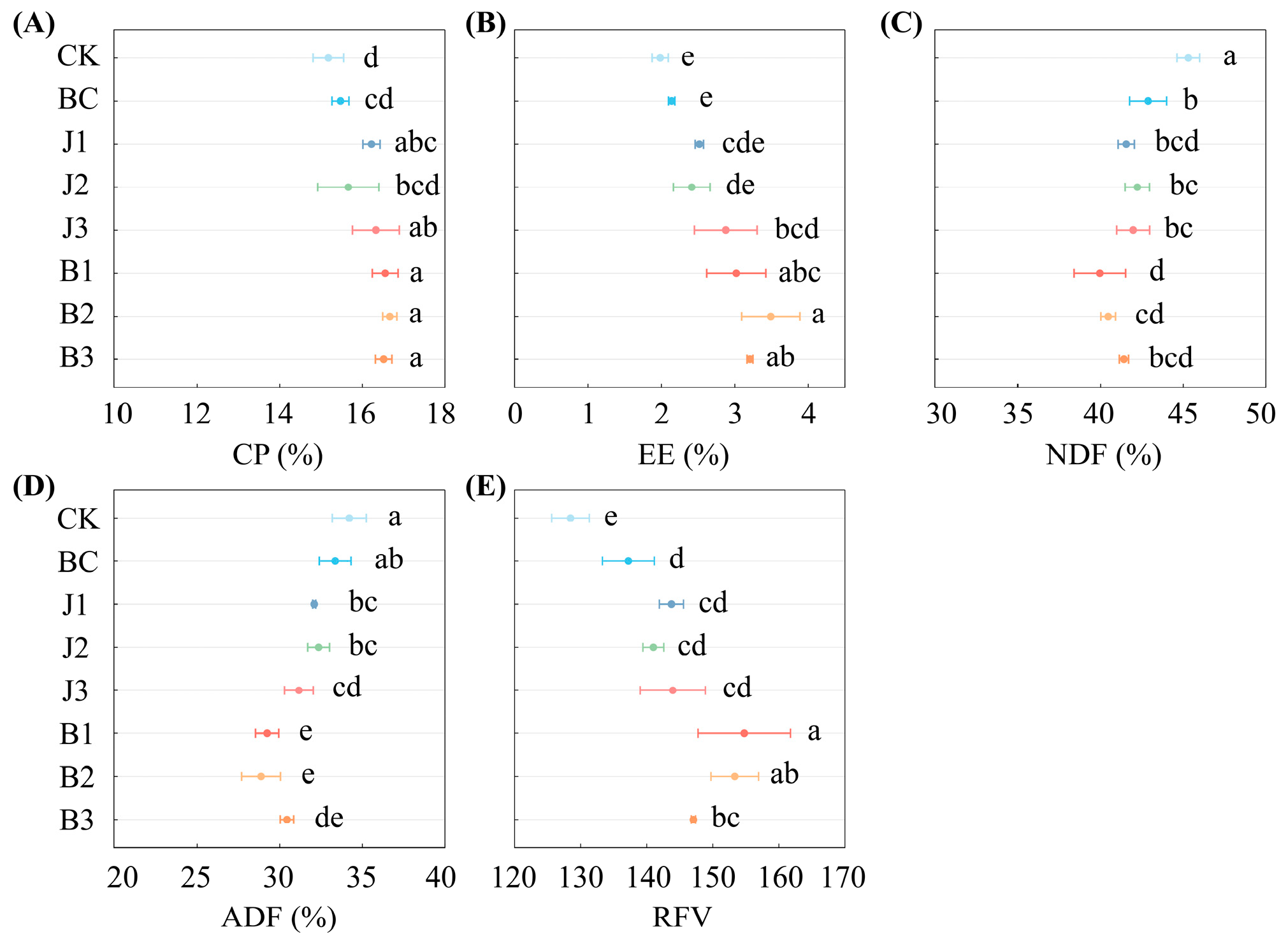
All treatment groups significantly improved the nutritional quality of alfalfa (p < 0.05).
The crude protein content of each treatment group ranged from 15.47% to 16.67% (Figure 2A), all higher than the CK, among which the B1 (rhizobium coating agent) and B2 (growth-promoting bacteria coating agent) treatment groups were significantly higher than CK (p < 0.05), with crude protein contents of 16.55% and 16.67%, respectively, representing increases of 9.03% and 9.82% compared to CK.
The crude fat content of each treatment group ranged from 1.35% to 3.49%, all higher than CK (Figure 2B), with J1, J2, J3, B1, B2, and B3 treatment groups showing significant differences from CK (p < 0.05). Among them, the B2 (growth-promoting bacteria coating agent) treatment group had the highest crude fat content at 3.49%, an increase of 75.90% compared to CK.
The neutral detergent fiber content of each treatment group ranged from 39.95% to 45.31% (Figure 2C), all significantly lower than CK (p < 0.05), with the B1 (rhizobium coating agent) treatment group showing the lowest neutral detergent fiber content at 39.95%, a decrease of 11.83% compared to CK.
The acid detergent fiber content of each treatment group ranged from 28.87% to 33.36% (Figure 2D), all lower than CK, with significant differences in J1, J2, J3, B1, B2 (p < 0.05), and B3 treatment groups compared to CK. Among them, the B2 (growth-promoting bacteria coating agent) treatment group had the lowest acid detergent fiber content at 28.87%, a decrease of 15.61% compared to CK;
The relative feed value of each treatment group ranged from 127.84 to 154.15 (Figure 2E), and all treatments significantly increased the relative feed value of alfalfa compared with CK (p < 0.05). Among them, the B1 treatment (rhizobium coating agent) had the highest relative feed value of 154.15, an increase of 20.47% compared with CK, followed by the B2 treatment (growth-promoting bacteria coating agent) with a relative feed value of 153.33, an increase of 19.35% compared with CK.

3.3. Effect of Microbial Coating Agents on Soil Particle Size of Alfalfa

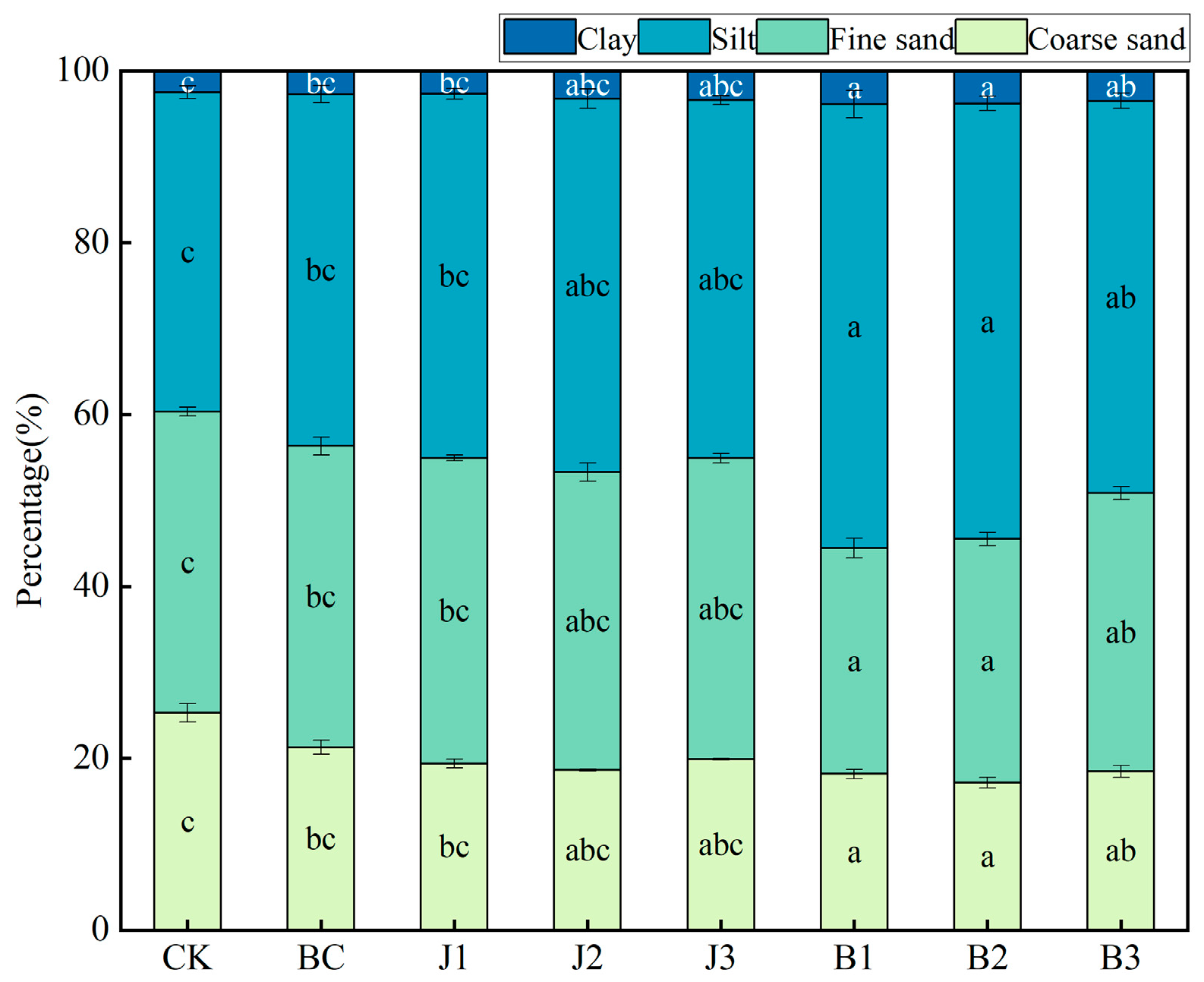
As shown in Figure 3, the microbial coating agent treatment groups all showed a significant reduction in the content of coarse sand particles in the soil compared to the CK group (p < 0.05). Among them, the B2 (growth-promoting bacteria coating agent) treatment group had the lowest coarse sand content at 17.19%, representing a reduction of 31.99% compared to CK. Both the B1 (rhizobium coating agent) and B2 (growth-promoting bacteria coating agent) treatment groups exhibited a significant decrease in fine sand content compared to CK (p < 0.05), with the respective fine sand contents of 26.26% and 28.31%, corresponding to reductions of 25.06% and 19.21%. Compared to CK, the microbial coating agent treatment groups significantly increased the silt and clay contents in the soil (p < 0.05). The B2 (growth-promoting bacteria coating agent) treatment group had the highest performance in this regard, with silt and clay contents of 50.71% and 3.79%, which were increases of 26.64% and 52.82% compared to CK, respectively.

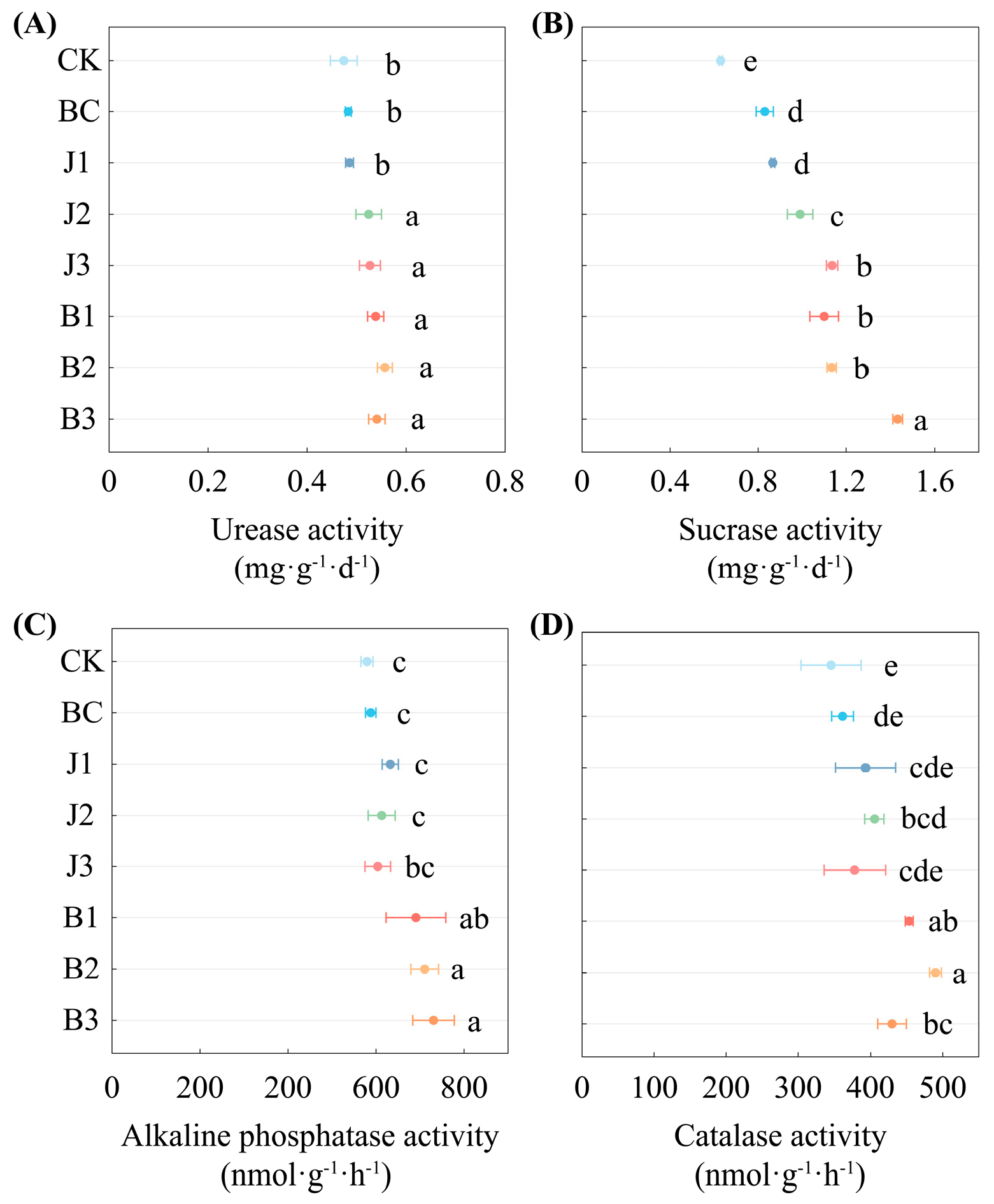
3.4. Effects of Microbial Coating Agents on Soil Enzyme Activities in Alfalfa

All treatments enhanced urease activity in alfalfa soil (Figure 4A). The J2, J3, B1, B2, and B3 treatment groups showed significant differences compared to CK (p < 0.05), with the B2 (plant growth-promoting bacterial coating agent) treatment group having the highest urease activity, an increase of 18.44% compared to CK.
As shown in Figure 4B, all treatments significantly increased sucrase activity in alfalfa soil compared to CK (p < 0.05), with the B3 (rhizobium and plant growth-promoting bacterial coating agent) treatment group exhibiting the highest sucrase activity, an increase of 127.51% compared to CK.
All treatments enhanced alkaline phosphatase activity in alfalfa soil (Figure 4C), with B1, B2, and B3 treatment groups showing significant differences compared to CK (p < 0.05), and the B3 (rhizobium and plant growth-promoting bacterial coating agent) treatment group having the highest alkaline phosphatase activity, an increase of 26.09% compared to CK.
As shown in Figure 4D, all treatments increased catalase activity in alfalfa soil, with J2, B1, B2, and B3 treatment groups showing significant differences compared to CK (p < 0.05), and the B2 (plant growth-promoting bacterial coating agent) treatment group having the highest catalase activity, an increase of 41.70% compared to CK.

3.5. Comprehensive Evaluation

3.5.1. Correlation Analysis

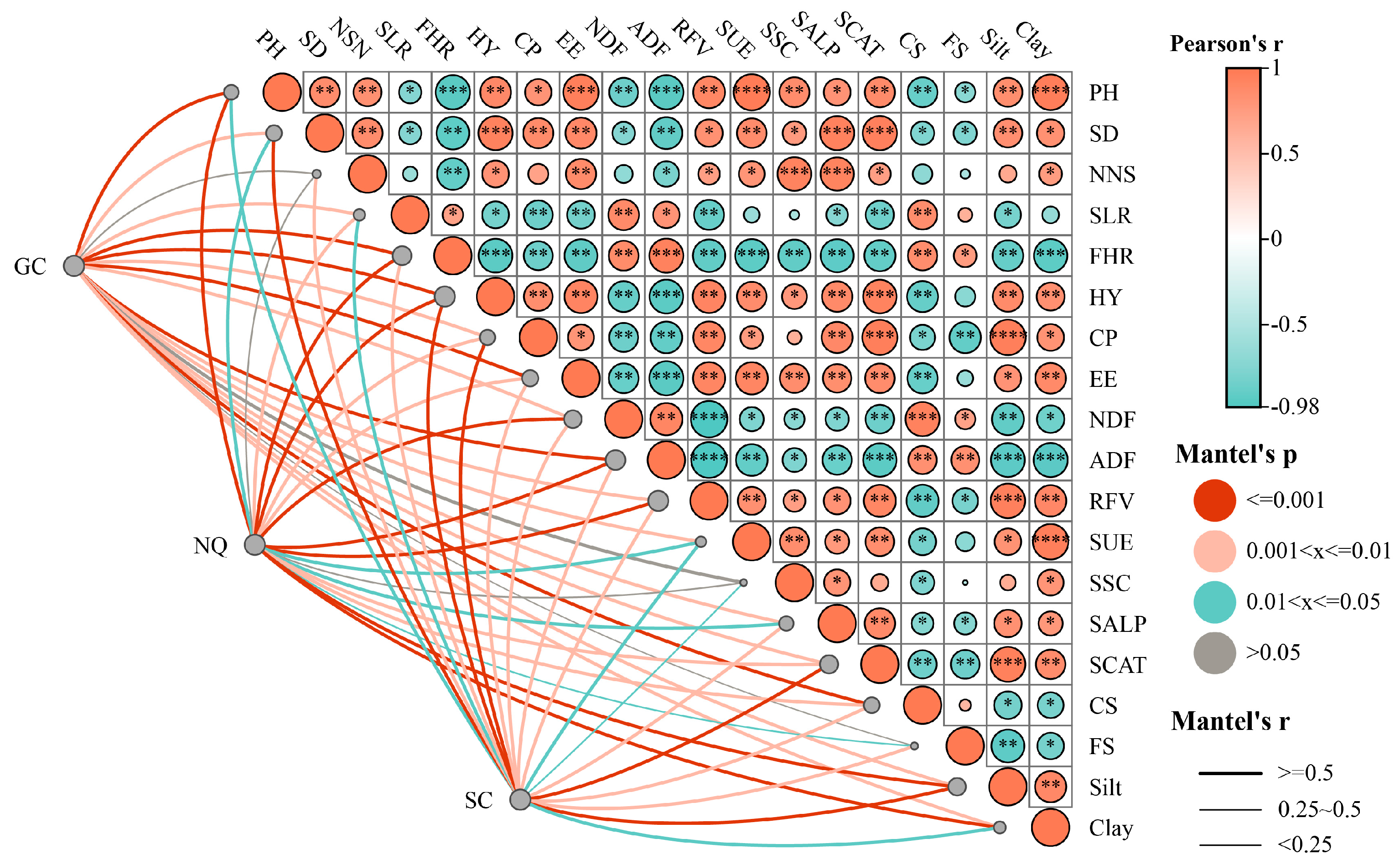
As illustrated in Figure 5, Correlation analysis was conducted between the production performance and nutritional quality indicators of alfalfa under different treatments and soil property indicators. Red represents a positive correlation between indicators, while blue represents a negative correlation. As shown in the figure, alfalfa HY is positively correlated with PH, SD, and NSN (p ≤ 0.01), negatively correlated with SLR and FHR (p ≤ 0.05), positively correlated with CP, EE, and RFV (p ≤ 0.05), negatively correlated with NDF and ADF (p ≤ 0.05), positively correlated with SUE, SSC, SALP, and SCAT (p ≤ 0.01), positively correlated with silt and clay (p ≤ 0.01), and negatively correlated with CS and FS (p ≤ 0.05). RFV is positively correlated with PH, HY, CP, and EE (p ≤ 0.01), positively correlated with SUE, SSC, SALP, and SCAT (p ≤ 0.01), and negatively correlated with SLR, FHR, NDF, ADF, CS, and FS (p ≤ 0.05).
GC has a strong influence on PH, FHR, HY, EE, ADF, and CS; NQ has a strong influence on PH, FHR, HY, NDF, ADF, RFV, Silt, and Clay; SC has a strong influence on SD, HY, CP, SCAT, and Silt; GC, NQ, and SC also show various correlations with the other different indicators.

3.5.2. TOPSIS Evaluation

A comprehensive evaluation of each treatment was conducted using the Technique for Order Preference by Similarity to Ideal Solution (TOPSIS) (Table 2). The results show that treatment B2 ranked first, while treatment CK ranked last. This indicates that alfalfa under treatment B2 can achieve the best overall benefits in terms of production performance, nutritional quality, soil particle size, and soil enzyme activity.

4. Discussion

Agronomic traits are core indicators for evaluating grassland production performance and the effects of cultivation management, directly reflecting plants’ responses to nutrient use efficiency, environmental adaptability, and interspecies competition. In addition, the plant height of alfalfa is an important indicator of yield and is closely related to production [29]. Plant height is a key indicator of forage production performance [30]. The results of this study indicate that microbial coating agent treatment significantly increased alfalfa plant height (15.46–17.76%), stem diameter (6.18–11.06%), number of stem nodes (7.69–15.65%), and yield (65.97–68.35%). Microbial seed soaking treatment increased alfalfa stem diameter (2.48–2.69%) and number of stem nodes (3.55–6.09%), while significantly enhancing plant height (6.55–13.09%) and yield (39.50–48.05%). Moreover, there were significant differences in plant height and yield between the microbial coating treatment group and the microbial seed soaking treatment group. Rocha et al. [31] also reported that, relative to non-inoculated control plants, seed coating with P. libanensis + multiple isolates of R. irregularis (coatPMR) resulted in significant increases in shoot dry weight (76%), and in the number of pods and seeds per plant (52% and 56%, respectively) and grain yield (56%); Liu et al. [32] isolated and screened two rhizobacterial strains, LJL-5 (Enterobacter aerogenes) and LJL-13 (Pseudomonas aeruginosa), both of which exhibited prominent 1-aminocyclopropane-1-carboxylate (ACC) deaminase activity. Field trial results further verified that the application of these two plant growth-promoting rhizobacteria (PGPR) elicited significant improvements in alfalfa plant height, fresh weight, dry weight, and forage yield under saline-alkali stress conditions. These results provide strong evidence that composite microbial seed coatings can promote growth-enhancing effects, which are attributed to the positive synergy among the constituent microbial populations rather than the effect of a single strain.
This experiment also found that the treatment group with microbial coating agents significantly reduced the fresh-to-hay ratio (24.59~27.48%) and stem-to-leaf ratio (14.33~23.19%) of alfalfa. This can be attributed to Pseudomonas, which is capable of converting insoluble phosphorus into a form that plants can absorb. The auxins and gibberellins it produces during metabolism can promote cell division and elongation, increasing stem thickness and the number of nodes. Acid phosphatase can improve nutrient use efficiency, thereby promoting the conversion of photosynthetic products into dry matter. At the same time, it reduces the proportion of excess water and ineffective tissue in stems and leaves, enhances palatability, lowers the content of neutral detergent fiber and acid detergent fiber, thereby improving relative feed value, and ultimately achieves a triple effect of lowering the fresh-to-dry ratio and stem-to-leaf ratio while increasing yield, palatability, and feed value.
Nutritional components are key indicators reflecting the quality of alfalfa; therefore, the nutritional quality of alfalfa can serve as one of the reference indicators for the overall effectiveness of microbial coatings. In our research, microbial coating treatment significantly reduced the neutral detergent fiber (NDF) content in alfalfa (decreased by 8.61–11.83%) and the acid detergent fiber (ADF) content (decreased by 11.03–14.54%), while significantly increasing the relative feed value (RFV) (by 14.56–20.58%). This indicates that the coating can significantly improve the feed quality of alfalfa by optimizing fiber structure and nutrient composition. Liu et al. [32] confirmed through field studies under saline-alkaline stress conditions that inoculating Enterobacter aerogenes (LJL-5) and Pseudomonas aeruginosa (LJL-13) could significantly increase the crude protein content of alfalfa while effectively reducing fiber components, providing direct field evidence for microbial regulation of alfalfa quality. Vessey et al. [33] provided core theoretical support for microbial regulation of crop quality from a mechanistic perspective. They pointed out that PGPR fertilizers function through multiple complex pathways: on one hand, they enhance the availability of nutrients in the rhizosphere, secrete siderophores, and collaboratively optimize the symbiotic system; on the other hand, they specifically promote the synthesis and metabolism of nutrients such as crude protein (CP) and crude fat (EE) while inhibiting the accumulation of inferior components like acid detergent fiber (ADF) and neutral detergent fiber (NDF). Ultimately, this achieves the dual goals of “high yield and quality” in crops, which also provides a clear theoretical basis for the application of microbial coatings in this study.
The results of this study indicated that all treatment groups with microbial coating agents showed a significant decrease in the content of coarse and fine sand particles and an increase in silt and clay particles compared to the CK group. Soil particles of different sizes have different physicochemical properties; therefore, to some extent, the soil particle size distribution determines the soil structure and properties. An increase in silt content is considered beneficial for improving soil aeration, water permeability, and nutrient retention. The total silt content in the three microbial coating agent treatments was higher than that of the control, while the total sand content was lower than the control. Overall, microbial coating agent treatments can increase the silt content in soil. Specifically, in the B2 treatment group, the soil particle composition showed significant differentiation, with coarse sand at 17.19% and fine sand at 28.31%, significantly lower than CK; silt content reached 50.71%, and clay content was 3.79%, significantly higher than CK. The cause of this phenomenon is still unclear and requires further investigation.
The increase in silt and clay content is crucial for improving soil quality: this particle fraction has a larger specific surface area and stronger adsorption capacity, which can enhance the soil’s ability to retain water and nutrients. Additionally, the increase in fine particles helps improve the stability of soil aggregates [34], reduces the risk of soil erosion, and creates a more suitable physical environment for microbial activity and crop root growth. Conversely, the reduction in the content of coarse and fine sand effectively alleviates the soil’s excessive aeration and permeability and loose structure, making the soil’s physical properties more balanced [35].
Soil enzymes act as catalysts in soil biochemical processes and play a crucial role in the soil ecosystem. The level of soil enzyme activity reflects the microbial activity and biochemical reactions in the soil, generally affecting soil fertility and plant growth and development [36]. This study found that microbial coatings have a significant regulatory effect on soil enzyme activity. The groups treated with microbial coatings showed significantly higher soil urease, sucrase, alkaline phosphatase, and catalase activities compared to the CK group. Specifically, the B2 treatment increased urease, sucrase, soil alkaline phosphatase, and catalase activities by 18.44%, 80.43%, 22.64%, and 41.70%, respectively, compared with the CK treatment. It has been reported that inoculation with Azospirillum brasilense and Burkholderia can increase urease activity in the rhizosphere soil of tomato (Lycopersicon esculentum L.), which is consistent with the findings of this study [37]. Ren et al. [38] studied the effects of applying Bacillus megaterium on soil enzyme activities in Eucalyptus L. plantations. The results showed that inoculation significantly increased sucrose and urease activities in the rhizosphere soil of eucalyptus. Furthermore, principal component analysis (PCA) performed by the authors indicated that the microbial inoculant had a notable positive effect on soil enzyme activity, further demonstrating that microbial inoculation helps maintain the stability of the soil ecosystem. Yang et al. [39] reported similar findings, demonstrating that the application of K. variicola in saline-alkali soil, soil enzyme activities were significantly enhanced: alkaline phosphatase activity increased by 146.08%, sucrase activity by 76.77%, urease activity by 86.60%, and catalase activity by 45.29%.
This study confirms that microbial coating treatment exert a dual beneficial effect: on the one hand, it significantly increase the plant height, stem diameter and number of nodes of alfalfa, thereby greatly enhancing hay yield, while also improving the nutritional quality of forage, achieving the dual optimization of higher palatability and lower fiber content; on the other hand, it can regulate soil particle composition and significantly increase the activity of key soil enzymes such as urease, invertase, alkaline phosphatase, and catalase. Moreover, because the effects of microbial coating treatment stem from microbial seed inoculation, microbial coating agents have high value for production and practical application.

5. Conclusions

Microbial coatings, especially probiotic coatings, can comprehensively improve the yield and nutritional quality of alfalfa from multiple aspects and have excellent soil-improving characteristics. They provide a green and sustainable technical pathway for promoting the high-quality development of the forage industry, while also holding significant theoretical and practical value for ecological restoration. This approach ultimately aims to boost the productivity and resilience of grassland agricultural ecosystems.

Author Contributions

Conceptualization, L.J. and T.Y.; methodology, L.J.; software, L.J.; validation, L.J.; formal analysis, L.J. and T.Y.; investigation, A.H., B.S., M.W. and X.H.; resources, T.Y.; data curation, L.J.; writing—original draft preparation, L.J.; writing—review and editing, L.J. and T.Y.; visualization, L.J.; supervision, T.Y.; project administration, T.Y.; funding acquisition, T.Y. All authors have read and agreed to the published version of the manuscript.

Funding

This research was funded by the National Forage Industry Technology System Program (No. CARS-34) and Doctoral Research Start-up Project ‘Mechanistic Study of the Effects of Biofertilizers on the Growth of Alfalfa and Soil Quality Improvement’ (GAU-KYQD-2022-48).

Data Availability Statement

The data presented in this study are available upon request from the corresponding author.

Acknowledgments

The authors thank Xiaolei Yang and Sitong Cheng of Gansu Agricultural University for all their help during the experiment.

Conflicts of Interest

The authors declare no conflicts of interest.

Abbreviations

The following abbreviations are used in this manuscript:
PHPlant height
SDStem diameter
NSNNumber of stem nodes
SLRStem-to-leaf ratio
FHRFresh-to-hay ratio
HYHay yield
CPCrude protein
EECrude fat
NDFNeutral detergent fiber
ADFAcid detergent fiber
RFVXRelative feed value
SUESoil urease
SSCSoil sucrase
SALPSoil alkaline phosphatase
SCATSoil catalase
CSCoarse sand
FSFine sand
GCGrowth performance
NQNutritional quality
SCSoil properties

References

  1. Yang, X.; Li, Q.; Bai, X.; Li, C.; Li, X.; Yao, T. Optimal fermentation of Pseudomonas synxantha M1 and metabolomics analysis. Prep. Biochem. Biotechnol. 2024, 55, 502–512. [Google Scholar] [CrossRef]
  2. Li, M.; Wang, J.; Yao, T.; Wang, Z.; Zhang, H.; Li, C. Isolation and Characterization of Cold-Adapted PGPB and Their Effect on Plant Growth Promotion. J. Microbiol. Biotechnol. 2021, 31, 1218–1230. [Google Scholar] [CrossRef] [PubMed]
  3. Zhou, D.; Huang, X.F.; Chaparro, J.M.; Badri, D.V.; Manter, D.K.; Vivanco, J.M.; Guo, J. Root and bacterial secretions regulate the interaction between plants and PGPR leading to distinct plant growth promotion effects. Plant Soil 2016, 401, 259–272. [Google Scholar] [CrossRef]
  4. Qin, Y.; Druzhinina, I.S.; Pan, X.; Yuan, Z. Microbially Mediated Plant Salt Tolerance and Microbiome-Based Solutions for Saline Agriculture. Biotechnol. Adv. 2016, 34, 1245–1259. [Google Scholar] [CrossRef] [PubMed]
  5. Gao, J.; Luo, Y.; Wei, Y.; Huang, Y.; Zhang, H.; He, W.; Sheng, H.; An, L. Screening of Plant Growth Promoting Bacteria (PGPB) from Rhizosphere and Bulk Soil of Caragana microphylla in Different Habitats and Their Effects on the Growth of Arabidopsis Seedlings. Biotechnol. Biotechnol. Equip. 2019, 33, 921–930. [Google Scholar] [CrossRef]
  6. Li, H.; Qiu, Y.; Yao, T.; Ma, Y.; Zhang, H.; Yang, X. Effects of PGPR Microbial Inoculants on the Growth and Soil Properties of Avena sativa, Medicago sativa, and Cucumis sativus Seedlings. Soil Tillage Res. 2020, 199, 104577. [Google Scholar] [CrossRef]
  7. Gupta, A.; Gopal, M.; Thomas, G.V.; Manikandan, V.; Gajewski, J.; Thomas, G.; Seshagiri, S.; Schuster, S.C.; Rajesh, P.; Gupta, R. Whole Genome Sequencing and Analysis of Plant Growth Promoting Bacteria Isolated from the Rhizosphere of Plantation Crops Coconut, Cocoa and Arecanut. PLoS ONE 2014, 9, e104259. [Google Scholar] [CrossRef]
  8. Sarkar, J.; Chakraborty, B.; Chakraborty, U. Plant growth promoting rhizobacteria protect wheat plants against temperature stress through antioxidant signalling and reducing chloroplast and membrane injury. J. Plant Growth Regul. 2018, 37, 1396–1412. [Google Scholar] [CrossRef]
  9. Kloepper, J.W.; Lifshitz, R.; Zablotowicz, R.M. Free-Living Bacterial Inocula for Enhancing Crop Productivity. Trends Biotechnol. 1989, 7, 39–44. [Google Scholar] [CrossRef]
  10. Nadeem, S.M.; Ahmad, M.; Zahir, Z.A.; Javaid, A.; Ashraf, M. The Role of Mycorrhizae and Plant Growth Promoting Rhizobacteria (PGPR) in Improving Crop Productivity under Stressful Environments. Biotechnol. Adv. 2014, 32, 429–448. [Google Scholar] [CrossRef]
  11. De Vries, F.T.; Griffiths, R.I.; Knight, C.G.; Nicolitch, O.; Williams, A. Harnessing Rhizosphere Microbiomes for Drought-Resilient Crop Production. Science 2020, 368, 270–274. [Google Scholar] [CrossRef]
  12. Radović, J.; Sokolović, D.; Marković, J. Alfalfa-Most Important Perennial Forage Legume in Animal Husbandry. Biotechnol. Anim. Husb. 2009, 25, 465–475. [Google Scholar] [CrossRef]
  13. Sun, Y.; Sun, J.; Wang, X.; Cartmill, A.D.; López, I.F.; Ma, C.; Zhang, Q. Nitrogen and Phosphorus Fertilizer Use Efficiency Improves Alfalfa (Medicago sativa L.) Production and Performance in Alkaline Desert Soil. Front. Plant Sci. 2025, 16, 1526648. [Google Scholar] [CrossRef] [PubMed]
  14. Bhandari, K.B.; West, C.P.; Acosta-Martinez, V. Assessing the Role of Interseeding Alfalfa into Grass on Improving Pasture Soil Health in Semi-Arid Texas High Plains. Appl. Soil Ecol. 2020, 147, 103399. [Google Scholar] [CrossRef]
  15. Bora, K.S.; Sharma, A. Phytochemical and Pharmacological Potential of Medicago sativa: A Review. Pharm. Biol. 2011, 49, 211–220. [Google Scholar] [CrossRef]
  16. Hadidi, M.; Palacios, J.C.O.; McClements, D.J.; Mahfouzi, M.; Moreno, A. Alfalfa as a Sustainable Source of Plant-Based Food Proteins. Trends Food Sci. Technol. 2023, 135, 202–214. [Google Scholar] [CrossRef]
  17. Kaufman, G. Seed Coating: A Tool for Stand Establishment; a Stimulus to Seed Quality. HortTechnology 1991, 1, 98–102. [Google Scholar] [CrossRef]
  18. Gong, M.; He, J.; Kong, M.; Huo, Q.; Jiang, Y.; Song, J.; Han, W.; Lv, G. A Microencapsulation Approach to Design Microbial Seed Coatings to Boost Wheat Seed Germination and Seedling Growth under Salt Stress. Front. Plant Sci. 2023, 14, 1283590. [Google Scholar] [CrossRef]
  19. Paravar, A.; Piri, R.; Balouchi, H.; Ma, Y. Microbial Seed Coating: An Attractive Tool for Sustainable Agriculture. Biotechnol. Rep. 2023, 37, e00781. [Google Scholar] [CrossRef]
  20. Sikhao, P.; Taylor, A.G.; Marino, E.T.; Catranis, C.M.; Siri, B. Development of Seed Agglomeration Technology Using Lettuce and Tomato as Model Vegetable Crop Seeds. Sci. Hortic. 2015, 184, 85–92. [Google Scholar] [CrossRef]
  21. Beesley, L.; Moreno-Jiménez, E.; Gomez-Eyles, J.L.; Harris, E.; Robinson, B.; Sizmur, T. A Review of Biochars’ Potential Role in the Remediation, Revegetation and Restoration of Contaminated Soils. Environ. Pollut. 2011, 159, 3269–3282. [Google Scholar] [CrossRef]
  22. Cortés-Rojas, D.; Beltrán-Acosta, C.; Zapata-Narvaez, Y.; Chaparro, M.; Gómez, M.; Cruz-Barrera, M. Seed Coating as a Delivery System for the Endophyte Trichoderma koningiopsis Th003 in Rice (Oryza sativa). Appl. Microbiol. Biotechnol. 2021, 105, 1889–1904. [Google Scholar]
  23. Ji, L.; He, A.; He, F.; Li, C.; Yao, T. Screening of Alfalfa Seed Coating Materials and Theirs Effect on Seed Germination. Acta Agrestia Sin. 2025, 33, 2728−2736. [Google Scholar]
  24. Yao, T. Research and Application of Plant Rhizosphere Growth-Promoting Bacteria; Chinese Agricultural Press: Beijing, China, 2021; pp. 32–38. [Google Scholar]
  25. Wu, K.; Zhao, R. Soil Texture Classification and Its Application in China. Acta Pedol. Sin. 2019, 56, 227–241. [Google Scholar]
  26. Zhang, L.Y. Feed Analysis and Feed Quality Testing Technology; Chinese Agricultural Press: Beijing, China, 2007; pp. 52–70. [Google Scholar]
  27. Guang, S.Y.; Zhang, D.; Zhang, Z. Soil Enzymes and Their Research Methods; Chinese Agricultural Press: Beijing, China, 1986; pp. 274–297. [Google Scholar]
  28. Chen, C.T. Extensions of the TOPSIS for Group Decision-Making under Fuzzy Environment. Fuzzy Sets Syst. 2000, 114, 1–9. [Google Scholar] [CrossRef]
  29. Jing, F.; Shi, S.; A, Y.; Guan, J.; Lu, B.; Wu, B.; Wang, W.; Ma, R.; Nan, P. Analysis of Phenotypic and Physiological Characteristics of Plant Height Difference in Alfalfa. Agronomy 2023, 13, 1744. [Google Scholar] [CrossRef]
  30. Wang, X.; Wang, J.; Li, E.; Guo, Y.; Li, W. Plant Height Is the Main Factor Driving Forage Yield of Poa Species under Different Row Spacings and Seeding Rates in the Qilian Mountains. Front. Plant Sci. 2025, 16, 1535937. [Google Scholar] [CrossRef]
  31. Rocha, I.; Souza-Alonso, P.; Pereira, G.; Ma, Y.; Vosátka, M.; Freitas, H.; Oliveira, R.S. Using Microbial Seed Coating for Improving Cowpea Productivity under a Low-Input Agricultural System. J. Sci. Food Agric. 2020, 100, 1092–1098. [Google Scholar] [CrossRef]
  32. Liu, J.; Tang, L.; Gao, H.; Zhang, M.; Guo, C. Enhancement of Alfalfa Yield and Quality by Plant Growth-promoting Rhizobacteria under Saline-alkali Conditions. J. Sci. Food Agric. 2019, 99, 281–289. [Google Scholar]
  33. Vessey, J.K.; Heisinger, K.G. Effect of Penicillium bilaii Inoculation and Phosphorus Fertilisation on Root and Shoot Parameters of Field-Grown Pea. Can. J. Plant Sci. 2001, 81, 361–366. [Google Scholar] [CrossRef]
  34. Guber, A.K.; Pachepsky, Y.A.; Levkovsky, E.V. Fractal Mass–Size Scaling of Wetting Soil Aggregates. Ecol. Model. 2005, 182, 317–322. [Google Scholar] [CrossRef]
  35. Ma, R.; Dou, S.; Zhang, Y.; Wu, D.; Ndzelu, B.S.; Xie, S.; YaLiHong, D. Different Soil Particle Size Changes the 15N Retention in Soil and 15N Utilization by Maize. Sci. Total Environ. 2022, 843, 157133. [Google Scholar] [CrossRef]
  36. Wang, G.; Zhang, L.; Zhang, S.; Li, B.; Li, J.; Wang, X.; Zhang, J.; Guan, C.; Ji, J. The Combined Use of a Plant Growth Promoting Bacillus sp. Strain and GABA Promotes the Growth of Rice under Salt Stress by Regulating Antioxidant Enzyme System, Enhancing Photosynthesis and Improving Soil Enzyme Activities. Microbiol. Res. 2023, 266, 127225. [Google Scholar] [CrossRef]
  37. Madhaiyan, M.; Poonguzhali, S.; Kang, B.G.; Lee, Y.J.; Chung, J.B.; Sa, T.M. Effect of Co-Inoculation of Methylotrophic Methylobacterium oryzae with Azospirillum brasilense and Burkholderia pyrrocinia on the Growth and Nutrient Uptake of Tomato, Red Pepper and Rice. Plant Soil 2010, 328, 71–82. [Google Scholar] [CrossRef]
  38. Ren, H.; Qin, X.; Huang, B.; Fernández-García, V.; Lv, C. Responses of Soil Enzyme Activities and Plant Growth in a Eucalyptus Seedling Plantation Amended with Bacterial Fertilizers. Arch. Microbiol. 2020, 202, 1381–1396. [Google Scholar] [CrossRef]
  39. Yang, L.; Yang, K. Biological Function of Klebsiella variicola and Its Effect on the Rhizosphere Soil of Maize Seedlings. PeerJ 2020, 8, e9894. [Google Scholar] [CrossRef]
Figure 1. Effect of microbial coating agents on the production performance of alfalfa. (A) Effect of microbial coating agent treatment on plant height of alfalfa. (B) Effect of microbial coating agent treatment on stem diameter of alfalfa. (C) Effect of microbial coating agent treatment on the number of alfalfa stem nodes. (D) Effect of microbial coating agent treatment on stem-to-leaf ratio of alfalfa. (E) Effect of microbial coating agent treatment on fresh-to-hay ratio of alfalfa. (F) Effect of microbial coating agent treatment on hay yield of alfalfa. Different lowercase letters in the figure indicate significant differences (p < 0.05).
Agronomy 16 00172 g001
Figure 2. The Effect of Microbial Coating Agent on the Nutritional Quality of Alfalfa. (A) Effect of microbial coating treatment on the crude protein of alfalfa. (B) Effect of microbial coating treatment on the crude fat of alfalfa. (C) Effect of microbial coating treatment on the neutral detergent fiber of alfalfa. (D) Effect of microbial coating treatment on the acid detergent fiber of alfalfa. (E) Effect of microbial coating treatment on the relative feed value of alfalfa. Different lowercase letters indicate significant differences at the 0.05 level.
Agronomy 16 00172 g002
Figure 3. The effect of microbial coating agents on soil particle size of alfalfa. Different lowercase letters indicate significant differences at the 0.05 level.
Agronomy 16 00172 g003
Figure 4. Effect of microbial coating agents on soil enzyme activity in alfalfa. (A) Effect of microbial coating treatment on urease activity in alfalfa soil. (B) Effect of microbial coating treatment on sucrase activity in alfalfa soil. (C) Effect of microbial coating treatment on alkaline phosphatase activity in alfalfa soil. (D) Effect of microbial coating treatment on catalase activity in alfalfa soil. Different lowercase letters indicate significant differences at the 0.05 level.
Agronomy 16 00172 g004
Figure 5. Correlation analysis of various indicators of alfalfa. PH, plant height; SD, stem diameter; NSN, number of stem nodes; SLR, stem-to-leaf ratio; FHR, fresh-to-hay ratio; HY, hay yield; CP, crude protein; EE, crude fat; NDF, neutral detergent fiber; ADF, acid detergent fiber; RFV, relative feed value; SUE, soil urease; SSC, soil sucrase; SALP, soil alkaline phosphatase; SCAT, soil catalase; CS, coarse sand; FS, fine sand; GC, growth performance; NQ, nutritional quality; SC, soil properties. “*” indicates p < 0.05; “**” indicates p < 0.01; “***” indicates p < 0.001 and “****” indicates p < 0.0001.
Agronomy 16 00172 g005
Table 1. Field test treatment.
TreatmentProcessing MethodRemarks
CKbare seeds-
BCadhesive filler coated agent-
J1seed soaking with rhizobium agentGAU-123 seed soaking
J2seed soaking with growth-promoting agentLrM2+MBQ3 seed soaking
J3seed soaking with rhizobium + growth-promoting agentGAU-123+LrM2+MBQ3 seed soaking
B1rhizobium coating agentGAU-123 coating agent
B2growth-promoting bacteria coating agentMBQ3+LrM2 coating agent
B3Rhizobium+growth-promoting bacteria coating agentGAU-123+ MBQ3+LrM2 coating agent
Table 2. TOPSIS model was established to comprehensively evaluate the growth-promoting effect of composite microbial coating.
TreatmentPositive Ideal Solution Distance (D+)Negative Ideal Solution Distance (D−)Relative Proximity (C)Ranking Results
CK2.570.040.028
BC2.160.580.217
J11.721.130.406
J21.611.120.415
J31.511.310.464
B10.652.150.772
B20.402.370.861
B30.782.050.733
Disclaimer/Publisher’s Note: The statements, opinions and data contained in all publications are solely those of the individual author(s) and contributor(s) and not of MDPI and/or the editor(s). MDPI and/or the editor(s) disclaim responsibility for any injury to people or property resulting from any ideas, methods, instructions or products referred to in the content.