Article

Can the Application of Microbial Inocula Allow for Reducing Phosphate Fertilisation Rates in Open Field Tomato Crops?


1
The National Institute of Horticultural Research, Konstytucji 3 Maja 1-3, 96-100 Skierniewice, Poland
2
CREA Center for Viticulture and Enology, Via Micca 35, 14100 Asti, Italy
*
Authors to whom correspondence should be addressed.
Agronomy 2026, 16(2), 170; https://doi.org/10.3390/agronomy16020170
Submission received: 28 November 2025 / Revised: 5 January 2026 / Accepted: 7 January 2026 / Published: 9 January 2026

Abstract

In addition to its obvious benefits, mineral fertilisation also poses a number of threats to the environment. A four-year study was conducted to verify the possibility of integrating the application of a bacterial consortium to reduce the dose of mineral phosphorus (P) fertilisers in field-grown tomato crops without negative effects on yield. The combination of the microbial consortium with a 60% dose of both simple and complex P fertilisers did not show statistical differences in crop productivity and fruit quality compared to the full dose fertilisation each year, even when considering the cumulative yield. This was paralleled by a similar level of leaf chlorophyll index. Plants grown in rhizoboxes showed that the inoculation favoured, in the case of the complex fertiliser, a modification of the root system architecture, though not confirmed statistically. In the case of this kind of fertiliser, the inoculation induced a significant increase in the rhizospheric bacterial metabolic activity, which could be partly accounted for by the agronomic performance. However, this was not paralleled by a modification of the metabolic biodiversity of the bacterial population. The study demonstrated that, for highly demanding crops such as tomato, a valid agrononomic target for the application of microbial-based products integrated into a reduced mineral P fertilisation strategy could reach crop productivity not different from that obtained without them. Such a strategy could favour the adoption of an integrated nutrient management strategy by farmers, with positive impacts also on the environment.

1. Introduction

Research into the introduction of new solutions in the agricultural sector is necessary to achieve the objectives set out in the European Union’s strategic action plan introduced in December 2019, known as the Green Deal. One of its strategies, “From Farm to Fork,” aims to reduce the use of pesticides, antibiotics, and fertilisers.
It is estimated that the lives of almost half of the world’s population depend on the application of artificial fertilisers in agricultural crops [1], which explains the almost thirteenfold increase in their use in the period from 1950 to 2013 [2]. However, even though effective plant nutrient management should be based on soil chemical analysis, this is not always the case, resulting in excessive application of fertilisers, which is reflected in a low nutrient use efficiency and negative environmental impact. Indeed, particularly for vegetable crops, a significant part of the nutrients provided by fertilisers, instead of being absorbed by plants, is wasted in the natural environment, including water [1,3,4], reduces the biodiversity of soil microorganisms [5], and can become a major environmental problem. Even though the causes of inefficiency in P-use are different for highly P-sorbing soils (e.g., accumulation of P in soil) or for soils with low P-sorption capacity, an appropriate and sustainable soil fertility management is applicable to both cases.
A strategy to address the excessive use of artificial fertilisers is to integrate them with the application of appropriate strains of microorganisms. Currently, microbial-based products that serve as potential alternatives or complements to synthetic fertilisers and pesticides in agriculture are among the fastest-growing sectors in agriculture. A variety of bacteria and fungi have the ability to increase nutrient uptake by plants by colonising the rhizosphere and making mineral nutrients readily available to plants [6,7,8]. However, as for other agronomical practices, their effective application is closely related to the conditions in which they are used. Factors related to their production process [9], their persistence in the soil environment [10], the relations with the plant [11], the soil conditions, and the farmers’ practices (fertilisation, soil management practices, application method) [6] can strongly influence the outcome of microbial biostimulants. To reduce some of these limitations, the selection of the strains from the native microbiome of the soils where they would be applied, as they are adapted to local environmental conditions, could be a suitable strategy [12]. Recently, the marketing of microbial inocula has been regulated in the EU [13], classifying them as microbial biostimulants. Products of this category are defined as stimulating plant nutrition processes independently of the product’s nutrient content, improving the plant nutrient use efficiency, tolerance to abiotic stress, and quality traits by increasing the availability of confined nutrients in soil or rhizosphere.
The objective of the study was, thus, to assess, within a pluriannual term, the agronomical performance of a formulated bacterial consortium, selected for the phosphorus solubilization capacity of its strains, to integrate mineral phosphorus fertilisers in open field tomato production. The novelty compared to other works lies in the use of a formulated product containing various strains, unlike the use of single strains in non-formulated bioinocula, a frequent and common method of application of plant growth-promoting bacteria in research works, which does not consider the impact of the formulation on the efficacy of the product [9]. Moreover, the 4-year-long period of application of the formulated product considered in the study also provided results suitable to define practical indications for operators (farmers and advisors) to exploit bioinocula within their fertilisation strategies. The hypothesis tested was that the formulation would allow for achieving at least the same yield of the crop fertilised with a standard dose of mineral fertilisers. Moreover, to better understand the effect of the consortium on the plant physiology, an experiment was carried out using rhizoboxes to assess the effect on plant growth and rhizospheric soil microbial activity.

2. Materials and Methods

2.1. Field Trial Set Up

The field trials were carried out during a period of four years (2018–2021) in the experimental field of the National Institute of Horticultural Research (INHORT) in Skierniewice (Central Poland). The soil of the experimental field was characterised by a sandy loamy texture (18% silt, 6% clay, and 76% sand), with a bulk density of 1.55 (g/cm3), pH 6.4, 1.8% organic matter, and 82 mg/kg of total P. The trials were set up using the tomato variety Calista, applying a randomised block design with four replicates for each treatment (each replicate plot with an area of 6.8 m2). The tomato seedlings planted for the trials were obtained in a greenhouse under optimal conditions for tomato growth and development, sowing the seeds in multiplates filled with peat substrate. Before applying the fertilisers, soil samples were collected for chemical analysis.
Two fertilisers commonly utilised for the provision of phosphorus were applied: a simple phosphate fertiliser (Super fosdar 40, Grupa Azoty, Puławy, Poland; 0-40-0 NPK—“SF”) and a complex fertiliser (Polifoska 6, Grupa Azoty, Puławy, Poland; 6-20-30 NPK—“CF”) applied at a full or reduced dose (60% of the full dose—“60% fert.”), in conjunction with a consortium made up of three bacterial strains. The standard full dose of the fertilisers (80 kg/ha P2O5) without the addition of the bacterial consortium was considered as the control (“100% fert.”). The reduction of 40% for the P fertilisers was based on preliminary trials carried out in pots and taking into consideration previous works (e.g., [6,8]). Even though a treatment applying 60% phosphorus fertilisation without microbial inoculation could have allowed separating the effects of fertiliser reduction from those of microbial inoculation, it was not included in the trial as it would not be a feasible treatment for agronomical practice, particularly when considering the length of the trial. The nitrogen and potassium provided with the complex fertiliser were adjusted to provide the same amount of the two nutrients in all treatments by applying potassium sulphate before transplanting (in total 192 kg/ha K2O) and ammonium nitrate distributed in two split doses (in total 150 Kg/ha N).
The microbial consortium consisted of the strains Paenibacillus polymyxa CHT114AB, Priestia sp. CZP4/4, and Bacillus sp. AF75BB. The two former strains had been isolated from the rhizosphere soil of wheat sown in czernozem soil from Ukraine, while the latter was isolated from the rhizosphere soil of the grape rootstock 5BB grown in the Experimental Orchard of INHORT. All of them were characterised by a strong P-solubilizing feature. A formulation of the bacterial consortium with maltodextrin as carrier was prepared, adding each of the three bacterial strains (each with a concentration of at least 1.5 × 10⁷ cfu/g) with equal weight ratios (1:1:1). The formulation was applied immediately after preparation when transplanting the plants and again after about one month, distributed on the soil near the plants and incorporated with a light tillage. In the field, the weight ratio of the fertilisers and the bacterial consortium was 85:15, which resulted in an application of the microbial consortium of about 20 kg/ha, resulting in an average concentration of about 4 × 10⁷ cfu/m2.

2.2. Field Trials Measurements

Non-invasive measurements of chlorophyll and flavonoid content were performed on young, fully grown, and formed leaves using the DUALEX® device (ForceA, Paris, France), according to the company method. The Nitrogen Balance Index (NBI) coefficient was determined by the device based on the ratio of chlorophyll to flavonoid content.
Fruit harvesting was performed once a week, and the weight was used to determine total yield. Moreover, the commercial quality of the fruits was assessed considering three fruit size categories: (1) Ø > 7 cm; (2) Ø 3.5–7 cm; (3) Ø < 3.5 cm. In addition, the proportion of cracked, diseased, and green fruits was determined to calculate the weight of fruits with commercial quality.

2.3. Rhizobox Experiment

The tomato plants were planted in rhizoboxes filled with the soil collected from the site where the field trials were conducted. Fertilisation in the rhizoboxes was analogous to that applied in the field, converting the dose to the volume of one chamber (1 dm3). Each chamber was filled with the soil that had been previously mixed with fertilisers and a bacterial consortium, and then the tomato seedlings were planted. Two double-chamber rhizoboxes constituted a replicate (4 plants).

2.4. Rhizobox Experiment Measurements

Plant growth was assessed 2 months after planting by measuring the total dry weight of the plant, as well as of the shoots and root system separately.
The root system architecture was assessed by scanning the root system with an EPSON Expression 10000 XL scanner (Epson Europe Electronics GmbH, Munich, Germany) and analysing the images with WinRhizo software ver. 2009c (Regent Instruments Inc., Québec City, QC, Canada).
EcoPlate (Biolog Inc., Newark, DE, USA) was used to assess the biodiversity and activity of bacteria colonising the rhizosphere soil. At the end of the experiment, a small amount of roots was collected from each plant growing in the rhizobox, from which the rhizosphere soil was separated using a vortex mixer at a speed of 4500 rpm and suspended in sterile distilled water in a 1:9 ratio. From the suspension, a series of successive tenfold dilutions in sterile distilled water was prepared. Suspensions diluted at a ratio of 1:1000 were used to inoculate EcoPlate plates, which were incubated at 26 °C for 72 h and then read using an ELx 808 titration plate reader (Agilent BioTek, Winooski, VE, USA). The microbial activity (AWCD) was estimated based on the activity of dehydrogenase enzymes determined by a colour reaction (reduction of tetrazolium salt to formazan by NADH). The following formula was used to determine the activity:
AWCD = Σ ODi/31
where ODi is the optical density of each well [14,15].
The microbial diversity was estimated using the Shannon–Weaver index (H):
H = −Σ pi(ln pi),
where pi is the level of microbial activity in individual wells (ODi) divided by the sum of activity in all wells (Σ ODi).
When assessing the level of microbial activity and the H index, the background OD level value of the control well was deducted.

2.5. Statistical Analysis

Results were estimated using Student’s t-test, and one-way analysis of variance (ANOVA) with Newman-Keuls’ post-hoc test at p ≤ 0.05, also determining Cohen’s d effect size. The effect of the year (season) as a random factor was verified with two-way ANOVA for yield data from the field trials. Two-way ANOVA was also carried out to assess the impact of the kind of fertiliser (SF and CF) in relation to the application of the microbial inoculum. The statistical analyses were carried out with IBM SPSS Statistics, version 31.0.0.0 (IBM Corp., Armonk, NY, USA).

3. Results

3.1. Effect of the Integration of the Bacterial Consortium in the Fertilisation Management on Agronomic Performance of Tomato Plants Under Open Field Cultivation

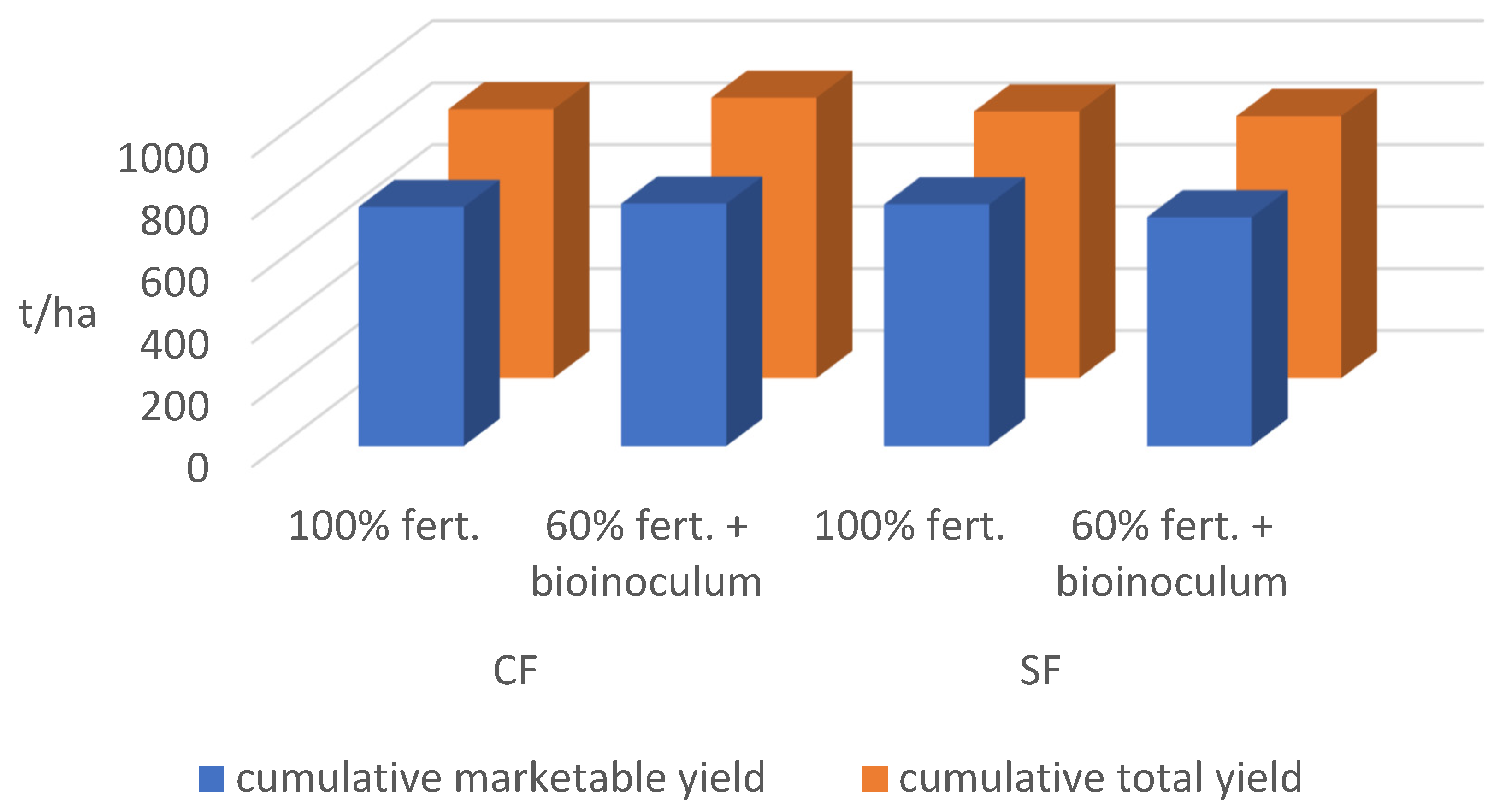
The reduction in the amount of mineral fertilisers applied together with the bacterial consortium did not affect the total yield of the tomato plants during the four years of the trial, irrespective of the kind of fertiliser used, which averaged 217.5 t/ha (Table 1). The season significantly affected the yield, but this effect was derived from the significantly higher yield obtained in 2019 compared to that obtained in the other three years, which did not differ significantly from each other (Table 1). Interestingly, the effect size in the various years was generally medium or high, suggesting a consistent effect of the treatment in comparison to the full fertilisation. No significant effect was observed when considering the fertiliser type or the microbial inoculum on total yield (F1,60 = 0.264, p = 0.610), including the interaction between fertiliser type and treatment (F1,60 = 0.160, p = 0.690), suggesting that the effect of microbial inoculation did not differ depending on the fertiliser used. Moreover, when evaluating the effect of the two phosphorus fertilisers (complex or simple) and microbial inoculation (100% fertilisation or 60% fert. + bioinoculum) over the four-year period of the trial, there was no significant difference (p = 0.805 in the case of CF and p = 0.942 in the case of SF) on cumulative total yield, which averaged about 860 t/ha (Figure 1).
Analogous results were obtained when considering the yield of fruits with suitable commercial quality (Table 1). The application of the bacterial consortium with a reduced rate of the mineral fertilisers showed no difference in the commercial yield compared to the full fertilisation dose, irrespective of the kind of fertiliser used, and with a medium or high effect size. On average, the yearly yield was 192.1 t/ha, i.e., about 11% less than the total yield. The lack of statistical differences was also observed when considering the cumulative commercial yield (Figure 1), which was similar for both CF (on average 776 t/ha, p = 0.954) and SF fertilisers (on average 759 t/ha, p = 0.856).
The higher total and marketable yield obtained in 2019 in all treatments compared to all other years was due to the very optimal climatic conditions of that season (see meteorological data provided as Supplementary Materials Figure S1).
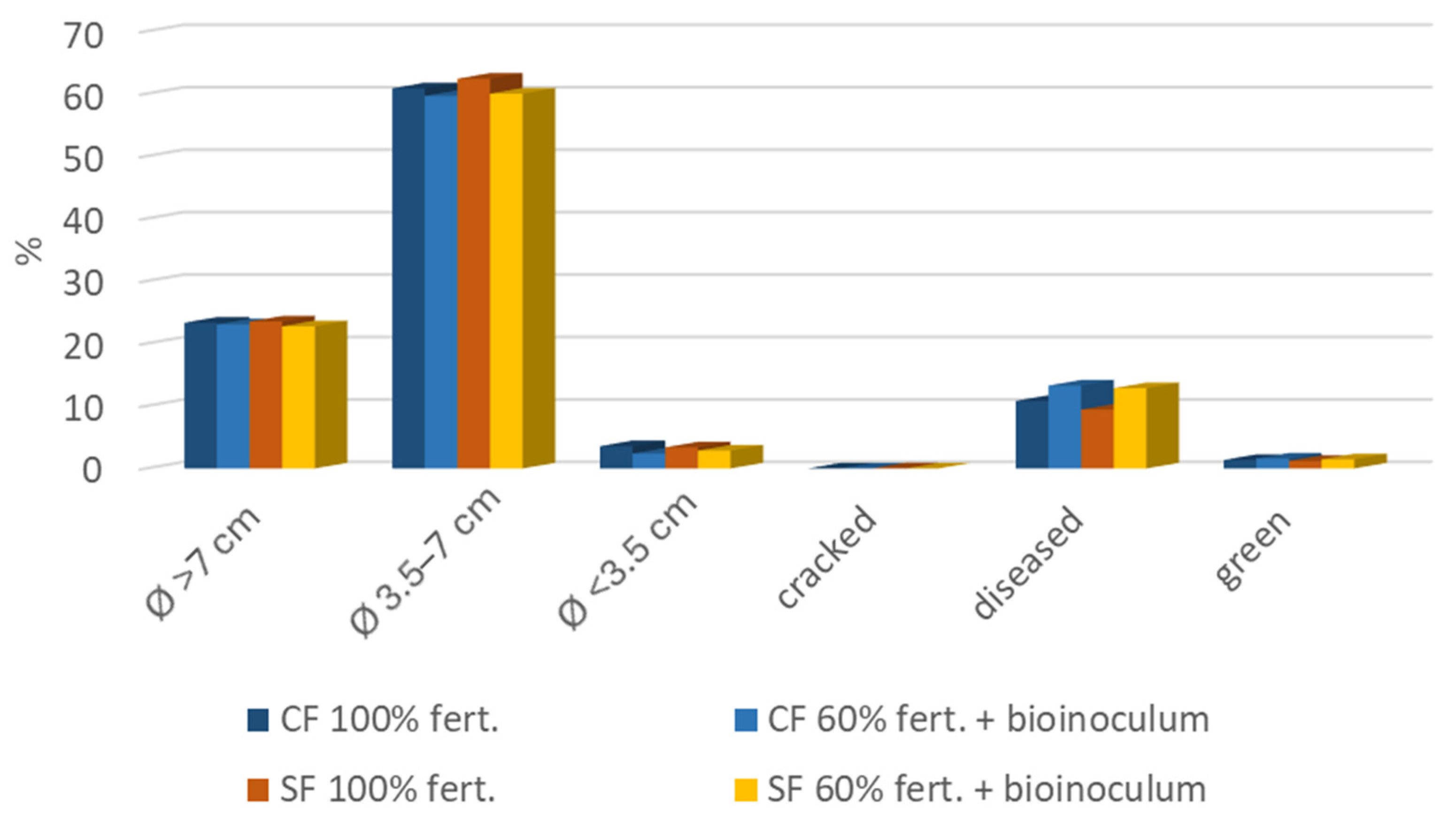
The reduced dose combined with the bioinoculum application of both kinds of fertilisers did not alter the quality of the tomato fruits, considering the frequency of fruits belonging to the three size categories or the incidence of damaged fruits (Figure 2).

3.2. Effect of the Integration of the Bacterial Consortium in the Fertilisation Management on the Physiology of Tomato Plants

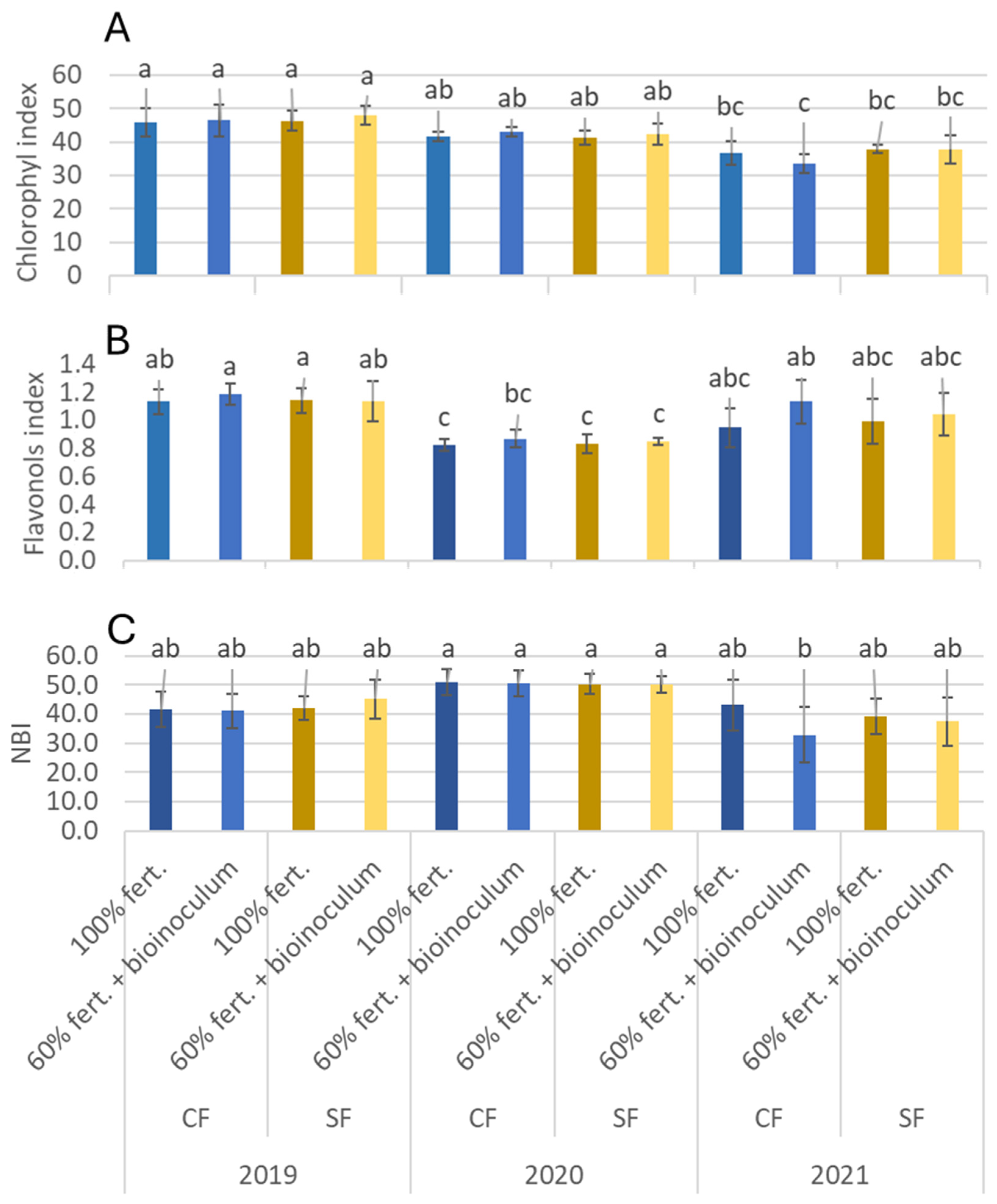
The chlorophyll content index was not affected by the integration of the bacterial consortium to a reduced amount of mineral fertilisation, independently of the fertiliser used, when considering the comparison between the two treatments within each season (Figure 3A). On average, during the three years, the chlorophyll index was 41.75. However, the highest index was determined in 2019 (on average 46.66 for all treatments), which is significantly higher than that measured in 2021, for both kinds of fertilisers, irrespective of the treatment.
A fluctuation in the flavonol content of the tomato leaves was observed in the three years of observations, but not related to the treatment (Figure 3B). The lowest content was determined in the 2020 season (on average 0.84), which is significantly different from that of 2019 (on average 1.15), with the index of 2021 intermediate between the other two seasons (on average 1.03).
The NBI was not affected by the treatments, with no significant differences observed when comparing the full fertilization dose to the reduced one with the addition of the bioinoculum for each kind of fertiliser across the years (on average 43.38 and 44.04 for CF and SF, respectively) (Figure 3C).

3.3. Effect of the Inoculation with the Bacterial Consortium on Plant Growth and Root Architecture of Tomato Plants and on Rhizosphere Bacterial Activity

The inoculation with the bacterial consortium at a reduced rate of mineral fertilisation did not significantly modify the architecture of the root system of the plants grown in rhizoboxes (Table 2). However, the complex fertiliser induced a tendential higher number of tips, which was associated with a reduced total length of the roots, and was also reflected by the tendentially smaller total volume of the root system, in inoculated plants compared to the non-inoculated. This tendency was not observed in the case of the simple fertiliser.
The growth of the plants, expressed by the weight of the biomass produced, was not affected by the reduced fertilisation integrated with the inoculation of the consortium containing P-solubilising bacteria: for both fertilisers, the dry weight of the aboveground and root systems did not differ in comparison with the full rate fertilisation (Table 3). The shoots/root ratio was also not affected by the 60% fert+bioinoculum treatment for both kinds of fertilisers.
The inoculation differently affected the bacterial activity (AWCD) in the rhizosphere depending on the kind of fertiliser used: it induced a significant increase compared to the full fertilisation when applied with the complex fertiliser but not with the simple phosphate fertiliser (Table 4). Nevertheless, the overall biodiversity (H index) was not affected by the inoculation for any of the two fertilisers.

4. Discussion

The reduction in the dose of mineral P fertiliser in combination with the application of beneficial strains of P-solubilising bacteria to tomato crops allowed them to consistently achieve, during a period of four years, a yield not statistically different compared to that obtained with the standard P fertilisation full rate, irrespective of the kind of P fertiliser used. Moreover, the inoculation with the bacterial consortium at a reduced P fertilisation rate did not alter the quality of the tomato fruits, which were consistently without significant differences compared to the full fertilisation in terms of overall quality and, particularly, for the fruit size categories.
The possibility of reducing the use of mineral fertilisers, particularly phosphatic ones, by the integration of microbial inocula into fertilisation management has been supported by numerous studies on several crops [16,17]. Indeed, considering that, up to 40–90% of applied P fertilisers can be lost because of leakage or run-off, particularly in sandy soils [18], and that only 10–45% of P fertilisers are taken up by crops [19] the application of microbial inocula can support the development of an integrated nutrient management system, reducing the environmental impact of crop fertilisation, in line with international (SDG 2030) and EU strategies (e.g., Green Deal). In the specific case of P fertilisation, 50% supply of phosphorus fertilisers with simultaneous inoculation with microorganisms was sufficient to obtain optimal yields in the cultivation of both monocotyledonous and dicotyledonous species [20]. A Paenibacillus polymxa strain applied to the soil efficiently promoted yield in field-grown organic tomato cultivation compared to non-inoculated plants [21]. A consortium of PGPR with mycorrhizal fungi also led to high tomato yields with reduced mineral fertilisation [22]. The positive effects of bacteria strains on plants’ P nutrition may derive from higher mobilisation of inorganic P sources [23], either those made available with low soluble fertilisers, as the simple fertiliser used in this study, or the insoluble fraction present in the soil, and/or the accelerated mineralization of organic P [24].
The impact of agroenvironmental conditions on the efficacy of microbial inocula, which can affect the agronomic performance, can be associated with that of the formulation in ensuring the efficacy and persistence of the microbial fertiliser in soil [25]. The effect of the seasonal climatic conditions that were observed in the present study, with better results obtained in 2019 compared to the other years, can be attributed to the capacity of the strains to perform under diverse conditions [26]. This was also shown for a tomato cropping system in a greenhouse: a bacterial consortium was better performing under optimal conditions of water and nitrogen availability compared to abiotic stress conditions [27]. The use of maltodextrin as a carrier in the formulation of the bioinoculum applied in the present work, together with the high concentration of the bacteria cells in the formulation, could also be considered to have favoured the performance of the plants under the reduced P fertilisation rate [28,29,30]. Moreover, the strategy of using a consortium of species rather than a single species could be more efficient due to the different mechanisms of action of the various microorganisms present [31], improving the overall functional diversity of the consortium [32,33].
The inoculation with reduced fertilisation did not negatively affect the physiology of the plant in relation to the photosynthetic capacity (chlorophyll index) or polyphenolic pathways (flavonols index) measured in the field. Similarly, the inoculation with the reduced fertilisation rate did not affect the growth and morphological features of the root system compared to the standard full fertilisation under laboratory conditions. Even though the photosynthetic capacity is closely related to nitrogen nutrition, microbial strains have demonstrated the ability to enhance crop nutrition, directly boosting photosynthesis [34,35], and when microbial inoculation was combined with NP fertilisers, the biosynthesis of chlorophyll was much higher than that achieved by simply increasing the supply of nitrogen and phosphorus fertilisers [36]. The frequent effect on root development observed in plants inoculated with PGPR, i.e., increased root growth [37], was not statistically confirmed in the rhizobox experiment. It is thus hypothesised that the inoculation helped maintain the balance between root and shoot growth even with a much lower application of P. Nevertheless, a tendency for higher number of root tips was observed with the complex fertiliser, paralleled by a trend of a lower total root length and volume compared to the full fertilisation, pointing to a potential modification of the overall root system architecture, which could result in increased surface area for nutrient exchange and/or improving the root system functioning at physiological levels [38,39]. It is noteworthy to mention that the application of four strains of PGPR also tended only to induce a higher growth of the tomato root system when applied together with rock phosphate, a low-soluble P fertiliser [40].
Reducing the P fertiliser rate and inoculation with the microbial consortium increased the rhizosphere bacterial activity index (AWCD), significantly so only when the complex P fertiliser was used. However, this was not accompanied by a change in the overall metabolic biodiversity in the bacterial community. Inoculation with PGPR improved AWCD and carbon source utilisation by soil organisms in the rhizosphere of alfa alfa [41], particularly when a consortium of microorganisms was applied compared to a single strain inoculation. Nevertheless, it is known that soil inoculation may lead, at least temporarily, to modifications of the structure of the autochthonous microbial communities [42], which can have implications for their safe introduction into the environment [9]. However, the method used in the present study to assess the bacterial activity provides information only about the metabolic activity of culturable microbial community, thus not evaluating the potential of non-culturable species, which could be verified only by DNA-based analyses. To fully understand the dimension of these impacts for the consortium utilised in the present study, a verification under open field conditions should be carried out.
The three strains utilised for the formulation belong to genera that are well known to promote plant growth by various mechanisms, including P solubilisation [43]. The genus Bacillus is commonly considered a beneficial organism with multifunctional properties and ubiquitous colonisation of the rhizosphere under various pedo-climatic conditions, with various species and strains characterised by P solubilisation capacity [44,45]. The high cell viability of Bacillus strains, also when formulated, has fostered their commercial use in microbial-based products [6]. Being taxonomically related to Bacillus, the genus Paenibacillus also contains several species that demonstrated crop growth promotion both directly via P solubilization and through production of the phytohormone indole-3-acetic acid, which enhances root development, nitrogen fixation, or release of siderophores [46,47]. Prestia is a genus that was recently separated from the genus Bacillus into a clade including seven species (B. megaterium, B. abyssalis, B. aryabhattai, B. endophyticus, B. filamentosus, B. flexus, and B. koreensis) [48]. The plant growth promotion activity of strains previously classified under these species has been demonstrated with various crops [49,50,51], also under pedo-climatic conditions similar to the current study [52], highlighting the potential for a more extensive use in commercial applications.

5. Conclusions

The application of a consortium of PGPR with P-solubilising capacity allowed a significant reduction in the amount of P fertilisers applied, both simple and complex formulations, without a negative impact on tomato yield and fruit quality during four growing seasons. This could be explained by maintaining the physiological status of the plant related to major primary (photosynthesis capacity) and secondary (polyphenolic pigments) pathways. The inoculation tended to favour, in the case of the complex fertiliser, a modification of the root system architecture, though this was not confirmed statistically. In the case of this kind of fertiliser, the inoculation induced a significant increase in the rhizospheric bacterial activity, which could be partly accounted for in the agronomic performance. However, this was not paralleled by a modification of the metabolic biodiversity of the bacterial population.
The study demonstrated that a valid agronomic target for the application of microbial-based products could be reaching a crop productivity not different compared to that obtained without them. It is believed that such an outcome could help foster the application under field conditions of microbial-based products with a realistic approach that can be appreciated by farmers. Besides the potential economic impact on the crop’s production cost achieved with this approach, the significant reduction of mineral P fertilisers use resulting from the application of the microbial inoculum has the potential to help reduce the buildup, leaching, or runoff of this nutrient in the field, with clear environmentally positive impact, in highly demanding crops such as tomato, further favouring the adoption of an integrated nutrient management strategy by farmers as promoted by current policy strategies, particularly in the European Union.

Supplementary Materials

The following supporting information can be downloaded at: https://www.mdpi.com/article/10.3390/agronomy16020170/s1.

Author Contributions

Conceptualization, A.K., L.S.-P. and E.M.; methodology, A.K., L.S.-P. and E.M.; investigation, A.K. and P.T.; data curation, A.e.M. and P.T.; writing—original draft preparation, A.K.; writing—review and editing, E.M.; visualisation, A.e.M.; funding acquisition, L.S.-P. All authors have read and agreed to the published version of the manuscript.

Funding

This research was funded by the National Centre for Research and Development: BIOSTRATEG3/347464/NCBR/2017.

Data Availability Statement

The original contributions presented in this study are included in the article/Supplementary Materials. Further inquiries can be directed to the corresponding authors.

Conflicts of Interest

The authors declare no conflicts of interest.

References

  1. Ritchie, H.; Roser, M.; Rosado, P. Fertilizers. Our World in Data. 2022. Available online: https://ourworldindata.org/fertilizers (accessed on 20 October 2025).
  2. Kazakova, I.V. Features of the Formation of global and domestic markets for mineral fertilizers. Econ. Forecast. 2015, 2, 104–118. [Google Scholar]
  3. Ulen, B.; Bechmann, M.; Fölster, J.; Jarvie, H.P.; Tunney, H. Agriculture as a phosphorus source for eutrophication in the north-west European countries, Norway, Sweden, United Kingdom and Ireland: A review. Soil Use Manag. 2007, 23, 5–15. [Google Scholar] [CrossRef] [Scilit]
  4. Adomaitis, T.; Vaisvila, Z.; Mazvila, J.; Staugaitis, G.; Fullen, M.A. Influence of mineral fertilizer on nitrogen leaching. Acta Agric. Scand. B Soil Plant Sci. 2008, 58, 199–207. [Google Scholar] [CrossRef] [Scilit]
  5. Bharathi, M.J.; Anbarasu, M.; Raghu, R.; Subramanian, E. Assessment of soil microbial diversity and soil enzyme activities under inorganic input sources on maize and rice ecosystems. Saudi J. Biol. Sci. 2024, 31, 103978. [Google Scholar] [CrossRef] [Scilit]
  6. Malusà, E.; Pinzari, F.; Canfora, L. Efficacy of biofertilizers: Challenges to improve crop production. In Microbial Inoculants in Sustainable Agricultural Productivity; Singh, D.P., Singh, H.B., Prabha, R., Eds.; Springer: New Delhi, India, 2016; Volume 2, pp. 17–40. [Google Scholar] [CrossRef] [Scilit]
  7. Sun, W.L.; Zhao, Y.G.; Yang, M. Microbial fertilizer improving the soil nutrients and growth of reed in degraded wetland. IOP Conf. Ser. Earth Environ. Sci. 2017, 69, 012062. [Google Scholar] [CrossRef] [Scilit]
  8. Angulo, J.; Martinez, M.M.; Ortega-Blu, R.; Fincheira, P. Combined effects of chemical fertilization and microbial inoculant on nutrient use efficiency and soil quality indicators. Sci. Agropecu. 2020, 11, 375–380. [Google Scholar] [CrossRef] [Scilit]
  9. Vassileva, M.; Mocali, S.; Canfora, L.; Malusà, E.; García del Moral, L.F.; Martos, V.; Flor-Peregrin, E.; Vassilev, N. Safety level of microorganism-bearing products applied in soil–plant systems. Front. Plant Sci. 2022, 13, 862875. [Google Scholar] [CrossRef] [Scilit]
  10. Manfredini, A.; Malusà, E.; Costa, C.; Pallottino, F.; Mocali, S.; Pinzari, F.; Canfora, L. Current methods, common practices, and perspectives in tracking and monitoring bioinoculants in soil. Front. Microbiol. 2021, 12, 698491. [Google Scholar] [CrossRef] [Scilit] [PubMed]
  11. Hartmann, A.; Schmid, M.; van Tuinen, D.; Berg, G. Plant-driven selection of microbes. Plant Soil 2009, 321, 235–257. [Google Scholar] [CrossRef] [Scilit]
  12. Singh, M.; Jha, S.; Pathak, D.; Maisnam, G. Advancing biofertilizers: The evolution from single-strain formulations to synthetic microbial communities (SynCom) for sustainable agriculture. Discov. Plants 2025, 2, 226. [Google Scholar] [CrossRef] [Scilit]
  13. European Union. Regulation (EU) 2019/1009 of the European Parliament and of The Council of 5 June 2019 Laying down Rules on the Making Available on the Market of EU Fertilising Products and Amending Regulations (EC) No 1069/2009 and (EC) No 1107/2009 and Repealing Regulation (EC) No 2003/2003. Official Journal of the European Union, L 170, 1–114. Available online: https://eur-lex.europa.eu/eli/reg/2019/1009/oj/eng (accessed on 20 October 2025).
  14. Choi, K.H.; Dobbs, F.C. Comparison of two kinds of Biolog Microplates (GN and ECO) in their ability to distinguish among aquatic microbial communities. J. Microbiol. Methods 1999, 36, 203–213. [Google Scholar] [CrossRef] [Scilit]
  15. Gomez, E.; Ferreras, L.; Toresani, S. Soil bacterial functional diversity as influenced by organic amendment application. Bioresour. Technol. 2006, 97, 1484–1489. [Google Scholar] [CrossRef] [Scilit] [PubMed]
  16. Chaudhary, P.; Singh, S.; Chaudhary, A.; Sharma, A.; Kumar, G. Overview of biofertilizers in crop production and stress management for sustainable agriculture. Front. Plant Sci. 2022, 13, 930340. [Google Scholar] [CrossRef] [Scilit] [PubMed]
  17. Trivedi, P.; Schenk, P.M.; Wallenstein, M.D.; Singh, B.K. Tiny microbes, big yields: Enhancing food crop production with biological solutions. Microb. Biotechnol. 2017, 10, 999–1003. [Google Scholar] [CrossRef] [Scilit] [PubMed]
  18. Ozanne, P.G.; Kirkton, D.J.; Shaw, T.C. The loss of phosphorus from sandy soils. Aust. J. Agric. Res. 1961, 12, 409–423. [Google Scholar] [CrossRef] [Scilit]
  19. Adesemoye, A.O.; Torbert, H.A.; Kloepper, J.W. Enhanced plant nutrient use efficiency with PGPR and AMF in an integrated nutrient management system. Can. J. Microbiol. 2008, 54, 876–886. [Google Scholar] [CrossRef] [Scilit]
  20. Saini, V.K.; Bhandari, S.C.; Tarafdar, J.C. Comparison of crop yield, soil microbial C, N and P, N-fixation, nodulation and mycorrhizal infection in inoculated and non-inoculated sorghum and chickpea crops. Field Crops Res. 2004, 89, 39–47. [Google Scholar] [CrossRef] [Scilit]
  21. Yagmur, B.; Gunes, A. Evaluation of the Effects of Plant Growth Promoting Rhizobacteria (PGPR) on yield and quality parameters of tomato plants in organic agriculture by Principal Component Analysis (PCA). Gesunde Pflanz. 2021, 73, 219–228. [Google Scholar] [CrossRef] [Scilit]
  22. Adesemoye, A.O.; Torbert, H.A.; Kloepper, J.W. Plant Growth-Promoting Rhizobacteria allow reduced application rates of chemical fertilizers. Microb. Ecol. 2009, 58, 921–929. [Google Scholar] [CrossRef] [Scilit]
  23. Wen, Z.; White, P.J.; Shen, J.; Lambers, H. Linking root exudation to belowground economic traits for resource acquisition. New Phytol. 2021, 233, 1620–1635. [Google Scholar] [CrossRef] [Scilit]
  24. Lugtenberg, B.; Kamilova, F. Plant-Growth-Promoting Rhizobacteria. Annu. Rev. 2009, 63, 541–556. [Google Scholar] [CrossRef] [Scilit]
  25. Schoebitz, M.; Simonin, H.; Poncelet, D. Starch filler and osmoprotectants improve the survival of rhizobacteria in dried alginate beads. J. Microencapsul. 2012, 29, 532–538. [Google Scholar] [CrossRef] [Scilit]
  26. Awasthi, A.; Singh, M.; Soni, S.K.; Singh, R.; Kalra, A. Biodiversity acts as insurance for productivity of bacterial communities under abiotic perturbations. ISME J. 2014, 8, 2445–2452. [Google Scholar] [CrossRef] [Scilit]
  27. Cirillo, V.; Romano, I.; Woo, S.L.; Di Stasio, E.; Lombardi, N.; Comite, E.; Pepe, O.; Ventorino, V.; Maggio, A. Inoculation with a microbial consortium increases soil microbial diversity and improves agronomic traits of tomato under water and nitrogen deficiency. Front. Plant Sci. 2023, 14, 1304627. [Google Scholar] [CrossRef] [Scilit]
  28. Chen, K.-N.; Chen, C.-Y.; Lin, Y.-C.; Chen, M.-J. Formulation of a novel antagonistic bacterium based biopesticide for fungal disease control using microencapsulation techniques. J. Agric. Sci. 2013, 5, 153. [Google Scholar]
  29. Grzegorczyk, M.; Kancelista, A.; Łaba, W.; Piegza, M.; Witkowska, D. The effect of lyophilization and storage time on the survival rate and hydrolytic activity of trichoderma strains. Folia Microbiol. 2018, 63, 433–441. [Google Scholar] [CrossRef] [Scilit]
  30. Azaroual, S.E.; El Mernissi, N.; Zeroual, Y.; Bouizgarne, B.; Meftah-Kadmiri, I. Effect of Bacillus spp. strains on wheat nutrient assimilation and bioformulation by new spray drying approach using natural phosphate powder. Dry. Technol. 2021, 40, 2630–2644. [Google Scholar] [CrossRef] [Scilit]
  31. Han, H.S.; Lee, K.D. Phosphate and potassium solubilizing bacteria effect on mineral uptake, soil availability and growth of eggplant. Res. J. Agric. Biol. Sci. 2005, 1, 176–180. [Google Scholar]
  32. Nannipieri, P.; Ascher, J.; Ceccherini, M.T.; Landi, L.; Pietramellara, G.; Renella, G. Microbial diversity and soil functions. Eur. J. Soil Sci. 2017, 68, 12–26. [Google Scholar] [CrossRef] [Scilit]
  33. Saleem, M.; Hu, J.; Jousset, A. More than the sum of its parts: Microbiome biodiversity as a driver of plant growth and soil health. Annu. Rev. Ecol. Evol. Syst. 2019, 50, 145–168. [Google Scholar] [CrossRef] [Scilit]
  34. Susič, N.; Žibrat, U.; Sinkovič, L.; Vončina, A.; Razinger, J.; Knapič, M.; Sedlar, A.; Širca, S.; Stare, B.G. From genome to field—Observation of the multi-modal nematicidal and plant growth-promoting effects of Bacillus firmus I-1582 on tomatoes using hyperspectral remote sensing. Plants 2020, 9, 592. [Google Scholar] [CrossRef] [Scilit]
  35. Shen, G.; Ju, W.; Liu, Y.; Guo, X.; Zhao, W.; Fang, L. Impact of urea addition and Rhizobium inoculation on plant resistance in metal contaminated soil. Int. J. Environ. Res. Public Health 2019, 16, 1955. [Google Scholar] [CrossRef] [Scilit]
  36. Hussain, M.; Asgher, Z.; Tahir, M.; Ijaz, M.; Shahid, M.; Ali, H.; Sattar, A. Bacteria in combination with fertilizers improve growth, productivity and net returns of wheat (Triticum aestivum L.). Pak. J. Agric. Sci. 2016, 53, 633–645. [Google Scholar] [CrossRef] [Scilit]
  37. Palacio-Rodríguez, R.; Nava-Reyes, B.; Sánchez-Galván, H.; Quezada-Rivera, J.J.; Sáenz-Mata, J. Effect of Plant Growth-Promoting Rhizobacteria inoculation on tomato under commercial shade-house conditions. Rev. Mex. Cienc. Agric. 2022, 13, 231–242. [Google Scholar] [CrossRef] [Scilit]
  38. Grover, M.; Bodhankar, S.; Sharma, A.; Sharma, P.; Singh, J.; Nain, L. PGPR mediated alterations in root traits: Way toward sustainable crop production. Front. Sustain. Food Syst. 2021, 4, 618230. [Google Scholar] [CrossRef] [Scilit]
  39. Pii, Y.; Mimmo, T.; Tomasi, N.; Terzano, R.; Cesco, S.; Crecchio, C. Microbial interactions in the rhizosphere: Beneficial influences of plant growth-promoting rhizobacteria on nutrient acquisition process. A review. Biol. Fertil. Soils 2015, 51, 403–415. [Google Scholar] [CrossRef] [Scilit]
  40. Rehan, M.; Al-Turki, A.; Abdelmageed, A.H.A.; Abdelhameid, N.M.; Omar, A.F. Performance of Plant-Growth-Promoting Rhizobacteria (PGPR) isolated from sandy soil on growth of tomato (Solanum lycopersicum L.). Plants 2023, 12, 1588. [Google Scholar] [CrossRef] [Scilit] [PubMed]
  41. Tang, L.; Shi, Y.; Zhang, Y.; Yang, D.; Guo, C. Effects of Plant-Growth-Promoting Rhizobacteria on soil bacterial community, soil physicochemical properties, and soil enzyme activities in the rhizosphere of alfalfa under field conditions. Diversity 2023, 15, 537. [Google Scholar] [CrossRef] [Scilit]
  42. Trabelsi, D.; Mhamdi, R. Microbial inoculants and their impact on soil microbial communities: A Review. BioMed Res. Int. 2013, 2013, 863240. [Google Scholar] [CrossRef] [Scilit]
  43. Aloo, B.N.; Makumba, B.A.; Mbega, E.R. The potential of Bacilli rhizobacteria for sustainable crop production and environmental sustainability. Microbiol. Res. 2019, 219, 26–39. [Google Scholar] [CrossRef] [Scilit]
  44. Miljaković, D.; Marinković, J.; Balešević-Tubić, S. The Significance of Bacillus spp. in Disease Suppression and Growth Promotion of Field and Vegetable Crops. Microorganisms 2020, 8, 1037. [Google Scholar] [CrossRef] [Scilit] [PubMed]
  45. Zutter, N.; Ameye, M.; Bekaert, B.; Verwaeren, J.; Gelder, L.; Audenaert, K. Uncovering new insights and misconceptions on the effectiveness of phosphate solubilizing rhizobacteria in plants: A meta-analysis. Front. Plant Sci. 2022, 13, 858804. [Google Scholar] [CrossRef] [Scilit]
  46. Grady, E.N.; MacDonald, J.; Liu, L.; Richman, A.; Yuan, Z.-C. Current knowledge and perspectives of Paenibacillus: A review. Microb. Cell Factories 2016, 15, 203. [Google Scholar] [CrossRef] [Scilit] [PubMed]
  47. Vitali, F.; Trzciński, P.; Manfredini, A.; Olimi, E.; Bigiotti, G.; Ptaszek, M.; Sas-Paszt, L.; Bickel, S.; Berg, G.; Canfora, L.; et al. Combined genomic and phenomic analyses reveals multifunctionality of Paenibacillus polymyxa K16 for plant’s nutrition, growth and health. Sci. Rep. 2025, 15, 33487. [Google Scholar] [CrossRef] [Scilit]
  48. Gupta, R.S.; Patel, S.; Saini, N.; Chen, S. Robust demarcation of 17 distinct Bacillus species clades, proposed as novel Bacillaceae genera, by phylogenomics and comparative genomic analyses: Description of Robertmurraya kyonggiensis sp. nov. and proposal for an emended genus Bacillus limiting it only to the members of the subtilis and Cereus clades of species. Int. J. Syst. Evol. Microbiol. 2020, 70, 5753–5798. [Google Scholar] [CrossRef] [Scilit]
  49. Trivedi, P.; Pandey, A. Plant growth promotion abilities and formulation of Bacillus megaterium strain B 388 (MTCC6521) isolated from a temperate Himalayan location. Indian J. Microbiol. 2008, 48, 342–347. [Google Scholar] [CrossRef] [Scilit] [PubMed]
  50. Nascimento, F.X.; Hernández, A.G.; Glick, B.R.; Rossi, M.J. Plant growth-promoting activities and genomic analysis of the stress-resistant Bacillus megaterium STB1, a bacterium of agricultural and biotechnological interest. Biotechnol. Rep. 2020, 25, e00406. [Google Scholar] [CrossRef] [Scilit]
  51. Paul, S.; Chakraborty, A.P. Priestia flexa—A Phosphate-Solubilizing and IAA-Producing Actinobacterium from the Rhizosphere of Oryza sativa Showing In Vitro Antagonism Against Bipolaris oryzae. In Recent Trends and Applications in Plants, Microbes and Agricultural Sciences (APMAS 2023); Roy, S., Mathur, P., Chowdhury, M., Bhandari, J.B., Eds.; Springer: Cham, Switzerland, 2023. [Google Scholar] [CrossRef] [Scilit]
  52. Stępień, A.; Wojtkowiak, K.; Kolankowska, E. Effect of Commercial Microbial Preparations Containing Paenibacillus azotofixans, Bacillus megaterium and Bacillus subtilis on the Yield and Photosynthesis of Winter Wheat and the Nitrogen and Phosphorus Content in the Soil. Appl. Sci. 2022, 12, 12541. [Google Scholar] [CrossRef] [Scilit]
Figure 1. Effect of the integration of a consortium containing P-solubilising bacteria into two kinds of phosphorus fertilisers on the average cumulative (2018–2021) total and commercial yield of tomato fruits. The differences for both parameters were not significant at p ≤ 0.05.
Agronomy 16 00170 g001
Figure 2. Effect of the integration of a consortium containing P-solubilising bacteria into two kinds of phosphorus fertilisation management on the commercial quality of tomato fruits, considering three fruit size classes and three categories of damage, over the four years of the trial. The differences for both parameters were not significant for p ≤ 0.05.
Agronomy 16 00170 g002
Figure 3. Effect of the integration of a consortium containing P-solubilising bacteria into two kinds of phosphorus fertilisation management on (A) chlorophyll content index, (B) flavonol content index, and (C) nitrogen balance index—NBI of tomato leaves; Means ± SD. Values marked with the same letter do not differ significantly at p ≤ 0.05.
Agronomy 16 00170 g003
Table 1. Effect of the integration of a consortium containing P-solubilising bacteria into two kinds of phosphorus fertilisers on the total and commercial yield of tomato fruits; means ± SD; effect size calculated according to Cohen’s formula. Values marked with the same letter do not differ significantly at p ≤ 0.05.
YearFertiliser TypeTreatmentTotal Yield
(t/ha)
Effect SizeMarketable Yield
(t/ha)
Effect Size
2018CF100% fert.179.06 ± 29.9 d0.33167.90 ± 31.7 c0.48
60% fert. + bioinoculum196.66 ± 68.7 cd155.48 ± 18.9 c
SF100% fert.160.08 ± 8.4 d1.23148.75 ± 9.7 c0.82
60% fert. + bioinoculum202.28 ± 47.8 cd164.85 ± 26.0 c
2019CF100% fert.282.29 ± 37.9 abc0.65275.00 ± 35.6 a0.64
60% fert. + bioinoculum308.87 ± 43.3 ab300.23 ± 42.7 a
SF100% fert.334.61 ± 51.90 a1.26326.29 ± 49.8 a1.36
60% fert. + bioinoculum282.80 ± 26.6 abc272.92 ± 24.7 ab
2020CF100% fert.192.78 ± 62.6 cd0.32145.10 ± 47.4 c0.24
60% fert. + bioinoculum209.81 ± 40.4 bcd155.89 ± 42.9 c
SF100% fert.175.47 ± 40.5 d0.54133.84 ± 40.3 c0.59
60% fert. + bioinoculum156.88 ± 27.7 d112.90 ± 29.9 c
2021CF100% fert.213.72 ± 6.4 bcd1.02183.78 ± 17.9 c0.55
60% fert. + bioinoculum189.73 ± 32.4 cd171.07 ± 27.2 c
SF100% fert.190.39 ± 25.3 cd0.41171.82 ± 24.0 c0.50
60% fert. + bioinoculum204.00 ± 40.2 cd187.94 ± 38.6 bc
Table 2. Effect of the inoculation with a consortium containing P-solubilising bacteria into two kinds of phosphorus fertilisers on selected parameters of the root system structure of tomato plants grown in rhizoboxes. Means ± SD. Values marked with the same letter do not differ significantly at p ≤ 0.05.
TreatmentTotal Root Length
(mm)
Root Diameter
(mm)
Root Volume
(cm3)
Number of
Root Tips
Complex fertiliser
100% fert.6405 ± 1240 a0.26 ± 0.01 a3.34 ± 0.45 a32724 ± 5720 a
60% fert.
+ bioinoculum
5181 ± 1797 a0.24 ± 0.01 a2.35 ± 1.00 a45387 ± 13144 a
Simple fertiliser
100% fert. 4973 ± 739 a0.26 ± 0.02 a2.57 ± 0.49 a36059 ± 15466 a
60% fert.
+ bioinoculum
4894 ± 822 a0.25 ± 0.03 a2.44 ± 0.39 a35668 ± 9389 a
Table 3. Effect of the inoculation with a consortium containing P-solubilising bacteria into two kinds of phosphorus fertilisers on the growth of tomato plants in rhizoboxes. Means ± SD. Values marked with the same letter do not differ significantly at p ≤ 0.05.
TreatmentShoots d.w.
(g)
Roots d.w.
(g)
Shoot/Roots d.w.
(g)
Complex fertiliser
100% fert.8.04 ± 0.42 a2.82 ± 0.28 a2.85 ± 0.33 a
60% fert. + bioinoculum8.24 ± 1.79 a2.94 ± 1.01 a2.80 ± 0.63 a
Simple fertiliser
100% fert.8.85 ± 1.59 a2.80 ± 0.83 a3.16 ± 0.76 a
60% fert. + bioinoculum7.37 ± 0.82 a2.77 ± 0.50 a2.66 ± 0.68 a
Table 4. Effect of the inoculation with a consortium containing P-solubilising bacteria into two kinds of phosphorus fertilisers on the bacterial activity and biodiversity in the rhizosphere soil of tomato plants grown in rhizoboxes. Means ± SD. Values marked with the same letter do not differ significantly at p ≤ 0.05.
TreatmentAWCDH Index
Complex fertiliser
100% fert.1.18 ± 0.04 b3.07 ± 0.12 a
60% fert. + bioinoculum1.42 ± 0.09 a3.21 ± 0.05 a
Simple fertiliser
100% fert.1.50 ± 0.03 a3.25 ± 0.09 a
60% fert. + bioinoculum1.38 ± 0.04 a2.99 ± 0.33 a
Disclaimer/Publisher’s Note: The statements, opinions and data contained in all publications are solely those of the individual author(s) and contributor(s) and not of MDPI and/or the editor(s). MDPI and/or the editor(s) disclaim responsibility for any injury to people or property resulting from any ideas, methods, instructions or products referred to in the content.