You are currently on the new version of our website. Access the old version .

Cancers, Volume 13, Issue 18

September-2 2021 - 236 articles

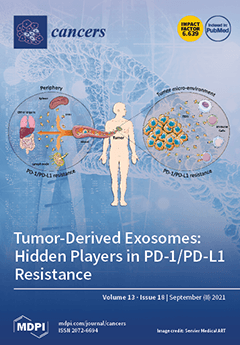
Cover Story: The mechanisms leading to anti-PD-L1/PD-1 resistance in cancer remain elusive. Exosomes (extracellular nanovesicles secreted by almost all cells, including tumor cells) are key actors in this resistance. Exosomes released by tumor cells (TEXs) express different immune checkpoints and disseminate immune-suppressive properties. Their impact is mediated by a wide range of actions, exerting an overall effect on immunity by inactivating immune cells even before they get to the tumor. Much remains to be discovered to understand the molecular mechanisms through which TEXs modulate resistance to immunotherapies. Blocking TEXs bearing immune checkpoints might be a way to counteract PD-L1/PD-1 blockade resistance. Therefore, TEXs have potential clinical interest as new targets for immunotherapy and as biomarkers in liquid biopsies. View this paper
  • Issues are regarded as officially published after their release is announced to the table of contents alert mailing list .
  • You may sign up for email alerts to receive table of contents of newly released issues.
  • PDF is the official format for papers published in both, html and pdf forms. To view the papers in pdf format, click on the "PDF Full-text" link, and use the free Adobe Reader to open them.

Articles (236)

  • Review
  • Open Access
53 Citations
8,281 Views
30 Pages

21 September 2021

Tumor-associated macrophages (TAMs) are one of the most abundant infiltrating immune cells of solid tumors. Despite their possible dual role, i.e., pro- or anti-tumoral, there is considerable evidence showing that the accumulation of TAMs promotes tu...

  • Article
  • Open Access
10 Citations
3,072 Views
11 Pages

Comparison of the Clinical Features and Outcomes of Gallbladder Neuroendocrine Carcinoma with Those of Adenocarcinoma: A Propensity Score-Matched Analysis

  • Min-Young Do,
  • Sung-Ill Jang,
  • Hua-Pyong Kang,
  • Eui-Joo Kim,
  • Kyong-Joo Lee,
  • Go-Eun Park,
  • Su-Jee Lee,
  • Dong-Ki Lee,
  • Sang-Myung Woo and
  • Jae-Hee Cho

21 September 2021

Neuroendocrine neoplasms (NENs) of the gallbladder (GB) are extremely rare. We aimed to compare the clinical features, disease progression, management, and prognosis of patients with GB-NENs with those of patients with GB-adenocarcinomas (ADCs). A to...

  • Article
  • Open Access
6 Citations
4,143 Views
15 Pages

Spectrum of Germline Pathogenic Variants in BRCA1/2 Genes in the Apulian Southern Italy Population: Geographic Distribution and Evidence for Targeted Genetic Testing

  • Margherita Patruno,
  • Simona De Summa,
  • Nicoletta Resta,
  • Mariapia Caputo,
  • Silvia Costanzo,
  • Maria Digennaro,
  • Brunella Pilato,
  • Rosanna Bagnulo,
  • Antonino Pantaleo and
  • Angelo Paradiso
  • + 4 authors

21 September 2021

BRCA1/2-associated hereditary breast and ovarian cancer is the most common form of hereditary breast and ovarian cancer and occurs in all ethnicities and racial populations. Different BRCA1/BRCA2 pathogenic variants (PVs) have been reported with a wi...

  • Article
  • Open Access
3 Citations
3,855 Views
15 Pages

RAD50 Loss of Function Variants in the Zinc Hook Domain Associated with Higher Risk of Familial Esophageal Squamous Cell Carcinoma

  • Josephine Mun Yee Ko,
  • Shiu Yeung Lam,
  • Lvwen Ning,
  • Annie Wai Yeeng Chai,
  • Lisa Chan Lei,
  • Sheyne Sta Ana Choi,
  • Carissa Wing Yan Wong and
  • Maria Li Lung

21 September 2021

Unbiased whole-exome sequencing approaches in familial esophageal squamous cell carcinoma (ESCC) initially prioritized RAD50 as a candidate cancer predisposition gene. The combined study with 3289 Henan individuals from Northern China identified two...

  • Review
  • Open Access
15 Citations
5,063 Views
26 Pages

21 September 2021

Pancreatic cancer is a treatment-resistant malignancy associated with high mortality. However, defective homologous recombination (HR), a DNA repair mechanism required for high-fidelity repair of double-strand DNA breaks, is a therapeutic vulnerabili...

  • Review
  • Open Access
8 Citations
4,657 Views
14 Pages

How Immunotherapy Has Changed the Continuum of Care in Hepatocellular Carcinoma

  • Giulia Martini,
  • Davide Ciardiello,
  • Fernando Paragliola,
  • Valeria Nacca,
  • Walter Santaniello,
  • Fabrizio Urraro,
  • Maria Stanzione,
  • Marco Niosi,
  • Marcello Dallio and
  • Erika Martinelli
  • + 4 authors

21 September 2021

Hepatocellular carcinoma (HCC) is one of the leading causes of death worldwide. The use of local treatment, such as surgical resection, liver transplant, and local ablation, has improved the survival of patients with HCC detected at an early stage. U...

  • Article
  • Open Access
8 Citations
4,535 Views
12 Pages

Reproducibility of mRNA-Based Testing of ESR1, PGR, ERBB2, and MKI67 Expression in Invasive Breast Cancer—A Europe-Wide External Quality Assessment

  • Ramona Erber,
  • Arndt Hartmann,
  • Peter Andreas Fasching,
  • Matthias Ruebner,
  • Robert Stöhr,
  • Matthias Wilhelm Beckmann,
  • Miriam Zentgraf,
  • Verena Popp,
  • Jodi Weidler and
  • Fulvia Ferrazzi
  • + 14 authors

21 September 2021

Estrogen receptor (ER), progesterone receptor (PgR), Ki-67, and HER2 immunohistochemistry (IHC) together with HER2 in situ hybridization (ISH) are utilized to classify invasive breast cancer (IBC) into predictive molecular subtypes. As IHC evaluation...

  • Article
  • Open Access
8 Citations
3,117 Views
16 Pages

Tumour-Derived Cell Lines and Their Potential for Therapy Prediction in Patients with Metastatic Colorectal Cancer

  • Sandra Wagner,
  • Nicola T. Beger,
  • Stephanie Matschos,
  • Antonia Szymanski,
  • Randy Przybylla,
  • Florian Bürtin,
  • Friedrich Prall,
  • Michael Linnebacher and
  • Christina S. Mullins

21 September 2021

The prognosis of metastatic colorectal cancer (CRC) remains poor. Patients and physicians are in need of individual therapies and precise response predictions. We investigated the predictive capacity of primary tumour material for treatment response...

  • Review
  • Open Access
172 Citations
11,235 Views
18 Pages

The Role of Cancer-Associated Fibroblasts in Cancer Invasion and Metastasis

  • Paris Jabeen Asif,
  • Ciro Longobardi,
  • Michael Hahne and
  • Jan Paul Medema

21 September 2021

Cancer-associated fibroblasts (CAFs) play a key role in cancer progression by contributing to extracellular matrix (ECM) deposition and remodeling, extensive crosstalk with cancer cells, epithelial-to-mesenchymal transition (EMT), invasion, metastasi...

  • Review
  • Open Access
55 Citations
8,212 Views
19 Pages

21 September 2021

Extracellular vesicles released by tumor cells (T-EVs) are known to contain danger-associated molecular patterns (DAMPs), which are released in response to cellular stress to alert the immune system to the dangerous cell. Part of this defense mechani...

of 24

Get Alerted

Add your email address to receive forthcoming issues of this journal.

XFacebookLinkedIn
Cancers - ISSN 2072-6694