You are currently viewing a new version of our website. To view the old version click .

Toxins, Volume 14, Issue 6

June 2022 - 57 articles

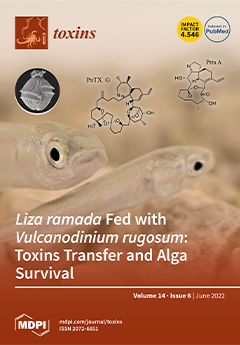
Cover Story: The harmful dinoflagellate Vulcanodinium rugosum produces potent neurotoxic and cytotoxic toxins, pinnatoxins (PnTX), and portimines (Prtn). The transfer of these toxins in the marine food chain and the dissemination of the microalga cells are essential concerns in understanding its environmental and health impacts. This work provides the first experimental evidence of the ability of a fish, the planktivorous and heavily predated juvenile grey mullet (Liza ramada), to feed on V. rugosum, to accumulate its toxins and to release viable cells through its feces. This highlights its potential to be a vector of toxins to the upper trophic levels and to disseminate toxic microalga in the environment. View this paper
  • Issues are regarded as officially published after their release is announced to the table of contents alert mailing list .
  • You may sign up for email alerts to receive table of contents of newly released issues.
  • PDF is the official format for papers published in both, html and pdf forms. To view the papers in pdf format, click on the "PDF Full-text" link, and use the free Adobe Reader to open them.

Articles (57)

  • Review
  • Open Access
16 Citations
5,634 Views
24 Pages

Evidence-Based Framework to Manage Cyanobacteria and Cyanotoxins in Water and Sludge from Drinking Water Treatment Plants

  • Farhad Jalili,
  • Saber Moradinejad,
  • Arash Zamyadi,
  • Sarah Dorner,
  • Sébastien Sauvé and
  • Michèle Prévost

15 June 2022

Freshwater bodies and, consequently, drinking water treatment plants (DWTPs) sources are increasingly facing toxic cyanobacterial blooms. Even though conventional treatment processes including coagulation, flocculation, sedimentation, and filtration...

  • Article
  • Open Access
6 Citations
3,444 Views
13 Pages

Mycotoxin DON Accumulation in Wheat Grains Caused by Fusarium Head Blight Are Significantly Subjected to Inoculation Methods

  • Limei Xian,
  • Yuhui Zhang,
  • Yi Hu,
  • Suqin Zhu,
  • Zhuo Wen,
  • Chen Hua,
  • Lei Li,
  • Zhengxi Sun and
  • Tao Li

15 June 2022

The disease severity and mycotoxin DON content in grains caused by fusarium head blight (FHB) have been two prioritized economical traits in wheat. Reliable phenotyping is a prerequisite for genetically improving wheat resistances to these two traits...

  • Article
  • Open Access
5 Citations
3,606 Views
23 Pages

Improving the Annotation of the Venom Gland Transcriptome of Pamphobeteus verdolaga, Prospecting Novel Bioactive Peptides

  • Cristian Salinas-Restrepo,
  • Elizabeth Misas,
  • Sebastian Estrada-Gómez,
  • Juan Carlos Quintana-Castillo,
  • Fanny Guzman,
  • Juan C. Calderón,
  • Marco A. Giraldo and
  • Cesar Segura

15 June 2022

Spider venoms constitute a trove of novel peptides with biotechnological interest. Paucity of next-generation-sequencing (NGS) data generation has led to a description of less than 1% of these peptides. Increasing evidence supports the underestimatio...

  • Article
  • Open Access
8 Citations
3,228 Views
11 Pages

An Ecotoxicological Evaluation of Four Fungal Metabolites with Potential Application as Biocides for the Conservation of Cultural Heritage

  • Mariagioia Petraretti,
  • Antonietta Siciliano,
  • Federica Carraturo,
  • Alessio Cimmino,
  • Antonino De Natale,
  • Marco Guida,
  • Antonino Pollio,
  • Antonio Evidente and
  • Marco Masi

14 June 2022

Biocides based on chemical synthetic compounds have been commonly used to counteract damages caused by microorganisms on stone cultural heritage. However, in the last few years, the use of commercial and traditional biocides has been banned and/or li...

  • Review
  • Open Access
12 Citations
5,220 Views
12 Pages

Botulinum Toxin Type A for the Treatment of Skin Ulcers: A Review Article

  • Waranaree Winayanuwattikun and
  • Vasanop Vachiramon

14 June 2022

The normal biological wound healing process consists of three precisely and highly programmed phases that require optimal conditions including internal and external factors. Any negative factors that disrupt the sequence or time frame of the healing...

  • Article
  • Open Access
4 Citations
5,209 Views
23 Pages

An Interlaboratory Comparison Study of Regulated and Emerging Mycotoxins Using Liquid Chromatography Mass Spectrometry: Challenges and Future Directions of Routine Multi-Mycotoxin Analysis including Emerging Mycotoxins

  • David Steiner,
  • Armin Humpel,
  • Eleonore Stamminger,
  • Anna Schoeberl,
  • Gerlinde Pachschwoell,
  • Anita Sloboda,
  • Christy Swoboda,
  • Jolene Rigg,
  • Dawei Zhang and
  • Yahong Wang
  • + 16 authors

13 June 2022

The present interlaboratory comparison study involved nine laboratories located throughout the world that tested for 24 regulated and non-regulated mycotoxins by applying their in-house LC-MS/MS multi-toxin method to 10 individual lots of 4 matrix co...

  • Feature Paper
  • Review
  • Open Access
23 Citations
4,693 Views
17 Pages

13 June 2022

rRNA N-glycosylases (EC 3.2.2.22) remove a specific adenine (A4324, rat 28S rRNA) in the sarcin ricin loop (SRL) involved into ribosome interaction with elongation factors, causing the inhibition of translation, for which they are known as plant &lsq...

  • Article
  • Open Access
27 Citations
4,716 Views
13 Pages

13 June 2022

Fungal infections in cereals lead to huge economic losses in the food and agriculture industries. This study was designed to investigate the occurrence of toxigenic fungi and their mycotoxins in marketed cereals and explore the effect of the antagoni...

  • Opinion
  • Open Access
6 Citations
3,239 Views
8 Pages

11 June 2022

In patients with severe kidney disease, renal clearance is compromised, resulting in the accumulation of a plethora of endogenous waste molecules that cannot be removed by current dialysis techniques, the most often applied treatment. These uremic re...

  • Article
  • Open Access
3 Citations
3,664 Views
17 Pages

Liza ramada Juveniles after Exposure to the Toxic Dinoflagellate Vulcanodinium rugosum: Effects on Fish Viability, Tissue Contamination and Microalgae Survival after Gut Passage

  • Aurélien Bouquet,
  • Marie Anaïs Perdrau,
  • Mohamed Laabir,
  • Elodie Foucault,
  • Nicolas Chomérat,
  • Jean Luc Rolland and
  • Eric Abadie

10 June 2022

Pinnatoxins (PnTX) and Portimines (Prtn), two toxins produced by the benthic dinoflagellate Vulcanodinium rugosum, are known to be lethal to mice after intraperitoneal or oral administration. They are also known to accumulate in shellfish such as mus...

of 6

Get Alerted

Add your email address to receive forthcoming issues of this journal.

XFacebookLinkedIn
Toxins - ISSN 2072-6651