

You are currently on the new version of our website. Access the old version .

Nutrients, Volume 9, Issue 10

October 2017 - 118 articles

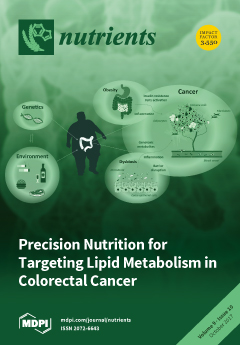
Cover Story: Cancer is a multifactorial condition with genetic and environmental factors modulating tumorogenesis. Nutrients are considered among the most important risk factors in colorectal cancer. The direct association of an unhealthy diet with obesity and dysbiosis opens new routes in the understanding of how nutrients influence cancer prognosis. In the "omics" era, traditional nutrition has been evolved to precision nutrition. Together with classical diet-nutrition-related genes, lipid-metabolism-related genes have acquired relevant interest in precision nutrition studies. A wide range of tumorogenic steps are influenced by lipid metabolism, both in primary tumours and distal metastasis. The extent to which genetic variants, along with intake of dietary components affect risk of colorectal neoplasia is under investigation and new therapeutic or preventive applications must be explored in colorectal cancer models. View this paper
  • Issues are regarded as officially published after their release is announced to the table of contents alert mailing list .
  • You may sign up for email alerts to receive table of contents of newly released issues.
  • PDF is the official format for papers published in both, html and pdf forms. To view the papers in pdf format, click on the "PDF Full-text" link, and use the free Adobe Reader to open them.

Articles (118)

  • Article
  • Open Access
67 Citations
16,106 Views
13 Pages

Diosgenin-Rich Yam Extract Enhances Cognitive Function: A Placebo-Controlled, Randomized, Double-Blind, Crossover Study of Healthy Adults

  • Chihiro Tohda,
  • Ximeng Yang,
  • Mie Matsui,
  • Yuna Inada,
  • Emika Kadomoto,
  • Shotaro Nakada,
  • Hidetoshi Watari and
  • Naotoshi Shibahara

24 October 2017

Diosgenin, a yam-derived compound, was found to facilitate the repair of axonal atrophy and synaptic degeneration and improve memory dysfunction in a transgenic mouse model of Alzheimer’s disease (AD). It was also found to enhance neuronal excitation...

  • Article
  • Open Access
132 Citations
11,422 Views
13 Pages

Flavonoid Naringenin Attenuates Oxidative Stress, Apoptosis and Improves Neurotrophic Effects in the Diabetic Rat Retina

  • Dalia I. Al-Dosari,
  • Mohammed M. Ahmed,
  • Salim S. Al-Rejaie,
  • Abdullah S. Alhomida and
  • Mohammad S. Ola

24 October 2017

Diabetic retinopathy (DR) is one of the leading causes of decreased vision and blindness worldwide. Diabetes-induced oxidative stress is believed to be the key factor that initiates neuronal damage in the diabetic retina leading to DR. Experimental a...

  • Article
  • Open Access
14 Citations
6,377 Views
9 Pages

24 October 2017

Although there is accumulating evidence for a protective role of n-3 polyunsaturated fatty acids (n-3 PUFAs) on bone health, there are limited studies that examine the effect of altering dietary n-6:n-3 PUFA ratio with plant and marine sources of n-3...

  • Communication
  • Open Access
3 Citations
7,128 Views
10 Pages

23 October 2017

Eccentric contractions induce muscle damage, which impairs recovery of glycogen and adenosine tri-phosphate (ATP) content over several days. Leucine-enriched essential amino acids (LEAAs) enhance the recovery in muscles that are damaged after eccentr...

  • Article
  • Open Access
22 Citations
6,280 Views
10 Pages

Comparison of the Micellar Incorporation and the Intestinal Cell Uptake of Cholecalciferol, 25-Hydroxycholecalciferol and 1-α-Hydroxycholecalciferol

  • Charles Desmarchelier,
  • Marielle Margier,
  • Damien P. Prévéraud,
  • Marion Nowicki,
  • Véronique Rosilio,
  • Patrick Borel and
  • Emmanuelle Reboul

23 October 2017

In the context of the global prevalence of vitamin D insufficiency, we compared two key determinants of the bioavailability of 3 vitamin D forms with significant biopotencies: cholecalciferol, 25-hydroxycholecalciferol and 1-α-hydroxycholecalciferol....

  • Review
  • Open Access
158 Citations
16,147 Views
31 Pages

23 October 2017

There is a growing body of evidence documenting probiotic bacteria to have a beneficial effect to the host through their ability to modulate the mucosal immune system. Many probiotic bacteria can be considered to act as either immune activators or im...

  • Article
  • Open Access
8 Citations
6,252 Views
13 Pages

22 October 2017

The purpose of this study was to analyze foodservice operation, dietary life education, and nutrition counseling tasks of nutrition teachers and dietitians in elementary, middle, and high schools in Jeju, Korea, and to provide effective ways to imple...

  • Review
  • Open Access
198 Citations
22,906 Views
32 Pages

Fatty Acids Consumption: The Role Metabolic Aspects Involved in Obesity and Its Associated Disorders

  • Priscila Silva Figueiredo,
  • Aline Carla Inada,
  • Gabriela Marcelino,
  • Carla Maiara Lopes Cardozo,
  • Karine De Cássia Freitas,
  • Rita De Cássia Avellaneda Guimarães,
  • Alinne Pereira de Castro,
  • Valter Aragão do Nascimento and
  • Priscila Aiko Hiane

22 October 2017

Obesity and its associated disorders, such as insulin resistance, dyslipidemia, metabolic inflammation, dysbiosis, and non-alcoholic hepatic steatosis, are involved in several molecular and inflammatory mechanisms that alter the metabolism. Food habi...

  • Article
  • Open Access
16 Citations
5,685 Views
17 Pages

Association between Diet Quality and Adiposity in the Atlantic PATH Cohort

  • Vanessa DeClercq,
  • Yunsong Cui,
  • Cynthia Forbes,
  • Scott A. Grandy,
  • Melanie Keats,
  • Louise Parker,
  • Ellen Sweeney,
  • Zhijie Michael Yu and
  • Trevor J.B. Dummer

21 October 2017

The aim of this study was to examine diet quality among participants in the Atlantic Partnership for Tomorrow’s Health (PATH) cohort and to assess the association with adiposity. Data were collected from participants (n = 23,768) aged 35–69 years tha...

  • Article
  • Open Access
8 Citations
6,831 Views
14 Pages

21 October 2017

Anemia is a prevalent public health problem associated with nutritional and socio-economic factors that contribute to iron deficiency. To understand the complex interplay of risk factors, we investigated a prospective population sample from the Jiang...

of 12

Get Alerted

Add your email address to receive forthcoming issues of this journal.

XFacebookLinkedIn
Nutrients - ISSN 2072-6643