

You are currently viewing a new version of our website. To view the old version click .

Current Issues in Molecular Biology, Volume 44, Issue 9

September 2022 - 39 articles

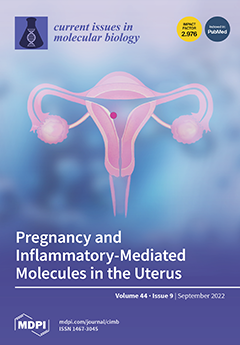
Cover Story: The chain of correlation between the processes responsible for embryo implantation and the subsequent physiological course of pregnancy is complicated. On the one hand, the induction of inflammation during implantation is necessary. On the other hand, an abnormal response from any side might result in a pregnancy failure or a pathological course of pregnancy. In this review, we summarize recognized mechanisms and the significance of inflammatory processes for embryo implantation and pregnancy establishment. Additionally, we present disorders involving an excessive inflammatory response and their influence on events occurring during embryo implantation. View this paper
  • Issues are regarded as officially published after their release is announced to the table of contents alert mailing list .
  • You may sign up for email alerts to receive table of contents of newly released issues.
  • PDF is the official format for papers published in both, html and pdf forms. To view the papers in pdf format, click on the "PDF Full-text" link, and use the free Adobe Reader to open them.

Articles (39)

  • Article
  • Open Access
14 Citations
3,225 Views
11 Pages

19 September 2022

Evodiamine isolated from Evodia rutaecarpa has been known to have anti-tumor activity against various cancer cell types. Although there have been reports showing the inhibitory effect of evodiamine on cell survival of gastric cancer cell, it is not c...

  • Review
  • Open Access
7 Citations
5,161 Views
25 Pages

Nutraceutical Prevention of Diabetic Complications—Focus on Dicarbonyl and Oxidative Stress

  • Mark F. McCarty,
  • James J. DiNicolantonio and
  • James H. O’Keefe

18 September 2022

Oxidative and dicarbonyl stress, driven by excess accumulation of glycolytic intermediates in cells that are highly permeable to glucose in the absence of effective insulin activity, appear to be the chief mediators of the complications of diabetes....

  • Article
  • Open Access
25 Citations
3,176 Views
11 Pages

Myopia Development in Tree Shrew Is Associated with Chronic Inflammatory Reactions

  • Hsiangyu Ku,
  • Jamie Jiin-Yi Chen,
  • Min Hu,
  • Peng-Tai Tien,
  • Hui-Ju Lin,
  • Gezhi Xu,
  • Lei Wan and
  • Dekang Gan

17 September 2022

In this study, we aimed to investigate whether chronic retinal inflammation is involved in the pathogenesis of form-deprivation myopia (FDM) using tree shrews as an animal model. Twenty-one tree shrews were randomly divided into 7-day/14-day FDM (FDM...

  • Article
  • Open Access
2 Citations
2,601 Views
13 Pages

17 September 2022

Brassica napus is an important oil source. Its narrow gene pool can be widened by interspecific hybridization with the Brassicaceae species. One of the agronomically important traits, that can be transferred through the hybridization, is the resistan...

  • Article
  • Open Access
3 Citations
2,559 Views
8 Pages

Inhibitory Activity of Quaternary Isoquinoline Alkaloids on Soluble Epoxide Hydrolase

  • Jang Hoon Kim,
  • Chong Woon Cho,
  • Mok Hur,
  • Woo Tae Park,
  • Youn-Ho Moon,
  • Sung-Cheol Koo,
  • Yun-Chan Hur,
  • Jong Seong Kang and
  • Ik Soo Lee

16 September 2022

The quaternary isoquinoline alkaloids of palmatine (1), berberine (2), and jatrorrhizine (3) were evaluated in terms of their ability to inhibit soluble epoxide hydrolase (sEH). They had similar inhibitory activities, with IC50 values of 29.6 ±...

  • Article
  • Open Access
10 Citations
3,641 Views
14 Pages

PADI4 Haplotypes Contribute to mRNA Expression, the Enzymatic Activity of Peptidyl Arginine Deaminase and Rheumatoid Arthritis Risk in Patients from Western Mexico

  • Mónica Guadalupe Matuz-Flores,
  • Jesús Alfredo Rosas-Rodríguez,
  • Orlando Tortoledo-Ortiz,
  • Salvador Muñoz-Barrios,
  • Gloria Esther Martínez-Bonilla,
  • Jorge Hernández-Bello,
  • Christian Johana Baños-Hernández,
  • Cesar Pacheco-Tena,
  • Gabriela Athziri Sánchez-Zuno and
  • Beatriz Panduro-Espinoza
  • + 1 author

16 September 2022

Citrullination is catalyzed by the peptidyl arginine deiminase 4 (PAD4) enzyme, encoded by the PADI4 gene. Increased PAD4 activity promotes the onset and progression of rheumatoid arthritis (RA). This study aimed to evaluate the association of PADI4...

  • Article
  • Open Access
1 Citations
3,286 Views
13 Pages

Clinico-Immunological Effects of a Single-Agent CDK4/6 Inhibitor in Advanced HR+/HER2− Breast Cancer Based on a Window of Opportunity Study

  • Alberto D’Angelo,
  • Fabiola Giudici,
  • Robert Chapman,
  • Jacob Darlow,
  • Huseyin Kilili,
  • Navid Sobhani,
  • Mattia Cinelli,
  • Maria Rosa Cappelletti,
  • Carla Strina and
  • Manuela Milani
  • + 1 author

15 September 2022

Background: Cyclin-dependent kinase 4/6 inhibitors (CDK4/6 i), abemaciclib, palbociclib, and ribociclib, have been FDA-approved for the treatment of hormone receptor-positive (HR+), HER2−negative (HER2−) advanced breast cancer (aBC). This...

  • Article
  • Open Access
3 Citations
2,561 Views
15 Pages

14 September 2022

The use of perinatal mesenchymal stem cells (MSCs) in bone tissue regeneration and engineering to substitute bone marrow MSCs has drawn great interest due to their high yield, ease of procurement, multilineage differentiation potential and lack of et...

  • Review
  • Open Access
6 Citations
3,231 Views
11 Pages

13 September 2022

Group II introns are large catalytic RNAs (ribozymes) in the bacteria and organelle genomes of several lower eukaryotes. Many critical photosynthesis-related genes in the plant chloroplast genome also contain group II introns, and their splicing is c...

  • Article
  • Open Access
14 Citations
3,355 Views
13 Pages

12 September 2022

Theobromine is mainly found in plant foods, such as tea; the primary source of theobromine is the seeds of the Theobroma cacao tree. Theobromine is an alkaloid belonging to the methylxanthine class of drugs, and it is similar to theophylline and...

of 4

Get Alerted

Add your email address to receive forthcoming issues of this journal.

XFacebookLinkedIn
Curr. Issues Mol. Biol. - ISSN 1467-3045