You are currently viewing a new version of our website. To view the old version click .

Molecules, Volume 25, Issue 2

January-2 2020 - 192 articles

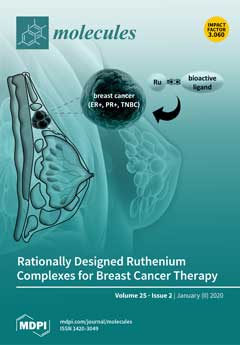
Cover Story: Since the discovery of the anticancer potential of ruthenium-based complexes, several species were reported as promising candidates for the treatment of breast cancer, which accounts for the greatest number of new cases in women every year worldwide. This review of the literature aims at providing an overview of the rationally designed ruthenium-based complexes that have been reported to date for which ligands were carefully selected for the treatment of hormone-receptor-positive breast cancers (estrogen receptor (ER+) or progesterone receptor (PR+)). In addition, this brief survey highlights some of the most successful examples of ruthenium complexes reported for the treatment of triple-negative breast cancer (TNBC), a highly aggressive type of cancer. View this paper.
  • Issues are regarded as officially published after their release is announced to the table of contents alert mailing list .
  • You may sign up for email alerts to receive table of contents of newly released issues.
  • PDF is the official format for papers published in both, html and pdf forms. To view the papers in pdf format, click on the "PDF Full-text" link, and use the free Adobe Reader to open them.

Articles (192)

  • Editorial
  • Open Access
2 Citations
11,275 Views
112 Pages

20 January 2020

The editorial team greatly appreciates the reviewers who have dedicated their considerable time and expertise to the journal’s rigorous editorial process over the past 12 months, regardless of whether the papers are finally published or not [...]

  • Review
  • Open Access
34 Citations
7,896 Views
13 Pages

Pharmacological Overview of the BGP-15 Chemical Agent as a New Drug Candidate for the Treatment of Symptoms of Metabolic Syndrome

  • Ágota Pető,
  • Dóra Kósa,
  • Pálma Fehér,
  • Zoltán Ujhelyi,
  • Dávid Sinka,
  • Miklós Vecsernyés,
  • Zoltán Szilvássy,
  • Béla Juhász,
  • Zoltán Csanádi and
  • László Vígh
  • + 1 author

20 January 2020

BGP-15 is a new insulin sensitizer drug candidate, which was developed by Hungarian researchers. In recent years, numerous research groups have studied its beneficial effects. It is effective in the treatment of insulin resistance and it has protecti...

  • Review
  • Open Access
33 Citations
9,474 Views
20 Pages

20 January 2020

The comprehensive characterization of Intramolecular Charge Transfer (ICT) stemming in push-pull molecules with a delocalized π-system of electrons is noteworthy for a bespoke design of organic materials, spanning widespread applications from phot...

  • Feature Paper
  • Review
  • Open Access
29 Citations
6,495 Views
15 Pages

20 January 2020

This review will show how solid state nuclear magnetic resonance (NMR) has contributed to a better understanding of the borophosphate glass structure. Over the last fifteen years, 1D and 2D magic angle spinning (MAS)-NMR has been used to produce key...

  • Feature Paper
  • Article
  • Open Access
11 Citations
4,197 Views
14 Pages

Cross-Linked Cyclodextrins Bimetallic Nanocatalysts: Applications in Microwave-Assisted Reductive Aminations

  • Emanuela Calcio Gaudino,
  • Elisa Acciardo,
  • Silvia Tabasso,
  • Maela Manzoli,
  • Giancarlo Cravotto and
  • Rajender S. Varma

19 January 2020

The optimization of sustainable protocols for reductive amination has been a lingering challenge in green synthesis. In this context, a comparative study of different metal-loaded cross-linked cyclodextrins (CDs) were examined for the microwave (MW)-...

  • Article
  • Open Access
20 Citations
3,718 Views
8 Pages

Constituents from the Seeds of Sophora Alopecuroides L.

  • Zi-Jian Rong,
  • Gao-Sheng Hu,
  • Shi-Yi Lin,
  • Ting Yan,
  • Na Li,
  • Yue Zhao,
  • Jing-Ming Jia and
  • An-Hua Wang

19 January 2020

Three new isoflavone glucosides, kudonol A−C (1–3), two new ester derivatives of phenylpropanoid, kudolignan A and B (4–5) and five known compounds, (−)-maackiain (6), neoliquiritin (7), methyl 4-coumarate (8), methyl ferulate...

  • Article
  • Open Access
39 Citations
4,886 Views
16 Pages

19 January 2020

To elucidate the role of fruit cuticle in fungal infection, changes in cuticle composition and morphology of ‘Satsuma’ mandarin during ambient (at 25 °C) storage and their role in Penicillium digitatum infection were investigated. Res...

  • Feature Paper
  • Article
  • Open Access
20 Citations
5,387 Views
18 Pages

Multifunctional Hydroxyapatite Coated with Arthemisia absinthium Composites

  • Mariana Stefania Raita,
  • Simona Liliana Iconaru,
  • Andreea Groza,
  • Carmen Cimpeanu,
  • Gabriel Predoi,
  • Liliana Ghegoiu,
  • Monica Luminita Badea,
  • Mariana Carmen Chifiriuc,
  • Luminita Marutescu and
  • Roxana Trusca
  • + 4 authors

19 January 2020

There is significant research showing that essential oils extracted from the plants have antibacterial effects. The purpose of this study was to develop a biocomposite based on hydroxyapatite coated with Artemisia absinthium essential oil and to high...

  • Article
  • Open Access
13 Citations
4,785 Views
17 Pages

Identification and Repurposing of Trisubstituted Harmine Derivatives as Novel Inhibitors of Mycobacterium tuberculosis Phosphoserine Phosphatase

  • Elise Pierson,
  • Marie Haufroid,
  • Tannu Priya Gosain,
  • Pankaj Chopra,
  • Ramandeep Singh and
  • Johan Wouters

19 January 2020

Mycobacterium tuberculosis is still the deadliest bacterial pathogen worldwide and the increasing number of multidrug-resistant tuberculosis cases further complicates this global health issue. M. tuberculosis phosphoserine phosphatase SerB2 is a prom...

  • Review
  • Open Access
66 Citations
17,359 Views
82 Pages

The Pictet-Spengler Reaction Updates Its Habits

  • Andrea Calcaterra,
  • Laura Mangiardi,
  • Giuliano Delle Monache,
  • Deborah Quaglio,
  • Silvia Balducci,
  • Simone Berardozzi,
  • Antonia Iazzetti,
  • Roberta Franzini,
  • Bruno Botta and
  • Francesca Ghirga

19 January 2020

The Pictet-Spengler reaction (P-S) is one of the most direct, efficient, and variable synthetic method for the construction of privileged pharmacophores such as tetrahydro-isoquinolines (THIQs), tetrahydro-β-carbolines (THBCs), and polyheterocyc...

of 20

Get Alerted

Add your email address to receive forthcoming issues of this journal.

XFacebookLinkedIn
Molecules - ISSN 1420-3049