
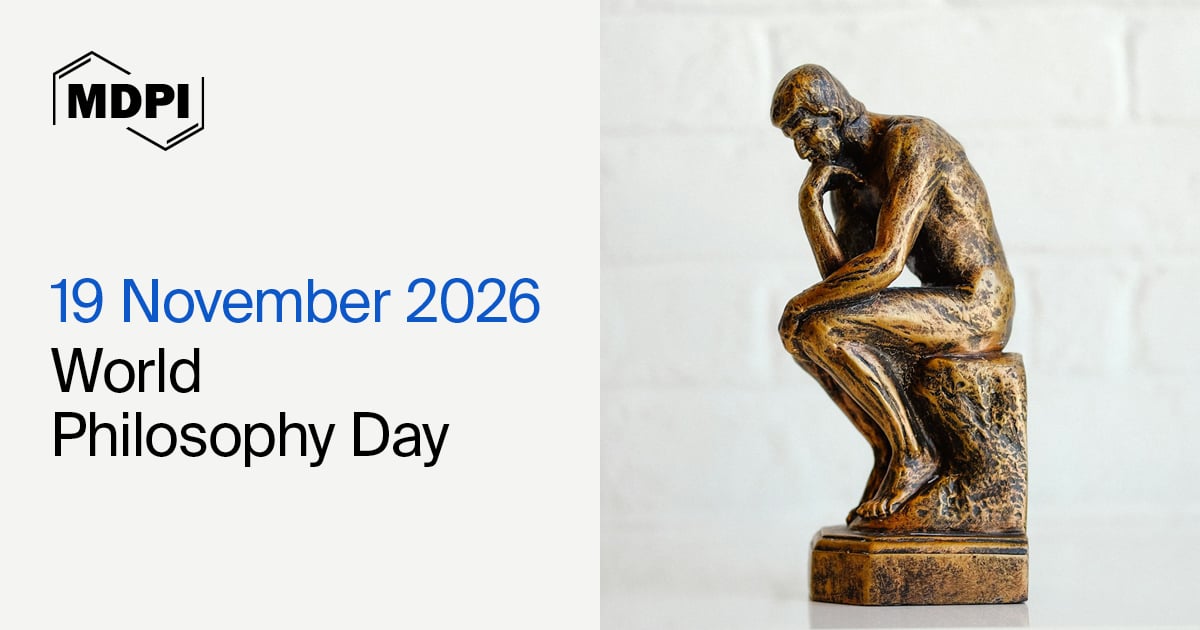
World Philosophy Day, 19 November 2026
Philosophy is both an inspiring discipline and an everyday practice that can transform societies. By fostering an appreciation of diverse intellectual traditions, philosophy promotes intercultural dialogue, critical thinking, and the reasoned exchange of ideas. It also contributes to building more tolerant and respectful societies and helps us understand and respond to the major challenges of our time.
World Philosophy Day is celebrated annually on the third Thursday of November, highlighting the importance of philosophical reflection in advancing human thought, promoting intercultural dialogue, and addressing contemporary global challenges.
In recognition of this day, MDPI invites you to explore a curated selection of philosophical research, including articles, Special Issues, and a webinar session covering a wide range of themes, from classical and contemporary philosophical traditions to ethics, religion, artificial intelligence, and aesthetics. Through open access publishing, we aim to encourage the sharing of ideas, stimulate meaningful intellectual discussions, and support the continued development of philosophical inquiry across disciplines and cultures.

 |
 |
 |
 |
 |
 |
 |
 |


|
Keynote Speakers |
||
|
|
|
|
|
Prof. Dr. Jordi Vallverdú |
Dr. Sebastian De Haro |
Prof. Dr. Robert van Rooij |
|
|
|
|
|
Prof. Dr. Chen Bo |
Prof. Dr. Jean-Yves Beziau |
Prof. Dr. Yong Li |


“A Theory of Partial Truth for Scientific Statements”
by Gustavo E. Romero
Philosophies 2026, 11(5), 194; https://doi.org/10.3390/philosophies11050194
“The Afterlife of Greek Tragedy: Cultural Memory, Identity, and the Transformation of Tragic Myth Across Historical Periods”
by Andreas Markantonatos
Histories 2026, 6(4), 61; https://doi.org/10.3390/histories6040061
“From Mythos to Metaphysics: Giorgio Vasari’s Ephesian Diana, Venus, and Minerva in the Context of Ficinian Neoplatonism”
by Liana De Girolami Cheney
Arts 2026, 15(9), 213; https://doi.org/10.3390/arts15090213
“Sectarian Trifles and Political Necessity: Swift on Lilliputian Religion in Gulliver’s Travels”
by Gregory Alan McBrayer
Literature 2026, 6(3), 15; https://doi.org/10.3390/literature6030015
“Key Considerations in Bioethics from a Cultural Perspective”
by Alvaro Acevedo-Merlano
Culture 2026, 2(2), 11; https://doi.org/10.3390/culture2020011
“Is Idempotence “More Fundamental” than Non-Contradiction?”
by Odysseus Makridis
Logics 2026, 4(2), 4; https://doi.org/10.3390/logics4020004
“Words, Words, Words”: Hamlet, Polonius, and the Death of Philosophy in the State”
by John Hawkins
Humanities 2025, 14(11), 218; https://doi.org/10.3390/h14110218
“The Question of AI During the Papacy of Pope Francis: A Philosophical and Theological Analysis”
by Justin Nnaemeka Onyeukaziri
Religions 2025, 16(11), 1379; https://doi.org/10.3390/rel16111379
“Penal Philosophy and Practice from a Historical and Theological Perspective”
by Andrew Skotnicki and Karol Lucken
Histories 2025, 5(4), 52; https://doi.org/10.3390/histories5040052
“Hegel’s Souls: Aristotle, Kant, and the Climax of Life”
by Antonios Kalatzis
Philosophies 2025, 10(4), 92; https://doi.org/10.3390/philosophies10040092
“Hölderlin’s and Novalis’ Philosophical Beginnings (1795)”
by Manfred Frank
Humanities 2025, 14(4), 84; https://doi.org/10.3390/h14040084
“The Psycholinguistics of Self-Talk in Logic-Based Therapy: Using a Toolbox of Philosophical Antidotes to Overcome Self-Destructive Speech Acts”
by Elliot D. Cohen
Philosophies 2025, 10(2), 36; https://doi.org/10.3390/philosophies10020036

|
“New Paths Towards a Scientific Metaphysics: Trends, Prospects and Controversial Topics” |
“Aesthetics Reconsidered: Philosophical Perspectives in the Era of Digital Media and AI” |
|
|
|
|
“Religious Epistemology Across Traditions: Pluralism, Pragmatism and Beyond” |
“What’s Next: Artificial Intelligence, Humans, and the Environment” |
|
|
|
|
“Film and Philosophy” |
“Phenomenology of Imagination: Legacies and Perspectives” |
|
|
|


 |
 |
 |