
The No-Hair Theorems at Work in the Tidal Disruption Event AT2020afhd


Abstract
1. Introduction
2. The Mathematical Model of the No-Hair Disk Precession
3. Constraining the Parameter Space
3.1. The Parameter Space in the Most General Case
- 1.
- The cause of the TDE is a SMBH, so that [84];
- 2.
- For tidal disruption to actually occur outside a SMBH, accompanied by detectable flares, it must be [1];
- 3.
- The external spacetime of the SMBH is described by the Kerr metric;
- 4.
- The disk likely exhibits a not-excessively large tilt to the SMBH’s spin axis due to intervening non-gravitational effects of electromagnetic nature, so that ;
- 5.
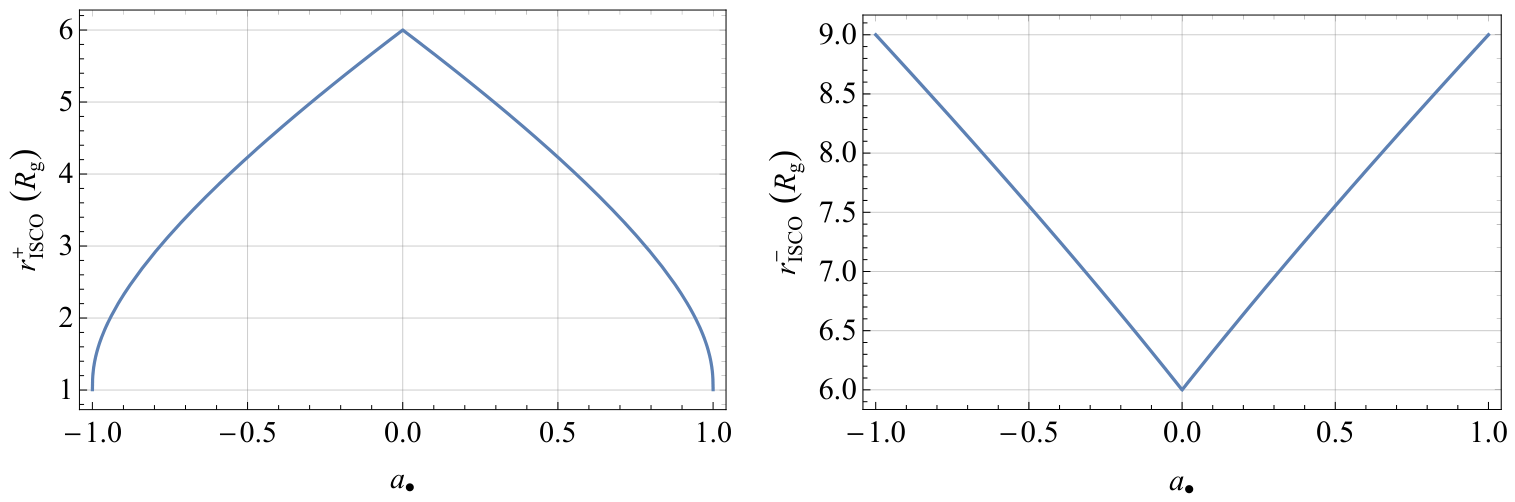
- The radius of the effective orbit should be at least larger than that of the SMBH’s ISCO
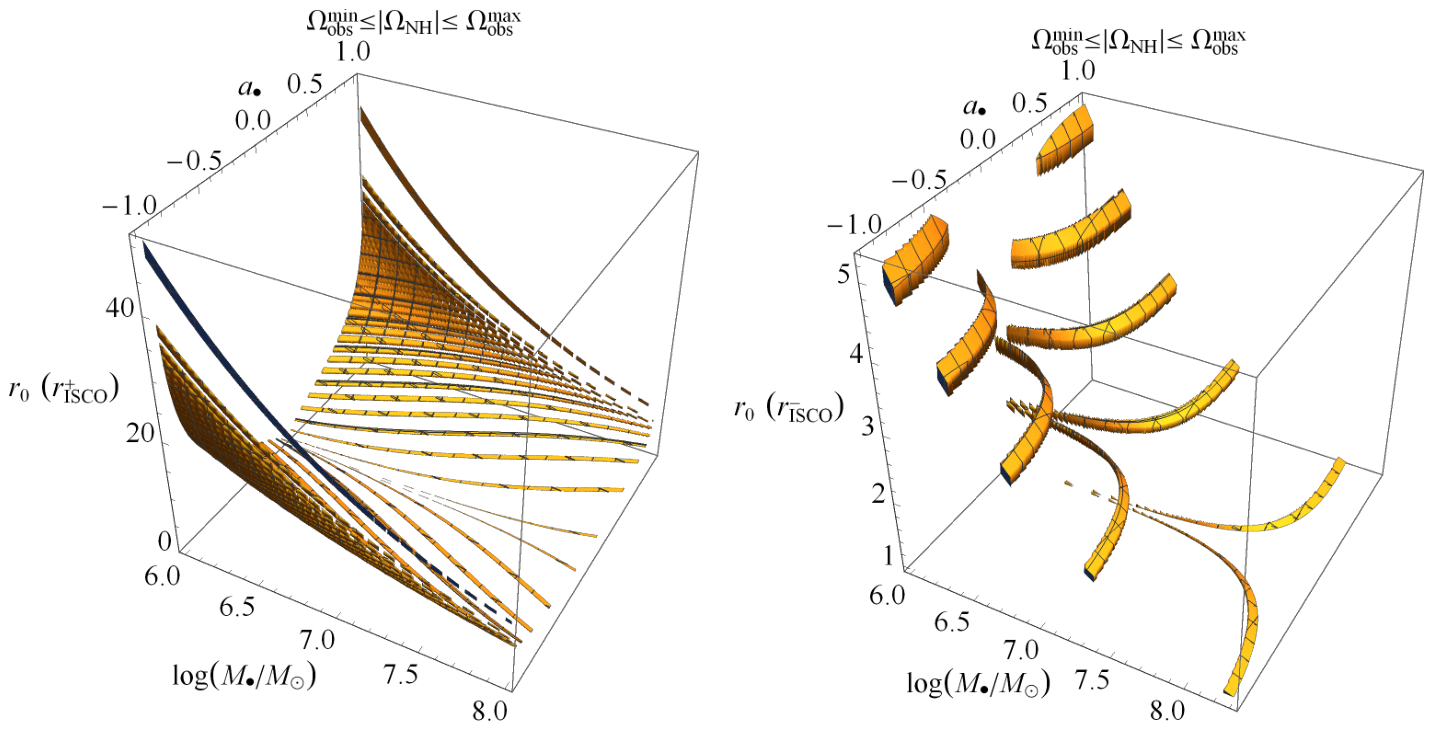
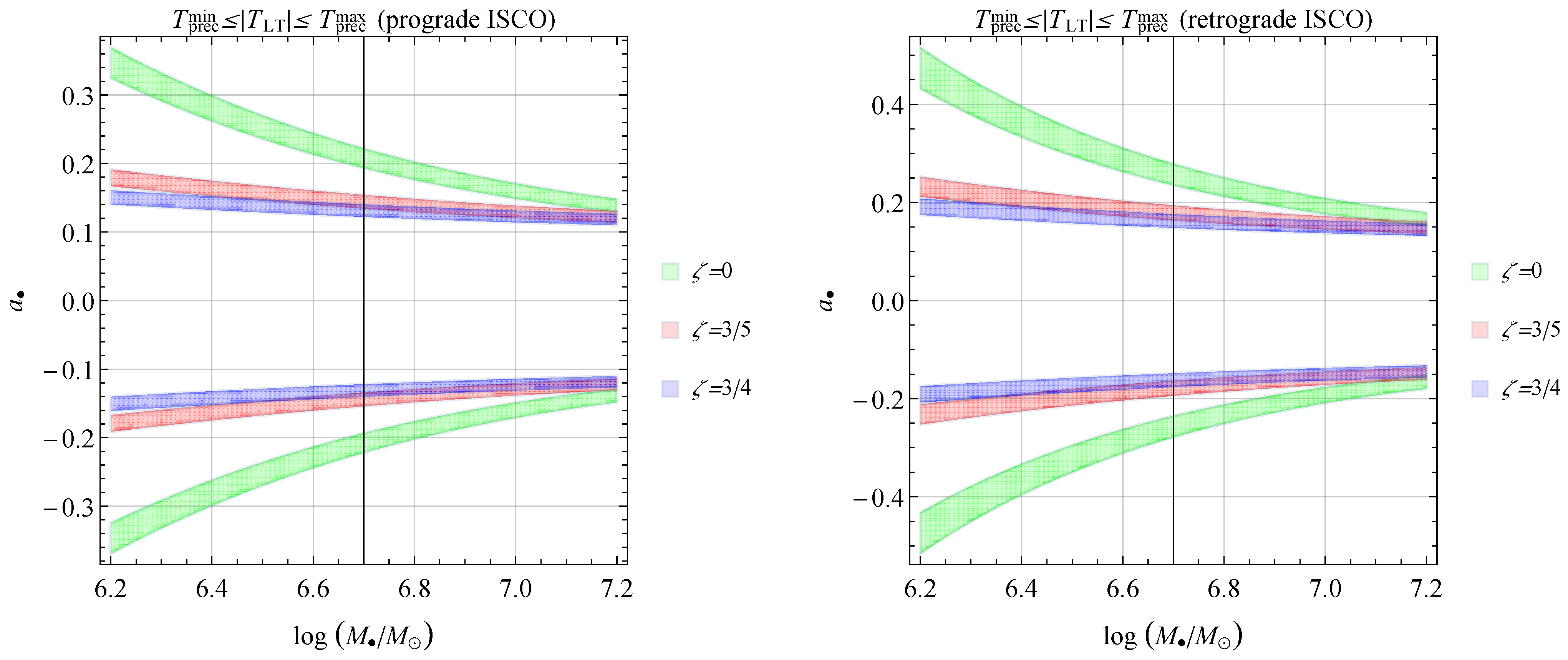
3.2. Narrowing the Parameter Space with the SMBH’s Mass
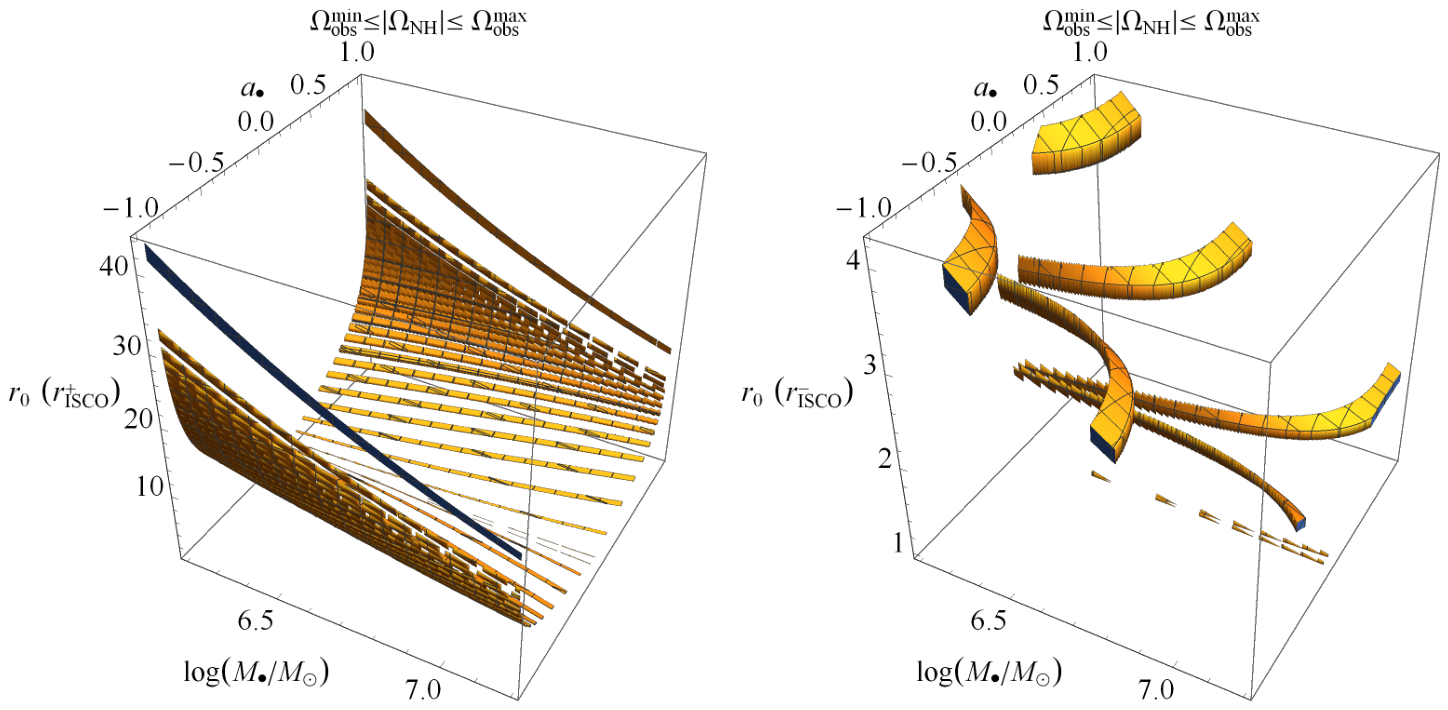
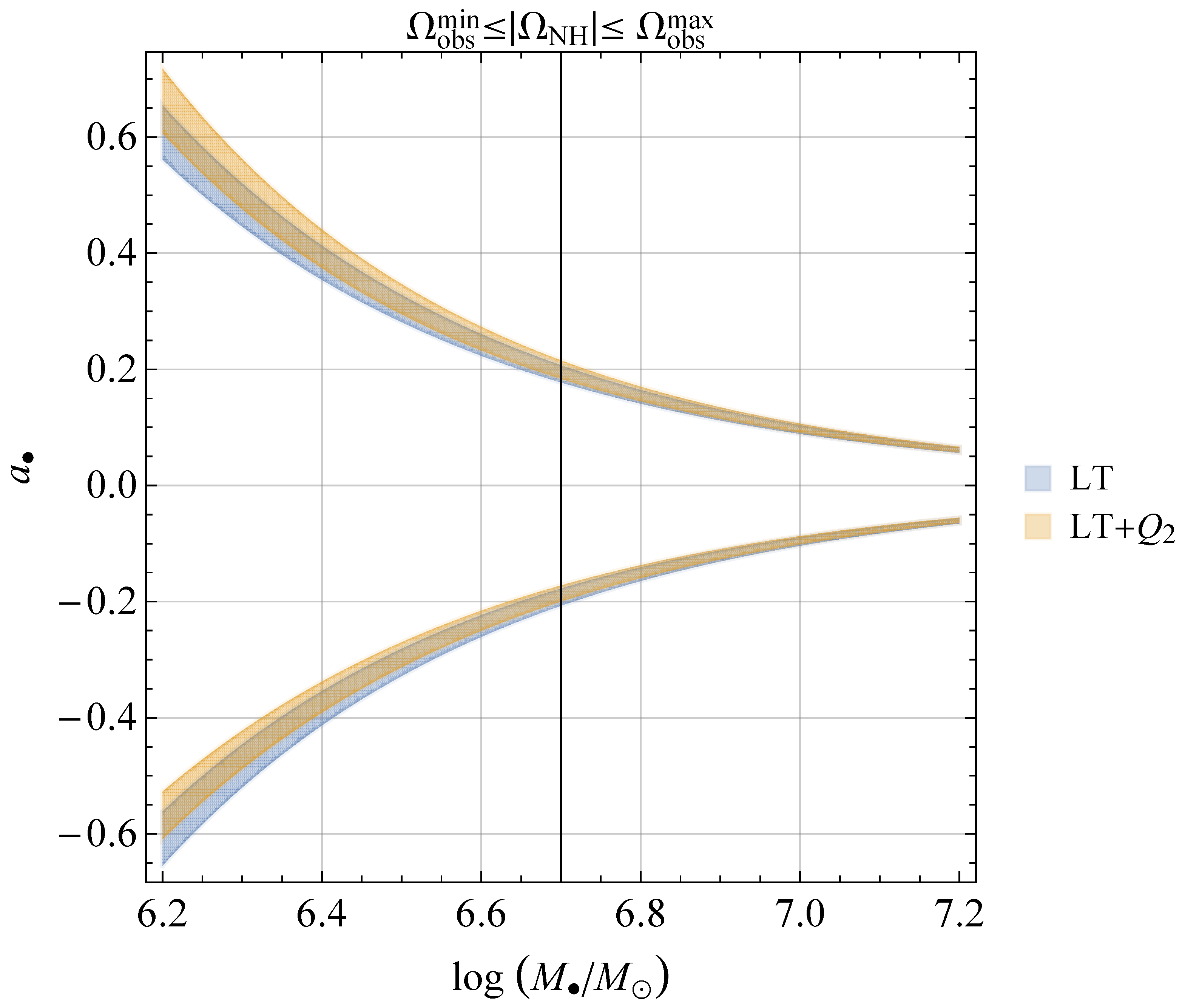
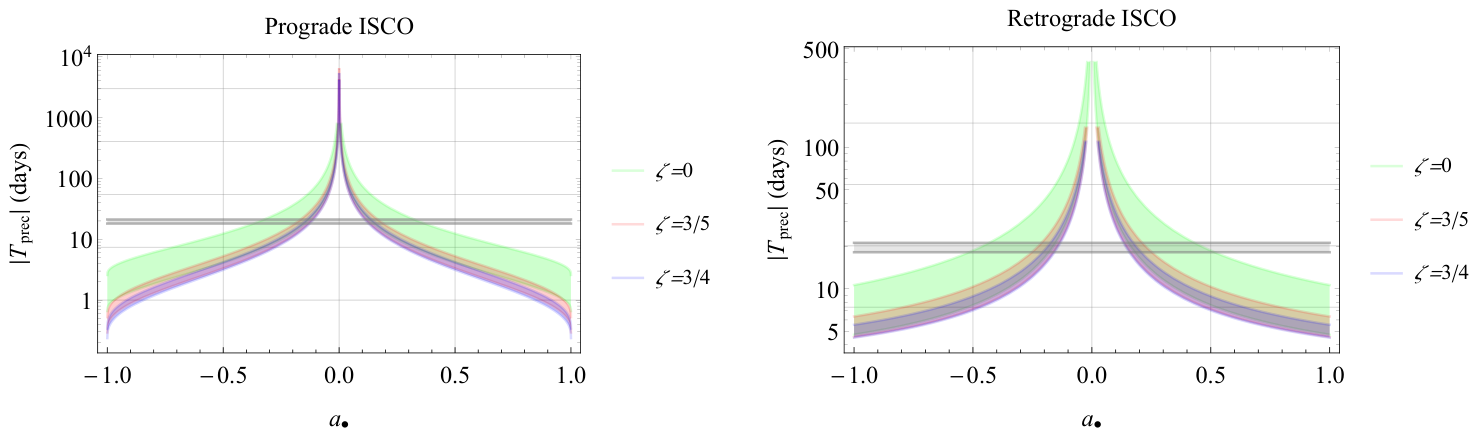
3.3. Reducing the Dimensionality of the Parameter Space by Fixing the Orbital Radius
4. A Discussion on the Range for the BH’s Spin Parameter by Wang et al. 2025 [32]
5. A Critical Examination of Some of the Assumptions on Which This Study Is Based
6. Summary and Conclusions
Funding
Data Availability Statement
Acknowledgments
Conflicts of Interest
| 1 | Its observed optical decay rate is in agreement with the debris fallback rate expected in TDE theories. |
| 2 | The formalisms by Geroch-Hansen and Thorne were proven to be equivalent, up to a normalization factor, by Gürsel [48]. |
| 3 | Dubbed as angular momentum per unit mass or specific angular momentum when geometrized units are adopted, is sometimes denoted in the literature by the same symbol which, instead, is used in this paper for its dimensionless counterpart. Caution is in order to avoid confusions with the semimajor axis of a Keplerian orbit, usually denoted as a in celestial mechanics [55]. |
| 4 | |
| 5 | |
| 6 | Here, the symbol is adopted for it instead of p used in Wang et al. [32] to avoid confusions with the semilatus rectum of the test particle’s orbit. |
References
- Hills, J.G. Possible power source of Seyfert galaxies and QSOs. Nature 1975, 254, 295–298. [Google Scholar] [CrossRef]
- Iorio, L. Pyknons: A Suggestion for Rebranding Black Holes. Universe 2025, 11, 251. [Google Scholar] [CrossRef]
- Evans, C.R.; Kochanek, C.S. The Tidal Disruption of a Star by a Massive Black Hole. Astrophys. J. Lett. 1989, 346, L13. [Google Scholar] [CrossRef]
- Mockler, B.; Hammerstein, E.; Coughlin, E.R.; Nicholl, M. Tidal Disruption Events. In Encyclopedia of Astrophysics; Mandel, I., Ed.; Elsevier: Amsterdam, The Netherlands, 2026; Volume 3, pp. 423–457. [Google Scholar] [CrossRef]
- Rees, M.J. Tidal disruption of stars by black holes of 106–108 solar masses in nearby galaxies. Nature 1988, 333, 523–528. [Google Scholar] [CrossRef]
- Hayasaki, K.; Stone, N.; Loeb, A. Circularization of tidally disrupted stars around spinning supermassive black holes. Mon. Not. Roy. Astron. Soc. 2016, 461, 3760–3780. [Google Scholar] [CrossRef]
- Strubbe, L.E.; Quataert, E. Optical flares from the tidal disruption of stars by massive black holes. Mon. Not. Roy. Astron. Soc. 2009, 400, 2070–2084. [Google Scholar] [CrossRef]
- Ulmer, A. Flares from the Tidal Disruption of Stars by Massive Black Holes. Astrophys. J. 1999, 514, 180–187. [Google Scholar] [CrossRef] [PubMed]
- Cannizzo, J.K.; Lee, H.M.; Goodman, J. The Disk Accretion of a Tidally Disrupted Star onto a Massive Black Hole. Astrophys. J. 1990, 351, 38. [Google Scholar] [CrossRef]
- McKinney, J.C.; Tchekhovskoy, A.; Blandford, R.D. Alignment of Magnetized Accretion Disks and Relativistic Jets with Spinning Black Holes. Science 2013, 339, 49. [Google Scholar] [CrossRef]
- Dai, J.L.; Lodato, G.; Cheng, R. The Physics of Accretion Discs, Winds and Jets in Tidal Disruption Events. Space Sci. Rev. 2021, 217, 12. [Google Scholar] [CrossRef]
- De Colle, F.; Lu, W. Jets from Tidal Disruption Events. New Astron. Rev. 2020, 89, 101538. [Google Scholar] [CrossRef]
- Foschini, L. The physics of relativistic jets. Front. Astron. Space Sci. 2022, 8, 234. [Google Scholar] [CrossRef]
- Foschini, L.; Barba, B.D.; Tornikoski, M.; Andernach, H.; Marziani, P.; Marscher, A.P.; Jorstad, S.G.; Järvelä, E.; Antón, S.; Dalla Bontà, E. The Power of Relativistic Jets: A Comparative Study. Universe 2024, 10, 156. [Google Scholar] [CrossRef]
- Chatterjee, K.; Younsi, Z.; Liska, M.; Tchekhovskoy, A.; Markoff, S.B.; Yoon, D.; van Eijnatten, D.; Hesp, C.; Ingram, A.; van der Klis, M.B.M. Observational signatures of disc and jet misalignment in images of accreting black holes. Mon. Not. Roy. Astron. Soc. 2020, 499, 362–378. [Google Scholar] [CrossRef]
- Liska, M.; Hesp, C.; Tchekhovskoy, A.; Ingram, A.; van der Klis, M.; Markoff, S. Formation of precessing jets by tilted black hole discs in 3D general relativistic MHD simulations. Mon. Not. Roy. Astron. Soc. 2018, 474, L81–L85. [Google Scholar] [CrossRef]
- Fragile, P.C.; Blaes, O.M.; Anninos, P.; Salmonson, J.D. Global General Relativistic Magnetohydrodynamic Simulation of a Tilted Black Hole Accretion Disk. Astrophys. J. 2007, 668, 417–429. [Google Scholar] [CrossRef]
- Franchini, A.; Lodato, G.; Facchini, S. Lense–Thirring precession around supermassive black holes during tidal disruption events. Mon. Not. Roy. Astron. Soc. 2016, 455, 1946–1956. [Google Scholar] [CrossRef]
- Pasham, D.R.; Zajaček, M.; Nixon, C.J.; Coughlin, E.R.; Śniegowska, M.; Janiuk, A.; Czerny, B.; Wevers, T.; Guolo, M.; Ajay, Y.; et al. Lense-Thirring precession after a supermassive black hole disrupts a star. Nature 2024, 630, 325–328. [Google Scholar] [CrossRef]
- Stone, N.; Loeb, A. Observing Lense-Thirring Precession in Tidal Disruption Flares. Phys. Rev. Lett. 2012, 108, 061302. [Google Scholar] [CrossRef]
- Jantzen, R.T.; Carini, P.; Bini, D. The many faces of gravitoelectromagnetism. Ann. Phys. 1992, 215, 1–50. [Google Scholar] [CrossRef]
- Mashhoon, B. Gravitoelectromagnetism. In Reference Frames and Gravitomagnetism; Pascual-Sánchez, J.F., Floría, L., Miguel, A.S., Vicente, A.F., Eds.; World Scientific: Singapore, 2001. [Google Scholar]
- Mashhoon, B. Gravitoelectromagnetism: A Brief Review. In The Measurement of Gravitomagnetism: A Challenging Enterprise; Iorio, L., Ed.; Nova Science: Hauppauge, NY, USA, 2007; pp. 29–39. [Google Scholar]
- Ruggiero, M.L.; Tartaglia, A. Gravitomagnetic effects. Nuovo Cim. B 2002, 117, 743. [Google Scholar]
- Thorne, K.S. Black Holes: The Membrane Viewpoint. In Highlights of Modern Astrophysics: Concepts and Controversies; Shapiro, S.L., Teukolsky, S.A., Salpeter, E.E., Eds.; Wiley: Hoboken, NJ, USA, 1986; pp. 103–161. [Google Scholar]
- Thorne, K.S. Gravitomagnetism, jets in quasars, and the Stanford Gyroscope Experiment. In Near Zero: New Frontiers of Physics; Fairbank, J.D., Deaver, B.S., Jr., Everitt, C.W.F., Michelson, P.F., Eds.; Freeman: Dallas, TX, USA, 1988; pp. 573–586. [Google Scholar]
- Thorne, K.S.; MacDonald, D.A.; Price, R.H. (Eds.) Black Holes: The Membrane Paradigm; Yale University Press: New Haven, CT, USA, 1986. [Google Scholar]
- Ma, X.; Tao, L.; Zhang, S.-N.; Zhang, L.; Bu, Q.-C.; Ge, M.-Y.; Chen, Y.-P.; Qu, J.-L.; Zhang, S.; Lu, F.-J.; et al. Discovery of oscillations above 200 keV in a black hole X-ray binary with Insight-HXMT. Nat. Astron. 2021, 5, 94–102. [Google Scholar] [CrossRef]
- Saxton, C.J.; Soria, R.; Wu, K.; Kuin, N.P.M. Long-term X-ray variability of Swift J1644+57. Mon. Not. Roy. Astron. Soc. 2012, 422, 1625–1639. [Google Scholar] [CrossRef]
- Cui, Y.; Hada, K.; Kawashima, T.; Kino, M.; Lin, W.; Mizuno, Y.; Ro, H.; Honma, M.; Yi, K.; Yu, J.; et al. Precessing jet nozzle connecting to a spinning black hole in M87. Nature 2023, 621, 711–715. [Google Scholar] [CrossRef]
- Tian, P.; Zhang, P.; Wang, W.; Wang, P.; Sun, X.; Liu, J.; Zhang, B.; Dai, Z.; Yuan, F.; Zhang, S.; et al. Subsecond periodic radio oscillations in a microquasar. Nature 2023, 621, 271–275. [Google Scholar] [CrossRef]
- Wang, Y.; Lin, Z.; Wu, L.; Lei, W.; Wei, S.; Zhang, S.-N.; Ji, L.; del Palacio, S.; Baldi, R.D.; Huang, Y.; et al. Detection of disk-jet co-precession in a tidal disruption event. Science 2025, 11, eady9068. [Google Scholar] [CrossRef]
- Barker, B.M.; Oconnell, R.F. Effect of the rotation of the central body on the orbit of a satellite. Phys. Rev. D 1974, 10, 1340–1342. [Google Scholar] [CrossRef]
- Iorio, L. Lense-Thirring effect at work in M87*. Phys. Rev. D 2025, 111, 044035. [Google Scholar] [CrossRef]
- Dexter, J.; Fragile, P.C. Observational Signatures of Tilted Black Hole Accretion Disks from Simulations. Astrophys. J. 2011, 730, 36. [Google Scholar] [CrossRef]
- Iorio, L. The no-hair theorems at work in M87*. Mon. Not. Roy. Astron. Soc. 2025, 537, 1470–1474. [Google Scholar] [CrossRef]
- Cui, Y.; Lin, W. Co-precession of a curved jet and compact accretion disk in M87. Nat. Astron. 2025, 9, 1218–1225. [Google Scholar] [CrossRef]
- Will, C.M. Inaugural Article: On the unreasonable effectiveness of the post–Newtonian approximation in gravitational physics. Proc. Natl. Acad. Sci. USA 2011, 108, 5938–5945. [Google Scholar] [CrossRef]
- Kerr, R.P. Gravitational Field of a Spinning Mass as an Example of Algebraically Special Metrics. Phys. Rev. Lett. 1963, 11, 237–238. [Google Scholar] [CrossRef]
- Kerr, R.P. Gravitational Collapse and Rotation. In Quasi-Stellar Sources and Gravitational Collapse; Robinson, I., Schild, A., Schucking, E.L., Eds.; University of Chicago Press: Chicago, IL, USA, 1965; pp. 99–102. [Google Scholar]
- Teukolsky, S.A. The Kerr metric. Class. Quantum Gravit. 2015, 32, 124006. [Google Scholar] [CrossRef]
- Visser, M. The Kerr spacetime: A brief introduction. In The Kerr Spacetime. Rotating Black Holes in General Relativity; Wiltshire, D.L., Visser, M., Scott, S.M., Eds.; Cambridge University Press: Cambridge, UK, 2009; pp. 3–37. [Google Scholar]
- Bardeen, J.M. Kerr Metric Black Holes. Nature 1970, 226, 64–65. [Google Scholar] [CrossRef] [PubMed]
- Carter, B. Axisymmetric Black Hole Has Only Two Degrees of Freedom. Phys. Rev. Lett. 1971, 26, 331–333. [Google Scholar] [CrossRef]
- Israel, W. Event Horizons in Static Vacuum Space–Times. Phys. Rev. 1967, 164, 1776–1779. [Google Scholar] [CrossRef]
- Robinson, D.C. Uniqueness of the Kerr Black Hole. Phys. Rev. Lett. 1975, 34, 905–906. [Google Scholar] [CrossRef]
- Ruffini, R.; Wheeler, J.A. Introducing the black hole. Phys. Today 2009, 62, 47–53. [Google Scholar] [CrossRef]
- Gürsel, Y. Multipole moments for stationary systems: The equivalence of the Geroch-Hansen formulation and the Thorne formulation. Gen. Relativ. Gravit. 1983, 15, 737–754. [Google Scholar] [CrossRef]
- Geroch, R. Multipole Moments. II. Curved Space. J. Math. Phys. 1970, 11, 2580–2588. [Google Scholar] [CrossRef]
- Hansen, R.O. Multipole moments of stationary space–times. J. Math. Phys. 1974, 15, 46–52. [Google Scholar] [CrossRef]
- Thorne, K.S. Multipole expansions of gravitational radiation. Rev. Mod. Phys. 1980, 52, 299–340. [Google Scholar] [CrossRef]
- Shapiro, S.L.; Teukolsky, S.A. Black Holes, White Dwarfs and Neutron Stars: The Physics of Compact Objects; Wiley: Hoboken, NJ, USA, 1986. [Google Scholar]
- Boyer, R.H.; Lindquist, R.W. Maximal Analytic Extension of the Kerr Metric. J. Math. Phys. 1967, 8, 265–281. [Google Scholar] [CrossRef]
- Bardeen, J.M.; Press, W.H.; Teukolsky, S.A. Rotating Black Holes: Locally Nonrotating Frames, Energy Extraction, and Scalar Synchrotron Radiation. Astrophys. J. 1972, 178, 347–370. [Google Scholar] [CrossRef]
- Murray, C.D.; Dermott, S.F. Solar System Dynamics; Cambridge University Press: Cambridge, UK, 1999. [Google Scholar] [CrossRef]
- Coviello, C.; Gregory, R. On extremal black holes. arXiv 2025, arXiv:2512.01898. [Google Scholar]
- Dafermos, M. The stability problem for extremal black holes: The stability problem for extremal black holes. Gen. Relativ. Gravit. 2025, 57, 60. [Google Scholar] [CrossRef]
- Shapiro, S.L.; Teukolsky, S.A. Formation of naked singularities: The violation of cosmic censorship. Phys. Rev. Lett. 1991, 66, 994–997. [Google Scholar] [CrossRef]
- Penrose, R. Gravitational Collapse and Space-Time Singularities. Phys. Rev. Lett. 1965, 14, 57–59. [Google Scholar] [CrossRef]
- Penrose, R. “Golden Oldie”: Gravitational Collapse: The Role of General Relativity. Gen. Relativ. Gravit. 2002, 7, 1141–1165. [Google Scholar] [CrossRef]
- Landsman, K. Singularities, Black Holes, and Cosmic Censorship: A Tribute to Roger Penrose. Found. Phys. 2021, 51, 42. [Google Scholar] [CrossRef]
- Ong, Y.C. Space-time singularities and cosmic censorship conjecture: A Review with some thoughts. Int. J. Mod. Phys. A 2020, 35, 2030007. [Google Scholar] [CrossRef]
- Penrose, R. The Question of Cosmic Censorship. J. Astrophys. Astron. 1999, 20, 233–248. [Google Scholar] [CrossRef]
- Calvani, M.; de Felice, F.; Muchotrzeb, B.; Salmistraro, F. Time machine and geodesic motion in Kerr metric. Gen. Relativ. Gravit. 1978, 9, 155–163. [Google Scholar] [CrossRef]
- de Felice, F.; Calvani, M. Causality violation in the Kerr metric. Gen. Relativ. Gravit. 1979, 10, 335–342. [Google Scholar] [CrossRef]
- Ali, R.M. Fluid sources for the Kerr metric. Nuovo Cim. B 2001, 116, 1009. [Google Scholar]
- Azreg-Aïnou, M. From static to rotating to conformal static solutions: Rotating imperfect fluid wormholes with(out) electric or magnetic field. Eur. Phys. J. C 2014, 74, 2865. [Google Scholar] [CrossRef]
- Chou, Y.-C. An Interior Solution for the Kerr Metric: A Novel Approach. Universe 2025, 11, 23. [Google Scholar] [CrossRef]
- Cohen, J.M. Note on the Kerr Metric and Rotating Masses. J. Math. Phys. 1967, 8, 1477–1478. [Google Scholar] [CrossRef]
- Drake, S.P.; Turolla, R. The application of the Newman—Janis algorithm in obtaining interior solutions of the Kerr metric. Class. Quantum Gravit. 1997, 14, 1883–1897. [Google Scholar] [CrossRef]
- Haggag, S. A fluid source for the Kerr metric. Nuovo Cim. B 1990, 105, 365. [Google Scholar] [CrossRef]
- Haggag, S.; Marek, J. A nearly-perfect-fluid source for the Kerr metric. Nuovo Cim. B 1981, 62, 273–282. [Google Scholar] [CrossRef]
- Hernandez, W.C. Material Sources for the Kerr Metric. Phys. Rev. 1967, 159, 1070–1072. [Google Scholar] [CrossRef]
- Hernandez, W.C. Kerr Metric, Rotating Sources, and Machian Effects. Phys. Rev. 1968, 167, 1180–1185. [Google Scholar] [CrossRef]
- Hernandez-Pastora, J.L.; Herrera, L. Interior solution for the Kerr metric. Phys. Rev. D 2017, 95, 024003. [Google Scholar] [CrossRef]
- Herrera, L.; Jimenez, J. The complexification of a nonrotating sphere: An extension of the Newman-Janis algorithm. J. Math. Phys. 1982, 23, 2339–2345. [Google Scholar] [CrossRef]
- Israel, W. Source of the Kerr Metric. Phys. Rev. D 1970, 2, 641–646. [Google Scholar] [CrossRef]
- Krasinski, A. Ellipsoidal space-times, sources for the Kerr metric. Ann. Phys. 1978, 112, 22–40. [Google Scholar] [CrossRef]
- Kyriakopoulos, E. Family of Rotating Anisotropic Fluid Solutions which Match to Kerr’s Solution. Int. J. Mod. Phys. D 2013, 22, 1350051. [Google Scholar] [CrossRef]
- Papakostas, T. Rotating fluids in General Relativity. J. Phys. Conf. Ser. 2005, 8, 13–22. [Google Scholar] [CrossRef]
- Viaggiu, S. Interior Kerr Solutions with the Newman-Janis Algorithm Starting with Static Physically Reasonable Space-Times. Int. J. Mod. Phys. D 2006, 15, 1441–1453. [Google Scholar] [CrossRef]
- Viaggiu, S. Generating Anisotropic Fluids from Vacuum Ernst Equations. Int. J. Mod. Phys. D 2010, 19, 1783–1795. [Google Scholar] [CrossRef]
- Wahlquist, H.D. Interior Solution for a Finite Rotating Body of Perfect Fluid. Phys. Rev. 1968, 172, 1291–1296. [Google Scholar] [CrossRef]
- Furusawa, K.; Tashiro, H.; Yokoyama, S.; Ichiki, K. Probing the Mass Relation between Supermassive Black Holes and Dark Matter Halos at High Redshifts by Gravitational Wave Experiments. Astrophys. J. 2023, 959, 117. [Google Scholar] [CrossRef]
- Phinney, E.S. Manifestations of a Massive Black Hole in the Galactic Center. In The Center of the Galaxy; Morris, M., Ed.; Cambridge University Press: Cambridge, UK, 1989; Volume 136, p. 543. [Google Scholar]
- Kopáček, O.; Karas, V. On Innermost Stable Spherical Orbits near a Rotating Black Hole: A Numerical Study of the Particle Motion near the Plunging Region. Astrophys. J. 2024, 966, 226. [Google Scholar] [CrossRef]
- Lu, W. Accretion Disk Evolution in Tidal Disruption Events. In Handbook of X-Ray and Gamma-Ray Astrophysics; Bambi, C., Sangangelo, A., Eds.; Springer: Singapore, 2022; pp. 1–24. [Google Scholar] [CrossRef]
- Abramowicz, M.A.; Brandenburg, A.; Horák, J.; Lančová, D.; Miller, J.C.; Szuszkiewicz, E.; Wielgus, M. Universal behaviour of α-viscosity in black hole accretion discs. arXiv 2026, arXiv:2603.10997. [Google Scholar]
- Shakura, N.I.; Sunyaev, R.A. Black holes in binary systems. Observational appearance. Astron. Astrophys. 1973, 24, 337–355. [Google Scholar]



| (d) | (°) | (°) | (°) | |
|---|---|---|---|---|
Disclaimer/Publisher’s Note: The statements, opinions and data contained in all publications are solely those of the individual author(s) and contributor(s) and not of MDPI and/or the editor(s). MDPI and/or the editor(s) disclaim responsibility for any injury to people or property resulting from any ideas, methods, instructions or products referred to in the content. |
© 2026 by the author. Licensee MDPI, Basel, Switzerland. This article is an open access article distributed under the terms and conditions of the Creative Commons Attribution (CC BY) license.
Share and Cite
Iorio, L. The No-Hair Theorems at Work in the Tidal Disruption Event AT2020afhd. Universe 2026, 12, 120. https://doi.org/10.3390/universe12050120
Iorio L. The No-Hair Theorems at Work in the Tidal Disruption Event AT2020afhd. Universe. 2026; 12(5):120. https://doi.org/10.3390/universe12050120
Chicago/Turabian StyleIorio, Lorenzo. 2026. "The No-Hair Theorems at Work in the Tidal Disruption Event AT2020afhd" Universe 12, no. 5: 120. https://doi.org/10.3390/universe12050120
APA StyleIorio, L. (2026). The No-Hair Theorems at Work in the Tidal Disruption Event AT2020afhd. Universe, 12(5), 120. https://doi.org/10.3390/universe12050120