
Skip to Content
  • 1.3
    Impact Factor
  • 47 days
    Submission to First Decision
  • 5 days
    Acceptance to Publication

Sexes

Sexes is an international, peer-reviewed, open access journal on the interdisciplinary study of sexuality, with broad coverage of issues related to sexual health and behavior, published quarterly online by MDPI.

Get Alerted

Add your email address to receive forthcoming issues of this journal.

All Articles (309)

  • Review
  • Open Access

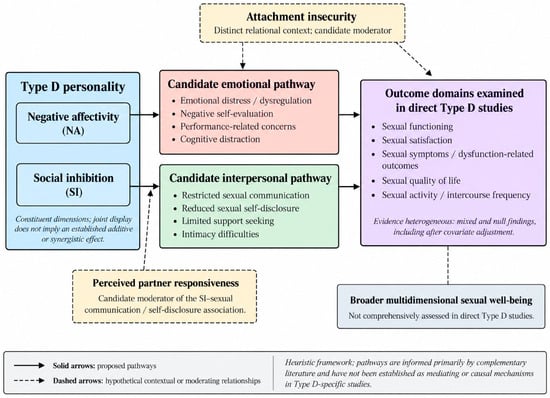
Sexual well-being extends beyond the absence of sexual dysfunction and includes relational, emotional, and autonomy-related dimensions. This integrative narrative review synthesised direct evidence concerning Type D personality, attachment, intimacy, and sexuality, and considered it alongside complementary literature on emotion regulation, communication, self-disclosure, and partner responsiveness. Direct evidence was identified through PubMed/MEDLINE and Scopus, supplemented by Google Scholar and backward and forward citation searching. Seventeen peer-reviewed empirical studies met the eligibility criteria. The evidence was limited, heterogeneous, and predominantly cross-sectional, with only limited prospective data. Most studies operationalised Type D personality categorically, and current evidence does not establish that the co-occurrence or interaction of negative affectivity and social inhibition contributes beyond their independent effects. Outcomes included erectile functioning, premature-ejaculation-related outcomes, female sexual functioning, sexual satisfaction, sexual symptoms, and sexual quality of life; these narrower outcomes should not be equated with broader multidimensional sexual well-being, which has not been comprehensively assessed. Differences in populations and outcome measures, together with scarce formal sex-based interaction analyses and limited assessment of gender-related constructs, preclude robust conclusions about sex- and gender-related differences. We therefore propose two candidate pathways: an emotional pathway linking negative affectivity with distress, negative self-evaluation, performance-related concerns, and cognitive distraction, and an interpersonal pathway linking social inhibition with restricted communication, limited self-disclosure, reduced partner support, and difficulties in intimacy. Attachment insecurity is considered a distinct relational context and a potential moderator of associations between Type D personality dimensions and sexual outcomes, while perceived partner responsiveness is proposed as a candidate moderator of interpersonal processes. The framework is heuristic and hypothesis-generating rather than sequential, mediational, or causal.

Sexes

27 October 2026

Heuristic conceptual framework illustrating candidate emotional and interpersonal pathways linking the dimensions of Type D personality with relational and sexual outcomes. Negative affectivity (NA) and social inhibition (SI) are presented as constituent dimensions of Type D personality; their joint presentation does not imply an established additive or synergistic effect. The proposed emotional and interpersonal pathways are informed primarily by complementary literature and have not been established as mediating or causal mechanisms in Type D-specific studies. Attachment insecurity is considered a distinct relational context and candidate moderator of associations between Type D personality dimensions and intimate or sexual outcomes. Perceived partner responsiveness is proposed specifically as a candidate moderator of the association between social inhibition and sexual communication or self-disclosure. Neither moderating relationship has been directly tested in the identified Type D studies. The outcome domains shown were examined in direct empirical studies, but the reported associations were heterogeneous, including mixed and null findings after covariate adjustment. These outcomes should not be equated with broader multidimensional sexual well-being, which has not been comprehensively assessed. Solid arrows indicate proposed pathways, whereas dashed arrows represent hypothetical contextual or moderating relationships requiring direct empirical testing.
  • Article
  • Open Access

Understanding Beliefs About Sexuality in Later Life: A Latent Profile Analysis of Attitudes, Knowledge, and Ageism

  • Verónica Estruch-García,
  • María Dolores Gil-Llario and
  • Encarnación Satorres

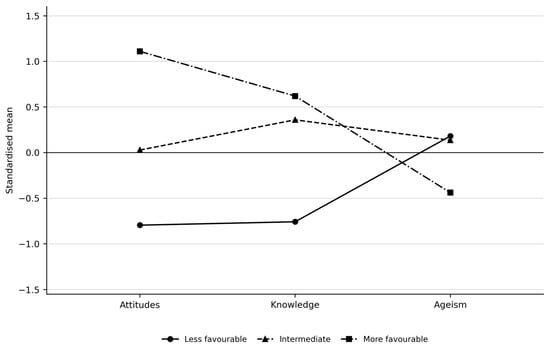
Sexuality remains an important component of well-being across the lifespan, yet perceptions of sexuality in later life may be shaped by knowledge, ageist beliefs, and broader sexual attitudes. This study aimed to identify distinct profiles based on attitudes towards older adults’ sexuality, knowledge about sexuality in later life, and ageism, and to examine the characteristics associated with profile membership. A cross-sectional sample of 425 Spanish adults aged 18–88 years completed measures of these constructs and general sexual attitudes. Latent profile analysis identified three profiles: less favourable (38.4%), intermediate (35.1%), and more favourable (26.6%). The less favourable profile combined lower knowledge and less permissive attitudes with higher ageism, whereas the more favourable profile showed the opposite pattern. Multinomial logistic regression indicated that general sexual attitudes were consistently associated with profile membership. Educational attainment, gender, and marital status also differentiated specific profile contrasts, whereas age and religious self-identification did not independently predict membership after adjustment. These findings demonstrate substantial heterogeneity in perceptions of sexuality in later life and support person-centred approaches to their study. Educational initiatives should address knowledge, ageist beliefs, and broader sexual attitudes rather than relying solely on sociodemographic characteristics.

Sexes

27 October 2026

Standardised Means Across the Three Profile Indicators for the Retained Three-Profile Solution.
  • Article
  • Open Access

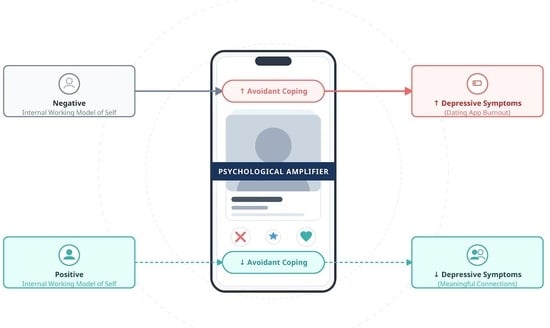
Although single individuals represent a significant portion of the population and are more motivated in their adoption of Dating Applications (DAs), their experiences in relation to psychological well-being remain inadequately explored. Grounded in attachment theory, this study investigates the psychological impact of DAs use among single individuals, specifically how it interacts with self-representation and coping strategies, and how these constructs may be associated with depressive symptoms. We build upon the conceptualization of DAs as a “psychological amplifier”, hypothesizing and empirically testing how their use may intensify pre-existing associations between self-concept and mental health outcomes via coping strategies. Data from 2124 Italian singles (704 DA users, 1420 non-users) were investigated using a moderated mediation model, holding self-representation (using the Internal Working Model of Self—IWMSelf) as the exogenous variable, avoidant coping strategies as the mediator, depressive symptoms as the outcome, and DAs usage as the moderator. The negative indirect association between a positive IWMSelf and avoidant coping was more pronounced for users (b = −0.32) than non-users (b = −0.22), with DAs usage exerting a moderating effect. Similarly, avoidant coping’s positive association with depressive symptoms was stronger for users (b = 0.36) compared to non-users (b = 0.28). Finally, the significant moderated mediation model confirmed this amplification (b = −0.056). These findings supported the hypothesized amplification effect (index of moderated mediation: b = −0.056, 95% CI −0.098, −0.016), providing initial empirical evidence for DA use functioning as a psychological amplifier and contributing to understanding the complex interplay between digital platforms and mental health, emphasizing the critical need for a psychologically informed approach to online intimacy.

Sexes

23 October 2026

The proposed Moderated Mediation Model. This path diagram illustrates the hypothesized mediating role of avoidant coping (M) in the relationship between the internal working model of the self (X) and depression (Y), with the indirect pathway being moderated by dating app usage (W).
  • Review
  • Open Access

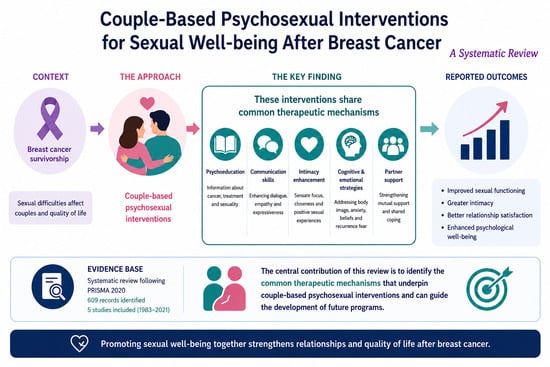
Breast cancer frequently affects sexual well-being, with long-lasting consequences for intimacy, relationship functioning, and quality of life. Although couple-based psychosexual interventions are increasingly recommended within survivorship care, little is known about the therapeutic principles underpinning these programs. This systematic review aimed to identify, describe, and critically synthesize couple-based psychosexual interventions designed to improve sexual well-being after breast cancer, with particular emphasis on their therapeutic architecture, core components, and methodological characteristics. Following PRISMA 2020 guidelines, a systematic search was conducted in Web of Science Core Collection, PubMed, PsycINFO, and Cochrane Library. Five studies met the eligibility criteria. Methodological quality was assessed using the Mixed Methods Appraisal Tool (MMAT 2018). Despite substantial methodological heterogeneity, the interventions consistently involved both partners and shared key therapeutic components, including psychoeducation, communication skills training, intimacy enhancement, and partner support. More recent interventions additionally incorporated cognitive-behavioral and acceptance-based strategies, reflecting a shift from symptom-oriented approaches toward biopsychosocial and relational models of sexual recovery. Overall, the available evidence suggests that couple-based psychosexual interventions may improve sexual and relational outcomes. However, conclusions remain limited by the small number of studies, heterogeneous intervention protocols, and scarce long-term follow-up. These findings identify common therapeutic components that may guide the development of more theoretically grounded, standardized, and clinically applicable psychosexual interventions for couples coping with breast cancer.

Sexes

7 October 2026

PRISMA flow diagram of the development of literature selection.

Highly Accessed Articles

News & Conferences

Latest Issues

Open for Submission

Journal Sections

XFacebookLinkedIn
Sexes - ISSN 2411-5118