







Skip to Content

Nanomaterials

Nanomaterials is an international, interdisciplinary, peer-reviewed, open access journal published semimonthly online by MDPI, and that publishes reviews, regular research papers, communications, and short notes that are relevant to any field of study that involves nanomaterials with respect to their science and applications. The Spanish Carbon Group (GEC) and The Chinese Society of Micro-Nano Technology (CSMNT) are affiliated with Nanomaterials and their members receive discounts on the article processing charges.
  • Open Access— free for readers, with article processing charges (APC) paid by authors or their institutions.
  • High Visibility: indexed within Scopus, SCIE (Web of Science), PubMed, PMC, CAPlus / SciFinder, Inspec, and other databases.
  • Journal Rank: JCR - Q2 (Physics, Applied) / CiteScore - Q1 (General Chemical Engineering )
  • Rapid Publication: manuscripts are peer-reviewed and a first decision is provided to authors approximately 12.5 days after submission; acceptance to publication is undertaken in 2.7 days (median values for papers published in this journal in the first half of 2026).
  • Recognition of Reviewers: Reviewers whose reports are timely and of high quality receive an APC discount voucher for a future publication in an MDPI journal. Become a reviewer.
  • Companion journals for Nanomaterials include: Nanomanufacturing and Applied Nano.

Get Alerted

Add your email address to receive forthcoming issues of this journal.

All Articles (22,644)

Physical processing can modify the structural, textural, and dispersion characteristics of nanostructured oxide materials, thereby altering their functional state under suspension conditions. Here, poorly crystalline, sol–gel-derived porous MnOx materials were used to establish how post-synthetic physical processing affects the relationship between nanoscale structure, accessible mesoporosity, powder-to-suspension transfer, and chromogenic response in 3,3′,5,5′-tetramethylbenzidine (TMB) oxidation. Two compositionally distinct processing series were examined: an ultrasonic processing/recovery route for Sr- and Fe-containing MnOx and vibratory milling followed by identical ultrasonic dispersion for Sr-free Fe-containing MnOx. The recovered SrFeMn-US-S solid showed higher N2-accessible surface area and pore volume, stronger hydration signatures, and a larger low-temperature H2 temperature-programmed reduction (H2-TPR) contribution than SrFeMn-S. In contrast, vibratory milling of FeMn-S preserved the bulk Fe/Mn ratio but decreased SBET from 305.9 to 127.1 m2 g−1, Vtot from 0.533 to 0.215 cm3 g−1, total H2 uptake from 0.38 to 0.34 mmol g−1, and the Mn concentration in the operationally defined stable suspension fraction from 50.5 to 17.3 mg L−1. At an identical assay concentration of 500 ng Mn mL−1, milled FeMn-S5 also exhibited a lower time-summed ΣA652 response than FeMn-S. Thus, milling affected both the efficiency of powder-to-suspension transfer and the Mn-normalized functional response of the dispersed material. The contrasting outcomes show that the functional state of nanostructured, powder-derived MnOx is route-dependent and cannot be predicted from a single solid-state descriptor.

Nanomaterials

11 September 2026

Schematic representation of the experimental routes used for sample processing and analysis. (A) Two related ultrasonic-processing routes applied to SrFeMn-S: preparation of the working suspension for Mn-normalized A652 measurements and a concentrated ultrasonic processing/recovery route used to obtain the SrFeMn-US-S solid for powder-state characterization. (B) Comparison of two routes for preparing FeMn-S suspensions: direct ultrasonic dispersion and vibratory milling followed by ultrasonic dispersion, with subsequent evaluation of the Mn-normalized A652 response.

Super-liquid-repellent materials hold significant promise for minimizing food residue, suppressing interfacial fouling, and enhancing the cleanability of food-contact surfaces. However, prevailing evaluation paradigms—centered on static contact angle, roll-off angle, and dry abrasion—fail to forecast long-term service performance in complex food-processing environments. Unlike idealized probes, real food matrices comprise proteins, polysaccharides, lipids, surfactants, and microbiota, driving interfacial behavior that is time-dependent, multicomponent-coupled, and dynamically evolving. Consequently, traditional static metrics are inadequate across temporal, chemical, and mechanical dimensions. Furthermore, while “fluorine-free,” “edible,” or “bio-based” labels offer design cues, they cannot substitute for rigorous, lifecycle-resolved assessments encompassing fabrication, aging, migration, and end-of-life impacts. This review delineates the fundamental mismatch between current evaluation frameworks and operational food environments, exposing latent safety and sustainability risks obscured by superficial green claims. We subsequently discuss a dynamic evaluation framework featuring multidimensional metrics and a tiered screening workflow, shifting the paradigm from endpoint-focused assessment to a process-based evidentiary chain. Finally, we outline future trajectories, emphasizing the transition from passive repellency to active fouling modulation and the co-design of performance, safety, and sustainability. This work provides a conceptual blueprint for updating evaluation standards and accelerating the industrial translation of food-contact super-liquid-repellent materials.

Nanomaterials

10 September 2026

Dynamic evaluation framework for super-liquid-repellent materials in real food environments. The framework integrates temporal fouling evolution, chemical interference, mechanical stress, hidden safety/sustainability costs, and tiered screening to shift evaluation from static contact-angle endpoints to a time–chemical–mechanical process-based evidence chain.

Fabricating nanoscale metal–organic frameworks (MOFs) with hierarchical pores is an effective strategy to engineer high-performance adsorbents. Herein, hierarchically porous NH2-MIL-53(Al) nanorods were synthesized through a straightforward one-pot solvothermal approach, featuring inherently interconnected micro-/mesoporous with an average pore width of 19.51 nm and abundant amino-functionalized active sites. Toward the anionic Direct Scarlet dye, the material delivers a Langmuir maximum adsorption capacity of 694.99 mg·g−1, with its adsorption kinetics and isotherms well described by the pseudo-second-order kinetics and Langmuir isotherm model. Combined spectroscopic, thermodynamic, and diffusion analyses suggest monolayer electrostatic chemisorption between protonated –NH3+ and dye sulfonate groups. The material exhibits favorable reusability, retaining over 85% of its original dye removal efficiency after five adsorption–desorption cycles, and PXRD and SEM results verify well-preserved morphology and crystalline lattice. This work clarifies the intrinsic correlation between structure and adsorption performance of NH2-MIL-53(Al), offering a facile nanoscale pore-tuning strategy for the design and fabrication of high-performance MOF adsorbents.
Nanomaterials

10 September 2026

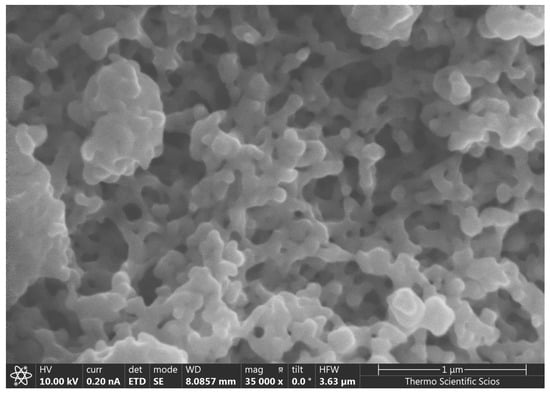
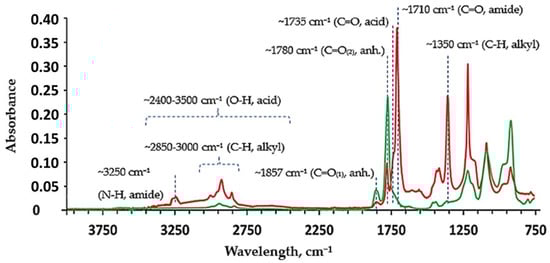
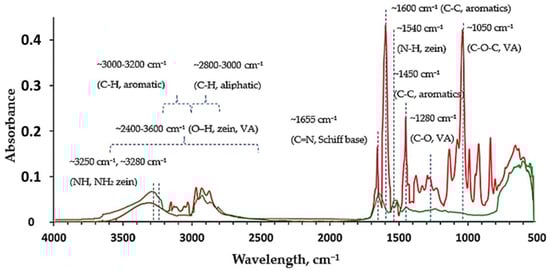
(a) XRD patterns, (b) FT-IR spectra, (c) SEM images, and (d) TGA and DTG curves of NH2-MIL-53(Al).
  • Communication
  • Open Access

In this study, we present the development of selective-area porous GaN (SPG) microarrays integrated with embedded quantum dots (QDs) for next-generation display applications. We report a dielectric hard mask-based architecture that withstands high etching voltages without suffering structural damage, overcoming the limitations of conventional polymer masks. This process provides precise control over both vertical and lateral pore propagation, achieving an effective pixel size of 15 μm and realizing an ultrahigh-resolution (>1270 ppi) display structure. Furthermore, optical performance measurements confirmed that the obtained array exhibited an excellent color gamut, reaching 119.2% of the NTSC and 95.6% of the Rec. 2020 standards. Therefore, the present dielectric hard mask-based patterning technology provides an effective solution for achieving both process stability and high-resolution pixel structures, enabling the fabrication of high-performance micro-LED displays with full-color capabilities.
Nanomaterials

10 September 2026

Schematic illustration of fabrication process of QD-integrated SPG pixel arrays. The blue and orange arrows represent the fabrication routes for mono-color and full-color pixel arrays, respectively.

Highly Accessed Articles

News & Conferences

Latest Issues

Open for Submission

Journal Sections

Advanced Nanomaterials for Water Remediation (2nd Edition)
Reprint

Advanced Nanomaterials for Water Remediation (2nd Edition)

Editors: Pedro Manuel Martins, Noelia González-Ballesteros
XFacebookLinkedIn
Nanomaterials - ISSN 2079-4991