Article

Design of Lattice-Matched InAs1−xSbx/Al1−yInySb Type-I Quantum Wells with Tunable Near-To Mid-Infrared Emission (2–5 μm): A Strain-Optimized Approach for Optoelectronic Applications

by
Gerardo Villa-Martínez
1,* and
Julio Gregorio Mendoza-Álvarez
2
1
Sección de Estudios de Posgrado e Investigación, ESIME-Ticomán, Instituto Politécnico Nacional, Ciudad de México 07340, Mexico
2
Departamento de Física, Centro de Investigación y de Estudios Avanzados del IPN, Ciudad de México 07360, Mexico
*
Author to whom correspondence should be addressed.
Nanomaterials 2026, 16(2), 147; https://doi.org/10.3390/nano16020147 (registering DOI)
Submission received: 19 November 2025 / Revised: 13 December 2025 / Accepted: 19 January 2026 / Published: 22 January 2026
(This article belongs to the Special Issue Theory and Modeling of Nanostructured Materials)

Abstract

We propose a strain-optimized design strategy for lattice-matched InAs1−xSbx/Al1−yInySb Type-I quantum wells (QWs) that emit across the near-to mid-infrared spectrum (2–5 µm). By combining elastic strain energy minimization with band offset calculations, we identify Type-I alignment for Sb contents (x ≤ 0.40) and In contents (0.10 < y ≤ 1). At the same time, Type-II dominates at higher Sb compositions (x ≥ 0.50). Using the transfer matrix method under the effective mass approximation, we demonstrate precise emission tuning via QW thickness (LW) and compositional control, achieving a wavelength coverage of 2–5 µm with <5% strain-induced energy deviation. Our results provide a roadmap for high-efficiency infrared optoelectronic devices, addressing applications in sensing and communications technologies.

1. Introduction

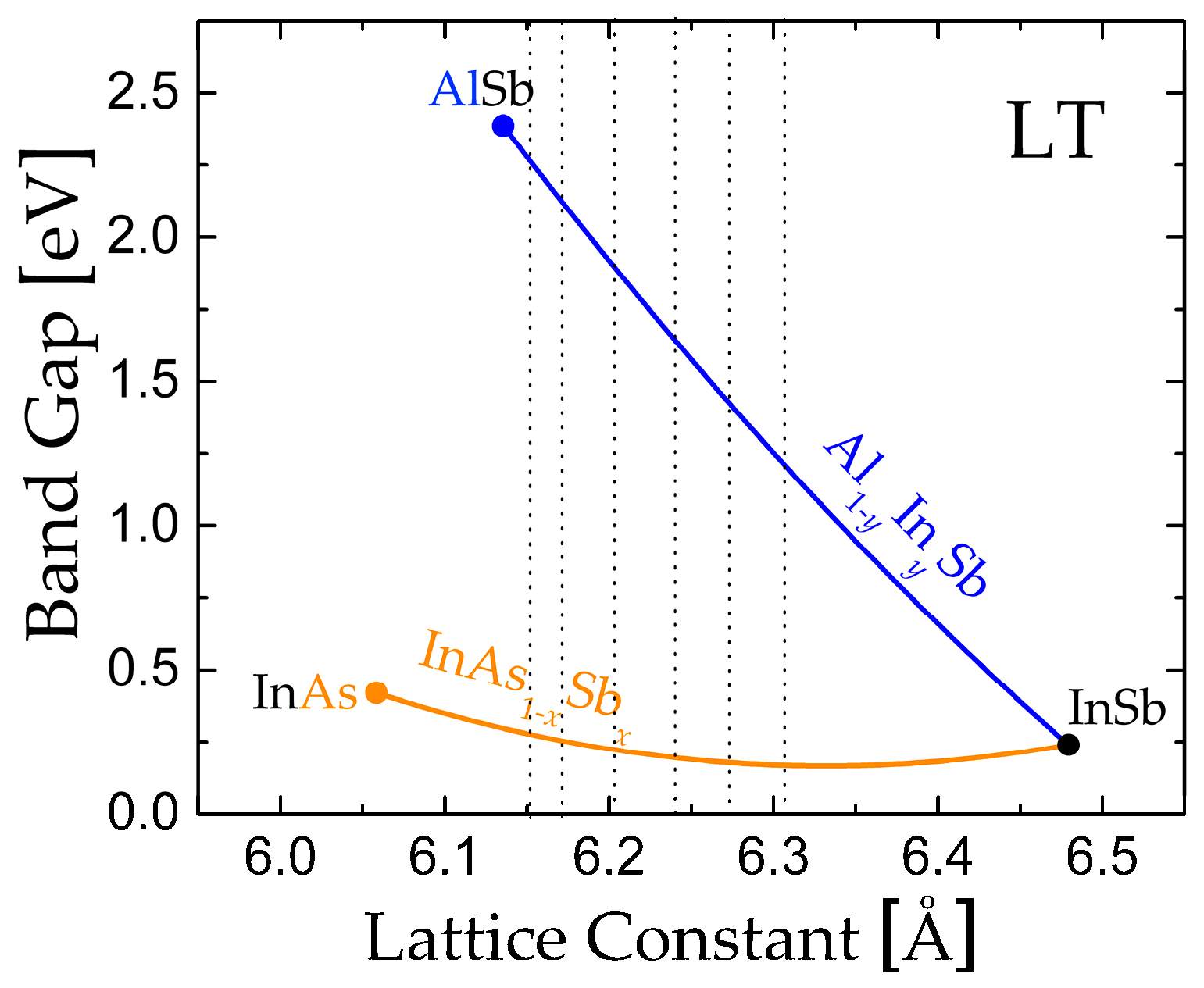
Antimonide-based semiconductors have emerged as a cornerstone for infrared optoelectronics due to their tailorable band gaps and high carrier mobility. Among these, InAsSb alloys are particularly promising for the 2–5 µm range, bridging the near- and mid-infrared spectral windows critical for molecular sensing and free-space communication [1]. InSb-based QWs exhibit record electron mobilities exceeding 200,000 cm2/Vs at low temperatures (LT) and room temperature (RT) mobilities of 78,000 cm2/Vs [2,3], attributed to their ultra-low effective mass (m* = 0.013me) and high Fermi velocities [4]. However, the incorporation of As (e.g., InAs0.10Sb0.90) shifts alignment to Type II [5], reducing resistivity but impeding light emission efficiency. Recent studies demonstrate that InAsSb/AlInSb heterostructures grown by molecular beam epitaxy (MBE) achieve exceptional interfacial and strong carrier confinement [1,6], yet thermal instability and lattice-mismatch induced defects persist, especially on GaAs substrates [7]. Critical to performance is strain management at the InAsSb/AlInSb interface, where mismatched lattice parameters and thermodynamic differences degrade QW integrity [8,9]. The InAs1−xSbx ternary alloy exhibits a pronounced bandgap (Eg) bowing effect, enabling tunable emission across the 2.95–5.17 µm range [2], but optimal compositions (e.g., x ≈ 0.2) demand lattice matching (y = 1.2245x − 0.2245, Figure 1) to minimize strain. While InAs1−xSbx QWs (x = 0.4–0.6) offer improved thermal stability [10], achieving Type-I alignment requires precise control of composition and QW thickness (Lw) to balance band offsets and dislocation suppression [1,11].
Despite progress, designing strain-optimized, Type-I InAsSb/AlInSb QWs with tunable emission (2–5 µm) remains unresolved, particularly for high-efficiency light-emitting devices. Here, we combine elastic strain energy minimization with band offset calculations to predict Type-I alignment and suppress Type-II transitions. Using transfer matrix methods, we demonstrate broadband emission tuning via Lw and composition for IR optoelectronic applications.

2. Calculation Procedures

Research shows that In-As-Sb alloys have a shared cation group (In) formed by substituting group V atoms during crystal growth. Similarly, Al-In-Sb alloys share an anion group (Sb) formed by substituting group III atoms [8]. Thus, InAs1−xSbx and Al1−yInySb alloys are combinations of compounds (InAs, InSb, AlSb) [12]. All physical parameters were computed utilizing Virtual Crystal Approximation (VCA). In this context, a VCA crystal is regarded as possessing an average effective crystal potential, which is determined based on a lattice constant as defined by Vegard’s Law. Generally, the properties of a ternary alloy can be linearly interpolated between those of its binary constituents, indicating that the chemical bonding of atoms within the alloy transitions smoothly between the values of the endpoint compounds. This assumption serves as the foundation of the VCA. The VCA offers an efficient framework for predicting alloy properties. It models the alloy with a perfectly periodic average potential, ignoring short-range disorder or local composition fluctuations common in real ternary alloys. For parameters with nonlinear composition dependence, linear interpolation (Equation (1)), even with empirical bowing parameters, can introduce inaccuracies in properties such as deformation potentials or effective masses, especially at intermediate compositions. The main errors stem from oversimplified band edges, possibly leading to underestimates of band-tailing and transition energies. Despite this, VCA effectively identifies trends, phase boundaries, and design principles, as shown in this work [13]. Accordingly, we employed the following formulas:
P I n A s 1 x S b x = 1   x P I n A s + x P I n S b , P A l 1 y I n y S b = 1   y P A l S b + y P I n S b
where P I n A s , P I n S b , and P A l S b are parameters associated with binary compounds that form a given ternary alloy, for example, the lattice constant, effective mass, elastic stiffness, band gap energy (see Table 1); in the case of Eg of ternary alloys, as a function of composition, the non-linear deviation occurring during alloy formation is accounted for by including a bowing parameter specific to each ternary alloy. The bowing parameters for the alloys, bInAsSb = 0.60 eV and bAlInSb = 0.43 eV, are well-known values from the literature and are consistent with Vurgaftman et al. [8], who suggest that bInAsSb = 0.67 eV and bAlInSb = 0.43 eV. The minor difference in InAsSb, within the typical 0.6–0.7 eV range, does not impact the trends. Using these standard parameters ensures our bandgap calculations align with recognized data for III-V semiconductors.

3. Results and Discussion

3.1. Elastic Strain Energy in InAs1−xSbx/Al1−yInySb Heterostructures

Lattice matching is critical for minimizing defects in InAs1−xSbx/Al1−yInySb quantum wells (QWs). The in-plane strain ( ε ) at the interface is governed by
ε = ε y y = ε z z = a A l I n S b ( y ) a I n A s S b ( x ) a A l I n S b ( y )
where a is the lattice constant (Table 1). For (100)-oriented growth, ε induces tetragonal distortion, with out-of-plane strain ( ε ) given by
ε = ε x x = 2 C 12 C 11 ε
Strain energy minimization is achieved via calculations of the elastic potential energy given by the following [15]:
E s t r a i n = E x , y = 1 2 C 11 ε x x 2 + ε y y 2 + ε z z 2 + C 12 ε x x ε y y + ε z z ε y y + ε x x ε z z     + 1 2 C 44 ε x y 2 + ε y z 2 + ε x z 2
The elastic stiffness coefficients ( C 11 , C 12 , C 44 ) of InAs1−xSbx and Al1−yInySb are expressed as C I n A s S b = 1 x C I n A s + x C I n S b and C A l I n S b = 1 y C A l S b + y C I n S b . The numerical values of the stiffness coefficients used in the calculations are presented in Table 1. For the (100)-oriented heterostructure, the InAs1−xSbx epilayer undergoes biaxial in-plane strain, inducing tetragonal distortion. Additionally, we assumed that the Al1−yInySb epilayer is infinitely thick, thereby eliminating any in-plane shear strain on the Al1−yInySb. The strain tensor was computed using the reference [16], incorporating both normal and shear components, resulting in a (100)-oriented heterostructure, ε y z = ε y x = ε x z = 0 .
In the absence of lattice matching, residual strain significantly impacts both the electronic structure and the luminescence efficiency of the QWs. Electronically, strain modifies the band gap energy via the deformation potential and induces splitting of the valence bands into heavy-hole (HH) and light-hole (LH) subbands [8]. This alters the density of states, shifts transition energies, and can change the effective mass of carriers. In extreme cases, strain can even modify the band alignment, potentially driving a Type-I heterostructure into a Type-II configuration, thereby spatially separating electrons and holes and reducing the probability of radiative recombination [5]. High strain energy promotes the generation of misfit dislocations at the heterointerface. These defects act as non-radiative recombination centers, drastically quenching photoluminescence intensity and degrading internal quantum efficiency [17]. Furthermore, accumulated strain may lead to partial or complete relaxation of the quantum well layer, resulting in interfacial roughness and increased carrier scattering [18]. Therefore, minimizing strain through lattice matching is not merely a structural concern but is essential for achieving high radiative efficiency and predictable emission characteristics in InAsSb/AlInSb QW-based devices.
While this work focuses on the ideal lattice-matched condition for maximal performance, practical device integration on conventional substrates, or for specific bandgap targets, may require operating under some residual strain. In such cases, advanced strain compensation strategies can be employed to mitigate defect formation. These include the use of strain-balanced superlattices, in which alternating tensile and compressive layers achieve a net zero average strain on the substrate, and graded buffer layers that gradually transition the lattice constant from the substrate to the active region, thereby filtering threading dislocations [19,20]. The design principles established here for individual QWs can be extended within these more complex, strain-engineered architectures, offering a pathway to integrate tunable InAsSb/AlInSb emitters with a broader range of photonic platforms.
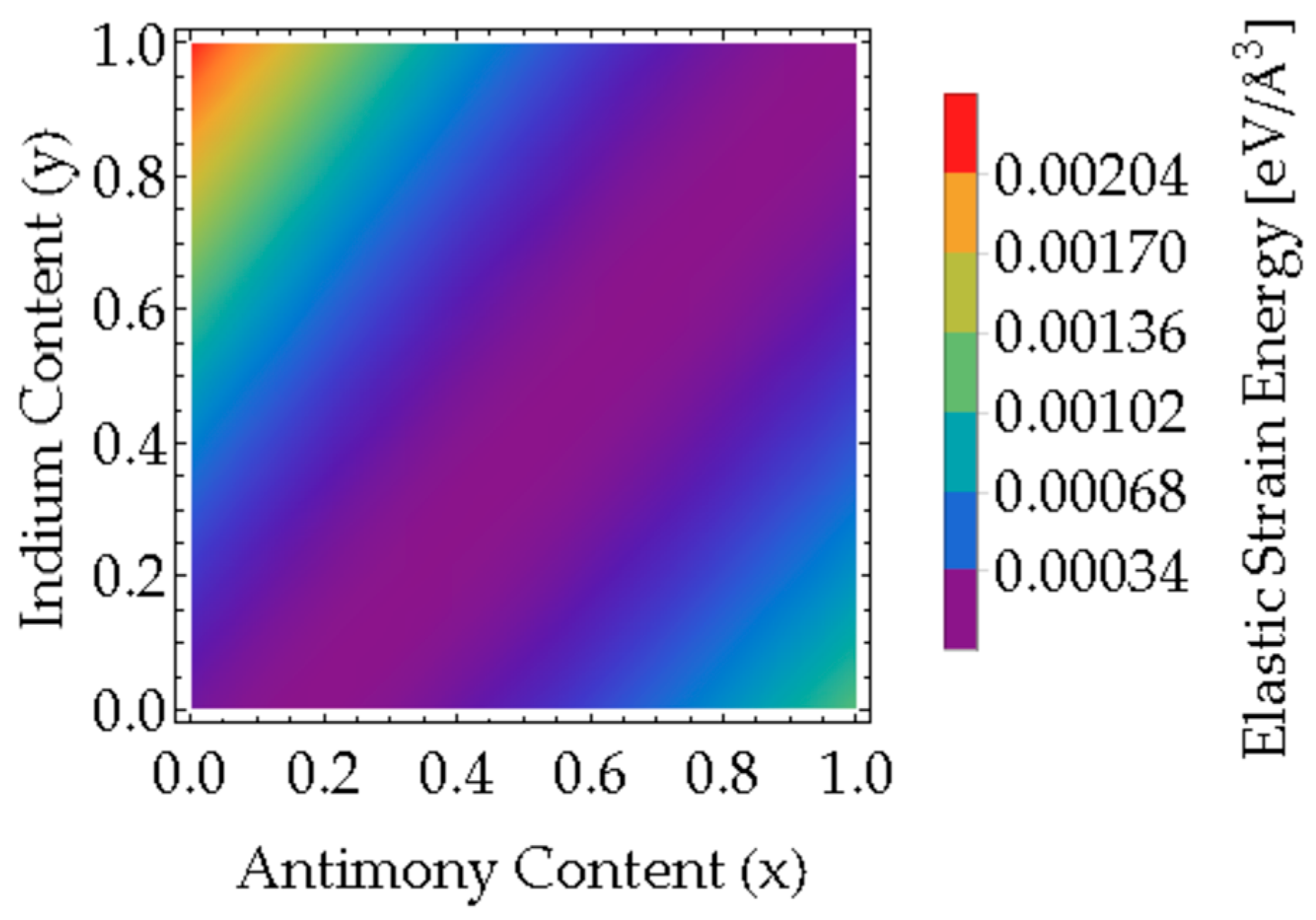
Figure 2 maps E s t r a i n across all (x, y) compositions, revealing a minimum (purple region) at the lattice-matched condition y = 1.2245 x 0.2245 . Meanwhile, the maximum strain energy (red region) is observed for InAs ( x = 0 ) on InSb ( y = 1 ), where the considerable tensile strain arises from the mismatch between InAs (smaller lattice parameter) and InSb (most significant lattice parameter). Based on reports from the literature for high-quality, defect-free III–V quantum wells, the acceptable in-plane strain is typically below 1–2%, corresponding to an elastic strain energy of less than 1–2 meV/Å3 in Figure 2. Compositions lying within the dark blue/purple regions of Figure 2 satisfy this criterion and are thus considered experimentally feasible for device implementation.

3.2. Band Alignment and Type-I/II Criteria in InAs1−xSbx/Al1−yInySb Interface

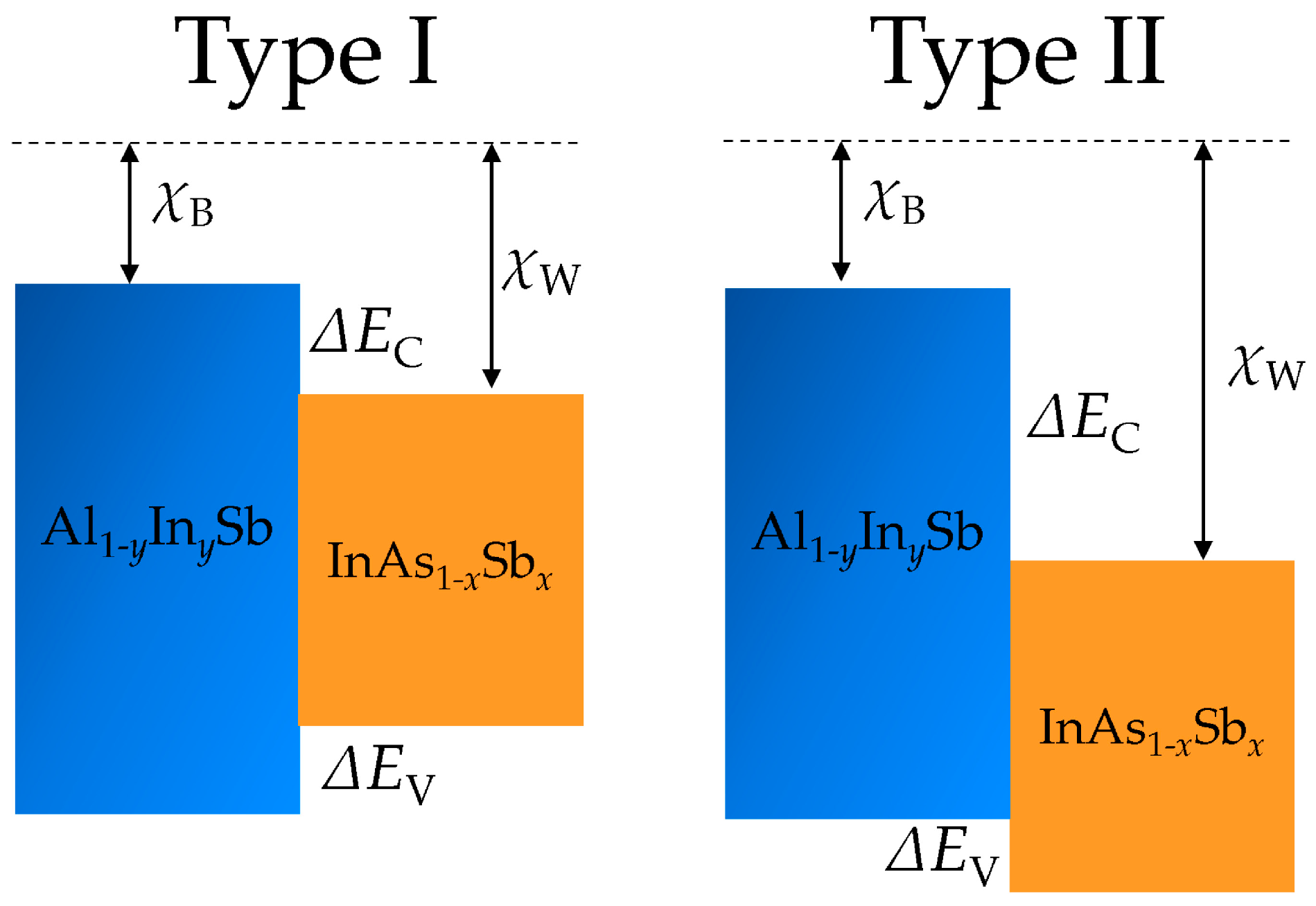
The heterostructure type can be identified using the electron affinity rule, where the offset in the conduction band at the interface equals the difference in the electron affinity values of the two compounds, InAs1−xSbx/Al1−yInySb. Band offsets refer to the relative alignment of the energy bands at the interface of a heterojunction—a junction formed between two distinct semiconductor materials. This phenomenon is crucial in optoelectronic device design, as it governs the behavior of electrons and holes at the interface, directly influencing carrier recombination dynamics, light emission efficiency, and electrical conductivity. Band offsets are commonly determined using theoretical models, such as Anderson’s rule and linear theory, which account for intrinsic semiconductor properties and interfacial effects. Anderson’s rule estimates band alignment using fundamental material parameters, including electron affinity and bandgap values, providing a first-order approximation of the band alignment, band offsets [21]. Meanwhile, linear theory refines this approach by incorporating electronic structure details and bonding characteristics at the interface, enabling more accurate predictions for complex heterostructures [22]. Their continued relevance stems from their adaptability to novel material systems and their utility in guiding the design of interfaces for advanced optoelectronic applications. Heterojunctions exhibit two primary band alignment configurations (see Figure 3): Type I (straddling) and Type II (staggered), depending on the alignment of the conduction and valence bands [23]. In Type I, the conduction band minimum (CBM) and valence band maximum (VBM) of one material are fully nested within the bandgap of the other. This configuration localizes both electrons and holes in the same material, enhancing radiative recombination. In Type II, the CBM of one material aligns within the band gap of the other, creating a spatial separation of electrons and holes. This promotes charge transfer across the interface, which is suitable for photovoltaic and photocatalytic devices.
By using the electron affinity rule [21], in which the offset in the conduction band (ΔEC) at the interface is equal to the difference in electron affinity values of the two semiconductors, in our case, for InAs1−xSbx and AlIn1−ySby, defined as
E C = χ W χ B = χ I n A s S b χ A l I n S b
While Anderson’s rule provides a reliable first-order estimate based on electron affinity differences, it does not account for interface dipole effects, strain-induced band edge modifications, or chemical bonding disparities, which can be significant in polar, mismatched systems such as InAsSb/AlInSb. More advanced first-principles calculations or experimental measurements would be required for precise quantitative alignment, but are beyond the scope of this design-oriented study.
In addition, the following expression must be fulfilled, E C + E V = E g , B E g , W , where E V corresponding to the offset in the valence band; E C + E V = E g , A l I n S b E g , I n A s S b .
Following the linear approximation, we can express the band offsets as follows:
E C = E C x , y = χ I n A s S b χ A l I n S b = 1 x χ I n A s + x χ I n S b 1 y χ A l S b y χ I n S b
and
E V = E V x , y = E g , A l I n S b y E g , I n A s S b x E C x , y
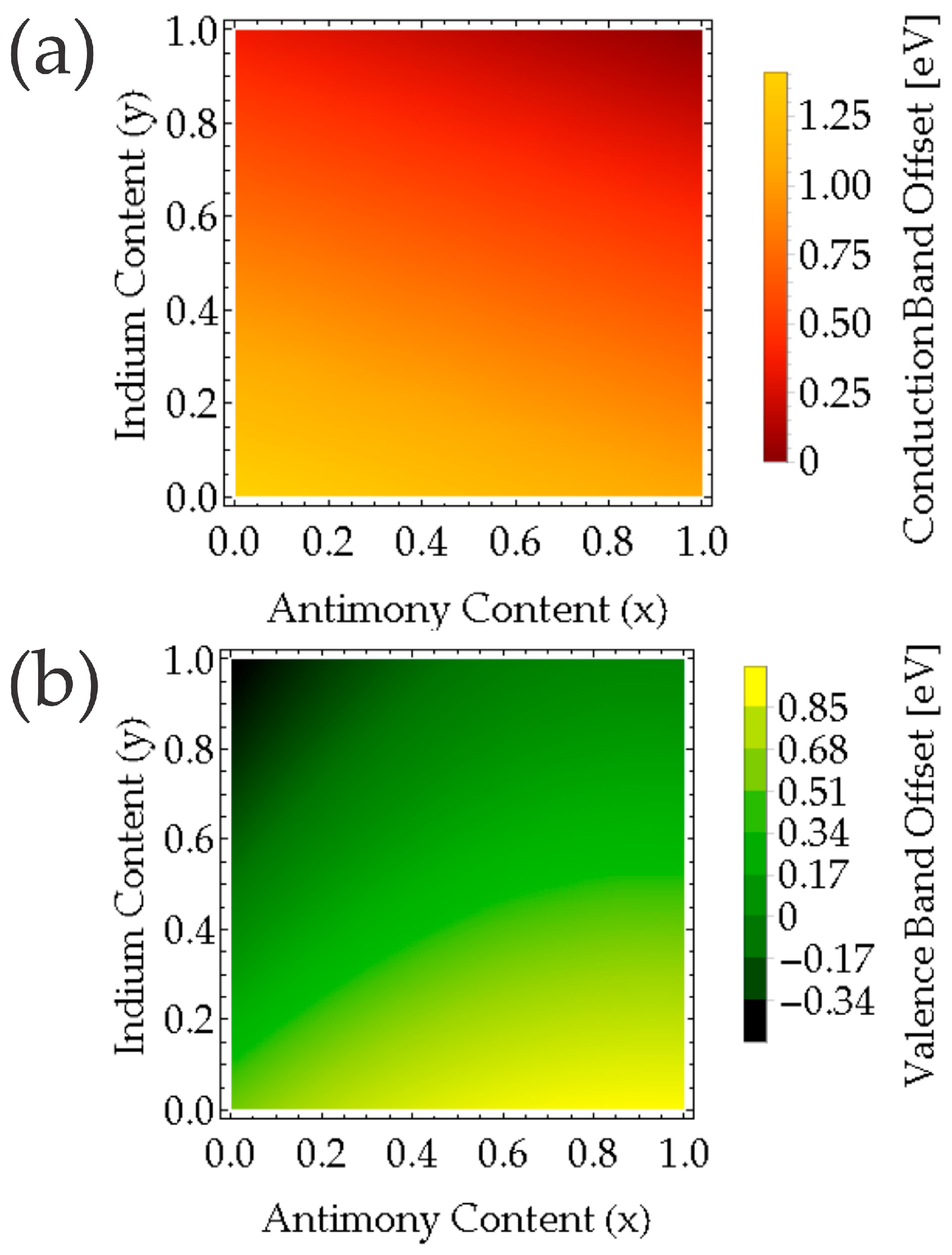
The values employed for the calculation are presented in Table 1. Figure 4a displays the conduction band offset for InAs1−xSbx/AlInySb1−y interface for all combinations of Sb (x) and In(y) contents. We can observe that E C > 0 . Figure 4b shows the valence band offset for InAs1−xSbx/AlInySb1−y interface for all combinations of Sb and In. InAs1−xSbx/AlInySb1−y interface presents an E V < 0 , indicating that for this region, the interface is Type II, and, also, E V > 0 corresponds to interface Type I.
It can be concluded that Type I is obtained for y ≤ 0.40 and 0 ≤ x ≤1; for y > 0.40, the antimony content (x) range can be found for 0.10 < x ≤ 1. While Type II is allowed for y ≥ 0.50, the antimony content (x) range can be found for 0.10 < x ≤ 1.

3.3. Tuning of Excitonic Transitions in Lattice-Matched Quantum Wells

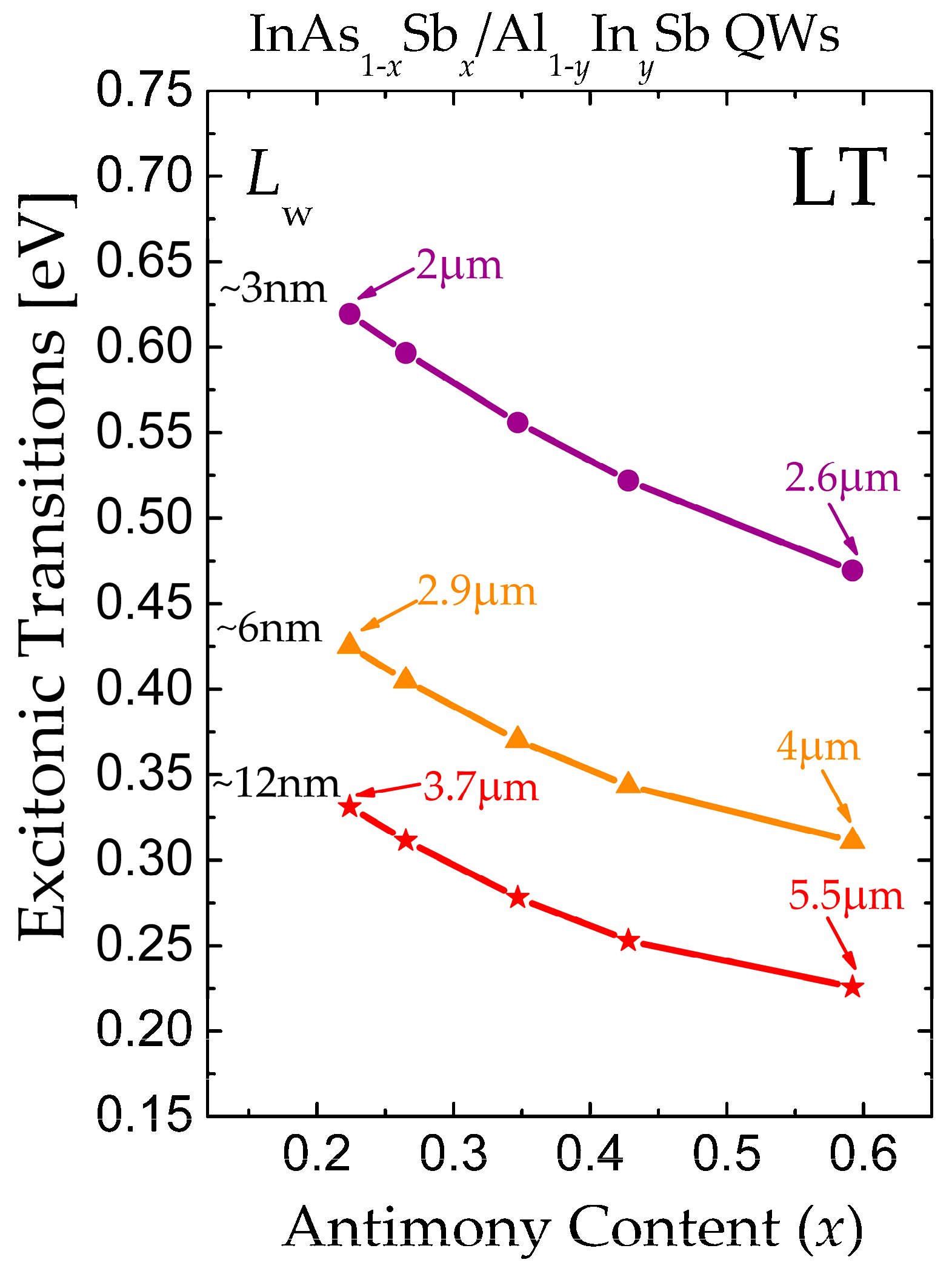
We have calculated the QW energy levels of QWs; we used the transfer matrix method under the effective mass envelope function approximation. The values used are shown in Table 1. For general calculations, we considered a QW with an InAs1−xSbx central region and Al1−yInySb barriers under lattice-matched conditions, presenting a Type-I band alignment. The assumption of an infinitely thick, unstrained first (bottom) barrier is a standard simplification in envelope-function calculations, ensuring complete carrier confinement within the QW. In practice, barrier thicknesses exceeding 30 nm are typically sufficient to approximate this condition, with negligible coupling between adjacent wells or quantization effects in the barriers themselves. We have deemed excitonic transitions, and the excitonic binding energy was calculated following ref. [24]. The energy of the excitonic transition at low temperature can be expressed as Eexc(LT) = Eg(LT) + E1e + E1hhE1s, where Eg(LT) is the bandgap at low temperature of the QW material, E1e and E1hh are the ground states for electrons and heavy holes in their respective quantum wells, and E1s is the exciton binding energy. The analytical model for exciton binding energy used in this work [24] provides a reliable estimate for strongly confined excitons in Type-I QWs, with an expected accuracy within 5 meV for the well width and composition range considered. This uncertainty does not affect the overall trends in tunability or the identification of Type-I/II transitions. In Figure 5, we observe the excitonic transition of InAs1−xSbx/Al1−yInySb QW Type-I under lattice-matched conditions. As a reference, if we choose x = 0.224, then the lattice matching in content of the barrier will be y = 0.5 (lattice-matched Al0.95In0.5Sb/InAs0.776Sb0.224/Al0.95In0.5Sb QW Type I). From this figure, we can see that by choosing y = 0.5 in the QW, we can tune the emission to a range of 2–3.7 µm. Figure 5 reveals tunable excitonic transitions (2–5.5 µm) for five lattice-matched (x, y) compositions, (x, y) = (0.224, 0.05), (0.265, 0.10), (0.347, 0.20), (0.428, 0.30), and (0.592, 0.50), indicated by circles, triangles, and stars. For each (x, y) pair, we varied the thickness of QW (Lw), from ~3 to ~12 nm. Notably, the (x = 0.224, y = 0.05) configuration achieves 3.7 µm emission at Lw = 12 nm, and Type-I alignment persists up to x = 0.40, beyond which Type-II dominates due to valence band crossover (Figure 4b), suggesting a trade-off between tunability and radiative efficiency. To ensure the experimental viability of the proposed designs, the strain energy analysis must be considered alongside the critical thickness for dislocation formation. Exceeding this thickness, as estimated by the Matthews–Blakeslee criterion for lattice-mismatched systems, generates misfit dislocations that severely degrade optical efficiency. The strain minimized compositions identified here inherently favor operation below the critical thickness, providing a practical pathway for growing defect-free, high-efficiency InAsSb/AlInSb quantum well structures [25,26]. From this figure, we can see that by choosing the adequate thickness of QW (Lw) and In content, we can tune the emission from 2 to 5.5 µm.
The theoretical framework and predictions presented in this work are consistent with key experimental studies on InAsSb/AlInSb QW structures. Our identification of the transition from Type-I to Type-II alignment at higher Sb compositions (x ≥ 0.50) is strongly supported by the transport property analysis of Manago et al. [7,12]. Their work on InAsxSb1−x/Al0.1In0.9Sb QWs demonstrated a clear evolution from a characteristic two-dimensional electron gas to a behavior indicative of spatially separated carriers for x > 0.5, which they attributed to the onset of Type-II band alignment. This aligns perfectly with our band offset calculations, which show a valence band crossover ( E V < 0 ) in this compositional range. Furthermore, our prediction of efficient tunable emission in the 3–4 µm range for Type-I structures is corroborated by the work of Nash et al. [3], who demonstrated room-temperature electroluminescence at 3.4 µm from an InSb/AlInSb QW light-emitting diode system corresponding to the (x = 1, y = 1) point in our design space. While direct experimental reports of luminescence across the whole compositional range we mapped are scarce, the existing data on specific points validate the overall trends predicted by our model. The close correspondence between our theoretical phase diagram and these experimental QW results underscores the predictive power of our approach. While all calculations are performed at low temperature to reflect intrinsic material parameters, the predicted emission wavelength will shift to longer wavelengths at elevated temperatures due to bandgap shrinkage (Varshni effect). Furthermore, increased carrier leakage from the quantum well and enhanced non-radiative recombination via phonon scattering will reduce internal quantum efficiency. However, the relative trends in tunability and Type-I/II behavior presented here remain qualitatively valid for room temperature operation. It provides a reliable, comprehensive roadmap for the molecular beam epitaxy (MBE) growth of next-generation, high-efficiency InAsSb/AlInSb optoelectronic devices. The sensitivity of III–V heterostructures to strain and temperature is well-documented, not only in antimonides but also in other ternary and quaternary systems [27]. The importance of strain and thermal management in optoelectronic devices has grown on mismatched substrates, where residual strain from thermal expansion mismatch can lead to unintended shifts in electronic structure and degradation in device performance. Translating the proposed lattice-matched designs into high-quality epitaxial structures requires addressing several material-specific challenges inherent to molecular beam epitaxy (MBE) of antimonide-based heterostructures. Precise flux control is paramount, particularly for the group-V elements As and Sb. Sb has a high surface mobility and a strong tendency to segregate and surface accumulate, which can lead to composition grading, interfacial broadening, and difficulty in achieving sharp heterointerfaces [28]. The growth of Al-c12ontaining barrier (AlInSb) introduces additional complexity due to Al’s high reactivity with residual oxygen and carbon, potentially forming non-radiative recombination centers that degrade luminescent efficiency [29]. Optimal substrate temperatures for InAsSb and AlInSb layers differ, necessitating careful temperature control to prevent interfacial intermixing and ensure crystal quality. Strain management is crucial; minor deviations from lattice matching can cause misfit dislocations and relaxation, degrading emission [30]. Experimental validation uses high-resolution X-ray diffraction (HR-XRD) to assess lattice constants, matching, and strain. Temperature-dependent photoluminescence (PL) spectroscopy provides key optoelectronic validation by directly measuring emission wavelength and linewidth, indicating interface quality and uniformity.

4. Conclusions

We have established a design of the lattice-matched InAs1−xSbx/AlInySb1−y Type-I QWs that enables tunable emission across the 2–5 µm range via precise control of Sb (x) and In (y) contents. Strain energy minimization and band offset calculations indicate that Type-I alignment is achievable for x ≤ 0.40, whereas Type-II alignment dominates at higher Sb concentrations. This theoretical prediction, supported by excitonic transition calculations, provides a design toolkit for infrared optoelectronic devices. Future work will focus on validating MBE growth and characterizing devices to assess nonradiative losses at room temperature.

Author Contributions

Conceptualization, G.V.-M.; methodology, G.V.-M. and J.G.M.-Á.; software, G.V.-M.; validation, G.V.-M.; formal analysis, G.V.-M.; investigation, G.V.-M. and J.G.M.-Á.; resources, G.V.-M.; data curation, G.V.-M.; writing—original draft preparation, G.V.-M.; writing—review and editing, G.V.-M. and J.G.M.-Á.; visualization, G.V.-M. and J.G.M.-Á.; supervision, G.V.-M. and J.G.M.-Á.; project administration, G.V.-M.; funding acquisition, G.V.-M. All authors have read and agreed to the published version of the manuscript.

Funding

This research was funded by the project SIP-IPN, grant number 20250054.

Data Availability Statement

The original contributions presented in this study are included in the article. For further inquiries, please do not hesitate to contact the corresponding author.

Acknowledgments

The authors acknowledge the partial support of Secihti-Mexico during the development of this work.

Conflicts of Interest

The authors declare that they have no known competing financial interests or personal relationships that could have appeared to influence the work reported in this paper.

References

  1. Manago, T.; Kasahara, K.; Shibasaki, I. Composition optimization of InAsxSb1−x/AlyIn1−ySb quantum Wells for Hall sensors with high sensitivity and high thermal stability. AIP Adv. 2021, 11, 035213. [Google Scholar] [CrossRef]
  2. Mironova, M.S.; Komkov, O.S.; Firsov, D.D.; Glinskii, G.F. Determination of InSb/AlInSb quantum well energy spectrum. J. Phys. Conf. Ser. 2014, 541, 012085. [Google Scholar] [CrossRef]
  3. Nash, G.R.; Haigh, M.K.; Hardaway, H.R.; Buckle, L.; Andreev, A.D.; Gordon, N.T.; Smith, S.J.; Emeny, M.T.; Ashley, T. InSb/AlInSb quantum-well light-emitting diodes. Appl. Phys. Lett. 2006, 88, 051107. [Google Scholar] [CrossRef]
  4. Kroemer, H. The 6.1 Å family (InAs, GaSb, AlSb) and its heterostructures: A selective review. Phys. E 2004, 20, 196–203. [Google Scholar] [CrossRef]
  5. Manago, T.; Ishida, S.; Geka, H.; Shibasaki, I. Relationship between transport properties and band diagrams in InAsxSb1−x/Al0.1In0.9Sb quantum wells. AIP Adv. 2015, 5, 067149. [Google Scholar] [CrossRef]
  6. Casallas-Moreno, Y.L.; Ramírez López, M.; Villa-Martínez, G.; Martínez-López, A.L.; Macías, M.; Cruz-Orea, A.; González de la Cruz, G.; Tomás, T.A.; Rodríguez-Fragoso, P.; Herrera-Pérez, J.L.; et al. Effect of the Sb content and the n- and p-GaSb(100) substrates on the physical and chemical properties of InSbxAs1−x alloys for mid-infrared applications: Analysis of surface, bulk and interface. J. Alloys Compd. 2021, 861, 157936. [Google Scholar] [CrossRef]
  7. Bal, M.E.; Cheah, E.; Lei, Z.; Schott, R.; Lehner, C.A.; Engelkamp, H.; Wegscheider, W.; Zeitler, U. Quantum Hall effect in InAsSb quantum wells at elevated temperatures. Phys. Rev. Res. 2024, 6, 023259. [Google Scholar] [CrossRef]
  8. Vurgaftman, I.; Meyer, J.R.; Ram-Mohan, L.R. Band parameters for III-V compounds semiconductors and their alloys. J. Appl. Phys. 2001, 89, 5815–5875. [Google Scholar] [CrossRef]
  9. Rogalski, A. Recent Progress in infrared detector technologies. Infrared Phys. Technol. 2011, 54, 136–154. [Google Scholar] [CrossRef]
  10. Somolka, T.; Motyka, M.; Romanov, V.V.; Moiseev, K.D. Photoluminescence Spectroscopy of the InAsSb-Based p-i-n Heterostructure. Materials 2022, 15, 1419. [Google Scholar] [CrossRef]
  11. Yi, W.; Kiselev, A.A.; Thorp, J.; Noah, R.; Nguyen, B.M.; Bui, S.; Rajavel, R.D.; Hussain, T.; Gyure, M.F.; Kratz, P.; et al. Gate-tunable high mobility remote-doped InSb/In1−xAlxSb quantum well heterostructures. Appl. Phys. Lett. 2015, 106, 142103. [Google Scholar] [CrossRef]
  12. Krier, A. III-Sb-based Type-I QW Diode Lasers. In Mid-Infrared Semiconductor Optoelectronics, 1st ed.; Rattunde, M., Schmitz, J., Mermelstein, C., Kiefer, R., Wagner, J., Eds.; Springer: Lancaster, UK, 2006; pp. 131–157. [Google Scholar]
  13. Nestoklon, M.O.; Benchamekh, R.; Voisin, P. Virtual crystal description of III-V semiconductor alloys in the tight binding approach. J. Phys. Condens. Matter 2016, 28, 305801. [Google Scholar] [CrossRef]
  14. Adachi, S. Properties of Semiconductor Alloys: Group-IV, III-V and II-VI Semiconductors, 1st ed.; Wiley: Chichester, UK, 2009; pp. 9–347. [Google Scholar]
  15. Tanner, D.S.P.; Caro, M.A.; Schulz, S.; O’Reilly, E.P. Fully analytic valence force field model for the elastic and inner elastic properties of diamond and zincblende crystal. arXiv 2019, arXiv:1908.11245. [Google Scholar] [CrossRef]
  16. Pohl, U.W. Structural Properties of Heterostructures. In Epitaxy of Semiconductors, 1st ed.; Rhodes, W.T., Stanley, H.E., Needs, R., Eds.; Springer: Berlin/Heidelberg, Germany, 2013; pp. 11–77. [Google Scholar] [CrossRef]
  17. Bansal, B.; Dixit, V.K.; Venkataraman, V.; Bhat, H.L. Alloying induced degradation of the absorption edge of InAsxSb1−x. Appl. Phys. Lett. 2007, 90, 101905. [Google Scholar] [CrossRef]
  18. Manyk, T.; Rutkowski, J.; Kopytko, M.; Martyniuk, P. Determination of the Strain Influence on the InAs/InAsSb Type-II Superlattice Effective Masses. Sensors 2022, 22, 8243. [Google Scholar] [CrossRef]
  19. Marchewka, M.; Jarosz, D.; Ruszala, M.; Jus’, A.; Krzeminski, P.; Ploch, D.; Mas, K.; Wojnarowska-Nowak, R. Strain-Balanced InAs/AlSb Type II Superlattice Structures Growth on GaSb Substrate by Molecular Beam Epitaxy. Materials 2023, 16, 1968. [Google Scholar] [CrossRef]
  20. Achilli, E.; Armani, N.; Pedrini, J.; Greco, E.; Digrandi, S.; Fratta, A.; Pezzoli, F.; Campesato, R.; Timó, G. Step-Graded II-V Metamophic Buffers on Ge for High-Efficiency Photovoltaics: Investigation of Strain Relaxation and Morphology Evolution. Crystals 2025, 15, 900. [Google Scholar] [CrossRef]
  21. Anderson, R.L. Experiments on Ge-GaAs heterojunctions. Solid-State Electron. 1962, 5, 341–351. [Google Scholar] [CrossRef]
  22. Harrison, W.A. Elementary theory of heterojunctions. J. Vac. Sci. Technol. 1977, 14, 1016–1021. [Google Scholar] [CrossRef]
  23. Magri, R.; Zunger, A.; Kroemer, H. Evolution of the band-gap and band-edge energies of the lattice-matched GaInAsSb/GaSb and GaInAsSb/InAs alloys as a function of composition. J. Appl. Phys. 2005, 98, 043709. [Google Scholar] [CrossRef]
  24. Mathieu, H.; Lefebvre, P.; Christol, P. Simple analytical method for calculating exciton binding energies in semiconductor quantum wells. Phys. Rev. B 1992, 46, 4092. [Google Scholar] [CrossRef]
  25. Pinardi, K.; Jain, U.; Jain, S.C.; Maes, H.E.; Overstraeten, R.V. Critical thickness and strain relaxation in lattice mismatched II-VI semiconductor layers. J. Appl. Phys. 1998, 83, 4724. [Google Scholar] [CrossRef]
  26. Ohtake, A.; Mano, T.; Sakuma, Y. Strain relaxation in InAs heteroepitaxy on lattice-mismatched substrates. Sci. Rep. 2020, 10, 4605. [Google Scholar] [CrossRef]
  27. Davlatov, A.B.; Hameed, A.H.; Feddi, K.; Baymatov, P.J.; Abdulazizov, B.T.; Abdukarimov, A.A.; Al-Shatravi, A.G.; Al-Khursan, A.H.; Pérez, L.M.; Laroze, D.; et al. Strain, pressure and temperature effects on linear and nonlinear optical properties of InP/InAs1−xPx/InP quantum well heterostructures. Appl. Phys. A 2025, 131, 1. [Google Scholar] [CrossRef]
  28. Haugan, H.J.; Brown, G.J.; Peoples, J.A. On the study of antimony incorporation in InAs/InAsSb superlattices for infrared sensing. J. Vac. Sci. Technol. B 2017, 35, 02B107. [Google Scholar] [CrossRef]
  29. Gonzalez, D.; Flores, S.; Braza, V.; Reyes, D.F.; Gallego Carro, A.; Stanojevic, L.; Schwarz, M.; Ulloa, J.M.; Ben, T. Identification of the Segregation Kinetics of Ultrathin GaAsSb/GaAs Films Using AlAs Markers. Nanomaterials 2023, 13, 798. [Google Scholar] [CrossRef]
  30. Ince, F.F.; Frost, M.; Shima, D.; Rotter, T.J.; Addamane, S.; McCartney, M.R.; Smith, D.J.; Canedy, C.L.; Tomasulo, S.; Kim, C.S.; et al. Interband cascade light-emitting diodes grown on silicon substrates using GaSb buffer layer. Appl. Phys. Lett. 2024, 125, 011101. [Google Scholar] [CrossRef]
Figure 1. The band gap energy as a function of the lattice constant for InAs1−xSbx and Al1−yInySb. The vertical line marks lattice-matched compositions.
Nanomaterials 16 00147 g001
Figure 2. Elastic strain energies of the InAs1−xSbx/AlInySb1−y interface were calculated for all combinations of the Sb(x) and In(y) contents.
Nanomaterials 16 00147 g002
Figure 3. The band alignments for Al1−yInySb/InAs1−xSbx heterojunctions can be Type I or Type II.
Nanomaterials 16 00147 g003
Figure 4. Evolution of the band alignment in evolution of the band alignment in InAs1−xSbx/Al1−yInySb interface. (a) The conduction band offset, (b) the valence band offset.
Nanomaterials 16 00147 g004
Figure 5. Calculated energies of the excitonic transitions under lattice match conditions for (x, y) compositions. The transition can be tuned by modifying the thickness of the QW (Lw) and the content of (Sb, In). Five latticed-matched compositions are represented by solid line with purple circles (Lw = 3 nm), solid line with orange triangles (Lw = 6 nm) and solid line with red starts (Lw = 12 nm).
Nanomaterials 16 00147 g005
Table 1. Parameters of binary III-V compounds. Lattice constant a: Eg is the band gap, me is the electron effective mass, mhh is the heavy hole effective mass, C11 and C12 are the elastic stiffness constants, ad and bd are the deformation potentials, ε is the dielectric constant, γ1 and γ2 are the Luttinger parameters, χ the electron affinity, and the bowing parameters are bAlInSb and bInAsSb.
ParameterAlSbInAsInSb
a [ Å ]6.13556.05836.4793
Eg [LT][eV]2.3860.4200.240
me/m00.140.0240.013
mhh/m00.90.360.38
C11 [GPa]87.6983.2966.08
C12 [GPa]43.4145.2635.31
ad [eV]-−5.08−6.94
bd [eV]-−1.8−2
ε11.2114.317.2
γ14.1520.436.3
γ21.018.316.1
χ [eV]3.655.064.72
bAlInSb [eV]0.43--
bInAsSb [eV]0.60--
Parameter taken from [14].
Disclaimer/Publisher’s Note: The statements, opinions and data contained in all publications are solely those of the individual author(s) and contributor(s) and not of MDPI and/or the editor(s). MDPI and/or the editor(s) disclaim responsibility for any injury to people or property resulting from any ideas, methods, instructions or products referred to in the content.