

Preparation Method of Upconversion Nanoparticles and Its Biological Application

Abstract
1. Introduction
2. Luminescence Mechanism and Composition of Upconversion Nanomaterials
2.1. Composition of Upconversion Nanomaterials
2.2. Luminescence Mechanism of Nanomaterials
- (1)
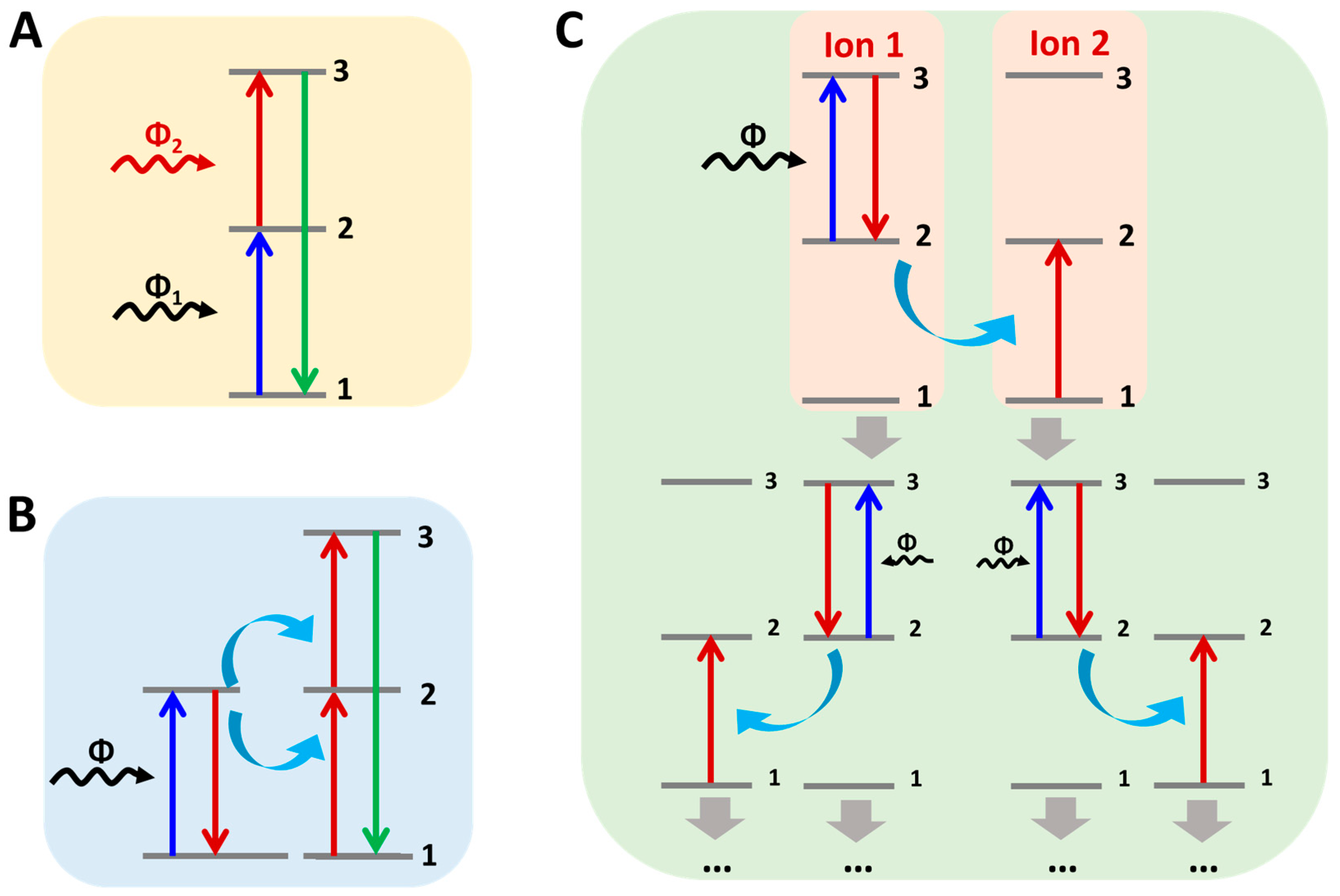
- Excited state absorption: Excited state absorption, also known as continuous two-photon absorption, is one of the most widely recognized models of upconversion luminescence [17]. Excited state absorption refers to the process of continuous absorption of multiple photons by an ion from a low-energy ground state level to a high-energy excited state level, and upconversion luminescence is generated when it returns to the ground state. The excited state absorption (ESA) method involves an ion sequentially absorbing two photons, with the second absorption occurring from an already occupied excited state. As shown in Figure 1A, under a suitable excitation light source the first photon causes ions to enter the metastable intermediate excited state (state 2) from the ground state (state 1), which is called ground state absorption (GSA). If the energy difference between the intermediate excited state (state 2) and the higher excited state (state 3) matches the energy of the excitation light source, the ion will continue to absorb the second photon from state 2 to the higher excited state (state 3), and when the ion returns from the higher excited state (state 3) to the ground state (state 1), the upconversion luminescence will occur.

- (2)
- Energy transfer: Energy transfer involves two or more ions. Unlike the excited state absorption process, energy transfer process 1 involves the exciting ion (sensitizer or donor) absorbing the energy provided by the light source and transferring the energy to another adjacent ion (activator or acceptor). Different types of ET mechanisms [18,19] that are well known include continuous energy transfer (SET), cross relaxation (CR), cooperative sensitization (CS), and cooperative luminescence (CL). For example, the energy transfer process of SET is shown in Figure 1B; an activated ion in state 1 is elevated to state 2 by ET. The activated ion is then promoted again to state 3 by a second ET. Only the sensitized ions can absorb photons from the incident light in this process.
- (3)
- Photon avalanche: Also known as absorption avalanche, photon avalanche was first discovered by Chivian and is one of the most efficient types of upconversion [18]. Of all the upconversion processes, the photon avalanche process is the least observed. Figure 1C shows the simple energy transfer process of the photon avalanche process. Initially, the sensitized ion (ion 1) in state 1 is promoted to state 2 by GSA. Next, an incident photon is pushed into state 3 by ESA. The basic process of photon avalanche is that a sensitized ion in state 3 (ion 1) can interact with an adjacent ion in the ground state (ion 2), and as a result of cross relaxation two ions are produced in state 2 (ion 1 and 2). Two newly created ions acting as sensitized ions can produce an additional four ions, which in turn can produce another eight ions, and so on. Finally, the intermediate excited state (state 2) acts as a storage vessel for energy and can build up an avalanche of ions in state 2.
3. Synthesis Method of Upconversion Nanoparticles
3.1. Thermal Decomposition Method

3.2. Coprecipitation Method

3.3. Hydrothermal/Solvothermal Method
3.4. Sol–Gel Method

4. Surface Modification of Upconversion Nanoparticles
4.1. SiO2 Coating Method
4.2. Polymer Coating Method


4.3. Ligand Oxidation Method
5. Biological Applications of Upconversion Nanoparticles
5.1. In Vitro Cell Imaging and in Vivo Tissue Imaging
- (1)
- Labeling and imaging of in vitro cells. The application of UPCNs in in vitro cell imaging can be divided into two scenarios. One involves the covalent conjugation of targeting ligands (e.g., folate, aptamers, proteins, or polypeptides) onto the surface of UCNPs. Such surface modifications enable targeted in vitro cellular imaging and ligand-directed delivery of tracer molecules. The other utilizes cellular endocytosis to internalize UCNPs, followed by fluorescence imaging to investigate the mechanisms and pathways of cellular uptake. Chatterjee et al. [79] used NaYF4:Yb, Er UCNPs for cell imaging for the first time, which were functionalized by PEI and then covalently combined with folic acid to form folate-modified NaYF4:Yb, Er UCNPs. Folate-modified NaYF4:Yb, Er UCNPs were then cultured with human HT29 breast cancer cell and human OVCAR3 ovarian cancer cells under physiological conditions for 24 h. UCNPs modified with folate were able to specifically target the cells because of unusually high levels of folate receptors expressed on the surfaces of both types of cells, and when the folate modified UCNPs was connected to the cells, UCNPs could glow green upconversion fluorescence under a confocal microscope equipped with a 980 nm laser (Figure 7).
- (2)
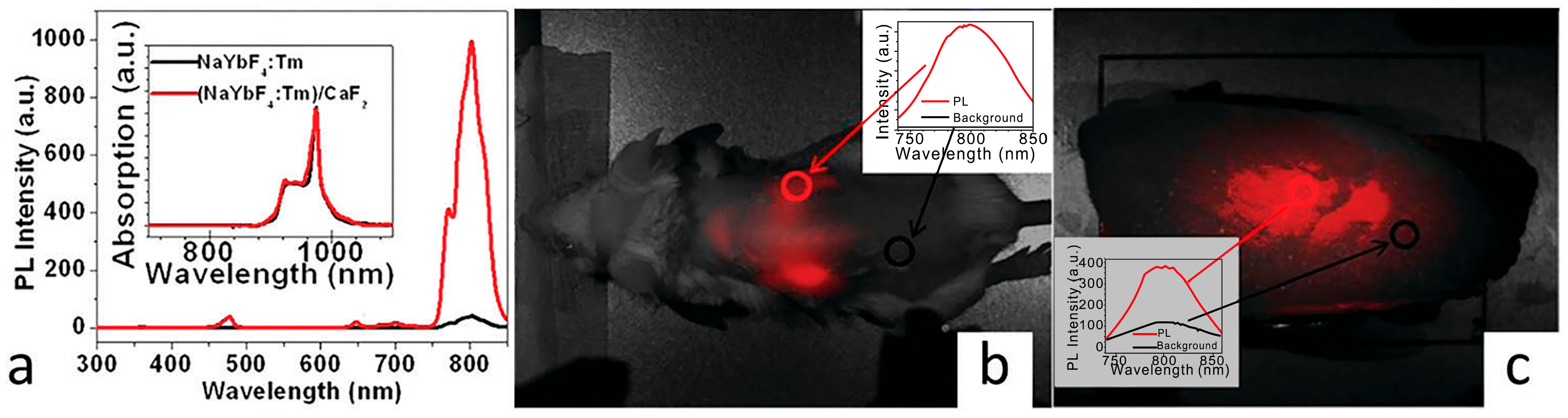
- In vivo tissue imaging. Chatterjee et al. [79] first reported the use of upconversion nanoparticles for in vivo imaging of deep tissue in Wistar rats. In their study, NaYF4:Yb coated with PEI (5 wt %) and Er UCNPs were first used, and then 100 μL PEI-coated UCNPs (4.4 mg/mL) were injected subcutaneously into the groin and thigh sites of rats at a depth of 10 mm. The rats were then stimulated with a 980 nm excitation light source. The results showed that UCNPs injected into the skin of the abdomen, the muscle of the thigh and under the skin of the back showed visible fluorescence under a 980 nm excitation light source. However, when the quantum dots (used as a control) were injected into the thicker skin of the back or abdomen, they did not show any fluorescence under UV excitation, and only the quantum dots injected into the translucent skin of the feet fluoresced. Thus, NIR radiation has been demonstrated to have better penetration than UV light, and NIR light-stimulated UCNPs has great potential for in vivo imaging and their application in tumor therapeutics. However, judging from the existing literature, the use of UCNPs for in vivo imaging is still at a preliminary stage.

5.2. Biological Detection and Analysis
- (1)
- Flourescence Resonance Energy Transfer (FRET)-based detection. FRET is a process that occurs when energy is transferred between a donor and recipient. When the absorption spectra of two fluorescent molecules (energy donor and energy accepter) overlap in a certain region, and the distance between the donor and the accepter is less than 10 nanometers, the fluorescence molecule as an energy accepter can absorb the photon radiated by another fluorescent molecule as an energy donor, and energy transfer occurs. This process is called FRET. In recent years, FRET-based analytical methods have received considerable attention as an important tool for biological detection due to their ease of operation and high sensitivity.
- (2)
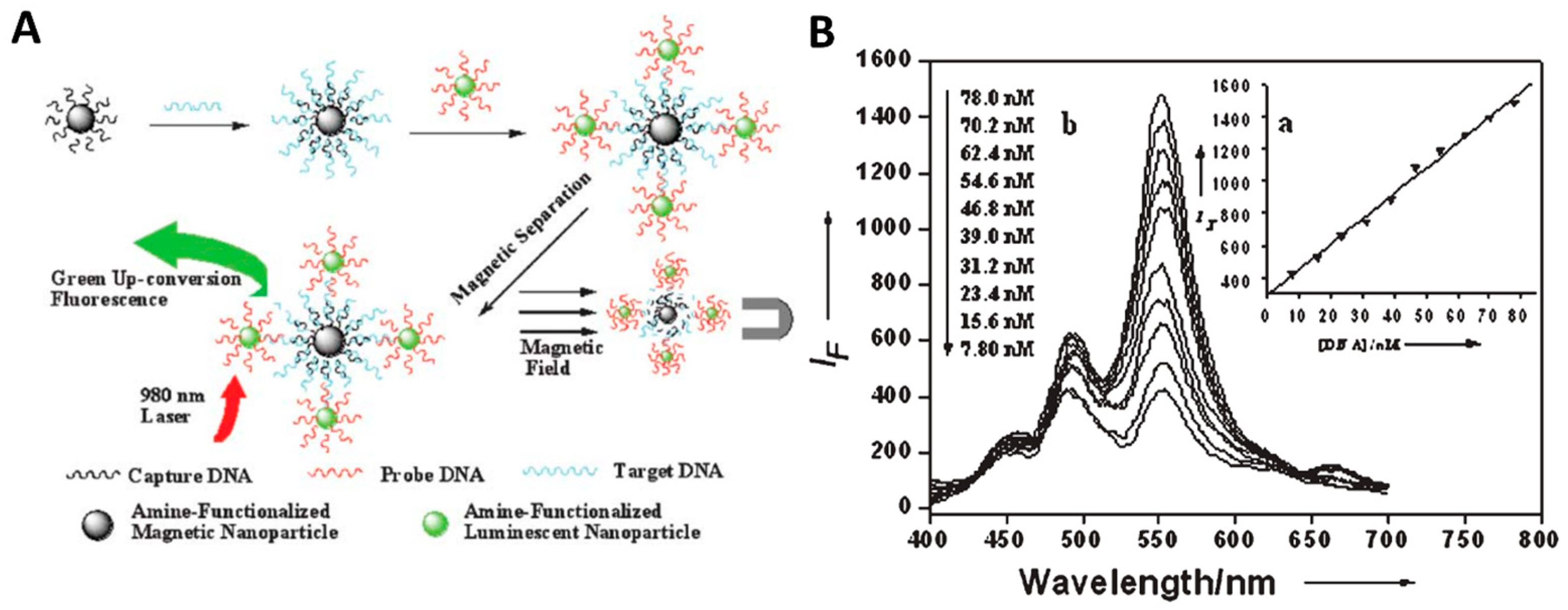
- Direct detection of biomolecules, also known as heterophase detection, refers to the specific recognition and high affinity between the molecules to be measured fixed on the substrate and the rare-earth-doped UCNPs labeled probe molecules [80,81,82,83,84]. The detection based on bioaffinity system is realized according to the proportional relationship between the concentration of the object to be measured and the fluorescence intensity [85]. Wang et al. [86] used NaYF4:Yb, Er UCNPs to design a fluorescence sensor based on magnetic field separation to detect trace DNA sensitively (Figure 8). Firstly, Fe3O4 magnetic nanoparticles were covalently linked to the capture DNA, and NaYF4:Yb, Er UCNPs were covalently linked to the probe DNA. When the target DNA is added to the system, the long strand of target DNA can specifically recognize the complementary sequence fragments on the trapping DNA connected to the Fe3O4 magnetic nanoparticle and the probe DNA connected to the UCNPs, and finally form a three-strand nanocomplex, which is then purified by magnetic separation. It was found that the upconversion fluorescence intensity of UCNPs was linearly correlated with the concentration of target DNA in the range of 7.8–78.0 nm. This method is a good choice for detecting trace amounts of DNA.

5.3. Diagnosis and Treatment
- (1)
- Drug delivery. The UCNPs-based drug delivery system can be used for drug tracers, evaluation of drug-delivery efficiency and study of drug-delivery mechanisms [87]. To date, most UCNPs drug-delivery systems have been coated with PEG [88,89] or mesoporous silica [90,91,92]. Liu and colleagues functionalized the amphiphilic polymer PEG by wrapping it in UCNPs, then loaded DOX molecules with pegylated UCNPs and covalently bound to FA for targeted drug delivery and cell imaging. The loading and release of DOX in UCNPs was controlled by changing pH; the drug dissociation rate increases in acidic environments, which is conducive to the control of drug release [93].
- (2)
- Photodynamic therapy (PDT). PDT is a relatively new clinical treatment method, which refers to the photosensitized agent that converts the adsorbated oxygen into reactive oxygen species or singlet oxygen to kill disease cells under the condition of high-energy excitation light [94,95,96]. However, the high energy of the excitation light source is mostly visible light or even ultraviolet light, which limits the penetration depth of photodynamic therapy, and it is impossible to treat deep-seated tumors or too-large tumors [97]. While upconversion nanomaterials can emit visible light when excited by near-infrared light, UCNPs can be used to activate photosensitizers in deep tissues, and the penetration depth of tissues can be increased due to weak absorption in the optical “transparent window”.
- (3)
- Photothermodynamic therapy (PTT). PTT is a treatment that absorbs radiation light energy through a light absorber to generate heat [98], resulting in the local temperature of tumor cells being too high and thus dying [99]. Various nanomaterials with high near-infrared absorbance, such as gold and silver nanoshells, nanorods and nanocages, have been used for PTT treatment of tumors [100]. Song et al. reported the hexagonal phase NaYF4 of the core–shell structure and their unique biological functional properties [101] showed that HepG2 cells from human liver cancer and BCap-37 cells from human breast cancer were cultured with UCNPs in vitro and photothermally induced death occurred when exposed to a 980 nm excitation light source.
5.4. Optogenetics

6. Conclusions and Perspectives
Author Contributions
Funding
Data Availability Statement
Acknowledgments
Conflicts of Interest
References
- Li, F.; Tu, L.; Zhang, Y.; Huang, D.; Liu, X.; Zhang, X.; Du, J.; Fan, R.; Yang, C.; Kraemer, K.W.; et al. Size-dependent lanthanide energy transfer amplifies upconversion luminescence quantum yields. Nat. Photonics 2024, 18, 440–449. [Google Scholar] [CrossRef]
- Singh, N.; Sen Gupta, R.; Bose, S. A comprehensive review on singlet oxygen generation in nanomaterials and conjugated polymers for photodynamic therapy in the treatment of cancer. Nanoscale 2024, 16, 3243–3268. [Google Scholar] [CrossRef]
- Du, K.; Feng, J.; Gao, X.; Zhang, H. Nanocomposites based on lanthanide-doped upconversion nanoparticles: Diverse designs and applications. Light Sci. Appl. 2022, 11, 222. [Google Scholar] [CrossRef]
- Leiner, M.J.P. Luminescence chemical sensors for biomedical applications—Scope and limitations. Anal. Chim. Acta 1991, 255, 209–222. [Google Scholar] [CrossRef]
- Roda, A.; Guardigli, M.; Pasini, P.; Mirasoli, M.; Michelini, E.; Musiani, M. Bio- and chemiluminescence imaging in analytical chemistry. Anal. Chim. Acta 2005, 541, 25–36. [Google Scholar] [CrossRef]
- Li, H.; Sheng, W.; Haruna, S.A.; Hassan, M.M.; Chen, Q. Recent advances in rare earth ion-doped upconversion nanomaterials: From design to their applications in food safety analysis. Compr. Rev. Food Sci. Food Saf. 2023, 22, 3732–3764. [Google Scholar] [CrossRef]
- Vinegoni, C.; Razansky, D.; Hilderbrand, S.A.; Shao, F.; Ntziachristos, V.; Weissleder, R. Transillumination fluorescence imaging in mice using biocompatible upconverting nanoparticles. Opt. Lett. 2009, 34, 2566–2568. [Google Scholar] [CrossRef]
- Xu, C.T.; Svensson, N.; Axelsson, J.; Svenmarker, P.; Somesfalean, G.; Chen, G.; Liang, H.; Liu, H.; Zhang, Z.; Andersson-Engels, S. Autofluorescence insensitive imaging using upconverting nanocrystals in scattering media. Appl. Phys. Lett. 2008, 93, 171103. [Google Scholar] [CrossRef]
- Gu, B.; Zhang, Q. Recent Advances on Functionalized Upconversion Nanoparticles for Detection of Small Molecules and Ions in Biosystems. Adv. Sci. 2018, 5, 170069. [Google Scholar] [CrossRef]
- Chen, B.; Wang, F. Combating Concentration Quenching in Upconversion Nanoparticles. Acc. Chem. Res. 2020, 53, 358–367. [Google Scholar] [CrossRef] [PubMed]
- Kang, D.; Jeon, E.; Kim, S.; Lee, J. Lanthanide-Doped Upconversion Nanomaterials: Recent Advances and Applications. Biochip J. 2020, 14, 124–135. [Google Scholar] [CrossRef]
- Okubo, K.; Umezawa, M.; Soga, K. Review-Concept and Application of Thermal Phenomena at 4f Electrons of Trivalent Lanthanide Ions in Organic/Inorganic Hybrid Nanostructure. ECS J. Solid State Sci. Technol. 2021, 10, 096006. [Google Scholar]
- Sun, J.; Fu, H.; Jing, H.; Hu, X.; Chen, D.; Li, F.; Liu, Y.; Qin, X.; Huang, W. Synergistic Integration of Halide Perovskite and Rare-Earth Ions toward Photonics. Adv. Mater. 2025, 37, 2417397. [Google Scholar]
- Cheng, X.; Luo, J.; Rosei, F. Photon upconversion tuning through energy migration in lanthanides sensitized nanoparticles. Nano Mater. Sci. 2025, 7, 134. [Google Scholar] [CrossRef]
- Wang, J.; Deng, R.; MacDonald, M.A.; Chen, B.; Yuan, J.; Wang, F.; Chi, D.; Hor, T.S.A.; Zhang, P.; Liu, G.; et al. Enhancing multiphoton upconversion through energy clustering at sublattice level. Nat. Mater. 2014, 13, 157–162. [Google Scholar] [CrossRef]
- Zheng, K.; Loh, K.Y.; Wang, Y.; Chen, Q.; Fan, J.; Jung, T.; Nam, S.H.; Suh, Y.D.; Liu, X. Recent advances in upconversion nanocrystals: Expanding the kaleidoscopic toolbox for emerging applications. Nano Today 2019, 29, 100797. [Google Scholar] [CrossRef]
- Tsang, M.-K.; Bai, G.; Hao, J. Stimuli responsive upconversion luminescence nanomaterials and films for various applications. Chem. Soc. Rev. 2015, 44, 1585–1607. [Google Scholar]
- Zhang, J.; Zhang, L.; Wang, W.; Yu, J. In Situ Irradiated X-ray Photoelectron Spectroscopy Investigation on Electron Transfer Mechanism in S-Scheme Photocatalyst. J. Phys. Chem. Lett. 2022, 13, 8462–8469. [Google Scholar] [CrossRef]
- Huang, J.; Tu, L.; Huang, H.; Wei, H.; Zhang, Q.; Zhou, B. Manipulating energy migration in nanoparticles toward tunable photochromic upconversion. Nat. Commun. 2024, 15, 10890. [Google Scholar] [CrossRef]
- Jiang, Y.; Zhao, M.; Miao, J.; Chen, W.; Zhang, Y.; Miao, M.; Yang, L.; Li, Q.; Miao, Q. Acidity-activatable upconversion afterglow luminescence cocktail nanoparticles for ultrasensitive in vivo imaging. Nat. Commun. 2024, 15, 2124. [Google Scholar] [CrossRef]
- Zou, H.; Hu, Y.; Zhu, X.; Peng, D.; Chai, X.; Wang, X.; Liu, B.; Shen, D. Upconversion photoluminescence properties of Er3+ doped CaBi2Nb2O9 phosphors for temperature sensing. J. Mater. Sci. 2017, 28, 11921–11925. [Google Scholar]
- Vetrone, F.; Naccache, R.; Mahalingam, V.; Morgan, C.G.; Capobianco, J.A. The Active-Core/Active-Shell Approach: A Strategy to Enhance the Upconversion Luminescence in Lanthanide-Doped Nanoparticles. Adv. Funct. Mater. 2009, 19, 2924–2929. [Google Scholar]
- Yang, D.; Li, C.; Li, G.; Shang, M.; Kang, X.; Lin, J. Colloidal synthesis and remarkable enhancement of the upconversion luminescence of BaGdF5: Yb3+/Er3+ nanoparticles by active-shell modification. J. Mater. Chem. 2011, 21, 5923–5927. [Google Scholar] [CrossRef]
- Chen, B.; Wang, F. Recent advances in the synthesis and application of Yb-based fluoride upconversion nanoparticles. Inorg. Chem. Front. 2020, 7, 1067–1081. [Google Scholar] [CrossRef]
- Sun, X.; Zhang, Y.W.; Du, Y.P.; Yan, Z.G.; Si, R.; You, L.P.; Yan, C.-H. From trifluoroacetate complex precursors to monodisperse rare-earth fluoride and oxyfluoride nanocrystals with diverse shapes through controlled fluorination in solution phase. Chem. Eur. J. 2007, 13, 2320–2332. [Google Scholar] [CrossRef]
- Wang, W.; Zhao, M.; Zhang, C.; Qian, H. Recent Advances in Controlled Synthesis of Upconversion Nanoparticles and Semiconductor Heterostructures. Chem. Rec. 2020, 20, 2–9. [Google Scholar] [CrossRef] [PubMed]
- Du, H.; Zhang, W.; Sun, J. Structure and upconversion luminescence properties of BaYF5:Yb3+, Er3+ nanoparticles prepared by different methods. J. Alloys Compd. 2011, 509, 3413–3418. [Google Scholar] [CrossRef]
- Passuello, T.; Piccinelli, F.; Pedroni, M.; Bettinelli, M.; Mangiarini, F.; Naccache, R.; Vetrone, F.; Capobianco, J.A.; Speghini, A. White light upconversion of nanocrystalline Er/Tm/Yb doped tetragonal Gd4O3F6. Opt. Mater. 2011, 33, 643–646. [Google Scholar] [CrossRef]
- Passuello, T.; Piccinelli, F.; Pedroni, M.; Polizzi, S.; Mangiarini, F.; Vetrone, F.; Bettinelli, M.; Speghini, A. NIR-to-visible and NIR-to-NIR upconversion in lanthanide doped nanocrystalline GdOF with trigonal structure. Opt. Mater. 2011, 33, 1500–1505. [Google Scholar] [CrossRef]
- Ren, X.; Wei, Q.; Ren, P.; Wang, Y.; Peng, Y. Hydrothermal-solvothermal cutting integrated synthesis and optical properties of MoS2 quantum dots. Opt. Mater. 2018, 86, 62–65. [Google Scholar]
- Yan, X.; Michael, E.; Komarneni, S.; Brownson, J.R.; Yan, Z.F. Microwave-hydrothermal/solvothermal synthesis of kesterite, an emerging photovoltaic material. Ceram. Int. 2014, 40, 1985–1992. [Google Scholar]
- Karmegam, S.; Kolikkaje, M.; George, S.D. Solvent-Dependent Upconversion Luminescent Studies of Single and Colloidal Nanoparticles. J. Phys. Chem. C 2024, 128, 14709. [Google Scholar] [CrossRef]
- Bai, J.; Fang, D.; Wen, J.; Bai, C.; Nie, K.; Mi, B.; Gao, Z. NaOH Promoted Synthesis of β-NaYF4:Yb,Er Nanoparticles with Enhanced Upconversion Luminescence. ChemNanoMat 2025, 11, e202500202. [Google Scholar] [CrossRef]
- Cheng, X.; Zhou, X.; Liu, Z.; Zhang, Y.; Liu, Q.; Liu, Q.; Li, B. Hydrothermal solvothermal synthesis and microwave absorbing study of MCo2O4 (M = Mn, Ni) microparticles. Adv. Appl. Ceram. 2019, 118, 466–472. [Google Scholar] [CrossRef]
- Maisang, W.; Phuruangrat, A.; Thongtem, S.; Thongtem, T. Photoluminescence and photonic absorbance of Ce2(MoO4)3 nanocrystal synthesized by microwave-hydrothermal/solvothermal method. Rare Met. 2018, 37, 868–874. [Google Scholar] [CrossRef]
- Xu, L.; Zhu, K.; Wang, J.; Gu, Q.; Cao, Y.; Zheng, H.; Liu, J.; Qiu, J. Microwave-assisted sol-hydrothermal synthesis of tetragonal barium titanate nanoparticles with hollow morphol-ogies. J. Mater. Sci. Mater. Electron. 2015, 26, 1597. [Google Scholar] [CrossRef]
- Moreira, M.L.; Mambrini, G.P.; Volanti, D.P.; Leite, E.R.; Orlandi, M.O.; Pizani, P.S.; Mastelaro, V.R.; Paiva-Santos, C.O.; Longo, E.; Varela, J.A. Hydrothermal microwave: A new route to obtain photoluminescent crystalline BaTiO3 nanoparticles. Chem. Mater. 2008, 20, 5381. [Google Scholar] [CrossRef]
- Kartsonakis, I.A.; Kordas, G. Synthesis and characterization of cerium molybdate nanocontainers and their inhibitor complexes. J. Am. Ceram. Soc. 2010, 93, 65. [Google Scholar]
- Chang, H.; Xie, J.; Zhao, B.; Liu, B.; Xu, S.; Ren, N.; Xie, X.; Huang, L.; Huang, W. Rare Earth Ion-Doped Upconversion Nanocrystals: Synthesis and Surface Modification. Nanomaterials 2015, 5, 1–25. [Google Scholar]
- Luo, R.; Zhang, C.; Zhang, Z.; Ren, P.; Xu, Z.; Liu, Y. NIR-II upconversion nanomaterials for biomedical applications. Nanoscale 2025, 17, 2985–3002. [Google Scholar] [CrossRef]
- Tasleem, S.; Tahir, M. Recent progress in structural development and band engineering of perovskites materials for photocatalytic solar hydrogen production: A review. Int. J. Hydrog. Energy 2020, 45, 19078–19111. [Google Scholar] [CrossRef]
- Liu, H.; Kulkarni, A.; Kostiv, U.; Sandberg, E.; Lakshmanan, A.; Sotiriou, G.A.; Widengren, J. Interplay between a Heptamethine Cyanine Dye Sensitizer (IR806) and Lanthanide Upconversion Nanoparticles. Adv. Opt. Mater. 2024, 12, 2400987. [Google Scholar] [CrossRef]
- Liu, M.; Xu, J.; Zhu, K.; Yan, M.; He, M.; Huang, X.; Xu, Y.; Wang, W.; Zhao, S.; Zeng, Q. A general synthesis method for small-size and water-soluble NaYF4Yb, Ln upconversion nanoparticles at high temperature. RSC Adv. 2024, 14, 38689. [Google Scholar] [PubMed]
- Chhetri, B.P.; Karmakar, A.; Ghosh, A. Recent Advancements in Ln-Ion-Based Upconverting Nanomaterials and Their Biological Applications. Part. Part. Syst. Charact. 2019, 36, 1900153. [Google Scholar] [CrossRef]
- Wolfbeis, O.S. An overview of nanoparticles commonly used in fluorescent bioimaging. Chem. Soc. Rev. 2015, 44, 4743–4768. [Google Scholar] [CrossRef] [PubMed]
- Zeng, L.; Huang, L.; Han, G. Dye Doped Metal-Organic Frameworks for Enhanced Phototherapy. Adv. Drug Deliv. Rev. 2022, 189, 114479. [Google Scholar] [CrossRef]
- Wen, B.; Zhang, W.; Zhang, Q.-W.; Tian, Y. Cyclodextrin-me diate d efficient antibody immobilization on upconversion nanoparticles for CKD biomarker sensing via luminescent lateral flow assay. Chin. Chem. Lett. 2026, 37, 111459. [Google Scholar] [CrossRef]
- Wen, S.; Zhou, J.; Schuck, P.J.; Suh, Y.D.; Schmidt, T.W.; Jin, D. Future and challenges for hybrid upconversion nanosystems. Nat. Photonics 2019, 13, 828–838. [Google Scholar]
- Richards, B.S.; Hudry, D.; Busko, D.; Turshatov, A.; Howard, I.A. Photon Upconversion for Photovoltaics and Photocatalysis: A Critical Review. Chem. Rev. 2021, 121, 9165–9195. [Google Scholar] [CrossRef]
- Schroter, A.; Hirsch, T. Control of Luminescence and Interfacial Properties as Perspective for Upconversion Nanoparticles. Small 2024, 20, 2306042. [Google Scholar] [CrossRef]
- Liu, S.; Yan, L.; Huang, J.; Zhang, Q.; Zhou, B. Controlling upconversion in emerging multilayer core-shell nanostructures: From fundamentals to frontier applications. Chem. Soc. Rev. 2022, 51, 1729–1765. [Google Scholar]
- Xiao, X.; Dong, X.; Du, Y.; Cao, T.; Liang, T.; Su, Y.; Luo, F.; Zhang, K.; Ding, Y. Neutral red functionalized upconversion nanoparticles as ratiometric luminescence nanoprobes for high sensitively and precisely sensing megestrol acetate in bovine liver. Spectrochim. Acta Part A 2026, 348, 127237. [Google Scholar]
- Arppe, R.; Hyppanen, I.; Perala, N.; Peltomaa, R.; Kaiser, M.; Wuerth, C.; Christ, S.; Resch-Genger, U.; Schaferling, M.; Soukka, T. Quenching of the upconversion luminescence of NaYF4: Yb3+,Er3+ and NaYF4:Yb3+,Tm3+ nanophosphors by water: The role of the sensitizer Yb3+ in non-radiative relaxation. Nanoscale 2015, 7, 11746–11757. [Google Scholar]
- Song, W.; Guo, X.; He, G.; Qin, W. Ultraviolet Upconversion Emissions of Gd3+ in β-NaLuF4: Yb3+,Tm3+,Gd3+ Nanocrystals. J. Nanosci. Nanotechnol. 2014, 14, 3722–3725. [Google Scholar]
- Liu, B.; Li, C.; Ma, P.A.; Chen, Y.; Zhang, Y.; Hou, Z.; Huang, S.; Lin, J. Multifunctional NaYF4: Yb, Er@mSiO2@Fe3O4-PEG nanoparticles for UCL/MR bioimaging and magnetically targeted drug delivery. Nanoscale 2015, 7, 1839–1848. [Google Scholar] [PubMed]
- Ling, B.; Wang, Y.; Dong, H.; Chen, H.; Wang, L. Enzyme-triggered aggregation of upconversion nanoparticles for targeted photodynamic therapy via NIR irradiation. Nanoscale Adv. 2025, 7, 3068. [Google Scholar] [CrossRef] [PubMed]
- Li, Y.; Wang, R.; Zheng, W.; Li, Y. Silica-Coated Ga(III)-Doped ZnO: Yb3+, Tm3+ Upconversion Nanoparticles for High-Resolution in Vivo Bioimaging using Near-Infrared to Near-Infrared Upconversion Emission. Inorg. Chem. 2019, 58, 8230–8236. [Google Scholar] [CrossRef]
- Shi, Y.; Zhang, F.; Xu, J.; Zhou, K.; Chen, C.; Cheng, J.; Li, P. Upconversion fluorescence enhancement of NaYF4:Yb/Re nanoparticles by coupling with SiO2 opal photonic crystals. J. Mater. Sci. 2019, 54, 8461–8471. [Google Scholar]
- Malhotra, K.; Fuku, R.; Kumar, B.; Hrovat, D.; Van Houten, J.; Piunno, P.A.E.; Gunning, P.T.; Krull, U.J. Unlocking Long-Term Stability of Upconversion Nanoparticles with Biocompatible Phosphonate-Based Polymer Coatings br. Nano Lett. 2022, 22, 7285–7293. [Google Scholar]
- Xu, L.; Li, Y.; Liu, W.; Yang, Y. Upconversion circularly polarized luminescence of cholesteric liquid crystal polymer networks with NaYF4:Yb,Tm UCNPs. Mater. Horiz. 2024, 11, 6455–6462. [Google Scholar] [PubMed]
- Lee, G.; Choi, I.; Molkenova, A.; Son, Y.; Yang, S.; Kwon, M.; Kim, T.-i.; Kim, K.S.; Hahn, S.K. Upconversion Nanoparticles Embedded Photonic Contact Lens for Transepithelial Corneal Crosslinking Using Hyaluronate Riboflavin Conjugate. Adv. Funct. Mater. 2025, e17654. [Google Scholar] [CrossRef]
- Gallardo-Rivera, O.; Rivera, A.; Espinoza, L.O.M.; Ortiz, Z.L. Upconversion-Enhanced Luminescence in PMMA Doped with Rare Earth Ions by Plasmonic Resonance with Metallic Nanoparticles. Acs Omega 2025, 10, 11806. [Google Scholar] [CrossRef] [PubMed]
- Li, H.; Liu, H.; Wong, K.-L.; Adeli, M.; All, A.H. Dye-sensitized upconversion nanoparticles with enhanced aqueous luminescence for neuronal imaging. Nanoscale 2025, 17, 26982. [Google Scholar] [CrossRef] [PubMed]
- Ling, H.; Zhang, W.; Zhang, Y.; Shen, J.; Liu, Q. Lanthanide-Doped Upconversion Nanoparticles for Single-Particle Imaging. ChemBioChem 2025, 26, e202400942. [Google Scholar] [PubMed]
- Li, X.; Wu, Y.; Liu, Y.; Zou, X.; Yao, L.; Li, F.; Feng, W. Cyclometallated ruthenium complex-modified upconversion nanophosphors for selective detection of Hg2+ ions in water. Nanoscale 2014, 6, 1020–1028. [Google Scholar] [CrossRef]
- Makhneva, E.; Spacek, P.; Hlavacek, A.; Weisova, J.; Gorris, H.H.; Skladal, P.; Farka, Z. Bioconjugates of photon-upconversion nanoparticles with antibodies for the detection of prostate-specific antigen and p53 in heterogeneous and homogeneous immunoassays. Nanoscale 2025, 17, 11401. [Google Scholar] [CrossRef]
- Premcheska, S.; Lederer, M.; Garcia-Balduz, J.; Alici, A.; Parakhonskiy, B.; Skirtach, A.G.; Kaczmarek, A.M. Developing Upconversion (Yb3+Er3+) and Downshifting (Yb3+Ho3+Er3+) PEG-Ylated Na3ZrF7 Degradable Nanoparticles as Ratiometric Luminescent Nanothermometers for Theranostic Applications. ACS Appl. Mater. Interfaces 2025, 17, 31859. [Google Scholar]
- Weitzel, N.; Tsutskiridze, A.; Bramowski, J.; Konig, B.; Hirsch, T. Fully Sensitized Upconversion Nanoparticles as Efficient Catalysts for NIR-Driven UV Photochemistry. Angew. Chem. Int. Ed. 2025, 64, e202511247. [Google Scholar] [CrossRef]
- Alkahtani, M.; Alshehri, B.; Alrashood, H.; Alshehri, L.; Alzahrani, Y.A.; Alenzi, S.; Almalki, I.S.; Yafi, G.S.; Alessa, A.M.; Alghannam, F.S.; et al. Enhanced Efficiency and Stability of Perovskite Solar Cells Through Neodymium-Doped Upconversion Nanoparticles with TiO2 Coating. Molecules 2025, 30, 2166. [Google Scholar] [CrossRef]
- Lyu, N.; Cao, Y.; Zhang, J.; Zheng, L.; Poudel, B.; Piper, J.A.; Wang, Y.; Lu, Y. Embedding Upconversion Nanoparticles in Polymer Films Toward Mono-Dispersity at High Loading Factor. Macromol. Mater. Eng. 2025, 310, e00155. [Google Scholar] [CrossRef]
- Niu, L.; Sun, Q.; Wei, S.; Gong, D.; Wang, E.; Chen, Y.; Xia, L.; Liu, X.; Tu, L.; Shao, L.; et al. High-Level Lanthanide-Doped Upconversion Nanoparticles-Based Aptasensor to Increase Carcinoembryonic Antigen Detection Sensitivity. Materials 2025, 18, 796. [Google Scholar]
- Yang, Y.; Dev, A.; Lu, X.; Sychugov, I.; Zhang, S.-L. Plasmon-enhanced photoluminescence of single upconversion nanoparticles site-selectively captured between gold nanorods. Appl. Phys. Lett. 2025, 126, 263504. [Google Scholar]
- Chen, Z.; Chen, H.; Hu, H.; Yu, M.; Li, F.; Zhang, Q.; Zhou, Z.; Yi, T.; Huang, C. Versatile synthesis strategy for carboxylic acid-functionalized upconverting nanophosphors as biological labels. J. Am. Chem. Soc. 2008, 130, 3023–3029. [Google Scholar]
- Song, S.; Sun, X.; Wang, Y.; Wang, M.; Shi, Z.; Sun, D.; Li, D.; Chen, J.; Wang, C. Sodium alginate hydrogel loaded with upconversion nanoparticles and magnesium ions enhances bone regeneration and photodynamic tumor therapy. Front. Pharmacol. 2025, 16, 1543678. [Google Scholar] [CrossRef]
- Naccache, R.; Vetrone, F.; Mahalingam, V.; Cuccia, L.A.; Capobianco, J.A. Controlled Synthesis and Water Dispersibility of Hexagonal Phase NaGdF4: Ho3+/Yb3+ Nanoparticles. Chem. Mater. 2009, 21, 717–723. [Google Scholar]
- Tang, X.; Zhong, Y.; Yang, X.; Chen, Y.; Song, Y.; Lin, Q.; Mai, Y.; Chrzanowski, W.; Fan, Z.; Liao, Y. BBB-Crossing Ionizable Upconversion Nanoparticles for Synergistic Therapy of Carbapenem-Resistant Central Nervous System Infection. Research 2025, 8, 0946. [Google Scholar] [PubMed]
- Chen, G.; Shen, J.; Ohulchanskyy, T.Y.; Patel, N.J.; Kutikov, A.; Li, Z.; Song, J.; Pandey, R.K.; Ågren, H.; Prasad, P.N.; et al. (α-NaYbF4:Tm3+)/CaF2 Core/Shell Nanoparticles with Efficient Near-Infrared to Near-Infrared Upconversion for High-Contrast Deep Tissue Bioimaging. ACS Nano 2012, 6, 8280–8287. [Google Scholar] [CrossRef]
- Zhang, H.; Wang, X.; Jin, R.; Su, Q. Preparation and applications of polymer-modified lanthanide-doped upconversion nanoparticles. Giant 2022, 12, 100130. [Google Scholar]
- Chatteriee, D.K.; Rufalhah, A.J.; Zhang, Y. Upconversion fluorescence imaging of cells and small animals using lanthanide doped nanocrystals. Biomaterials 2008, 29, 937–943. [Google Scholar] [CrossRef]
- Zhang, L.; Zhou, J.; Shimoni, O.; Wen, S.; Alghalayini, A.; Liu, Y.; Rezaeishahmirzadi, M.; Liao, J.; Maddahfar, M.; Hunt, R.; et al. A COVID-19 rapid antigen test employing upconversion nanoparticles. Smart Mol. 2025, 3, e20240042. [Google Scholar]
- Feng, Y.; Lei, D.; Zu, B.; Li, J.; Li, Y.; Dou, X. A Self-Accelerating Naphthalimide-Based Probe Coupled with Upconversion Nanoparticles for Ultra-Accurate Tri-Mode Visualization of Hydrogen Peroxide. Adv. Sci. 2024, 11, 2309182. [Google Scholar]
- Wu, J.; Wu, J.; Wei, W.; Zhang, Y.; Chen, Q. Upconversion Nanoparticles Based Sensing: From Design to Point-of-Care Testing. Small 2024, 20, 2311729. [Google Scholar]
- Zheng, Y.; Wei, Y.; Yang, Y.; Wen, X.; Yang, C.; Xiao, Y.; Du, Z.; Liu, X. Development of Manganese Carbonyl Loaded Upconversion Nanoparticles for Near-Infrared-Triggered Carbon Monoxide and Mn2+ Delivery. Adv. Nanobio. Res. 2024, 4, 2300171. [Google Scholar]
- Yao, J.; Simon-Fuente, S.; Lopez-Pena, G.; Gomez-Pastor, S.; Guisan-Ceinos, S.; Marin, R.; Martin Rodriguez, E.; Jaque, D.; Sanz-Rodriguez, F.; Ribagorda, M.; et al. Multifunctional azo-BODIPY-functionalised upconversion nanoparticles as sensors of hypoxia in biological environments. J. Mater. Chem. C 2025, 13, 1972–1981. [Google Scholar]
- Balhara, A.; Rohilla, R.; Dutta, B.; Prakash, J.; Samui, S.; Gupta, S.K. Flexible and Water-Resistant Y3Al5O12: Er3+/Yb3+ Upconversion Nanoparticles-Based Luminescent Cellulose Paper for Anti-Counterfeiting and VOCs Detection. Adv. Opt. Mater. 2025, 13, 2500898. [Google Scholar]
- Wang, L.; Li, Y. Green upconversion nanocrystals for DNA detection. Chem. Comm. 2006, 2557–2559. [Google Scholar] [CrossRef]
- Choi, H.E.; Park, J.-M.; Jeong, W.Y.; Lee, S.B.; Kim, J.-H.; Kim, K.S. Water-Dispersible and Biocompatible Polymer-Based Organic Upconversion Nanoparticles for Transdermal Delivery. Biomater. Res. 2024, 28, 0106. [Google Scholar]
- Wang, C.; Cheng, L.; Liu, Z. Drug delivery with upconversion nanoparticles for multi-functional targeted cancer cell imaging and therapy. Biomaterials 2011, 32, 1110–1120. [Google Scholar] [CrossRef]
- Tian, G.; Gu, Z.; Zhou, L.; Yin, W.; Liu, X.; Yan, L.; Jin, S.; Ren, W.; Xing, G.; Li, S.; et al. Mn2+ Dopant-Controlled Synthesis of NaYF4: Yb/Er Upconversion Nanoparticles for in vivo Imaging and Drug Delivery. Adv. Mater. 2012, 24, 1226–1231. [Google Scholar] [CrossRef] [PubMed]
- Gai, S.; Yang, P.; Li, C.; Wang, W.; Dai, Y.; Niu, N.; Lin, J. Synthesis of Magnetic, Up-Conversion Luminescent, and Mesoporous Core-Shell-Structured Nanocomposites as Drug Carriers. Adv. Funct. Mater. 2010, 20, 1166–1172. [Google Scholar]
- Liu, J.N.; Bu, W.; Pan, L.M.; Zhang, S.; Chen, F.; Zhou, L.; Zhao, K.-l.; Peng, W.; Shi, J. Simultaneous nuclear imaging and intranuclear drug delivery by nuclear-targeted multifunctional upconversion nanoprobes. Biomaterials 2012, 33, 7282–7290. [Google Scholar] [CrossRef]
- Guo, H.; Hao, R.; Qian, H.; Sun, S.; Sun, D.; Yin, H.; Liu, Z.; Liu, X. Upconversion nanoparticles modified with aminosilanes as carriers of DNA vaccine for foot-and-mouth disease. Appl. Microbiol. Biotechnol. 2012, 95, 1253–1263. [Google Scholar] [PubMed]
- Hong, E.; Liu, L.; Bai, L.; Xia, C.; Gao, L.; Zhang, L.; Wang, B. Control synthesis, subtle surface modification of rare-earth-doped upconversion nanoparticles and their applications in cancer diagnosis and treatment. Mater. Sci. Eng. C 2019, 105, 110097. [Google Scholar]
- Koo, Y.-E.L.; Fan, W.; Hah, H.; Xu, H.; Orringer, D.; Ross, B.; Rehemtulla, A.; Philbert, M.A.; Kopelman, R. Photonic explorers based on multifunctional nanoplatforms for biosensing and photodynamic therapy. Appl. Opt. 2007, 46, 1924–1930. [Google Scholar] [CrossRef] [PubMed]
- Reddy, G.R.; Bhojani, M.S.; McConville, P.; Moody, J.; Moffat, B.A.; Hall, D.E.; Kim, G.; Koo, Y.-E.L.; Woolliscroft, M.J.; Sugai, J.V.; et al. Vascular targeted nanoparticles for imaging and treatment of brain tumors. Clin. Cancer Res. 2006, 12, 6677–6686. [Google Scholar] [CrossRef] [PubMed]
- Dash, P.; Panda, P.K.; Su, C.; Lin, Y.-C.; Sakthivel, R.; Chen, S.-L.; Chung, R.-J. Near-infrared-driven upconversion nanoparticles with photocatalysts through water-splitting towards cancer treatment. J. Mater. Chem. B 2024, 12, 3881. [Google Scholar]
- Shapoval, O.; Patsula, V.; Vetvicka, D.; Slouf, M.; Kabesova, M.; Vasylyshyn, T.; Svobodova, L.M.; Konefal, M.; Kockova, O.; Pankrac, J.; et al. Theranostic Verteporfin-Conjugated Upconversion Nanoparticles for Cancer Treatment. Nanomaterials 2025, 15, 1690. [Google Scholar] [CrossRef]
- Yang, M.; Huang, Y.; Chen, Z.; Ye, Q.; Zeng, Z.; You, X.; Bao, B.; Xing, W.; Zhao, N.; Zou, Z.; et al. Synthetic carbon-based lanthanide upconversion nanoparticles for enhanced photothermal therapy. Nat. Commun. 2025, 16, 6343. [Google Scholar] [CrossRef]
- Amoozadeh, M.; Khorsandi, D.; Farahani, A.; Zarepour, A.; Khosravi, A.; Iravani, S.; Zarrabi, A. Photothermal applications of upconversion nanoparticles. RSC Adv. 2025, 15, 21582. [Google Scholar] [CrossRef]
- Li, K.; Hong, E.; Wang, B.; Wang, Z.; Zhang, L.; Hu, R.; Wang, B. Advances in the application of upconversion nanoparticles for detecting and treating cancers. Photodiagn. Photodyn. 2019, 25, 177–192. [Google Scholar]
- Dong, B.; Xu, S.; Sun, J.; Bi, S.; Li, D.; Bai, X.; Wang, Y.; Wang, L.; Song, H. Multifunctional NaYF4: Yb3+, Er3+@Agcore/shell nanocomposites: Integration of upconversion imaging and photothermal therapy. J. Mater. Chem. 2011, 21, 6193–6200. [Google Scholar] [CrossRef]
- Uji, M.; Kondo, J.; Hara-Miyauchi, C.; Akimoto, S.; Haruki, R.; Sasaki, Y.; Kimizuka, N.; Ajioka, I.; Yanai, N. In Vivo Optogenetics Based on Heavy Metal-Free Photon Upconversion Nanoparticles. Adv. Mater. 2024, 36, 2405509. [Google Scholar] [CrossRef] [PubMed]
- Geng, S.; Li, H.; Lv, Z.; Zhai, Y.; Tian, B.; Luo, Y.; Zhou, Y.; Han, S.-T. Challenges and Opportunities of Upconversion Nanoparticles for Emerging NIR Optoelectronic Devices. Adv. Mater. 2025, 37, 2419678. [Google Scholar] [CrossRef] [PubMed]
- Chen, S.; Weitemier, A.Z.; Zeng, X.; He, L.M.; Wang, X.Y.; Tao, Y.Q.; Huang, A.J.Y.; Hashimotodani, Y.; Kano, M.; Iwasaki, H.; et al. Near-infrared deep brain stimulation via upconversion nanoparticle-mediated optogenetics. Science 2018, 359, 679–683. [Google Scholar] [CrossRef]
- Hososhima, S.; Yuasa, H.; Ishizuka, T.; Hoque, M.R.; Yamashita, T.; Yamanaka, A.; Sugano, E.; Tomita, H.; Yawo, H. Near-infrared (NIR) up-conversion optogenetics. Sci. Rep. 2015, 5, 16533. [Google Scholar] [CrossRef]
- He, L.; Zhang, Y.; Ma, G.; Tan, P.; Li, Z.; Zang, S.; Wu, X.; Jing, J.; Fang, S.; Zhou, L.; et al. Near-infrared photoactivatable control of Ca2+ signaling and optogenetic immunomodulation. eLife 2015, 4, e10024. [Google Scholar] [CrossRef]
- Maerkl, S.; Przybilla, F.; Rachel, R.; Hirsch, T.; Keller, M.; Witzgall, R.; Mely, Y.; Wegener, J. Impact of surface chemistry of upconversion nanoparticles on time-dependent cytotoxicity in non-cancerous epithelial cells. Sci. Rep. 2024, 14, 30610. [Google Scholar] [CrossRef]

| Method | Core Principle | Advantage | Disadvantage |
|---|---|---|---|
| Thermal Decomposition | Thermal decomposition of precursors (e.g., RE(CF3COO)3) in high-boiling-point organic solvents. | 1. High product quality (pure crystalline phase, good monodispersity). 2. Strong luminescence intensity. 3. Morphology and size can be finely tuned via ligands (OA/OM). | 1. Complex process; requires pre-synthesis of precursors, strictly anhydrous/oxygen-free conditions. 2. Toxic byproducts; decomposition of trifluoroacetates produces toxic fluorinated compounds. 3. High cost; requires high temperature and inert gas protection. |
| Coprecipitation | Co-precipitation of rare-earth salts and fluoride sources in an organic phase at high temperature to form nanocrystals. | 1. Relatively simple operation. 2. Lower cost. 3. Non-toxic byproducts. | 1. Time-consuming (typically >5 h). 2. Difficult to scale up. 3. Less precise control over crystal growth compared to thermal decomposition. |
| Hydrothermal/Solvothermal | Precipitation of products from solvent via ionic reactions under high temperature and pressure in water or organic solvents. | 1. Simple equipment and operation. 2. Lower reaction temperature (typically <200 °C). 3. Easy control over particle size and morphology. 4. High product purity. | Products are typically coated with hydrophobic ligands (e.g., OA), resulting in poor water solubility and requiring further surface modification. |
| Sol–Gel | Formation of a sol via hydrolysis and condensation of precursors, followed by gelation and high-temperature annealing to obtain nanocrystals. | 1. Suitable for large-scale production. 2. High crystallinity and strong luminescence after high-temperature annealing. | 1. Broad particle size distribution and irregular morphology. 2. Poor water solubility. 3. Annealing process critically affects product quality and is difficult to control. |
| Method | Core Principle | Advantage | Disadvantage | Primary Purpose |
|---|---|---|---|---|
| SiO2 Coating | Growth of an amorphous silica shell on UCNP surface via a sol–gel process. | 1. Provides abundant surface functional groups (-OH, -NH2, -COOH) for easy multifunctionalization. 2. Effectively protects the core from chemical erosion. 3. Good biocompatibility. | 1. Time-consuming process, difficult to scale up. 2. Silica shell may cause light scattering, reducing luminescence intensity. 3. The coating layer is relatively thick, which may affect performance. | Construction of multifunctional bioprobes and drug delivery platforms. |
| Polymer Coating | Physical coating via hydrophobic interactions between the hydrophobic chains of amphiphilic polymers and the hydrophobic ligands on the UCNP surface. | 1. Simple and rapid operation. 2. Hydrophilic chains (e.g., PEG) provide excellent water solubility and biocompatibility. 3. Easy functionalization via polymer termini. | Coating relies mainly on hydrophobic interactions, resulting in insufficient long-term stability; may dissociate in complex environments. | Rapid achievement of water solubility for applications in biosensing and instant detection. |
| Ligand Oxidation | Oxidation of unsaturated carbon–carbon bonds in the native ligands on UCNPs (e.g., oleic acid) to generate hydrophilic groups (e.g., carboxyl groups). | Oxidation of unsaturated carbon–carbon bonds in the native ligands on UCNPs (e.g., oleic acid) to generate hydrophilic groups (e.g., carboxyl groups). | 1. Limited applicability, only suitable for ligands containing unsaturated bonds. 2. Harsh conditions; over-oxidation may lead to ligand detachment or generation of hard-to-remove byproducts (e.g., MnO2), which quench fluorescence. | Direct hydrophilization and conjugation for specific systems with compatible surface ligand structures. |
| Application Fields | Advantages | Specific Applications | Research Stage/Challenges |
|---|---|---|---|
| In vitro cell imaging | Near-infrared excitation, high signal-to-noise ratio—low light damage | Targeted imaging: Surface-modified targeted molecules (such as folic acid) specifically mark the endocytosis mechanism of cancer cells. Research on the endocytosis pathway by cells taking up UCNPs | The technology is relatively mature. |
| In vivo tissue imaging | Near-infrared light has deep tissue penetration (up to several centimeters)—its penetration is significantly enhanced compared to ultraviolet light | When UCNPs is subcutaneously or intramuscularly injected into animal models (such as rats), fluorescence can be observed under 980 nm excitation. Traditional quantum dots cannot form images at the same depth | In the initial stage, further optimization of imaging depth and resolution is required |
| Biological detection and analysis | High sensitivity—Easy to operate | FRET detection: As an energy donor, a biosensor is constructed for direct detection; combined with magnetic separation technology, trace DNA is detected (linear range: 7.8–78.0 nm). | There is a considerable amount of methodological research, and it is in the process of being transformed into actual sample testing |
| Integrated diagnosis and treatment of tumors | Diagnosis; Image-guided therapy; Controlled release, deep therapy | Drug delivery: PEG/ mesoporous silica coating, ph-responsive release (such as DoX-loaded). Photodynamic therapy: activation of deep tissue photosensitizers. Photothermal therapy: NIR photothermal killing of tumor cells | Preclinical research is active, but the safety and targeting efficiency need to be optimized |
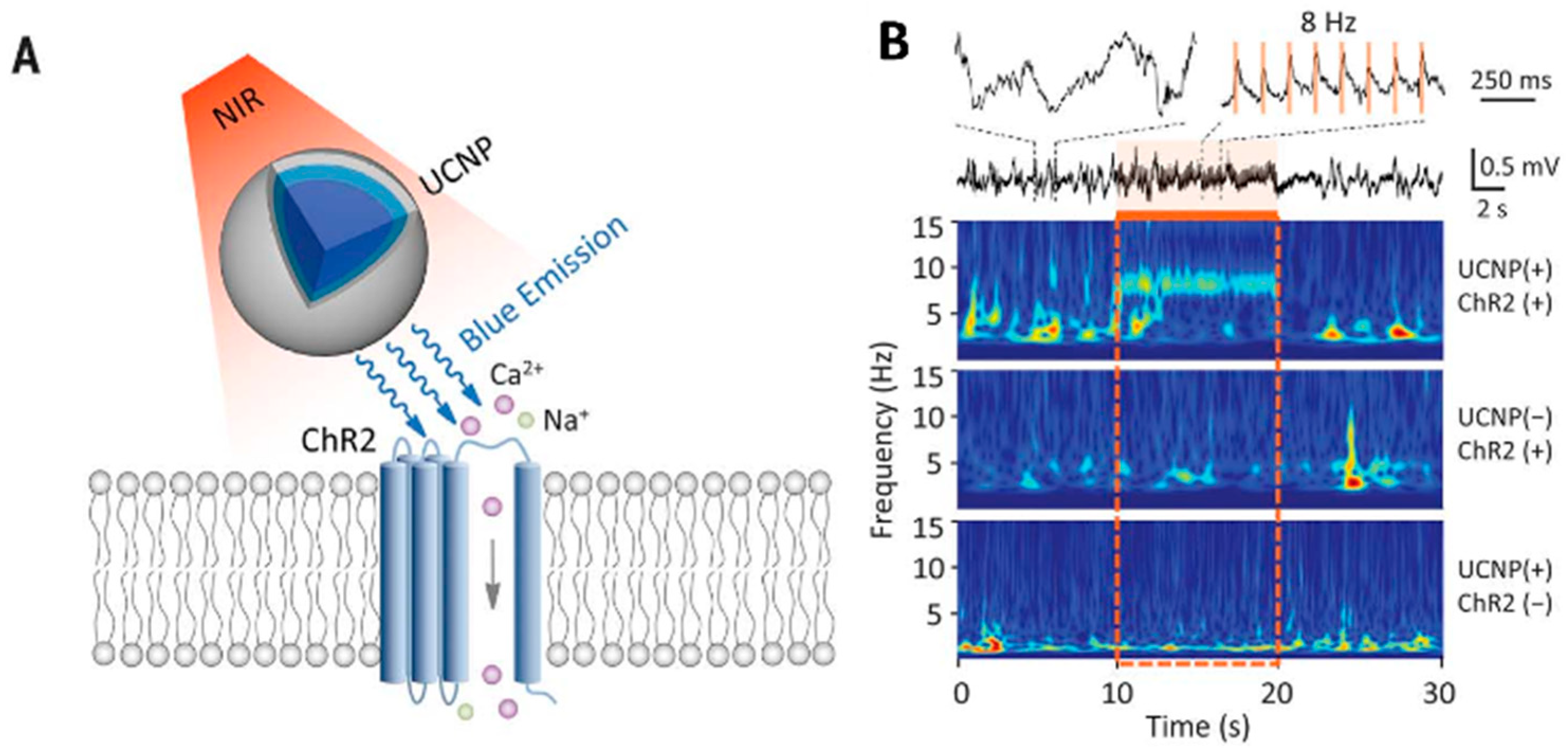
| optogenetics | Achieve non-invasive/minimally invasive deep brain region stimulation—near-infrared penetrates the skull, and UCNPs are converted into visible light to activate neurons | Successfully activating dopamine neurons, inhibiting hippocampal neurons, and triggering memory recall in animal models; verification of UCNPs matching with photopigments (such as ChR2) | In the frontier exploration stage, the accuracy and long-term safety of targeted delivery remain to be studied |
Disclaimer/Publisher’s Note: The statements, opinions and data contained in all publications are solely those of the individual author(s) and contributor(s) and not of MDPI and/or the editor(s). MDPI and/or the editor(s) disclaim responsibility for any injury to people or property resulting from any ideas, methods, instructions or products referred to in the content. |
© 2026 by the authors. Licensee MDPI, Basel, Switzerland. This article is an open access article distributed under the terms and conditions of the Creative Commons Attribution (CC BY) license.
Share and Cite
Li, L.; Li, M. Preparation Method of Upconversion Nanoparticles and Its Biological Application. Nanomaterials 2026, 16, 148. https://doi.org/10.3390/nano16020148
Li L, Li M. Preparation Method of Upconversion Nanoparticles and Its Biological Application. Nanomaterials. 2026; 16(2):148. https://doi.org/10.3390/nano16020148
Chicago/Turabian StyleLi, Liang, and Ming Li. 2026. "Preparation Method of Upconversion Nanoparticles and Its Biological Application" Nanomaterials 16, no. 2: 148. https://doi.org/10.3390/nano16020148
APA StyleLi, L., & Li, M. (2026). Preparation Method of Upconversion Nanoparticles and Its Biological Application. Nanomaterials, 16(2), 148. https://doi.org/10.3390/nano16020148