



You are currently viewing a new version of our website. To view the old version click .

Microorganisms

Microorganisms is a scientific, peer-reviewed, open access journal of microbiology, published monthly online by MDPI. 
The Hellenic Society Mikrobiokosmos (MBK), the Spanish Society for Nitrogen Fixation (SEFIN) and the Society for Microbial Ecology and Disease (SOMED) are affiliated with Microorganisms, and their members receive a discount on the article processing charges.
Indexed in PubMed | Quartile Ranking JCR - Q2 (Microbiology)

All Articles (16,896)

Root-knot nematodes (RKNs) of the Meloidogyne genus impact various plants, including crops, fruits, and vegetables. Few chemical control options exist globally, and many nematicides are banned due to health and environmental risks. This study tested a new nematicidal agent, the symbiotic bacterium Xenorhabdus indica, which was molecularly identified (PV845100). Cell-free culture supernatants of Xenorhabdus spp. and their biogenic Ag-NPs were used in nematicidal assays. Meloidogyne incognita showed high mortality rates of 95.3%, 74.6%, and 72.6% after 72 h of treatment with the X. indica filtrate at three concentrations. At the same concentrations, biogenic Ag-NPs resulted in 82.0%, 90.0%, and 85.3% mortality rates, respectively. After 72 h, hatchability decreased by 53%, 74.6%, and 72.6% for the X. indica filtrate and 82.0%, 90.0%, and 85.3% for Ag-NPs. Quantitative real-time PCR (Q-PCR) revealed that Mi-Ache1 expression was lower in M. incognita second-stage juveniles (J2s) treated with the filtrate and Ag-NPs after 72 h compared to controls. Mi-Ache2 expression was also decreased, but only slightly. Furthermore, both the X. indica filtrate and biogenic Ag-NPs were safe in human lung (WI-38) and skin (HFB4) cell lines. These findings suggest that bacterial filtrates and their biogenic Ag-NPs could serve as cost-effective, environmentally friendly alternatives to commercial nematicides.

31 December 2025
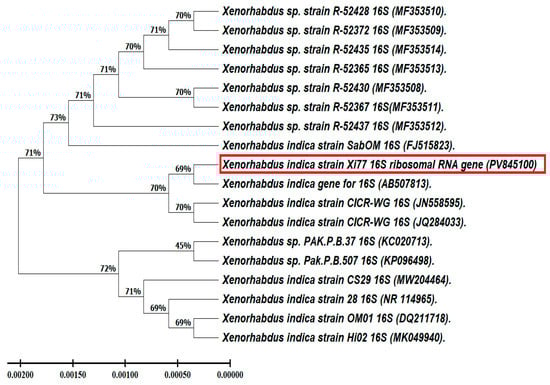
Xenorhabdus indica’s phylogenetic analysis based on gene sequences illustrating its relationships to other Xenorhabdus species.

Probiotics hold great potential in aquaculture, as they can effectively modulate gut microbiota and improve fish health, thereby enhancing farming efficiency. Translating this potential into practical application critically relies on screening high-efficacy probiotic strains. This study evaluated the growth-promoting and health-enhancing effects of probiotic candidates Lactobacillus rhamnosus GG (LGG), Lactobacillus plantarum FZU310 (LP-FZU310) and Bacillus subtilis FZU103 (BS-FZU103) in largemouth bass (Micropterus salmoides). After feeding different probiotics for 30 days, the growth, antioxidant, and intestinal enzyme indicators of M. salmoides were detected. BS-FZU103 demonstrated superior efficacy among the tested strains, showing significant differences in both specific growth rate (SGR) (p < 0.05) and condition factor (CF) (p < 0.05). It also markedly enhanced hepatic antioxidant status, elevating superoxide dismutase and glutathione peroxidase activities while reducing malondialdehyde levels by 80%. Improved liver integrity was indicated by significant decreases in serum alanine aminotransferase, aspartate aminotransferase and alkaline phosphatase. Digestively, BS-FZU103 specifically increased intestinal amylase activity by 14.7%, without affecting protease or lipase, suggesting enhanced carbohydrate digestion. 16S rRNA sequencing revealed BS-FZU103 remodeled gut microbiota, increasing Proteobacteria abundance at the phylum level and enriching Bacillus while reducing Clostridium sensu stricto 1 at the genus level. Functional prediction based on PICRUSt2 indicated an enhanced metabolic potential of the gut microbiota, with inferred upregulation of pathways related to carbohydrate transport and metabolism (e.g., ABC transporters) and intestinal enzymatic activities. Collectively, BS-FZU103 is associated with metabolic modulation, promoting M. salmoides growth through gut microbiota remodeling, hepatic antioxidant fortification, and targeted augmentation of carbohydrate utilization efficiency.

31 December 2025

Continuous cropping of Brassica napus impairs sustainable production via soil nutrient imbalance and microecological degradation. We evaluated rhizosphere soil properties and microbial communities under rotations crops (Triticum aestivum [TaBn], Beta vulgaris [BvBn], Glycine max [GmBn], Sorghum bicolor [SbBn], Hordeum vulgare [HvBn], and Brassica napus [BnBn]). BvBn had the highest total nitrogen, total potassium, available potassium, and organic matter contents. TaBn exhibited the highest soil enzyme activities, and its bacterial/fungal Chao1/Simpson indices and unique operational taxonomic units (OTUs; bacteria: 333, fungi: 37) exceeded other patterns. Principal coordinate analysis showed distinct microbial community separation in BvBn/TaBn versus BnBn. TaBn enriched dominant bacterial phyla Pseudomonadota and Actinomycetota; all preceding crops increased fungal phylum Ascomycota while reducing Mucoromycota. Comprehensive assessment confirmed all preceding crops, except oilseed rape altered rhizosphere microbial structure, with TaBn as the optimal preceding crops.

31 December 2025

The antimicrobial resistance crisis necessitates novel therapeutics. Selenium nanoparticles (SeNPs) offer promise, but their precise bactericidal mechanism remains poorly defined. This study aimed to define the antibacterial action of SeNPs synthesized via a green method with ascorbic acid and sodium citrate. The resulting SeNPs were monodisperse (17.8 ± 0.66 nm), crystalline, and highly stable (zeta potential: −69.9 ± 4.3 mV), exhibiting potent bactericidal activity against multidrug-resistant E. coli. To generate a mechanistic hypothesis, we integrated phenotypic analyses with a preliminary, single-replicate proteomic profiling. Recognizing this as an exploratory step, we focused our analysis on proteins with the most substantial changes. This revealed a coherent pattern of a targeted dual assault on core cellular processes. The data indicate that SeNPs simultaneously induce oxidative stress while severely depleting key components of the primary antioxidant glutathione system; key detoxification enzymes—glutathione S-transferase and glutaredoxin 2—were depleted 18- to 19-fold, while the stress protein HchA was reduced by over 63-fold. Concurrently, the patterns point toward a crippling of central energy metabolism; iron–sulfur enzymes in the TCA cycle, including aconitate hydratase (8.1-fold decrease) and succinate dehydrogenase (13.9-fold decrease), were severely suppressed, and oxidative phosphorylation was impaired (e.g., 4.7-fold decrease in NADH dehydrogenase subunit B). We propose that this coordinated disruption creates a lethal feedback loop leading to metabolic paralysis. Consequently, this work provides a detailed and testable mechanistic hypothesis for SeNPs action, positioning them as a candidate for a potent, multi-targeted antimicrobial strategy against drug-resistant pathogens.

31 December 2025

News & Conferences

Issues

Open for Submission

Editor's Choice

Get Alerted

Add your email address to receive forthcoming issues of this journal.

XFacebookLinkedIn
Microorganisms - ISSN 2076-2607